624
©IJRASET: All Rights are Reserved
Disease Prediction with Machine Learning
Algorithm
Prof. B. B. Shah 1, S. S. Chikkmat2
1, 2
Suman Ramesh Tulsiani Technical Campus – Pune University
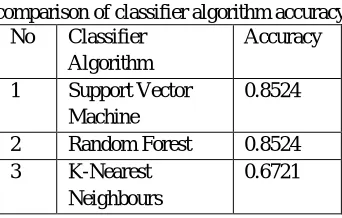
Abstract: The new Medical Health care & Management System with web application is designed to resolve the issues related to the management of health check up, appointments, reports. In order to manage the Health Check up a web application is designed. Disease prediction model is also used which predicts Heart Diseases for the patients. In order to predict disease three different classifiers are used which predicts heart disease. Among the three modules the SVM & Random forest has higher accuracy compared to the KNN classifier. The three classifiers have got different accuracy, SVM & Random forest have got same accuracy 85.24% & K-Nearest Neighbour have got 67.21% accuracy.
Keywords: MongoDB database, Web Application, Health Check Up, PHP, Cloud, Machine Learning, Classifier
I. INTRODUCTION
This web application is developed to manage health care services with its information & data. Information Technologies have brought revolution in the Medical Sector which is the most significant health sector. This doctor provides the best suggestion to the patients by viewing the medical reports online. This system provides flexibility to the patients to book an appointment get consultation of the doctors. This research papers discussed the details of the web application. There is fast growth in the field of data analytics which plays an significant role in the healthcare research. As there are large quantity of data generated in healthcare field which provides accurate analysis of medical data which benefits in immediate disease detection. The learning curve begins with observations of data, by looking for patterns in data which us used to make better decisions based on the data that we provide. Machine learning methods generates analysis of large amount & big quantities of data. Combining machine learning with AI and cognitive technologies can make it even more effective in processing large volumes of information related work. Section I provides an introduction about the Medical Health Care services provided by this system. Section II provides details & related work to this proposed system. Section III provides the details of the proposed system health care management system web application developed. Section IV provides detail information about the methodology used to develop this system & the output of the web application.
II. PROPOSEDSYSTEM
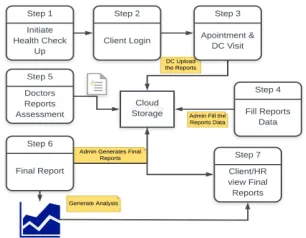
[image:1.612.236.389.597.716.2]The proposed health care management system provides a digitized health care system through an online web application. Through this web application, clients get access to the medical reports & can consult the doctors. They can also book appointments & choose a diagnostic centre wherever they want to conduct health in India. The proposed system consists of many modules which are integrated with each other. This proposed system also interacts with cloud services which stores medical reports of the health check-up which can be accessed by the clients & the doctors also. The Proposed system contains 5 modules as Admin module, Client module, Doctor Module, Corporate Module, Diagnostic Centre module. The proposed modules also contains disease prediction module which predicts Heart disease for the clients. The doctor or User has enter the medical reports data which will predict whether the person will have heart disease or not.
625
©IJRASET: All Rights are Reserved
III.METHODOLOGY
The methods used for web application development is agile web application development method. The web application is developed with languages as PHP, HTML, JavaScript, CSS. The editor used is Visual Studio Code with help of Laravel Framework. The backend data base is MongoDB & Apache Server. The data will be stored in the mongo database and the medical reports will be stored amazon AWS cloud Simple Storage Service (S3) service.
A. Admin Module
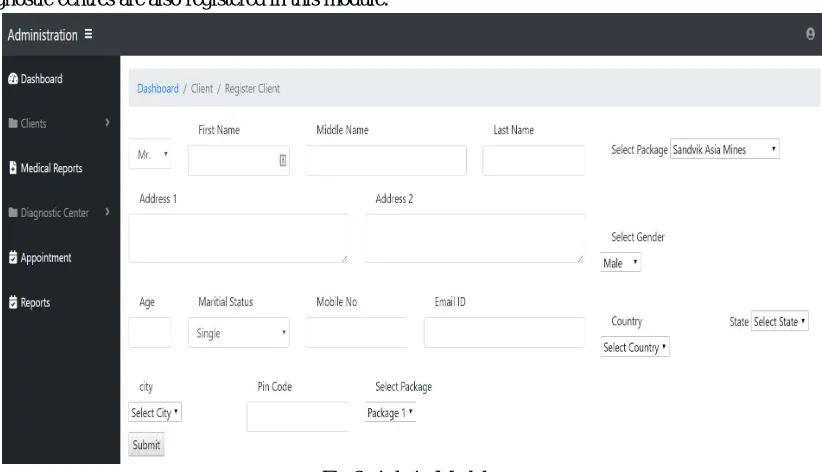
1) This Module which is used by the administration for managing the health check-up, appointments of the clients, reports uploading & downloading.
2) The client registration is done in this module, which also send the new login id & password to the clients.
3) Appointment is also booked & also sends the appointment details through mail to the client.
4) The medical reports are uploaded on the cloud which later can also be downloaded.
[image:2.612.107.518.241.477.2]5) The new diagnostic centres are also registered in this module.
Fig 2. Admin Module
B. Doctors Module
1) This modules is for doctors who will view the reports & based on this reports will prescribe medicines & Suggestions to the client.
626
©IJRASET: All Rights are Reserved
C. Diagnostic Centre Modules
1) The diagnostic centre views the appointments & confirms the appointment. This centre will also provide significant instructions to the client before conducting the health check-up.
[image:3.612.162.451.560.723.2]2) The diagnostic centre upload the reports on the system.
Fig 4. Diagnostic centre Module
D. Client Module
1) The client logins the system provided through registration process.
2) The client books appointments by selecting the state, city & diagnostic canter.
3) They can download the medical reports & can view the medicine prescription & suggestions to maintain the health.
Fig 5. Client Module
E. Corporate Module
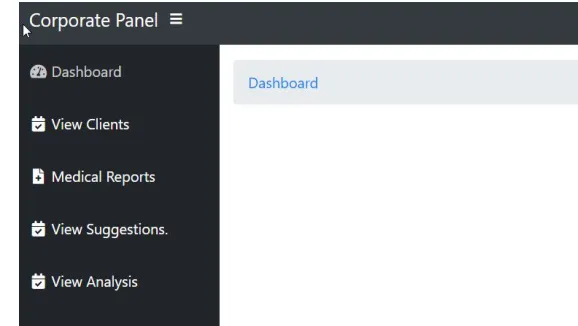
1) The corporate companies will view the registered employees & also download the medical reports.
2) They can also view suggestions & analysis of the reports.
627
©IJRASET: All Rights are Reserved
F. Heart Disease Prediction Module.
[image:4.612.221.392.153.262.2]1) This module predicts heart disease after entering the data. Classifiers are used is predict the disease. The three classifiers are SVM, Random Forest & KNN. The SVM classifier & Random Forest classifier have higher accuracy to predict the disease compared to the KNN classifier. The following table shows the accuracy comparison of three algorithms.
TABLE I
comparison of classifier algorithm accuracy
No Classifier
Algorithm
Accuracy
1 Support Vector
Machine
0.8524
2 Random Forest 0.8524
3 K-Nearest
Neighbours
0.6721
The data set is taken from UCI heart disease of Cleveland, Hungary, Switzerland & VA Long Beach. This database consists of total 76 attributes, of which many published experiments have reference for using a subset of 14 of them. The Cleveland database has been used by Machine Learning researchers for many years. The presence of the disease is determined with two value 1 which indicates heart disease & 0 indicated no heart disease.
2) Support vector machine have higher accuracy compared to the KNN algorithm; it has 85.24% accuracy. It can predict heart disease more accurately. The SVM offers very high accuracy compared to other classifiers such as logistic regression, and decision trees. The classifier separates data points using a hyperplane with the largest amount of margin. That's why an SVM classifier is also known as a deterministic classifier. SVM searches an optimal hyperplane which helps in classifying new data points. It segregates the data set. The margin is known as the distance between the either of nearest points.
Algorithm works as follows:
a) Segregate the classed to generate hyperplane.
b) The maximum segregation from the either data points is select.
Fig 7. Heat Map
3) Random forest neighbour has similar accuracy to the SVM.
Algorithm works as:
a) Select Random Sample from a given set.
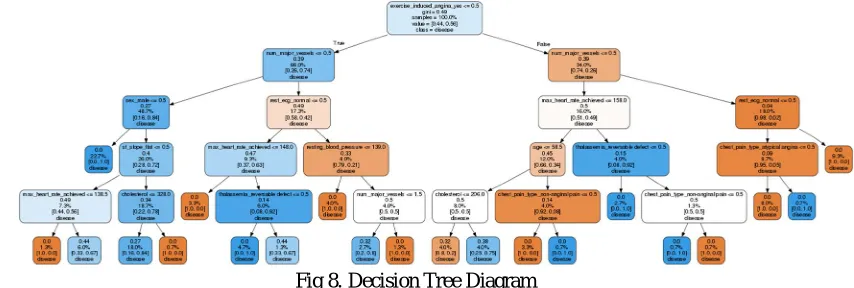
b) Construct decision tress for each sample & get a prediction result from each decision tree.
c) Perform a vote for each predicted result.
[image:4.612.186.459.428.619.2]628
[image:5.612.104.531.77.221.2]©IJRASET: All Rights are Reserved
Fig 8. Decision Tree Diagram
4) In KNN, K is the number of nearest neighbours. The number of neighbours is the core deciding factor. K is taken as odd number
if the number of classes is 2, then, we have to find the one closest point to P1 and then the nearest point assigned to P1 is labelled.
Algorithm works as follows:
1) Calculate the distance
2) Find the closest neighbours
3) Vote for labels.
IV.CONCLUSIONS
The Health care management system in web application is developed by referring the reference papers. This newly developed web application will provide flexibility & provide services to the organizations & clients as well.
REFERENCES
[1] S. S. Chikkmat, Prof. B. B. Shah "Medical Healthcare Management System with Web Application", International Journal for Research in Applied Science &
Engineering Technology (IJRASET), Volume 6 Issue XII, Dec 2018
[2] F. Anjum, A.S. Shoaib, A.I Hossain, M.M. Khan “Online Health Care”, IEEE 8th Annual Computing and Communication Workshop and Conference
(CCWC), pp. 580-583, 2018
[3] C. Gyorodi, R. Gyorodi, G. Pecherle, A. Olah “A Comparative Study: MongoDB vs. MySQL” 13th International Conference on Engineering of Modern
Electric Systems (EMES) , pp. 1–6, 2015
[4] M. Hillsm “Evolution of Dynamic Feature Usage in PHP” IEEE 22nd International Conference on Software Analysis, Evolution, and Reengineering (SANER),
pp. 525 – 529, 2015
[5] R. Sharma, S.R. Kumar, K. Gupta “Strategies for Web Application Development Methodologies” International Conference on Computing, Communication
and Automation (ICCCA), pp. 160 – 165, 2016.
[6] W. Jiang, M. Zhang, B. Zhou, Y. Jiang, Y. Zhang “Responsive Web Design Mode and Application” IEEE Workshop on Advanced Research and Technology