JOURNAL OF FOREST SCIENCE, 61, 2015 (10): 456–464
doi: 10.17221/75/2015-JFS
Diameter increment of beech in relation to social position
of trees, climate characteristics and thinning intensity
J. Remeš
1, L. Bílek
1, J. Novák
2, Z. Vacek
1, S. Vacek
1, T. Putalová
1, L. Koubek
1 1Faculty of Forestry and Wood Sciences, Czech University of Life Sciences Prague, Prague,Czech Republic
2Forestry and Game Management Research Institute, Jíloviště-Strnady,
Opočno Research Station, Opočno, Czech Republic
ABSTRACT: We present the results of research on diameter increment in beech stands in the area of Hostýnské and
Vsetín-ské vrchy. The data were collected on three series of permanent research plots (PRP) in middle-aged stands in the property of BFP Forests and Estates of Tomas Baťa, Ltd. established for the evaluation of the effect of different thinning regimes. Each series consists of one control plot and two plots with different treatment intensity. The objective of this paper was to assess the increment response of beech individuals in the first year after a thinning intervention and to evaluate the incre-ment of sample trees in relation to the social position of tree in the stand and the climate trends in the last 30 years. The diameter increment was evaluated on harvested sample trees, after the thinning treatment the growth reaction of standing sample trees of the main stand was evaluated based on their dendrometric characteristics.To calculate the radial growth of beech, the annual ring increment series were cross-dated individually (to eliminate errors caused by missing annual rings) using statistical tests in the PAST4 application software (Knibbe 2007) and then subjected to visual inspection according to Yamaguchi (1991). If a missing annual ring was found, a ring 0.01 mm wide was inserted in its place. The individual curves from PRPs were then detrended and an average annual ring series was created in the ARSTAN software. First a negative exponential spline was used, and then the 30-year spline was applied (Grissino-Mayer et al. 1992). The response of tree radial growth to climatic factors was evaluated using the DendroClim software. The method of single pointer years analysis was used to estimate the influence of extreme climatic events on diameter growth. One year after thinning, the harvest intensity had no significant effect on the radial growth of dominant trees (F(4, 293) = 1.0, P > 0.05), but oppositely, differences in the average diameter increment of co-dominant trees on PRPs were statistically significant (F(4, 362) = 2.6, P < 0.05). The diameter increment of dominant trees in 1978–2013 showed positive correlations with the March tempera-tures of the current year (r = 0.27) and negative ones with June–September (r = –0.28 to –0.43) and November (r = –0.36) of the last year and April, June and July (r = –0.35 to –0.44) of the current year. Negative correlations of temperature in the growing season of the current year were similar to dominant trees, only the impact was weaker in April to August (r = –0.28 to –0.32). According to the results of the PCA analysis, annual ring width was negatively correlated with tem-peratures in the vegetation season of the last year and current year, July, April and June temperature of the current year, and with precipitation in January–March of the current year.
Keywords: climate change; dendrochronology; precipitation; temperature; tree growth
In our fast-changing society, the requirements for forest functions also change significantly, en-compassing not only immaterial goods collective-ly known as non-production functions, but also material ones, among which the wood-producing function is the most important. In general, the
for-est management sector has to remain sustainable ecologically as well as economically. The European beech (Fagus sylvatica L.) seems to be the tree spe-cies capable of meeting, at the optimal level, the re-quirements for both production and non-produc-tion forest funcnon-produc-tions. Being the natural tree species
for habitats with average moisture and nutrient contents at medium to higher elevations (Ellen-berg 1996), it will play the role of not only an eco-logically but also productively stabilizing element. Despite this, silvicultural practices must currently respect the potential risks of a decrease in the com-petitive capacity of beech on many sites that might be reduced under the expected future climate con-ditions (Gessler et al. 2007).
Thinning is the most important silvicultural op-eration which makes use of the rapid growth re-sponse of trees in a young stand and decides on the assortment at the cutting age (Assmann 1970; Indruch 1989; Cameron 2002; Slodičák 2007; Štefančík 2013). The possibility of increasing the volume production of forest stands by thinning has been debated for a long time, and was essentially the first principal objective of silviculture (Wallentin 2007). At present, however, the assumption is that this contribution of thinning is relatively limited (Pretzsch 2005; Chroust 1997). Nevertheless, changes in the stand structure resulting from thin-ning have a strong effect on the production value.
As shown in numerous studies, intensive beech thinning leads to higher diameter increments, thus to superior dimensions of target trees (Štefančík 2013), and possibly to a reduced rotation period with a lower risk of timber declassifying effects, pri-marily red heart formation (Knoke, Wenderoth 2001; Kladtke 2002, 2003), which considerably re-duces the production value of beech stands (Knoke et al. 2006; Račko et al. 2015). With this objective in mind, it is recommended to realize the positive se-lection in quality beech stands relatively early, when the reaction to liberation is the strongest (Korpeľ 1988; Poleno, Vacek et al. 2009; Štefančík 2014). A large number of studies recommended the period of 30 to 40 years as the best age for determination of crop trees (Štefančík 1974, 1984; Spellmann, Nagel 1996; Guericke 2002).
Indruch (1989) saw the best practice in beech silviculture in the rule: eliminate individuals that do harm to the better ones. Given the necessity of ra-tionalization of silvicultural operations, acceleration of the growth process and reduction of the rotation period, this concept has been modified many times to be the best suited for different site conditions and management goals (Alther 1971, 1981; Štefančík 1974; Korpeľ 1986). For example, Schütz (1996) recommended 97–166 target trees, Abetz (1979) and Altherr (1981) limited this range to 110 trees per hectare. Kurt (1982) and Boncina et al. (2007) con-sidered even less than 100 selected target trees as an optimal number. A higher number of target trees was
proposed by Štefančík (1984), ranging from 121 to 217 stems per hectare, depending on the site condi-tions and/or tree spacing.
Newly, climate change mitigation and appropri-ate silvicultural techniques leading to structurally complex and ecologically stable forest stands are becoming more and more important in this debate. In general, a decrease in stand basal area through thinning is considered as a measure for control-ling the competition for water, nutrient and light resources (Pretzsch 2005; Aranda et al. 2012). It seems that at higher altitudes in Central Eu-rope, environmental changes with negative effects on radial growth are the main factors influencing growth (Dittmar et al. 2003). On the other hand, increased height growth of beech and its higher tolerance to drought were revealed by several au-thors (Felbermeier 1994; Badeau 1995; Cailler-et, Davi 2011). Elevated temperatures and nitro-gen deposition often lead to an increase in beech growth, but with the accumulation of summer droughts worsened health status and forest decline can occur (Piovesan et al. 2008).
The objective of this paper was to assess the incre-ment response of beech individuals in the first year after a thinning intervention and to evaluate the in-crement of sample trees in relation to the coenotic position and climate trends in the last 30 years.
MATERIAL AND METHODS
Study area. Three series of permanent research
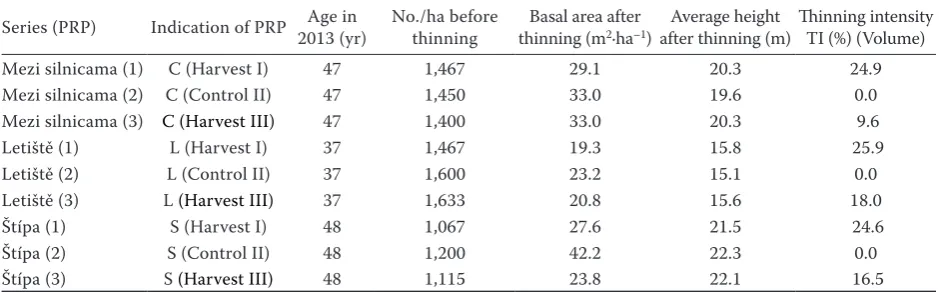
expo-sition on Letiště locality. Identically on each PRP, with respect to regular spacing we chose 9 to 10 target trees with desirable characteristics such as stem and crown quality, diameter and health sta-tus, meaning 150 to 167 trees per hectare. Table 1 shows an overview of all PRP and their basic den-drometric characteristics, including the thinning intensities. The average annual temperature and total precipitation data, including the monthly fig-ures, were downloaded from the freely accessible CHMI database (www.chmi.cz) for the Zlín Region.
Data collection. Thinning was done in the autumn
of 2013, including selection of sample individuals of different coenotic status (social position of tree) without signs of damage in their trunks and crowns and without visible fungal infestation. On each PRP 7 to 14 felled trees were analysed (in total 69 indi-viduals; 4–7 dominant trees and 3–9 co-dominant trees per PRP). From sample trees a circular disk was cut crosswise from each of the felled trees at breast height. The image processing was done in the Letok-ruhy software (© Daniel Zahradník, Czech Univer-sity of Life Sciences in Prague, Faculty of Forestry and Wood Sciences, Department of Forest Manage-ment). The diameter increment in the main stand trees was assessed based on data from a dendromet-ric survey in the autumn of 2013 and 2014.
Statistical analysis. To calculate the radial growth
of beech, the annual ring increment series were cross-dated individually (to eliminate errors caused by missing annual rings) using statistical tests in the PAST4 application software (Knibbe 2007) and then subjected to visual inspection according to Yama-guchi (1991). If a missing annual ring was found, a ring 0.01 mm wide was inserted in its place. The individual curves from PRPs were then detrended and an average annual ring series was created in the ARSTAN software. First a negative exponential spline was used, and then the 30-year spline was ap-plied (Grissino-Mayer et al. 1992).
In order to determine the response of tree radial growth to climatic factors, the average annual ring series from PRPs differenced by the coenotic posi-tion of the tree in the stand were correlated with climatic data (precipitation and temperatures; 1981–2013) for each month and year using the Den-droClim software (Biondi, Waikul 2004).
The method of single pointer year analysis (Schweingruber et al. 1990; Desplanque et al. 1999) was used to estimate the influence of extreme climatic events on diameter growth. For each tree, the negative event years were defined as extremely narrow ring widths that were 40% or less compared with the average value of ring widths in the previous four years (Schweingruber et al. 1990). A negative pointer year occurred when an event year was iden-tified for at least 20% of the trees within the plot.
Impacts of harvest intensity on diameter incre-ment were analysed in the STATISTICA 12 software (StatSoft, Tulsa, USA). Data were log transformed to acquire normal distribution and tested by the Kolmogorov-Smirnov test. The differences in radial growth between harvest intensity, coenotic posi-tion of the tree and research plots were separately tested by one-way analysis of variance (ANOVA). Significant differences were subsequently tested by post-hoc comparison Tukey’s HSD tests.
Unconstrained principal component analysis (PCA) in the Canoco 4.5 program (Ter Braak,
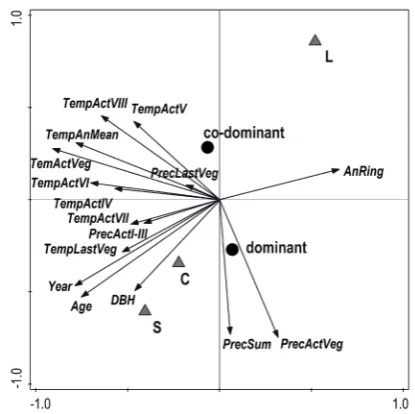
[image:3.595.63.533.75.221.2]Šmilauer 2002) was used to analyse relationships and interactions between climatic data (tempera-ture, precipitation), stand parameters (age, DBH), productivity (ring width), coenotic position of the tree in the stand (dominant, co-dominant) and similarity of 3 research plots during the time (1981–2013). Data were centred and standardized during the analysis. The results of the PCA analysis were visualized in the form of an ordination dia-gram constructed by the CanoDraw prodia-gram (Ter Braak, Šmilauer 2002).
Table 1. Average height, number of trees and thinning intensity on treated plots
Series (PRP) Indication of PRP Age in 2013 (yr) No./ha before thinning thinning (mBasal area after 2·ha–1) after thinning (m)Average height Thinning intensity TI (%) (Volume)
Mezi silnicama (1) C (Harvest I) 47 1,467 29.1 20.3 24.9
Mezi silnicama (2) C (Control II) 47 1,450 33.0 19.6 0.0
Mezi silnicama (3) C (Harvest III) 47 1,400 33.0 20.3 9.6
Letiště (1) L (Harvest I) 37 1,467 19.3 15.8 25.9
Letiště (2) L (Control II) 37 1,600 23.2 15.1 0.0
Letiště (3) L (Harvest III) 37 1,633 20.8 15.6 18.0
Štípa (1) S (Harvest I) 48 1,067 27.6 21.5 24.6
Štípa (2) S (Control II) 48 1,200 42.2 22.3 0.0
RESULTS
Diameter increment of the main stand
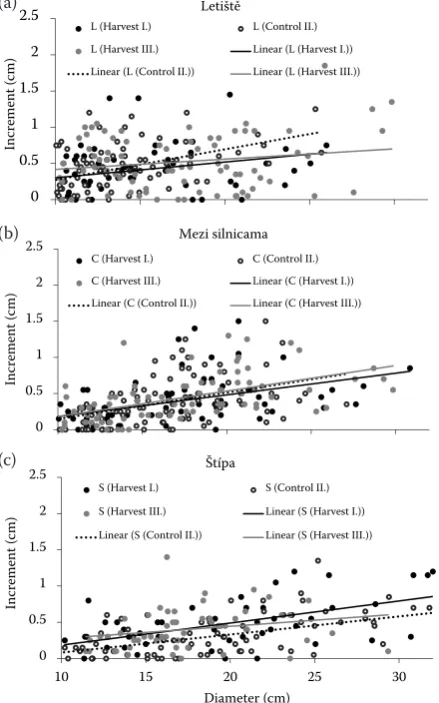
Increment response in the first year after a thin-ning intervention indicates in general a more pro-nounced growth response of trees of larger dimen-sions, nevertheless without pronounced differences between harvest intensities (Fig. 1). The average diameter increment of the entire tree set on three PRPs with high harvest intensity (Harvest I) was 0.39–0.47 cm; it was 0.40–0.52 cm for low harvest intensity (Harvest III) and 0.33–0.40 cm on PRPs without any treatment (Control II).
The average ring increment of dominant and co-dominant trees in 2014 on PRP according to harvest intensity is shown in Fig. 2. Harvest inten-sity had no significant effect on the radial growth of dominant trees (F(4, 293) = 1.0, P > 0.05), but op-positely, differences in the average diameter incre-ment of co-dominant trees on PRPs were statisti-cally significant (F(4, 362)= 2.6, P < 0.05). The highest
average ring increment was observed on PRP L on dominant trees after low harvest intensity (0.67 ± 0.06 SE), the lowest increment was measured on PRP S on control plot (0.49 ± 0.06 SE). The highest average diameter growth of co-dominant trees was found on PRP L after low harvest intensity (0.41 ± 0.04 SE), the lowest increment was measured on PRP S without thinning (0.18 ± 0.04 SE). Compar-ing the plots separately, on PRP L the increment of co-dominant trees on control plot was significantly lower than on the plot with low harvest intensity (P < 0.05, Fig. 2). The largest differences were on PRP S, where both thinning interventions had a significant positive effect on the radial increment of co-dominant trees (F(2. 98) = 7.4, P < 0.001). Totally, the thinning intervention had a positive effect on productivity in five cases (two statistically signifi-cant) out of the six studied groups.
Dynamics of radial increment
[image:4.595.316.504.56.315.2]The average tree-ring curves of beech and trends of average annual ring width after removal of the age trend on PRP are shown in Fig. 3, respectively. The
Fig. 1.Diameter increment of beech individuals on research plots with different thinning intensity and in relation to their initial diameter – PRP L (a), C (b), S (c)
L (Harvest I.) L (Control II.) L (Harvest III.)
Strom D d Strom D d
2 16.65 0.55 1 12 1.2
5 13.05 0.55 2 9.45 0.3
7 8.85 0.2 3 10.7 0.7
8 12.7 0.15 4 10.35 0.8
9 10.8 0.1 5 14.7 0.45
10 16.95 0.5 6 11.3 0.3
11 14.45 0.3 7 15 0.4
12 18.1 0 8 17.75 1.2
13 13.2 1.4 11 22.6 0.5
15 12.15 0 12 17.95 0.5
16 13.15 0.3 13 14.5 1.15
17 13.9 0.4 14 14.35 0.05
19 13.45 0.55 15 15.75 0.45
20 14.1 0.45 16 10.6 0
21 17.7 0.2 17 25.7 0.65
22 10.65 0.4 18 11.95 0
25 9.4 0.25 19 7.5 0.15
26 20.3 1.45 20 10.2 0.75
27 17.1 0.8 21 11.5 0.45
28 11.15 0.55 22 17.7 0.8
30 12.35 0.45 23 13.3 0.1
31 15.9 0.75 24 9.8 0.3
32 14.45 0.45 25 16.7 0.15
33 9.3 0.3 26 12.65 0.4
34 11.2 0 27 7.75 0
35 14.6 0.3 28 21.95 0.9
36 9.45 0.1 29 14.1 0.6
38 21 0 30 9.1 0.05
39 24.1 0.4 31 17.15 0.55
40 12.55 0.5 32 14.4 0.4
41 9.75 0 33 13.95 0.5
42 7.45 0 34 12.7 0.65
44 25.05 0.5 35 13.7 0.4
45 20.65 0.2 36 6.85 0.05
46 16.5 0.4 37 12.15 0.6
47 18.65 0 38 9.1 0.5
48 23.55 0.2 39 19.65 0.6
49 8 0.45 40 14.95 0.1
51 20.35 0.25 41 9.85 0.35
52 10.75 0.05 42 14.1 1
53 22.45 0.5 43 15.6 0.3
54 14.7 0.4 44 13.65 0.8
55 9.05 0.15 45 11.3 0.05
56 12.3 0.7 46 11.25 0.5
57 11.7 0.6 47 11.9 0.1
58 11.95 0.2 48 11.65 0.55
60 18 0.65 49 9.9 0.05
61 10.4 0 50 15.1 0.9
62 10.65 0.6 51 18.35 0.25
64 23.6 0.7 52 6.75 0.05
65 26 0.75 53 8.65 0.35
66 7.05 0.1 54 16.15 0.85
67 16.65 0.45 55 14 0.7
68 10.75 0.05 56 13.4 0.6
0 0.5 1 1.5 2 2.5
10 15 20 25 30
In cr eme nt (c m) Diameter (cm) Letiště
L (Harvest I.) L (Control II.)
L (Harvest III.) Linear (L (Harvest I.))
Linear (L (Control II.)) Linear (L (Harvest III.))
0 0.5 1 1.5 2 2.5
10 15 20 25 30
In cr ement (c m) Diameter (cm) Mezi silnicama
C (Harvest I.) C (Control II.)
C (Harvest III.) Linear (C (Harvest I.))
Linear (C (Control II.)) Linear (C (Harvest III.))
0 0.5 1 1.5 2 2.5
10 15 20 25 30
In cr ement (c m) Diameter (cm) Štípa
S (Harvest I.) S (Control II.)
S (Harvest III.) Linear (S (Harvest I.))
[image:4.595.65.285.353.705.2]Linear (S (Control II.)) Linear (S (Harvest III.))
Fig. 2. Average ring increment (2014) on PRP according
to harvest intensity; tested by one-way ANOVA and
post-hoc Tukey’s HSD tests, significant differences (P < 0.05) between harvest intensities (Harvest I strong intensity, Control II without harvest, Harvest III weak intensity) on each plot separately are indicated by different letters; error bars represent SE
Dominant 0.0 0.2 0.4 0.6 0.8 1.0 Radial increment (cm) Harvest I. Control II. Harvest III.
a a a
a a
a a a a
0.0 0.2 0.4 0.6 0.8 1.0
C L S
Radial
increment
(cm)
Permanent research plots
a a b
a b
a a ab
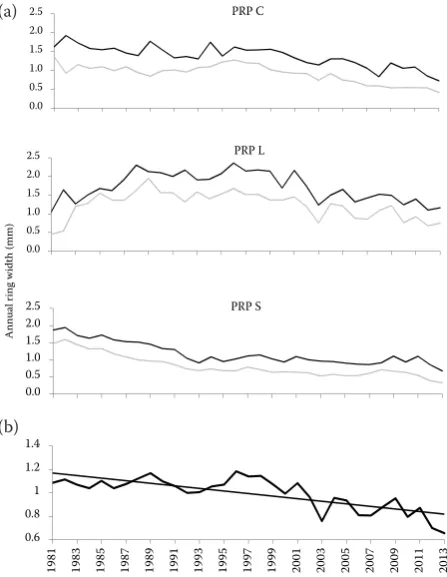
was 1.9 mm (± 0.4 SD), while the increment of co-dominant trees was only 0.9 mm (± 0.3 SD), i.e. 48% of the ring width of dominant trees.
The diameter increment of dominant trees in 1978–2013 showed positive correlations with the March temperatures of the current year (r = 0.27, Fig. 4) and a negative correlation with June-September (r = –0.28 to –0.43) and November (r = –0.36) of the last year and April, June and July (r =
–0.35 to –0.44) of the current year. The radial growth of co-dominant trees did not show any positive cor-relations. Negative correlations of temperature in the growing season of the current year were similar to dominant trees, only the impact was weaker in April to August (r = –0.28 to –0.32), while no correlations were confirmed in June to August of the last year against dominant trees. The diameter increment of dominant trees was negatively correlated with Janu-ary precipitation of the current year (r = –0.36).
Climate, stand parameters and productivity interactions
[image:5.595.65.289.55.344.2]Results of the PCA analysis are presented in the form of an ordination diagram in Fig. 5. The first ordination axis explained 34%, the first two axes together 51% and the first four axes together eplained 70% of variability in the data. The first x-axis represented radial increment with tempera-ture in April, June and July of the current year. The second y-axis represented annual precipitation and precipitation in the growing season. Annual ring width was negatively correlated with temperatures in the vegetation season of the last year and cur-rent year, July, April and June temperature of the current year, and with precipitation in January-March of the current year. DBH was increasing in the course of time, while annual diameter incre-ment was decreasing in time. Total annual precipi-tation and precipiprecipi-tation of the growing season of the current year were not correlated, or only very weakly with the production. Differences in data in the course of 33 years (1981–2014) were remark-able especially for individual PRPs as scores of each record are relatively distant from one another whereas scores for the coenotic position of the tree (dominant, co-dominant) were closer to each other in the diagram. PRP L occupied the extreme right upper part of the diagram typical of higher annu-al radiannu-al width, while PRP S was characterised by higher stand age and DBH. Dominant trees were characterised by higher annul ring increment and DBH compared to co-dominant trees.
Fig. 3. Annual tree-ring chronology of: dominant (black line) and co-dominant (grey line) trees for PRP C, S, L in the period 1981–2013 (a), increment in the entire study area after removing the age trend in Arstan software (b)
0.0 0.5 1.0 1.5 2.0
2.5 PRP C
0.0 0.5 1.0 1.5 2.0 2.5
A
nnual
rin
g
w
id
th
(m
m)
PRP L
0.0 0.5 1.0 1.5 2.0 2.5
0.6 0.8 1 1.2 1.4
198
1
198
3
198
5
198
7
198
9
199
1
199
3
199
5
199
7
199
9
200
1
200
3
200
5
200
7
200
9
201
1
201
3
PRP S (a)
(b)
regional standard annual ring chronology indicates a relatively balanced radial growth on PRP C and S, and a slight decrease in the course of time with slight oscillations. On PRP L the year 1981 started a peri-od of gradual increased radial increment until 1988, then the growth was balanced, interrupted by a de-crease in 2001. The analysis of significant negative years indicated the extreme years 2003 (PRP L) and 2008 (PRP C) with significant growth depression of dominant trees. On the contrary, no negative event years were identified for co-dominant trees.
Differences in the radial growth rate between in-dividuals within one PRP were not high. The aver-age annual ring width for dominant trees on PRP C reached 1.4 mm (± 0.3 SD), on PRP L 1.7 mm (± 0.4 SD), and PRP S 1.3 mm (± 0.3 SD) while for co-dominant trees on PRP L it was 1.2 mm (± 0.4 SD), PRP C 1.0 mm (± 0.3 SD) and PRP S 1.0 mm (± 0.4 SD). The highest increment of 2.6 mm (± 0.8 SD) was observed for dominant trees on PRP L in 1996, while the lowest annual ring width of 0.3 mm (± 0.2 SD) was found for co-dominant trees on PRP S in 2013. Comparing the annual ring increment of dominant and co-dominant trees, the mean radial growth of dominant trees was significantly higher
(F(1.2 275) = 662.7, P < 0.001). For example in 1982 the
On the contrary, no negative event years were identified for co-dominant trees. Both years can be characterized by above-average annual tem-perature (0.6 and 1.2°C, resp.) and subnormal precipitation (75 and 87% of the long-term av-erage annual precipitation). In particular with respect to the scarcity of precipitation these two years are the most extreme years in the last two decades. In accordance with Lebourgeois et al. (2014) these results suggest that in fully stocked stands dominant trees respond more to climate extremes than co-dominant and sup-pressed trees and this mostly in relation to pre-cipitation. On the other hand, the increment was mainly negatively influenced by monthly average temperatures in the second half of the vegeta-tion period of the previous year and the first half of the current year. On the contrary, the higher March temperature of the current year may have an effect on the longer vegetation period. Simi-lar results were also confirmed by Petráš and Mecko (2011), who compared the radial growth of beech, spruce and oak in relation to climatic factors. The used techniques for the evaluation of beech radial growth show different results to a certain extent. Nevertheless, in accordance with Dittmar and Elling (1999) and van der Maaten (2012) in beech stands both precipita-tion and temperature are important producprecipita-tion factors with close relation to radial growth.
Fig. 4. Values of correlation coefficients of regional residual index tree-ring chronology of dominant and co-dominant trees with average monthly temperature (T) and precipitation (P) from May of the previous year (block letters) to August of the current year in the period 1981–2013
values highlighted in black are statistically significant (α = 0.05), capital letters indicate the months of the previous year and the normal letters the months of the current (given) year
–0.5 –0.4 –0.3 –0.2 –0.1 0 0.1 0.2 0.3 0.4 0.5 M AY T JU N T JU L T A U G T SE P T O C T T N O V T D EC T Ja n T Feb T M ar T A pr T M ay T Ju n T Ju l T Aug T Sep T M AY T JU N T JU L T A U G T SE P T O C T T N O V T D EC T Ja n T Feb T M ar T A pr T M ay T Ju n T Ju l T Aug T Sep T –0.5 –0.4 –0.3 –0.2 –0.1 0 0.1 0.2 0.3 0.4 0.5 M AY P JU N P JU L P A U G P SE P P O C T P N O V P D EC P Ja n P Feb P M ar P A pr P M ay P Ju n P Ju l P Aug P Sep P M AY P JU N P JU L P A U G P SE P P O C T P N O V P D EC P Ja n P Feb P M ar P A pr P M ay P Ju n P Ju l P Aug P Sep P Co-dominant trees Dominant trees
(a) (b)
(c) (d)
Fig. 5. Ordination diagram showing results of PCA analysis of relationships between climatic data (Temp – temperature, Prec –precipitation, Act – current year, Last – last year, Veg – growing season, Sum – summary; I–VIII – months), stand parameters (Age, DBH), ring width (AnRing – an-nual ring width) and time (Year); codes indicate coenotic position of the tree in the stand (dominant, co-dominant), research plots (C, L, S); years of the record 1981–2013
DISCUSSION
[image:6.595.72.280.439.646.2]Along with an increase in precipitation during spring and a higher frequency of intensive drought periods in summer, forest trees will have to with-stand drastic changes in environmental condi-tions (Gessler et al. 2007). Positive responses of beech to increases in temperature in the past do not imply that it will necessarily do so in the fu-ture. For example, if temperature increases were accompanied by prolonged drought periods in the growing season, productivity would be negatively affected (Schou, Meilby 2013). In accordance with our study, the growth of beech in many Eu-ropean regions was characterized by a growth de-crease in recent decades (Biondi 1993; Dittmar et al. 2003; Štefančík 2014). These findings sug-gest an overall recently decreased vigour of com-mon beech in Europe, although highly productive sites buffer environmental changes better than low productive sites near the edge of the species range (Aertsen et al. 2014). According to Schou and Meilby (2013) optimal harvest policies for beech stand transformation does not vary much between climate change scenarios, but only when beech is considered as low-risk species. On par-ticular sites e.g. on shallow soils with low water potential or on soils susceptible to waterlogging in the spring time (Gessler et al. 2007) beech may lose its dominance and competitive capacity.
Crucial questions for the positive selection of beech stands remain the number of selected tar-get trees and the thinning intensity. From this point of view, the original concept of Schädelin (1936), with a large number of substitutes that was slowly reduced to a definite collection of marked target trees, seems to be reasonable. In our field experiment, we used an approach combining thin-ning from above and selection of target trees that allows to a certain extent future modifications in the number and spatial arrangement of selected high quality individuals. The number of high-quality target trees was set at 150–167 individuals per hectare with the following different thinning intensities (TI) reaching from TI = 0% on control plots up to approx. TI = 25% (corresponding to the removal of up to 2 individuals per target tree). Increment response in the first year after a thin-ning intervention indicates in general the more pronounced growth response of trees of larger dimensions. The lowest average annual diameter increment for particular PRP was 0.39 cm, the highest 0.52 cm, nevertheless without clear trend among harvest intensities. Obviously, only one vegetation period is a very short time to evalu-ate the effect of thinning treatment and we expect
more pronounced differences in growth response in the years to come. Despite this, we saw a sig-nificant positive effect on the radial increment of co-dominant trees in both thinning interventions, which was not the case for dominant trees.
CONCLUSIONS
Increasing heterogeneity of spatial and canopy structure by selective logging creates various stand environmental conditions. Moreover, thinning from above in beech stands, as already applied in many well managed forest properties, is the best suited thinning technique not only for increasing the pro-duction value, but also for mitigating the impact of extreme climate events. Doing so, the development of target trees in the main canopy is assured, at the same time place is given to sub-canopy individuals.
References
Abetz P. (1979): Brauchen wir „Durchforstungshilfen?“. Schweizerische Zeitschrift für Forstwesen, 130: 945–963. Aertsen W., Janssen E., Kint V., Bontemps J.D., Van Orshoven, J.,
Muys B. (2014): Long-term growth changes of common beech (Fagus sylvatica L.) are less pronounced on highly productive sites. Forest Ecology and Management, 312: 252–259. Altherr E. (1971): Festschrift zur 15. Hauptversammlung des
baden-württembergischen Forstvereins, 15: 123 – 127. Altherr E. (1981): Erfahrungen bei der Anwendung
quan-tifizierter Durchforstungshilfen in Buchen beständen. Allgemeine Forstzeitschrift, 22: 552–554.
Aranda I., Forner A., Cuesta B., Valladares F. (2012): Species-specific water use by forest tree species: From the tree to the stand. Agricultural Water Management, 114: 67–77. Assmann E. (1970): The Principles of Forest Yield Study.
Oxford: Pergamon Press: 506.
Biondi F. (1993): Climatic signals in tree rings of Fagus sylvatica L. from the central Apennines, Italy. Acta Oecologica, 14: 57–71. Biondi F., Waikul K. (2004): Dendroclim 2002: AC++ pro-gram for statistical calibration of climate signals in tree ring chronologie. Comput Geosci, 30: 303–311.
Boncina A., Kadunc A., Robic D. (2007): Effects of selective thinning on growth and development of beech (Fagus syl-vatica L.) forest stands in south-eastern Slovenia. Annals of Forest Science, 64: 47–57.
Cailleret M., Davi H. (2011): Effects of climate on diameter growth of co-occurring Fagus sylvatica and Abies alba along an altitudinal gradient. Trees, 25: 265–276. Cameron A. D. (2002): Importance of early selective
Desplanque C., Rolland C., Schweingruber F.H. (1999): Influence of species and abiotic factors on extréme tree ring modulation: Picea abies and Abies alba in Tarentaise and Maurienne (French Alps). Trees, 13: 218–227. Dittmar C., Elling W. (1999): Radial growth of Norway
spruce and European beech in relation to weather and alti-tude. Forstwissenschaftliches Centralblatt, 118: 251–270. Dittmar Ch., Zech W., Elling W. (2003): Growth variations of
Common beech (Fagus sylvatica L.) under different climatic and environmental conditions in Europe – a dendroeco-logical study. Forest Ecology and Management, 173: 63–78. Felbermeier B. (1994): Die klimatische Belastbarkeit der Bu-che. Forstwissenschaftliches Centralblatt, 113: 152–174. Geßler A., Keitel C., Kreuzwieser J., Matyssek R., Seiler W.,
Rennenberg H. (2007): Potential risks for European beech (Fagus sylvatica L.) in a changing climate. Trees, 21: 1–11 Grissino-Mayer H.D., Holmes R.L., Fritts H.C. (1992): In-ternational tree-ring data bank program library: user´s manual. Laboratory of Tree-Ring Research. Tuscon, University of Arizona: 104.
Guericke M. (2002): Untersuchungen zur Wuchsdynamik der Buche. Forst und Holz, 57: 331–337.
Chroust L. (1997): Ekologie výchovy lesních porostu. Smrk obecný – borovice lesní – dub letní – porostní prostředí – růst stromu – produkce porostu. Opočno, Výzkumný ústav lesního hospodářství – Výzkumná stanice Opočno: 277.
Indruch A. (1989): Zakládání a výchova listnatých porostů. Praha, SZN: 144.
Kladtke J. (2002): Wachstum groskroniger Buchen und waldbauliche Konsequenzen. Forstarchiv, 73(6): 211-217. Knibbe B. (2007): PAST 4: personal analysis system for
treer-ing research, Version 4.2. Vienna, SCIEM: 101.
Knoke T. (2003): Felling strategies in beech stands (Fagus sylvatica L.) in the context of risks of red heartwood – a silvicultural/forest economics study. Forstliche For-schungsberichte Munchen, 193: 11.
Knoke T., Stang S., Remler N., Seifert T. (2006): Ranking the importance of quality variables for the price of high quality beech timber (Fagus sylvatica L.). Annals of Forest Science, 63: 399–413.
Knoke T., Wenderoth S.S. (2001): Ein Ansatz zur Be-schreibung von Wahrscheinlichkeit und Ausmass der Farbkernbildung bei Buche (Fagus sylvatica L.). Forst-wissenschaftliches Centralblatt, 120: 154–172.
Korpeľ Š. (1986): Pestovanie lesa. Zvolen, VŠLD: 404. Korpeľ Š. (1988): Dynamika rastu a vývoja bukových
po-rastov vo fáze mladiny až žrďoviny vplyvom pestovnej techniky. Acta Facultatis Forestalis, 30: 9–38.
Kurt A. (1982): Ziel, Voraussage und Kontrolle von Nut-zungen im Forstbetrieb. Schweizerische Zeitschrift für Forstwesen, 133: 93–114.
Lebourgeois F., Eberlé P., Mérian P., Seynave I. (2014): Social status-mediated tree-ring responses to climate of
Abies alba and Fagus sylvatica shift in importance with increasing stand basal area. Forest Ecology and Manage-ment, 328: 209–218.
Petráš R., Mecko J. (2011): Effect of climatic factors on the dynamics of radial increments of Norway spruce, European beech and sessile oak. Journal of Forest Science, 57: 293–302. Piovesan G., Biondi F., Di Filippo A., Alessandrini A., Maugeri M. (2008): Drought-driven growth reduction in old beech (Fagus sylvatica) forests of the central Apen-nines, Italy. Global Change Biology, 14: 1265–1281. Poleno Z., Vacek S., Podrázský V., Remeš J., Štefánčík I.,
Mikeska M., Kobliha J., Kupka I., Malík V., Turčáni M., Dvořák J., Zatloukal V., Bílek L., Baláš M., Simon J. (2009): Pěstování lesů III. Kostelec n Č. l., Lesnická práce: 952. Pretzsch H. (2005): Stand density and growth of Norway
spruce (Picea abies (L.) Karst.) and European beech ( Fa-gus sylvatica L.): evidence from long-term experimental plots. European Journal of Forest Research, 124: 193–205. Račko V., Čunderlík I., Saniga M. (2015): Influence of silvi-cultural strategies on red heartwood occurrence in beech (Preliminary study). Wood Research, 60: 11–24. Saniga M., (2001): Pestovanie lesa. Vyd. 1. Zvolen: Ústav pre
výchovu a vzdelávanie pracovníkov lesného a vodného hospodárstva SR: 176.
Schädelin W. (1936): Die Durchforstung als Auslese- und Veredelungsbetrieb höchster Wertleistung. Bern, Leipzig, Haupt: 124.
Schou E., Meilby H. (2013): Transformation of even-aged Eu-ropean beech (Fagus sylvatica L.) to uneven-aged manage-ment under changing growth conditions caused by climate change. European Journal of Forest Research, 132: 777–789. Schütz J.P. (1987): Auswahl der Auslesebäume in der
schweizerischen Auslesedurchforstung, Schweizerische Zeitschrift für Forstwesen, 183: 1037–1053.
Schweingruber F.H., Eckstein D., Serre-Bachet F., Bräker O.U. (1990): Identification, presentation and in terpreta-tion of event years and pointer years in dendrochronology. Dendrochronologia, 8: 9–38.
Slodičák M., Novák J. (2007): Výchova lesních porostů hlavních hospodářských dřevin. Strnady, VÚLHM: 46. Spellmann H., Nagel J. (1996): Zur Durchforstung von Fichte
und Buche. Allgemeine Forst und Jagdzeitung, 167: 6–15. Spellmann H., Nagel J. (1996): Zur Durchforstung von Fichte und Buche. Allgemeine Forst und Jagdzeitung, 167: 6–15. Štefančík L. (1974): Prebierky bukových žrďovín. Lesnícke
štúdie. Bratislava, Príroda: 141.
Štefančík L. (1984): Úrovňová voľná prebierka – metóda biologickej intenzifikácie a racionalizácie selekčnej výchovy bukových porastov. Vedecké práce VÚLH vo Zvolene, 34: 69–112.
Štefančík I. (2014): Porovnanie kvalitatívnej produkcie dvoch bukových (Fagus sylvatica L.) porastov na kys-lom stanovišti. Lesnicky časopis – Forestry Journal, 60: 231–239.
ter Braak C.J.F., Šmilauer P. (2002): CANOCO Reference Manual and CanoDraw for Windows User›s Guide: Software for Canonical Community Ordination (version 4.5). Ithaca. Microcomputer Power. Available at www. canoco.com.
van der Maaten E. (2012): Climate sensitivity of radial growth in European beech (Fagus sylvatica L.) at different aspects in southwestern Germany. Trees, 26: 777–788. Wallentin C. (2007): Thinning of Norway Spruce. [Doctoral
Thesis.] Acta Universitatis Agriculturae Sueciae, 29: 116.
Received for publication August 14, 2015 Accepted after corrections October 20, 2015
Corresponding author: