Received 10 June 2019 Accepted 9 September 2019
Edited by L. Fabian, University of East Anglia, England
Keywords:crystal structure; zwitterionic co-crystal; 2,4-dichlorophenol; bifurcated hydrogen bonding;–interactions.
CCDC reference:1952329
Supporting information:this article has supporting information at journals.iucr.org/e
The crystal structure of the zwitterionic co-crystal
of
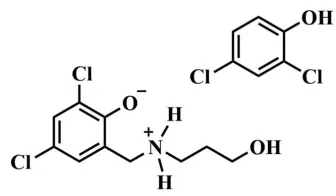
2,4-dichloro-6-{[(3-hydroxypropyl)azaniumyl]-methyl}phenolate and 2,4-dichlorophenol
Bhawna Uprety and Charmaine Arderne*
Department of Chemistry, University of Johannesburg, PO Box 524, Auckland Park, Johannesburg, 2006, South Africa. *Correspondence e-mail: [email protected]
The title compound, C10H13Cl2NO2C6H4Cl2O, was formed from the incomplete Mannich condensation reaction of 3-aminopropan-1-ol, formaldehyde and 2,4-dichlorophenol in methanol. This resulted in the formation of a co-crystal of the zwitterionic Mannich base, 2,4-dichloro-6-{[(3-hydroxypropyl)azaniumyl]meth-yl}phenolate and the unreacted 2,4-dichlorophenol. The compound crystallizes in the monoclinic crystal system (in space groupCc) and the asymmetric unit contains a molecule each of the 2,4-dichlorophenol and 2,4-dichloro-6-{[(3-hydroxypropyl)azaniumyl]methyl}phenolate. Examination of the crystal struc-ture shows that the two components are clearly linked together by hydrogen bonds. The packing patterns are most interesting along the band the caxes, where the co-crystal in the unit cell packs in a manner that shows alternating aromatic dichlorophenol fragments and polar hydrogen-bonded channels. The 2,4-dichlorophenol rings stack on top of one another, and these are held together by –interactions. The crystal studied was refined as an inversion twin.
1. Chemical context
The Mannich condensation is an important reaction in synthetic organic chemistry. The formation of the C—N bond in the resulting Mannich base is often an important step in the biosynthesis of several natural products, such as alkaloids and flavanoids (Sarhanet al., 2006). Amino-phenolic ligands have versatile applications in inorganic as well as analytical chem-istry. The flexible C—N bond in these ligands offers a tractable three-dimensional structure when coordinated to different metal centres (Riisio¨ et al., 2012). This provides numerous applications, particularly in enzyme mimicking and catalysis, as well as extraction of trace metals (Mauryaet al., 2015; Riisio¨
et al., 2013; Leeet al., 2010). In the present study, we wanted to prepare a tripodal amino (bis) phenolate Mannich base derived from 3-propanol-1-amine, formaldehyde and 2,4-di-chlorophenol. The reaction was performed following conventional bench-top techniques by heating a solution of the reactants in methanol (Sopo et al., 2006). However, probably because of the poor solubility, the dipodal product precipitated out from the incomplete reaction mixture. The dipodal product, 2,4-dichloro-6-{[(3-hydroxypropyl)-azaniumyl]methyl}phenolate is stabilized by extensive intra-as well intra-as intermolecular hydrogen bonding and thus exists intra-as a zwitterion. The zwitterion co-crystallized with the unreacted phenol, resulting in the serendipitous isolation of the title compound.
2. Structural commentary
The title compound crystallizes in the monoclinic crystal system, in the space groupCc. The molecular structure of the title compound is shown in Fig. 1, and the asymmetric unit comprises a molecule of both 2,4-dichlorophenol and 2,4-di-chloro-6-{[(3-hydroxypropyl)azaniumyl]methyl}phenolate, held together by hydrogen bonds.
A complete geometrical analysis using theMogulgeometry check tool (Brunoet al., 2004) withinMercury(Macraeet al., 2008) did not show any unusual bond lengths or bond angles. The torsion angles of the complete azaniumylphenolate chain (specifically C7–N1–C8–C9–C10–O2) deviate significantly from planarity (Table 1). This can be attributed to the hydrogen bonds in this environment (see below).
The organic Mannich base exists as a zwitterion with the negative charge of phenolate being stabilized by the positively charged ammonium moiety. This is corroborated by the fact that the phenolic oxygen–carbon bond is slightly shorter [O1—C1 = 1.322 (4) A˚ ] than the corresponding bond in the free 2,4-dichlorophenol [O1B—C1B= 1.355 (4) A˚ ], indicating partial double-bond character and the presence of a phen-oxide moiety in the zwitterion fragment. The ammonium nitrogen atom adopts a slightly distorted tetrahedral geometry.
3. Supramolecular features
The co-crystal structure displays an extensive hydrogen-bonding network (Table 2). The zwitterion,
2,4-dichloro-6-{[(3-hydroxypropyl)azaniumyl]methyl}phenolate, is involved in intra– as well as intermolecular hydrogen bonding. The ammonium hydrogen H1B takes part in a bifurcated intra-molecular hydrogen bond, N1—H1B O1 and N1— H1B O2, forcing the propyl chain of the zwitterion to adopt a distortedgaucheconformation with an N1—C8—C9—C10 torsion angle of 64.5 (3). The other ammonium hydrogen,
H1A, is involved in intermolecular hydrogen bonding with the negatively charged O atom of an adjacent zwitterion [d(H1A O1) = 1.76 A˚ ], extending the hydrogen bonding into an infinite network. The two components of the co-crystal are also bonded together by intermolecular hydrogen bonds between the phenolic proton of 2,4-dichlorophenol and the alcoholic oxygen of the zwitterion [d(H1BA O2) = 1.82 A˚ ]. These hydrogen bonds give rise to interesting graph-set patterns, which are depicted in Fig. 2. The two intramolecular self-motifs ofS11(6) are generated as a result of the bifurcation involving H1B, while the zwitterion interacts with a second zwitterion generating a large ring motif with the graph-set
R2 2(16).
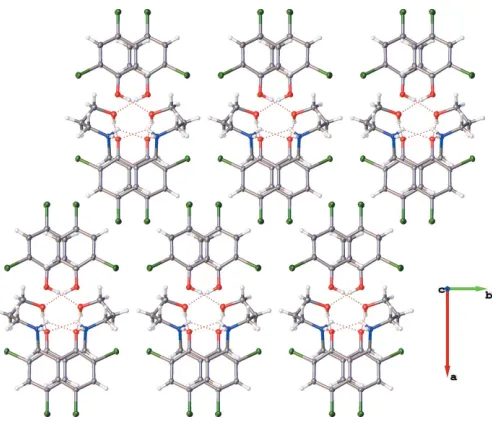
The packing arrangement of the co-crystal involves alter-nating hydrophobic layers of the aromatic dichlorophenol rings and the hydrogen-bonded polar channels. These layers stack one over the other along thec-axis direction and also propagate along the a-axis direction, thereby resulting in a
research communications
Acta Cryst.(2019). E75, 1452–1455 Uprety and Arderne C
[image:2.610.85.253.82.180.2]10H13Cl2NO2C6H4Cl2O
1453
Table 1Selected torsion angles ().
C7—N1—C8—C9 69.9 (3) C8—C9—C10—O2 65.1 (3)
N1—C8—C9—C10 64.5 (3)
Table 2
Hydrogen-bond geometry (A˚ ,).
D—H A D—H H A D A D—H A
N1—H1A O1i 0.91 1.76 2.663 (3) 171
N1—H1B O1 0.91 2.17 2.779 (3) 124
N1—H1B O2 0.91 2.29 2.947 (3) 129
O2—H2 O1ii 0.84 1.80 2.634 (3) 171
O1B—H1BA O2 0.84 1.82 2.653 (3) 172
Symmetry codes: (i)x;yþ1;zþ1
[image:2.610.45.307.571.703.2]2; (ii)x;yþ1;z 1 2.
Figure 2
[image:2.610.293.565.586.702.2]Molecular structure of the zwitterionic part of the co-crystal depicting the selected hydrogen-bonding graph sets. H atoms not involved in hydrogen bonding have been omitted for clarity and hydrogen bonds are drawn with red dashed lines.
Figure 1
ladder-like structure network (Figs. 3 and 4). The presence of the glide plane in theacplane of the crystal causes the packing to appear like a regular mirror image (Fig. 4). As a result of the nature of the packing arrangement in the crystal structure, it was possible to measure the ring centroid to ring centroid distance between the dichlorophenol rings of the adjacent layers; this distance was found to be in the range 4.045 (17)– 4.056 (19) A˚ (Fig. 5). The layers are stacked in this manner as a result of extensive – interactions between the phenyl rings. A detailed list of the relevant–interactions is given in Table 3.
4. Database survey
A search of the Cambridge structural database (Version 5.40, February 2019 updates; Groomet al., 2016) for the zwitterionic Mannich base, 2,4-dichloro-6-{[(3-hydroxypropyl)azaniumyl]-methyl}phenolate gave no hits. Search parameters that included 2,4-dichlorophenol and other relevant starting materials as well as the co-crystal resulted in only four hits, with one being the crystal structure of 2,4-dichlorophenol itself (DCPHOM; Bavoux & Perrin, 1979); the second hit was a clathrate containing 2,4-dichlorophenol as a guest molecule within the cavities of zinc tetraphenylporphyrin molecules (JIVNOR; Byrn et al., 1991), and the third and fourth hits were found to be two three–component co-crystal solvates [EVEYUB (Caiet al., 2016) and ZISJUI (Cai & Jin, 2014)] containing H-atom-bridged
2,4-dichlorophenolate/2,4-di-chlorophenol units held together by O—H N and O— H O hydrogen bonds. Of all the hits found in the CSD, none of the structures is reported to have any – interactions between the phenyl rings, whereas the title compound has these types of interactions. However, a database search for the alcoholamine fragment, NH2(+)–(CH2)3–OH, gave seven hits. Two of these, GIPHIX (Bu¨ttner et al., 2007) and EPANUF (Pestov et al., 2010), also involved intramolecular hydrogen bonding resulting inS1
1(6) graph sets, as also seen in the title compound.
5. Synthesis and crystallization
[image:3.610.44.296.108.168.2]The starting materials, comprising of 3-aminopropan-1-ol, formaldehyde and 2,4-dichlorophenol were purchased from Sigma Aldrich and used as received without any purification. To a methanolic solution of 3-amino-1-propanol (5 mmol, 0.38 g) was added a solution of formaldehyde (10 mmol,
Figure 4
Packing diagram of the title compound viewed down thecaxis, depicting an apparent regular mirror image resulting from the glide plane in theac
plane.
Figure 5
Partial packing arrangement of the title compound showing the–
[image:3.610.45.317.566.705.2]interaction between the 2,4-dichlorophenol hydrophobic layers. Table 3
–interactions (A˚ ,).
Cg1 andCg2 are the centroids of the C1–C6 and C1B–C6Brings, respectively.
Cg Cg Distance Slippage
Cg1 Cg1i 4.0449 (17) 2.006
Cg1 Cg1ii 4.0448 (17) 2.583
Cg2 Cg2i 4.0559 (19) 2.714
Cg2 Cg2ii 4.0559 (19) 1.849
Symmetry codes: (i)x,y+ 1,z+1
2; (ii)x,y+ 1,z 1 2.
Figure 3
[image:3.610.312.566.575.717.2]0.81 g) in methanol under stirring. A solution of 2,4-di-chlorophenol (10 mmol, 1.63 g) in methanol was added to the above mixture to afford a clear solution. The resulting solution was stirred at room temperature for two days to yield an oily solution. The oil was dissolved in diethyl ether and a few drops of methanol were added to the solution. The solution was then cooled in a refrigerator to obtain diffraction-quality single crystals.
6. Refinement
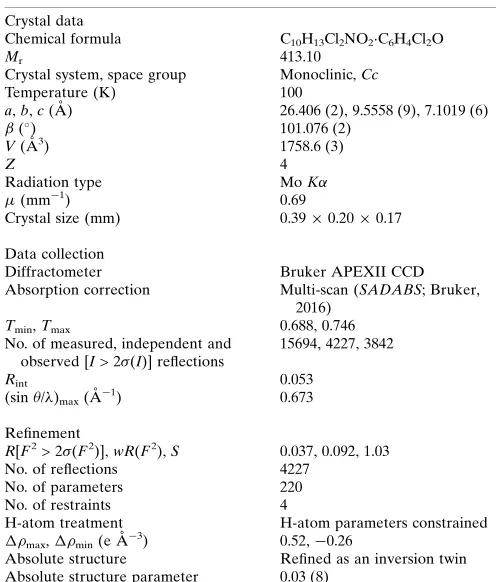
Crystal data, data collection and structure refinement details are summarized in Table 4. All carbon-bound H atoms were placed in calculated positions and refined using a riding-model approximation, with C—H = 0.95–1.00 A˚ and Uiso(H) = 1.2Ueq(C). H atoms bonded to N or O atoms were located from difference-Fourier electron-density maps and were also refined using a riding-model approximation with N—H bond distances of 0.89–0.91 A˚ and O—H = 0.84 A˚ withUiso(H) = 1.5Ueq(N,O). The atom H1A was restrained by DFIX in
SHELXto be at a distance of 0.88 (2) A˚ from N1 and by the SADI command to be equidistant from C7 and C8 ( = 0.02 A˚ ), so as to inhibit too much movement of this H atom during the refinement. The structure was also refined as an inversion twin, but low coverage of Friedel pairs in the data precludes the reliable determination of the absolute structure. All related structure and refinement checks were carried out withPLATON(Spek, 2009).
Acknowledgements
The authors thank the University of Johannesburg for providing access to the Single Crystal XRD facilities. They also gratefully acknowledge Dr Matthias Zeller, Purdue University, Indiana, USA, for assistance in solving the crystal structure.
Funding information
Funding for this research was provided by: National Research Fund Thuthuka (grant No. 99164 to CA). BU thanks the University of Johannesburg for funding from the UJ–GES post-doctoral fellowship. CA and BU thank the Research Centre for Synthesis and Catalysis for ancillary funding for the project.
References
Bavoux, C. & Perrin, M. (1979).Cryst. Struct. Commun.8, 847–850. Bruker (2014). APEX2. Bruker AXS, Inc., Madison, Wisconsin,
USA.
Bruker (2016). SAINTand SADABS. Bruker AXS, Inc., Madison, Wisconsin, USA.
Bruno, I. J., Cole, J. C., Kessler, M., Luo, J., Motherwell, S., Purkis, L. H., Smith, B. R., Taylor, R., Cooper, R. I., Harris, S. E. & Orpen, A. G. (2004).J. Chem. Inf. Comput. Sci.44, 2133–2144.
Bu¨ttner, M. W., Burschka, C., Daiss, J. O., Ivanova, D., Rochel, N., Kammerer, S., Peluso-Iltis, C., Bindler, A., Gaudon, C., Germain, P., Moras, D., Gronemeyer, H. & Tacke, R. (2007).ChemBioChem,
8, 1688–1699.
Byrn, M. P., Curtis, C. J., Goldberg, I., Hsiou, Y., Khan, S. I., Sawin, P. A., Tendick, S. K. & Strouse, C. E. (1991).J. Am. Chem. Soc.113, 6549–6557.
Cai, X.-Q. & Jin, Z. M. (2014).Acta Cryst.C70, 207–209.
Cai, X.-Q., Tian, B., Zhang, J.-N. & Jin, Z.-M. (2016).Acta Cryst.C72, 720–723.
Dolomanov, O. V., Bourhis, L. J., Gildea, R. J., Howard, J. A. K. & Puschmann, H. (2009).J. Appl. Cryst.42, 339–341.
Groom, C. R., Bruno, I. J., Lightfoot, M. P. & Ward, S. C. (2016).Acta Cryst.B72, 171–179.
Lee, W. Z., Tseng, H. S., Wang, T. L., Tsai, H. L. & Kuo, T. S. (2010).
Organometallics,29, 2874–2881.
Macrae, C. F., Bruno, I. J., Chisholm, J. A., Edgington, P. R., McCabe, P., Pidcock, E., Rodriguez-Monge, L., Taylor, R., van de Streek, J. & Wood, P. A. (2008).J. Appl. Cryst.41, 466–470.
Maurya, M. R., Uprety, B., Avecilla, F., Ada˜o, P. & Costa Pessoa, J. (2015).Dalton Trans.44, 17736–17755.
Pestov, A. V., Slepukhin, P. A., Molochnikov, L. S., Ezhikova, M. A., Kodess, M. I. & Yatluk, Yu. G. (2010).Russ. J. Inorg. Chem. 55, 201–208.
Riisio¨, A., Ha¨nninen, M. M. & Sillanpa¨a¨, R. (2012).Eur. J. Inorg. Chem.pp. 1048–1053.
Riisio¨, A., Va¨isa¨nen, A. & Sillanpa¨a¨, R. (2013).Inorg. Chem. 52, 8591–8600.
Sarhan, A. E. A. O., Abdel–Hafez, S. H., El–Sherief, H. & Aboel– Fadl, T. (2006).Synth. Commun.36, 987–996.
Sheldrick, G. M. (2015a).Acta Cryst.C71, 3–8. Sheldrick, G. M. (2015b).Acta Cryst.A71, 3–8.
Sopo, H., Sviili, J., Valkonen, A. & Sillanpa¨a¨, R. (2006).Polyhedron,
25, 1223–1232.
Spek, A. L. (2009).Acta Cryst.D65, 148–155.
research communications
Acta Cryst.(2019). E75, 1452–1455 Uprety and Arderne C
[image:4.610.312.560.90.381.2]10H13Cl2NO2C6H4Cl2O
1455
Table 4Experimental details.
Crystal data
Chemical formula C10H13Cl2NO2C6H4Cl2O
Mr 413.10
Crystal system, space group Monoclinic,Cc
Temperature (K) 100
a,b,c(A˚ ) 26.406 (2), 9.5558 (9), 7.1019 (6)
() 101.076 (2)
V(A˚3) 1758.6 (3)
Z 4
Radiation type MoK
(mm1) 0.69
Crystal size (mm) 0.390.200.17
Data collection
Diffractometer Bruker APEXII CCD
Absorption correction Multi-scan (SADABS; Bruker, 2016)
Tmin,Tmax 0.688, 0.746
No. of measured, independent and observed [I> 2(I)] reflections
15694, 4227, 3842
Rint 0.053
(sin/)max(A˚
1) 0.673
Refinement
R[F2> 2(F2)],wR(F2),S 0.037, 0.092, 1.03
No. of reflections 4227
No. of parameters 220
No. of restraints 4
H-atom treatment H-atom parameters constrained
max, min(e A˚
3
) 0.52,0.26
Absolute structure Refined as an inversion twin Absolute structure parameter 0.03 (8)
sup-1 Acta Cryst. (2019). E75, 1452-1455
supporting information
Acta Cryst. (2019). E75, 1452-1455 [https://doi.org/10.1107/S2056989019012544]
The crystal structure of the zwitterionic co-crystal of
2,4-dichloro-6-{[(3-hy-droxypropyl)azaniumyl]methyl}phenolate and 2,4-dichlorophenol
Bhawna Uprety and Charmaine Arderne
Computing details
Data collection: APEX2 (Bruker, 2014); cell refinement: SAINT (Bruker, 2016); data reduction: SAINT (Bruker, 2016);
program(s) used to solve structure: SHELXT2014/5 (Sheldrick, 2015b); program(s) used to refine structure: SHELXL
(Sheldrick, 2015a); molecular graphics: OLEX2 (Dolomanov et al., 2009); software used to prepare material for
publication: OLEX2 (Dolomanov et al., 2009).
2,4-Dichlorophenol– 2,4-dichloro-6-{[(3-hydroxypropyl)azaniumyl]methyl}phenolate (1/1)
Crystal data
C10H13Cl2NO2·C6H4Cl2O Mr = 413.10
Monoclinic, Cc a = 26.406 (2) Å b = 9.5558 (9) Å c = 7.1019 (6) Å β = 101.076 (2)° V = 1758.6 (3) Å3
Z = 4
F(000) = 848 Dx = 1.560 Mg m−3
Mo Kα radiation, λ = 0.71073 Å Cell parameters from 6679 reflections θ = 2.3–28.6°
µ = 0.69 mm−1 T = 100 K Plank, colourless 0.39 × 0.20 × 0.17 mm
Data collection
Bruker APEXII CCD diffractometer φ and ω scans
Absorption correction: multi-scan (SADABS; Bruker, 2016) Tmin = 0.688, Tmax = 0.746
15694 measured reflections
4227 independent reflections 3842 reflections with I > 2σ(I) Rint = 0.053
θmax = 28.6°, θmin = 1.6° h = −34→35
k = −12→12 l = −9→9
Refinement
Refinement on F2
Least-squares matrix: full R[F2 > 2σ(F2)] = 0.037 wR(F2) = 0.092 S = 1.03 4227 reflections 220 parameters 4 restraints
Primary atom site location: dual
Hydrogen site location: inferred from neighbouring sites
H-atom parameters constrained w = 1/[σ2(F
o2) + (0.051P)2]
where P = (Fo2 + 2Fc2)/3
(Δ/σ)max = 0.001
Δρmax = 0.52 e Å−3
Δρmin = −0.25 e Å−3
supporting information
sup-2 Acta Cryst. (2019). E75, 1452-1455
Special details
Geometry. All esds (except the esd in the dihedral angle between two l.s. planes) are estimated using the full covariance matrix. The cell esds are taken into account individually in the estimation of esds in distances, angles and torsion angles; correlations between esds in cell parameters are only used when they are defined by crystal symmetry. An approximate (isotropic) treatment of cell esds is used for estimating esds involving l.s. planes.
Refinement. Refined as a 2-component inversion twin.
Fractional atomic coordinates and isotropic or equivalent isotropic displacement parameters (Å2)
x y z Uiso*/Ueq
C1 0.60636 (12) 0.3974 (3) 0.4792 (4) 0.0142 (6)
C2 0.63604 (11) 0.2750 (3) 0.5205 (4) 0.0157 (6)
C3 0.68630 (12) 0.2726 (3) 0.6225 (4) 0.0165 (6)
H3 0.704950 0.187257 0.645494 0.020*
C4 0.70848 (12) 0.3991 (3) 0.6902 (5) 0.0168 (6)
C5 0.68172 (11) 0.5238 (3) 0.6521 (4) 0.0165 (6)
H5 0.697687 0.609545 0.698121 0.020*
C6 0.63169 (11) 0.5240 (3) 0.5469 (4) 0.0147 (6)
O1 0.55807 (8) 0.3971 (2) 0.3846 (3) 0.0155 (5)
C7 0.60594 (11) 0.6628 (3) 0.4870 (4) 0.0158 (5)
H7A 0.625976 0.738673 0.561830 0.019*
H7B 0.606421 0.679235 0.349730 0.019*
N1 0.55136 (9) 0.6690 (2) 0.5164 (3) 0.0147 (4)
H1A 0.550581 0.642000 0.638674 0.018*
H1B 0.532185 0.606588 0.435781 0.018*
C8 0.52697 (11) 0.8107 (3) 0.4826 (4) 0.0175 (5)
H8A 0.550100 0.879869 0.559396 0.021*
H8B 0.494264 0.809926 0.531229 0.021*
C9 0.51540 (11) 0.8601 (3) 0.2744 (4) 0.0175 (6)
H9A 0.503078 0.958053 0.271129 0.021*
H9B 0.547924 0.859396 0.224456 0.021*
C10 0.47556 (12) 0.7729 (3) 0.1416 (4) 0.0202 (6)
H10A 0.443328 0.769495 0.193267 0.024*
H10B 0.467599 0.817985 0.013813 0.024*
O2 0.49333 (8) 0.6335 (2) 0.1213 (3) 0.0184 (4)
H2 0.513930 0.633301 0.044658 0.028*
Cl1 0.60850 (3) 0.11500 (7) 0.43483 (9) 0.01842 (17)
Cl2 0.77111 (3) 0.39949 (8) 0.82500 (10) 0.0250 (2)
O1B 0.44186 (9) 0.3939 (2) 0.1038 (4) 0.0241 (6)
H1BA 0.455585 0.473101 0.102256 0.036*
C1B 0.39283 (14) 0.3987 (3) 0.0027 (5) 0.0199 (7)
C2B 0.36413 (13) 0.2748 (4) −0.0255 (5) 0.0222 (7)
C3B 0.31382 (13) 0.2721 (4) −0.1258 (5) 0.0248 (7)
H3B 0.295037 0.186795 −0.143940 0.030*
C4B 0.29142 (13) 0.3965 (3) −0.1992 (5) 0.0218 (7)
C5B 0.31829 (12) 0.5215 (4) −0.1709 (4) 0.0216 (7)
H5B 0.302285 0.606604 −0.219504 0.026*
sup-3 Acta Cryst. (2019). E75, 1452-1455
H6B 0.387375 0.606724 −0.052605 0.025*
Cl2B 0.22825 (3) 0.39666 (9) −0.32799 (12) 0.0308 (2)
Cl1B 0.39215 (3) 0.11872 (9) 0.07078 (15) 0.0370 (3)
Atomic displacement parameters (Å2)
U11 U22 U33 U12 U13 U23
C1 0.0169 (16) 0.0145 (16) 0.0124 (14) −0.0011 (11) 0.0055 (11) −0.0008 (9)
C2 0.0192 (15) 0.0122 (15) 0.0165 (13) −0.0052 (12) 0.0057 (11) −0.0028 (10)
C3 0.0178 (15) 0.0129 (16) 0.0189 (13) 0.0016 (12) 0.0036 (11) −0.0006 (10)
C4 0.0110 (15) 0.0175 (17) 0.0210 (15) −0.0005 (11) 0.0011 (12) −0.0027 (11)
C5 0.0172 (15) 0.0150 (16) 0.0177 (14) −0.0015 (12) 0.0048 (11) −0.0019 (10)
C6 0.0178 (14) 0.0128 (15) 0.0151 (13) 0.0005 (12) 0.0069 (10) −0.0004 (10)
O1 0.0145 (12) 0.0156 (12) 0.0163 (10) −0.0013 (8) 0.0029 (8) −0.0017 (7)
C7 0.0168 (13) 0.0120 (14) 0.0193 (13) 0.0005 (10) 0.0049 (10) 0.0008 (9)
N1 0.0168 (11) 0.0144 (11) 0.0130 (11) −0.0011 (9) 0.0033 (8) 0.0003 (8)
C8 0.0223 (14) 0.0120 (13) 0.0182 (13) 0.0004 (10) 0.0038 (10) 0.0005 (10)
C9 0.0199 (14) 0.0154 (14) 0.0174 (14) 0.0010 (10) 0.0037 (11) 0.0026 (10)
C10 0.0212 (14) 0.0191 (15) 0.0197 (14) 0.0031 (11) 0.0026 (10) −0.0015 (11)
O2 0.0193 (10) 0.0168 (10) 0.0201 (10) −0.0005 (8) 0.0060 (8) −0.0012 (7)
Cl1 0.0201 (4) 0.0128 (4) 0.0216 (3) −0.0027 (3) 0.0023 (3) −0.0022 (3)
Cl2 0.0169 (4) 0.0194 (4) 0.0353 (5) 0.0010 (3) −0.0038 (3) −0.0041 (3)
O1B 0.0159 (13) 0.0151 (13) 0.0403 (15) −0.0022 (8) 0.0027 (10) −0.0003 (9)
C1B 0.0152 (16) 0.0220 (19) 0.0235 (17) −0.0002 (12) 0.0062 (12) −0.0015 (11)
C2B 0.0199 (16) 0.0120 (17) 0.0352 (17) 0.0023 (13) 0.0068 (13) 0.0024 (12)
C3B 0.0211 (18) 0.0162 (19) 0.0373 (18) −0.0030 (13) 0.0059 (14) −0.0017 (13)
C4B 0.0184 (18) 0.0197 (18) 0.0274 (17) −0.0020 (12) 0.0046 (14) −0.0020 (12)
C5B 0.0234 (17) 0.0164 (17) 0.0251 (16) −0.0007 (13) 0.0045 (12) 0.0015 (12)
C6B 0.0243 (17) 0.0142 (16) 0.0242 (16) −0.0043 (13) 0.0076 (12) −0.0022 (11)
Cl2B 0.0200 (5) 0.0207 (5) 0.0474 (6) −0.0024 (3) −0.0038 (4) 0.0031 (4)
Cl1B 0.0209 (5) 0.0167 (5) 0.0705 (7) 0.0004 (3) 0.0018 (5) 0.0095 (4)
Geometric parameters (Å, º)
C1—C2 1.407 (4) C9—H9A 0.9900
C1—C6 1.421 (4) C9—H9B 0.9900
C1—O1 1.322 (4) C9—C10 1.520 (4)
C2—C3 1.385 (4) C10—H10A 0.9900
C2—Cl1 1.751 (3) C10—H10B 0.9900
C3—H3 0.9500 C10—O2 1.429 (3)
C3—C4 1.388 (4) O2—H2 0.8400
C4—C5 1.386 (4) O1B—H1BA 0.8400
C4—Cl2 1.744 (3) O1B—C1B 1.355 (4)
C5—H5 0.9500 C1B—C2B 1.400 (5)
C5—C6 1.387 (4) C1B—C6B 1.384 (5)
C6—C7 1.514 (4) C2B—C3B 1.382 (5)
C7—H7A 0.9900 C2B—Cl1B 1.745 (3)
supporting information
sup-4 Acta Cryst. (2019). E75, 1452-1455
C7—N1 1.496 (3) C3B—C4B 1.384 (5)
N1—H1A 0.9100 C4B—C5B 1.385 (4)
N1—H1B 0.9100 C4B—Cl2B 1.742 (4)
N1—C8 1.499 (3) C5B—H5B 0.9500
C8—H8A 0.9900 C5B—C6B 1.385 (4)
C8—H8B 0.9900 C6B—H6B 0.9500
C8—C9 1.526 (4)
C2—C1—C6 115.5 (3) C9—C8—H8A 108.3
O1—C1—C2 123.3 (3) C9—C8—H8B 108.3
O1—C1—C6 121.3 (3) C8—C9—H9A 108.6
C1—C2—Cl1 118.4 (2) C8—C9—H9B 108.6
C3—C2—C1 124.2 (3) H9A—C9—H9B 107.6
C3—C2—Cl1 117.3 (2) C10—C9—C8 114.7 (2)
C2—C3—H3 121.2 C10—C9—H9A 108.6
C2—C3—C4 117.7 (3) C10—C9—H9B 108.6
C4—C3—H3 121.2 C9—C10—H10A 109.2
C3—C4—Cl2 119.0 (2) C9—C10—H10B 109.2
C5—C4—C3 121.1 (3) H10A—C10—H10B 107.9
C5—C4—Cl2 120.0 (2) O2—C10—C9 111.8 (2)
C4—C5—H5 119.9 O2—C10—H10A 109.2
C4—C5—C6 120.2 (3) O2—C10—H10B 109.2
C6—C5—H5 119.9 C10—O2—H2 109.5
C1—C6—C7 119.6 (3) C1B—O1B—H1BA 109.5
C5—C6—C1 121.3 (3) O1B—C1B—C2B 118.9 (3)
C5—C6—C7 118.8 (3) O1B—C1B—C6B 123.4 (3)
C6—C7—H7A 109.0 C6B—C1B—C2B 117.7 (3)
C6—C7—H7B 109.0 C1B—C2B—Cl1B 119.3 (3)
H7A—C7—H7B 107.8 C3B—C2B—C1B 122.0 (3)
N1—C7—C6 112.8 (2) C3B—C2B—Cl1B 118.6 (3)
N1—C7—H7A 109.0 C2B—C3B—H3B 120.8
N1—C7—H7B 109.0 C2B—C3B—C4B 118.5 (3)
C7—N1—H1A 108.7 C4B—C3B—H3B 120.8
C7—N1—H1B 108.7 C3B—C4B—C5B 121.1 (3)
C7—N1—C8 114.1 (2) C3B—C4B—Cl2B 119.7 (3)
H1A—N1—H1B 107.6 C5B—C4B—Cl2B 119.2 (3)
C8—N1—H1A 108.7 C4B—C5B—H5B 120.4
C8—N1—H1B 108.7 C4B—C5B—C6B 119.2 (3)
N1—C8—H8A 108.3 C6B—C5B—H5B 120.4
N1—C8—H8B 108.3 C1B—C6B—C5B 121.5 (3)
N1—C8—C9 115.8 (2) C1B—C6B—H6B 119.3
H8A—C8—H8B 107.4 C5B—C6B—H6B 119.3
C1—C2—C3—C4 0.8 (4) N1—C8—C9—C10 64.5 (3)
C1—C6—C7—N1 50.1 (3) C8—C9—C10—O2 −65.1 (3)
C2—C1—C6—C5 −2.1 (4) Cl1—C2—C3—C4 179.7 (2)
C2—C1—C6—C7 171.6 (2) Cl2—C4—C5—C6 −179.2 (2)
sup-5 Acta Cryst. (2019). E75, 1452-1455
C2—C3—C4—Cl2 178.3 (2) O1B—C1B—C2B—Cl1B 0.3 (4)
C3—C4—C5—C6 0.8 (5) O1B—C1B—C6B—C5B −179.0 (3)
C4—C5—C6—C1 1.2 (4) C1B—C2B—C3B—C4B −0.3 (5)
C4—C5—C6—C7 −172.6 (3) C2B—C1B—C6B—C5B −0.6 (5)
C5—C6—C7—N1 −136.0 (3) C2B—C3B—C4B—C5B −0.9 (5)
C6—C1—C2—C3 1.2 (4) C2B—C3B—C4B—Cl2B 179.5 (2)
C6—C1—C2—Cl1 −177.8 (2) C3B—C4B—C5B—C6B 1.4 (5)
C6—C7—N1—C8 172.5 (2) C4B—C5B—C6B—C1B −0.6 (5)
O1—C1—C2—C3 −178.7 (3) C6B—C1B—C2B—C3B 1.1 (5)
O1—C1—C2—Cl1 2.4 (4) C6B—C1B—C2B—Cl1B −178.2 (2)
O1—C1—C6—C5 177.7 (3) Cl2B—C4B—C5B—C6B −179.0 (2)
O1—C1—C6—C7 −8.6 (4) Cl1B—C2B—C3B—C4B 178.9 (3)
C7—N1—C8—C9 69.9 (3)
Hydrogen-bond geometry (Å, º)
D—H···A D—H H···A D···A D—H···A
N1—H1A···O1i 0.91 1.76 2.663 (3) 171
N1—H1B···O1 0.91 2.17 2.779 (3) 124
N1—H1B···O2 0.91 2.29 2.947 (3) 129
O2—H2···O1ii 0.84 1.80 2.634 (3) 171
O1B—H1BA···O2 0.84 1.82 2.653 (3) 172