Direct Crystallization of the Nd
2Fe
14B Peritectic Phase by Containerless
Solidification in a Drop Tube
Shunpei Ozawa
1, Mingjun Li
1, Suguru Sugiyama
2, Itaru Jimbo
2and Kazuhiko Kuribayashi
11
The Institute of Space and Astronautical Science, Sagamihara 229-8510, Japan
2Department of Metallurgical Engineering, Tokai University, Hiratsuka 259-1292, Japan
Nd2Fe14B molten alloy droplets were containerlessly solidified using a 25 m drop tube. The relationship between the sample diameter and
the microstructure was investigated. The diameter of the resultant spherical samples was in range of 150 to 2000mm. When sample diameter was larger than 500mm, the microstructure of the spherical sample consisted of the-Fe phase embedded in matrix of the Nd2Fe14B phase within
entire sections. In the spherical sample with diameter of 400mm, the microstructures consisted of two regions, one was columnar grains of the Nd2Fe14B phase and the other was-Fe phase embedded in matrix of the Nd2Fe14B phase. The columnar Nd2Fe14B region expanded as the
sample diameter decreased from 400 to 350mm. When sample diameter reduced to 250mm, the microstructure of a spherical sample consisted of the pure dendritic Nd2Fe14B phase without any-Fe phase.
(Received November 21, 2002; Accepted February 17, 2003)
Keywords: containerless solidification, undercooling, direct crystallization, neodymium–iron–boron
1. Introduction
Neodymium–iron–boron (Nd–Fe–B) permanent magnets are one of the highest performance magnets. It has been
reported1)that the Nd–Fe–B magnets can yield the maximum
energy products of more than 444 kJm3. This value is over
10 times larger than that of ferrite magnets that are widely applied at present. Therefore, the production volume of the Nd–Fe–B magnets will increase due to the expanding needs in various applications such as computer and electric devices. The superiority of the magnets originates from the
Nd2Fe14B intermetallic compound that exhibits a large
saturation magnetization and a high anisotropy field.2,3)
According to the Nd–Fe–B ternary alloy phase diagram, the Nd2Fe14B phase is formed via the peritectic reaction from
liquid phase and primary iron phase.4)Therefore, the primary
iron phase always remains between the Nd2Fe14B phase in
alloy ingots due to the nature of peritectic reaction.5,6) The
primary iron phase transforms to the soft magnetic -Fe
phase at room temperature, which deteriorates the hard magnetic property of the Nd–Fe–B magnets. Thus, it is crucial to reduce the amount of the primary iron phase in Nd– Fe–B alloy ingots.
A large undercooling is one of the most promising alternatives for yielding peritectic compounds directly from a melt. The most common technique to obtain a large undercooling is the rapid solidification processing such as
melt-spinning or splat-quenching.7,8) Furthermore, it has
been reported that an undercooling can be achieved by containerless solidification.9,10) In the containerless techni-que, a bulk liquid material may experience a large under-cooling prior to solidification because of the absence of container wall that may act as heterogeneous nucleation sites. In this study, an Nd–Fe–B spherical alloy with the
stoichiometric Nd2Fe14B composition was produced by
containerless solidification processing in a drop tube of 25 m in height. It is expected that the molten alloy droplets experience a large undercooling prior to solidification by drop tube processing. Such a large undercooling may favor
the direct crystallization of the Nd2Fe14B hard magnetic
phase from the undercooled melt. The purpose of this study is to investigate the relationship between the sample size and the microstructure. The particular interest in the investigation was to confirm the critical diameter of a spherical sample, in which direct crystallization of the Nd2Fe14B phase can be
achieved without the primary iron phase.
2. Experimental Procedure
Figure1 shows a schematic diagram of the drop tube
experiment. Small segments of Nd–Fe–B alloy ingots with stoichiometric composition of Nd2Fe14B were charged in a
Fig. 1 Schematic diagram of the drop tube experiment. Special Issue on Solidification Science and Processing for Advanced Materials
[image:1.595.304.543.504.770.2]quartz glass crucible with an orifice from 0.3 to 1.0 mm in diameter at the bottom. The quartz crucible with ingots was fixed in a chamber at the top of the drop tube. The drop tube
was evacuated to1103Pa and backfilled with 99.999%
helium. The ingots were induction heated up to 1650 K that is about 100 K above the equilibrium liquidus temperature. The temperature of the melt was monitored by a thermocouple encased in a quartz glass sheath placed at the center of the sample. The molten alloy was ejected into the drop tube through the orifice by controlling the helium pressure, and shaped into comparatively uniform droplets continuously. The rapid solidification of the droplets was accomplished during their free fall in a containerless state. The sample accumulated at the bottom of the drop tube was spherical grain. The resultant samples were sifted into various groups
according to sample diameter, ranging from 100 to 2000mm
with regard to the nozzle diameter and ejection pressure. After spherical samples were polished and etched in 1% Nital, the microstructures and accurate diameter of the spherical samples were examined under scanning electron microscope (SEM) equipped with an electron probe micro-analyzer (EPMA) for analyzing chemical composition. The phases of the samples were identified by powdered X-ray
diffraction (XRD) using Cu-K radiation at room
tempera-ture.
3. Results and Discussion
The spherical samples had a metallic surface in spite of a high oxidation tendency of the neodymium in the alloy. In the drop tube experiment, the melt solidifies without the container wall that may act as the heterogeneous nucleation site. Moreover, the reduction of the number of the potential heterogeneous nuclei in a fine droplet is favorable to enhance the undercooling level. Therefore, it is important to examine the influence of sample diameter on the phase selection and microstructure formation. It has been reported that a number
of metals and alloys can experience an undercoolingT of
0:2TLprior to solidification.11,12)When it is assumed that
the Nd2Fe14B melts experience an undercooling of0:2TL
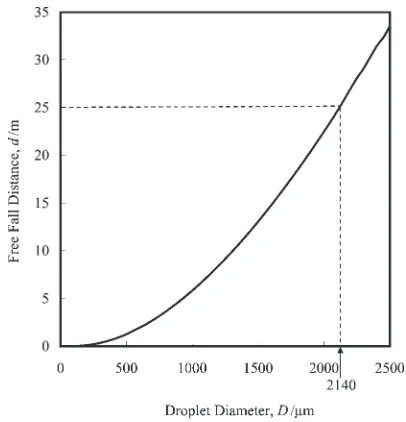
prior to solidification, the free fall distance as a function of
the sample diameter is shown in Fig.2. This value is
estimated by the following equations;
dT=dt¼ 6=ðCpdÞ½hðTT0Þ þSB"ðT4T04Þ ð1Þ
dV=dt¼gðgÞ=g3=4DrðV2=dÞ ð2Þ
h¼Kg=dð2:0þ0:3Pr0:33Re0:6Þ ð3Þ
Dr¼24=Re ðRe<1Þ ð4Þ
Dr¼ ð0:55þ4:8=Re1=2Þ2 ð1<Re<104Þ ð5Þ
wheredis the diameter of droplets,andgare the density of
the droplet and gas,Cpis the specific heat of the droplet,his
heat transfer coefficient, T andT0 are the melt temperature
and ambient temperature,SBis Stefan-Boltzmann constant,
"is the droplet surface hemispherical total emissivity,gis the gravitational acceleration,Dris the drag coefficient,Vis the
relative velocity between the droplet and the gas and,Kg is
thermal conductivity of the gas.13) The physical properties
used in the estimation are listed in Table1. Maximum
diameter of the melt which can experience the undercooling of0:2TLduring free fall in the drop tube is about 2150mm.
In this study, the spherical sample with 150 to 2000mmin
diameter is obtained. Hence, the molten Nd2Fe14B droplet
may experience such a large undercooling.
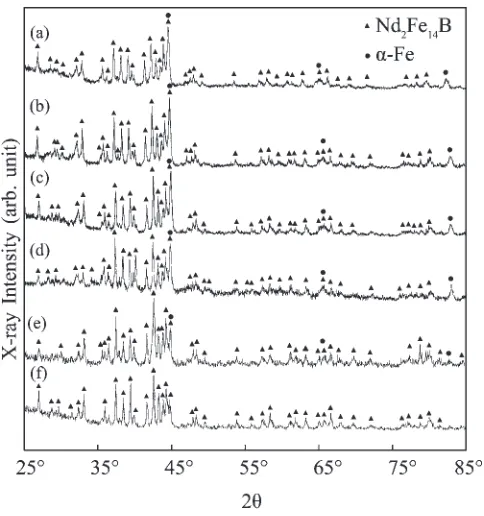
Figure3 shows the XRD patterns of the spherical
Nd2Fe14B alloys with various diameters solidified during
free fall in the drop tube. For comparison, the XRD pattern of the alloy ingot is also depicted. The XRD pattern of the alloy ingot is well indexed to tetragonal Nd2Fe14B phase and the
-Fe phase. This indicates that the alloy ingot contains some -Fe phase together with the Nd2Fe14B phase. In the
stoichio-metric Nd2Fe14B alloy, the -Fe phase should coexist with
other phase such as Nd phase and Fe2B phase.4)However, no
detectable diffraction peaks of other phase can be found in the XRD pattern. When the diameter of the spherical sample
is 2000mm, the XRD pattern of the samples shows the
diffraction peaks of the Nd2Fe14B phase and the-Fe phase
as is the case of the ingot. Virtually the same XRD patterns
are obtained from the spherical samples with 500mm and
400mmin diameter. This indicates that the spherical samples
with diameter in range of 2000 to 400mmcontain some-Fe
phase together with the Nd2Fe14B phase as in that alloy ingot.
It is expected that the primary-Fe phase was transformed to
the stable -Fe phase. The primary iron phase was not
completely transformed into the Nd2Fe14B phase by the
[image:2.595.324.527.70.281.2]Fig. 2 Free fall distance as a function of the sample diameter.
Table 1 Physical properties used in the theoretical calculation in Fig.2.
Parameter Unit Value
Cp Jkg1K1 502
T K 1650
T0 K 300
kgm3 7600
g kgm3 0.1785
Kg Pas1 0.1422
e — 0.1
[image:2.595.304.548.337.449.2]peritectic reaction and thus remained as the-Fe phase in the spherical samples with diameter in range of 2000 to 400mm. Although the diffraction peaks of the-Fe phase can still be found in the XRD pattern of the spherical sample with 350mmin diameter, the intensity of the diffraction peaks of the Nd2Fe14B phase become slightly strong. This implies that
the amount of the Nd2Fe14B phase in the spherical sample
with 350mm in diameter increases, in short, the volume
fraction of the-Fe phase decreases. The XRD pattern of the
sample with 250mmin diameter shows only the diffraction
peaks of the Nd2Fe14B phase. No appreciable diffraction
peaks of other phase are observed. This indicates that the spherical sample with 250mmin diameter only consists of the Nd2Fe14B phase.
Figure4shows the typical cross section microstructures of the spherical Nd2Fe14B alloys with various diameters and
further magnified microstructures at center position. The
microstructure of the spherical sample with 500mm in
diameter consists of ‘‘isolated fragmented dendrite’’ embed-ding in matrix. EPMA study reveals that the fragmented
dendrite and matrix are the -Fe phase and the Nd2Fe14B
phase, respectively. Schwarzet al.have reported that such a fragmentation is resulted in a comparatively low cooling
rate.14)Even though the XRD studies does not confirm the
existence of any other phase, the EPMA studies reveals that the grain boundary is Nd-rich phase. The volume fraction of this Nd-rich phase is so small that it is beyond the detectable limit of XRD.
In the spherical sample with diameter of 400mm, the
microstructure consists of two regions though almost the same microstructure is still observed at about 10 percent of the spherical samples. One is columnar grains together with grain boundary and the other is fragmented dendrites embedding in the matrix as that evidenced in the spherical
samples with 500mm in diameter. On the other hand, the
columnar grains and grain boundaries were the Nd2Fe14B
phase and Nd-rich phase, respectively. When the Nd2Fe14B
phase is formed by peritectic reaction, it surrounds the primary iron phase and prevents further peritectic reaction. As a result, the primary iron phase always remains in the
resultant Nd2Fe14B phase.5,6) However, no primary iron
phase was observed in the current columnar Nd2Fe14B
grains. Similar columnar grains of Nd2Fe14B phase can be
observed in the microstructures of the Nd–Fe–B alloys solidified from the undercooled melt.6)Hence, the Nd2Fe14B
columnar grains may be formed directly from the under-cooled melt. As a diameter of the droplet is decreased, the probability for a droplet to contain potential catalytic site for heterogeneous nucleation is reduced and the cooling rate increases. Thus, the undercooling level may be enhanced by reduction of the sample diameter. Even if a number of droplets experience a large undercooling, it is expected that
Fig. 3 XRD pattern of the Nd2Fe14B alloy ingots (a) and (b), (c), (d), (e),
and (f) depict the profiles of samples with 2000mm, 500mm, 400mm, 350mm, and 250mm, respectively.
Fig. 4 Cross sectional microstructures of Nd2Fe14B alloy with (a) 500mm,
[image:3.595.306.549.68.511.2] [image:3.595.48.290.70.328.2]some droplets do not experience such a large undercooling because potential heterogeneous nuclei should exist
some-where. Thus, about 10 percent of the sample with 400mmin
diameter may consist of the -Fe and matrix. It has been
reported that Nd2Fe14B alloy solidified from the melt with the
undercooling level of about 165 K mainly consists of Nd2Fe14B phase.15) Therefore, the undercooling level that
the spherical sample with 400mmexperiences may be lower
than 165 K. The undercooling level of the spherical sample
with 400mmin diameter may not be sufficient as a heat sink
to achieve the direct growth of the Nd2Fe14B completely. In
spite of the fact that about 10 percent samples consist of the
-Fe dendrite and Nd2Fe14B matrix as similar case of the
sample with 400mm diameter, the region that consisted of
columnar Nd2Fe14B grains and grain boundary expands in
the microstructure of the remainder spherical sample with
350mm in diameter. The enhancement of the undercooling
level due to the decrease of the diameter of the spherical sample must be responsible for such expansion of the Nd2Fe14B columnar region. Two possibilities arise for the
formation of the microstructure of two different region, as shown in Figs.4(b’) and (c’). The first is that the-Fe phase
and the Nd2Fe14B phase nucleate separately within one
droplet almost simultaneously. Then two phases start to grow and from different microstructures. The second is that the Nd2Fe14B phase will nucleate first and then begin to grow.
Due to the pronounced sluggish kinetics in growth, the released crystallization heat may lower the interface
under-cooling and thus the growth of Nd2Fe14B phase will be
terminated. At this lower undercooling, the growth of iron phase will be predomination and then followed by a peritectic reaction. This solidification mode can also yield two different regions, as observed in Figs.4(b’) and (c’).
In the spherical sample whose diameter is reduced to 250mm, the microstructure consists of dendrites. No other
microstructures can be observed in all samples with 250mm
in diameter. Although the morphology is different from the
Nd2Fe14B columnar grains in the spherical sample with
400mmand 350mmin diameter, EPMA study reveals that the dendrite grain is Nd2Fe14B phase. This indicates that the
critical diameter for obtaining the Nd2Fe14B alloy without
the -Fe phase is in range of 250mm and 350mm, which
coincides with the value reported by Gao and Wei.16) It is
well known that dendrite is formed by continuous growth of a
primary phase. Moreover, any-Fe phase is not observed in
the Nd2Fe14B dendrites. Therefore, it is expected that the
direct crystallization of the Nd2Fe14B phase is completely
achieved in the spherical sample with 250mmin diameter. If such a direct growth of the Nd2Fe14B phase is due to a large
undercooled melt, the sample without the undercooling should be obtained as is the case of the sample with 400mm
and 350mm in diameter. However, no microstructure that
consists of Nd2Fe14B and-Fe is observed in all the samples
with 250 m in diameter. This hints that the direct growth of the Nd2Fe14B phase in the spherical sample with diameter
less than 250mm is not due to a large undercooling. The
cooling rate of the sample is enhanced as the sample diameter decreases; the estimated cooling rate of the spherical sample
with 250mm in diameter is high value of 1:3104K/s.
Therefore, it is expected that the direct growth of the
Nd2Fe14B phase in the spherical sample with 250mm in
diameter strongly depends on the high cooling rate rather than undercooling level. High cooling rate may suppress the
primary growth of -Fe phase. It has been reported that a
metastable Nd2Fe17Bxis formed from undercooled Nd–Fe–B
system melts.17,18) However, no evidence of the metastable
phase was observed in this study. The dendrite arm spacing of Nd2Fe14B phase is about 2.2mm. This value is comparable to
that in the strip cast Nd–Fe–B alloy, which is used for sintered magnets with high performance.19)Thus, a drop tube
is well promising for the production of Nd2Fe14B alloys
without the-Fe phase.
4. Conclusion
Spherical Nd–Fe–B alloy ingots with the stoichiometric composition of Nd2Fe14B were produced by a containerless
solidification processing in a 25-m drop tube. The relation-ship between the sample size and microstructure was investigated and then, the critical diameter for forming the Nd2Fe14B phase without the-Fe phase was determined. The
microstructure of the sample with 500mm in diameter
consisted of the ‘‘fragmented dendrites’’ of the -Fe phase
and matrix of the Nd2Fe14B phase. The growth of primary
iron phase is due to a low cooling rate and low undercooling level. In the sample diameter was 400mmand 350mm, almost all the microstructure consisted two regions, one is primary
Nd2Fe14B columnar grains and the other is ‘‘fragmented
dendrites’’ of the -Fe phase in matrix of the Nd2Fe14B
phase. The region that consists of Nd2Fe14B columnar grains
expands as the sample diameter decreases from 400 to
350mm. Such a direct growth of the Nd2Fe14B columnar
depends on the enhancement of the undercooling level. When
sample diameter reduced to 250mm, the microstructure
consisted of only primary Nd2Fe14B dendrites without the
-Fe phase. High cooling rate of the sample must be responsible for the primary Nd2Fe14B dendrites without the-Fe phase.
The critical diameter for forming the Nd2Fe14B phase
without the-Fe phase was in range of 250mmand 350mm.
Acknowledgments
This work was financially supported by a grant-in aid for Scientific Research from The Ministry of Education, Culture, Sports, Science and Technology. We also thank Dr. S. Hirosawa (Research and Development Center, Sumitomo Special Metals Co., Ltd JAPAN) for supplying the Nd–Fe–B alloy ingot. One of authors (M. Li) is grateful to Japan Society for the Promotion of Science (JSPS) for offering a JSPS fellowship.
REFERENCES
1) Y. Kaneko: the Sixteenth International Workshop on Rare-Earth Magnets and their Applications, ed. by H. Kaneko, M. Homma, M. Okada, (Sendai, Miyagi, 2000) 83–98.
2) N. C. Koon, B. N. Das, M. Rubinstein and J. Tyson: J. Appl. Phys.57
(1985) 4091–4093.
3) C. Abache and Oesterreicher: J. Appl. Phys.57(1985) 4112–4114. 4) G. Schneider, E. T. Hening, G. Petzow and H. H. Stadelmaier: Z.
5) S. Ozawa, J. Yoshizawa, T. Saito and T. Motegi: Mater. Trans., JIM41
(2000) 1121–1124.
6) S. Ozawa, T. Saito, J. Yu and T. Motegi: J. Alloy. Compd.322(2001) 276–280.
7) J. J. Croat, J. F. Herbst, R. W. Lee and F. E. Pinkerton: J. Appl. Phys.55
(1984) 2078–2082.
8) M. Li, K. Nagashio and K. Kuribayashi: J. Mater. Res.17(2002) 2026– 2032.
9) K. Nagashio, Y. Takamura, K. Kuribayashi and Y. Shiohara: J. Cryst. Growth200(1999) 118–125.
10) K. Nagashio, K. Kuribayashi and Y. Shiohara: Acta Mater.50(2002) 3003–3012.
11) D. Turnbull: J. Chem. Phys.20(1952) 411–424.
12) D. Turnbull and R. E. Cech: J. Appl. Phys.21(1950) 804–810.
13) D. M. Herlach, R. F. Cochrane, I. Egry, H. J. Fecht and A. L. Greer: Int. Mater. Rev.38(1993) 273–347.
14) M. Schwarz, A. Karma, K. Eckler and D. M. Herlach: Phys. Rev. Lett.
73(1994) 1380–1383.
15) S. Ozawa, H. Sato, T. Saito and T. Motegi: J. Appl. Phys.91(2002) 8831–8833.
16) J. Gao and B. Wei: J. Alloy. Compd.285(1999) 229–232.
17) J. Gao, T. Volkmann and D. M. Herlach: J. Alloy. Compd.308(2000) 296–300.
18) J. Gao, T. Volkmann and D. M. Herlach: Acta Mater.50(2002) 3003– 3012.
19) W. Pei, C. He, F. Lian, G. Zhou and H. Yang: J. Magn. Magn. Mater.