
1-Nitro-9
H
-carbazole
Paul Kautnyaand Berthold Sto¨gerb*
aInstitute for Applied Synthetic Chemistry, Division Organic Chemistry, Vienna University of Technology, Getreidemarkt 9/163-OC, A-1060 Vienna, Austria, and bInstitute for Chemical Technologies and Analytics, Division Structural Chemistry, Vienna University of Technology, Getreidemarkt 9/164-SC, A-1060 Vienna, Austria Correspondence e-mail: [email protected]
Received 27 November 2013; accepted 2 December 2013
Key indicators: single-crystal X-ray study;T= 100 K; mean(C–C) = 0.001 A˚; Rfactor = 0.040;wRfactor = 0.068; data-to-parameter ratio = 15.8.
In the title molecule, C12H8N2O2, the nitro group is tilted
slightly with respect to the carbazole moiety [angle between the least-squares planes = 4.43 (9)]. In the crystal, the
molecules are connected via pairs of N—H O hydrogen bonds into dimers with 1 symmetry. The dimers in turn are arranged into layers parallel to (101).
Related literature
For the applications of arylamines as electron donors, see: Shirota & Kageyama (2007); Tao et al. (2011); Yook & Lee (2012); Kautny et al.(2014). For the synthesis of the catalyst (NHC)Pd(allyl)Cl, see: Marionet al.(2006).
Experimental
Crystal data
C12H8N2O2
Mr= 212.2
Monoclinic,P21=n a= 10.4400 (3) A˚
b= 5.3148 (2) A˚
c= 17.2638 (6) A˚
= 99.7460 (16)
V= 944.08 (6) A˚3
Z= 4
MoKradiation
= 0.11 mm1
T= 100 K
0.760.420.20 mm
Bruker Kappa APEXII CCD diffractometer
Absorption correction: multi-scan (SADABS; Bruker, 2013)
Tmin= 0.95,Tmax= 0.98
30130 measured reflections 2794 independent reflections 2397 reflections withI> 3(I)
Rint= 0.021
Refinement
R[F2> 3(F2)] = 0.040
wR(F2) = 0.068
S= 1.89 2794 reflections
177 parameters
All H-atom parameters refined max= 0.32 e A˚
3 min=0.21 e A˚
3
Table 1
Hydrogen-bond geometry (A˚ ,).
D—H A D—H H A D A D—H A
N1—Hn1 O1i
0.857 (13) 2.159 (13) 2.9940 (10) 164.6 (14)
Symmetry code: (i)xþ2;yþ1;z.
Data collection:APEX2(Bruker, 2013); cell refinement: SAINT-Plus(Bruker, 2013); data reduction:SAINT-Plus; program(s) used to solve structure: SUPERFLIP (Palatinus & Chapuis, 2007); program(s) used to refine structure:JANA2006(Petrˇı´cˇeket al., 2006); molecular graphics:ATOMS(Dowty, 2006); software used to prepare material for publication:publCIF(Westrip, 2010).
The X-ray centre (XRC) of the Vienna University of Technology is acknowledged for providing access to the single-crystal diffractometer and for financial support.
Supplementary data and figures for this paper are available from the IUCr electronic archives (Reference: FF2123).
References
Bruker (2013). SAINT-Plus, APEX2 and SADABS. Bruker AXS Inc., Madison, Wisconsin, USA.
Dowty, E. (2006).ATOMS. Shape Software, Kingsport, Tennessee, USA. Kautny, P., Lumpi, D., Wang, Y., Tissot, A., Bintinger, J., Horkel, E., Sto¨ger, B.,
Hametner, C., Hageman, H.-R., Ma, D. & Fro¨hlich, J. (2014).Mater. Chem. CSubmitted.
Marion, N., Navarro, O., Mei, J., Stevens, E. D., Scott, N. M. & Nolan, S. P. (2006).J. Am. Chem. Soc.95, 4101–4111.
Palatinus, L. & Chapuis, G. (2007).J. Appl. Cryst.40, 786–790.
Petrˇı´cˇek, V., Dusˇek, M. & Palatinus, L. (2006).JANA2006. Institute of Physics, Praha, Czech Republic.
Shirota, Y. & Kageyama, H. (2007).Chem. Rev.107, 953–1010. Tao, Y., Yang, C. & Qin, J. (2011).Chem. Soc. Rev.40, 2943–2970. Westrip, S. P. (2010).J. Appl. Cryst.43, 920–925.
Yook, K. S. & Lee, J. Y. (2012).Adv. Mater.24, 3169–3190. Structure Reports
Online
supporting information
Acta Cryst. (2014). E70, o28 [https://doi.org/10.1107/S1600536813032704]
1-Nitro-9
H
-carbazole
Paul Kautny and Berthold St
ö
ger
S1. Comment
In the last years, arylamines have been widely employed as electron donors in materials for organo-electronic
applications as for example organic light emitting diodes (OLEDs) (Shirota and Kageyama, 2007; Tao et al., 2011; Yook
and Lee, 2012). In the course of systematic investigations of the impact of planarized arylamine moieties on the
photo-physical and electro-chemical properties of bipolar host materials for phosphorescent OLEDs (Kautny, et al., 2013), we
synthesized the title compound 1-nitro-9H-carbazole (I) starting from 2-bromo-N-(2-nitrophenyl)benzenamine. Single
crystals of (I) grown from CDCl3 were subjected to X-ray diffraction for structure elucidation. To our knowledge, (I) is
the first structurally characterized nitrocarbazole.
(I) crystallizes in the space group P21/n with one molecule in the asymmetric unit. As expected, due to the conjugated π
-electron system, the molecule is virtually flat. The largest distance from the least-squares (LS) plane defined by the atoms
of the carbazole ring (N1, C1–C12) is only 0.1420 (10) Å, as observed for the O1 atom of the nitro group. The N2 atom
of the nitro group is located at 0.0512 (10) Å from the plane, all other atoms are closer than 0.04 Å. The plane defined by
the three atoms of the nitro group (N2, O1, O2) is inclined to the LS plane of the carbazole ring by 4.43 (9)°.
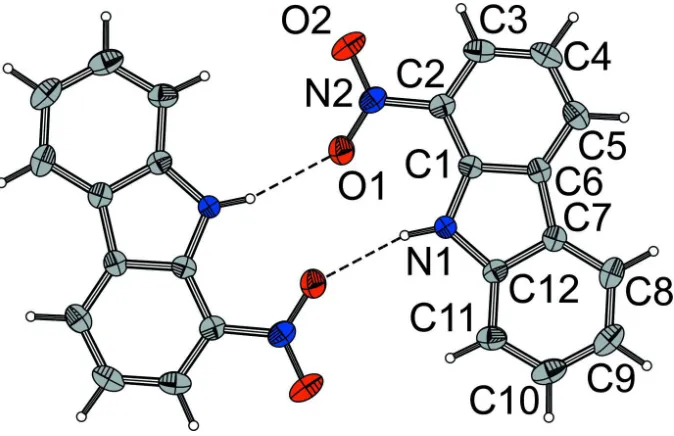
The molecules are connected via medium-strength N—H···O hydrogen bonds (N···O: 2.9940 (10) Å) to dimers with 1
symmetry (Fig. 1). The packing of the dimers, on the other hand, is solely controlled by van-der-Waals interactions. The
dimers are arranged into distinct crystallo-chemical layers parallel to (101), whereby adjacent dimers are related by the n
-glide (Fig. 2).
S2. Experimental
2-Bromo-N-(2-nitrophenyl)benzenamine (147 mg, 0.50 mmol, 1 eq.), K2CO3 (138 mg, 1 mmol, 2 eq.) and
(NHC)Pd(allyl)Cl (Marion et al., 2006) (6 mg, 10 µmol, 2 mol%) in DMAc (2.5 ml) were heated at 140 °C for 150 h in a
capped vial using a heating block. After cooling the reaction mixture was poured on water and extracted with Et2O. The
combined organic layers were dried over anhydrous Na2SO4 and concentrated under reduced pressure. Column
chromatography (light petroleum:CH2Cl2 75:25 → 60:40) yielded 1-nitro-9H-carbazole (18 mg, 0.08 mmol, 17%) as a
yellow solid. 1H NMR (200 MHz, CDCl
3): δ = 10.01 (bs, 1H), 8.37–8.31 (m, 2H), 8.10 (d, J=7.8 Hz, 1H), 7.60–7.50 (m,
2H), 7.39–7.26 (m, 2H) p.p.m.. 13C NMR (50 MHz, CDCl
3): δ = 139.7 (s), 133.7 (s), 132.1 (s), 127.7 (d), 127.5 (d), 127.4
(s), 122.2 (s), 121.9 (d), 121.2 (d), 120.6 (d), 118.7 (d), 111.6 (d) p.p.m.. Crystals suitable for single-crystal diffraction
were grown by slow evaporation of a CDCl3 solution.
S3. Refinement
The structure was refined against F values using the Jana2006 software package (Petříček et al., 2006). The non-H atoms
were located in the electron density map obtained by charge-flipping and refined with anisotropic displacement
Figure 1
Dimer of (I) molecules related by inversion and connected via N—O···H hydrogen bonds. C, N and O atoms are
represented by grey, blue and red ellipsoids drawn at the 75% probability level, H atoms by white spheres of arbitrary
Figure 2
The crystal structure of (I) viewed down [010]. Atoms are represented by spheres of arbitrary radius. Colour codes as in
Fig. 1.
1-Nitro-9H-carbazole
Crystal data
C12H8N2O2
Mr = 212.2 Monoclinic, P21/n
Hall symbol: -P 2yn
a = 10.4400 (3) Å
b = 5.3148 (2) Å
c = 17.2638 (6) Å
β = 99.7460 (16)°
V = 944.08 (6) Å3
Z = 4
F(000) = 440
Dx = 1.493 Mg m−3
Mo Kα radiation, λ = 0.71073 Å Cell parameters from 17802 reflections
θ = 2.4–30.1°
µ = 0.11 mm−1
T = 100 K Plate, dark yellow 0.76 × 0.42 × 0.20 mm
Data collection
Bruker Kappa APEXII CCD diffractometer
Radiation source: X-ray tube Graphite monochromator
ω and φ scans
Absorption correction: multi-scan (SADABS; Bruker, 2013)
Tmin = 0.95, Tmax = 0.98
Rint = 0.021
θmax = 30.2°, θmin = 2.1°
k = −7→7
l = −24→24
Refinement
Refinement on F R[F > 3σ(F)] = 0.040
wR(F) = 0.068
S = 1.89 2794 reflections 177 parameters 0 restraints
0 constraints
All H-atom parameters refined
Weighting scheme based on measured s.u.'s w = 1/(σ2(F) + 0.0009F2)
(Δ/σ)max = 0.015
Δρmax = 0.32 e Å−3
Δρmin = −0.21 e Å−3
Fractional atomic coordinates and isotropic or equivalent isotropic displacement parameters (Å2)
x y z Uiso*/Ueq
O1 0.89295 (6) 0.40415 (13) 0.03186 (4) 0.0210 (2) O2 0.72187 (8) 0.32391 (14) 0.08415 (4) 0.0262 (2) N1 0.94574 (7) 0.15206 (14) −0.09492 (4) 0.0148 (2) N2 0.79470 (7) 0.27907 (15) 0.03678 (4) 0.0172 (2) C1 0.84182 (8) 0.02688 (16) −0.07504 (5) 0.0136 (2) C2 0.76585 (8) 0.07065 (16) −0.01702 (5) 0.0155 (2) C3 0.66091 (8) −0.08542 (18) −0.01060 (5) 0.0190 (3) C4 0.62951 (9) −0.28368 (19) −0.06284 (6) 0.0210 (3) C5 0.70463 (9) −0.33376 (17) −0.12071 (6) 0.0184 (3) C6 0.81094 (8) −0.18269 (16) −0.12662 (5) 0.0145 (2) C7 0.90505 (8) −0.17966 (16) −0.17915 (5) 0.0148 (2) C8 0.92934 (10) −0.33696 (17) −0.24006 (5) 0.0193 (3) C9 1.03157 (10) −0.27687 (19) −0.27885 (6) 0.0226 (3) C10 1.10889 (9) −0.06296 (19) −0.25785 (6) 0.0222 (3) C11 1.08747 (9) 0.09238 (17) −0.19688 (6) 0.0187 (3) C12 0.98542 (8) 0.03034 (16) −0.15802 (5) 0.0145 (2) H11 1.1422 (11) 0.232 (3) −0.1779 (8) 0.028 (3)* H5 0.6817 (11) −0.477 (2) −0.1571 (7) 0.019 (3)* H4 0.5546 (13) −0.390 (2) −0.0614 (8) 0.027 (3)* H8 0.8730 (12) −0.480 (2) −0.2542 (8) 0.020 (3)* H9 1.0526 (14) −0.384 (3) −0.3211 (10) 0.039 (4)* H3 0.6077 (12) −0.069 (2) 0.0296 (8) 0.026 (3)* H10 1.1776 (11) −0.026 (2) −0.2858 (7) 0.018 (3)* Hn1 0.9851 (12) 0.275 (3) −0.0690 (9) 0.029 (3)*
Atomic displacement parameters (Å2)
U11 U22 U33 U12 U13 U23
C3 0.0138 (4) 0.0248 (5) 0.0187 (4) 0.0012 (3) 0.0033 (3) 0.0059 (3) C4 0.0158 (4) 0.0226 (5) 0.0242 (5) −0.0035 (3) 0.0018 (3) 0.0064 (4) C5 0.0177 (4) 0.0170 (4) 0.0187 (4) −0.0024 (3) −0.0017 (3) 0.0033 (3) C6 0.0149 (4) 0.0141 (4) 0.0135 (4) 0.0003 (3) −0.0005 (3) 0.0014 (3) C7 0.0163 (4) 0.0146 (4) 0.0127 (4) 0.0016 (3) 0.0007 (3) 0.0013 (3) C8 0.0246 (5) 0.0171 (4) 0.0151 (4) 0.0053 (3) −0.0001 (3) −0.0013 (3) C9 0.0279 (5) 0.0244 (5) 0.0160 (4) 0.0102 (4) 0.0053 (3) 0.0004 (3) C10 0.0237 (4) 0.0246 (5) 0.0201 (4) 0.0095 (4) 0.0089 (3) 0.0064 (3) C11 0.0177 (4) 0.0182 (4) 0.0215 (4) 0.0026 (3) 0.0067 (3) 0.0045 (3) C12 0.0152 (4) 0.0140 (4) 0.0144 (4) 0.0024 (3) 0.0030 (3) 0.0018 (3)
Geometric parameters (Å, º)
O1—N2 1.2372 (11) C5—C6 1.3875 (13) O2—N2 1.2305 (12) C5—H5 0.991 (11) N1—C1 1.3651 (12) C6—C7 1.4456 (13) N1—C12 1.3890 (12) C7—C8 1.3997 (13) N1—Hn1 0.857 (13) C7—C12 1.4068 (12) N2—C2 1.4442 (11) C8—C9 1.3898 (15) C1—C2 1.3984 (13) C8—H8 0.969 (13) C1—C6 1.4283 (12) C9—C10 1.4058 (14) C2—C3 1.3935 (13) C9—H9 0.981 (16) C3—C4 1.3897 (14) C10—C11 1.3854 (14) C3—H3 0.964 (15) C10—H10 0.951 (13) C4—C5 1.3962 (15) C11—C12 1.3914 (14) C4—H4 0.967 (13) C11—H11 0.960 (13)
D—H···A D—H H···A D···A D—H···A
N1—Hn1···O1i 0.857 (13) 2.159 (13) 2.9940 (10) 164.6 (14)
![Figure 2The crystal structure of (I) viewed down [010]. Atoms are represented by spheres of arbitrary radius](https://thumb-us.123doks.com/thumbv2/123dok_us/484129.546934/4.610.136.473.70.424/figure-crystal-structure-viewed-atoms-represented-spheres-arbitrary.webp)
