Received 20 December 2017 Accepted 15 March 2018
Edited by M. Weil, Vienna University of Technology, Austria
Keywords:crystal structure; ionic liquid; bis-triflimide; layered structure.
CCDC reference:1830211
Supporting information:this article has supporting information at journals.iucr.org/e
Cs[Tf
2N]: a second polymorph with a layered
structure
Jared T. Stritzinger,* Janelle E. Droessler, Brian L. Scott and George S. Goff
Materials Physics and Applications Division, Associate Directorate for Experimental Physical Sciences, Los Alamos National Laboratory, Los Alamos, New Mexico, 87545, USA. *Correspondence e-mail: [email protected]
The structural determination of the ionic liquid, caesium bis[(trifluorometh-yl)sulfonyl]imide or poly[[4-bis[(trifluoromethyl)sulfonyl]imido]caesium(I)], Cs[N(SO2CF3)2] or Cs[Tf2N], reveals a second polymorph that also crystallizes in a layer structure possessing monoclinicP21/csymmetry at 120 K instead of C2/cfor the known polymorph [Xueet al.(2002).Solid State Sci.4, 1535–1545]. The caesium ions in the cationic layers are coordinated by the sulfonyl groups of the bistriflimide molecules from anion layers while the trifluoromethyl groups are oriented in the opposite direction, forming a non-polar surface separating the layers. The layer direction is (100).
1. Chemical context
Recently, ionic liquids (IL) with melting points below 373 K, known as room temperature ionic liquids (RTIL), have emerged as a novel system that can be used to replace processes utilizing hazardous organic solvents and provide water-free environments (Welton, 1999). The exclusion of water from RTIL can be challenging as their ionic nature predisposes a hygroscopic nature, and even so-called hydro-phobic ILs can be difficult to dry (Francesco et al., 2011). Reducing the solubility of water is possible by exchanging constituent ions of the IL for those that are less hydrophilic, but this often results in higher melting points or increased viscosity (Francesco et al., 2011). The ability to change the physicochemical characteristics of ionic liquids has lead them to be praised as ‘tunable solvents’, but is often more of a challenging act of balancing physical properties.
The substitution of bis(trifluoromethyl)sulfonyl)imide (bistriflimide, Tf2N) as the anion in ILs offers a more hydro-phobic IL with lower melting point (Matsumotoet al., 2002; Sun et al., 1997). In general, anions of the triflate family are weakly coordinating when in the presence of other ligands, and interactions with metal ions may not be observed when in the presence of water. These weak interactions are due to the delocalization of charge across the molecule. The structure of bistriflimide also allows for multidentate coordination motifs when binding through the oxygen atoms, and often results in coordination of multiple metal cations. When Tf2N inter-actions expand beyond a single central metal atom, the ability to diffuse charge across a structure is highlighted (DesMar-teau, 1995).
Cs[Tf2N] has a desirably low melting point of 398 K which is outside the conventional definition of a RTIL; however, this melting point is in the range of many well-known ILs while
still being above the boiling point of water to enable con-venient drying (Hagiwara et al., 2008; Scheuermeyer et al., 2016). Previous reports of alkali metals and Tf2N include Cs[Tf2N], which presents as either an anhydrate or a variety of hydrates (Xueet al., 2002). Some common structural simila-rities can be observed across theA[Tf2N]nH2O (A= Li, Na, K, Rb, and Cs) series. The most notable feature is the formation of polar and non-polar regions that result from the coordination of multiple metal cations by the Tf2N ion. Each of the sulfonyl groups binds to a metal cation creating a polar chain that may extend to a layer, and orientates the tri-fluoromethyl groups to create non-polar surfaces. Within the series, only the structures of Cs and K salts as anhydrates have been reported.
Our synthesis and analysis of Cs[Tf2N] has revealed a second layered polymorph set in P21/c in addition to the previously reported structure inC2/c (Xueet al., 2002).
2. Structural commentary
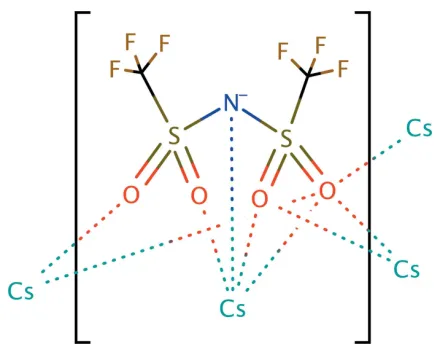
The structure develops from the various ways in which six Tf2N molecules coordinate the central 10-coordinate caesium cation (Fig. 1). The simplest coordination mode is mono-dentate, where one oxygen atom on one of the sulfonyl groups of the Tf2N molecule coordinates to the caesium cation. The bidentate coordination mode has two motifs. In end-on coordination, both oxygen atoms of a single sulfonyl group coordinate with Cs+, while in side-on coordination one oxygen on each of the sulfonyl groups within a Tf2N molecule coordinate with Cs+. Two of the six distinct Tf2N molecules exhibit the side-on coordination mode, and in one of them the nitrogen atom of the Tf2N molecule may come close enough to interact with the caesium cation. Examining the bond lengths in the coordination environment of the caesium cation, it is comprised of nine oxygen atoms ranging from 3.060 (2)– 3.539 (3) A˚ and one interaction with a nitrogen atom of 3.280 (3) A˚ . These three different modes of Tf2N binding join the caesium cations together in a complex sheet with layers of trifluoromethyl groups above and below (Fig. 1).
As the Tf2N molecule coordinates in the cis conformation, this orients the trifluoromethyl groups in the opposite
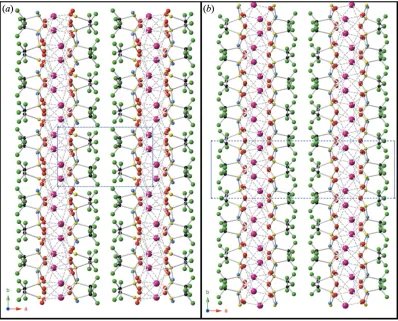
direc-tion from the sulfonyl groups creating a layer of fluorine atoms. With this layer, trifluoromethyl groups have an intra-molecular closest contact of 2.770 (4) A˚ and an intermolecular closest contact of 2.970 (4) A˚ . There is a fluorine–fluorine closest contact length of 3.01 A˚ spanning the void between the non-polar surfaces of adjacent sheets in the layered structure. These layers are easily observed parallel to (100), Fig. 2. Examining the bistriflimide molecule, the S—N—S bond angle is 127.60 (17) resulting in an intramolecular carbon–carbon
separation of 4.18 A˚ .
This structure of alternating layers of hydrophilic alkali metal cations bound by the sulfonyl groups and hydrophobic layers of trifluoromethyl groups closely matches the reported structures of K[Tf2N] and Cs[Tf2N] (Xue et al., 2002). The noted deviations are in the coordination environment of the Cs+cation. For the previously reported structure of Cs[Tf2N], the caesium coordination environment is also 10; however, the oxygen interactions are generally longer by about 0.05 A˚ , with Cs—O bonds ranging from 3.04 (1) to 3.65 (1) A˚ . The lone Cs—N bond is 3.39 (1) A˚ , which is considerably longer than the 3.280 (3) A˚ bond length observed in the current structure. This extension of bond lengths is reflected in the bistriflimide molecule where the S—N—S bond angle is contracted to 126.38 and the intramolecular carbon–carbon separation is shortened to 4.08 A˚ . As the molecule shifts, so does the orientation of the trifluoromethyl groups, resulting in an intramolecular closest contact of 2.72 A˚ and an intermolecular closest contact of 2.96 A˚ . The shift also extends to the void between the non-polar surface of adjacent sheets, where fluorine–fluorine closest contacts are observed at 2.69 A˚ spanning the void. While the void space between layers
552
Stritzingeret al. [Cs(C2F6NO4S2)] Acta Cryst.(2018). E74, 551–554
[image:2.610.317.561.72.264.2] [image:2.610.61.278.287.463.2]research communications
Figure 1
The coordination of the Cs+ cation by nine oxygen atoms and one
appears reduced, the overall structure has a calculated density of 2.58 g cm 3(Xueet al., 2002), less dense than the calculated 2.65 g cm 3of the more compact current structure.
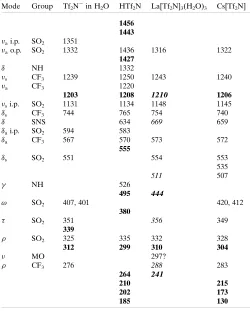
The Cs[Tf2N] purity was confirmed by melting point measurements that closely match literature values, showing an onset temperature of 397 K and complete melting at 399 K (Hagiwaraet al., 2008; Scheuermeyeret al., 2016). Additional Raman analysis (Fig. 3), shows a number of features that
[image:3.610.108.506.71.392.2]closely match the reported spectra for Tf2N in water and solid-state measurements made on HTf2N, confirming the presence of the Tf2N molecule (Reyet al., 1998). To elucidate bands that signify interactions with metal cations, a compar-ison to the reported Raman spectra of La[Tf2N]3(H2O)3 (Bhattet al., 2005) was made. The major bands and assign-ments of all compounds in the comparisons are reported in Table 1. The additional bands observed at 535 and 507 cm 1 for Cs[Tf2N] suggest multiple SO2bending modes associated with multiple coordination modes of Tf2N. In particular, the band at 507 cm 1for Cs[Tf2N] matches with a 511 cm 1band in La[Tf2N]3(H2O)3 suggesting a tentative assignment to a down-shift of the SO2bending mode by the bidentate side-on coordination of the Tf2N molecule, observed in both struc-tures.
3. Synthesis and crystallization
All reagents were used as received without further purifica-tion. 20.281 g of caesium carbonate (Alfa Aesar, 99.9%) were dissolved in 20 ml of deionized water. 26.26 ml of 4.74 molar bistriflimide acid (Alfa Aesar, 98.0%) were slowly added to the caesium carbonate solution, resulting in vigorous release of carbon dioxide. The solution was then placed in a sand bath at 403 K under stirring at approximately 100 rotations per Figure 2
Ball and stick model view along [001] showing the layer of the structure arising from the hydrophobic surfaces formed by orientation of the trifluoromethyl groups, comparing (a) the unit cell of the stucture discussed in the paper set inP21/cand (b) that of the previously reported structure set
inC2/c(Xueet al., 2002). Atoms are designated as caesium (purple), oxygen (red), sulfur (yellow), nitrogen (blue), carbon (black), and fluorine (green).
Figure 3
Raman spectra of Cs[Tf2N] with no other bands observed from 1400 cm 1
to 3200 cm 1. The additional bands at 535 and 507 cm 1 suggest the multiple SO2 bending modes associated with multiple coordination
[image:3.610.47.297.563.679.2]minute. After four h, the temperature was reduced to 378 K. While the liquid cooled, the stirring deposited droplets of the ionic liquid on the sides of the beaker resulting in rapid crystallization. These crystals were harvested and suitable crystals were selected for diffraction. Yield was estimated at 95% based on mass.
3.1. Experimental
Raman measurements were collected using a Thermo Scientific DXRxi Raman Imaging Microscope. A 532 nm laser was focused on the sample surface through a 10x objective providing a spot size of 1 um and the collection consisted of 200 scans at 10 mW for 0.25 seconds each.
Melting point data were collected on a Bu¨chi M-560, where two glass sample tubes were filled with 4–5mm of sample and the temperature was ramped at a rate of 0.5 K per minute.
4. Refinement
Crystal data, data collection and structure refinement details are summarized in Table 2.
Funding information
Funding for this research was provided by: National Nuclear Security Administration (NA-23).
References
Bhatt, A. I., May, I., Volkovich, V. A., Collison, D., Helliwell, M., Polovov, I. B. & Lewin, R. G. (2005).Inorg. Chem.44, 4934–4940. Bruker (2014). APEX2, SAINT-Plus and SADABS. Bruker AXS
Inc., Madison, Wisconsin, USA.
CrystalMaker (2013).CrystalMaker.CrystalMaker Software, Oxford-shire, UK.
DesMarteau, D. D. (1995).J. Fluor. Chem.72, 203–208.
Francesco, F. D., Calisi, N., Creatini, M., Melai, B., Salvo, P. & Chiappe, C. (2011).Green Chem.13, 1712–1717.
Hagiwara, R., Tamaki, K., Kubota, K., Goto, T. & Nohira, T. (2008).J. Chem. Eng. Data,53, 355–358.
Matsumoto, H., Kageyama, H. & Miyazaki, Y. (2002). Chem. Commun.pp. 1726–1727.
Rey, I., Johansson, P., Lindgren, J., Lasse`gues, J. C., Grondin, J. & Servant, L. (1998).J. Phys. Chem. A,102, 3249–3258.
Scheuermeyer, M., Kusche, M., Agel, F., Schreiber, P., Maier, F., Steinru¨ck, H.-P., Davis, J. H., Heym, F., Jess, A. & Wasserscheid, P. (2016).New J. Chem.40, 7157–7161.
Sheldrick, G. M. (2015a).Acta Cryst.A71, 3–8. Sheldrick, G. M. (2015b).Acta Cryst.C71, 3–8.
Sun, J., MacFarlane, D. R. & Forsyth, M. (1997).Ionics,3, 356–362. Welton, T. (1999).Chem. Rev.99, 2071–2084.
Xue, L., Padgett, C. W., DesMarteau, D. D. & Pennington, W. T. (2002).Solid State Sci.4, 1535–1545.
554
Stritzingeret al. [Cs(C2F6NO4S2)] Acta Cryst.(2018). E74, 551–554
[image:4.610.310.558.91.348.2]research communications
Table 1
Comparison of Raman modes in Tf2N compounds.
Comparison of observed Raman shifts in cm 1 from Tf
2N-containing
compounds. Band wavenumbers given in bold are unassigned and in italicized are from reanalysis of reported spectra for La[Tf2N]3(H2O)3. Major band
assignments are given with (stretching), (bending), ! (wagging),
(twisting) and(rocking) and planar designations are i.p. for in plane and o.p. for out of plane.
Mode Group Tf2N in H2O HTf2N La[Tf2N]3(H2O)3 Cs[Tf2N] 1456
1443
ai.p. SO2 1351
ao.p. SO2 1332 1436 1316 1322
1427
NH 1332
s CF3 1239 1250 1243 1240
a CF3 1220
1203 1208 1210 1206
si.p. SO2 1131 1134 1148 1145
s CF3 744 765 754 740
SNS 634 669 659
ai.p. SO2 594 583
a CF3 567 570 573 572
555
s SO2 551 554 553
535
511 507
NH 526
495 444
! SO2 407, 401 420, 412 380
SO2 351 356 349
339
SO2 325 335 332 328
312 299 310 304
MO 297?
CF3 276 288 283
264 241 210 215 202 173 185 130 Table 2 Experimental details. Crystal data
Chemical formula [Cs(C2F6NO4S2)]
Mr 413.06
Crystal system, space group Monoclinic,P21/c
Temperature (K) 120
a,b,c(A˚ ) 11.431 (4), 6.918 (2), 13.469 (4)
() 103.686 (4) V(A˚3) 1035.0 (5)
Z 4
Radiation type MoK
(mm 1) 4.07
Crystal size (mm) 0.400.350.33 Data collection
Diffractometer Bruker Photon 100
Absorption correction Multi-scan (SADABS; Bruker, 2014)
Tmin,Tmax 0.507, 0.746
No. of measured, independent and observed [I> 2(I)] reflections
12467, 2354, 1980
Rint 0.048
(sin/)max(A˚ 1) 0.650
Refinement
R[F2> 2(F2)],wR(F2),S 0.022, 0.058, 0.99 No. of reflections 2354
No. of parameters 145
max,min(e A˚ 3
) 0.84, 1.15
[image:4.610.44.294.154.465.2]sup-1 Acta Cryst. (2018). E74, 551-554
supporting information
Acta Cryst. (2018). E74, 551-554 [https://doi.org/10.1107/S2056989018004401]
Cs[Tf
2N]: a second polymorph with a layered structure
Jared T. Stritzinger, Janelle E. Droessler, Brian L. Scott and George S. Goff
Computing details
Data collection: APEX2 (Bruker, 2014); cell refinement: SAINT-Plus (Bruker, 2014); data reduction: SAINT-Plus (Bruker,
2014); program(s) used to solve structure: SHELXT2014 (Sheldrick, 2015a); program(s) used to refine structure:
SHELXL2014 (Sheldrick, 2015b); molecular graphics: CrystalMaker (CrystalMaker, 2013); software used to prepare material for publication: SHELXL2014 (Sheldrick, 2015b).
Poly[[µ4-bis[(trifluoromethyl)sulfonyl]imido]caesium(I)]
Crystal data [Cs(C2F6NO4S2)] Mr = 413.06 Monoclinic, P21/c a = 11.431 (4) Å b = 6.918 (2) Å c = 13.469 (4) Å β = 103.686 (4)° V = 1035.0 (5) Å3 Z = 4
F(000) = 768
Dx = 2.651 Mg m−3 Melting point: 399 K
Mo Kα radiation, λ = 0.71073 Å Cell parameters from 12467 reflections θ = 3.1–27.5°
µ = 4.07 mm−1 T = 120 K Block, colorless 0.40 × 0.35 × 0.33 mm
Data collection Bruker Photon 100
diffractometer
Radiation source: sealed tube Detector resolution: 0 pixels mm-1 0.5 wide w/exposures scans Absorption correction: multi-scan
(SADABS; Bruker, 2014) Tmin = 0.507, Tmax = 0.746
12467 measured reflections 2354 independent reflections 1980 reflections with I > 2σ(I) Rint = 0.048
θmax = 27.5°, θmin = 3.1° h = −14→14
k = −8→8 l = −17→17
Refinement Refinement on F2 Least-squares matrix: full R[F2 > 2σ(F2)] = 0.022 wR(F2) = 0.058 S = 0.99 2354 reflections 145 parameters
0 restraints w = 1/[σ2(F
o2) + (0.0256P)2 + 1.4815P] where P = (Fo2 + 2Fc2)/3
supporting information
sup-2 Acta Cryst. (2018). E74, 551-554
Special details
Experimental. Single crystal data for [Cs][Tf2N] were collected on a Bruker D8 Quest diffractometer, with CMOS detector in shutterless mode. The crystal was cooled to 100 K employing an Oxford Cryostream liquid nitrogen cryostat. The diffractometer was equipped with graphite monochromatized MoKa (λ= 0.71073 Å) radiation. A hemisphere of data was collected using omega scans and 0.5° frame widths. Data collection and initial indexing and cell refinement were handled using APEX II1 (Bruker, 2014)software. Frame integration, including Lorentz-polarization corrections, and final cell parameter calculations were carried out using SAINT+ software (Bruker, 2014). The data were corrected for
absorption using redundant reflections and the SADABS (Bruker, 2014)program. Decay of reflection intensity was not observed as monitored via analysis of redundant frames. The structure was solved using Direct methods and difference Fourier techniques.
Geometry. All esds (except the esd in the dihedral angle between two l.s. planes) are estimated using the full covariance matrix. The cell esds are taken into account individually in the estimation of esds in distances, angles and torsion angles; correlations between esds in cell parameters are only used when they are defined by crystal symmetry. An approximate (isotropic) treatment of cell esds is used for estimating esds involving l.s. planes.
Fractional atomic coordinates and isotropic or equivalent isotropic displacement parameters (Å2)
x y z Uiso*/Ueq
Cs1 −0.03866 (2) 0.63206 (3) 0.14267 (2) 0.01618 (7) S1 −0.19100 (7) 1.13281 (11) 0.03845 (6) 0.01796 (16) S2 −0.19461 (7) 0.61691 (11) 0.37165 (6) 0.01711 (16)
F3 −0.3349 (2) 1.3866 (4) 0.0842 (2) 0.0490 (7)
O1 −0.1407 (2) 1.0987 (4) 0.14485 (18) 0.0335 (6) F6 −0.4204 (2) 0.5355 (4) 0.29152 (18) 0.0473 (7)
F2 −0.4023 (2) 1.0936 (4) 0.0776 (2) 0.0523 (7)
F1 −0.4044 (2) 1.2485 (4) −0.06094 (18) 0.0451 (6) F5 −0.3425 (2) 0.7475 (4) 0.21036 (16) 0.0419 (6) O4 −0.1614 (2) 0.4598 (4) 0.31460 (17) 0.0282 (6)
F4 −0.3890 (2) 0.8228 (4) 0.3522 (2) 0.0512 (7)
N1 −0.2092 (3) 0.5687 (4) 0.48229 (19) 0.0198 (6) O2 −0.1390 (2) 1.2826 (4) −0.01035 (19) 0.0301 (6)
O3 −0.1285 (2) 0.7926 (4) 0.3755 (2) 0.0355 (6)
C2 −0.3470 (3) 0.6835 (6) 0.3026 (3) 0.0286 (8)
C1 −0.3433 (3) 1.2186 (5) 0.0345 (3) 0.0284 (8)
Atomic displacement parameters (Å2)
U11 U22 U33 U12 U13 U23
sup-3 Acta Cryst. (2018). E74, 551-554
N1 0.0249 (15) 0.0184 (13) 0.0154 (13) 0.0017 (11) 0.0034 (11) −0.0029 (10) O2 0.0414 (15) 0.0269 (13) 0.0266 (13) −0.0148 (11) 0.0170 (11) −0.0097 (10) O3 0.0315 (15) 0.0251 (13) 0.0462 (16) −0.0104 (11) 0.0019 (12) 0.0091 (12) C2 0.0229 (18) 0.0355 (19) 0.0259 (18) 0.0031 (15) 0.0029 (14) 0.0092 (15) C1 0.0284 (19) 0.0291 (19) 0.0257 (18) 0.0036 (15) 0.0022 (15) −0.0061 (14)
Geometric parameters (Å, º)
Cs1—O2i 3.060 (2) S2—N1 1.574 (3)
Cs1—O3ii 3.074 (3) S2—C2 1.829 (4)
Cs1—O1ii 3.110 (2) S2—Cs1vii 4.0548 (12)
Cs1—O4iii 3.174 (3) F3—C1 1.333 (4)
Cs1—O2iv 3.208 (2) F3—Cs1vi 3.703 (3)
Cs1—O4 3.207 (2) O1—Cs1iii 3.110 (2)
Cs1—N1v 3.280 (3) F6—C2 1.310 (5)
Cs1—O1 3.435 (3) F2—C1 1.314 (5)
Cs1—O3v 3.539 (3) F1—C1 1.326 (4)
Cs1—O3 3.694 (3) F5—C2 1.331 (4)
Cs1—F3iv 3.703 (3) O4—Cs1ii 3.175 (3)
Cs1—S2 3.9118 (12) F4—C2 1.326 (5)
S1—O1 1.432 (2) N1—S1vii 1.576 (3)
S1—O2 1.430 (3) N1—Cs1vii 3.280 (3)
S1—N1v 1.576 (3) O2—Cs1i 3.060 (2)
S1—C1 1.828 (4) O2—Cs1vi 3.208 (2)
S1—Cs1vi 3.9719 (12) O3—Cs1iii 3.074 (3)
S2—O3 1.426 (3) O3—Cs1vii 3.539 (3)
S2—O4 1.433 (2)
O2i—Cs1—O3ii 65.81 (8) O3—Cs1—S2 21.36 (4)
O2i—Cs1—O1ii 99.58 (7) F3iv—Cs1—S2 65.85 (4)
O3ii—Cs1—O1ii 74.33 (7) O1—S1—O2 117.87 (17)
O2i—Cs1—O4iii 54.48 (6) O1—S1—N1v 108.10 (16)
O3ii—Cs1—O4iii 97.22 (8) O2—S1—N1v 116.27 (14)
O1ii—Cs1—O4iii 66.20 (7) O1—S1—C1 103.70 (16)
O2i—Cs1—O2iv 87.52 (7) O2—S1—C1 104.35 (17)
O3ii—Cs1—O2iv 60.48 (7) N1v—S1—C1 104.86 (16)
O1ii—Cs1—O2iv 126.37 (7) O1—S1—Cs1vi 75.58 (12)
O4iii—Cs1—O2iv 141.95 (6) O2—S1—Cs1vi 48.47 (10)
O2i—Cs1—O4 162.97 (7) N1v—S1—Cs1vi 159.36 (11)
O3ii—Cs1—O4 99.20 (7) C1—S1—Cs1vi 93.60 (12)
O1ii—Cs1—O4 67.27 (7) O1—S1—Cs1 57.66 (12)
O4iii—Cs1—O4 123.62 (5) O2—S1—Cs1 126.74 (12)
O2iv—Cs1—O4 91.89 (7) N1v—S1—Cs1 52.89 (10)
O2i—Cs1—N1v 82.39 (7) C1—S1—Cs1 128.83 (13)
O3ii—Cs1—N1v 135.52 (7) Cs1vi—S1—Cs1 120.90 (3)
O1ii—Cs1—N1v 144.35 (7) O3—S2—O4 117.41 (17)
O4iii—Cs1—N1v 87.65 (7) O3—S2—N1 108.66 (16)
supporting information
sup-4 Acta Cryst. (2018). E74, 551-554
O4—Cs1—N1v 114.62 (7) O3—S2—C2 103.71 (17)
O2i—Cs1—O1 95.58 (7) O4—S2—C2 105.06 (17)
O3ii—Cs1—O1 159.64 (7) N1—S2—C2 103.49 (16)
O1ii—Cs1—O1 102.31 (7) O3—S2—Cs1 70.70 (12)
O4iii—Cs1—O1 63.81 (7) O4—S2—Cs1 50.92 (10)
O2iv—Cs1—O1 130.03 (7) N1—S2—Cs1 157.27 (11)
O4—Cs1—O1 97.80 (6) C2—S2—Cs1 98.57 (12)
N1v—Cs1—O1 42.47 (6) O3—S2—Cs1vii 59.03 (12)
O2i—Cs1—O3v 56.78 (7) O4—S2—Cs1vii 133.75 (11)
O3ii—Cs1—O3v 93.89 (6) N1—S2—Cs1vii 50.27 (10)
O1ii—Cs1—O3v 156.36 (7) C2—S2—Cs1vii 120.87 (13)
O4iii—Cs1—O3v 95.87 (6) Cs1—S2—Cs1vii 120.87 (3)
O2iv—Cs1—O3v 58.95 (7) C1—F3—Cs1vi 117.4 (2)
O4—Cs1—O3v 135.86 (7) S1—O1—Cs1iii 158.44 (17)
N1v—Cs1—O3v 41.69 (6) S1—O1—Cs1 101.72 (13)
O1—Cs1—O3v 81.53 (6) Cs1iii—O1—Cs1 85.77 (6)
O2i—Cs1—O3 142.43 (6) S2—O4—Cs1ii 135.68 (14)
O3ii—Cs1—O3 126.88 (6) S2—O4—Cs1 108.79 (12)
O1ii—Cs1—O3 59.74 (7) Cs1ii—O4—Cs1 88.69 (6)
O4iii—Cs1—O3 87.95 (6) S2—N1—S1vii 127.60 (17)
O2iv—Cs1—O3 130.02 (6) S2—N1—Cs1vii 108.07 (13)
O4—Cs1—O3 40.70 (6) S1vii—N1—Cs1vii 104.58 (12)
N1v—Cs1—O3 97.36 (7) S1—O2—Cs1i 144.39 (15)
O1—Cs1—O3 63.07 (6) S1—O2—Cs1vi 112.04 (12)
O3v—Cs1—O3 138.32 (6) Cs1i—O2—Cs1vi 92.48 (7)
O2i—Cs1—F3iv 131.63 (6) S2—O3—Cs1iii 169.31 (18)
O3ii—Cs1—F3iv 100.78 (7) S2—O3—Cs1vii 100.76 (13)
O1ii—Cs1—F3iv 122.16 (7) Cs1iii—O3—Cs1vii 86.11 (6)
O4iii—Cs1—F3iv 161.69 (6) S2—O3—Cs1 87.94 (13)
O2iv—Cs1—F3iv 49.29 (6) Cs1iii—O3—Cs1 81.90 (6)
O4—Cs1—F3iv 56.56 (7) Cs1vii—O3—Cs1 146.66 (8)
N1v—Cs1—F3iv 77.18 (7) F6—C2—F5 108.6 (3)
O1—Cs1—F3iv 97.90 (6) F6—C2—F4 109.1 (3)
O3v—Cs1—F3iv 79.67 (6) F5—C2—F4 109.1 (3)
O3—Cs1—F3iv 83.94 (6) F6—C2—S2 111.6 (3)
O2i—Cs1—S2 162.46 (5) F5—C2—S2 108.4 (2)
O3ii—Cs1—S2 116.76 (6) F4—C2—S2 110.0 (3)
O1ii—Cs1—S2 66.21 (6) F2—C1—F1 108.9 (3)
O4iii—Cs1—S2 108.62 (4) F2—C1—F3 109.5 (3)
O2iv—Cs1—S2 109.03 (5) F1—C1—F3 108.0 (3)
O4—Cs1—S2 20.30 (5) F2—C1—S1 111.0 (3)
N1v—Cs1—S2 103.02 (5) F1—C1—S1 111.0 (3)
O1—Cs1—S2 78.43 (4) F3—C1—S1 108.3 (3)
O3v—Cs1—S2 136.79 (5)