Effect of Oxygen Content on Microstructure and Mechanical Properties
of Biomedical Ti-29Nb-13Ta-4.6Zr Alloy under Solutionized and Aged Conditions
*Masaaki Nakai
1, Mitsuo Niinomi
1, Toshikazu Akahori
1, Harumi Tsutsumi
1and Michiharu Ogawa
21
Institute for Materials Research, Tohoku University, Sendai 980-8577, Japan
2Daido Steel Co., Ltd., Nagoya 457-8545, Japan
The effect of oxygen content on the microstructure and mechanical properties of the Ti-29 mass%Nb-13 mass%Ta-4.6 mass%Zr (TNTZ) alloy was investigated in this study. The microstructural observation of TNTZ alloys, containing 0.1–0.4 mass% oxygen, subjected to solution treatment shows the presence of a singlephase. With an increase in oxygen content, the hardness, tensile strength, and Young’s modulus of TNTZ alloy increase, but its elongation decreases. Further, thephase precipitates in TNTZ alloys subjected to aging treatment at 723 K for 259.2 ks. The results of transmission electron microscopy and X-ray diffraction analysis indicate that the size and volume fraction of thephase increase with oxygen content. Corresponding to the changes in the microstructure, the mechanical properties of TNTZ alloy subjected to aging treatment at 723 K change with oxygen content. The increase in oxygen content leads to enhancement of the age hardening of TNTZ alloy, thereby increasing both tensile strength and Young’s modulus of TNTZ alloy, but its elongation decreases due to the-phase precipitation. The mechanical properties of TNTZ alloy (Young’s modulus: around 60–100 GPa, tensile strength: around 600–1400 MPa, and elongation: around 5–25%) vary significantly depending on oxygen content and heat treatment. [doi:10.2320/matertrans.MA200904]
(Received April 20, 2009; Accepted June 1, 2009; Published July 15, 2009)
Keywords: biomaterial, titanium alloy, interstitial element, oxygen, Young’s modulus, tensile properties
1. Introduction
Recently, it has been reported that impurity elements found in practical metallic materials sometimes provide the beneficial effect on their properties.1–3) Titanium alloys normally contain oxygen, nitrogen, carbon, etc. as impurity elements. Although the concentration of these elements is considerably less, they significantly affect the properties of the alloys. The effect of oxygen, a strong-phase stabilizer, on the-transus temperature is around 7 times stronger than that of aluminum, which is also an -phase stabilizer.4)
Further, the aluminum equivalent of oxygen, which is used practically for estimation of -phase stability, is around 10 times higher than that of aluminum.5) Oxygen addition is
expected to cause solid-solution strengthening6,7) and to
improve mechanical functionality, such as shape memory effect and superelasticity.8) Moreover, the importance of oxygen for causing the unique characteristics of gum metal, a multifunctional titanium alloy, has been reported.9)
The authors have developed a biomedical titanium alloy, Ti-29 mass%Nb-13 mass%Ta-4.6 mass%Zr (TNTZ) alloy.10–15) The mechanical properties of the alloy can be
improved by heat treatment via precipitation strengthen-ing.12–14) However, further improvement of mechanical
properties of the alloy is required for putting into practical use. In this case, oxygen is one of the attractive elements, because the dissolution of oxygen in any constitutional phase is expected to lead to solid-solution strengthening and to enhance precipitation strengthening via phase stability changes. Therefore, in this study, the effect of oxygen content on the microstructure and mechanical properties of TNTZ alloy was investigated.
2. Experimental Procedure
2.1 Materials
In this study, three types of TNTZ alloys with different oxygen contents were prepared. The chemical compositions of these alloys are listed in Table 1. TNTZ alloys containing 0.1 mass%, 0.2 mass%, and 0.4 mass% oxygen are denoted by TNTZ0:1, TNTZ0:2, and TNTZ0:4, respectively. The
oxygen content was controlled by an appropriate addition of TiO2 during ingot making. The ingots were hot forged to
form circular bars with a diameter of around 20 mm. The oxygen content in the TNTZ alloy used in a previous study was 0.05–0.15 mass%,12–15) which corresponds to TNTZ0:1
used in this study.
2.2 Heat treatment
Figure 1 shows the schematic drawing of the heat treat-ment employed in this study. Because oxygen is one of the -phase stabilizers, the -transus temperature of the alloys increases with oxygen content. Therefore, the solution treatment temperature was set to 1063, 1073, and 1093 K for TNTZ0:1, TNTZ0:2, and TNTZ0:4, respectively. The solution
[image:1.595.304.550.373.432.2]treatment was carried out for 3.6 ks in vacuum, and the treatment was followed by ice water quenching. The optical microscopy observations of the TNTZ alloys subjected to solution treatment revealed an equiaxed grain structure with a grain diameter of around 25–30mm. Subsequently, the TNTZ alloys were subjected to aging treatment at 723 K for up to
Table 1 Chemical compositions of alloys used in this study (mass%).
Ti Nb Ta Zr O N
TNTZ0:1 Bal. 29.0 13.2 4.66 0.12 0.011
TNTZ0:2 Bal. 29.1 12.7 4.52 0.20 0.010
TNTZ0:4 Bal. 29.3 12.8 4.42 0.42 0.012
*This Paper was Originally Published in Japanese in J. Japan Inst. Metals
72(2008) 960–964.
Special Issue on Low Cost Reduction Processes, Roles of Low Cost Elements and Interstitial Elements, and Microstructural Control for Generalization of Titanium Alloys
259.2 ks in vacuum. The aging treatment was followed by ice water quenching.
2.3 Evaluation of aging property
Aging properties of TNTZ0:1, TNTZ0:2, and TNTZ0:4 at
723 K were evaluated by the Vickers hardness test. Disks with a diameter of 20 mm and a thickness of 5 mm were cut from the heat-treated bars. Subsequently, the surface of the disks was wet polished using emery papers of up to 1500 grit. Then, the Vickers hardness of the disks was measured by using a load of 1.96 N for a holding time of 15 s.
2.4 Microstructural observation
After TNTZ0:1, TNTZ0:2, and TNTZ0:4 were subjected to
solution treatment and aging treatment, the constitutional phases of these alloys were identified by X-ray diffraction (XRD) analysis. The specimens used for the XRD analysis were same as those used for the Vickers hardness test. The scanning angle range was 30–80, and the scanning rate was
1min 1. Cu-Kradiation was used at a voltage of 40 kV and a current of 30 mA.
Microstructures of TNTZ0:1, TNTZ0:2, and TNTZ0:4 that
were subjected to solution treatment and aging treatment were observed by transmission electron microscopy (TEM). Thin disks with a diameter of 3.0 mm and a thickness of 0.5 mm were machined by electron discharge method. The thickness of the disks was reduced to 0.1 mm by wet polishing using emery papers of up to 1500 grit. Then, the thinned disks were further polished to form thin foils by twin-jet electropolishing in a solution of 6 vol% perchloric acid, 34 vol% 1-butanol, and 60 vol% methanol. TEM observation was carried out at an accelerating voltage of 200 kV.
2.5 Mechanical tests
Mechanical properties of TNTZ0:1, TNTZ0:2, and TNTZ0:4
that were subjected to solution treatment and aging treatment were evaluated by tensile tests. The geometry of the tensile specimens used in the tests is shown in Fig. 2. The tensile specimens were machined from the heat-treated bars, and the specimen surface was wet polished using emery papers of up to 1500 grit. The tensile tests were carried out using an Instron-type machine with a cross head speed of
8:3310 6ms 1 in air, at room temperature. Load and
strain were measured using a load cell attached to the machine and a foil-type strain gage attached to the gage section of the specimens, respectively. The tensile strength, 0.2% proof stress, and Young’s modulus of the specimens were obtained from the tensile stress–strain curve. The elongation of the specimens was obtained by measuring the gage length of the specimens before and after the tensile tests.
3. Results and Discussion
[image:2.595.63.275.72.140.2]3.1 Aging property
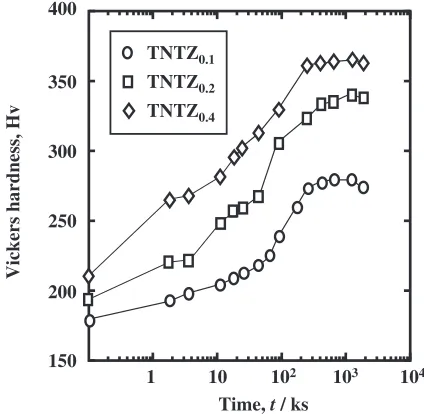
Figure 3 shows the age-hardening curves of TNTZ0:1,
TNTZ0:2, and TNTZ0:4 at 723 K. The values of the Vickers
hardness of TNTZ0:1, TNTZ0:2, and TNTZ0:4 before aging
treatment are 175, 191, and 214 Hv, respectively. This indicates that the hardness of the solutionized TNTZ alloys increases with the oxygen content. Further, the aging treatment at 723 K causes an increase in the hardness of the TNTZ alloys. The higher the oxygen content is, the higher the hardness of the aged TNTZ alloys is.
3.2 Microstructure
Figure 4 shows the XRD profiles of TNTZ0:1, TNTZ0:2,
and TNTZ0:4 after solution treatment. In all these profiles,
diffraction peaks of thephase are only detected. Therefore, it is considered the solutionized TNTZ alloys consist of a singlephase. Figure 5 shows the XRD profiles of TNTZ0:1,
TNTZ0:2, and TNTZ0:4subjected to aging treatment at 723 K
for 259.2 ks. In these profiles, peaks of the phase are detected in addition to those of the phase. Further, the profile of TNTZ0:4shows sharp peaks of thephase, and the
peak intensity of the phase decreases with a decrease in oxygen content. Because the peak intensity corresponds to the amount of second phase precipitated in the matrix, the
Solution treatment: at each temperature for 3.6 ks
(TNTZ0.1: 1063 K, TNTZ0.2: 1073 K, TNTZ0.4: 1093 K)
βtransus
Water quenching
Aging treatment: at 723 K for various time intervals
Water quenching
Fig. 1 Schematic drawing of heat treatment employed in this study.
3.0
R10
12
50 t = 1.0
(Unit: mm)
Fig. 2 Schematic drawing of specimen used for tensile test.
150 200 250 300 350 400
1 10 102 103 104
Time, t / ks
Vickers hardness, Hv
TNTZ0.1
TNTZ0.2
TNTZ0.4
Fig. 3 Vickers hardness of TNTZ0:1, TNTZ0:2, and TNTZ0:4as a function
[image:2.595.343.506.76.175.2] [image:2.595.320.532.219.426.2]volume fraction of the phase precipitated during aging treatment may increase with an increase in the oxygen content in TNTZ alloy.
Figure 6 shows bright-field images (BF), selected area electron diffraction patterns (SAD), and key diagrams (KD) of TNTZ0:1, TNTZ0:2, and TNTZ0:4 after aging treatment,
obtained by TEM observations. In every BF, lath-shaped second phases are observed. The second phase coarsens with the increase in oxygen content; the average lath widths
in the case of TNTZ0:1, TNTZ0:2, and TNTZ0:4 are around
29, 33, and 45 nm, respectively. The SAD analysis of the specimens reveals the diffraction pattern of the phase in addition to that of thephase. Therefore, the second phase is identified to be thephase. Consequently, from the results of XRD analysis and TEM observation, it is summarized that oxygen plays a role in promoting the precipitation of the
phase in TNTZ alloy during aging treatment carried out at 723 K.
30 40 50 60 70 80
Diffraction angle, 2θ/ degree : βphase
TNTZ0.1 TNTZ0.2 TNTZ0.4
Intensity (a. u.)
β
(110)
β
(200) β
(211)
Fig. 4 XRD profiles of TNTZ0:1, TNTZ0:2, and TNTZ0:4 after solution
treatments at 1063, 1073, and 1093 K, respectively, for 3.6 ks.
30 40 50 60 70 80
Diffraction angle, 2θ/ degree
: ββphase
: ααphase
TNTZ0.2 TNTZ0.4
Intensity (a. u.)
TNTZ0.1
β
(110)
β
(200) β(211)
α
(10·0) α
(10·1)
α
(10·2)
α
(11·2)
Fig. 5 XRD profiles of TNTZ0:1, TNTZ0:2, and TNTZ0:4 after aging
treatment at 723 K for 259.2 ks.
(a)
(b)
(c)
: βphase : αphase
: βphase : αphase
: βphase : αphase
200 nm
200 nm
BF
SAD
KD
200 nm
Fig. 6 TEM micrographs showing BF, SAD, and KD of (a) TNTZ0:1, (b) TNTZ0:2, and (c) TNTZ0:4after aging treatment at 723 K for
[image:3.595.64.276.71.251.2] [image:3.595.318.533.72.253.2] [image:3.595.85.508.307.631.2]3.3 Mechanical properties
[image:4.595.62.277.72.208.2]3.3.1 Young’s modulus
Figure 7 shows the Young’s moduli of TNTZ0:1, TNTZ0:2,
and TNTZ0:4 after solution treatment and aging treatment.
As a reference, the Young’s modulus of the Ti-6Al-4V ELI alloy, conforming to the ASTM F136 standard,16) is also
shown in this figure. The Young’s modulus of every TNTZ alloy is below 100 GPa. This value is closer to the Young’s modulus of human bones than that of the Ti-6Al-4V ELI alloy. The Young’s modulus of the solutionized TNTZ alloys increases with oxygen content. The microstructural observa-tion of the soluobserva-tionized TNTZ alloys reveals the presence of a single phase. Therefore, the increase in the Young’s modulus of the solutionized TNTZ alloys can be attributed to the oxygen dissolution in thephase. On the other hand, the Young’s modulus of the TNTZ alloys increases after aging treatment. Further, the TNTZ alloys with high oxygen content exhibit high Young’s modulus. The microstructural observation of these alloys reveals coarsening of thephase and an increase in the volume fraction of thephase with the increase in oxygen content. Therefore, the increase in the Young’s modulus of the aged TNTZ alloys probably depends on the size and/or the amount of thephase present in the
phase. However, the distribution of oxygen dissolved in the
phase and/orphase and its effect on the Young’s modulus of each constitutional phase is still not clear in this study.
3.3.2 Tensile properties
Figure 8 shows the tensile strengths, 0.2% proof stresses, and elongations of TNTZ0:1, TNTZ0:2, and TNTZ0:4
sub-jected to solution treatment and aging treatment. With the increase in oxygen content, the tensile strength and 0.2% proof stress of the solutionized TNTZ alloys increase, but their elongation decreases. Further, the change of tensile properties of the aged TNTZ alloys depending on oxygen content is found to be similar to that of the solutionized TNTZ alloys; with the increase in oxygen content, the tensile strength and 0.2% proof stress of the aged TNTZ alloys increase, but their elongation decreases. The dependence of the tensile properties of the solutionized and aged TNTZ alloys on oxygen content can be attributed to solid-solution strengthening and precipitation strengthening, respectively. However, the tensile properties of the aged TNTZ alloys are likely to be affected by oxygen dissolution in the
phase and/orphase. Therefore, a detailed investigation of solid-solution strengthening after aging treatment has to be carried out.
Figure 9 shows the balance between tensile strengths and elongations of solutionized and aged TNTZ0:1, TNTZ0:2, and
TNTZ0:4. As a reference, the tensile strength and elongation
of the Ti-6Al-4V ELI alloy, conforming to the ASTM F136 standard,16)are also shown in this figure. Although the tensile
strength of the solutionized TNTZ alloys is similar to or less than that of the Ti-6Al-4V ELI alloy, the elongation of the former is larger than that of the latter. On the other hand, the elongation of the aged TNTZ alloys is similar to or less than that of the Ti-6Al-4V ELI alloy, but the tensile strength of the former is higher than that of the latter. Further, as mentioned previously (Fig. 8), in the case of both solutionized and aged TNTZ alloys, their tensile strength increases while their elongation decreases with the increase in oxygen content. Thus, in the case of the TNTZ alloys, the balance between tensile strength and elongation changes significantly depend-ing on oxygen content. Therefore, the tensile strength and elongation of TNTZ alloys containing a certain amount of
0 20 40 60 80 100 120 Solutionized TNTZ0.1 Young’s modulus, E / GPa Solutionized TNTZ0.2 Solutionized TNTZ0.4 Aged TNTZ0.1 Aged TNTZ0.4 Aged TNTZ0.2
Ti-6Al-4V ELI (ASTM F136)
Fig. 7 Young’s moduli of TNTZ0:1, TNTZ0:2, and TNTZ0:4subjected to
solution treatments at 1063, 1073, and 1093 K, respectively, for 3.6 ks and aging treatment at 723 K for 259.2 ks after solution treatments.
Elongation (%)
0.2 % proof stress,
σσ0.2 / MPa Tensile strength, σB / MPa 0 5 15 10 20 25 35 0 200 600 400 800 1000 1400 1200
0.2% Proof stress Tensile strength Elongation 1600 40 30 Solutionized TNTZ0.1 Solutionized TNTZ0.2 Solutionized TNTZ0.4 Aged TNTZ0.1 Aged TNTZ0.4 Aged TNTZ0.2
Fig. 8 Tensile properties of TNTZ0:1, TNTZ0:2, and TNTZ0:4subjected to
solution treatments at 1063, 1073, and 1093 K, respectively, for 3.6 ks and aging treatment at 723 K for 259.2 ks after solution treatments.
0 5 10 15 20 25 30 35
0 200 400 600 800 1000 1200 1400 1600 Ti-6Al-4V ELI (ASTM F136)
Solutionized TNTZ0.1
Solutionized TNTZ0.2
Solutionized TNTZ0.4
Aged TNTZ0.4
Aged TNTZ0.2
Aged TNTZ0.1
Elongation (%)
Tensile strength,
σσB
/ MPa
Fig. 9 Balance between tensile strengths and elongations of TNTZ0:1,
TNTZ0:2, and TNTZ0:4subjected to solution treatments at 1063, 1073, and
[image:4.595.319.533.76.208.2] [image:4.595.319.533.266.471.2]oxygen can be controlled by heat treatment over a relatively wide range of around 600–1400 MPa and around 5–25%, respectively, as their Young’s modulus below that of the Ti-6Al-4V ELI alloy, i.e., within the range of 60–100 GPa is maintained.
4. Conclusions
The effect of oxygen content on the microstructure and mechanical properties of the Ti-29Nb-13Ta-4.6Zr (TNTZ) alloy was investigated in this study. The following results were obtained.
(1) The Young’s modulus, tensile strength, and 0.2% proof stress of solutionized TNTZ alloys increase while their elongation decreases with an increase in oxygen content; these changes can be attributed to oxygen dissolution in thephase.
(2) Thephase precipitates in the TNTZ alloys, containing 0.1–0.4 mass% oxygen, subjected to aging treatment at 723 K for 259.2 ks. The phase coarsens and its volume fraction increases with the increase in oxygen content in TNTZ alloy.
(3) With the increase in oxygen content, the Young’s modulus, tensile strength, and 0.2% proof stress of the TNTZ alloys subjected to aging treatment at 723 K for 259.2 ks increase, while their elongation decreases; these changes can be attributed to the -phase precip-itation although the effect of oxygen dissolution on the properties of constitutional phase is still not clear. (4) Mechanical properties of TNTZ alloys can be
con-trolled over a wide range (Young’s modulus: around 60–100 GPa, tensile strength: around 600–1400 MPa, and elongation: around 5–25%) by subjecting the alloy to heat treatment and changing its oxygen content.
Acknowledgments
This work was supported in part by the Global COE Program ‘‘Materials Integration International Center of Education and Research, Tohoku University’’, Ministry of
Education, Culture, Sports, Science and Technology (MEXT) of Japan, the Inter-university Cooperative Research Program ‘‘Highly-functional Interface Science: Innovation of Biomaterials with Highly-functional Interface to Host and Parasite, Tohoku University and Kyushu University’’, MEXT of Japan, the Industrial Technology Research Grant Program in 2009 from the New Energy and Industrial Technology Development Organization (NEDO) of Japan, and the cooperative research program of the Advanced Research Center of Metallic Glasses, Institute for Materials Research, Tohoku University, Japan.
REFERENCES
1) M. Morinaga, Y. Murata, R. Hashizume and Y. Sawaragi: ISIJ Int.41
(2001) 314–316.
2) M. Nakai, Y. Murata, M. Morinaga and Y. Sasaki: Mater. Trans.45
(2004) 865–869.
3) M. Nakai, K. Nagai, Y. Murata, M. Morinaga, S. Matsuda and M. Kanno: Mater. Trans.46(2005) 69–73.
4) C. Ouchi:Metallurgy and Technology of Practical Titanium Alloys, ed. by S. Fujishiro, D. Eylon and T. Kishi (TMS, Warrendale, PA, 1994) pp. 37–44.
5) R. Boyer, G. Welsch and E. W. Collings: Materials Properties Handbook: Titanium alloys, (ASM Int., Materials Park, OH, 1994) p. 10.
6) H. Fujii, S. Soeda, M. Hanaki and H. Okano:Titanium ’95 Science and Technology, ed. by P. A. Blenkinsop, W. J. Evans and H. M. Flower (TIM, London, 1996) pp. 2309–2316.
7) H. Fujii: Titanium JPN51(2003) 33–37.
8) J. I. Kim, H. Y. Kim, H. Hosoda and S. Miyazaki: Mater. Trans.46
(2005) 852–857.
9) T. Saitoet al.: Science300(2003) 464–467.
10) D. Kuroda, M. Niinomi, M. Morinaga, Y. Kato and T. Yashiro: Mater. Sci. Eng. A243(1998) 244–249.
11) M. Niinomi, T. Hattori, K. Morikawa, T. Kasuga, A. Suzuki, H. Fukui and S. Niwa: Mater. Trans.43(2002) 2970–2977.
12) M. Niinomi: Biomater.24(2003) 2673–2683.
13) T. Akahori, M. Niinomi, H. Fukui, M. Ogawa and H. Toda: Mater. Sci. Eng. C25(2005) 248–254.
14) T. Akahori, M. Niinomi, K. Ishimizu, H. Fukui and A. Suzuki: J. Japan Inst. Metals67(2003) 652–660.
15) M. Nakai, M. Niinomi, T. Akahori, H. Tsutsumi, X. Feng and M. Ogawa: Mater. Trans.50(2009) 423–426.