Experiments with Semi-Supervised and
Unsupervised Learning
Ekaterina Shutova
∗ University of CambridgeLin Sun
∗∗Greedy Intelligence
Elkin Dar´ıo Guti´errez
†University of California, San Diego
Patricia Lichtenstein
‡ University of California, MercedSrini Narayanan
§ Google ResearchHighly frequent in language and communication, metaphor represents a significant challenge for Natural Language Processing (NLP) applications. Computational work on metaphor has traditionally evolved around the use of hand-coded knowledge, making the systems hard to scale. Recent years have witnessed a rise in statistical approaches to metaphor processing. How-ever, these approaches often require extensive human annotation effort and are predominantly evaluated within a limited domain. In contrast, we experiment with weakly supervised and unsupervised techniques—with little or no annotation—to generalize higher-level mechanisms of metaphor from distributional properties of concepts. We investigate different levels and types of supervision (learning from linguistic examples vs. learning from a given set of metaphorical mappings vs. learning without annotation) in flat and hierarchical, unconstrained and con-strained clustering settings. Our aim is to identify the optimal type of supervision for a learning algorithm that discovers patterns of metaphorical association from text. In order to investigate
∗Computer Laboratory, William Gates Building, Cambridge CB3 0FD, UK. E-mail:[email protected]. ∗∗Greedy Intelligence Ltd, Hangzhou, China. E-mail:[email protected].
†Department of Cognitive Science, 9500 Gilman Dr, La Jolla, CA 92093, USA. E-mail:[email protected]. ‡Department of Cognitive and Information Sciences, UC Merced, 5200 Lake Rd Merced, CA 95343, USA.
E-mail:[email protected].
§Google, Brandschenkestrasse 110, 8002 Zurich, Switzerland. E-mail:[email protected].
Submission received: 28 September 2015; revised version received: 19 February 2016; accepted for publication: 29 May 2016.
the scalability and adaptability of our models, we applied them to data in three languages from different language groups—English, Spanish, and Russian—achieving state-of-the-art results with little supervision. Finally, we demonstrate that statistical methods can facilitate and scale up cross-linguistic research on metaphor.
1. Introduction
Metaphor brings vividness, distinction, and clarity to our thought and communica-tion. At the same time, it plays an important structural role in our cognition, helping us to organize and project knowledge (Lakoff and Johnson 1980; Feldman 2006) and guide our reasoning (Thibodeau and Boroditsky 2011). Metaphors arise from system-atic associations between distinct, and seemingly unrelated, concepts. For instance, when we talk about “theturning wheelsof a political regime,” “rebuildingthe campaign machinery” or “mendingforeign policy,” we viewpoliticsandpolitical systemsin terms of mechanisms—they canfunction, break, be mended, have wheels, and so forth. The existence of this association allows us to transfer knowledge and inferences from the domain of mechanisms to that of political systems. As a result, we reason about political systemsin terms ofmechanismsand discuss them using themechanismterminology in a variety of metaphorical expressions. The view of metaphor as a mapping between two distinct domains was echoed by numerous theories in the field (Black 1962; Hesse 1966; Lakoff and Johnson 1980; Gentner 1983). The most influential of these was the Conceptual Metaphor Theory of Lakoff and Johnson (1980). Lakoff and Johnson claimed that metaphor is not merely a property of language, but rather a cognitive mechanism that structures our conceptual system in a certain way. They coined the term concep-tual metaphor to describe the mapping between the target concept (e.g., politics) and the source concept (e.g., mechanism), andlinguistic metaphor to describe the resulting metaphorical expressions. Other examples of common metaphorical mappings include: TIME IS MONEY(e.g., “That flat tirecostme an hour”);IDEAS ARE PHYSICAL OBJECTS (e.g., “I can not grasp his way of thinking”); VIOLENCE IS FIRE (e.g., “violence flares amid curfew”);EMOTIONS ARE VEHICLES(e.g., “[...] she wastransportedwith pleasure”); FEELINGS ARE LIQUIDS(e.g., “[...] all of thisstirredan unfathomable excitement in her”); LIFE IS A JOURNEY (e.g., “Hearrived at the end of his life with very little emotional baggage”).
Manifestations of metaphor are pervasive in language and reasoning, making its computational processing an imperative task within Natural Language Processing (NLP). Explaining up to 20% of all word meanings according to corpus studies (Shutova and Teufel 2010; Steen et al. 2010), metaphor is currently a bottleneck, particularly in semantic tasks. An accurate and scalable metaphor processing system would become an important component of many practical NLP applications. These include, for instance, machine translation (MT): A large number of metaphorical expressions are culture-specific and therefore represent a considerable challenge in translation (Sch¨affner 2004; Zhou, Yang, and Huang 2007). Shutova, Teufel, and Korhonen (2013) conducted a study of metaphor translation in MT. Using Google Translate,1 a state-of-the-art MT system, they found that as many as 44% of metaphorical expressions in their data set were translated incorrectly, resulting in semantically infelicitous sentences. A metaphor
processing component could help to avoid such errors. Other applications of metaphor processing include, for instance, opinion mining: metaphorical expressions tend to contain a strong emotional component (e.g., compare the metaphor “Government loos-ened its strangleholdon business” and its literal counterpart “Government deregulated business” [Narayanan 1999]); or information retrieval: non-literal language without appropriate disambiguation may lead to false positives in information retrieval (e.g., documents describing “old school gentlemen” should not be returned for the query “school” [Korkontzelos et al. 2013]); and many others.
Because the metaphors we use are also known to be indicative of our under-lying viewpoints, metaphor processing is likely to be fruitful in determining political affiliation from text or pinning down cross-cultural and cross-population differences, and thus become a useful tool in data mining. In social science, metaphor is exten-sively studied as a way to frame cultural and moral models, and to predict social choice (Landau, Sullivan, and Greenberg 2009; Thibodeau and Boroditsky 2011; Lakoff and Wehling 2012). Metaphor is also widely viewed as a creative tool. Its knowl-edge projection mechanisms help us to grasp new concepts and generate innovative ideas. This opens many avenues for the creation of computational tools that foster creativity (Veale 2011, 2014) and support assessment in education (Burstein et al. 2013).
Our methods use distributional clustering techniques to investigate how meta-phorical cross-domain mappings partition the semantic space in three different languages—English, Russian, and Spanish. In a distributional semantic space, each word is represented as a vector of contexts in which it occurs in a text corpus.2 Because of the high frequency and systematicity with which metaphor is used in language, it is naturally and systematically reflected in the distributional space. As a result of metaphorical cross-domain mappings, the words’ context vectors tend to be non-homogeneous in structure and to contain vocabulary from different domains. For instance, the context vector for the nounideawould contain a set of literally used terms (e.g.,understand[an idea]) and a set of metaphorically used terms, describingideas asPHYSICAL OBJECTS(e.g.,grasp[an idea],throw[an idea]),LIQUIDS(e.g., [ideas]flow), orFOOD(e.g.,digest[an idea]), and so on. Similarly, the context vector forpoliticswould contain MECHANISM terms (e.g.,operate orrefuel [politics]),GAME terms (e.g.,playor dominate[politics]),SPACEterms (e.g.,enterorleave[politics]), as well as the literally used terms (e.g., explainor understand [politics]), as shown in Figure 1. This demonstrates how metaphorical usages, abundant in the data, structure the distributional space. As a result, the context vectors of different concepts contain a certain degree of cross-domain overlap, thus implicitly encoding cross-cross-domain mappings. Figure 1 shows such a term overlap in the direct object vectors for the concepts ofGAMEand POLITICS. We exploit such composition of the context vectors to induce information about metaphori-cal mappings directly from the words’ distributional behavior in an unsupervised or a minimally supervised way. We then use this information to identify metaphorical language. Clustering methods model modularity in the structure of the semantic space, and thus naturally provide a suitable framework to capture metaphorical information. To our knowledge, the metaphorical cross-domain structure of the distributional space has not yet been explicitly exploited in wider NLP. Instead, most NLP approaches tend to treat all types of distributional features as identical, thus possibly losing important conceptual information that is naturally encoded in the distributional semantic space.
The focus of our experiments is on the identification of metaphorical expressions in verb–subject and verb–object constructions, where the verb is used metaphorically. In the first set of experiments, we apply a flat clustering algorithm, spectral clustering (Ng et al. 2002), to learn metaphorical associations from text. The system clusters verbs and nouns to create representations of source and target domains. The verb clustering is used to harvest source domain vocabulary and the noun clustering is used to identify groups of target concepts associated with the same source. For instance, the nouns democracy and marriage are clustered together (in the target noun cluster), because both are metaphorically associated with (for example) mechanisms or games and, as such, appear with mechanismand game terms in the corpus (the source verb cluster). The obtained clusters represent source and target concepts between which metaphorical associations hold. We first experiment with the unconstrained version of spectral clustering using the method of Shutova, Sun, and Korhonen (2010), where metaphorical patterns are derived from the distributional information alone and the clustering process is fully unsupervised. We then extend this method to perform con-strained clustering, where a small number of example metaphorical mappings are used to guide the learning process, with the expectation of changing the cluster structure towards capturing metaphorically associated concepts. We then analyze and compare
N: game N: politics
1170play 31dominate
202win 30play
99 miss 28enter
76 watch 16discuss
66lose 13leave
63 start 12understand
42 enjoy 8study
22 finish 6explain
... 5shape
20dominate 4influence
18 quit 4change
17 host 4analyse
17 follow ...
17 control 2transform
[image:5.486.58.364.62.244.2]... ...
Figure 1
Context vectors forgameandpolitics(verb–direct object relations) extracted from the British National Corpus. The context vectors demonstrate how metaphor structures the distributional semantic space through cross-domain vocabulary projection.
the structure of the clusters obtained with or without the use of constraints. The learning of metaphorical associations is then boosted from a small set of example metaphorical expressions that are used to connect the verb and noun clusters. Finally, the acquired set of associations is used to identify new, unseen metaphorical expressions in a large corpus.
Although we believe that these methods would capture a substantial amount of information about metaphorical associations from distributional properties of concepts, they are still dependent on the seed expressions to identify new metaphorical language. In our second set of experiments, we investigate to what extent it is possible to ac-quire information about metaphor from distributional properties of concepts alone, without any need for labeled examples. For this purpose, we apply the hierarchical clustering method of Shutova and Sun (2013) to identify both metaphorical associations and metaphorical expressions in a fully unsupervised way. We use hierarchical graph factorization clustering (Yu, Yu, and Tresp 2006) of nouns to create a network (or a graph) of concepts and to quantify the strength of association between concepts in this graph. The metaphorical mappings are then identified based on the association patterns between concepts in the graph. The mappings are represented as cross-level, one-directional connections between clusters in the graph. The system then uses salient features of the metaphorically connected clusters to identify metaphorical expressions in text. Given a source domain, the method outputs a set of target concepts associated with this source, as well as the corresponding metaphorical expressions.
systems, and demonstrate that statistical methods can facilitate and scale up cross-linguistic research on metaphor.
2. Related Work
2.1 Metaphor Annotation Studies
Metaphor annotation studies have typically been corpus-based and involved either continuous annotation of metaphorical language (i.e., distinguishing between literal and metaphorical uses of words in a given text), or search for instances of a specific metaphor in a corpus and an analysis thereof. The majority of corpus-linguistic studies were concerned with metaphorical expressions and mappings within a limited domain, for example,WAR,BUSINESS,FOOD, orPLANTmetaphors (Santa Ana 1999; Izwaini 2003; Koller 2004; Skorczynska Sznajder and Pique-Angordans 2004; Hardie et al. 2007; Lu and Ahrens 2008; Low et al. 2010), or in a particular genre or type of discourse, such as financial (Charteris-Black and Ennis 2001; Martin 2006), political (Lu and Ahrens 2008), or educational (Cameron 2003; Beigman Klebanov and Flor 2013) discourse.
Two studies (Steen et al. 2010; Shutova and Teufel 2010) moved away from in-vestigating particular domains to a more general study of how metaphor behaves in unrestricted continuous text. Steen and colleagues (Pragglejaz Group 2007; Steen et al. 2010) proposed a metaphor identification procedure (MIP), in which every word is tagged as literal or metaphorical, based on whether it has a “more basic meaning” in other contexts than the current one. The basic meaning was defined as “more concrete; related to bodily action; more precise (as opposed to vague); historically older” and its identification was guided by dictionary definitions. The resulting VU Amsterdam Metaphor Corpus3 is a 200,000-word subset of the British National Corpus (BNC) (Burnard 2007) annotated for linguistic metaphor. The corpus has already found ap-plication in computational metaphor processing research (Dunn 2013b; Niculae and Yaneva 2013; Beigman Klebanov et al. 2014), as well as inspiring metaphor annotation efforts in other languages (Badryzlova et al. 2013). Shutova and Teufel (2010) extended MIP to the identification of conceptual metaphors along with the linguistic ones. Following MIP, the annotators were asked to identify the more basic sense of the word, and then label the context in which the word occurs in the basic sense as the source domain, and the current context as the target. Shutova and Teufel’s corpus is a 13,000-word subset of the BNC sampling a range of genres, and it has served as a testbed in a number of computational experiments (Shutova 2010; Shutova, Sun, and Korhonen 2010; Bollegala and Shutova 2013).
L ¨onneker (2004) investigated metaphor annotation in lexical resources. The result-ing Hamburg Metaphor Database contains examples of metaphorical expressions in German and French, which are mapped to senses from EuroWordNet4 and annotated with source-target domain mappings.
2.2 Computational Approaches to Metaphor Identification
Early computational work on metaphor tended to be theory-driven and utilized hand-coded descriptions of concepts and domains to identify and interpret metaphor.
The system of Fass (1991), for instance, was an implementation of the selectional preference violation view of metaphor (Wilks 1978) and detected metaphor and meto-nymy as a violation of a common preference of a predicate by a given argument. Another branch of approaches (Martin 1990; Narayanan 1997; Barnden and Lee 2002) implemented some aspects of the conceptual metaphor theory (Lakoff and Johnson 1980), reasoning over hand-crafted representations of source and target domains. The system of Martin (1990) explained linguistic metaphors through finding the correspond-ing metaphorical mappcorrespond-ing. The systems of Narayanan (1997) and Barnden and Lee (2002) performed inferences about entities and events in the source and target domains in order to interpret a given metaphor. The reasoning processes relied on manually coded knowledge about the world and operated mainly in the source domain. The results were then projected onto the target domain using the conceptual mapping representation.
The reliance on task- and domain-specific hand-coded knowledge makes these systems difficult to scale to real-world text. Later research thus turned to general-domain lexical resources and ontologies, as well as statistical methods, in order to design more scalable solutions. Mason (2004) introduced the use of statistical techniques for metaphor processing; however, his approach had a considerable reliance on Word-Net (Fellbaum 1998). His CorMet system discovered source–target domain mappings automatically, by searching for systematic variations in domain-specific verb prefer-ences. For example,pour is a characteristic verb in both LAB and FINANCE domains. In theLABdomain it has a strong preference forliquidsand in theFINANCEdomain for money. From this information, Mason’s system inferred the domain mappingFINANCE– LAB and the concept mappingmoney–liquid. The system of Krishnakumaran and Zhu (2007) used hyponymy relations in WordNet and word bigram counts to predict verbal, nominal, and adjectival metaphors. For instance, given anIS-Aconstruction (e.g., “The world is astage”) the system verified that the two nouns were in hyponymy relation in WordNet, and if this was not the case the expression was tagged as metaphori-cal. Given a verb–noun or an adjective–noun pair (such as “planting ideas” or “fertile imagination”), the system computed the bigram probability of this pair (including the hyponyms/hypernyms of the noun) and if the combination was not observed in the data with sufficient frequency, it was tagged as metaphorical.
Another branch of research focused on applying statistical learning to the problem of metaphor identification (Gedigian et al. 2006; Shutova, Sun, and Korhonen 2010; Dunn 2013a; Heintz et al. 2013; Hovy et al. 2013; Mohler et al. 2013; Shutova and Sun 2013; Tsvetkov, Mukomel, and Gershman 2013; Beigman Klebanov et al. 2014). The learning techniques they have investigated include supervised classification, clustering, and Latent Dirichlet Allocation (LDA) topic modeling. We review these methods in more detail subsequently.
2.2.1 Metaphor Identification as Supervised Classification.A number of approaches trained classifiers on manually annotated data to recognize metaphor (Gedigian et al. 2006; Dunn 2013a; Hovy et al. 2013; Mohler et al. 2013; Tsvetkov, Mukomel, and Gershman 2013; Beigman Klebanov et al. 2014). The method of Gedigian et al. (2006), for instance, discriminated between literal and metaphorical uses of the verbs ofMOTIONandCURE using a maximum entropy classifier. The authors obtained their data by extracting the lexical items whose frames are related toMOTIONandCUREfrom FrameNet (Fillmore, Johnson, and Petruck 2003). To construct their training and test sets, they searched the PropBank Wall Street Journal corpus (Kingsbury and Palmer 2002) for sentences containing such lexical items and manually annotated them for metaphoricity. They used PropBank annotation (arguments and their semantic types) as features to train the classifier and reported an accuracy of 95.12%. This result was, however, only a little higher than the performance of the naive baseline assigning majority class to all instances (92.90%).
Dunn (2013a, 2013b) presented an ontology-based domain interaction approach that identified metaphorical expressions at the utterance level. Dunn’s system first mapped the lexical items in the given utterance to concepts from SUMO ontology (Niles and Pease 2001, 2003), assuming that each lexical item was used in its default sense—that is, no sense disambiguation was performed. The system then extracted the proper-ties of concepts from the ontology, such as their domain type (ABSTRACT, PHYSICAL, SOCIAL,MENTAL) and event status (PROCESS, STATE, OBJECT). Those properties were then combined into feature-vector representations of the utterances. Dunn trained a logistic regression classifier using these features to perform metaphor identification, reporting an F-score of 0.58 on general-domain data.
Tsvetkov, Mukomel, and Gershman (2013) experimented with metaphor identifica-tion in English and Russian, first training a classifier on English data only, and then projecting the trained model to Russian using a dictionary. They abstracted from the words in English data to their higher-level features, such as concreteness, animate-ness, named-entity labels, and coarse-grained WordNet categories (corresponding to WN lexicographer files,5 [e.g.,noun.artifact, noun.body, verb.motion, verb.cognition]). The authors used a logistic regression classifier and a combination of the listed features to annotate metaphor at the sentence level. The model was trained on the TroFi data set (Birke and Sarkar 2006) of 1,298 sentences containing literal and metaphorical uses of 25 verbs. Tsvetkov and colleagues evaluated their method on self-constructed data sets of 98 sentences for English and 140 sentences for Russian, attaining F-scores of 0.78 and 0.76, respectively. The results are encouraging and show that porting coarse-grained semantic knowledge across languages is feasible. However, it should be noted that the generalization to coarse semantic features is likely to focus on shallow proper-ties of metaphorical language and to bypass conceptual information. Corpus-linguistic
research (Charteris-Black and Ennis 2001; Kovecses 2005; Diaz-Vera and Caballero 2013) suggests that there is considerable variation in metaphorical language across cultures, which makes training only on one language and translating the model problematic for modeling conceptual structure behind metaphor.
The approach of Mohler et al. (2013) relied on the concept of semantic signature of a text, defined as a set of highly related and interlinked WordNet senses. They induced domain-sensitive semantic signatures of texts and then trained a set of classifiers to detect metaphoricity within a text by comparing its semantic signature to a set of known metaphors. The intuition behind this approach was that the texts whose semantic sig-nature closely matched the sigsig-nature of a known metaphor would be likely to contain an instance of the same conceptual metaphor. Mohler and colleagues conducted their experiments within a limited domain (the target domain ofgovernance) and manually constructed an index of known metaphors for this domain. They then automatically created the target domain signature and a signature for each source domain among the known metaphors in the index. This was done by means of semantic expansion of domain terms using WordNet, Wikipedia links, and corpus co-occurrence statistics. Given an input text their method first identified all target domain terms using the target domain signature, then disambiguated the remaining terms using sense clustering and classified them according to their proximity to the source domains listed in the index. For the latter purpose, the authors experimented with a set of classifiers, including maximum entropy classifier, unpruned decision tree classifier, support vector machines, random forest classifier, as well as the combination thereof. They evaluated their system on a balanced data set containing 241 metaphorical and 241 literal examples, and obtained the highest F-score of 0.70 using the decision tree classifier.
Hovy et al. (2013) trained a support vector machine classifier (Cortes and Vapnik 1995) with tree kernels (Moschitti, Pighin, and Basili 2006) to capture the compositional properties of metaphorical language. Their hypothesis was that unusual semantic com-positions in the data would be indicative of the use of metaphor. The system was trained on labeled examples of literal and metaphorical uses of 329 words (3,872 sentences in total), with an expectation to learn the differences in their compositional behavior in the given lexico-syntactic contexts. The choice of dependency-tree kernels helped to capture such compositional properties, according to the authors. Hovy et al. used word vectors, as well as lexical, part-of-speech tags and WordNet supersense representations of sentence trees as features. They report encouraging results, F-score = 0.75, which is an indication of the importance of syntactic information and compositionality in metaphor identification.
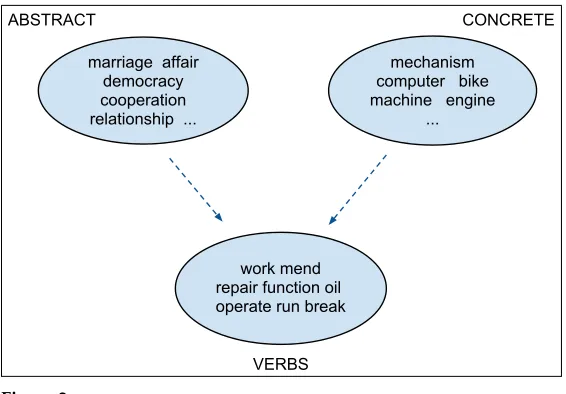
2.2.2 The Use of Clustering for Metaphor Processing.We first introduced the use of cluster-ing techniques to learn metaphorical associations in our earlier work (Shutova, Sun, and Korhonen 2010; Shutova and Sun 2013). The metaphor identification system of Shutova, Sun, and Korhonen (2010) starts from a small seed set of metaphorical expressions, learns the analogies involved in their production, and extends the set of analogies by means of spectral clustering of verbs and nouns. Shutova, Sun, and Korhonen (2010) introduced the hypothesis of “clustering by association,” stating that in the course of distributional noun clustering, abstract concepts tend to cluster together if they are associated with the same source domain, whereas concrete concepts cluster by meaning similarity. In the course of distributional clustering, concrete concepts (e.g.,water, coffee, beer, liquid) tend to be clustered together when they have similar meanings. In contrast, abstract concepts (e.g., marriage, democracy, cooperation) tend to be clustered together when they are metaphorically associated with the same source domain(s) (e.g., both marriageanddemocracycan be viewed asmechanismsorgames). Because of this shared association structure they share common contexts in the corpus. For instance, Figure 2 shows a more concrete cluster of mechanisms and a more abstract cluster containing bothmarriage anddemocracy, along with their associated verb cluster. Such clustering patterns allow the system to discover new, previously unseen conceptual and linguistic metaphors starting from a small set of examples, or seed metaphors. For instance, having seen the seed metaphor “mendmarriage” it infers that “thefunctioningof democ-racy” is also used metaphorically, sincemendandfunctionare bothMECHANISMverbs and marriage and democracyare in the same cluster. This is how the system expands from a small set of seed metaphorical expressions to cover new concepts and new metaphors.
[image:10.486.49.332.427.624.2]Shutova, Sun, and Korhonen (2010) experimented with unconstrained spectral clus-tering and applied their system to English data. In this article, we extend their method to perform constrained clustering, and thus investigate the effectiveness of additional supervision in the form of annotated metaphorical mappings. We then also apply the
Figure 2
original unconstrained method and its new constrained variant to three languages— English, Spanish, and Russian—thus testing the approach in a multilingual setting.
The second set of experiments in this article are based on the method of Shutova and Sun (2013), which is inspired by the same observation about distributional clustering. Through the use of hierarchical soft clustering techniques, Shutova and Sun (2013) de-rive a network of concepts in which metaphorical associations are exhibited at different levels of granularity. If, in the method of Shutova, Sun, and Korhonen (2010), the source and target domain clusters were connected through the use of the seed expressions, the method of Shutova and Sun (2013) learns both the clusters and the connections between them automatically from the data, in a fully unsupervised fashion. Because one of the aims of this article is to investigate the level and type of supervision optimally required to generalize metaphorical mechanisms from text, we adapt and apply the method of Shutova and Sun (2013) to our languages of interest and compare its performance to that of the spectral clustering based methods across languages. We thus also test the method, which has been previously evaluated only on English data, in a multilingual setting.
Clustering techniques have also been previously used in metaphor processing re-search in a more traditional sense (i.e., to identify linguistic expressions with a simi-lar or related meaning). Mason (2004) performed WordNet sense clustering to obtain selectional preference classes, and Mohler et al. (2013) used it to determine similarity between concepts and to link them in semantic signatures. Strzalkowski et al. (2013) and Gandy et al. (2013) clustered metaphorically used terms to form potential source domains. Birke and Sarkar (2006) clustered sentences containing metaphorical and literal uses of verbs. Their core assumption was that all instances of the verb in se-mantically similar sentences have the same sense, either the literal or the metaphorical one. However, the latter approaches did not investigate how metaphorical associations structure the distributional semantic space, which is what we focus on in this article.
2.2.3 LDA Topic Modeling.Heintz et al. (2013) applied LDA topic modeling (Blei, Ng, and Jordan 2003) to the problem of metaphor identification in experiments with English and Spanish. Their hypothesis was that if a sentence contained both source and target domain vocabulary, it contained a metaphor. The authors focused on the target domain ofgovernance and manually compiled a set of source concepts with whichgovernance could be associated. They used LDA topics as proxies for source and target concepts: If vocabulary from both source and target topics was present in a sentence, this sentence was tagged as containing a metaphor. The topics were learned from Wikipedia and then aligned to source and target concepts using sets of human-created seed words. When the metaphorical sentences were retrieved, the source topics that are common in the document were excluded. This ensured that the source vocabulary was transferred from a new domain. The authors collected the data for their experiments from news Web sites and governance-related blogs in English and Spanish. They ran their system on these data, and output a ranked set of metaphorical examples. They carried out two types of evaluation: (1) top five linguistic examples for each conceptual metaphor were judged by two annotators, yielding an F-score of 0.59 for English (κ=0.48); and (2) 250 top-ranked examples in system output were annotated for metaphoricity using Amazon Mechanical Turk, yielding a mean metaphoricity of 0.41 (standard deviation = 0.33) in English and 0.33 (standard deviation = 0.23) in Spanish.
et al. 2013; Tsvetkov, Mukomel, and Gershman 2013), as well as our own approach, share this intuition. However, our methods are different in their aims. If the method of Heintz et al. (2013) learned information about the internal domain structure from the data (through the use of LDA), our methods aim to learn information about cross-domain mappings, as well as the internal domain structure, from the words’ distributional behavior.
In addition, in contrast to most of the systems described in this section, we experi-ment with minimally supervised and unsupervised techniques that require little or no annotated training data, and thus can be easily adapted to new domains and languages. Unlike most previous approaches, we also experiment with metaphor identification in a general-domain setting.
3. Data Sets and Feature Extraction
Because our approach involves distributional learning from large collections of text, the choice of an appropriate text corpus plays an important role in the experiments and the interpretation of results. We have selected comparably large, wide-coverage corpora in our three languages to train the systems. The corpora were then parsed using a depen-dency parser and VERB–SUBJECT, VERB–DIRECT OBJECT, andVERB–INDIRECT OBJECT relations were extracted from the parser output. Following previous semantic noun and verb clustering experiments (Pantel and Lin 2002; Bergsma, Lin, and Goebel 2008; Sun and Korhonen 2009), we use these grammatical relations (GRs) as features for clustering. The features used for noun clustering consisted of the verb lemmas occurring inVERB– SUBJECT,VERB–DIRECT OBJECT, andVERB–INDIRECT OBJECTrelations with the nouns in our data set, indexed by relation type. The features used for verb clustering were the noun lemmas, occurring in the above GRs with the verbs in the data set, also indexed by relation type. The feature values were the relative frequencies of the features. For instance, the feature vector for democracy in English would contain the follow-ing entries: {restore-dobj n1, establish-dobj n2, build-dobj n3, ... , vote in-iobj
ni, call for-iobj ni+1, ... , survive-subj nk, emerge-subj nk+1, ...}, wherenis the
frequency of the feature.
3.1 English Data
The English verb and noun data sets used for clustering contain the 2,000 most frequent verbs and the 2,000 most frequent nouns in the BNC (Burnard 2007), respectively. The BNC is balanced with respect to topic and genre, which makes it appropriate for the selection of a data set of most common source and target concepts and their linguistic realizations. The features for clustering were, however, extracted from the English Gigaword corpus (Graff et al. 2003), which is more suitable for feature extraction be-cause of its large size. The Gigaword corpus was first parsed using the RASP parser (Briscoe, Carroll, and Watson 2006) and the VERB–SUBJECT, VERB–DIRECT OBJECT, and VERB–INDIRECT OBJECT relations were then extracted from the GR output of the parser, from which the feature vectors were formed.
3.2 Spanish Data
most frequent verbs and 2,000 most frequent nouns in this corpus. The corpus was parsed using the Spanish Malt parser (Nivre et al. 2007; Ballesteros et al. 2010). VERB–SUBJECT,VERB–DIRECT OBJECT, andVERB–INDIRECT OBJECTrelations were then extracted from the output of the parser and the feature vectors were constructed for all verbs and nouns in the data set in a similar manner to the English system. For example, the feature vector for the noun democracia included the following en-tries:{destruir-dobj n1, reinstaurar-dobj n2, proteger-dobj n3, ... , elegir a-iobj
ni, comprometer con-iobj ni+1, ... , florecer-subj nk, funcionar-subj nk+1, ...}.
3.3 Russian Data
The Russian data were extracted from the RU-WaC corpus (Sharoff 2006), a two-billion-word representative collection of text from the Russian Web. The corpus was parsed using the Malt dependency parser for Russian (Sharoff and Nivre 2011), and theVERB– SUBJECT, VERB–DIRECT OBJECT, andVERB–INDIRECT OBJECT relations were extracted to create the feature vectors. Similarly to the English and Spanish experiments, the 2,000 most frequent verbs and 2,000 most frequent nouns, according to the RU-WaC, constituted the verb and noun data sets used for clustering.
4. Semi-Supervised Metaphor Identification Experiments
We first experiment with a flat clustering solution, where metaphorical patterns are learned by means of hard clustering of verbs and nouns at one level of generality.6 This approach to metaphor identification is based on the hypothesis of clustering by association, which we first introduced in Shutova, Sun, and Korhonen (2010). Our expectation is that clustering by association would allow us to learn numerous new target domains that are associated with the same source domain from the data in a minimally supervised way. Following Shutova, Sun, and Korhonen (2010), we also use clustering techniques to collect source domain vocabulary.
We perform verb and noun clustering using the spectral clustering algorithm, which has proven to be effective in lexical acquisition tasks (Brew and Schulte im Walde 2002; Sun and Korhonen 2009) and is suitable for high-dimensional data (Chen et al. 2006). We experiment with itsunconstrainedandconstrainedversions. The unconstrained algorithm performs clustering (and thus identifies metaphorical patterns) in a fully unsupervised way, relying on the information contained in the data alone. The constrained version uses a small set of example metaphorical mappings as constraints to reinforce clustering by association. We then investigate to what extent adding metaphorical constraints affects the resulting partition of the semantic space as a whole. Further details of these two methods are provided subsequently. Once the clusters have been created in either the unconstrained or constrained setting, the identification of metaphorical expressions is boosted from a small number of linguistic examples—the seed expressions.
The seed expressions in our experiments are verb–subject and verb–direct object metaphors, in which the verb metaphorically describes the noun (e.g., “mend mar-riage”). Note that these are linguistic metaphors; their corresponding metaphorical mappings are not annotated. The seed expressions are then used to establish a link between the verb cluster that contains source domain vocabulary and the noun cluster
that contains diverse target concepts associated with that source domain. This link then allows the system to identify a large number of new metaphorical expressions in a text corpus. In summary, the system (1) performs noun clustering in order to harvest target concepts associated with the same source domain; (2) creates a source domain verb lexicon by means of verb clustering; (3) uses seed expressions to connect source (verb) and target (noun) clusters between which metaphorical associations hold; and (4) searches the corpus for metaphorical expressions describing the target domain concepts using the verbs from the source domain lexicon.
4.1 Clustering Methods
4.1.1 Spectral Clustering.Spectral clustering partitions objects relying on their similarity matrix. Given a set of data points, the similarity matrixW∈RN×Nrecords similarities wij between all pairs of points. We construct similarity matrices using the Jensen-Shannon divergence as a measure. Jensen-Shannon divergence between two feature vectorsqiandqjis defined as follows:
JSD(qi,qj)= 12D(qi||m)+12D(qj||m) (1)
whereDis the Kullback-Leibler divergence, andmis the average of theqi andqj. We then use the following similarity wij betweeniandjas defined in Sun and Korhonen (2009):
wij=e−JSD(qi,qj) (2)
The similarity matrixWencodes a weighted undirected graphG:=(V,E), by providing its adjacency weights. We can think of the points we are going to cluster as the vertices of the graph, and their similaritieswijas connection weights on the edges of the graph. Spectral clustering attempts to find a partitioning of the graph into clusters that are minimally connected to vertices in other clusters, but which are of roughly equal sizes (Shi and Malik 2000). This is important for metaphor identification, as our aim is to identify clusters of target concepts associated with the same source domain on one hand and to ensure that different metaphorical mappings are separated from each other in the overall partition on the other hand. In particular, we use theNJWspectral clustering algorithm introduced by Ng et al. (2002).7
In our case, each vertex vi represents a word indexed by i∈1,...,N. The weight between verticesvi andvjis denoted bywij≥0 and represents the similarity or adja-cency betweenviandvj, taken from the adjacency matrixW. Ifwij=0, we say vertices viandvjare unconnected. BecauseGis taken to be undirected,Wmust be symmetric— this explains our use of Jensen-Shannon divergence rather than the more well-known Kullback-Leibler divergence in constructing our similarity matrix W.8 We denote the
degreeof a vertexvibydi:=PNj=1wij. The degree represents the weighted connectivity ofvito the rest of the graph. Finally, we define thegraph LaplacianofGasL:=D−W; the role of the graph Laplacian will become apparent subsequently.
7 For a comprehensive review of spectral clustering algorithms see Von Luxburg (2007). Our description of spectral clustering here is largely based on this review.
Recall that our goal is to minimize similarities (weights) between clusters while producing clusters of roughly equal sizes. Denote the sum of weights between clusterA and points not in clusterAasW(A,−A) :=Pi∈A,j/∈Awij. The NCUTobjective function introduced by Shi and Malik (2000) incorporates a tradeoff between these two objec-tives as:
NCut(A1,...,AK) := K X
k=1
WP(Ak,−Ak)
v`∈Akd`
(3)
We can now recast our goal as finding the partitioningA1,...AK that minimizes this objective function. We can achieve some clarity about this objective function by rewriting it using linear algebra. If we define the normalized indicator vectors hk:= (h1k,...,hNk)Twhere we set
hi,k:=
1 qP
v`∈Akd`
ifvi∈Ak
0 otherwise
(4)
then some straightforward computations reveal that:
hTkLhk= 12 X
i∈Ak,j/∈Ak
wij= WP(Ak,−Ak) v`∈Akd`
(5)
Therefore, if we collect the vectorsh1,...,hKinto a matrixH=(h1,...,hK), thenhTkLhk= (HTLH)kk, and minimizing Equation (3) is equivalent to the following minimization problem on the graph Laplacian:
min H Tr(H
TLH) whereHis subject to constraint 4 (6)
If we could find the optimalH, it would be straightforward to find the cluster mem-berships fromH, since hik is nonzero if and only if vi is in cluster Ak. Unfortunately, solving this minimization problem is NP hard (Wagner and Wagner 1993; Von Luxburg 2007). However, an approximate solution can be found by relaxing the constraints on the elements ofHin constraint 4. Thus, we must relax our optimization problem somewhat. One entailment of constraint 4 is that the matrix D1/2H is a matrix of orthonormal vectors—that is, (D1/2H)T(D1/2H)=HTDH=I. Ng et al. (2002) proceed by dropping the constraint thathik be either 0 or 1/qPv`∈Akd`, but keeping the orthonormality constraint. Thus, they seek to solve the following problem:
min H∈RN×KTr(H
By settingT:=D1/2H, this can be rewritten as
min T∈RN×KTr(T
TD−1/2LD−1/2T) subject toTTT=I (8)
This problem is tractable because it is equivalent to the problem of finding the firstK
eigenvectors ofD−1/2LD−1/2.
Because we have dropped the constraint thathi,kbe nonzero if and only ifviis in cluster Akfrom Equation (4), then we can no longer infer the cluster memberships directly from HorT. Instead, Ng et al. (2002) approximately infer cluster memberships by clustering in the eigenspace defined by T using a clustering algorithm such as K-MEANS. The algorithm of Ng et al. (2002) is summarized as Algorithm 1.
4.1.2 Spectral Clustering with Constraints. Constrained clustering methods incorporate prior knowledge about which words belong in the same clusters. In our experiments, we sought methods that were well-behaved when given only positive constraints (i.e., two words belong in the same cluster) rather than both positive and negative constraints (i.e., two words do not belong in the same cluster). Because we have no hard-and-fast constraints that must be satisfied, but rather subjective information that we believe should influence the constraints, it was also important that our methods not strictly enforce constraints, but rather be capable of weighing the constraints against informa-tion available in the similarity matrix over the set of words.
In the constrained spectral clustering algorithm introduced by Ji, Xu, and Zhu (2006), constraints are introduced by a simple modification of the objective function of NCUT. Suppose we haveCpairs of constraints indicating that two words belong to the same cluster, and we have Nwords overall. For each paircof wordsi andjthat belong to the same cluster, we create an N-dimensional vectoruc=[uc1,uc2,...,ucN]T whereuci =1,ucj=−1, and the rest of the elements are equal to zero. We then collect these vectors into theC×Nconstraint matrixUT= [u
1,u2,...,uN].
Suppose that we form the matrixHusing the constraints onhikin Equation (4), as before. Then if all of the constraints encoded inUare correctly specified, we have that UH=0 and therefore the spectral normkUHk2=Tr((UH)TUH)=0. As more and more of the constraints encoded inUare violated byH,kUHkwill grow. This motivates Ji,
Algorithm 1NJWalgorithm
Require:NumberKof clusters; similarity matrixW∈RN×N Compute thedegree matrix Dwheredii=
PN
j=1wijanddij=0 ifi6=j Compute thegraph Laplacian L←D−W
Computenormalized graph LaplacianL¯←D−1/2LD−1/2 Compute the firstKeigenvectorsV1,...,VKofD−1/2LD−1/2
LetT∈RN×Kbe the matrix containing the normalized eigenvectors V1
kV1k2,...,
VK kVKk2
Letyi∈RKbe the vector corresponding to theithrow ofT
Xu, and Zhu (2006) to modify the objective function in Equation (6) by adding a term that penalizes a large norm forUH:
min H Tr(H
TLH)+β
kUHk2whereHis subject to constraint 4 (9)
Here, β governs how strongly the constraints encoded in Ushould be enforced. As before, we now relax contraint 4 and setT=D1/2Hto yield:
min T∈RN×KTr(T
TD−1/2LD−1/2T+βkUD−1/2Tk2) subject toTTT=I (10)
Note thatβkUD−1/2Tk2=βTr(TTD−1/2UTUD−1/2T). Therefore by collecting terms we can rewrite the objective function as:
min T∈RN×KTr(T
TD−1/2(L+βUTU)D−1/2T) subject toTTT=I (11)
Therefore, we can find the optimalTas the firstKeigenvectors of (L+βUTU), and we can assign cluster memberships usingK-MEANSin a manner analogous to algorithm NJW. The pseudocode for theJXZalgorithm is shown in Algorithm 2.
4.2 Clustering Experiments
4.2.1 Unconstrained Setting.We first applied the unconstrained version of spectral clus-tering algorithm to our data. We experimented with different clusclus-tering granularities (producing 100, 200, 300, and 400 clusters), examined the obtained clusters, and deter-mined that the number of clusters set to 200 is the optimal setting for both nouns and verbs in our task, across the three languages. This was done by means of qualitative analysis of the clusters as representations of source and target domains—that is, by judging how complete and homogeneous the verb clusters were as lists of potential source domain vocabulary and how many new target domains associated with the same source domain were found correctly in the noun clusters. This analysis was performed on 10 randomly selected clusters taken from different granularity settings and none of the seed expressions were used for it. Examples of clusters generated with this setting are shown in Figures 3 (nouns) and 4 (verbs) for English; Figures 5 (nouns) and 6 (verbs) for Spanish; and Figures 7 (nouns) and 8 (verbs) for Russian. The noun clusters represent
Algorithm 2JXZalgorithm
Require:NumberK of clusters; similarity matrixW∈RN×N; constraint matrixU∈ RN×C; enforcement parameterβ
Compute thedegree matrix Dwheredii=PNj=1wijanddij=0 ifi6=j Compute thegraph Laplacian L←D−W
Compute the firstKeigenvectorsV1,...,VKofD−1/2(L+βUTU)D−1/2 LetT∈RN×Kbe the matrix containing the normalized eigenvectors V1
kV1k2,...,
VK kVKk2
Letyi∈RKbe the vector corresponding to theithrow ofT
Suggested source domain:MECHANISM
Target Cluster: venture partnership alliance network association trust link relationship environment Suggested source domain:PHYSICAL OBJECT;LIVING BEING;STRUCTURE
Target Cluster: tradition concept doctrine idea principle notion definition theory logic hypothesis inter-pretation proposition thesis argument refusal
Suggested source domain:STORY;JOURNEY
Target Cluster: politics profession affair ideology philosophy religion competition education Suggested source domain:LIQUID
Target Cluster: frustration concern excitement anger speculation desire hostility anxiety passion fear curiosity enthusiasm emotion feeling suspicion
Figure 3
Clusters of English nouns (unconstrained setting; the source domain labels in the figure are suggested by the authors for clarity, the system does not assign any labels).
Source Cluster: sparkle glow widen flash flare gleam darken narrow flicker shine blaze bulge Source Cluster: gulp drain stir empty pour sip spill swallow drink pollute seep flow drip purify ooze pump bubble splash ripple simmer boil tread
Source Cluster: polish clean scrape scrub soak
Source Cluster: kick hurl push fling throw pull drag haul
Source Cluster: rise fall shrink drop double fluctuate dwindle decline plunge decrease soar tumble surge spiral boom
Source Cluster: initiate inhibit aid halt trace track speed obstruct impede accelerate slow stimulate hinder block
Figure 4
Clusters of English verbs.
Suggested source domain:MECHANISM
Target Cluster: avance consenso progreso soluci ´on paz acercamiento entendimiento arreglo coinciden-cia igualdad equilibrio
Target Cluster: relaci ´on amistad lazo v´ınculo conexi ´on nexo vinculaci ´on
Suggested source domain:LIVING BEING,ORGANISM,MECHANISM,STRUCTURE,BUILDING
Target Cluster: comunidad pa´ıs mundo naci ´on africa sector sociedad regi ´on europa estados continente asia centroam´erica bando planeta latinoam´erica
Suggested source domain:STORY,JOURNEY
Target Cluster: tendencia acontecimiento paso curso trayectoria ejemplo pendiente tradici ´on pista evoluci ´on
Suggested source domain:CONSTRUCTION,STRUCTURE,BUILDING
Target Cluster: seguridad vida democracia confianza estabilidad salud finanzas credibilidad competi-tividad
Figure 5
Clusters of Spanish nouns (unconstrained setting; the source domain labels in the figure are suggested by the authors for clarity, the system does not assign any labels).
target concepts associated with the same source concept.9The verb clusters contain lists of source domain vocabulary.
4.2.2 Constrained Setting. We then experimented with adding constraints to guide the clustering process. We used two types of constraints: (1) target–source constraints (TS) directly corresponding to metaphorical mappings (e.g.,marriageandmechanism); and (2) target–target constraints(TT), where two target concepts were associated with the same
Source Cluster: distribuir consumir importar ingerir comer fumar comercializar tragar consumar beber recetar
Source Cluster: atropellar chocar volcar colisionar embestir descarrilar arrollar Source Cluster: secar fluir regar limpiar
Source Cluster: llevar sacar lanzar colocar cargar transportar arrojar tirar echar descargar
Source Cluster: caer subir descender desplomar declinar bajar retroceder progresar repuntar replegar Source Cluster: inundar llenar abarrotar frecuentar copar colmar atestar saturar vaciar
Figure 6
Clusters of Spanish verbs.
Shutova, Sun, Gutiérrez and Narayanan Multilingual Metaphor Processing
Suggested source domain: construction, structure, building
Target Cluster: снг группировка ислам инфраструктура православие хор клан восстание колония культ социализм пирамида держава индустрия рота оркестр раса кружок заговор
Suggested source domain: mechanism, game, structure, living being, organism
Target Cluster: образ язык бог любовь вещь культура наука искусство бизнес политика природа литература теория стиль секс личность
Suggested source domain: story; journey; battle
Target Cluster: поход сотрудничество танец спор атака беседа карьера переговоры охота битва диалог наступление прогулка
Suggested source domain: liquid
Target Cluster: вопрос проблема тема мысль идея мнение задача чувство интерес желание ощущение необходимость
Target Cluster: боль впечатление радость надежда настроение страх сожаление мечта потребность сомнение эмоция ужас уважение запах
Target Cluster: результат информация ссылка материал данные документ опыт исследование список знание оценка анализ практика
Figure 7
Clusters of Russian nouns (unconstrained setting; the source domain labels in the Figure are suggested by the authors for clarity, the system does not assign any labels)
Source Cluster: спуститься спускаться скрываться направляться прятаться направиться бросаться вырваться выбраться устроиться приблизиться двинуться скрыться рваться поселиться оторваться возвратиться
Source Cluster: хлопать вскрыть распахнуть толкнуть стукнуть раскрыться приоткрыть взломать Source Cluster: разогреть пролить сушить взбить разбавить заправить нагреть остыть протереть выдавить процедить угощать натереть угостить обжарить растворить вонять сливать
Source Cluster: сбросить доставать спрятать повесить выбросить вырезать кинуть подбирать тащить надевать уложить прятать извлечь вынуть выкинуть выбить вставлять
Source Cluster: порвать шить скинуть завязать стирать одевать натянуть сшить
Figure 8
Clusters of Russian verbs
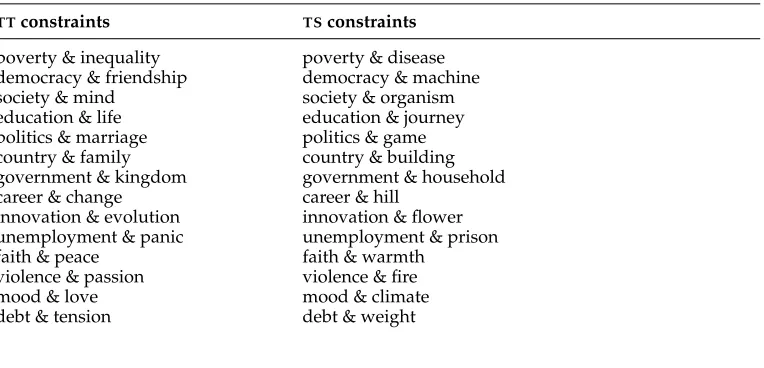
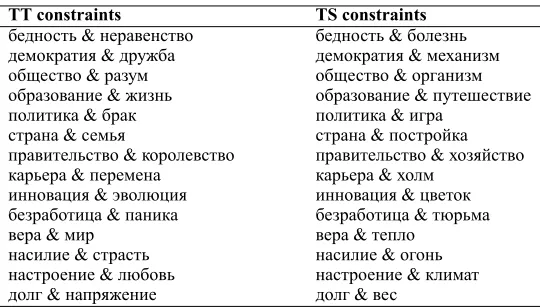
We created 30 st and 30 tt constraint pairs following this procedure. Constraints were selected and validated by the authors (who are native speakers of the respective languages) without taking the output of the unconstrained clustering step into account. Tables 1, 2 and 3 show some examples of st and tt constraints for the three languages. One pair of constraints (relationship&trade(tt) and relationship&vehicle(st)) was excluded from the set, sincerelationshipcan only be translated into Spanish and Russian by a plural form (e.g.relaciónes). We thus used 29 tt constraints and 29 st constraints in our experiments.
Our expectation is that the tt constraints are better suited to aid metaphor discovery, as the noun clusters tend to naturally contain distinct target domains associated with the same source. The tt constraints are designed to reinforce this principle. However, introducing the st type of constraints allows us to investigate to what extent explicitly reinforcing the source domain features in clustering allows to harvest more target domains associated with the source.
We experimented with different constraint enforcement parameter settings (β= 0.25; 1.0; 4.0) in order to investigate the effect of the constraints on the overall partition of the semantic space. The positive effects of the constraints were most strongly observed with β= 4.0and we thus used this setting in our experiments. Examples of clusters generated with the use of constraints in the three languages are shown in Figures 9, 10 and 11. Our analysis of the clusters has confirmed that the use of tt constraints resulted in clusters containing more diverse target concepts associated with the same source. Compare, for instance, the unconstrained and tt constrained clusters in Figure 9. The unconstrained cluster predominantly contains concepts related topolitics, such asprofessionandideology, albeit also capturing other target domains, such as religion and education. Adding the constraint marriage & politics, however, further
Figure 7
Clusters of Russian nouns (unconstrained setting; the source domain labels in the figure are suggested by the authors for clarity, the system does not assign any labels).
Figure 8
Clusters of Russian verbs
source domain (e.g.,marriageanddemocracy). The constraints were generated according to the following procedure:
1. TSconstraints:
r
Select 30 target concepts.r
For each of the target concepts select a source concept that it isassociated with. This results in 30 pairs ofTSconstraints.
2. TTconstraints:
r
For each of the resulting 30TSpairs of concepts, select anothertarget concept associated with the given source.
r
Pair the two target concepts into aTTconstraint.Table 1
Examples of constraints used in English clustering.
TTconstraints TSconstraints
poverty & inequality poverty & disease democracy & friendship democracy & machine society & mind society & organism education & life education & journey politics & marriage politics & game country & family country & building government & kingdom government & household career & change career & hill
innovation & evolution innovation & flower unemployment & panic unemployment & prison
faith & peace faith & warmth
violence & passion violence & fire
mood & love mood & climate
debt & tension debt & weight
3. Constraints should satisfy the following criteria:
r
Constraints represent metaphorical mappings that hold in all threelanguages, as validated by native speakers.
r
Each concept should appear in the set of constraints only once.10We created 30 TSand 30 TTconstraint pairs following this procedure. The source and target concepts in the constraints were selected from the lists of 2,000 nouns that we clustered in the three languages. Constraints were selected and validated by the authors (who are native speakers of the respective languages) without taking the output of the unconstrained clustering step into account (i.e., prior to having seen it). The lists of constraints were first created through individual introspection, and then finalized through discussion. Tables 1, 2, and 3 show some examples of TS and TT constraints for the three languages. One pair of constraints (relationship&trade[TT] andrelationship &vehicle[TS]) was excluded from the set, becauserelationshipis usually translated into Spanish and Russian by a plural form (e.g.,relaciones). We thus used 29 TTconstraints and 29TSconstraints in our experiments.
Our expectation is that the TT constraints are better suited to aid metaphor dis-covery, as the noun clusters tend to naturally contain distinct target domains associ-ated with the same source. TheTT constraints are designed to reinforce this principle. However, introducing theTStype of constraint allows us to investigate to what extent explicitly reinforcing the source domain features in clustering allows us to harvest more target domains associated with the source.
We experimented with different constraint enforcement parameter settings (β=
0.25, 1.0, 4.0) in order to investigate the effect of the constraints on the overall partition of
Table 2
Examples of constraints used in Spanish clustering.
TTconstraints TSconstraints
pobreza & desigualdad pobreza & enfermedad democracia & amistad democracia & m´aquina sociedad & mente sociedad & organismo educaci ´on & vida educaci ´on & viaje pol´ıtica & matrimonio pol´ıtica & juego pa´ıs & familia pa´ıs & edificio gobierno & reino gobierno & casa carrera & cambio carrera & colina innovaci ´on & evoluci ´on innovaci ´on & flor desempleo & p´anico desempleo & prisi ´on
fe & paz fe & calor
violencia & pasi ´on violencia & fuego
´animo & amor ´animo & clima
[image:21.486.58.328.351.505.2]deuda & tensi ´on deuda & peso
Table 3
Examples of constraints used in Russian clustering.
Shutova et al. Multilingual Metaphor Processing
Table 2
Examples of constraints used in Spanish clustering
tt constraints ts constraints
pobreza & desigualdad pobreza & enfermedad democracia & amistad democracia & máquina sociedad & mente sociedad & organismo educación & vida educación & viaje política & matrimonio política & juego país & familia país & edificio gobierno & reino gobierno & casa carrera & cambio carrera & colina innovación & evolución innovación & flor desempleo & pánico desempleo & prisión fe & paz fe & calor
violencia & pasión violencia & fuego ánimo & amor ánimo & clima deuda & tensión deuda & peso
Table 3
Examples of constraints used in Russian clustering
TT constraints TS constraints
бедность & неравенство бедность & болезнь демократия & дружба демократия & механизм общество & разум общество & организм образование & жизнь образование & путешествие политика & брак политика & игра
страна & семья страна & постройка правительство & королевство правительство & хозяйство карьера & перемена карьера & холм
инновация & эволюция инновация & цветок безработица & паника безработица & тюрьма вера & мир вера & тепло
насилие & страсть насилие & огонь настроение & любовь настроение & климат долг & напряжение долг & вес
languages are shown in Figures 9, 10 and 11. Our analysis of the clusters has confirmed that the use of tt constraints resulted in clusters containing more diverse target concepts associated with the same source. Compare, for instance, the unconstrained and tt constrained clusters in Figure 9. The unconstrained cluster predominantly contains concepts related topolitics, such as profession and ideology, albeit also capturing other target domains, such as religion and
education. Adding the constraint marriage & politics, however, further increases the domain diversity of the cluster, adding such target concepts as life, hope, dream and economy. The Spanish tt constrained clustering in Figure 10 shows the wider effects of constrained clustering throughout the whole noun space. Although none of the constraints is explicitly manifested in this cluster, one can see that this cluster nonetheless contains a more diverse set of target concepts associated with the same source, as compared to the original unconstrained cluster (see Figure 10). The ts constraints, as expected, highlighted the source domain features of the target word, resulting in e.g. assigningpoliticsto the same cluster asgameterms, such asroundand
matchin English (given the ts constraint politics & game). This type of constraints are thus the semantic space. Our data analysis has shown that interesting effects of metaphorical constraints were most strongly manifested withβ=4.0, and we thus used this setting in our further experiments. Examples of clusters generated with the use of constraints in the three languages are shown in Figures 9, 10, and 11. Our analysis of the clusters has confirmed that the use ofTTconstraints resulted in clusters containing more diverse tar-get concepts associated with the same source. Compare, for instance, the unconstrained andTTconstrained clusters in Figure 9. The unconstrained cluster predominantly con-tains concepts related topolitics, such asprofession and ideology, albeit also capturing other target domains, such asreligionandeducation. Adding the constraintMARRIAGE &POLITICS, however, further increases the domain diversity of the cluster, adding such
Unconstrained:
Cluster:politicsprofession affair ideology philosophy religion competition education
TTconstraints:
Cluster: fibremarriage politicsaffair career life hope dream religion education economy
TSconstraints:
[image:22.486.50.420.31.459.2]Cluster: field england part cardpoliticssport music tape tune guitar trick football organ instrument round matchgamerole ball host
Figure 9
Clusters of English nouns: unconstrained and constrained settings.
Unconstrained:
Cluster: dolor impacto miedo repercusi ´on consecuencia escasez efectodificultad
TTconstraints:
Cluster: miedo cuidado repercusi ´on epicentro acceso pendiente oportunidad conocimientodificultad
TSconstraints:
Cluster: veto bloqueo inmunidad restricci ´on obst´aculobarrera dificultad
Figure 10
Clusters of Spanish nouns: unconstrained and constrained settings.
Computational Linguistics Volume XX, Number XX
Unconstrained:
Cluster:politicsprofession affair ideology philosophy religion competition education tt constraints:
Cluster: fibremarriage politicsaffair career life hope dream religion education economy ts constraints:
[image:22.486.51.418.64.137.2]Cluster: field england part cardpoliticssport music tape tune guitar trick football organ instrument round match gamerole ball host
Figure 9
Clusters of English nouns: unconstrained and constrained settings
Unconstrained:
Cluster: dolor impacto miedo repercusión consecuencia escasez efectodificultad tt constraints:
Cluster: miedo cuidado repercusión epicentro acceso pendiente oportunidad conocimientodificultad ts constraints:
Cluster: veto bloqueo inmunidad restricción obstáculobarrera dificultad
Figure 10
Clusters of Spanish nouns: unconstrained and constrained settings
Unconstrained:
Cluster: знание способность красота усилие умение талант навык точность дар познание мудрость квалификация мастерство
TT constraints:
Cluster: властьсчастье красотаслава честь популярность благо богатство дар авторитет весть TS constraints:
Cluster: свет звезда солнцекрасотаулыбка луналуч
Figure 11
Clusters of Russian nouns: unconstrained and constrained settings
less likely to be suitable for metaphor identification, where purely target clusters are desired. These trends were evident across the three languages, as demonstrated by the examples in the respective figures.
4.3 Identification of metaphorical expressions
4.3.1 Seed expressions. Once the clusters have been obtained, we then used a set of seed metaphorical expressions to connect the source and target clusters, thus enabling the system to recognise new metaphorical expressions. The seed expressions in the three languages were extracted from naturally-occurring text, manually annotated for linguistic metaphor.
English seed expressions The seed examples used in the English experiments were extracted from the metaphor corpus created by Shutova and Teufel (2010). Their corpus is a subset of the BNC covering a range of genres: fiction, news articles, essays on politics, international relations and history, radio broadcast (transcribed speech). As such, the corpus provides a suitable platform for testing the metaphor processing system on real-world general-domain expressions in contemporary English. We extracted verb - subject and verb - direct object metaphorical expressions from this corpus. All phrases were included unless they fell in one of the following categories:
Figure 11
Clusters of Russian nouns: unconstrained and constrained settings.
target concepts aslife, hope, dream,andeconomy. The SpanishTTconstrained clustering in Figure 10 shows the wider effects of constrained clustering throughout the whole noun space. Although none of the constraints is explicitly manifested in this cluster, one can see that this cluster nonetheless contains a more diverse set of target concepts associated with the same source, as compared to the original unconstrained cluster (see Figure 10). The TS constraints, as expected, highlighted the source domain features of the target word, resulting in (for example) assigning politics to the same cluster as gameterms, such asroundandmatchin English (given the TSconstraintPOLITICS &GAME). These types of constraints are thus less likely to be suitable for metaphor identification, where purely target clusters are desired. These trends were evident across the three languages, as demonstrated by the examples in the respective figures.
4.3 Identification of Metaphorical Expressions
4.3.1 Seed Expressions. Once the clusters have been obtained, we then used a set of seed metaphorical expressions to connect the source and target clusters, thus enabling