A chance-corrected measure of inter-annotator agreement for syntax
Arne Skjærholt
Language technology group, dept. of informatics University of Oslo
Abstract
Following the works of Carletta (1996) and Artstein and Poesio (2008), there is an increasing consensus within the field that in order to properly gauge the reliability of an annotation effort, chance-corrected measures of inter-annotator agreement should be used. With this in mind, it is striking that virtually all evaluations of syntactic annotation efforts use uncor-rected parser evaluation metrics such as bracket F1 (for phrase structure) and ac-curacy scores (for dependencies).
In this work we present a chance-corrected metric based on Krippendorff’sα, adapted to the structure of syntactic annotations and applicable both to phrase structure and dependency annotation without any modifications. To evaluate our metric we first present a number of synthetic experi-ments to better control the sources of noise and gauge the metric’s responses, before finally contrasting the behaviour of our chance-corrected metric with that of un-corrected parser evaluation metrics on real corpora.1
1 Introduction
It is a truth universally acknowledged that an an-notation task in good standing be in possession of a measure of inter-annotator agreement (IAA). However, no such measure is in widespread use for the task of syntactic annotation. This is due to a mismatch between the formulation of the agree-ment measures, which assumes that the annota-tions have no or relatively little internal structure,
1The code used to produce the data in this paper,
and some of the datasets used, are available to download at
https://github.com/arnsholt/syn-agreement/
and syntactic annotation where structure is the en-tire point of the annotation. For this reason efforts to gauge the quality of syntactic annotation are hampered by the need to fall back to simple ac-curacy measures. As shown in Artstein and Poesio (2008), such measures are biased in favour of an-notation schemes with fewer categories and do not account for skewed distributions between classes, which can give high observed agreement, even if the annotations are inconsistent.
In this article we propose a family of chance-corrected measures of agreement, applicable to both dependency- and constituency-based syntac-tic annotation, based on Krippendorff’sαand tree edit distance. First we give an overview of tradi-tional agreement measures and why they are insuf-ficient for syntax, before presenting our proposed metrics. Next, we present a number of synthetic experiments performed in order to find the best distance function for this kind of annotation; fi-nally we contrast our new metric and simple accu-racy scores as applied to real-world corpora before concluding and presenting some potential avenues for future work.
1.1 Previous work
The definitive reference for agreement measures in computational linguistics is Artstein and Poe-sio (2008), who argue forcefully in favour of the use of chance-corrected measures of agreement over simple accuracy measures. However, most evaluations of syntactic treebanks use simple ac-curacy measures such as bracket F1 scores for constituent trees (NEGRA, Brants, 2000; TIGER, Brants and Hansen, 2002; Cat3LB, Civit et al., 2003; The Arabic Treebank, Maamouri et al., 2008) or labelled or unlabelled attachment scores for dependency syntax (PDT, Hajiˇc, 2004; PCEDT Mikulov´a and ˇStˇep´anek, 2010; Norwegian De-pendency Treebank, Skjærholt, 2013). The only work we know of using chance-corrected metrics
is Ragheb and Dickinson (2013), who use MASI (Passonneau, 2006) to measure agreement on de-pendency relations and head selection in multi-headed dependency syntax, and Bhat and Sharma (2012), who compute Cohen’s κ (Cohen, 1960) on dependency relations in single-headed depen-dency syntax. A limitation of the first approach is that token ID becomes the relevant category for the purposes of agreement, while the second ap-proach only computes agreements on relations, not on structure.
In grammar-driven treebanking (or parsebank-ing), the problems encountered are slightly differ-ent. In HPSG and LFG treebanking annotators do not annotate structure directly. Instead, the gram-mar parses the input sentences, and the annotator selects the correct parse (or rejects all the candi-dates) based on discriminants2of the parse forest. In this context, de Castro (2011) developed a vari-ant of κ that measures agreement over discrimi-nant selection. This is different from our approach in that agreement is computed on annotator deci-sions rather than on the treebanked analyses, and is only applicable to grammar-based approaches such as HPSG and LFG treebanking.
The idea of using edit distance as the basis for an inter-annotator agreement metric has previ-ously been explored by Fournier (2013). However that work used a boundary edit distance as the ba-sis of a metric for the task of text segmentation.
1.2 Notation
In this paper, we mostly follow the notation and terminology of Artstein and Poesio (2008), with some additions. The key components in an agree-ment study are theitemsannotated, thecoderswho make judgements on individual items, and the an-notationscreated for the items. We denote these as follows:
• The set of itemsI ={i1, i2, . . .}
• The set of codersC={c1, c2, . . .}
• The set of annotationsXis a set of setsX = {Xi|i ∈ I} where each set Xi = {xic|c ∈
C}contains the annotations for each item. If not all coders annotate all items, the different
Xiwill be of different sizes.
2A discriminant is an attribute of the analyses produced
by the grammar where some of the analyses differ, e.g. is the wordjumpa noun or a verb, or does a PP attach to a VP or the VP’s object NP.
In the case of nominal categorisation we will also use the setKof possible categories.
2 The metric
The most common metrics used in computational linguistics are the metrics κ (Cohen, 1960, in-troduced to computational linguistics by Carletta, 1996) andπ (Scott, 1955). These metrics express agreement on a nominal coding task as the ra-tioκ, π = Ao−Ae/1−Ae whereAo is the observed agreement andAethe expected agreement accord-ing to some model of “random” annotation. Both metrics have essentially the same model of ex-pected agreement:
Ae =
X
k∈K
P(k|c1)P(k|c2) (1)
differing only in how they estimate the probabil-ities: κ assigns separate probability distributions to each coder based on their observed behaviour, whileπ uses the same distribution for both coders based on their aggregate behaviour.
Now, if we want to perform this same kind of evaluation on syntactic annotation it is not possible to useκorπdirectly. In the case of dependency-based syntax we could conceivably use a variant of these metrics by considering the ID of a to-ken’s head as a categorical variable (the approach taken in Ragheb and Dickinson, 2013), but we ar-gue that this is not satisfactory. This use of the metrics would consider agreement on categories such as “tokens whose head is token number 24”, which is obviously not a linguistically informative category. Thus we have to reject this way of as-sessing the reliability of dependency syntax anno-tation. Also, this approach is not directly general-isable to constituency-based syntax.
For dependency syntax we could generalise these metrics similarly to howκis generalised to
κwto handle partial credit for overlapping annota-tions. Let the function LAS(t1, t2) be the number of tokens with the same head and label in the two trees t1 and t2,T(i) the set of trees possible for an item i ∈ I, and tokens the number of tokens in the corpus. Then we can compute an expected agreement as follows:
Ae= tokens1
X
i∈I
X
t1,t2∈T(i)2
LASe(t1, t2) (2)
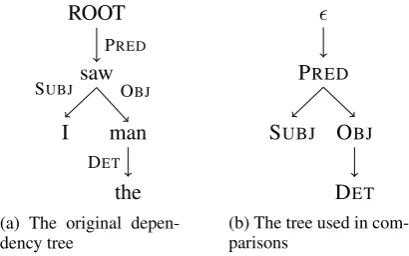
ROOT
saw
man
the
DET
I
SUBJ OBJ
PRED
(a) The original depen-dency tree
PRED
OBJ
DET
SUBJ
[image:3.595.80.285.64.192.2](b) The tree used in com-parisons
Figure 1: Transformation of dependency trees be-fore comparison
We see three problems with this approach. First of all the number of possible trees for a sentence grows exponentially with sentence length, which means that explicitly iterating over all possible such pairs is computationally intractable, nor have we been able to easily derive an algorithm for this particular problem from standard algorithms.
Second, the question of which model to use for
P(t|c)is not straightforward. It is possible to use generative parsing models such as PCFGs or the generative dependency models of Eisner (1996), but agreement metrics require a model ofrandom annotation, and as such using models designed for parsing runs the risk of over-estimatingAe, result-ing in artificially low agreement scores.
Finally, it may be hard to establish a consensus in the field of which particular metric to use. As shown by the existence of three different metrics (κ, π and S (Bennett et al., 1954)) for the rela-tively simple task of nominal coding, the choice of model forP(t|c)will not be obvious, and thus differing choices of generative model as well as different choices for parameters such as smooth-ing will result in subtly different agreement met-rics. The results of these different metrics will not be directly comparable, which will make the re-sults of groups using different metrics unnecessar-ily hard to compare.
Instead, we propose to use an agreement mea-sure based on Krippendorff’s α (Krippendorff, 1970; Krippendorff, 2004) and tree edit distance. In this approach we compare tree structures di-rectly, which is extremely parsimonious in terms of assumptions, and furthermore sidesteps the problem of probabilistically modelling annotators’ behaviour entirely. Krippendorff’sαis not as com-monly used asκandπ, but it has the advantage of being expressed in terms of an arbitrary distance
functionδ.
A full derivation of α is beyond the scope of this article, and we will simply state the formula used to compute the agreement. Krippendorff’s
α is normally expressed in terms of the ratio of observed and expected disagreements: α = 1−
Do/De, whereDois the mean squared distance be-tween annotations of the same item and De the mean squared distance between all pairs of anno-tations:
Do =
X
i∈I
1 |Xi| −1
X
c∈C
X
c0∈C
δ(xic, xic0)2
De= P 1
i∈I|Xi| −1
X
i∈I
X
c∈C
X
i0∈I X
c0∈C
δ(xic, xi0c0)2
Note that in the expression forDe, we are com-puting the difference between annotations for dif-ferent items; thus, our distance function for syn-tactic trees needs to be able to compute the differ-ence between arbitrary trees for completely unre-lated sentences. The function δ can be any func-tion as long as it is a metric; that is, it must be (1) non-negative, (2) symmetric, (3) zero only for identical inputs, and (4) it must obey the triangle inequality:
1. ∀x, y:δ(x, y)≥0
2. ∀x, y:δ(x, y) =δ(x, y)
3. ∀x, y:δ(x, y) = 0⇔x=y
4. ∀x, y, z:δ(x, y) +δ(y, z)≥δ(x, z)
This immediately excludes metrics like Pars-Eval (Black et al., 1991) and Leaf-Ancestor (Sampson and Babarczy, 2003), since they assume that the trees being compared are parses of the same sentence. Instead, we base our work on tree edit distance. The tree edit distance (TED) prob-lem is defined analogously to the more familiar problem of string edit distance: what is the min-imum number of edit operations required to trans-form one tree into the other? See Bille (2005) for a thorough introduction to the tree edit dis-tance problem and other related problems. For this work, we used the algorithm of Zhang and Shasha (1989). Tree edit distance has previously been used in the TEDEVAL software (Tsarfaty et
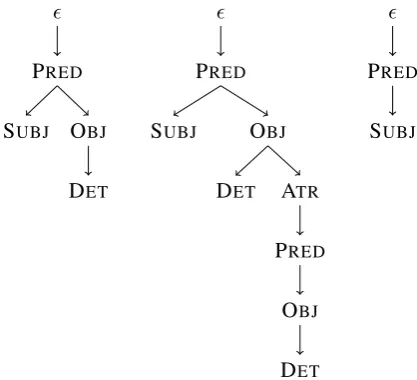
PRED
OBJ
DET
SUBJ
PRED
OBJ
ATR
PRED
OBJ
DET
DET
SUBJ
PRED
[image:4.595.77.286.62.252.2]SUBJ
Figure 2: Three trees with distance zero using
δdiff
uncorrected accuracy measure and thus unsuitable for our purposes.3
When comparing syntactic trees, we only want to compare dependency relations or non-terminal categories. Therefore we remove the leaf nodes in the case of phrase structure trees, and in the case of dependency trees we compare trees whose edges are unlabelled and nodes are labelled with the de-pendency relation between that word and its head; the root node receives the label. An example of this latter transformation is shown in Figure 1.
We propose three different distance functions for the agreement computation: the unmodified tree edit distance function, denotedδplain, a sec-ond functionδdiff(x, y) = TED(x, y)−abs(|x|−
|y|), the edit distance minus the difference in length between the two sentences, and finally
δnorm(x, y) = TED(x,y)/|x|+|y|, the edit distance
normalised to the range[0,1].4
The plain TED is the simplest in terms of parsi-mony assumptions, however it may overestimate the difference between sentences, we intuitively find to be syntactically similar. For example the only difference between the two leftmost trees in Figure 2 is a modifier, butδplain gives them dis-tance 4 andδdiff 0. On the other hand,δdiff might underestimate some distances as well; for
exam-3While it is quite different from other parser evaluation
schemes, TEDEVALdoes not correct for chance agreement and is thus an uncorrected metric. It could of course form the basis for a corrected metric, given a suitable measure of expected agreement.
4We can easily show that|x|+|y|is an upper bound on
the TED, corresponding to deleting all nodes in the source tree and inserting all the nodes in the target.
ple the leftmost and rightmost trees also have dis-tance zero usingδdiff, despite our syntactic intu-ition that the difference between a transitive and an intransitive should be taken account of.
The third distance function, δnorm, takes into account a slightly different concern; namely that when comparing a long sentence and a short sen-tence, the distance has to be quite large simply to account for the difference in number of nodes, un-like comparing two short or two long sentences. Normalising to the range[0,1]puts all pairs on an equal footing.
However, we cannot a priorisay which of the three functions is the optimal choice of distance functions. The different functions have different properties, and different advantages and draw-backs, and the nature of their strengths and weak-nesses differ. We will therefore perform a number of synthetic experiments to investigate their prop-erties in a controlled environment, before applying them to real-world data.
3 Synthetic experiments
In the previous section, we proposed three different agreement metrics αplain, αdiff and
αnorm, each involving different trade-offs. Decid-ing which of these metrics is the best one for our purposes of judging the consistency of syntactic annotation poses a bit of a conundrum. We could at this point apply our metrics to various real cor-pora and compare the results, but since the consis-tency of the corpora is unknown, it’s impossible to say whether the best metric is the one resulting in the highest scores, the lowest scores or somewhere in the middle. To properly settle this question, we first performed a number of synthetic experiments to gauge how the different metrics respond to dis-agreement.
The general approach we take is based on that used by Mathet et al. (2012), adapted to depen-dency trees. An already annotated corpus, in our case 100 randomly selected sentences from the Norwegian Dependency Treebank (Solberg et al., 2014), are taken as correct and then permuted to produce “annotations” of different quality. For de-pendency trees, the input corpus is permuted as follows:
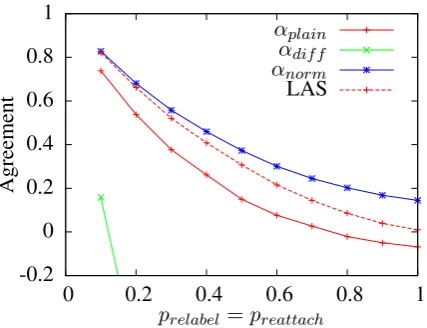
-0.2 0 0.2 0.4 0.6 0.8 1
0 0.2 0.4 0.6 0.8 1
Agreement
prelabel=preattach
αplain
αdiff
[image:5.595.72.286.68.232.2]αnorm LAS
Figure 3: Mean agreement over ten runs
2. Each token has a probabilitypreattach of be-ing assigned a new head uniformly at random from the set of tokens not dominated by the token.
The second permutation process is dependent on the order the tokens are processed, and we con-sider the tokens in the post-order5 as dictated by the original tree. This way tokens close to the root have a fair chance of having candidate heads if they are selected. A porder traversal would re-sult in tokens close to the root having few options, and in particular if the root has a single child, that node has no possible new heads unless one of its children has been assigned the root as its new head first. For example in the trees in figure 2, assign-ing any other head than the root to the PREDnodes
directly dominated by the root will result in in-valid (cyclic and unconnected) dependency trees. Traversing the tokens in the linear order dictated by the sentence has similar issues for tokens close to the root and close to the start of the sentence.
For our first set of experiments, we set
prelabel = preattach and evaluated the different agreement metrics for 10 evenly spacedp-values between 0.1 and 1.0. Initial exploration of the data showed that the mean follows the median very closely regardless of metric and perturbation level, and therefore we only report the mean scores across runs in this paper. The results of these ex-periments are shown in Figure 3, with the labelled attachment score6(LAS) for comparison.
5That is, the child nodes of a node are all processed before
the node itself. Nodes on the same level are traversed from left to right.
6Thede factostandard parser evaluation metric in
depen--0.2 0 0.2 0.4 0.6 0.8 1
0 0.2 0.4 0.6 0.8 1
Agreement
prelabel
αplain
αdiff
αnorm LAS
Figure 4: Mean agreement over ten runs,
preattach = 0
The αdiff metric is clearly extremely sensitive to noise, with p = 0.1 yielding mean αdiff =
15.8%, while αnorm is more lenient than both LAS and αplain, with mean αnorm = 14.5% at
p = 1, quite high compared to LAS = 0.9%,
αplain = −6.8% and αdiff = −246%. To fur-ther study the sensitivity of the metrics to the two kinds of noise, we performed an additional set of experiments, setting onep = 0while varying the other over the same range as in the previous exper-iment, the results of which are shown in Figures 4 and 5.
The LAS curves are mostly unremarkable, with one exception: Mean LAS atpreattach = 1of Fig-ure 5 is 23.9%, clearly much higher than we would expect if the trees were completely random. In comparison, mean LAS when only labels are per-turbed is 4.1%, and since the sample space of trees of sizen is clearly much larger than that of rela-bellings, a uniform random selection of tree would yield a LAS much closer to 0. This shows that our tree shuffling algorithm has a non-uniform distri-bution over the sample space.
While the behaviour of our alphas and LAS are relatively similar in Figure 3, Figures 4 and 5 show that they do in fact have important differences. Whereas LAS responds linearly to perturbation of both labels and structure, with its parabolic be-haviour in Figure 3 being simply the product of these two linear responses, theαmetrics respond differently to structural noise and label noise, with label disagreements being penalised less harshly
-0.2 0 0.2 0.4 0.6 0.8 1
0 0.2 0.4 0.6 0.8 1
Agreement
preattach
αplain
αdiff
αnorm LAS
Figure 5: Mean agreement over ten runs,
prelabel= 0
than structural disagreements.
The reason for the strictness of theαdiff met-ric and the laxity ofαnormis the effects the mod-ified distance functions have on the distribution of distances. The δdiff function causes an ex-treme shift of the distances towards 0; more than 30% of the sentence pairs have distance 0, 1, or 2, which causes Ddiffe to be extremely low and thus gives disproportionally large weight to non-zero distances inDodiff. On the other handδnorm causes a rightward shift of the distances, which re-sults in a highDnorm
e and thus individual disagree-ments having less weight.
4 Real-world corpora
Synthetic experiments do not always fully re-flect real-world behaviour, however. Therefore we will also evaluate our metrics on real-world inter-annotator agreement data sets. In our evaluation, we will contrast labelled accuracy, the standard parser evaluation metric, and our threeαmetrics. In particular, we are interested in the correlation (or lack thereof) between LAS and the alphas, and whether the results of our synthetic experi-ments correspond well with the results on real-world IAA sets. Finally, we also evaluate the met-ric on both dependency and phrase structure data.
4.1 The corpora
We obtained7 data from four different corpora. Three of the data sets are dependency treebanks
7We contacted a number of treebank projects, among
them the Penn Treebank and the Prague Dependency Tree-bank, but not all of them had data available.
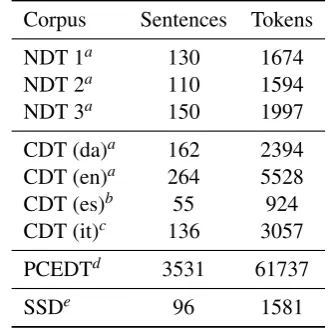
Corpus Sentences Tokens NDT 1a 130 1674
NDT 2a 110 1594
NDT 3a 150 1997
CDT (da)a 162 2394
CDT (en)a 264 5528
CDT (es)b 55 924
CDT (it)c 136 3057
PCEDTd 3531 61737
SSDe 96 1581
a2 annotators
b4 annotators, avg. 2.8 annotators/text (min. 2, max. 4) c3 annotators, avg. 2.7 annotators/text
[image:6.595.332.498.63.228.2]d11 annotators, avg. 2.5 annotators/text (min. 2, max. 6) e3 annotators, avg. 2.9 annotators/sent.
Table 1: Sizes of the different IAA corpora
(NDT, CDT, PCEDT) and one phrase structure treebank (SSD), and of the dependency tree-banks the PCEDT contains semantic dependen-cies, while the other two have traditional syntac-tic dependencies. The number of annotators and sizes of the different data sets are summarised in Table 1.
NDT The Norwegian Dependency Treebank (Solberg et al., 2014) is a dependency treebank constructed at the National Library of Norway. The data studied in this work has previously been used by Skjærholt (2013) to study agreement, but using simple accuracy measures (UAS, LAS) rather than chance-corrected measures. The IAA data set is divided into three parts, corresponding to different parsers used to preprocess the data be-fore annotation; what we term NDT 1 through 3 correspond to what Skjærholt (2013) labels Dan-ish, Swedish and Norwegian, respectively.
CDT The Copenhagen Dependency Treebanks (Buch-Kromann et al., 2009; Buch-Kromann and Korzen, 2010) is a collection of parallel depen-dency treebanks, containing data from the Danish PAROLE corpus (Keson, 1998b; Keson, 1998a) in the original Danish and translated into English, Italian and Spanish.
Czech translations of the English data. The syn-tactic annotations are layered and consist of an analytical layer similar to the annotations in most other dependency treebanks, and a more semantic tectogrammatical layer.
Our data set consists of a common set of analyt-ical annotations shared by all the annotators, and the tectogrammatical analyses built on top of this common foundation. A distinguishing feature of the tectogrammatical analyses, vis a vis the other treebanks we are using, is that semantically empty words only take part in the analytical annotation layer and nodes are inserted at the tectogrammat-ical layer to represent covert elements of the sen-tence not present in the surface syntax of the ana-lytical layer. Thus, inserting and deleting nodes is a central part of the task of tectogrammatical an-notation, unlike the more surface-oriented annota-tion of our other treebanks, where the tokenisaannota-tion is fixed before the text is annotated.
SSD The Star-Sem Data is a portion of the dataset released for the *SEM 2012 shared task (Morante and Blanco, 2012), parsed using the LinGO English Resource Grammar (ERG, Flickinger, 2000) and the resulting parse forest disambiguated based on discriminants. The ERG is an HPSG-based grammar, and as such its analy-ses are attribute-value matrices (AVMs); an AVM is not a tree but a directed acyclic graph however, and for this reason we compute agreement not on the AVM but the so-called derivation tree. This tree describes the types of the lexical items in the sentence and the bottom-up ordering of rule ap-plications used to produce the final analysis and can be handled by our procedure like any phrase-structure tree.
4.2 Agreement results
To evaluate our corpora, we compute the threeα
variants described in the previous two sections, and compare these with labelled accuracy scores.
When there are more than two annotators, we generalise the metric to be the average pairwise LAS for each sentence, weighted by the length of the sentence. Let LAS(t1, t2)be the fraction of to-kens with identical head and label in the treest1 and t2; the pairwise labelled accuracy LASp(X) of a set of annotationsX as described in section
Corpus αplain αdiff αnorm LAS NDT 1 98.4 93.0 98.8 94.0 NDT 2 98.9 95.0 99.1 94.4 NDT 3 97.9 91.2 98.7 95.3 CDT (da) 95.7 84.7 96.2 90.4 CDT (en) 92.4 70.7 95.0 88.4 CDT (es) 86.6 48.8 85.8 78.9a
CDT (it) 84.5 55.7 89.2 81.3b
PCEDT 95.9 89.9 96.5 68.0c
SSD 99.1 98.6 99.3 87.9d
a2 sentences ignored b15 sentences ignored c1178 sentences ignored
dMean pairwise Jaccard similarity
Table 2: Agreement scores on real-world corpora
1.2 is:
LASp(X) = P 1 i|xi1|
X |xi1|Λ(Xi) |Xi|(|Xi|−1)/2 (3)
Λ(Xi) =
|C| X
c=1
|C| X
c0=c+1
LAS(xic, xic0)
This is equivalent to the traditional metric in the case where there are only two annotators.
As our uncorrected metric for comparing two phrase structure trees we do not use the traditional bracketF1 as it does not generalise well to more than two annotators, but rather Jaccard similarity. The Jaccard similarity of two setsAandB is the ratio of the size of their intersection to the size of their union: J(A, B) = |A∩B|/|A∪B|, and we
use the Jaccard similarity of the sets of labelled bracketings of two trees as our uncorrected mea-sure. To compute the similarity for a complete set of annotations we use the mean pairwise Jaccard similarity weighted by sentence length; that is, the same procedure as in 3, but using Jaccard similar-ity rather than LAS.
Since LAS assumes that both of the sentences compared have identical sets of tokens, we had to exclude a number of sentences from the LAS computation in the cases of the English and Ital-ian CDT corpora, and especially the PCEDT. The large number of sentences excluded in the PCEDT is due to the fact that in the tectogrammatical anal-ysis of the PCEDT, inserting and deleting nodes is an important part of the annotation task.
40 50 60 70 80 90 100
70 75 80 85 90 95 100
α
LAS
αplain
αdiff
[image:8.595.78.282.70.232.2]αnorm
Figure 6: Correlation of LAS withα
two things. Most obvious, is the extremely large gap between the LAS and α metrics for the PCEDT data. However, there is a more subtle point; the orderings of the corpora by the differ-ent metrics are not the same. LAS order the cor-pora NDT 3, 2, 1, CDT da, en, it, es, PCEDT, whereasαdiff andαnorm gives the order NDT 2, 1, 3, PCEDT, CDT da, en, it, es, andαplain gives the same order as the other alphas but with CDT es and it changing places. Furthermore, as the scatter-plot in Figure 6 shows, there is a clear correlation between the α metrics and LAS, if we disregard the PCEDT results.
The reason the PCEDT gets such low LAS is essentially the same as the reason many sentences had to be excluded from the computation in the first place; since inserting and deleting nodes is an integral part of the tectogrammatical annotation task, the assumption implicit in the LAS computa-tion that sentences with the same number of nodes have the same nodes in the same order is obviously false, resulting in a very low LAS.
The corpus that scores the highest for all three metrics is the SSD corpus; the reason for this is uncertain, as our corpora differ along many dimen-sions, but the fact that the annotation was done by professional linguists who are very familiar with the grammar used to parse the data is likely a contributing factor. The difference between theα
metrics and the Jaccard similarity is larger than the difference betweenαand LAS for our depen-dency corpora, however the two similarity metrics are not comparable, and it is well known that for phrase structures single disagreements such as a PP-attachment disagreement can result in multiple
disagreeing bracketings.
5 Conclusion
The most important conclusion we draw from this work is the most appropriate agreement metric for syntactic annotation. First of all, we disqualify the LAS metric, primarily due to the methodologi-cal inadequacies of using an uncorrected measure. While our experiments did not reveal any seri-ous shortcomings (unlike those of Mathet et al., 2012 who in the case of categorisation showed that for large p the uncorrected measure can be increasing), the methodological problems of un-corrected metrics makes us wary of LAS as an agreement metric. Next, of the three α metrics,
αplain is clearly the best;αdiff is extremely sen-sitive to even moderate amounts of disagreement, whileαnormis overly lenient.
Looking solely at Figure 3, one might be led to believe that LAS andαplain are interchangeable, but this is not the case. As shown by Figures 4 and 5, the paraboloid shape of the LAS curve in Figure 3 is simply the combination of the met-ric’s linear responses to both label and structural perturbations. The behaviour of α on the other hand is more complex, with structural noise be-ing penalised harder than perturbations of the la-bels. Thus, the similarity of LAS andαplainis not at all assured when the amounts of structural and labelling disagreements differ. Additionally, we consider this imbalanced weighting of structural and labelling disagreements a benefit, as structure is the larger part of syntactic annotation compared to the labelling of the dependencies/bracketings. Finally our experiments show that α is a single metric that is applicable to both dependencies and phrase structure trees.
as the tectogrammatical annotation of the PCEDT. In this task inserting and deleting nodes is an in-tegral part of the annotation, and if two annotators insert or delete different nodes the all-or-nothing requirement of identical yield of the LAS metric makes it impossible as an evaluation metric in this setting.
5.1 Future work
In future work, we would like to investigate the use of other distance functions, in particular the use of approximate tree edit distance functions such as the pq-gram algorithm (Augsten et al., 2005). For large data sets such as the PCEDT set used in this work, computingα with tree edit distance as the distance measure can take a very long time.8 This is due to the fact thatαrequiresO(n2) com-parisons to be made, each of which isO(n2) us-ing our current approach. The problem of directed graph edit distance is NP-hard, which means that to apply our method to HPSG analyses directly ap-proximate algorithms are a requirement.
Another avenue for future work is improved synthetic experiments. As we saw, our implemen-tation of tree perturbations was biased towards trees similar in shape to the source tree, and an im-proved permutation algorithm may reveal interest-ing edge-case behaviour in the metrics. A method for perturbing phrase structure trees would also be interesting, as this would allow us to repeat the synthetic experiments performed here using phrase structure corpora to compare the behaviour of the metrics on the two types of corpus.
Finally, annotator modelling techniques like that presented in Passonneau and Carpenter (2013) has obvious advantages over agreement coeffi-cients such asα. These techniques are interpreted more easily than agreement coefficients, and they allow us to assess the quality of individual annota-tors, a crucial property in crowd-sourcing settings and something that’s impossible using agreement coefficients.
Acknowledgements
I would like to thank Jan ˇStˇep´anek at Charles Uni-versity for data from the PCEDT and help with the conversion process, the CDT project for pub-lishing their agreement data, Per Erik Solberg at
8The Python implementation used in this work, using
NumPy and the PyPy compiler, took seven and a half hours compute a singleαfor the PCEDT data set on an Intel Core i7 2.9 GHz computer. The program is single-threaded.
the Norwegian National Library for data from the NDT, and Emily Bender at the University of Washington for the SSD data.
References
Ron Artstein and Massimo Poesio. 2008. Inter-Coder Agreement for Computational Linguistics. Compu-tational Linguistics, 34(4):555–596.
Nikolaus Augsten, B¨ohlen Michael, and Johann Gam-per. 2005. Approximate Matching of Hierarchical Data Using pq-Grams. InProceedings of the 31st international conference on Very large data bases, pages 301–312, Trondheim. VLDB Endowment.
E. M. Bennett, R. Alpert, and A. C. Goldstein. 1954. Communications Through Limited-Response Ques-tioning. Public Opinion Quarterly, 18(3):303–308. Riyaz Ahmad Bhat and Dipti Misri Sharma. 2012.
A Dependency Treebank of Urdu and its Evalua-tion. InProceedings of the Sixth Linguistic Anno-tation Workshop, pages 157–165, Jeju. Association for Computational Linguistics.
Philip Bille. 2005. A survey on tree edit distance and related problems. Theoretical Computer Science, 337(1-3):217–239, June.
Ezra Black, Steven Abney, Dan Flickinger, Claudia Gdaniec, Ralph Grishman, Philip Harrison, Don-ald Hindle, Robert Ingria, Frederick Jelinek, Ju-dith Klavans, Mark Liberman, Mitchell P. Mar-cus, Salim Roukos, Beatrice Santorini, and Tomek Strzalkowski. 1991. A Procedure for Quantita-tively Comparing the Syntactic Coverage of English Grammars. In Proceedings of the workshop on Speech and Natural Language, pages 306–311, Pa-cific Grove, USA.
Sabine Brants and Silvia Hansen. 2002. Developments in the TIGER Annotation Scheme and their Realiza-tion in the Corpus. InProceedings of the Third In-ternational Conference on Language Resources and Evaluation, pages 1643–1649.
Thorsten Brants. 2000. Inter-Annotator Agreement for a German Newspaper Corpus. InProceedings of the Second International Conference on Language Re-sources and Evaluation.
Matthias Buch-Kromann and Iørn Korzen. 2010. The unified annotation of syntax and discourse in the Copenhagen Dependency Treebanks. In Proceed-ings of the Fourth Linguistic Annotation Workshop, pages 127–131, Uppsala. Association for Computa-tional Linguistics.
Methodology, Technology and Innovation in Trans-lation Process Research, pages 199–224. Samfund-slitteratur, Frederiksberg.
Jean Carletta. 1996. Assessing Agreement on Classi-fication Tasks: The Kappa Statistic. Computational Linguistics, 22(2):249–254.
Montserrat Civit, Alicia Ageno, Borja Navarro, N´uria Buf´ı, and M. Ant`onia Mart´ı. 2003. Qualitative and Quantitative Analysis of Annotators’ Agreement in the Development of. In Joakim Nivre and Erhard Hinrichs, editors,Proceedings of the Second Work-shop on Treebanks and Linguistic Theories, pages 21–32, V¨axj¨o. V¨axj¨o University Press.
Jacob Cohen. 1960. A Coefficient of Agreement for Nominal Scales. Educational and Psychological Measurement, 20(1):37–46, April.
S´ergio Ricardo de Castro. 2011. Developing relia-bility metrics and validation tools for datasets with deep linguistic information. Master’s thesis, Univer-sidade de Lisboa.
Jason M. Eisner. 1996. Three New Probabilistic Models for Dependency Parsing: An Exploration. In Proceedings of the 16th International Confer-ence on Computational Linguistics, pages 340–345, Stroudsburg. Association for Computational Lin-guistics.
Dan Flickinger. 2000. On building a more efficient grammar by exploiting types. Natural Language Engineering, 6(1):15–28, March.
Chris Fournier. 2013. Evaluating Text Segmentation using Boundary Edit Distance. In Proceedings of the 51st Annual Meeting of the Association for Com-putational Linguistics, pages 1702–1712, Sofia. As-sociation for Computational Linguistics.
Jan Hajiˇc, Eva Hajiˇcov´a, Jarmila Panevov´a, Petr Sgall, Silvie Cinkov´a, Eva Fuˇc´ıkov´a, Marie Mikulov´a, Petr Pajas, Jan Popelka, Jiˇr´ı Semeck´y, Jana ˇSindlerov´a, Jan ˇStˇep´anek, Josef Toman, Zdeˇnka Ureˇsov´a, and Zdˇenˇek ˇZabokrtsk´y. 2012. Prague Czech-English Dependency Treebank 2.0.
Jan Hajiˇc. 2004. Complex Corpus Annotation: The Prague Dependency Treebank. Jazykovedn´y ´ustav
ˇL. ˇSt´ura, SAV.
Britt Keson. 1998a. The Danish Morphosyntactically Tagged PAROLE Corpus. Technical report, Danish Society for Literature and Language, Copenhagen. Britt Keson. 1998b. Vejledning til det danske
morfo-syntaktisk taggede PAROLE-korpus. Technical re-port, Danish Society for Literature and Language, Copenhagen.
Klaus Krippendorff. 1970. Estimating the Reliabil-ity, Systematic Error and Random Error of Interval Data. Educational and Psychological Measurement, 30(1):61–70, April.
Klaus Krippendorff. 2004. Content Analysis: An in-troduction to its methodology. Sage Publications, Thousand Oaks, 2nd edition.
Mohamed Maamouri, Ann Bies, and Seth Kulick. 2008. Enhancing the Arabic Treebank : A Collab-orative Effort toward New Annotation Guidelines. In Proceedings of the Sixth International Confer-ence on Language Resources and Evaluation, pages 3192–3196. European Language Resources Associ-ation.
Mitchell P. Marcus, Beatrice Santorini, and Mary Ann Marcinkiewicz. 1993. Building a large annotated corpus of English: The Penn Treebank. Computa-tional Linguistics, 19(2):313–330.
Yann Mathet, Antoine Widl¨ocher, Kar¨en Fort, Claire Franc¸ois, Olivier Galibert, Cyril Grouin, Juliette Kahn, Sophie Rosset, and Pierre Zweigenbaum. 2012. Manual Corpus Annotation : Giving Meaning to the Evaluation Metrics. InProceedings of COL-ING 2012, pages 809–818, Mumbai.
Marie Mikulov´a and Jan ˇStˇep´anek. 2010. Ways of Evaluation of the Annotators in Building the Prague Czech-English Dependency Treebank. In Proceed-ings of the Seventh International Conference on Language Resources and Evaluation, pages 1836– 1839, Valletta. European Language Resources As-sociation.
Roser Morante and Eduardo Blanco. 2012. *SEM 2012 Shared Task : Resolving the Scope and Fo-cus of Negation. InThe First Joint Conference on Lexical and Computational Semantics, pages 265– 274, Montreal. Association for Computational Lin-guistics.
Joakim Nivre, Jens Nilsson, and Johan Hall. 2006. Tal-banken05 : A Swedish Treebank with Phrase Struc-ture and Dependency Annotation. In Proceedings of the Fifth International Conference on Language Resources and Evaluation.
Rebecca J. Passonneau and Bob Carpenter. 2013. The Benefits of a Model of Annotation. InProceedings of the 7th Linguistic Annotation Workshop and In-teroperability with Discourse, pages 187–195, Sofia. Association for Computational Linguistics.
Rebecca J. Passonneau. 2006. Measuring Agreement on Set-valued Items (MASI) for Semantic and Prag-matic Annotation. In Proceedings of the Fifth In-ternational Conference on Language Resources and Evaluation, pages 831–836.
Geoffrey Sampson and Anna Babarczy. 2003. A test of the leaf-ancestor metric for parse accuracy. Natural Language Engineering, 9(4):365–380, December. William A. Scott. 1955. Reliability of Content
Anal-ysis: The Case of Nominal Scale Coding. Public Opinion Quarterly, 19(3):321–325, January. Arne Skjærholt. 2013. Influence of preprocessing
on dependency syntax annotation: speed and agree-ment. InProceedings of the 7th Linguistic Annota-tion Workshop and Interoperability with Discourse, pages 28–32, Sofia. Association for Computational Linguistics.
Per Erik Solberg, Arne Skjærholt, Lilja Øvrelid, Kristin Hagen, and Janne Bondi Johannesen. 2014. The Norwegian Dependency Treebank. In Proceed-ings of the Ninth International Conference on Lan-guage Resources and Evaluation, Reykjavik. Euro-pean Language Resources Association.
Reut Tsarfaty, Joakim Nivre, and Evelina Andersson. 2011. Evaluating Dependency Parsing: Robust and Heuristics-Free Cross-Annotation Evaluation. In Proceedings of the 2011 Conference on Empirical Methods in Natural Language Processing, pages 385–396, Edinburgh. Association for Computational Linguistics.
Reut Tsarfaty, Joakim Nivre, and Evelina Andersson. 2012. Cross-Framework Evaluation for Statistical Parsing. In Proceedings of the 13th Conference of the European Chapter of the Association for Com-putational Linguistics, pages 44–54, Avignon. As-sociation for Computational Linguistics.