Munich Personal RePEc Archive
A note on the bootstrap method for
testing the existence of finite moments
Fedotenkov, Igor
Bank of Lithuania, department of Economics, Lithuanian Institute
of Agrarian Economics
16 June 2015
Online at
https://mpra.ub.uni-muenchen.de/66033/
A note on the bootstrap
method for testing the
existence of finite moments
Abstract
This paper discusses a bootstrap-based test, which checks if finite moments exist, and indicates cases of possible misapplication. It notes, that a procedure for finding the smallest power to which observations need to be raised, such that the test rejects a hypothesis that the corresponding moment is finite, works poorly as an estimator of the tail index or moment estimator. This is the case especially for very low- and high-order moments. Several examples of correct usage of the test are also shown. The main result is derived analytically, and a Monte-Carlo experiment is presented.
MSC2010 classification: 62G10, 65C05
1
IntroductionAssumptions that a finite moment of the first, second, fourth or another order exists appear in many theorems in econometrics and statistics. And so it is worthwhile to check if these assumptions are satisfied. One recent method was proposed by Fedotenkov (2013), who suggests applying bootstrap to this prob-lem, and proves consistency of the suggested method. The method employs the idea of Derman and Robbins (1955): if a sample is drawn from a distribution with an infinite mean - under certain general assumptions when the number of observations grows, the arithmetic mean of the sample grows faster than the arithmetic means of the subsamples of a smaller size. This method allows the researcher to test the assumption of the existence of the finite mean, skipping the step of the estimation of a tail index. One could think to use this test as a tail index or moment estimator so as to increase sequentially a power to which the observations are raised until the test starts to reject the hypothesis that the corresponding finite moment exists. The smallest power at which the test starts to reject the null hypothesis gives an inference about the tail index. Although this method of tail index estimation sounds logical and intuitive, our paper holds that it may lead to misleading results. One misunderstanding can already be seen at this stage: if this method skips the calculation of the tail index, why should it be used for tail index estimation? There are many methods designed intentionally for this purpose, several of which are discussed below.
Hypotheses about the existence of finite moments are usually checked as-suming that the tail of the distributionP(X > x) behaves as x−γ, γ > 0, for
largex, estimating the tail indexγ. The moments of an order larger or equal to the tail index are infinite. The most popular method for employing this idea is the Hill estimator (Hill 1975), which estimates 1/γ. Deheuvels et al. (1988) pre-sented conditions for consistency of the Hill estimator in the case of independent observations. Resnick and St˘aric˘a (1998) proved its consistency for dependent stationary sequences. A common problem of the Hill estimator is that it is not always clear how many observations should be used for the tail index estimation. To improve the method, a number of modifications and improvements were sug-gested, including Hill plots - where the estimates of the tail index are plotted over the number of observations treated as a tail, trusting that the region of stability of the plot would give an inference about the tail index. Once again, to improve this method, Hill plots with a logarithmic axis (Resnick and St˘aric˘a (1997), Drees, Resnick, and de Haan (2000)) were developed, and many other methods were proposed. Another weakness of the Hill estimator is that when applied to a sample drawn from a light-tailed distribution with infinitely many finite moments, it provides misleading results. In such cases a more general moment estimator, such as DEdH shall be applied (Dekkers, Einmahl and de Haan (1989)). As we show in this paper, the use of bootstrap for testing the finiteness of higher-order moments if samples are drawn from distributions with infinitely many finite moments may also produce unreliable results.
The rest of this paper is organized as follows: In the next section possible misapplications of the test are described; section 3 presents examples based on
Monte-Carlo simulations; section 4 concludes.
2
The test and its possible misapplicationsDenote (X1, ..., Xn) a sample of sizendrawn from a distributionF,Xi>0, i=
1, ..., n. (X∗
1, ..., Xm∗) is a bootstrap subsample with replacement of sizem,m→
∞,m=o(n) asn→ ∞, randomly and independently drawn from (X1, ..., Xn).
The method introduced by Fedotenkov (2013) for testing the null hypothesis that the first moment of the distributionF is finite, with an alternative that it is infinite, works as follows: First a significance levelαis chosen. Next, p-value is calculated:
pn=
1 B B X j=1 I m X s=1 X∗
j,s/m > ξ n
X
i=1 Xi/n
.
whereIis a unity indicator function,B is the number of bootstrap subsamples andξ is a constant 0< ξ <1 (close to 1). H0 is accepted ifpn > α otherwise
it is rejected.
As mentioned in Fedotenkov’s paper, if a researcher wants to test the exis-tence of a finitek-th order moment,k >0, he/she should raise the observations to the powerk. Formally, the hypothesis can be reformulated in the following way:
1. H0: Distribution F has a finitek-th moment.
2. H1: Distribution F does not have a finitek-th moment. Then, the p-value is calculated as
pn =
1 B B X j=1 I m X s=1 X∗k
j,s/m > ξ n X i=1 Xk i/n , (1)
the rest of the testing procedure remaining the same. The proof of consistency of such a test easily reduces to the proof used by Fedotenkov (2013) for the first moments.
Denote ther-th order statistics of (X1, ..., Xn) asX(r), i.e. X(1) ≤X(2) ≤ ...≤X(n).
Proposition 1. Suppose that F is a continuous distribution with a positive support, so that0< X(1) < X(2)< ... < X(n).1 Furthermore, suppose that the
sample sizen is large enough that m/n < α with the fixed significance levelα, and the number of bootstrap subsamplesB is sufficiently large. Thenk0 exists,
k0 <∞such that for k > k0 the test rejects the hypothesis that thek-th order moment is finite with probability 1.
Proof. Denote ˆF(X) =Pn
i=1I(Xi< X)/n, and the probability measure
corre-sponding to the empirical distribution function ˆF as P r∗:
P r∗
1 m m X s=1 X∗k
s > ξ n n X i=1 Xk i
≤P r∗
n mξ m X s=1 X∗k
s > X(kn)
= (2)
P r∗(X(
n)∈ {X1∗, ..., Xm∗})P r∗
n mξ
m
X
s=1 X∗k
s > X k
(n)
X(n)∈ {X
∗
1, ..., Xm∗}
+
P r∗(X(
n)∈ {/ X1∗, ..., Xm∗})P r∗
n mξ
m
X
s=1 X∗k
s > X k
(n)
X(n)∈ {/ X
∗
1, ..., Xm∗}
.
First, consider the case whenX(n)(the largest element in the sample) is not
in the subsample (X∗
1, ..., Xm∗). In this caseXi∗≤X(n−1), i= 1...m,
P r∗
n mξ m X s=1 X∗k
s > X(kn)
X(n)∈ {/ X
∗
1, ..., Xm∗}
≤
P r∗
n ξX
k
(n−1)> X
k
(n)
X(n)∈ {/ X
∗
1, ..., Xm∗}
= 0
ifk >log (nξ−1)/log (X(n)X−1
(n−1)) =:k0. Thus, fork > k0 the second term in
the right side of equation (2) is equal to zero.
Consider the first term in the right side of the equation (2). Using Bernoulli’s inequality, the probability that the largest element of the sample would be drawn into a subsample, can be evaluated as: P r∗(X(
n) ∈ {X1∗, ..., Xm∗}) =
1−(1−n−1)m≤m/n < α. If the number of bootstrap subsamplesB grows,
pn, defined in equation (1), converges almost surely to the probability defined
on the left side of equation (2) according to the Glivenko-Cantelli lemma; thus, ifB is large enough, the test rejects the hypothesis that the moment of orderk
is finite,k > k0, with probability 1.
It follows from proposition 1 that even if the sample of sizenis drawn from a distribution with infinitely many finite moments, a power k0 can be found so that the hypothesis that thek0-th (or higher) moment is finite is rejected.
1As it is assumed that the sample is drawn from a continuous distribution, the caseX (j)=
X(j−1)for anyjoccurs with probability equal to 0, and does not affect the analysis.
According to the definition ofk0,k0 is itself a random variable, but for a fixed sample this value is fixed and finite. Definitely, if H1 is valid, when n grows,
k0 also increases, and we may expect that the probability of making the first-order mistake decreases. But with a fixed-sample-size, increase ofkmay yield misleading results.
Similarly, if the sample is drawn from a distribution with super-heavy tails, such as a log-Pareto or log-Cauchy distribution, with tail indexes equal to zero,2 misleading results can be achieved. Raising the given sample to an ever-smaller powerkuntil the test starts to acceptH0in order to estimate the tail index is not a wise strategy either. For distributions with super-heavy tails such an approach would overestimate the tail index. This property is formally formulated and proved in the following proposition.
Proposition 2. Suppose that F is a continuous distribution with a positive support, so that 0 < X(1) < X(2) < ... < X(n). Furthermore, suppose that the
number of bootstrap subsamples B is sufficiently large. Then such k1 exists,
k1>0 that fork,0< k < k1 the test accepts the hypothesis that thek-th order moment is finite with probability one.
Proof. Recall that ξis a constant 0< ξ <1.
P r∗
1
m
m
X
s=1 X∗k
s >
ξ n
n
X
i=1 Xk
i
=P r∗
X∗k/Xk > ξ
≥ (3)
P r∗
X(1)/X(n) k
> ξ
= 1,
if
k < log(ξ)
log(X(1)/X(2))=k1>0.
Analogous to proposition 1, if the number of bootstrap subsamplesBgrows,
pn, defined in equation (1), converges almost surely to the probability defined
in the left side of the equation (3) according to the Glivenko-Cantelli lemma; thus, ifB is large enough, the test accepts the hypothesis that the moment of orderk, 0< k < k1, is finite with probability 1.
3
Monte-Carlo exampleIn this section two Monte-Carlo examples are presented to illustrate the per-formance of the test in case of distributions with infinitely large number of moments, and no finite positive moments at all. This Monte-Carlo experiment gives some insight about the range of moments for which the test performs well, and also gives indications when the test makes too many mistakes. The first example illustrates test performance for a sample drawn from the standard log-normal distribution of sizen= 200, when k increases. Lognormal distribution
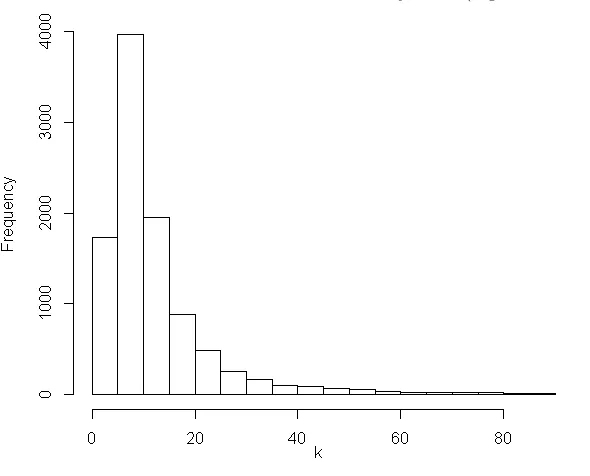
The smallest moments for which H0 is rejected (lognormal distribution)
[image:7.612.137.432.134.372.2]has infinitely many finite moments, thus H0 is true for each k, k > 0. The bootstrap subsample size is set tom= 5(≈logn), parameter ξis equalized to 0.9. 10,000 samples were drawn, from each of them 5,000 bootstrap subsamples with replacements were randomly selected.
Figure 1 is a histogram of the smallest integer moments for which the test rejects the hypothesis thatk-th finite moment exists. 1% of the largest values are not included in the histogram; the inclusion of values near 350 would have made the histogram unreadable. As seen in the figure, sometimes the numbers of estimated moments in the samples are not large, indicating that the effects discussed in the paper hold not only for very large moments. The test committed no mistakes for k = 1. For higher moments the test did not perform so well. Namely, for k = 2 the test was in error in 0.2% of cases. For k = 3 the test rejected the null hypothesis in 2.43% of cases, and fork= 4 the rate of rejections exceeded the 5% level (6.47%). Therefore, the conclusion can be drawn that, in this case, the test makes a reasonable number of mistakes fork ≤3, and it is better not to use it for higher moments.
The second example illustrates test performance in the case of super-heavy tails. Namely, samples were drawn from a log-Pareto distribution with shape and scale parameters equal to 1. k was then gradually reduced from k = 1 till k = 0 by 0.01 steps till the test accepted the hypothesis that the corre-sponding moment was finite with the significance level 0.05. The remainder of the experimental design (sample-sizes, number of bootstrap subsamples, etc.) was unchanged from the previous example. The results of this experiment are presented in Figure 2.
The largest moments for which H0 is accepted (log-Pareto distribution)
In 1.52% of cases, the test accepted the hypothesis that the first moment is finite; 5% error level was achieved checking the finiteness of thek > 0.67. In 31.54% of cases, the test accepted the hypothesis of the finiteness ofk > 0.05 moments; in 32.62% of cases, the test rejected the hypothesis that thek= 0.01 moment is finite and made no mistakes. Again it could be concluded that the test performed rather well for testing the finiteness of moments, which are close to 1.
The R code, which was used for simulations, can be found in the online appendix on the author’s personal web page.
4
Conclusionsthe tail index if the sample is taken from a distribution with super-heavy tails with the tail indexes equal to zero. But the test performs rather well when it is used for testing if the finite moments of an order close to unity exist.
References
Deheuvels, P., E. Haeusler, and M. D. Mason (1988). Almost sure conver-gence of the Hill estimator. Mathematical Proceedings of the Cambridge Philosophical Society 104(2), 371–381.
Dekkers, A. L. M., J. H. J. Einmahl, and L. de Haan (1989). A moment estimator for the index of an extreme-value distribution. The Annals of Statistics 17(4), 209–222.
Derman, C. and H. Robbins (1955). The strong law of large numbers when the first moment does not exist.Proceedings of the National Academy of Sciences 41(8), 586–587.
Drees, H., S. Resnick, and L. de Haan (2000). How to make a Hill plot. The Annals of Statistics 28(1), 254–274.
Fedotenkov, I. (2013). A bootstrap method to test for the existence of finite moments.Journal of Nonparametic Statistics 25(2), 315–322.
Hill, B. (1975). A simple general approach to inference about the tail of a distribution.The Annals of Statistics 3(5), 1163–1174.
Resnick, S. and C. St˘aric˘a (1997). Smoothing the Hill estimator.Advances in Applied Probability 29(1), 271–293.
Resnick, S. and C. St˘aric˘a (1998). Tail index estimation for dependent data.
Annals of Applied Probability 8(4), 1156–1183.