Processing Unknown Words in HPSG
Petra Barg and M a r k u s Walther*
Seminar ftir A l l g e m e i n e Sprachwissenschaft Heinrich-Heine-Universit~it Dtisseldorf Universit~itsstr. 1, D-40225 Dtisseldorf, G e r m a n y
{barg, walther}@ling, uni-duesseldor f. de
Abstract
The lexical acquisition system presented in this pa- per incrementally updates linguistic properties of un- known words inferred from their surrounding con- text by parsing sentences with an HPSG grammar for German. We employ a gradual, information- based concept of "unknownness" providing a uni- form treatment for the range of completely known to maximally unknown lexical entries. "Unknown" in- formation is viewed as revisable information, which is either generalizable or specializable. Updating takes place after parsing, which only requires a mod- ified lexical lookup. Revisable pieces of informa- tion are identified by grammar-specified declarations wlfich provide access paths into the parse feature structure. The updating mechanism revises the cor- responding places in the lexical feature structures iff the context actually provides new information. For revising generalizable inlbrmation, type union is re- quired. A worked-out example demonstrates the in- ferential capacity of our implemented system.
1 Introduction
It is a remarkable fact that humans can often un- derstand sentences containing unknown words, in- fer their grammatical properties and incrementally refine hypotheses about these words when encoun- tering later instances. In contrast, many current NLP systems still presuppose a complete lexicon. Notable exceptions include Zernik (1989), Erbach (1990), Hastings & Lytinen (1994). See Zernik for an intro- duction to the general issues involved.
This paper describes an HPSG-based system which can incrementally learn and refine proper- ties of unknown words after parsing individual sen-
*This work was carried out within the Sonderforschungs- bereich 282 "Theorie des Lexikons' (project B3), funded by the German Federal Research Agency DFG. We thank James Kil- bury and members of the B3 group for fruitful discussion.
tences. It focusses on extracting linguistic proper- ties, as compared to e.g. general concept learning (Hahn, Klenner & Schnattinger 1996). Unlike Er- bach (1990), however, it is not confined to sim- ple morpho-syntactic information but can also han- dle selectional restrictions, semantic types and argu- ment structure. Finally, while statistical approaches like Brent (1991) can gather e.g. valence informa- tion from large corpora, we are more interested in full grammatical processing of individual sentences to maximally exploit each context.
The following three goals serve to structure our model. It should i) incorporate a gradual, information-based conceptualization of "unknown- ness". Words are not unknown as a whole, but may contain unlmown, i.e. revisable pieces of infor- mation. Consequently, even known words can un- dergo revision to e.g. acquire new senses. This view replaces the binary distinction between open and closed class words. It should ii) maximally exploit the rich representations and modelling conventions of HPSG and associated formalisms, with essen- tially the same grammar and lexicon as compared to closed-lexicon approaches. This is important both to facilitate reuse of existing grammars and to en- able meaningful feedback for linguistic theorizing. Finally, it should iii) possess domain-independent in- ference and lexicon-updating capabilities. The gram- mar writer must be able to fully declare which pieces of information are open to revision.
The system was implemented using MicroCUF, a simplified version of the CUF typed unification formalism (DOrre & Dorna 1993) that we imple- mented in SICStus Prolog. It shares both the feature logic and the definite clause extensions with its big brother, but substitutes a closed-world type system for CUF's open-world regime. A feature of our type system implementation that will be significant later
tures (FSs) can be easily updated.
The HPSG grammar developed with MicroCUF models a fragment of German. Since our focus is on the lexicon, the range of syntactic variation treated is currently limited to simplex sentences with canon- ical word order. We have incorporated some recent developments of HPSG, esp. the revisions of Pol- lard & Sag (1994, ch. 9), Manning & Sag (1995)'s proposal for an independent level of argument struc- ture and Bouma (1997)'s use of argument structure to eliminate procedural lexical rules in favour of re- lational constraints. Our elaborate ontology of se- mantic types - useful for non-trivial acquisition of selectional restrictions and nominal sorts - was de- rived from a systematic corpus study of a biological domain (Knodel 1980, 154-188). The grammar also covers all valence classes encountered in the corpus. As for the lexicon format, we currently list full forms only. Clearly, a morphology component would sup- ply more contextual information from known affixes but would still require the processing of unknown stems.
2 I n c r e m e n t a l L e x i c a l A c q u i s i t i o n
When compared to a previous instance, a new sen- tential context can supply either identical, more spe- cial, more general, or even conflicting information along a given dimension. Example pairs illustrating the latter three relationships are given under (1)-(3) (words assumed to be unknown in bold face).
(1) a. Im Axon tritt ein Ruhepotential auf. 'a rest potential occurs in the axon'
b. Das Potential wandert tiber das Axon. 'the potential travels along the axon'
(2) a. Das Ohr reagiert auf akustische Reize. 'the ear reacts to acoustic stimuli'
b. Ein Sinnesorgan reagiert auf Reize. 'a sense organ reacts to stimuli'
(3) a. Die Nase ist ftir Geriiche sensibel. 'the nose is sensitive to smells'
b. Die sensible Nase reagiert auf Gertiche. 'the sensitive nose reacts to smells'
In contrast to (la), which provides the information that the gender of Axon is not feminine (via im), the context in (lb) is more specialized, assigning neuter gender (via das). Conversely, (2b) differs from (2a) in providing a more general selectional restriction for the subject of reagiert, since sense organs include
ears as a subtype. Finally, the adjective sensibel is used predicatively in (3a), but attributively in (3b). The usage types must be formally disjoint, because some German adjectives allow for just one usage (ehemalig 'former, attr.', schuld 'guilty, pred.').
On the basis of contrasts like those in (1)-(3) it makes sense to statically assign revisable informa- tion to one of two classes, namely specializable or generalizable. 1 Apart from the specializable kinds 'semantic type of nouns' and 'gender', the inflec- tional class of nouns is another candidate (given a morphological component). Generalizable kinds of information include 'selectional restrictions of verbs and adjectives', 'predicative vs attributive usage of adjectives' as well as 'case and form of PP argu- ments' and 'valence class of verbs'. Note that spe- cializable and generalizable information can cooccur in a given lexical entry. A particular kind of informa- tion may also figure in both classes, as e.g. seman- tic type of nouns and selectional restrictions of verbs are both drawn from the same semantic ontology. Yet the former must be invariantly specialized - indepen- dent of the order in which contexts are processed -, whereas selectional restrictions on NP complements should only become more general with further con- texts.
2.1 Representation
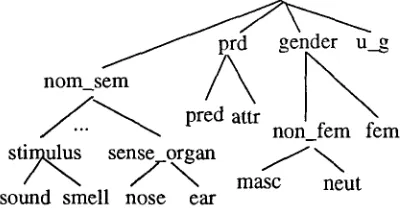
We require all revisable or updateable information to be expressible as formal types. 2 As relational clauses can be defined to map types to FSs, this is not much of a restriction in practice. Figure 1 shows a rele- vant fragment. Whereas the combination of special-
nom_sem / \ I ~
~ . . . ~ pred attr n°n I fern ?era
son)o
masc neut
sound smell nose ear
Figure 1: Excerpt from type hierarchy
izable information translates into simple type unifi- cation (e.g. non_fern A neut = neut), combining
1The different behaviour underlying this classification has previously been noted by e.g. Erbach (1990) and Hastings & Lytinen (1994) but received either no implementational status or no systematic association with arbitrary kinds of information.
[image:2.612.328.529.505.609.2]generalizable information requires type union (e.g.
pred V attr = prd). The latter might pose problems for type systems requiring the explicit definition of all possible unions, corresponding to least common supertypes. However, type union is easy for (Mi- cro)CUF and similar systems which allow for arbi- trary boolean combinations of types. Generalizable information exhibits another peculiarity: we need a disjoint auxiliary type u_g to correctly mark the initial unknown information state) This is because 'content' types like prd, pred, attr are to be inter- preted as recording what contextual information was encountered in the past. Thus, using any of these to prespecify the initial value - either as the side-effect of a feature appropriateness declaration (e.g. prd) or through grammar-controlled specification (e.g. pred, attr) - would be wrong (cf. prdiniti~t V attr = prd,
but u_ginitia l V attr = u_g V attr).
Generalizable information evokes another ques- tion: can we simply have types like those in fig. 1 within HPSG signs and do in-place type union, just like type unification? The answer is no, for essen- tially two reasons. First, we still want to rule out ungrammatical constructions through (type) unifica- tion failure of coindexed values, so that generalizable types cannot ahvays be combined by nonfailing type union (e.g. *der sensible Geruch 'the sensitive smell' must be ruled out via sense_organ A s m e l l = J_).
We would ideally like to order all type unifications pertaining to a value before all unions, but this vi- olates the order independence of constraint solv- ing. Secondly, we already know that a given infor- mational token can simultaneously be generalizable and specializable, e.g. by being coindexed through HPSG's valence principle. However, simultaneous in-place union and unification is contradictory.
To avoid these problems and keep the declarative monotonic setting, we employ two independent fea- tures gen and clxt. ctxt is the repository of contex- tually unified information, where conflicts result in ungrammaticality, gen holds generalizable informa- tion. Since all gen values contain u_g as a type dis- junct, they are always unifiable and thus not restric- tive during the parse. To nevertheless get correct gen
values we perform type union after parsing, i.e. dur- ing lexicon update. We will see below how this works out.
3Actually, the situation is more symmetrical, as we need a dual type u_s to correctly mark " u n k n o w n " specializable infor- mation. This prevents incorrect updating of known information. However, u_~ is unnecessary for the examples presented below.
The last representational issue is how to identity revisable information in (substructures ol) the parse FS. For this purpose the grammar defines revisability clauses like the following:
(4) a. generalizable([~], [~) :=
synsemlloelcatl head [adj gen
b. specializable([[I) :=
[ [cat lhead noun "1]
[synsem J oc [cont i ind 1 gend
2.2 Processing
The first step in processing sentences with unknown or revisable words consists of conventional parsing. Any HPSG-compatible parser may be used, subject to the obvious requirement that lexical lookup must not fail if a word's phonology is unknown. A canon- ical entry for such unknown words is defined as the disjunction of maximally underspecified generic lex- ical entries for nouns, adjectives and verbs.
The actual updating of lexical entries consists of four major steps. Step 1 projects the parse FS derived from the whole sentence onto all participating word tokens. This results in word FSs which are contextu- ally enriched (as compared to their original lexicon state) and disambiguated (choosing the compatible disjunct per parse solution if the entry was disjunc- tive). It then filters the set of word FSs by unification with the right-hand side of revisability clauses like in (4). The output of step 1 is a list of update candidates for those words which were unifiable.
Step 2 determines concrete update values for each word: for each matching generalizable clause we take the type union of the gen value of the old, lexical state of the word ( L e x G e n ) with the ctxt value of its parse projection (Ctxt): T U = L e x G e n U C t z t . For each matching specializable(Spec) clause we take the parse value Spec.
Step 3 checks whether updating would make a dif- ference w.r.t, the original lexical entry of each word. The condition to be met by generalizable information is that T U D L e x G e n , for specializable information we similarly require Spec C L e x S p e c .
In step 4 the lexical entries of words surviving step 3 are actually modified. We retract the old lexical en- try, revise the entry and re-assert it. For words never encountered before, revision must obviously be pre- ceded by making a copy of the generic unknown en- try, but with the new word's phonology. Revision it- self is the destructive modification of type informa-
tion according to the values determined in step 2, at the places in a word FS pointed to by the revis- ability clauses. This is easy in MicroCUF, as types are implemented via the attributed variable mecha- nism of SICStus Prolog, which allows us to substi- tute the type in-place. In comparison, general updat- ing of Prolog-encoded FSs would typically require the traversal of large structures and be dangerous if structure-sharing between substituted and unaffected parts existed. Also note that we currently assume DNF-expanded entries, so that updates work on the contextually selected disjunct. This can be motivated by the advantages of working with presolved struc- tures at run-time, avoiding description-level opera- tions and incremental grammar recompilation.
2.3 A Worked-Out Example
We will illustrate how incremental lexical revision works by going through the examples under (5)-(7).
(5) Die Nase ist ein Sinnesorgan. 'the nose is a sense organ'
(6) Das Ohr perzipiert. 'the ear perceives'
(7) Eine verschnupfte Nase perzipiert den Gestank.
'a bunged up nose perceives the stench'
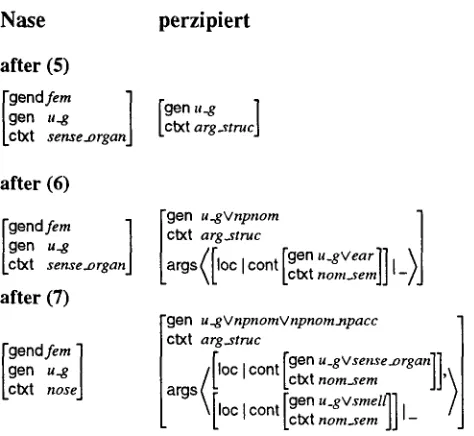
The relevant substructures corresponding to the lex- ical FSs of the unknown noun and verb involved are depicted in fig. 2. The leading feature paths synsemlloclcont for Nase and synsemlloclcatlarg-st for perzipiert have been omitted.
After parsing (5) the gender of the unknown noun Nase is instantiated to fern by agreement with the determiner die. As the specializable clause (4b) matches and the gend parse value differs from its lexical value gender, gender is updated to fern. Fur- thermore, the object's semantic type has percolated to the subject Nase. Since the objecrs sense_organ type differs from generic initial nom_sem, Nase's ctxt
value is updated as well. In place of the still nonex- isting entry for perzipiert, we have displayed the rel- evant part of the generic unknown verb entry.
Having parsed (6) the system then knows that perzipiert can be used intransitively with a nomi- native subject referring to ears. Formally, an HPSG mapping principle was successful in mediating be- tween surface subject and complement lists and the argument list. Argument list instantiations are them- selves related to corresponding types by a further
N a s e
after (5)
gend fem
]
gen u.g |etxt sense.organJ
perzipiert
gen u-g ] ctxt arg.~trucl
after (6)
gend fem
]
gen u_g |
ctxt sense.organJ
after (7)
gend fem ]
gen u.g / ctxt nose I
gen
u..gVnpnom]
ctxt arg.struc |
args([IoclcontLctxtnom_~em] ]rgenu_gvear]]
-]J\lgen u-gVnpnomVnpnom.npacc
]
ctxt arg.struc I [, , . [gen u_gVsense~rgan]] I /[,OC ICOmLctxtnom_sem j],\] [image:4.612.312.549.83.301.2]\ 'oc Icon, g = UogV';en :l I
/
Figure 2: Updates on lexical FSsmapping. On the basis of this type classification of argument structure patterns, the parse derived the ctxt value npnom. Since gen values are generaliz- able, this new value is unioned with the old lexi- cal gen value. Note that ctxt is properly unaffected. The first (subject) element on the aros list itself is targeted by another revisability clause. This has the side-effect of further instantiating the underspecified lexical FS. Since selectional restrictions on nominal subjects must become more general with new con- textual evidence, the union of ear and the old value u_g is indeed appropriate.
3 D i s c u s s i o n
The incremental lexical acquisition approach de- scribed above attains the goals stated earlier. It re- alizes a gradual, information-based conceptualiza- tion of unknownness by providing updateable formal types - classified as either generalizable or special- izable - together with grammar-defined revisability clauses. It maximally exploits standard HPSG rep- resentations, requiring moderate rearrangements in grammars at best while keeping with the standard assumptions of typed unification formalisms. One noteworthy demand, however, is the need for a type union operation. Parsing is conventional modulo a modified lexical lookup. The actual lexical revision is done in a domain-independent postprocessing step guided by the revisability clauses.
Of course there are areas requiring further consid- eration. In contrast to humans, who seem to leap to conclusions based on incomplete evidence, our ap- proach employs a conservative form of generaliza- tion, taking the disjunction of actually observed val- ues only. While this has the advantage of not leading to overgeneralization, the requirement of having to encounter all subtypes in order to infer their com- mon supertype is not realistic (sparse-data problem). In (2) sense_organ as the semantic type of the first argument ofperzipiert is only acquired because the simplified hierarchy in fig. 1 has nose and ear as its only subtypes. Here the work of Li & Abe (1995) who use the MDL principle to generalize over the slots of observed case frames might prove fruitful.
An important question is how to administrate alternative parses and their update hypotheses. In
Das Aktionspotential erreicht den Dendriten 'the action potential reaches the dendrite(s)', Dendriten
is ambiguous between acc.sg, and dat.pl., giving rise to two valence hypotheses npnom_npacc and
npnom_npdat for erreicht. Details remain to be worked out on how to delay the choice between such alternative hypotheses until further contexts provide enough information.
Another topic concerns the treatment of 'cooc- currence restrictions'. In fig. 2 the system has in- dependently generalized over the selectional restric- tions for subject and object, yet there are clear cases where this overgenerates (e.g. *Das Ohr perzipiert den Gestank 'the ear perceives the stench'). An idea worth exploring is to have a partial, extensible list of type cooccurrences, which is traversed by a recursive principle at parse time.
A more general issue is the apparent antagonism
95
between the desire to have both sharp grammatical predictions and continuing openness to contextual revision. If after parsing (7) we transfer the fact that smells are acceptable objects to perzipiert into the re- stricting ctxt feature, a later usage with an object of type sound falls. The opposite case concerns newly acquired specializable values. If in a later context these are used to update a gen value, the result may be too general. It is a topic of future research when to consider information certain and when to make re- visable information restrictive.
References
Bouma, G. (1997). Valence Alternation without Lexi- cal Rules. In: Papers from the seventh CLIN Meet- ing 1996, Eindhoven, 25--40.
Brent, M. R. (1991). Automatic Acquisition of Subcat- egorization Frames From Untagged Text. In: Pro- ceedings of 29th ACL, Berkeley, 209-214.
D0rre, J. & M. Dorna (1993). CUF - A Formalism for Linguistic Knowledge Representation. In: J. DOrre
(Exl.), ComputationaI Aspects of Constraint-Based Linguistic Description. IMS, Universitat Stuttgart. Deliverable R1.2.A, DYANA-2 - ESPRIT Project 6852.
Erbach, G. (1990). Syntactic Processing of Un- known Words. IWBS Report 131, Institute for Knowledge-Based Systems (IWBS), IBM Stuttgart.
Hahn, U., M. Klenner & K. Schnattinger (1996). Learning from Texts - A Terminological Meta- Reasoning Perspective. In: S. Wermter, E. Riloff & G. Scheler (Ed.), Connectionist, Statistical, and Symbolic Approaches to Learning for Natural Lan- guage Processing, 453--468. Berlin: Springer. Hastings, P. M. & S. L. Lytinen (1994). The Ups and
Downs of Lexical Acquisition. In: Proceedings of AAAI'94, 754-759.
Knodel, H. (1980). Linder Biologie - Lehrbuch far die Oberstufe. Stuttgart: J.B. Metzlersche Verlags- buchhandlung.
Li, H. & N. Abe (1995). Generalizing Case Frames Us- ing a Thesaurus and the MDL Principle. In: Pro- ceedings of Recent Advantages in Natural Lan- guage Processing, Velingrad, Bulgaria, 239-248. Manning, C. & I. Sag (1995). Dissociations between
argument structure and grammatical relations. Ms., Stanford University.
Pollard, C. & I. Sag (1994). Head-Driven Phrase Structure Grammar. Chicago University Press. Zernik, U. (1989). Paradigms in Lexical Acquisition.