Tractability and Structural Closures in Attribute Logic Type Signatures
Gerald Penn
Department of Computer Science
University of Toronto
10 King’s College Rd.
Toronto M5S 3G4, Canada
[email protected]
Abstract
This paper considers three assumptions conventionally made about signatures in typed feature logic that are in po-tential disagreement with current prac-tice among grammar developers and linguists working within feature-based frameworks such as HPSG: meet-semi-latticehood, unique feature introduc-tion, and the absence of subtype cover-ing. It also discusses the conditions un-der which each of these can be tractably restored in realistic grammar signatures where they do not already exist.
1
Introduction
The logic of typed feature structures (LTFS, Car-penter 1992) and, in particular, its implementa-tion in the Attribute Logic Engine (ALE, Car-penter and Penn 1996), have been widely used as a means of formalising and developing gram-mars of natural languages that support computa-tionally efficient parsing and SLD resolution, no-tably grammars within the framework of Head-driven Phrase Structure Grammar (HPSG, Pollard and Sag 1994). These grammars are formulated using a vocabulary provided by a finite partially ordered set of types and a set of features that must be specified for each grammar, and feature struc-tures in these grammars must respect certain con-straints that are also specified. These include ap-propriateness conditions, which specify, for each type, all and only the features that take values in feature structures of that type, and with which types of values (value restrictions). There are also more general implicational constraints of the form
, where is a type, and
is an expres-sion from LTFS’s description language. In LTFS and ALE, these four components, a partial order of types, a set of features, appropriateness declara-tions and type-antecedent constraints can be taken as the signature of a grammar, relative to which descriptions can be interpreted.
LTFS and ALE also make several assump-tions about the structure and interpretation of this partial order of types and about appropriateness, some for the sake of generality, others for the sake of efficiency or simplicity. Appropriate-ness is generally accepted as a good thing, from the standpoints of both efficiency and representa-tional accuracy, and while many have advocated the need for implicational constraints that are even more general, type-antecedent constraints at the very least are also accepted as being necessary and convenient. Not all of the other assumptions are universally observed by formal linguists or gram-mar developers, however.
This paper addresses the three most contentious assumptions that LTFS and ALE make, and how to deal with their absence in a tractable manner. They are:
1. Meet-semi-latticehood: every partial order of types must be a meet semi-lattice. This implies that every consistent pair of types has a least upper bound.
2. Unique feature introduction: for every fea-ture,F, there is a unique most general type to whichFis appropriate.
can be partially ordered and taken to repre-sent partial information states about some set of objects. When subtype covering is as-sumed, feature structures are discretely or-dered and totally informative, and can be taken to represent objects in the (linguistic) world themselves. The latter interpretation is subscribed to by Pollard and Sag (1994), for example.
All three of these conditions have been claimed elsewhere to be either intractable or impossible to restore in grammar signatures where they do not already exist. It will be argued here that: (1) restoring meet-semi-latticehood is theoretically intractable, for which the worst case bears a dis-quieting resemblance to actual practice in current large-scale grammar signatures, but nevertheless can be efficiently compilable in practice due to the sparseness of consistent types; (2) unique feature introduction can always be restored to a signature in low-degree polynomial time, and (3) while type inferencing when subtype covering is assumed is intractable in the worst case, a very elegant con-straint logic programming solution combined with a special compilation method exists that can re-store tractability in many practical contexts. Some simple completion algorithms and a corrected NP-completeness proof for non-disjunctive type infer-encing with subtype covering are also provided.
2
Meet-semi-latticehood
In LTFS and ALE, partial orders of types are as-sumed to be meet semi-lattices:
Definition 1 A partial order, , is a meet semi-lattice iff for any , .
is the binary greatest lower bound, or meet
op-eration, and is the dual of the join opop-eration, ,
which corresponds to unification, or least upper bounds (in the orientation where corresponds
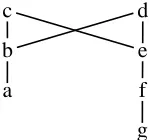
to the most general type). Figure 1 is not a meet semi-lattice because and do not have a meet,
nor do and , for example.
In the finite case, the assumption that every pair of types has a meet is equivalent to the assump-tion that every consistent set of types, i.e., types with an upper bound, has a join. It is theoretically convenient when discussing the unification of fea-ture strucfea-tures to assume that the unification of
a b c
[image:2.595.377.452.63.133.2]g f e d
Figure 1: An example of a partial order that is not a meet semi-lattice.
two consistent types always exists. It can also be more efficient to make this assumption as, in some representations of types and feature structures, it avoids a source of non-determinism (selection among minimal but not least upper bounds) dur-ing search.
Just because it would be convenient for unifica-tion to be well-defined, however, does not mean it would be convenient to think of any empiri-cal domain’s concepts as a meet semi-lattice, nor that it would be convenient to add all of the types necessary to a would-be type hierarchy to ensure meet-semi-latticehood. The question then natu-rally arises as to whether it would be possible, given any finite partial order, to add some extra elements (types, in this case) to make it a meet semi-lattice, and if so, how many extra elements it would take, which also provides a lower bound on the time complexity of the completion.
It is, in fact, possible to embed any finite partial order into a smallest lattice that preserves exist-ing meets and joins by addexist-ing extra elements. The resulting construction is the finite restriction of the Dedekind-MacNeille completion (Davey and Priestley, 1990, p. 41).
Definition 2 Given a partially ordered set,
, the Dedekind-MacNeille completion of , ! "#%$&(' , is given by:
"#%$*),+.-/'0213-4(56)7-98
123 124 134 234
1 2 3 4
Figure 2: A worst case for the Dedekind-MacNeille completion at:;)=< .
in turn given rise to several interesting studies of incremental computations of the Dedekind-MacNeille completion in which LUBs are added as they are needed (Habib and Nourine, 1994; Bertet et al., 1997). This was also the choice made in the LKB parsing system for HPSG (Malouf et al., 2000).
There are partial orders of unbounded size for
which 1> "#%$(1%)@?2"#ACBD*B3$ . As one family of
worst-case examples, parametrised by: , consider
a set EF)G+IH(JJ(JK:L8 , and a partial order
de-fined as all of the size:NM;H subsets ofE and all of
the sizeH subsets ofE , ordered by inclusion.
Fig-ure 2 shows the case where:O)P< . Although the
maximum subtype and supertype branching fac-tors in this family increase linearly with size, the partial orders can grow in depth instead in order to contain this.
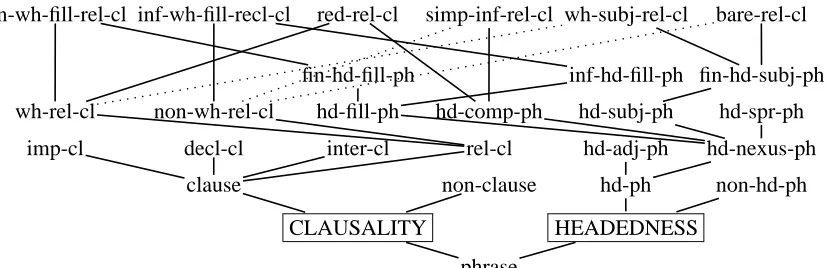
That yields something roughly of the form shown in Figure 3, which is an example of a recent trend in using type-intensive encodings of linguis-tic information into typed feature logic in HPSG, beginning with Sag (1997). These explicitly iso-late several dimensions1 of analysis as a means of classifying complex linguistic objects. In Fig-ure 3, specific clausal types are selected from among the possible combinations of CLAUSAL-ITY and HEADEDNESS subtypes. In this set-ting, the parameter : corresponds roughly to the
number of dimensions used, although an exponen-tial explosion is obviously not dependent on read-ing the type hierarchy accordread-ing to this conven-tion.
There is a simple algorithm for performing this completion, which assumes the prior existence of a most general element ( ), given in Figure 4.
1
It should be noted that while the common parlance for these sections of the type hierarchy is dimension, borrowed from earlier work by Erbach (1994) on multi-dimensional inheritance, these are not dimensions in the sense of Erbach (1994) because not everyQ -tuple of subtypes from anQ -dimensional classification is join-compatible.
Most instantiations of the heuristic, “where there is no meet, add one” (Fall, 1996), do not yield the Dedekind-MacNeille completion (Bertet et al., 1997), and other authors have proposed incremen-tal methods that trade greater efficiency in com-puting the entire completion at once for their in-crementality.
Proposition 1 The MSL completion algorithm is correct on finite partially ordered sets, , i.e., upon termination, it has produced! R"S%$ .
Proof: LetT;"#%$ be the partially ordered set
pro-duced by the algorithm. Clearly, U'VT;"#%$. It
suffices to show that (1)T;"#%$ is a complete lattice
(with W added), and (2) for all XY,T"#%$ , there
exist subsets-Z[\'Y such thatX])7^2_a` Db
-Y)
c
_a` Db
[ . 2
Suppose there are Xdfeg=T;"#%$ such that X
eih . There is a least element, so X and e have
more than one maximal lower bound, jSk&jml and
others. But then +njk jl 8 is upper-bounded and
jSkojplqh , so the algorithm should not have
termi-nated. Suppose instead that X!reih . Again, the
algorithm should not have terminated. So T;"#%$
withW added is a complete lattice.
GivenXOT"S%$ , ifXO , then choose-is])
[ist)u+nXv8 . Otherwise, the algorithm addedX
be-cause of a bounded set+(w k xw l 8 , with minimal
up-per bounds,yzk{J(J(J|yd} , which did not have a least
upper bound, i.e., ~ H . In this case, choose
- s )-i# O-i and[ s ) kxCpd}
[
4(
. In ei-ther case, clearlyXZ) ^ _`
Db -is)
c
_` Db
[is for
allX2T"S%$ .
Termination is guaranteed by considering, af-ter every iaf-teration, the number of sets of meet-irreducible elements with no meet, since all com-pletion types added are meet-reducible by defini-tion.
In LinGO (Flickinger et al., 1999), the largest publicly-available LTFS-based grammar, and one which uses such type-intensive encodings, there are 3414 types, the largest supertype branching factor is 19, and although dimensionality is not distinguished in the source code from other types, the largest subtype branching factor is 103. Using supertype branching factor for the most conserva-tive estimate, this still implies a theoretical
maxi-2
fin-wh-fill-rel-cl inf-wh-fill-recl-cl red-rel-cl simp-inf-rel-cl wh-subj-rel-cl bare-rel-cl
fin-hd-fill-ph inf-hd-fill-ph fin-hd-subj-ph
wh-rel-cl non-wh-rel-cl hd-fill-ph hd-comp-ph hd-subj-ph hd-spr-ph
imp-cl decl-cl inter-cl rel-cl hd-adj-ph hd-nexus-ph
clause non-clause hd-ph non-hd-ph
CLAUSALITY HEADEDNESS
[image:4.595.99.513.61.195.2]phrase
Figure 3: A fragment of an English grammar in which supertype branching distinguishes “dimensions” of classification.
mum of approximately 500,000 completion types, whereas only 893 are necessary, 648 of which are inferred without reference to previously added completion types.
Whereas incremental compilation methods rely on the assumption that the joins of most pairs of types will never be computed in a corpus before the signature changes, this method’s efficiency re-lies on the assumption that most pairs of types are join-incompatible no matter how the signa-ture changes. In LinGO, this is indeed the case: of the 11,655,396 possible pairs, 11,624,866 are join-incompatible, and there are only 3,306 that are consistent (with or without joins) and do not stand in a subtyping or identity relationship. In fact, the cost of completion is often dominated by the cost of transitive closure, which, using a sparse matrix representation, can be completed for LinGO in about 9 seconds on a 450 MHz Pentium II with 1GB memory (Penn, 2000a).
While the continued efficiency of compile-time completion of signatures as they further increase in size can only be verified empirically, what can be said at this stage is that the only reason that sig-natures like LinGO can be tractably compiled at all is sparseness of consistent types. In other ge-ometric respects, it bears a close enough resem-blance to the theoretical worst case to cause con-cern about scalability. Compilation, if efficient, is to be preferred from the standpoint of static error detection, which incremental methods may elect to skip. In addition, running a new signa-ture plus grammar over a test corpus is a frequent task in large-scale grammar development, and in-cremental methods, even ones that memoise pre-vious computations, may pay back the savings in compile-time on a large test corpus. It should also
be noted that another plausible method is compi-lation into logical terms or bit vectors, in which some amount of compilation (ranging from linear-time to exponential) is performed with the remain-ing cost amortised evenly across all run-time uni-fications, which often results in a savings during grammar development.
3
Unique Feature Introduction
LTFS and ALE also assume that appropriateness guarantees the existence of a unique introducer for every feature:
Definition 3 Given a type hierarchy,#N( , and a finite set of features, Feat, an appropriateness specification is a partial function, { f *¡
7M
such that, for everyF
:
¢
(Feature Introduction) there is a type
£¤d
Kd" F$; such that: – ¥¦Kf§"F
£¤d
Kd"F$x$¨ , and
– for everywZO , if¥¦Kf§"Fqw$K , then £¤6
d" F$ ©w, and
¢
(Upward Closure / Right Monotonic-ity) if ¥¦Kf"Fª$K and ª w , then
{§"FxwK$K and ¥¦Kf"Fª($ {§"FxwK$ .
1. Find two elements,« K¬
«
with minimal upper bounds,
¯®K®K® .°
, such that their join« ²±
«
is undefined, i.e., ³N´¶µ
. If no such pair exists, then stop.
2. Add an element,· , such that:
¸
for allµ*¹ºv¹³ ,·»
, and
¸
for all elements«,«§»r· iff for all
µ¹rº§¹O³ ,
«6»
.
3. Go to (1).
Figure 4: The MSL completion algorithm.
Just as with the condition of meet-semi-latticehood, however, it is possible to take a would-be signature without feature introduction and restore this condition through the addition of extra unique introducing types for certain appropriate features. The algorithm in Figure 5 achieves this. In practice, the same signature completion type, X , can be used for different
features, provided that their minimal introducers are the same set, ¼ . This clearly produces a
partially ordered set with a unique introducing type for every feature. It may disturb meet-semi-latticehood, however, which means that this completion must precede the meet semi-lattice completion of Section 2. If generalisation has already been computed, the signature completion algorithm runs in ½"S¾¦:$ , where¾ is the number
of features, and: is the number of types.
4
Subtype Covering
In HPSG, it is generally assumed that non-maximally-specific types are simply a convenient shorthand for talking about sets of maximally specific types, sometimes called species, over which the principles of a grammar are stated. In a view where feature structures represent discretely ordered objects in an empirical model, every feature structure must bear one of these species. In particular, each non-maximally-specific type in a description is equivalent to the disjunction of the maximally specific subtypes that it subsumes.
There are some good reasons not to build this assumption, called “subtype covering,” into LTFS or its implementations. Firstly, it is not an ap-propriate assumption to make for some empiri-cal domains. Even in HPSG, the denotations of
1. Given candidate signature, ¿ , find a feature, F, for which there is no unique introducing type. LetÀ be the set of minimal types to which F is appropriate, whereÁÀ2Á
´;µ
. If there is no such feature, then stop.
2. Add a new type,· , to¿ , to whichFis appropriate, such that:
¸
for all³Â À ,·¥»
³
,
¸
for all types,« in¿ ,«%»7· iff for all ³OÂ
À , «v»
³
, and ¸;ÃzÄ&įÅpÆ|Ä
F
¬
·& Ç
ÃzÄ&įÅpÆ|Ä F
¬
³
È ÃzÄ&įÅpÆ|Ä
F
¬
³
=È ®K®K®
È
ÃÄ&įÅmÆ|Ä F
¬
³ÉÊ*É , the generalization of the value restrictions onF
of the elements ofÀ .
3. Go to (1).
Figure 5: The introduction completion algorithm.
parametrically-typed lists are more naturally in-terpreted without it. Secondly, not to make the as-sumption is more general: where it is appropriate, extra type-antecedent constraints can be added to the grammar signature of the form:
:
UË
kÍÌÏÎ(ÎÎÌ
Ë
for each non-maximally-specific type, : , and its
Ð
maximal subtypes, Ë
k J(JJx
Ë
. These
con-straints become crucial in certain cases where the possible permutations of appropriate feature val-ues at a type are not covered by the permutations of those features on its maximally specific sub-types. This is the case for the type,verb, in the signature in Figure 6 (given in ALE syntax, where sub/2 defines the partial order of types, and intro/2defines appropriateness on unique in-troducers of features). The combination,AUXÑMÒ INVÔÓ , is not attested by any ofverb’s subtypes.
While there are arguably better ways to represent this information, the extra type-antecedent con-straint:
verb
aux verbÌ main verb
bot sub [verb,bool]. bool sub [+,-].
verb sub [aux_verb,main_verb] intro [aux:bool,inv:bool]. aux_verb sub [aux:+,inv:bool]. main_verb sub [aux:-,inv:-].
Figure 6: A signature with a deranged type.
4.1 Non-Disjunctive Type Inference under Subtype Covering is NP-Complete
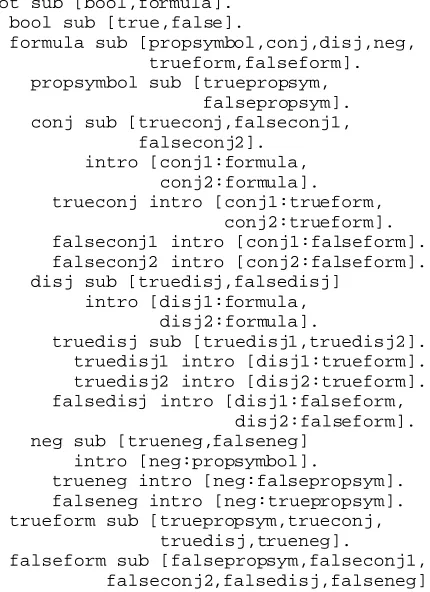
Third, although subtype covering is, in the au-thor’s experience, not a source of inefficiency in practical LTFS grammars, when subtype cover-ing is implicitly assumed, determincover-ing whether a non-disjunctive description is satisfiable under ap-propriateness conditions is an NP-complete prob-lem, whereas this is known to be polynomial time without it (and without type-antecedent con-straints, of course). This was originally proven by Carpenter and King (1995). The proof, with cor-rections, is summarised here because it was never published. Consider the translation of a 3SAT for-mula into a description relative to the signature given in Figure 7. The resulting description is al-ways non-disjunctive, since logical disjunction is encoded in subtyping. Asking whether a formula is satisfiable then reduces to asking whether this description conjoined withtrueformis satisfi-able. Every type is normal except fortruedisj, for which the combination,DISJ1falseformÒ DISJ2falseform, is not attested in either of its
subtypes. Enforcing subtype covering on this one deranged type is the sole source of intractability for this problem.
4.2 Practical Enforcement of Subtype Covering
Instead of enforcing subtype covering along with type inferencing, an alternative is to suspend con-straints on feature structures that encode subtype covering restrictions, and conduct type inferenc-ing in their absence. This restores tractability at the cost of rendering type inferencing sound but not complete. This can be implemented very transparently in systems like ALE that are built on top of another logic programming language with support for constraint logic programming such as SICStus Prolog. In the worst case, an answer to a query to the grammar signature may contain
vari-bot sub [bool,formula]. bool sub [true,false].
formula sub [propsymbol,conj,disj,neg, trueform,falseform]. propsymbol sub [truepropsym,
falsepropsym]. conj sub [trueconj,falseconj1,
falseconj2]. intro [conj1:formula,
conj2:formula]. trueconj intro [conj1:trueform,
conj2:trueform]. falseconj1 intro [conj1:falseform]. falseconj2 intro [conj2:falseform]. disj sub [truedisj,falsedisj]
intro [disj1:formula, disj2:formula].
truedisj sub [truedisj1,truedisj2]. truedisj1 intro [disj1:trueform]. truedisj2 intro [disj2:trueform]. falsedisj intro [disj1:falseform,
disj2:falseform]. neg sub [trueneg,falseneg]
intro [neg:propsymbol].
trueneg intro [neg:falsepropsym]. falseneg intro [neg:truepropsym]. trueform sub [truepropsym,trueconj,
truedisj,trueneg].
[image:6.595.313.528.66.362.2]falseform sub [falsepropsym,falseconj1, falseconj2,falsedisj,falseneg].
Figure 7: The signature reducing 3SAT to non-disjunctive type inferencing.
ables with constraints attached to them that must be exhaustively searched over in order to deter-mine their satisfiability, and this is still intractable in the worst case. The advantage of suspending subtype covering constraints is that other princi-ples of grammar and proof procedures such as SLD resolution, parsing or generation can add de-terministic information that may result in an early failure or a deterministic set of constraints that can then be applied immediately and efficiently. The variables that correspond to feature structures of a deranged type are precisely those that require these suspended constraints.
whenever the deranged type or the type of one of its appropriate features’ values is updated to a more specific subtype, and checks the types of the appropriate features’ values. Of particular use is the SICStus Constraint Handling Rules (CHR, Fr¨uhwirth and Abdennadher (1997)) library, which has the ability not only to suspend, but to suspend until a particular variable is instantiated or even bound to another variable. This is the powerful kind of mechanism required to check these constraints efficiently, i.e., only when nec-essary. Re-entrancies in a Prolog term encoding of feature structures, such as the one ALE uses (Penn, 1999), may only show up as the binding of two uninstantiated variables, and re-entrancies are often an important case where these con-straints need to be checked. The details of this reduction to constraint handling rules are given in Penn (2000b). The relevant complexity-theoretic issue is the detection of deranged types.
4.3 Detecting Deranged Types
The detection of deranged types themselves is also a potential problem. This is something that needs to be detected at compile-time when sub-type covering constraints are generated, and as small changes in a partial order of types can have drastic effects on other parts of the signature be-cause of appropriateness, incremental compila-tion of the grammar signature itself can be ex-tremely difficult. This means that the detection of deranged types must be something that can be formed very quickly, as it will normally be per-formed repeatedly during development.
A naive algorithm would be, for every type, to expand the product of its features’ appropriate value types into the set, - , of all possible
maxi-mally specific products, then to do the same for the products on each of the type’s Ð
maximally spe-cific subtypes, forming sets [i, and then to
re-move the products in the[i from- . The type is
deranged iff any maximally specific products re-main in -NÕd"##[$ . If the maximum number of
features appropriate to any type is , and there are
w types in the signature, then the cost of this is
dominated by the cost of expanding the products,
wÖ , since in the worst case all features could have as their appropriate value.
A less naive algorithm would treat normal
(non-deranged) subtypes as if they were maximally spe-cific when doing the expansion. This works be-cause the products of appropriate feature values of normal types are, by definition, covered by those of their own maximally specific subtypes. Maxi-mally specific types, furthermore, are always nor-mal and do not need to be checked. Atomic types (types with no appropriate features) are also triv-ially normal.
It is also possible to avoid doing a great deal of the remaining expansion, simply by counting the number of maximally specific products of types rather than by enumerating them. For exam-ple, in Figure 6,main verbhas one such prod-uct, AUX×M\Ò INV×M , andaux verbhas two, AUXÔÓ\Ò INVÔÓ , and AUXÔÓØÒ INVM . verb,
on the other hand, has all four possible combina-tions, so it is deranged. The resulting algorithm is thus given in Figure 8. Using the smallest normal
For each type,«, in topological order (from maximally spe-cific down toÙ ):
¸
if t is maximal or atomic then« is normal. Tabulate normalsp«p6Ç;Ú«mÛ , a minimal normal subtype cover of the maximal subtypes of«.
¸
Otherwise:
1. LetÜÝÇÞiß#à{áKâÔãåä normalspæx, whereçp«p is the set of immediate subtypes of«.
2. Letè be the number of features appropriate to
«, and let é Ç Úëêpæ x¬ ®K®K® ¬
æxìfíUÁPæ
Ç
AppropF
¬ æx ¬ Approp F ¬ «mÑî ¬ æ Â Ü%Û . 3. Givenï
x¬
ï
Â
é such thatï ±
ï
î (coordinate-wise):
– ifï
»©ï
(coordinate-wise), then discard
ï
, – ifï
ȕ
, then discard
ï
, – otherwise replaceÚfï
q¬
ï
Û iné with:
Úëê
¬ ®K®® ¬
ì
íLÁ
immed. subtype ofæ
inï Û ð Ú&ê K¬ ®K®x® ¬ ìfíÁ
immed. subtype ofæ
in ï Û ®
Repeat this step until no suchï ¬
ï
exist. 4. LetñÇ;ò F
óApprop
â
Fô
ãåä×õ maximal
AppropF
¬
«m#xö ÷ø×ù{ú
ôûûûÔô ùxüëý à{þ ò #ÿ ÿ
ì maximal
, where maximalpæq is the number of maximal subtypes ofæ.
5. if ñ Ç , then « is deranged; tabulate normalsp«m;ÇÜ and continue. Otherwise, « is normal; tabulate normalsp«p ÇÝÚf«mÛ and con-tinue.
subtype cover that we have for the product ofw’s
feature values, we iteratively expand the feature value products for this cover until they partition their maximal feature products, and then count the maximal products using multiplication. A similar trick can be used to calculate maximal efficiently. The complexity of this approach, in practice, is much better: "mw
Ö
$ , where is the weighted
mean subtype branching factor of a subtype of a value restriction of a non-maximal non-atomic type’s feature, and is the weighted mean length
of the longest path from a maximal type to a sub-type of a value restriction of a maximal non-atomic type’s feature. In the Dedekind-MacNeille completion of LinGO’s signature, is 1.9, is 2.2,
and the sum of Ö over all non-maximal types
with arity is approximately H . The sum of
maximalÖ
"mw$ over every non-maximal type, w, on
the other hand, is approximately H k
. Practical performance is again much better because this al-gorithm can exploit the empirical observation that most types in a realistic signature are normal and that most feature value restrictions on subtypes do not vary widely. Using branching factor to move the total number of types to a lower degree term is crucial for large signatures.
5
Conclusion
Efficient compilation of both meet-semi-latticehood and subtype covering depends crucially in practice on sparseness, either of consistency among types, or of deranged types, to the extent it is possible at all. Closure for unique feature introduction runs in linear time in both the number of features and types. Subtype covering results in NP-complete non-disjunctive type inferencing, but the postponement of these constraints using constraint handling rules can often hide that complexity in the presence of other principles of grammar.
References
H. A¨ıt-Ka´ci, R. Boyer, P. Lincoln, and R. Nasr. 1989. Efficient implementation of lattice operations. ACM Transactions on Programming Languages and Sys-tems, 11(1):115–146.
K. Bertet, M. Morvan, and L. Nourine. 1997. Lazy completion of a partial order to the smallest lattice.
In Proceedings of the International KRUSE Sympo-sium: Knowledge Retrieval, Use and Storage for Ef-ficiency, pages 72–81.
B. Carpenter and P.J. King. 1995. The complexity of closed world reasoning in constraint-based gram-mar theories. In Fourth Meeting on the Mathemat-ics of Language, University of Pennsylvania.
B. Carpenter and G. Penn. 1996. Compiling typed attribute-value logic grammars. In H. Bunt and M. Tomita, editors, Recent Advances in Parsing Technologies, pages 145–168. Kluwer.
B. Carpenter. 1992. The Logic of Typed Feature Struc-tures. Cambridge.
B. A. Davey and H. A. Priestley. 1990. Introduction to Lattices and Order. Cambridge University Press.
G. Erbach. 1994. Multi-dimensional inheritance. In Proceedings of KONVENS 94. Springer.
D. Flickinger et al. 1999. The LinGO English
resource grammar. Available on-line from
http://hpsg.stanford.edu/hpsg/ lingo.html.
A. Fall. 1996. Reasoning with Taxonomies. Ph.D. the-sis, Simon Fraser University.
T. Fr¨uhwirth and S. Abdennadher. 1997. Constraint-Programmierung. Springer Verlag.
M. Habib and L. Nourine. 1994. Bit-vector encod-ing for partially ordered sets. In Orders, Algorithms, Applications: International Workshop ORDAL ’94 Proceedings, pages 1–12. Springer-Verlag.
R. Malouf, J. Carroll, and A. Copestake. 2000. Ef-ficient feature structure operations without compi-lation. Journal of Natural Language Engineering, 6(1):29–46.
G. Penn. 1999. An optimized prolog encoding of typed feature structures. In Proceedings of the 16th International Conference on Logic Program-ming (ICLP-99), pages 124–138.
G. Penn. 2000a. The Algebraic Structure of Attributed
Type Signatures. Ph.D. thesis, Carnegie Mellon
University.
G. Penn. 2000b. Applying Constraint
Han-dling Rules to HPSG. In Proceedings of the
First International Conference on Computational Logic (CL2000), Workshop on Rule-Based Con-straint Reasoning and Programming, London, UK.
C. Pollard and I. Sag. 1994. Head-driven Phrase Structure Grammar. Chicago.