Unsupervised Multilingual Learning for Morphological Segmentation
Benjamin Snyder and Regina Barzilay
Computer Science and Artificial Intelligence Laboratory Massachusetts Institute of Technology
{bsnyder,regina}@csail.mit.edu
Abstract
For centuries, the deep connection between languages has brought about major discover-ies about human communication. In this pa-per we investigate how this powerful source of information can be exploited for unsuper-vised language learning. In particular, we study the task of morphological segmentation of multiple languages. We present a non-parametric Bayesian model that jointly in-duces morpheme segmentations of each lan-guage under consideration and at the same time identifies cross-lingual morpheme pat-terns, orabstract morphemes. We apply our model to three Semitic languages: Arabic, He-brew, Aramaic, as well as to English. Our results demonstrate that learning morpholog-ical models in tandem reduces error by up to 24% relative to monolingual models. Fur-thermore, we provide evidence that our joint model achieves better performance when ap-plied to languages from the same family.
1 Introduction
For centuries, the deep connection between human languages has fascinated linguists, anthropologists and historians (Eco, 1995). The study of this con-nection has made possible major discoveries about human communication: it has revealed the evolu-tion of languages, facilitated the reconstrucevolu-tion of proto-languages, and led to understanding language universals.
The connection between languages should be a powerful source of information for automatic lin-guistic analysis as well. In this paper we investi-gate two questions:(i)Can we exploit cross-lingual correspondences to improve unsupervised language
learning?(ii)Will this joint analysis provide more or less benefit when the languages belong to the same family?
We study these two questions in the context of unsupervised morphological segmentation, the auto-matic division of a word into morphemes (the basic units of meaning). For example, the English word
misunderstanding would be segmented into mis
-understand - ing. This task is an informative testbed
for our exploration, as strong correspondences at the morphological level across various languages have been well-documented (Campbell, 2004).
The model presented in this paper automatically induces a segmentation and morpheme alignment from a multilingual corpus of short parallel phrases.1 For example, given parallel phrases meaningin my land in English, Arabic, Hebrew, and Aramaic, we wish to segment and align morphemes as follows:
fy arḍ - y b - arṣ - y b - arʿ - y in my land English:
Arabic:
Hebrew:
Aramaic:
This example illustrates the potential benefits of unsupervised multilingual learning. The three Semitic languages use cognates (words derived from a common ancestor) to represent the word land. They also use an identical suffix (-y) to represent the first person possessive pronoun (my). These similar-ities in form should guide the model by constraining
1
In this paper, we focus on bilingual models. The model can be extended to handle several languages simultaneously as in this example.
the space of joint segmentations. The corresponding English phrase lacks this resemblance to its Semitic counterparts. However, in this as in many cases, no segmentation is required for English as all the mor-phemes are expressed as individual words. For this reason, English should provide a strong source of disambiguation for highly inflected languages, such as Arabic and Hebrew.
In general, we pose the following question. In which scenario will multilingual learning be most effective? Will it be for related languages, which share a common core of linguistic features, or for distant languages, whose linguistic divergence can provide strong sources of disambiguation?
As a first step towards answering this question, we propose a model which can take advantage of both similarities and differences across languages. This joint bilingual model identifies optimal mor-phemes for two languages and at the same time finds compact multilingual representations. For each lan-guage in the pair, the model favors segmentations which yield high frequency morphemes. More-over, bilingual morpheme pairs which consistently share a common semantic or syntactic function are treated as abstract morphemes, generated by a sin-gle language-independent process. These abstract morphemes are induced automatically by the model from recurring bilingual patterns. For example, in the case above, the tuple(in, fy, b-, b-)would consti-tute one of three abstract morphemes in the phrase. When a morpheme occurs in one language with-out a direct counterpart in the other language, our model can explain away the stray morpheme as aris-ing through a language-specific process.
To achieve this effect in a probabilistic frame-work, we formulate a hierarchical Bayesian model with Dirichlet Process priors. This framework al-lows us to define priors over the infinite set of pos-sible morphemes in each language. In addition, we define a prior over abstract morphemes. This prior can incorporate knowledge of the phonetic re-lationship between the two alphabets, giving poten-tial cognates greater prior likelihood. The resulting posterior distributions concentrate their probability mass on a small group of recurring and stable pat-terns within and between languages.
We test our model on a multilingual corpus of short parallel phrases drawn from the Hebrew Bible
and Arabic, Aramaic, and English translations. The Semitic language family, of which Hebrew, Arabic, and Aramaic are members, is known for a highly productive morphology (Bravmann, 1977). Our re-sults indicate that cross-lingual patterns can indeed be exploited successfully for the task of unsuper-vised morphological segmentation. When modeled in tandem, gains are observed for all language pairs, reducing relative error by as much as 24%. Further-more, our experiments show that both related and unrelated language pairs benefit from multilingual learning. However, when common structures such as phonetic correspondences are explicitly modeled, related languages provide the most benefit.
2 Related Work
Multilingual Language Learning Recently, the availability of parallel corpora has spurred research on multilingual analysis for a variety of tasks ranging from morphology to semantic role label-ing (Yarowsky et al., 2000; Diab and Resnik, 2002; Xi and Hwa, 2005; Pad´o and Lapata, 2006). Most of this research assumes that one language has annota-tions for the task of interest. Given a parallel cor-pus, the annotations are projected from this source language to its counterpart, and the resulting anno-tations are used for supervised training in the target language. In fact, Rogati et al., (2003) employ this method to learn arabic morphology assuming anno-tations provided by an English stemmer.
An alternative approach has been proposed by Feldman, Hana and Brew (2004; 2006). While their approach does not require a parallel corpus it does assume the availability of annotations in one lan-guage. Rather than being fully projected, the source annotations provide co-occurrence statistics used by a model in the resource-poor target language. The key assumption here is that certain distributional properties are invariant across languages from the same language families. An example of such a prop-erty is the distribution of part-of-speech bigrams. Hana et al., (2004) demonstrate that adding such statistics from an annotated Czech corpus improves the performance of a Russian part-of-speech tagger over a fully unsupervised version.
not assume supervised data in any of the languages. Second, we learn a single multilingual model, rather than asymmetrically handling one language at a time. This design allows us to capitalize on struc-tural regularities across languages for the mutual benefit of each language.
Unsupervised Morphological Segmentation
Unsupervised morphology is an active area of research (Schone and Jurafsky, 2000; Goldsmith, 2001; Adler and Elhadad, 2006; Creutz and Lagus, 2007; Dasgupta and Ng, 2007).
Most existing algorithms derive morpheme lexi-cons by identifying recurring patterns in string dis-tribution. The goal is to optimize the compactness of the data representation by finding a small lexicon of highly frequent strings. Our work builds on prob-abilistic segmentation approaches such as Morfes-sor (Creutz and Lagus, 2007). In these approaches, models with short description length are preferred. Probabilities are computed for both the morpheme lexicon and the representation of the corpus condi-tioned on the lexicon. A locally optimal segmenta-tion is identified using a task-specific greedy search. In contrast to previous approaches, our model induces morphological segmentation for multiple related languages simultaneously. By represent-ing morphemes abstractly through the simultane-ous alignment and segmentation of data in two lan-guages, our algorithm capitalizes on deep connec-tions between morpheme usage across different lan-guages.
3 Multilingual Morphological Segmentation
The underlying assumption of our work is that struc-tural commonality across different languages is a powerful source of information for morphological analysis. In this section, we provide several exam-ples that motivate this assumption.
The main benefit of joint multilingual analysis is that morphological structure ambiguous in one guage is sometimes explicitly marked in another lan-guage. For example, in Hebrew, the preposition meaning “in”, b-, is always prefixed to its nomi-nal argument. On the other hand, in Arabic, the most common corresponding particle is fy, which appears as a separate word. By modeling
cross-lingual morpheme alignments while simultaneously segmenting, the model effectively propagates infor-mation between languages and in this case would be encouraged to segment the Hebrew prefixb-.
Cognates are another important means of disam-biguation in the multilingual setting. Consider trans-lations of the phrase“...and they wrote it...”:
• Hebrew:w-ktb-w ath
• Arabic:f-ktb-w-ha
In both languages, the triliteral root ktb is used to express the act of writing. By considering the two phrases simultaneously, the model can be encour-aged to split off the respective Hebrew and Arabic prefixesw-andf-in order to properly align the cog-nate rootktb.
In the following section, we describe a model that can model both generic cross-lingual patterns (fyand
b-), as well as cognates between related languages (ktbfor Hebrew and Arabic).
4 Model
Overview In order to simultaneously model prob-abilistic dependencies across languages as well as morpheme distributions within each language, we employ a hierarchical Bayesian model.2
Our segmentation model is based on the notion that stable recurring string patterns within words are indicative of morphemes. In addition to learn-ing independent morpheme patterns for each lan-guage, the model will prefer, when possible, to join together frequently occurring bilingual morpheme pairs into singleabstract morphemes. The model is fully unsupervised and is driven by a preference for stable and high frequency cross-lingual morpheme patterns. In addition the model can incorporate character-to-character phonetic correspondences be-tween alphabets as prior information, thus allowing the implicit modeling of cognates.
Our aim is to induce a model which concentrates probability on highly frequent patterns while still allowing for the possibility of those previously un-seen. Dirichlet processes are particularly suitable for such conditions. In this framework, we can encode
2
prior knowledge over the infinite sets of possible morpheme strings as well as abstract morphemes. Distributions drawn from a Dirichlet process nev-ertheless produce sparse representations with most probability mass concentrated on a small number of observed and predicted patterns. Our model utilizes a Dirichlet process prior for each language, as well as for the cross-lingual links (abstract morphemes). Thus, a distribution over morphemes and morpheme alignments is first drawn from the set of Dirichlet processes and then produces the observed data. In practice, we never deal with such distributions di-rectly, but rather integrate over them during Gibbs sampling.
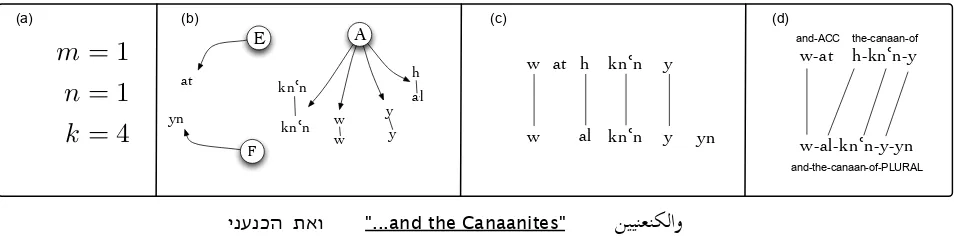
In the next section we describe our model’s “gen-erative story” for producing the data we observe. We formalize our model in the context of two languages EandF. However, the formulation can be extended to accommodate evidence from multiple languages as well. We provide an example of parallel phrase generation in Figure 1.
High-level Generative Story We have a parallel corpus of several thousand short phrases in the two languages E andF. Our model provides a genera-tive story explaining how these parallel phrases were probabilistically created. The core of the model consists of three components: a distributionAover bilingual morpheme pairs (abstract morphemes), a distributionE over stray morphemes in languageE occurring without a counterpart in languageF, and a similar distributionF for stray morphemes in lan-guageF.
As usual for hierarchical Bayesian models, the generative story begins by drawing the model pa-rameters themselves – in our case the three distri-butionsA, E, andF. These three distributions are drawn from three separate Dirichlet processes, each with appropriately defined base distributions. The Dirichlet processes ensure that the resulting distri-butions concentrate their probability mass on a small number of morphemes while holding out reasonable probability for unseen possibilities.
Once A, E, and F have been drawn, we model our parallel corpus of short phrases as a series of independent draws from a phrase-pair generation model. For each new phrase-pair, the model first chooses the number and type of morphemes to be
generated. In particular, it must choose how many unaligned stray morphemes from language E, un-aligned stray morphemes from language F, and abstract morphemes are to compose the parallel phrases. These three numbers, respectively denoted asm,n, andk, are drawn from a Poisson distribu-tion. This step is illustrated in Figure 1 part (a).
The model then proceeds to independently draw m language E morphemes from distribution E, n language-F morphemes from distributionF, andk abstract morphemes from distributionA. This step is illustrated in part (b) of Figure 1.
The m+k resulting language-E morphemes are then ordered and fused to form a phrase in language E, and likewise for the n+k resulting language-F morphemes. The ordering and fusing decisions are modeled as draws from a uniform distribution over the set of all possible orderings and fusings for sizesm,n, andk. These final steps are illustrated in parts (c)-(d) of Figure 1. Now we describe the model more formally.
Stray Morpheme Distributions Sometimes a morpheme occurs in a phrase in one language with-out a corresponding foreign language morpheme in the parallel phrase. We call these “stray phemes,” and we employ language-specific mor-pheme distributions to model their generation.
For each language, we draw a distribution over all possible morphemes (finite-length strings com-posed of characters in the appropriate alphabet) from a Dirichlet process with concentration parameterα and base distributionPeorPf respectively:
E|α, Pe ∼ DP(α, Pe) F|α, Pf ∼ DP(α, Pf)
وا#
$
%&
%''
(
ו א ת ה כ נ ע נ
י "...and the Canaanites"
w-at h-knʿn-y
w-al-knʿn-y-yn
and-ACC the-canaan-of
and-the-canaan-of-PLURAL
at knʿn
knʿn yn w
w
y
y al
h
at knʿn
knʿn
yn w
w y
y al h
E
F
A
m
= 1
n
= 1
k
= 4
[image:5.612.74.551.61.181.2](a) (b) (c) (d)
Figure 1: Generation process for a parallel bilingual phrase, with Hebrew shown on top and Arabic on bottom. (a) First the numbers of stray (mandn) and abstract (k) morphemes are drawn from a Poisson distribution. (b) Stray morphemes are then drawn fromEandF (language-specific distributions) and abstract morphemes are drawn from A. (c) The resulting morphemes are ordered. (d) Finally, some of the contiguous morphemes are fused into words.
controlled by the priorα. Nevertheless, some non-zero probability is reserved for every possible string. We note that these single-language morpheme distributions also serve as monolingual segmenta-tion models, and similar models have been success-fully applied to the task of word boundary detection (Goldwater et al., 2006).
Abstract Morpheme Distribution To model the connections between morphemes across languages, we further define a model for bilingual morpheme pairs, or abstract morphemes. This model assigns probabilities to all pairs of morphemes – that is, all pairs of finite strings from the respective alphabets –(e, f). Intuitively, we wish to assign high proba-bility to pairs of morphemes that play similar syn-tactic or semantic roles (e.g.(fy, b-)for “in” in Ara-bic and Hebrew). These morpheme pairs can thus be viewed as representingabstract morphemes. As with the stray morpheme models, we wish to define a distribution which concentrates probability mass on a small number of highly co-occurring morpheme pairs while still holding out some probability for all other pairs.
We define this abstract morpheme model A as a draw from another Dirichlet process:
A|α0, P0 ∼ DP(α0, P0)
(e, f) ∼ A
As before, the resulting distribution A will give non-zero probability to all abstract morphemes
(e, f). The base distribution P0 acts as a prior on such pairs. To defineP0, we can simply use a mix-ture of geometric distributions in the lengths of the component morphemes. However, if the languages E andF are related and the regular phonetic corre-spondences between the letter in the two alphabets are known, then we can useP0to assign higher like-lihood to potential cognates. In particular we define the priorP0(e, f) to be the probabilistic string-edit distance (Ristad and Yianilos, 1998) betweeneand f, using the known phonetic correspondences to pa-rameterize the string-edit model. In particular, in-sertion and deletion probabilities are held constant for all characters, and substitution probabilities are determined based on the known sound correspon-dences.
We report results for both the simple geometric prior as well as the string-edit prior.
Phrase Generation To generate a bilingual paral-lel phrase, we first drawm,n, andkindependently from a Poisson distribution. These three integers represent the number and type of the morphemes that compose the parallel phrase, giving the number of stray morphemes in each languageE andF and the number of coupled bilingual morpheme pairs, re-spectively.
m, n, k ∼ P oisson(λ)
e1, ..., em ∼ E
f1, ..., fn ∼ F
(e01, f10), ...,(e0k, fk0) ∼ A
The sets of morphemes drawn for each language are then ordered:
˜
e1, ...,˜em+k ∼ ORDER|e1, ..., em, e01, ..., e
0 k ˜
f1, ...,f˜n+k ∼ ORDER|f1, ..., fn, f10, ..., fk0
Finally the ordered morphemes are fused into the words that form the parallel phrases:
w1, ..., ws ∼ F U SE|e˜1, ...,e˜m+k v1, ..., vt ∼ F U SE|f˜1, ...,fn˜+k
To keep the model as simple as possible, we em-ploy uniform distributions over the sets of orderings and fusings. In other words, given a set ofr mor-phemes (for each language), we define the distribu-tion over permutadistribu-tions of the morphemes to simply be ORDER(·|r) = r1!. Then, given a fixed pheme order, we consider fusing each adjacent mor-pheme into a single word. Again, we simply model the distribution over ther−1fusing decisions uni-formly asF U SE(·|r) = 2r−11.
Implicit Alignments Note that nowhere do we ex-plicitly assign probabilities to morpheme alignments between parallel phrases. However, our model al-lows morphemes to be generated in precisely one of two ways: as a lone stray morpheme or as part of a bilingual abstract morpheme pair. Thus, our model implicitly assumes that each morpheme is either un-aligned, or aligned to exactly one morpheme in the opposing language.
If we are given a parallel phrase with already seg-mented morphemes we can easily induce the distri-bution over alignments implied by our model. As we will describe in the next section, drawing from these induced alignment distributions plays a crucial role in our inference procedure.
Inference Given our corpus of short parallel bilin-gual phrases, we wish to make segmentation de-cisions which yield a set of morphemes with high joint probability. To assess the probability of a po-tential morpheme set, we need to marginalize over all possible alignments (i.e. possible abstract mor-pheme pairings and stray mormor-pheme assignments). We also need to marginalize over all possible draws of the distributionsA, E, andF from their respec-tive Dirichlet process priors. We achieve these aims by performing Gibbs sampling.
Sampling We follow (Neal, 1998) in the deriva-tion of our blocked and collapsed Gibbs sampler. Gibbs sampling starts by initializing all random vari-ables to arbitrary starting values. At each iteration, the sampler selects a random variableXi, and draws a new value forXifrom the conditional distribution ofXi given the current value of the other variables: P(Xi|X−i). The stationary distribution of variables derived through this procedure is guaranteed to con-verge to the true joint distribution of the random variables. However, if some variables can be jointly sampled, then it may be beneficial to perform block sampling of these variables to speed convergence. In addition, if a random variable is not of direct inter-est, we can avoid sampling it directly by marginal-izing it out, yielding a collapsed sampler. We uti-lize variable blocking by jointly sampling multiple segmentation and alignment decisions. We also col-lapse our Gibbs sampler in the standard way, by us-ing predictive posteriors marginalized over all possi-ble draws from the Dirichlet processes (resulting in Chinese Restaurant Processes).
Resampling For each bilingual phrase, we resam-ple each word in the phrase in turn. For word w in languageE, we consider at once all possible seg-mentations, and for each segmentation all possible alignments. We keep fixed the previously sampled segmentation decisions for all other words in the phrase as well as sampled alignments involving mor-phemes in other words. We are thus considering at once: all possible segmentations of w along with all possible alignments involving morphemes in w with some subset of previously sampled language-Fmorphemes.3
3
justi-Arabic Hebrew
precision recall F-score precision recall F-score
RANDOM 18.28 19.24 18.75 24.95 24.66 24.80
MORFESSOR 71.10 60.51 65.38 65.38 57.69 61.29
MONOLINGUAL 52.95 78.46 63.22 55.76 64.44 59.78
+ ARABIC/HEBREW 60.40 78.64 68.32 59.08 66.50 62.57
+ ARAMAIC 61.33 77.83 68.60 54.63 65.68 59.64
+ ENGLISH 63.19 74.79 68.49 60.20 64.42 62.23
+ ARAMAIC+PH 66.74 75.46 70.83 60.87 59.73 60.29
[image:7.612.112.504.59.200.2]+ ARABIC/HEBREW+PH 67.75 77.29 72.20 64.90 62.87 63.87
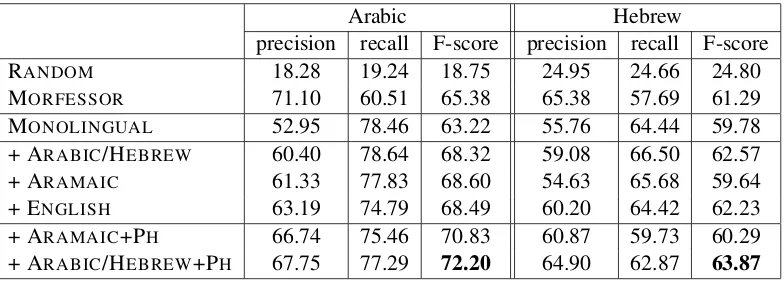
Table 1: Precision, recall and F-score evaluated on Arabic and Hebrew. The first three rows provide baselines (random selection, an alternative state-of-the-art system, and the monolingual version of our model). The next three rows show the result of our bilingual model when one of Arabic, Hebrew, Aramaic, or English is added. The final two rows show the result of the bilingual model when character-to-character phonetic correspondences are used in the abstract morpheme prior.
The sampling formulas are easily derived as prod-ucts of the relevant Chinese Restaurant Processes (with a minor adjustment to take into account the number of stray and abstract morphemes resulting from each decision). See (Neal, 1998) for general formulas for Gibbs sampling from distributions with Dirichlet process priors. All results reported are av-eraged over five runs using simulated annealing.
5 Experimental Set-Up
Morpheme Definition For the purpose of these experiments, we definemorphemes to include con-junctions, prepositional and pronominal affixes, plu-ral and dual suffixes, particles, definite articles, and roots. We do not model cases of infixed morpheme transformations, as those cannot be modeled by lin-ear segmentation.
Dataset As a source of parallel data, we use the Hebrew Bible and translations. For the Hebrew ver-sion, we use an edition distributed by Westminster Hebrew Institute (Groves and Lowery, 2006). This Bible edition is augmented by gold standard mor-phological analysis (including segmentation) per-formed by biblical scholars.
For the Arabic, Aramaic, and English versions,
fied by augmenting the model with a pair of “morpheme-identity” variables deterministically drawn from each abstract morpheme. Thus the identity of the drawn morphemes can be retained even while resampling their generation mechanism.
we use the Van Dyke Arabic translation,4 Targum Onkelos,5 and the Revised Standard Version (Nel-son, 1952), respectively. We obtained gold stan-dard segmentations of the Arabic translation with a hand-crafted Arabic morphological analyzer which utilizes manually constructed word lists and compat-ibility rules and is further trained on a large corpus of hand-annotated Arabic data (Habash and Ram-bow, 2005). The accuracy of this analyzer is re-ported to be 94% for full morphological analyses, and 98%-99% when part-of-speech tag accuracy is not included. We don’t have gold standard segmen-tations for the English and Aramaic portions of the data, and thus restrict our evaluation to Hebrew and Arabic.
To obtain our corpus of short parallel phrases, we preprocessed each language pair using the Giza++ alignment toolkit.6 Given word alignments for each language pair, we extract a list of phrase pairs that form independent sets in the bipartite alignment graph. This process allows us to group together phrases like fy s.bah. in Arabic and bbqr in He-brew while being reasonably certain that all the rele-vant morphemes are contained in the short extracted phrases. The number of words in such phrases ranges from one to four words in the Semitic lan-guages and up to six words in English. Before per-forming any experiments, a manual inspection of
4http://www.arabicbible.com/bible/vandyke.htm 5
http://www.mechon-mamre.org/i/t/u/u0.htm 6
the generated parallel phrases revealed that many infrequent phrase pairs occurred merely as a result of noisy translation and alignment. Therefore, we eliminated all parallel phrases that occur fewer than five times. As a result of this process, we obtain 6,139 parallel short phrases in Arabic, Hebrew, Ara-maic, and English. The average number of mor-phemes per word in the Hebrew data is 1.8 and is 1.7 in Arabic.
For the bilingual models which employs prob-abilistic string-edit distance as a prior on abstract morphemes, we parameterize the string-edit model with the chart of Semitic consonant relationships listed on pagexxiv of (Thackston, 1999). All pairs of corresponding letters are given equal substitution probability, while all other letter pairs are given sub-stitution probability of zero.
Evaluation Methods Following previous work, we evaluate the performance of our automatic seg-mentation algorithm using F-score. This measure is the harmonic mean of recall and precision, which are calculated on the basis of all possible segmentation points. The evaluation is performed on a random set of 1/5 of the parallel phrases which is unseen dur-ing the traindur-ing phase. Durdur-ing testdur-ing, we do not allow the models to consider any multilingual
evi-dence. This restriction allows us to simulate future
performance on purely monolingual data.
Baselines Our primary purpose is to compare the performance of our bilingual model with its fully monolingual counterpart. However, to demonstrate the competitiveness of this baseline model, we also provide results using MORFESSOR(Creutz and La-gus, 2007), a state-of-the-art unsupervised system for morphological segmentation. While developed originally for Finnish, this system has been success-fully applied to a range of languages including Ger-man, Turkish and English. The probabilistic formu-lation of this model is close to our monolingual seg-mentation model, but it uses a greedy search specif-ically designed for the segmentation task. We use the publicly available implementation of this system. To provide some idea of the inherent difficulty of this segmentation task, we also provide results from a random baseline which makes segmentation deci-sions based on a coin weighted with the true seg-mentation frequency.
6 Results
Table 1 shows the performance of the various auto-matic segmentation methods. The first three rows provide baselines, as mentioned in the previous sec-tion. Our primary baseline is MONOLINGUAL, which is the monolingual counterpart to our model and only uses the language-specific distributionsE orF. The next three rows shows the performance of various bilingual models that don’t use character-to-character phonetic correspondences to capture cog-nate information. We find that with the excep-tion of the HEBREW(+ARAMAIC) pair, the bilingual models show marked improvement over MONOLIN -GUAL. We notice that in general, adding English – which has comparatively little morphological ambi-guity – is about as useful as adding a more closely related Semitic language. However, once character-to-character phonetic correspondences are added as an abstract morpheme prior (final two rows), we find the performance of related language pairs out-strips English, reducing relative error over MONO -LINGUAL by 10% and 24% for the Hebrew/Arabic pair.
7 Conclusions and Future Work
We started out by posing two questions: (i)Can we exploit cross-lingual patterns to improve unsuper-vised analysis? (ii)Will this joint analysis provide more or less benefit when the languages belong to the same family? The model and results presented in this paper answer the first question in the affirmative, at least for the task of morphological segmentation.
We also provided some evidence that considering closely related languages may be more beneficial than distant pairs if the model is able to explicitly represent shared language structure (the character-to-character phonetic correspondences in our case). In the future, we hope to apply similar multilingual models to other core unsupervised analysis tasks, in-cluding part-of-speech tagging and grammar induc-tion, and to further investigate the role that language relatedness plays in such models.7
7
References
Meni Adler and Michael Elhadad. 2006. An un-supervised morpheme-based hmm for hebrew mor-phological disambiguation. In Proceedings of the ACL/CONLL, pages 665–672.
M. M. Bravmann. 1977. Studies in Semitic Philology. Leiden:Brill.
Lyle Campbell. 2004. Historical Linguistics: An Intro-duction. Cambridge: MIT Press.
Mathias Creutz and Krista Lagus. 2007. Unsupervised models for morpheme segmentation and morphology learning.ACM Transactions on Speech and Language Processing, 4(1).
Sajib Dasgupta and Vincent Ng. 2007. Unsuper-vised part-of-speech acquisition for resource-scarce languages. In Proceedings of the EMNLP-CoNLL, pages 218–227.
Mona Diab and Philip Resnik. 2002. An unsupervised method for word sense tagging using parallel corpora. InProceedings of the ACL, pages 255–262.
Umberto Eco. 1995. The Search for the Perfect Lan-guage. Wiley-Blackwell.
Anna Feldman, Jirka Hana, and Chris Brew. 2006. A cross-language approach to rapid creation of new morpho-syntactically annotated resources. In Pro-ceedings of LREC.
John A. Goldsmith. 2001. Unsupervised learning of the morphology of a natural language. Computational Linguistics, 27(2):153–198.
Sharon Goldwater, Thomas L. Griffiths, and Mark John-son. 2006. Contextual dependencies in unsupervised word segmentation. InProceedings of the ACL, pages 673–680.
Alan Groves and Kirk Lowery, editors. 2006. The West-minster Hebrew Bible Morphology Database. West-minster Hebrew Institute, Philadelphia, PA, USA. Nizar Habash and Owen Rambow. 2005. Arabic
tok-enization, part-of-speech tagging and morphological disambig uation in one fell swoop. InProceedings of the ACL, pages 573–580.
Jiri Hana, Anna Feldman, and Chris Brew. 2004. A resource-light approach to russian morphology: Tag-ging russian using czech resources. InProceedings of EMNLP, pages 222–229.
Radford M. Neal. 1998. Markov chain sampling meth-ods for dirichlet process mixture models. Technical Report 9815, Dept. of Statistics and Dept. of Computer Science, University of Toronto, September.
Thomas Nelson, editor. 1952. The Holy Bible Revised Standard Version. Thomas Nelson & Sons.
Sebastian Pad´o and Mirella Lapata. 2006. Optimal con-stituent alignment with edge covers for semantic pro-jection. InProceedings of ACL, pages 1161 – 1168. Eric Sven Ristad and Peter N. Yianilos. 1998. Learning
string-edit distance. IEEE Trans. Pattern Anal. Mach. Intell., 20(5):522–532.
Monica Rogati, J. Scott McCarley, and Yiming Yang. 2003. Unsupervised learning of arabic stemming us-ing a parallel corpus. InProceedings of the ACL, pages 391–398.
Patrick Schone and Daniel Jurafsky. 2000. Knowledge-free induction of morphology using latent semantic analysis. InProceedings of the CoNLL, pages 67–72. Benjamin Snyder and Regina Barzilay. 2008.
Cross-lingual propagation for morphological analysis. In
Proceedings of AAAI.
Wheeler M. Thackston. 1999. Introduction to Syriac. Ibex Publishers.
Chenhai Xi and Rebecca Hwa. 2005. A backoff model for bootstrapping resources for non-english languages. InProceedings of HLT/EMNLP, pages 851 – 858. David Yarowsky, Grace Ngai, and Richard Wicentowski.