Confidence Measure for Word Alignment
Fei Huang
IBM T.J.Watson Research Center Yorktown Heights, NY 10598, USA
Abstract
In this paper we present a confidence mea-sure for word alignment based on the posterior probability of alignment links. We introduce sentence alignment confi-dence measure and alignment link con-fidence measure. Based on these mea-sures, we improve the alignment qual-ity by selecting high confidence sentence alignments and alignment links from mul-tiple word alignments of the same sen-tence pair. Additionally, we remove low confidence alignment links from the word alignment of a bilingual training corpus, which increases the alignment F-score, improves Chinese-English and Arabic-English translation quality and sig-nificantly reduces the phrase translation table size.
1 Introduction
[image:1.595.310.529.248.342.2]Data-driven approaches have been quite active in recent machine translation (MT) research. Many MT systems, such as statistical phrase-based and syntax-based systems, learn phrase translation pairs or translation rules from large amount of bilingual data with word alignment. The qual-ity of the parallel data and the word alignment have significant impacts on the learned tion models and ultimately the quality of transla-tion output. Due to the high cost of commissioned translation, many parallel sentences are automat-ically extracted from comparable corpora, which inevitably introduce many ”noises”, i.e., inaccu-rate or non-literal translations. Given the huge amount of bilingual training data, word alignments are automatically generated using various algo-rithms ((Brown et al., 1994), (Vogel et al., 1996)
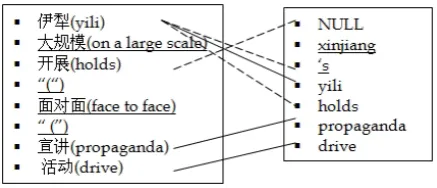
Figure 1: An example of inaccurate translation and word alignment.
and (Ittycheriah and Roukos, 2005)), which also introduce many word alignment errors.
The example in Figure 1 shows the word align-ment of the given Chinese and English sentence pair, where the English words following each Chi-nese word is its literal translation. We find untrans-lated Chinese and English words (marked with underlines). These spurious words cause signifi-cant word alignment errors (as shown with dash lines), which in turn directly affect the quality of phrase translation tables or translation rules that are learned based on word alignment.
In this paper we introduce a confidence mea-sure for word alignment, which is robust to extra or missing words in the bilingual sentence pairs, as well as word alignment errors. We propose a sentence alignment confidence measure based on the alignment’s posterior probability, and ex-tend it to the alignment link confidence measure. We illustrate the correlation between the align-ment confidence measure and the alignalign-ment qual-ity on the sentence level, and present several ap-proaches to improve alignment accuracy based on the proposed confidence measure: sentence align-ment selection, alignalign-ment link combination and alignment link filtering. Finally we demonstrate
the improved alignments also lead to better MT quality.
The paper is organized as follows: In section 2 we introduce the sentence and alignment link confidence measures. In section 3 we demon-strate two approaches to improve alignment accu-racy through alignment combination. In section 4 we show how to improve a MaxEnt word ment quality by removing low confidence align-ment links, which also leads to improved transla-tion quality as shown in sectransla-tion 5.
2 Sentence Alignment Confidence Measure
2.1 Definition
Given a bilingual sentence pair (S,T) where S={s1,. . . ,sI}is the source sentence andT={t1,
. . . ,tJ} is the target sentence. LetA = {aij} be the alignment between S andT. The alignment confidence measure C(A|S, T) is defined as the geometric mean of the alignment posterior proba-bilities calculated in both directions:
C(A|S, T) =pPs2t(A|S, T)Pt2s(A|T, S), (1)
where
Ps2t(A|S, T) =
P(A, T|S)
P
A0P(A0, T|S)
. (2)
When computing the source-to-target alignment posterior probability, the numerator is the sentence translation probability calculated according to the given alignmentA:
P(A, T|S) =
J
Y
j=1
p(tj|si, aij ∈A). (3)
It is the product of lexical translation probabili-ties for the aligned word pairs. For unaligned tar-get wordtj, considersi =N U LL. The source-to-target lexical translation model p(t|s) and target-to-source model p(s|t) can be obtained through IBM Model-1 or HMM training. The denomina-tor is the sentence translation probability summing over all possible alignments, which can be calcu-lated similar to IBM Model 1 in (Brown et al., 1994):
X
A0
P(A0, T|S) =
J
Y
j=1
I
X
i=1
p(tj|si). (4)
Aligner F-score Cor. Coeff.
HMM 54.72 -0.710
BM 62.53 -0.699
[image:2.595.319.528.326.464.2]MaxEnt 69.26 -0.699
Table 1: Correlation coefficients of multiple align-ments.
Note that here only the word-based lexicon model is used to compute the confidence measure. More complex models such as alignment models, fertility models and distortion models as described in (Brown et al., 1994) could estimate the proba-bility of a given alignment more accurately. How-ever the summation over all possible alignments is very complicated, even intractable, with the richer models. For the efficient computation of the de-nominator, we use the lexical translation model.
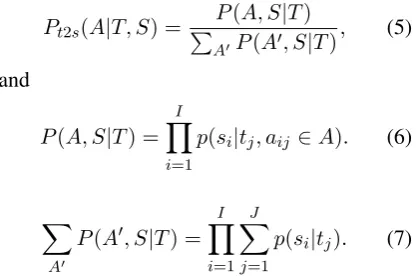
Similarly,
Pt2s(A|T, S) =
P(A, S|T)
P
A0P(A0, S|T)
, (5)
and
P(A, S|T) =
I
Y
i=1
p(si|tj, aij ∈A). (6)
X
A0
P(A0, S|T) =
I
Y
i=1
J
X
j=1
p(si|tj). (7)
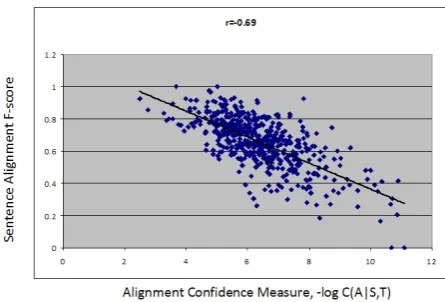
We randomly selected 512 Chinese-English (C-E) sentence pairs and generated word alignment using the MaxEnt aligner (Ittycheriah and Roukos, 2005). We evaluate per sentence alignment F-scores by comparing the system output with a reference alignment. For each sentence pair, we also calculate the sentence alignment confidence score −logC(A|S, T). We compute the corre-lation coefficients between the alignment confi-dence measure and the alignment F-scores. The results in Figure 2 shows strong correlation be-tween the confidence measure and the alignment F-score, with the correlation coefficients equals to -0.69. Such strong correlation is also observed on an HMM alignment (Ge, 2004) and a Block Model (BM) alignment (Zhao et al., 2005) with varying alignment accuracies, as seen in Table1.
2.2 Sentence Alignment Selection Based on Confidence Measure
F-Figure 2: Correlation between sentence alignment confidence measure and F-score.
measure suggests the possibility of selecting the alignment with the highest confidence score to ob-tain better alignments. For each sentence pair in the C-E test set, we calculate the confidence scores of the HMM alignment, the Block Model align-ment and the MaxEnt alignalign-ment, then select the alignment with the highest confidence score. As a result, 82% of selected alignments have higher F-scores, and the F-measure of the combined align-ments is increased over the best aligner (the Max-Ent aligner) by 0.8. This relatively small improve-ment is mainly due to the selection of thewhole
sentence alignment: for many sentences the best alignment still contains alignment errors, some of which could be fixed by other aligners. Therefore, it is desirable to combine alignment links from dif-ferent alignments.
3 Alignment Link Confidence Measure
3.1 Definition
Similar to the sentence alignment confidence mea-sure, the confidence of an alignment linkaij in the sentence pair (S,T) is defined as
c(aij|S, T) =
q
qs2t(aij|S, T)qt2s(aij|T, S) (8) where the source-to-target link posterior probabil-ity
qs2t(aij|S, T) =
p(tj|si)
PJ
j0=1p(tj0|si)
, (9)
which is defined as the word translation probabil-ity of the aligned word pair divided by the sum of the translation probabilities over all the target words in the sentence. The higher p(tj|si) is,
the higher confidence the link has. Similarly, the target-to-source link posterior probability is de-fined as:
qt2s(aij|T, S) =
p(si|tj)
PI
i0=1p(si0|tj)
. (10)
Intuitively, the above link confidence definition compares the lexical translation probability of the aligned word pair with the translation probabilities of all the target words given the source word. If a wordtoccursN times in the target sentence, for anyi∈ {1, ..., I},
J
X
j0=1
p(tj0|si)≥N p(t|si),
thus for anytj =t,
qs2t(aij)≤
1
N.
This indicates that the confidence score of any link connectingtj to any source word is at most
1/N. On the one hand this is expected because multiple occurrences of the same word does in-crease the confusion for word alignment and re-duce the link confidence. On the other hand, ad-ditional information (such as the distance of the word pair, the alignment of neighbor words) could indicate higher likelihood for the alignment link. We will introduce a context-dependent link confi-dence measure in section 4.
3.2 Alignment Link Selection
From multiple alignments of the same sentence pair, we select high confidence links from different alignments based on their link confidence scores and alignment agreement ratio.
Typically, links appearing in multiple align-ments are more likely correct alignalign-ments. The alignment agreement ratio measures the popular-ityof a link. Suppose the sentence pair(S, T)have alignments A1,. . . , AD, the agreement ratio of a linkaij is defined as
r(aij|S, T) =
P
dC(Ad|S, T:aij ∈Ad)
P
d0C(Ad0|S, T) , (11)
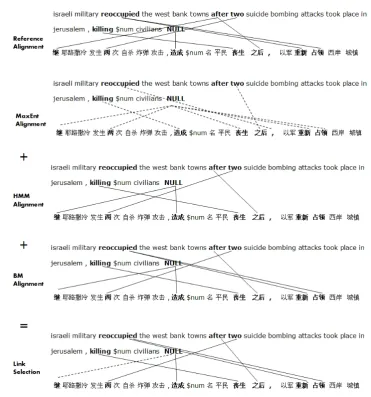
[image:3.595.73.296.64.215.2]Figure 3: Example of alignment link selection by combining MaxEnt, HMM and BM alignments.
normalized by the sum of all alignments’ confi-dence scores.
We collect all the links from all the alignments. For each link we calculate the link confidence score c(aij) and the alignment agreement ratio r(aij). We link the word pair (si, tj) if either c(aij) > h1 orr(aij) > r1, whereh1 andr1 are
empirically chosen thresholds.
We combine the HMM alignment, the BM alignment and the MaxEnt alignment (ME) us-ing the above link selection algorithm. Figure 3 shows such an example, where alignment er-rors in the MaxEnt alignment are shown with dot-ted lines. As some of the links are correctly aligned in the HMM and BM alignments (shown with solid lines), the combined alignment corrects some alignment errors while still contains com-mon incorrect alignment links.
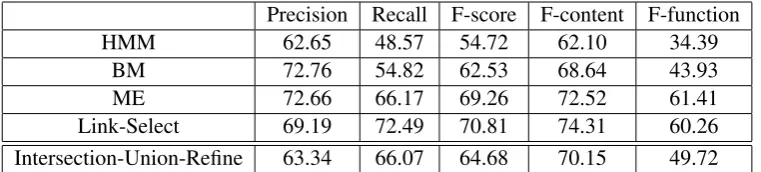
Table 2 shows the precision, recall and F-score of individual alignments and the combined
align-ment. F-content and F-function are the F-scores for content words and function words, respec-tively. The link selection algorithm improves the recall over the best aligner (the ME align-ment) by 7 points (from 65.4 to 72.5) while de-creasing the precision by 4.4 points (from 73.6 to 69.2). Overall it improves the F-score by 1.5 points (from 69.3 to 70.8), 1.8 point improvement for content words and 1.0 point for function words. It also significantly outperforms the traditionally used heuristics, ”intersection-union-refine” (Och and Ney, 2003) by 6 points.
4 Improved MaxEnt Aligner with Confidence-based Link Filtering
Precision Recall F-score F-content F-function
HMM 62.65 48.57 54.72 62.10 34.39
BM 72.76 54.82 62.53 68.64 43.93
ME 72.66 66.17 69.26 72.52 61.41
Link-Select 69.19 72.49 70.81 74.31 60.26
[image:5.595.110.491.62.148.2]Intersection-Union-Refine 63.34 66.07 64.68 70.15 49.72
Table 2: Link Selection and Combination Results
the highest F-measure among the three aligners, although the algorithm described below can be ap-plied to any aligner.
It is often observed that words within a con-stituent (such as NP, PP) are typically translated together, and their alignments are close. As a re-sult the confidence measure of an alignment link aij can be boosted given the alignment of its con-text words. From the initial sentence alignment we first identify an anchor linkamn, the high con-fidence alignment link closest to aij. The an-chor link is considered as the most reliable con-nection between the source and target context. The context is then defined as a window center-ing at amn with window width proportional to the distance between aij and amn. When com-puting the context-dependent link confidence, we only consider words within the context window. The context-dependent alignment link confidence is calculated in the following steps:
1. Calculate thecontext-independent link con-fidence measurec(aij) according to formula (8).
2. Sort all links based on their link confidence measures in decreasing order.
3. Select links whose confidence scores are higher than an empirically chosen threshold Has anchor links1.
4. Walking along the remaining sorted links. For each link{aij :c(aij)< H},
(a) Find the closest anchor linkamn2,
(b) Define the context window width w = |m−i|+|n−j|.
1H is selected to maximize the F-score on an alignment
devset.
2When two equally close alignment links have the same
confidence score), we randomly select one of the tied links as the anchor link.
(c) Compute the link posterior probabilities within the context window:
qs2t(aij|amn) =
p(tj|si)
Pj+w
j0=j−wp(tj0|si)
,
qt2s(aij|amn) =
p(si|tj)
Pi+w
i0=i−wp(si0|tj)
.
(d) Compute the context-dependent link confidence scorec(aij|amn)=
q
qs2t(aij|amn)qt2s(aij|amn).
Ifc(aij|amn) > H, addaij into the set of anchor links.
5. Only keep anchor links and remove all the re-maining links with low confidence scores.
The above link filtering algorithm is designed to remove incorrect links. Furthermore, it is possible to create new links by relinking unaligned source and target word pairs within the context window if their context-dependent link posterior probability is high.
Figure 4 shows context-independent link con-fidence scores for the given sentence alignment. The subscript following each word indicates the word’s position. Incorrect alignment links are shown with dashed lines, which have low confi-dence scores (a5,7, a7,3, a8,2, a11,9) and will be
removed through filtering. When the anchor link a4,11is selected, the context-dependent link
confi-dence ofa6,12is increased from 0.12 to 0.51. Also
note that a new linka7,12(shown as a dotted line)
Figure 4: Alignment link filtering based on context-independent link confidence.
Precision Recall F-score
Baseline 72.66 66.17 69.26
[image:6.595.83.276.304.347.2]+ALF 78.14 64.36 70.59
Table 3: Confidence-based Alignment Link Filter-ing on C-E Alignment
Precision Recall F-score
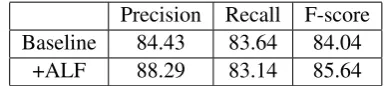
Baseline 84.43 83.64 84.04
+ALF 88.29 83.14 85.64
Table 4: Confidence-based Alignment Link Filter-ing on A-E Alignment
512 sentence pairs, and the A-E alignment test set is the 200 Arabic-English sentence pairs from NIST MT03 test set.
Tables 3 and 4 show the improvement of C-E and A-E alignment F-measures with the confidence-based alignment link filtering (ALF). For C-E alignment, removing low confidence alignment links increased alignment precision by 5.5 point, while decreased recall by 1.8 point, and the overall alignment F-measure is increased by 1.3 point. When looking into the alignment links which are removed during the alignment link fil-tering process, we found that 80% of the removed links (1320 out of 1661 links) are incorrect align-ments, For A-E alignment, it increased the pre-cision by 3 points while reducing recall by 0.5 points, and the alignment F-measure is increased by about 1.5 points absolute, a 10% relative align-ment error rate reduction. Similarly, 90% of the removed links are incorrect alignments.
5 Translation
We evaluate the improved alignment on sev-eral Chinese-English and Arabic-English machine translation tasks. The documents to be trans-lated are from difference genres: newswire (NW)
and web-blog (WB). The MT system is a phrase-based SMT system as described in (Al-Onaizan and Papineni, 2006). The training data are bilin-gual sentence pairs with word alignment, from which we obtained phrase translation pairs. We extract phrase translation tables from the baseline MaxEnt word alignment as well as the alignment with confidence-based link filtering, then trans-late the test set with each phrase translation ta-ble. We measure the translation quality with au-tomatic metrics including BLEU (Papineni et al., 2001) and TER (Snover et al., 2006). The higher the BLEU score is, or the lower the TER score is, the better the translation quality is. We com-bine the two metrics into (TER-BLEU)/2 and try to minimize it. In addition to the whole test set’s scores, we also measure the scores of the ”tail” documents, whose (TER-BLEU)/2 scores are at the bottom 10 percentile (for A-E translation) and 20 percentile (for C-E translation) and are consid-ered the most difficult documents to translate.
# phrase pairs Average Tail
TER BLEU (TER-BLEU)/2 TER BLEU (TER-BLEU)/2
Baseline 934206 60.74 28.05 16.35 69.02 17.83 25.60
ALF 797685 60.33 28.52 15.91 68.31 19.27 24.52
Table 5: Improved Chinese-English Newswire Translation with Alignment Link Filtering
# phrase pairs Average Tail
TER BLEU (TER-BLEU)/2 TER BLEU (TER-BLEU)/2
Baseline 934206 62.87 25.08 18.89 66.55 18.80 23.88
[image:7.595.78.524.62.123.2]ALF 797685 62.30 24.89 18.70 65.97 19.25 23.36
Table 6: Improved Chinese-English Web-Blog Translation with Alignment Link Filtering
alignment links are more likely to be selected. The removal of incorrect alignment links and cleaner phrase translation pairs brought more gains on the tail documents.
In the Arabic-English MT, we selected 80 NW documents and 55 WB documents. The NW train-ing data includes 319 thousand A-E sentence pairs subsampled from 7.2 million sentence pairs with word alignments. The WB training data includes 240 thousand subsampled sentence pairs. Tables 7 and 8 show the corresponding translation results. Similarly, the phrase table size is significantly re-duced by 35%, while the gains on the tail docu-ments range from 0.6 to 1.4. On the whole test set the difference is smaller, 0.07 for the newswire translation and 0.58 for the web-blog translation.
6 Related Work
In the machine translation area, most research on confidence measure focus on the confidence of MT output: how accurate a translated sentence is. (Gandrabur and Foster, 2003) used neural-net to improve the confidence estimate for text predic-tions in a machine-assisted translation tool. (Ueff-ing et al., 2003) presented several word-level con-fidence measures for machine translation based on word posterior probabilities. (Blatz et al., 2004) conducted extensive study incorporating various sentence-level and word-level features thru multi-layer perceptron and naive Bayes algorithms for sentence and word confidence estimation. (Quirk, 2004) trained a sentence level confidence mea-sure using a human annotated corpus. (Bach et al., 2008) used the sentence-pair confidence scores estimated with source and target language mod-els to weight phrase translation pairs. However, there has been little research focusing on
confi-dence measure for word alignment. This work is the first attempt to address the alignment con-fidence problem.
Regarding word alignment combination, in ad-dition to the commonly used ”intersection-union-refine” approach (Och and Ney, 2003), (Ayan and Dorr, 2006b) and (Ayan et al., 2005) com-bined alignment links from multiple word align-ment based on a set of linguistic and alignalign-ment features within the MaxEnt framework or a neural net model. While in this paper, the alignment links are combined based on their confidence scores and alignment agreement ratios.
(Fraser and Marcu, 2007) discussed the impact of word alignment’s precision and recall on MT quality. Here removing low confidence links re-sults in higher precision and slightly lower recall for the alignment. In our phrase extraction, we allow extracting phrase translation pairs with un-alignedfunctionalwords at the boundary. This is similar to the ”loose phrases” described in (Ayan and Dorr, 2006a), which increased the number of correct phrase translations and improved the trans-lation quality. On the other hand, removing
incor-rect content word links produced cleaner phrase
translation tables. When translating documents with lower phrase coverage (typically the “tail” documents), high quality phrase translations are particularly important because a bad phrase trans-lation can be picked up more easily due to limited phrase translation pairs available.
7 Conclusion
se-# phrase pairs Average Tail
TER BLEU (TER-BLEU)/2 TER BLEU (TER-BLEU)/2
Baseline 939911 43.53 50.51 -3.49 53.14 40.60 6.27
[image:8.595.78.523.62.123.2]ALF 618179 43.11 50.24 -3.56 51.75 42.05 4.85
Table 7: Improved Arabic-English Newswire Translation with Alignment Link Filtering
# phrase pairs Average Tail
TER BLEU (TER-BLEU)/2 TER BLEU (TER-BLEU)/2
Baseline 598721 49.91 39.90 5.00 57.30 30.98 13.16
ALF 383561 48.94 40.00 4.42 55.99 31.92 12.04
Table 8: Improved Arabic-English Web-Blog Translation with Alignment Link Filtering
lected among multiple alignments and it obtained 0.8 F-measure improvement over the single best Chinese-English aligner. The second is the align-ment link confidence measure, which selects the most reliable links from multiple alignments and obtained 1.5 F-measure improvement. When we removed low confidence links from the MaxEnt aligner, we reduced the Chinese-English ment error by 5% and the Arabic-English align-ment error by 10%. The cleaned alignalign-ment sig-nificantly reduced the size of phrase translation ta-bles by 15-35%. It furthermore led to better trans-lation scores for Chinese and Arabic documents with different genres. In particular, it improved the translation scores of the tail documents by 0.5-1.4 points measured by the combined metric of (TER-BLEU)/2.
For future work we would like to explore richer models to estimate alignment posterior probabil-ity. In most cases, exact calculation by summing over all possible alignments is impossible, and ap-proximation using N-best alignments is needed.
Acknowledgments
We are grateful to Abraham Ittycheriah, Yaser Al-Onaizan, Niyu Ge and Salim Roukos and anony-mous reviewers for their constructive comments. This work was supported in part by the DARPA GALE project, contract No. HR0011-08-C-0110.
References
Yaser Al-Onaizan and Kishore Papineni. 2006. Distor-tion Models for Statistical Machine TranslaDistor-tion. In Proceedings of the 21st International Conference on Computational Linguistics and 44th Annual Meet-ing of the Association for Computational LMeet-inguis- Linguis-tics, pages 529–536, Sydney, Australia, July. Asso-ciation for Computational Linguistics.
Necip Fazil Ayan and Bonnie J. Dorr. 2006a. Going beyond aer: An extensive analysis of word align-ments and their impact on mt. In Proceedings of the 21st International Conference on Computational Linguistics and 44th Annual Meeting of the Asso-ciation for Computational Linguistics, pages 9–16, Sydney, Australia, July. Association for Computa-tional Linguistics.
Necip Fazil Ayan and Bonnie J. Dorr. 2006b. A max-imum entropy approach to combining word align-ments. In Proceedings of the Human Language Technology Conference of the NAACL, Main Con-ference, pages 96–103, New York City, USA, June. Association for Computational Linguistics.
Necip Fazil Ayan, Bonnie J. Dorr, and Christof Monz. 2005. Neuralign: Combining word alignments us-ing neural networks. In Proceedings of Human Language Technology Conference and Conference on Empirical Methods in Natural Language Pro-cessing, pages 65–72, Vancouver, British Columbia, Canada, October. Association for Computational Linguistics.
Nguyen Bach, Qin Gao, and Stephan Vogel. 2008. Im-proving word alignment with language model based confidence scores. In Proceedings of the Third Workshop on Statistical Machine Translation, pages 151–154, Columbus, Ohio, June. Association for Computational Linguistics.
John Blatz, Erin Fitzgerald, George Foster, Simona Gandrabur, Cyril Goutte, Alex Kulesza, Alberto Sanchis, and Nicola Ueffing. 2004. Confidence es-timation for machine translation. In COLING ’04: Proceedings of the 20th international conference on Computational Linguistics, page 315, Morristown, NJ, USA. Association for Computational Linguis-tics.
Alexander Fraser and Daniel Marcu. 2007. Measuring word alignment quality for statistical machine trans-lation. Comput. Linguist., 33(3):293–303.
Simona Gandrabur and George Foster. 2003. Confi-dence estimation for translation prediction. In Pro-ceedings of the seventh conference on Natural lan-guage learning at HLT-NAACL 2003, pages 95–102, Morristown, NJ, USA. Association for Computa-tional Linguistics.
Niyu Ge. 2004. Max-posterior hmm alignment for machine translation. In Presentation given at DARPA/TIDES NIST MT Evaluation workshop.
Abraham Ittycheriah and Salim Roukos. 2005. A maximum entropy word aligner for arabic-english machine translation. In HLT ’05: Proceedings of the conference on Human Language Technology and Empirical Methods in Natural Language Process-ing, pages 89–96, Morristown, NJ, USA. Associa-tion for ComputaAssocia-tional Linguistics.
Franz J. Och and Hermann Ney. 2003. A systematic comparison of various statistical alignment models. Comput. Linguist., 29(1):19–51, March.
Kishore Papineni, Salim Roukos, Todd Ward, and Wei-Jing Zhu. 2001. BLEU: a Method for Automatic Evaluation of Machine Translation. In ACL ’02: Proceedings of the 40th Annual Meeting on Asso-ciation for Computational Linguistics, pages 311– 318, Morristown, NJ, USA. Association for Compu-tational Linguistics.
Chris Quirk. 2004. Training a sentence-level machine translation confidence measure. In In Proc. LREC 2004, pages 825–828, Lisbon, Portual. Springer-Verlag.
Matthew Snover, Bonnie Dorr, Richard Schwartz, Lin-nea Micciulla, and John Makhoul. 2006. A Study of Translation Edit Rate with Targeted Human An-notation. InProceedings of Association for Machine Translation in the Americas.
Nicola Ueffing, Klaus Macherey, and Hermann Ney. 2003. Confidence measures for statistical machine translation. InIn Proc. MT Summit IX, pages 394– 401. Springer-Verlag.
Stephan Vogel, Hermann Ney, and Christoph Tillmann. 1996. Hmm-based word alignment in statistical translation. In Proceedings of the 16th conference on Computational linguistics, pages 836–841, Mor-ristown, NJ, USA. Association for Computational Linguistics.