Stochastic Language Generation Using WIDL-expressions and its
Application in Machine Translation and Summarization
Radu Soricut
Information Sciences Institute University of Southern California
4676 Admiralty Way, Suite 1001 Marina del Rey, CA 90292
Daniel Marcu
Information Sciences Institute University of Southern California
4676 Admiralty Way, Suite 1001 Marina del Rey, CA 90292
Abstract
We propose WIDL-expressions as a flex-ible formalism that facilitates the integra-tion of a generic sentence realizaintegra-tion sys-tem within end-to-end language process-ing applications. WIDL-expressions rep-resent compactly probability distributions over finite sets of candidate realizations, and have optimal algorithms for realiza-tion via interpolarealiza-tion with language model probability distributions. We show the ef-fectiveness of a WIDL-based NLG system in two sentence realization tasks: auto-matic translation and headline generation.
1 Introduction
The Natural Language Generation (NLG) com-munity has produced over the years a consid-erable number of generic sentence realization systems: Penman (Matthiessen and Bateman, 1991), FUF (Elhadad, 1991), Nitrogen (Knight and Hatzivassiloglou, 1995), Fergus (Bangalore and Rambow, 2000), HALogen (Langkilde-Geary, 2002), Amalgam (Corston-Oliver et al., 2002), etc. However, when it comes to end-to-end, text-to-text applications – Machine Translation, Summa-rization, Question Answering – these generic sys-tems either cannot be employed, or, in instances where they can be, the results are significantly below that of state-of-the-art, application-specific systems (Hajic et al., 2002; Habash, 2003). We believe two reasons explain this state of affairs.
First, these generic NLG systems use input rep-resentation languages with complex syntax and se-mantics. These languages involve deep, semantic-based subject-verb or verb-object relations (such as ACTOR, AGENT, PATIENT, etc., for Penman
and FUF), syntactic relations (such assubject,
object, premod, etc., for HALogen), or
lexi-cal dependencies (Fergus, Amalgam). Such inputs cannot be accurately produced by state-of-the-art analysis components from arbitrary textual input in the context of text-to-text applications.
Second, most of the recent systems (starting with Nitrogen) have adopted a hybrid approach to generation, which has increased their robust-ness. These hybrid systems use, in a first phase, symbolic knowledge to (over)generate a large set of candidate realizations, and, in a second phase, statistical knowledge about the target language (such as stochastic language models) to rank the candidate realizations and find the best scoring one. The disadvantage of the hybrid approach – from the perspective of integrating these sys-tems within end-to-end applications – is that the two generation phases cannot be tightly coupled. More precisely, input-driven preferences and tar-get language–driven preferences cannot be inte-grated in a true probabilistic model that can be trained and tuned for maximum performance.
In this paper, we propose WIDL-expressions (WIDL stands for Weighted Interleave, Disjunc-tion, and Lock, after the names of the main op-erators) as a representation formalism that facil-itates the integration of a generic sentence real-ization system within end-to-end language appli-cations. The WIDL formalism, an extension of the IDL-expressions formalism of Nederhof and Satta (2004), has several crucial properties that differentiate it from previously-proposed NLG representation formalisms. First, it has a sim-ple syntax (expressions are built using four oper-ators) and a simple, formal semantics (probability distributions over finite sets of strings). Second, it is a compact representation that grows linearly
in the number of words available for generation (see Section 2). (In contrast, representations such as word lattices (Knight and Hatzivassiloglou, 1995) or non-recursive CFGs (Langkilde-Geary, 2002) require exponential space in the number of words available for generation (Nederhof and Satta, 2004).) Third, it has good computational properties, such as optimal algorithms for inter-section with -gram language models (Section 3). Fourth, it is flexible with respect to the amount of linguistic processing required to produce WIDL-expressions directly from text (Sections 4 and 5). Fifth, it allows for a tight integration of input-specific preferences and target-language prefer-ences via interpolation of probability distributions using log-linear models. We show the effec-tiveness of our proposal by directly employing a generic WIDL-based generation system in two end-to-end tasks: machine translation and auto-matic headline generation.
2 The WIDL Representation Language
2.1 WIDL-expressions
In this section, we introduce WIDL-expressions, a formal language used to compactly represent prob-ability distributions over finite sets of strings.
Given a finite alphabet of symbols
, atomic WIDL-expressions are of the form , with
. For a WIDL-expression , its semantics is
a probability distribution "! #$%'&)(
, where *
,+-. and /0012
&
. Complex WIDL-expressions are created from other WIDL-expressions, by employing the fol-lowing four operators, as well as operator distri-bution functions354 from an alphabet6 .
Weighted Disjunction. If 87 %595959:%
<; are
WIDL-expressions, then = >*?@A*7 %595959-%
B;,
with 3C ,+ &D%595959:%
. !
#$%'&)(
, specified such that FE-GIHKJML<N
?
@KO 3CPRQ/S
&
, is a WIDL-expression. Its semantics is a probability
distribution 0TU !
#$%'&)(
, where
V
;
4XW<7
* PY, and the
probabil-ity values are induced by 3'C and 1)B4R, &[Z]\^Z
. For example, if _ >?@D0` %ba
,
c
@ed^fg hji'kl-monphji'kn)q , its semantics is a
proba-bility distribution )R over j+-` %ba
. ,
defined by rDsDtuwvXxzy|{wxX}){
d
c
@
x
g
{
d i'kl and
r sItu~vxzy|{wxA{
d
c
@
x
n
{
di'kn .
Precedence. If 7
%
B are WIDL-expressions,
then 7 is a WIDL-expression. Its
semantics is a probability distribution |R
S!
#$%'&)(
, where is the set of all
strings that obey the precedence imposed over the arguments, and the probability values are in-duced by /07) and /RB- . For example, if
7>?b50` %ba
,
c
dfgBh[i-kl-mnhi'knq , and >?:0
%K ,
c
d2fgFhi'k'mon hi-k'q , then
7 represents a probability distribution
over the set p +-`A
%
`
%ba
%ba|
. , defined
by r sItu~v
xzy|{wxX}Mb{
d
c
x
g
{
c
x
g
{
di'kl ,
r
sDtu~v xzy{wxX}MI{
d
c
x
g
{
c
x
n
{
di-kn , etc.
Weighted Interleave. If87 %595959:%
<; are
WIDL-expressions, then _)?@A*7
%
B %595959:%
<;, with
c
@5fbM ¢¡M£'¤¡M£X¥§¦q)fK¦w 5¨b©¡w¦wqh«ªi'mbgw¬,
¯®°1±D²p; ,
specified such that e³ GIHKJMLBN ?@ O
3CA01
&
, is a WIDL-expression. Its semantics is a probability
distribution R´U* !
#$%'&)(
, where
consists of all the possible interleavings of
strings from PY,
&µZ¶\·Z
, and the proba-bility values are induced by3-C and 1)B4R . The
distribution function3 C is defined either explicitly,
over ´®¸°1±D²¹p; (the set of all permutations of
elements), or implicitly, as 3-CP0DºM»I±D²½¼P±D²¹ ¾M .
Be-cause the set of argument permutations is a sub-set of all possible interleavings, 3-C also needs to
specify the probability mass for the strings that are not argument permutations, 3-CP¿¾5»ÁÀ'Âñ¾). For
example, if M?@ 0` a§%
-,
c
@ d_f5gÄnh i-kl)i'm*Mw ¢¡¢£5¤¡M£X¥§¦ÆÅÈÇÉhÊËÈÌÍ i-kÎgKÏ5m¦ 5¨b©8¡w¦ÄÅÇÈÉhÊËÈÌÍ i-ki)Ïq , its
semantics is a probability distribution |0 ,
with domain ]+-`
a
%
5` a§%
`A
a
. , defined
by r sDtu~vxzy{wxX}¢Ab{
d
c
@
x
g8n
{
d[i'kl)i ,
r sItu~vxzy|{wxb}¢A{
d
Ð0ÑbÒ ËXÓÎÔÕXÌRÖÈÕXÌÍ5×zØ
di-kÎgbÏ ,
rDsItu~vxzy|{wxX}MwD{
d
Ð0ÑbÒ ×ÙÔÅÛÚDÕz×ÛØ
di'ki)Ï .
Lock. If *Ü is a WIDL-expression, then ]
Ý
ÜX is a WIDL-expression. The semantic
map-ping /0 is the same as R Ü, except
that contains strings in which no
addi-tional symbol can be interleaved. For exam-ple, if M?@A
Ý
0`
a
%
-,
c
@[d,fgÞn¸h i-kl)i'm|¢w ¢¡M£5¤)¡M£X¥§¦ßh¶i-knMiq , its semantics is a
proba-bility distribution R, with domain
+-5` ao%
`
a
D. , defined by r sDtu~vxzy{wxX}¢Ab{
d
c
@
x
g8n
{
d
i-kl)i ,
r sItu~vxzy|{wxb}MI{
d
Ð0Ñ¢Ò ËÈÓÔXÕXÌRÖXÕXÌÍ×àØ
di-knMi .
In Figure 1, we show a more complex WIDL-expression. The probability distribution 3 7
associ-ated with the operator )?~ assigns probability 0.2
to the argument order á &oâ
; from a probability mass of 0.7, it assigns uniformly, for each of the remaining
â½ãä&
æå argument permutations, a
permutation probability value of C)çè
é
$9X&ê
¢?~:
Ý
¿ºMÀÁ²¾5» I±D²Á ±-º¢ >?A
Ý
w²È± P±¾ »:º
Ý
-ºwºM± ²± P±¾Mb z²Á
3:7+:á &oâ
!
$9
á
%
Dº)»:±D²½¼P±D² ¾
JÛL
!
$9 Á%
¾5»ÁÀ'Âñ¾!
J!ÛL
!
$9X&
.
%
3 +
&
!
$9#"
å
%
á ! $9Ùâ
åÁ.
Figure 1: An example of a WIDL-expression.
remaining probability mass of 0.1 is left for the 12 shuffles associated with the unlocked expres-sion z² , for a shuffle probability of
C)ç7 7¹
$9Î$A$%$
. The list below enumerates some of the
&
¾bº)²
%(' ¿¾bº)²
) pairs that belong to the
proba-bility distribution defined by our example: rebels fighting turkish government in iraq 0.130
in iraq attacked rebels turkish goverment 0.049
in turkish goverment iraq rebels fighting 0.005
The following result characterizes an important representation property for WIDL-expressions.
Theorem 1 A WIDL-expression over
and 6 using atomic expressions has space complexity O( ), if the operator distribution functions of have space complexity at most O( ).
For proofs and more details regarding WIDL-expressions, we refer the interested reader to (Soricut, 2006). Theorem 1 ensures that high-complexity hypothesis spaces can be represented efficiently by WIDL-expressions (Section 5).
2.2 WIDL-graphs and Probabilistic Finite-State Acceptors
WIDL-graphs. Equivalent at the representation level with WIDL-expressions, WIDL-graphs al-low for formulations of algorithms that process them. For each WIDL-expression , there exists
an equivalent WIDL-graph * . As an example,
we illustrate in Figure 2(a) the WIDL-graph cor-responding to the WIDL-expression in Figure 1. WIDL-graphs have an initial vertex+-, and a final
vertex +%. . Vertices +PC , +0/ , and +AbC with in-going
edges labeled 1
7
? ,
1
? , and 132
? , respectively, and
vertices +
é
,+½754 , and+A
2
with out-going edges la-beled 6
7
?~ ,
6
?b , and 632
?~ , respectively, result from
the expansion of the )?~ operator. Vertices +Áè
and + 7
2
with in-going edges labeled
7
?¹ ,
?¹ ,
re-spectively, and vertices+17¹ and+½757 with out-going
edges labeled
7
? ,
? , respectively, result from the
expansion of the >?¹ operator.
With each WIDL-graph *
, we associate a
probability distribution. The domain of this dis-tribution is the finite collection of strings that can be generated from the paths of a WIDL-specific
traversal of* , starting from+8, and ending in+%. .
Each path (and its associated string) has a proba-bility value induced by the probaproba-bility distribution functions associated with the edge labels of* . A
WIDL-expression and its corresponding
WIDL-graph * are said to be equivalent because they
represent the same distribution ) .
WIDL-graphs and Probabilistic FSA. Proba-bilistic finite-state acceptors (pFSA) are a well-known formalism for representing probability dis-tributions (Mohri et al., 2002). For a WIDL-expression , we define a mapping, called
UNFOLD, between the WIDL-graph * and a
pFSA 9 . A state : in 9 is created for each
set of WIDL-graph vertices that can be reached simultaneously when traversing the graph. State
: records, in what we call a -stack (interleave
stack), the order in which 1
4
? ,
6
4
? –bordered
sub-graphs are traversed. Consider Figure 2(b), in which state
#
+PC;+04<+D
2
%
+
&
?b
â
áÁ.
(
(at the bottom) cor-responds to reaching vertices +ÁC
%
+4 , and +A
2
(see the WIDL-graph in Figure 2(a)), by first reach-ing vertex +P
2
(inside the 1 2 ?~ ,
6 2
?~ –bordered
sub-graph), and then reaching vertex+ 4 (inside the1
?b ,
6
?b –bordered sub-graph).
A transition labeled between two 9 states
:P7 and :: in 9
exists if there exists a vertex +=
in the description of : 7 and a vertex +
E
in the de-scription of :I such that there exists a path in *
between += and +
E
, and is the only
-labeled transitions in this path. For example, transition
#
+AC;+04<+D
2
%
+
&
?b
â
áÁ.
(
?>A@>CBD
!
#
+AC<+½754<+A
2
%
+
&
?~
â
áÁ.
(
(Fig-ure 2(b)) results from unfolding the path +84FE!
+½7¹C #>C@>ABD
! +½7b7GE!H+½7¹
O
Ð
!I+½754 (Figure 2(a)). A
tran-sition labeledJ between two9p states: 7 and: in
9 exists if there exists a vertex+= in the
descrip-tion of : 7 and vertices +
7
E
%595959-%
+
;
E
in the
descrip-tion of :: , such that +=LK
Y
Ð
!M+
4
E
N* ,
&Z«\ Z
(see transition
#
+O, %~(
E
!
#
+AC<+/;+AbC
%
+
&
?~;)w?~.
(
), or if there exists vertices +
7
=
%595959-%
+
;
= in the description
of :
7 and vertex
+
E
in the description of :
, such
that+
4
=
P:Y
Ð
!Q+
E
R* , & Z´\FZ
! ! " "# # $ $% % & &' ' ( () ) * *+ + , , -. ./ / 0 01 1 2 23 3 45454 45454 45454 45454 45454 45454 65656 65656 65656 65656 65656 65656 75757 75757 75757 75757 75757 75757 75757 85858 85858 85858 85858 85858 85858 95959 95959 95959 95959 95959 95959 :5:5: :5:5: :5:5: :5:5: :5:5: :5:5: ;5;5;5; ;5;5;5; ;5;5;5; ;5;5;5; ;5;5;5; ;5;5;5; ;5;5;5; <5<5<5< <5<5<5< <5<5<5< <5<5<5< <5<5<5< <5<5<5< attacked attacked attacked attacked attacked rebels rebels rebels fighting rebels rebels rebels rebels rebels fighting fighting fighting fighting turkish turkish turkish turkish turkish turkish turkish government government government government government government in iraq in in in in in iraq iraq iraq iraq iraq ε ε δ1 government turkish :0.3 attacked:0.1 :0.3 :1 :1 rebels :0.2 :1 fighting :1 rebels :1 δ1 :0.18 :0.18 :1 rebels :1 rebels :1 ε
0 6 21
0 623 09 23
9 01121
0920 0 1520 6 20 2 0 21 s e (b) (a) rebels rebels fighting (
(2 )
δ1 δ1 δ1 δ1 δ1 δ1 δ2 δ2 δ2 1 2 3 2 1 1 3 )1 δ2 attacked in iraq
ε ε ε
ε ε
ε
ε ε ε
ε
turkish 1 1government 1
1 1 1 1
1 1 1 1
2
v
v v v v
v v v v v v
v v v v v v
v v
v v v v
v 1
v
s e
0 1 2 3 4
v6
7 8 9 10 11 12
13 14 15 16 17 18
19
20 21 22 23
5
0 6 20
01923δ1
01923
[v , ]
01923δ1
01923
[v v v ,<32] [v v v ,<32]
[v v v ,<3]
[v v v ,<3] [v v v ,<32]
[v v v ,<0] [v v v ,<32] [v v v ,<2]
[v v v ,<2] [v , ]
[v v v ,<1 ]
ε ε δ1 δ1 δ1 δ1 δ1 δ1 δ1 δ1 δ1 δ1 0.1 } shuffles 0.7, δ1= { 2 1 3 0.2,other perms δ2 = {1 0.65, 2 0.35 }
δ1 [v v v ,< > ]δ1
[v v v ,< 0 > ] [v v v ,< 321 > ]δ1δ1
Figure 2: The WIDL-graph corresponding to the WIDL-expression in Figure 1 is shown in (a). The probabilistic finite-state acceptor (pFSA) that corresponds to the WIDL-graph is shown in (b).
are responsible for adding and removing, respec-tively, the
&
? ,)~? symbols in the -stack. The
prob-abilities associated with 9 transitions are
com-puted using the vertex set and the -stack of each
9 state, together with the distribution functions
of the > and operators. For a detailed
presen-tation of the UNFOLDrelation we refer the reader to (Soricut, 2006).
3 Stochastic Language Generation from WIDL-expressions
3.1 Interpolating Probability Distributions in a Log-linear Framework
Let us assume a finite set
=
of strings over a finite alphabet
, representing the set of possi-ble sentence realizations. In a log-linear frame-work, we have a vector of feature functions >
&
> C > 7 95959
>@? ), and a vector of parameters A¶
&
AC5A|7 95959
A ? ) . For any B
=
, the interpolated probability CÞDB: can be written under a log-linear
model as in Equation 1:
C·DBI* EGFIH # ? J W|C A J > J DBI ( .LK EGFIH # ? J W|C A J > J DB Ü ( (1)
We can formulate the search problem of finding the most probable realization B under this model
as shown in Equation 2, and therefore we do not need to be concerned about computing expensive normalization factors. `NMPORQÃ` F . CÞDB:*T`NMPOSQÃ` F . EGFIH # ? J W|C A J > J DB: ( (2)
For a given WIDL-expression over
, the set =
is defined by Ä0 /b, and feature function
>C is taken to be R. Any language model
we want to employ may be added in Equation 2 as a feature function>4,
\UT&
.
3.2 Algorithms for Intersecting WIDL-expressions with Language Models
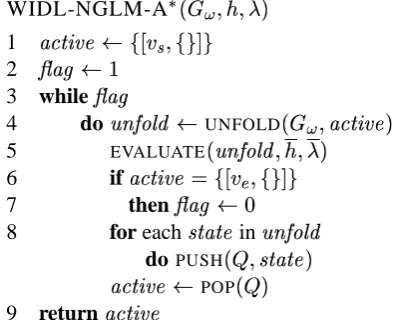
Algorithm WIDL-NGLM-AV (Figure 3) solves
the search problem defined by Equation 2 for a WIDL-expression (which provides feature
func-tion > C ) and
W -gram language models (which
provide feature functions >§7 %595959:%
> ? . It does
so by incrementally computing UNFOLD for *
(i.e., on-demand computation of the correspond-ing pFSA9 ), by keeping track of a set of active
states, called XZY\[^]`_Na . The set of newlyUNFOLDed
states is called bdc5eGfNgih . Using Equation 1
(unnor-malized), we EVALUATE the current C·DB: scores
for the bIc\ejfNgkh states. Additionally, EVALUATE
uses an admissible heuristic function to compute future (admissible) scores for thebIc\eGflgkh states.
The algorithmPUSHes each state from the cur-rent bdc5eGfNgih into a priority queue m , which sorts
the states according to their total score (current n
admissible). In the next iteration, XZY5[^]o_la is a
sin-gleton set containing the statePOPed out from the
top ofm . The admissible heuristic function we use
is the one defined in (Soricut and Marcu, 2005), using Equation 1 (unnormalized) for computing the event costs. Given the existence of the ad-missible heuristic and the monotonicity property of the unfolding provided by the priority queuem ,
the proof for AV optimality (Russell and Norvig,
1995) guarantees that WIDL-NGLM-AV finds a
WIDL-NGLM-AV*
%
>
%
A
1 XZY5[^]o_la +
#
+%,
%
+A.
(
.
2
X
&
3 while X
4 do bIc\ejfNgkh UNFOLD*
%
XZY5[^]o_laD
5 EVALUATE bdc5eGfNgih
%
>
%
A|
6 if XZY\[^]`_Na +
#
+0.
%
+A.
(
.
7 then
X
$
8 for each [Xl[ a inbIc\ejfNgih doPUSH m
%
[ Xl[aP X Y\[^]`_Na POPm
9 returnXZY5[^]o_la
Figure 3: AV algorithm for interpolating
WIDL-expressions with -gram language models.
An important property of the
WIDL-NGLM-AV algorithm is that theUNFOLD
relation (and, implicitly, the 9p acceptor) is
computed only partially, for those states for which the total cost is less than the cost of the optimal path. This results in important savings, both in space and time, over simply running a single-source shortest-path algorithm for directed acyclic graphs (Cormen et al., 2001) over the full acceptor9 (Soricut and Marcu, 2005).
4 Headline Generation using WIDL-expressions
We employ the WIDL formalism (Section 2) and the WIDL-NGLM-AV algorithm (Section 3) in a
summarization application that aims at producing both informative and fluent headlines. Our head-lines are generated in an abstractive, bottom-up manner, starting from words and phrases. A more common, extractive approach operates top-down, by starting from an extracted sentence that is com-pressed (Dorr et al., 2003) and annotated with ad-ditional information (Zajic et al., 2004).
Automatic Creation of WIDL-expressions for Headline Generation. We generate WIDL-expressions starting from an input document. First, we extract a weighted list of topic keywords from the input document using the algorithm of Zhou and Hovy (2003). This list is enriched with phrases created from the lexical dependen-cies the topic keywords have in the input docu-ment. We associate probability distributions with these phrases using their frequency (we assume
Keywords + iraq 0.32,syria 0.25,rebels 0.22,
kurdish 0.17,turkish 0.14,attack 0.10.
Phrases
iraq+ in iraq 0.4,northern iraq 0.5,iraq and iran 0.1. ,
syria+ into syria 0.6,and syria 0.4.
rebels+ attacked rebels 0.7,rebels fighting 0.3.
. . .
WIDL-expression & trigram interpolation
[image:5.595.69.270.72.232.2]TURKISH GOVERNMENT ATTACKED REBELS IN IRAQ AND SYRIA
Figure 4: Input and output for our automatic head-line generation system.
that higher frequency is indicative of increased im-portance) and their position in the document (we assume that proximity to the beginning of the doc-ument is also indicative of importance). In Fig-ure 4, we present an example of input keywords and lexical-dependency phrases automatically ex-tracted from a document describing incidents at the Turkey-Iraq border.
The algorithm for producing WIDL-expressions combines the lexical-dependency phrases for each keyword using a> operator with
the associated probability values for each phrase multiplied with the probability value of each topic keyword. It then combines all the > -headed
expressions into a single WIDL-expression using a operator with uniform probability. The
WIDL-expression in Figure 1 is a (scaled-down) example of the expressions created by this algorithm. On average, a WIDL-expression created by this algorithm, using
"
keywords and an average ofQÃ
ê
lexical-dependency phrases per keyword, compactly encodes a candidate set of about 3 million possible realizations. As the specification of the M? operator takes spaceÃ
&
for uniform 3 ,
Theorem 1 guarantees that the space complexity of these expressions is· Q/.
Finally, we generate headlines from WIDL-expressions using the WIDL-NGLM-AV
algo-rithm, which interpolates the probability distribu-tions represented by the WIDL-expressions with -gram language model distributions. The output presented in Figure 4 is the most likely headline realization produced by our system.
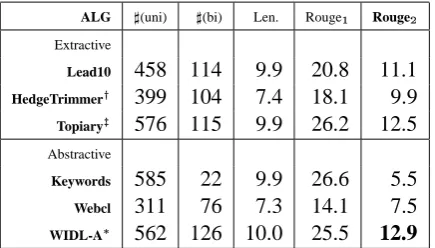
ALG (uni) (bi) Len. Rouge Rouge
Extractive
Lead10 458 114 9.9 20.8 11.1
HedgeTrimmer 399 104 7.4 18.1 9.9
Topiary 576 115 9.9 26.2 12.5
Abstractive
Keywords 585 22 9.9 26.6 5.5
Webcl 311 76 7.3 14.1 7.5
WIDL-A 562 126 10.0 25.5 12.9
Table 1: Headline generation evaluation. We com-pare extractive algorithms against abstractive al-gorithms, including our WIDL-based algorithm.
and the other half is used as test set (273 docu-ments). We automatically measure performance by comparing the produced headlines against one reference headline produced by a human using ROUGE (Lin, 2004).
For each input document, we train two language models, using the SRI Language Model Toolkit (with modified Kneser-Ney smoothing). A gen-eral trigram language model, trained on 170M English words from the Wall Street Journal, is used to model fluency. A document-specific tri-gram language model, trained on-the-fly for each input document, accounts for both fluency and content validity. We also employ a word-count model (which counts the number of words in a proposed realization) and a phrase-count model (which counts the number of phrases in a proposed realization), which allow us to learn to produce headlines that have restrictions in the number of words allowed (10, in our case). The interpolation weights A (Equation 2) are trained using
discrimi-native training (Och, 2003) using ROUGE as the
objective function, on the development set. The results are presented in Table 1. We com-pare the performance of several extractive algo-rithms (which operate on an extracted sentence to arrive at a headline) against several abstractive algorithms (which create headlines starting from scratch). For the extractive algorithms, Lead10
is a baseline which simply proposes as headline the lead sentence, cut after the first 10 words.
HedgeTrimmer
is our implementation of the Hedge Trimer system (Dorr et al., 2003), andTopiary is
our implementation of the Topiary system (Zajic et al., 2004). For the abstractive algorithms,
Key-words is a baseline that proposes as headline the
sequence of topic keywords, Webcl is the system
THREE GORGES PROJECT IN CHINA HAS WON APPROVAL
WATER IS LINK BETWEEN CLUSTER OF E. COLI CASES
SRI LANKA ’S JOINT VENTURE TO EXPAND EXPORTS
OPPOSITION TO EUROPEAN UNION SINGLE CURRENCY EURO
[image:6.595.72.290.62.186.2]OF INDIA AND BANGLADESH WATER BARRAGE
Figure 5: Headlines generated automatically using a WIDL-based sentence realization system.
described in (Zhou and Hovy, 2003), and WIDL-A is the algorithm described in this paper.
This evaluation shows that our WIDL-based approach to generation is capable of obtaining headlines that compare favorably, in both content and fluency, with extractive, state-of-the-art re-sults (Zajic et al., 2004), while it outperforms a previously-proposed abstractive system by a wide margin (Zhou and Hovy, 2003). Also note that our evaluation makes these results directly compara-ble, as they use the same parsing and topic identi-fication algorithms. In Figure 5, we present a sam-ple of headlines produced by our system, which includes both good and not-so-good outputs.
5 Machine Translation using WIDL-expressions
We also employ our WIDL-based realization en-gine in a machine translation application that uses a two-phase generation approach: in a first phase, WIDL-expressions representing large sets of pos-sible translations are created from input foreign-language sentences. In a second phase, we use our generic, WIDL-based sentence realization en-gine to intersect WIDL-expressions with an -gram language model. In the experiments reported here, we translate between Chinese (source lan-guage) and English (target lanlan-guage).
Automatic Creation of WIDL-expressions for MT. We generate WIDL-expressions from Chi-nese strings by exploiting a phrase-based trans-lation table (Koehn et al., 2003). We use an al-gorithm resembling probabilistic bottom-up pars-ing to build a WIDL-expression for an input Chi-nese string: each contiguous span
\K%
over a
Chinese string 4= is considered a possible
“con-stituent”, and the “non-terminals” associated with each constituent are the English phrase transla-tions =
E
4= that correspond in the translation
ta-ble to the Chinese string 84= . Multiple-word
En-glish phrases, such as , are represented
"!
#%$&'"'%()*+,-'"./0.12# 3+'"43567(8 %
#9
#:%(77:%(77 ,:%(77();<
=
->@?
502/ABDC EF G C A H I J
;K)L
=
M>N? JOI
K;PQ&K;KPKR; JS
K;TQ)
=
!
>@? JMI
KR;
J
P&K; JU
K; JV
K;KWR T
I
K;PQKR;
J
KK;PTK;PXR
T
I
K;
U
WK;
J
QK;PKKR;
U
X) P
I
K;PKKR;
V
W&K; US
K;P
S
L
P
I
K; JU
K; JJ
K; JV
KR;KW)
=
9
>N? JOI
K;XQ&K;PPKR;TQ&K;XP) UYI
K;
J
XK;TWK;T
U
KR;T
U
T
I
K;TPKR;QKK;QPK;TXR
Q
I
K;
J
KK;PPK;
J
KKR;
J
XL P
I
K;
J
TKR;
J
X&K;TTK; JJ
L
WIDL-expression & trigram interpolation
[image:7.595.75.300.63.177.2]gunman was killed by police .
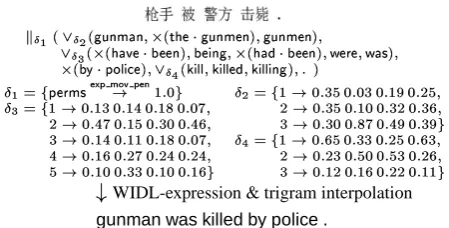
Figure 6: A Chinese string is converted into a WIDL-expression, which provides a translation as the best scoring hypothesis under the interpolation with a trigram language model.
lock (Ý
) operators, as Ý
8 . To limit
the number of possible translations =
E
4=
corre-sponding to a Chinese span 84= , we use a
prob-abilistic beam Z and a histogram beam : to beam
out low probability translation alternatives. At this point, each 4= span is “tiled” with likely
transla-tions =
E
4= taken from the translation table.
Tiles that are adjacent are joined together in a larger tile by a M? operator, where 3
+P¼P±D² ¾
>[R\ LJ] \>
!
&
. . That is, reordering of
the component tiles are permitted by the 5?
op-erators (assigned non-zero probability), but the longer the movement from the original order of the tiles, the lower the probability. (This distor-tion model is similar with the one used in (Koehn, 2004).) When multiple tiles are available for the same span
\K%
, they are joined by a >*?
opera-tor, where 3 is specified by the probability
distri-butions specified in the translation table. Usually, statistical phrase-based translation tables specify not only one, but multiple distributions that ac-count for context preferences. In our experi-ments, we consider four probability distributions:
'
^`_BD %('
B_^o %('Ya
.b ^`_BD, and 'ca
.b B3_^| , where ^
and B are Chinese-English phrase translations as
they appear in the translation table. In Figure 6, we show an example of WIDL-expression created by this algorithm1.
On average, a WIDL-expression created by this algorithm, using an average of
â0$
tiles per sentence (for an average input sentence length of 30 words) and an average ofQ·ed possible
trans-lations per tile, encodes a candidate set of about 10
é
C
possible translations. As the specification of the ¢? operators takes space Ã
&
, Theorem 1
1English reference:
the gunman was shot dead by the police.
guarantees that these WIDL-expressions encode compactly these huge spaces in· Q/.
In the second phase, we employ our WIDL-based realization engine to interpolate the distri-bution probabilities of WIDL-expressions with a trigram language model. In the notation of Equa-tion 2, we use four feature funcEqua-tions>|C
%595959:%
>
2
for the WIDL-expression distributions (one for each probability distribution encoded); a feature func-tion >Of for a trigram language model; a feature
function>
é
for a word-count model, and a feature function> / for a phrase-count model.
As acknowledged in the Machine Translation literature (Germann et al., 2003), full AV search is
not usually possible, due to the large size of the search spaces. We therefore use an approxima-tion algorithm, called WIDL-NGLM-AV
E
, which considers for unfolding only the nodes extracted from the priority queue m which already unfolded
a path of length greater than or equal to the max-imum length already unfolded minus Q (we used
QÃTá in the experiments reported here).
MT Performance Evaluation. When evaluated against the state-of-the-art, phrase-based decoder Pharaoh (Koehn, 2004), using the same experi-mental conditions – translation table trained on the FBIS corpus (7.2M Chinese words and 9.2M English words of parallel text), trigram lan-guage model trained on 155M words of English newswire, interpolation weights A (Equation 2)
trained using discriminative training (Och, 2003) (on the 2002 NIST MT evaluation set), probabilis-tic beamZ set to 0.01, histogram beam: set to 10
– and BLEU (Papineni et al., 2002) as our met-ric, the WIDL-NGLM-AV algorithm produces
translations that have a BLEU score of 0.2570, while Pharaoh translations have a BLEU score of 0.2635. The difference is not statistically signifi-cant at 95% confidence level.
These results show that the WIDL-based ap-proach to machine translation is powerful enough to achieve translation accuracy comparable with state-of-the-art systems in machine translation.
6 Conclusions
preferences (Soricut and Marcu, 2005). One can also work with bags of words and phrases that en-code context preferences, a scenario that applies to current approaches in statistical machine transla-tion (Sectransla-tion 5). And one can also encode context and ordering preferences typically used in summa-rization (Section 4).
The generation engine we describe enables a tight coupling of content selection with sen-tence realization preferences. Its algorithm comes with theoretical guarantees about its optimality. Because the requirements for producing WIDL-expressions are minimal, our WIDL-based genera-tion engine can be employed, with state-of-the-art results, in a variety of text-to-text applications.
Acknowledgments This work was partially sup-ported under the GALE program of the Defense Advanced Research Projects Agency, Contract No. HR0011-06-C-0022.
References
Srinivas Bangalore and Owen Rambow. 2000. Using TAG, a tree model, and a language model for gen-eration. In Proceedings of the Fifth International Workshop on Tree-Adjoining Grammars (TAG+).
Thomas H. Cormen, Charles E. Leiserson, Ronald L. Rivest, and Clifford Stein. 2001. Introduction to Algorithms. The MIT Press and McGraw-Hill.
Simon Corston-Oliver, Michael Gamon, Eric K. Ring-ger, and Robert Moore. 2002. An overview of Amalgam: A machine-learned generation module. In Proceedings of the INLG.
Bonnie Dorr, David Zajic, and Richard Schwartz. 2003. Hedge trimmer: a parse-and-trim approach to headline generation. In Proceedings of the HLT-NAACL Text Summarization Workshop, pages 1–8.
Michael Elhadad. 1991. FUF User manual — version 5.0. Technical Report CUCS-038-91, Department of Computer Science, Columbia University.
Ulrich Germann, Mike Jahr, Kevin Knight, Daniel Marcu, and Kenji Yamada. 2003. Fast decoding and optimal decoding for machine translation. Artificial Intelligence, 154(1–2):127-143.
Nizar Habash. 2003. Matador: A large-scale Spanish-English GHMT system. In Proceedings of AMTA.
J. Hajic, M. Cmejrek, B. Dorr, Y. Ding, J. Eisner, D. Gildea, T. Koo, K. Parton, G. Penn, D. Radev, and O. Rambow. 2002. Natural language genera-tion in the context of machine translagenera-tion. Summer workshop final report, Johns Hopkins University.
K. Knight and V. Hatzivassiloglou. 1995. Two level, many-path generation. In Proceedings of the ACL.
Philipp Koehn, Franz J. Och, and Daniel Marcu. 2003. Statistical phrase based translation. In Proceedings of the HLT-NAACL, pages 127–133.
Philipp Koehn. 2004. Pharaoh: a beam search decoder for phrase-based statistical machine transltion mod-els. In Proceedings of the AMTA, pages 115–124.
I. Langkilde-Geary. 2002. A foundation for general-purpose natural language generation: sentence re-alization using probabilistic models of language. Ph.D. thesis, University of Southern California.
Chin-Yew Lin. 2004. ROUGE: a package for auto-matic evaluation of summaries. In Proceedings of the Workshop on Text Summarization Branches Out (WAS 2004).
Christian Matthiessen and John Bateman. 1991. Text Generation and Systemic-Functional Linguis-tic. Pinter Publishers, London.
Mehryar Mohri, Fernando Pereira, and Michael Ri-ley. 2002. Weighted finite-state transducers in speech recognition. Computer Speech and Lan-guage, 16(1):69–88.
Mark-Jan Nederhof and Giorgio Satta. 2004. IDL-expressions: a formalism for representing and pars-ing finite languages in natural language processpars-ing. Journal of Artificial Intelligence Research, pages 287–317.
Franz Josef Och. 2003. Minimum error rate training in statistical machine translation. In Proceedings of the ACL, pages 160–167.
Kishore Papineni, Salim Roukos, Todd Ward, and Wei-Jing Zhu. 2002. BLEU: a method for automatic evaluation of machine translation. In In Proceedings of the ACL, pages 311–318.
Stuart Russell and Peter Norvig. 1995. Artificial Intel-ligence. A Modern Approach. Prentice Hall.
Radu Soricut and Daniel Marcu. 2005. Towards devel-oping generation algorithms for text-to-text applica-tions. In Proceedings of the ACL, pages 66–74.
Radu Soricut. 2006. Natural Language Generation for Text-to-Text Applications Using an Information-Slim Representation. Ph.D. thesis, University of South-ern California.
David Zajic, Bonnie J. Dorr, and Richard Schwartz. 2004. BBN/UMD at DUC-2004: Topiary. In Pro-ceedings of the NAACL Workshop on Document Un-derstanding, pages 112–119.