Translating HPSG-style Outputs of a Robust Parser
into Typed Dynamic Logic
Manabu Sato† Daisuke Bekki‡ Yusuke Miyao† Jun’ichi Tsujii†
∗
† Department of Computer Science, University of Tokyo Hongo 7-3-1, Bunkyo-ku, Tokyo 113-0033, Japan
‡ Center for Evolutionary Cognitive Sciences, University of Tokyo Komaba 3-8-1, Meguro-ku, Tokyo 153-8902, Japan
∗School of Informatics, University of Manchester
PO Box 88, Sackville St, Manchester M60 1QD, UK
∗SORST, JST (Japan Science and Technology Corporation)
Honcho 4-1-8, Kawaguchi-shi, Saitama 332-0012, Japan † {sa-ma, yusuke, tsujii}@is.s.u-tokyo.ac.jp
Abstract
The present paper proposes a method by which to translate outputs of a ro-bust HPSG parser into semantic rep-resentations of Typed Dynamic Logic (TDL), a dynamic plural semantics de-fined in typed lambda calculus. With its higher-order representations of con-texts, TDL analyzes and describes the inherently inter-sentential nature of quantification and anaphora in a strictly lexicalized and compositional manner. The present study shows that the pro-posed translation method successfully combines robustness and descriptive ad-equacy of contemporary semantics. The present implementation achieves high coverage, approximately 90%, for the real text of the Penn Treebank corpus.
1 Introduction
Robust parsing technology is one result of the recent fusion between symbolic and statistical approaches in natural language processing and has been applied to tasks such as information extraction, information retrieval and machine translation (Hockenmaier and Steedman, 2002; Miyao et al., 2005). However, reflecting the field boundary and unestablished interfaces be-tween syntax and semantics in formal theory of grammar, this fusion has achieved less in semantics than in syntax.
For example, a system that translates the output of a robust CCG parser into seman-tic representations has been developed (Bos et al., 2004). While its corpus-oriented parser at-tained high coverage with respect to real text,
the expressive power of the resulting semantic representations is confined to first-order predi-cate logic.
The more elaborate tasks tied to discourse information and plurality, such as resolution of anaphora antecedent, scope ambiguity, pre-supposition, topic and focus, are required to refer to ‘deeper’ semantic structures, such as dynamic semantics (Groenendijk and Stokhof, 1991).
However, most dynamic semantic theories are not equipped with large-scale syntax that covers more than a small fragment of target languages. One of a few exceptions is Min-imal Recursion Semantics (MRS) (Copestake et al., 1999), which is compatible with large-scale HPSG syntax (Pollard and Sag, 1994) and has affinities with UDRS (Reyle, 1993). For real text, however, its implementation, as in the case of the ERG parser (Copestake and Flickinger, 2000), restricts its target to the static fragment of MRS and yet has a lower coverage than corpus-oriented parsers (Baldwin, to appear).
The lack of transparency between syntax and discourse semantics appears to have created a tension between the robustness of syntax and the descriptive adequacy of semantics.
In the present paper, we will introduce a robust method to obtain dynamic seman-tic representations based on Typed Dynamic Logic (TDL) (Bekki, 2000) from real text by translating the outputs of a robust HPSG parser (Miyao et al., 2005). Typed Dy-namic Logic is a dyDy-namic plural seman-tics that formalizes the structure underlying the semantic interactions between quantifica-tion, plurality, bound variable/E-type anaphora
re×···×e7→txi
1· · ·xin ≡ λG(i7→e)7→t.λgi7→e.g∈G∧rgx1, . . . ,gxm®
∼φprop ≡ λG(i7→e)7→t.λgi7→e.g∈G∧¬∃hi7→e.h∈φG
⎡ ⎣
φprop
.. .
ϕprop
⎤
⎦ ≡ λG(i7→e)7→t.(ϕ· · ·(φG))
re f¡xi¢[φprop] [ϕprop] ≡ λG(i7→e)7→t.
⎧ ⎨ ⎩
i f G±x=φG±x thenλgi7→e.g
∈ϕG∧G±x=ϕG±x otherwise unde f ined
⎫ ⎬ ⎭ ⎛
⎜ ⎝
where prop ≡ ((i7→e)7→t)7→(i7→e)7→t gα∈Gα7→t ≡ Gg
G(i7→e)7→t.
xi ≡ λde.∃gi7→e.g∈G∧gx=d
[image:2.595.96.395.71.209.2]⎞ ⎟ ⎠
Figure 1: Propositions of TDL (Bekki, 2005)
and presuppositions. All of this complex discourse/plurality-related information is encap-sulated within higher-order structures in TDL, and the analysis remains strictly lexical and compositional, which makes its interface with syntax transparent and straightforward. This is a significant advantage for achieving robustness in natural language processing.
2 Background
2.1 Typed Dynamic Logic
Figure 1 shows a number of propositions de-fined in (Bekki, 2005), including atomic pred-icate, negation, conjunction, and anaphoric ex-pression. Typed Dynamic Logic is described in typed lambda calculus (Gödel’s System T) with four ground types: e(entity), i(index), n(natural number), and t(truth). While assignment func-tions in static logic are funcfunc-tions in meta-language from type e variables (in the case of first-order logic) to objects in the domain De,
assignment functions in TDL are functions in object-language from indices to entities. Typed Dynamic Logic defines the notion context as a set of assignment functions (an object of type (i7→e)7→t) and a proposition as a
func-tion from context to context (an object of type
((i7→e)7→t)→7 (i7→e)7→t). The conjunctions
of two propositions are then defined as com-posite functions thereof. This setting conforms to the view of “propositions as information flow”, which is widely accepted in dynamic semantics.
Since all of these higher-order notions are described in lambda terms, the path for compo-sitional type-theoretic semantics based on func-tional application, funcfunc-tional composition and
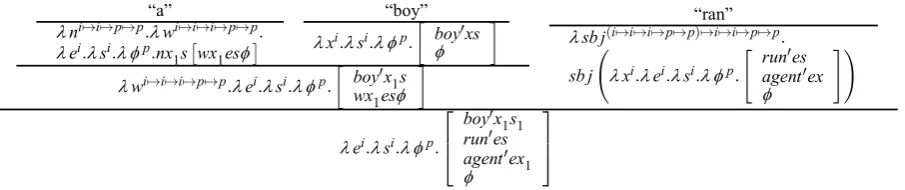
type raising is clarified. The derivations of TDL semantic representations for the sentences “A boy ran. He tumbled.” are exemplified in Figure 2 and Figure 3. With some instantia-tion of variables, the semantic representainstantia-tions of these two sentences are simply conjoined and yield a single representation, as shown in (1).
⎡ ⎢ ⎢ ⎢ ⎣
boy0x
1s1 run0e
1s1 agent0e
1x1 re f(x2) [ ]
∙
tumble0e
2s2 agent0e
2x2
¸
⎤ ⎥ ⎥ ⎥ ⎦
(1)
The propositions boy0x
1s1, run0e1s1 and agent0e
1x1 roughly mean “the entity referred to by x1 is a boy in the situation s1”, “the event referred to by e1 is a running event in the situation s1”, and “the agent of event e1 is x1”, respectively.
The former part of (1) that corresponds to the first sentence, filtering and testing the input context, returns the updated context schema-tized in (2). The updated context is then passed to the latter part, which corresponds to the second sentence as its input.
· · · x1 s1 e1 · · ·
john situation1 running1
john situation2 running2
. .
. ... ... (2)
[image:2.595.309.502.611.653.2]“a”
λni7→i7→p7→p.λwi7→i7→i7→p7→p.
λei.λsi.λ φp.nx
1s £wx
1esφ ¤
“boy”
λxi.λsi.λ φp.
∙
boy0xs
φ
¸
λwi7→i7→i7→p7→p.λei.λsi.λ φp.∙ boy0x1s
wx1esφ
¸
“ran”
λsb j(i7→i7→i7→p7→p)7→i7→i7→p7→p.
sb j Ã
λxi.λei.λsi.λ φp.
" run0es agent0ex
φ
#!
λei.λsi.λ φp.
⎡ ⎢ ⎣
boy0x 1s1 run0es agent0ex
1
φ
[image:3.595.75.528.73.168.2]⎤ ⎥ ⎦
Figure 2: Derivation of a TDL semantic representation of “A boy ran”.
“he”
λwi7→i7→i7→p7→p.
λei.λsi.λ φp.re f¡x
2 ¢
[ ]£wx2esφ¤
“tumbled”
λsb j(i7→i7→i7→p7→p)7→i7→i7→p7→p.
sb j Ã
λxi.λei.λsi.λ φp.
" tumble0es agent0ex
φ
#!
λei.λsi.λ φp.re f¡x
2¢[ ]
∙ tumble0e
2s2 agent0e
[image:3.595.128.470.226.295.2]2x2 ¸
Figure 3: Derivation of TDL semantic representation of “He tumbled”.
Although the antecedent for x2 is not de-termined in this structure, the possible candi-dates can be enumerated: x1, s1 and e1, which precede x2. Since TDL seamlessly represents linguistic notions such as “entity”, “event” and “situation”, by indices, the anaphoric expres-sions, such as “the event” and “that case”, can be treated in the same manner.
2.2 Head-driven Phrase Structure Grammar
Head-driven Phrase Structure Grammar (Pollard and Sag, 1994) is a kind of lexicalized gram-mar that consists of lexical items and a small number of composition rules called schema. Schemata and lexical items are all described in typed feature structures and the unification operation defined thereon.
⎡ ⎢ ⎢ ⎢ ⎢ ⎣
PHON “boy”
SY N SEM
⎡ ⎢ ⎢ ⎢ ⎢ ⎢ ⎣
H EAD
∙
noun MOD h i
¸
VAL
" SU BJ h i COMPS h i SPR hdeti
#
SLASH h i
⎤ ⎥ ⎥ ⎥ ⎥ ⎥ ⎦
⎤ ⎥ ⎥ ⎥ ⎥ ⎦
(3)
Figure 4 is an example of a parse tree, where the feature structures marked with the same boxed numbers have a shared struc-ture. In the first stage of the derivation of this tree, lexical items are assigned to each of the strings, “John” and “runs.” Next, the mother node, which dominates the two items,
⎡ ⎢ ⎣
PH ON “John runs” H EAD 1
SU BJ h i COMPS h i
⎤ ⎥ ⎦
⎡ ⎢ ⎣
PH ON “John” H EAD noun SU BJ h i COMPS h i
⎤ ⎥ ⎦: 2
⎡ ⎢ ⎢ ⎣
PH ON “runs” H EAD verb: 1 SU BJ h2i COMPS h i
⎤ ⎥ ⎥ ⎦
[image:3.595.314.519.345.477.2]John runs
Figure 4: An HPSG parse tree
is generated by the application of Subject-Head Schema. The recursive application of these op-erations derives the entire tree.
3 Method
⎡ ⎣
PH ON “John runs” H EAD 1
SU BJ h i COMPS h i
⎤ ⎦
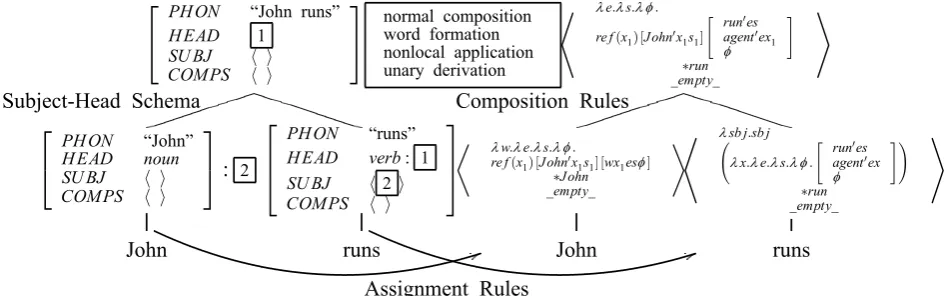
Subject-Head Schema
* λe.λs.λ φ. re f(x1) [John0x1s1]
" run0es agent0ex
1 φ
#
∗run
_empty_
+
Composition Rules normal composition
word formation nonlocal application unary derivation
⎡ ⎣
PH ON “John” H EAD noun SU BJ h i COMPS h i
⎤ ⎦: 2
⎡ ⎢ ⎣
PH ON “runs” H EAD verb: 1 SU BJ h 2i COMPS h i
⎤ ⎥ ⎦
Assignment Rules
¿ λw.λe.λs.λ φ.
re f(x1) [John0x1s1] [wx1esφ]
∗John
_empty_
À* λÃsb j.sb j
λx.λe.λs.λ φ.
" run0es agent0ex
φ
#!
∗run
_empty_
+
[image:4.595.71.546.63.211.2]John runs John runs
Figure 5: Example of the application of the rules
parser, a compound noun is regarded as two distinct words, whereas in TDL, a compound noun is regarded as one word. Long-distance dependency is also treated differently in the two systems. Furthermore, TDL has an opera-tion called unary derivaopera-tion to deal with empty categories, whereas the HPSG parser does not have such an operation.
In order to overcome these differences and realize a straightforward composition of TDL representations according to the HPSG parse tree, we defined two extended composition rules, word formation rule and non-local application rule, and redefined TDL unary derivation rules for the use in the HPSG parser. At each step of the composition, one composition rule is chosen from the set of rules, based on the information of the schemata applied to the HPSG tree and TDL represen-tations of the constituents. In addition, we de-fined extended TDL semantic representations, referred to as TDL Extended Structures (TD-LESs), to be paired with the extended compo-sition rules.
In summary, the proposed method is com-prised of TDLESs, assignment rules, composi-tion rules, and unary derivacomposi-tion rules, as will be elucidated in subsequent sections.
3.1 Data Structure
A TDLES is a tuple hT,p,ni, where T is an extended TDL term, which can be either a TDL term or a special value ω. Here, ω
is a value used by the word formation rule, which indicates that the word is a word modi-fier (See Section 3.3). In addition, p and n are the necessary information for extended
compo-sition rules, where p is a matrix predicate in T and is used by the word formation rule, and n is a nonlocal argument, which takes either a variable occurring in T or an empty value. This element corresponds to the SLASH fea-ture in HPSG and is used by the nonlocal application rule.
The TDLES of the common noun “boy” is given in (4). The contents of the structure are T, p and n, beginning at the top. In (4), T corresponds to the TDL term of “boy” in Figure 2, p is the predicate boy, which is identical to a predicate in the TDL term (the identity relation between the two is indicated by “∗”). If either T or p is changed, the other will be changed accordingly. This mechanism is a part of the word formation rule, which offers advantages in creating a new predicate from multiple words. Finally, n is an empty value.
*
λx.λs.λ φ.
∙
∗boy0xs
φ
¸
∗boy _empty_
+
(4)
3.2 Assignment Rules
We define assignment rules to associate HPSG lexical items with corresponding TDLESs. For closed class words, such as “a”, “the” or “not”, assignment rules are given in the form of a template for each word as exemplified below.
" PH ON “a” H EAD det SPEC hnouni
#
⇓
* λx.λs.λ φ.∙ λn.λw.λe.λs.λ φ. nx1s£wx1esφ¤
¸
_empty_ _empty_
Shown in (5) is an assignment rule for the indefinite determiner “a”. The upper half of (5) shows a template of an HPSG lexical item that specifies its phonetic form as “a”, where POS is a determiner and specifies a noun. A TDLES is shown in the lower half of the fig-ure. The TDL term slot of this structure is identical to that of “a” in Figure 2, while slots for the matrix predicate and nonlocal argument are empty.
For open class words, such as nouns, verbs, adjectives, adverbs and others, assignment rules are defined for each syntactic category.
⎡ ⎢ ⎢ ⎢ ⎢ ⎣
PH ON P
H EAD noun
MOD h i
SU BJ h i COMPS h i SPR hdeti
⎤ ⎥ ⎥ ⎥ ⎥ ⎦
⇓ * λx.λs.λ φ.∙ ∗P0xs
φ
¸
∗P _empty_
+ (6)
The assignment rule (6) is for common nouns. The HPSG lexical item in the upper half of (6) specifies that the phonetic form of this item is a variable, P, that takes no arguments, does not modify other words and takes a specifier. Here, POS is a noun. In the TDLES assigned to this item, an actual input word will be sub-stituted for the variable P, from which the ma-trix predicate P0 is produced. Note that we can
obtain the TDLES (4) by applying the rule of (6) to the HPSG lexical item of (3).
As for verbs, a base TDL semantic represen-tation is first assigned to a verb root, and the representation is then modified by lexical rules to reflect an inflected form of the verb. This process corresponds to HPSG lexical rules for verbs. Details are not presented herein due to space limitations.
3.3 Composition Rules
We define three composition rules: the func-tion applicafunc-tion rule, the word formation rule, and the nonlocal application rule. Hereinafter, let SL = hTL,pL,nLi and SR =
hTR,pR,nRi be TDLESs of the left and the
right daughter nodes, respectively. In addition, let SM be TDLESs of the mother node.
Function application rule: The composition of TDL terms in the TDLESs is performed by
function application, in the same manner as in the original TDL, as explained in Section 2.1.
Definition 3.1 (function application rule). If Type¡TL¢=α and Type¡TR¢=α7→β then
SM=
* T
RTL
pR union¡nL,nR¢
+
Else if Type¡TL¢=α7→β and Type¡TR¢=α then
SM=
* T
LTR
pL union¡nL,nR¢
+
In Definition 3.1, Type(T) is a function
that returns the type of TDL term T, and union(nL,nR) is defined as:
union⎧ ¡nL,nR¢=
⎪ ⎨ ⎪ ⎩
empty i f nL=nR=_empty_ n i f nL=n,nR=_empty_ n i f nL=_empty_,nR=n unde f ined i f nL6=_empty_,nR6=_empty_
This function corresponds to the behavior of the union of SLASH in HPSG. The composi-tion in the right-hand side of Figure 5 is an example of the application of this rule.
Word formation rule: In natural language, it is often the case that a new word is cre-ated by combining multiple words, for exam-ple, “orange juice”. This phenomenon is called word formation. Typed Dynamic Logic and the HPSG parser handle this phenomenon in different ways. Typed Dynamic Logic does not have any rule for word formation and re-gards “orange juice” as a single word, whereas most parsers treat “orange juice” as the sepa-rate words “orange” and “juice”. This requires a special composition rule for word formation to be defined. Among the constituent words of a compound word, we consider those that are not HPSG heads as word modifiers and define their value for T as ω. In addition, we apply the word formation rule defined below.
Definition 3.2 (word formation rule). If Type¡TL¢=ω then
SM=
* T
R
concat¡pL,pR¢ nR
+
Else if Type¡TR¢=ω then
SM=
* T
L
concat¡pL,pR¢ nL
concat(pL,pR) in Definition 3.2 is a
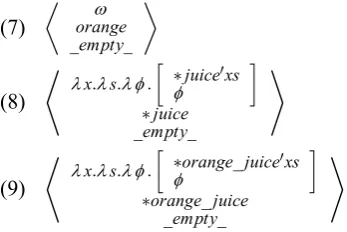
func-tion that returns a concatenafunc-tion of pL and pR. For example, the composition of a word mod-ifier “orange” (7) and and a common noun “juice” (8) will generate the TDLES (9).
¿ ω
orange _empty_
À
(7)
*
λx.λs.λ φ.
∙
∗juice0xs
φ
¸
∗juice _empty_
+
(8)
*
λx.λs.λ φ.
∙
∗orange_juice0xs
φ
¸
∗orange_juice _empty_
+
(9)
Nonlocal application rule: Typed Dynamic Logic and HPSG also handle the phenomenon of movement differently. In HPSG, a wh-phrase is treated as a value of SLASH, and the value is kept until the Filler-Head Schema are applied. In TDL, however, wh-movement is handled by the functional composition rule. In order to resolve the difference between these two approaches, we define the nonlocal application rule, a special rule that introduces a slot relating to HPSG SLASH to TDLESs. This slot becomes the third element of TD-LESs. This rule is applied when the Filler-Head Schema are applied in HPSG parse trees.
Definition 3.3 (nonlocal application rule). If Type¡TL¢ = (α7→β) 7→ γ, Type¡TR¢ = β, Type¡nR¢=α and the Filler-Head Schema are applied in HPSG, then
SM= * T
L¡λnR.TR¢
pL _empty_
+
3.4 Unary Derivation Rules
[image:6.595.72.246.143.259.2]In TDL, type-shifting of a word or a phrase is performed by composition with an empty cat-egory (a catcat-egory that has no phonetic form, but has syntactic/semantic functions). For ex-ample, the phrase “this year” is a noun phrase at the first stage and can be changed into a verb modifier when combined with an empty category. Since many of the type-shifting rules are not available in HPSG, we defined unary derivation rules in order to provide an equiva-lent function to the type-shifting rules of TDL. These unary rules are applied independently with HPSG parse trees. (10) and (11) illus-trate the unary derivation of “this year”. (11)
Table 1: Number of implemented rules assignment rules
HPSG-TDL template 51
for closed words 16
for open words 35
verb lexical rules 27
composition rules
binary composition rules 3 function application rule word formation rule nonlocal application rule unary derivation rules 12
is derived from (10) using a unary derivation rule.
¿ λw.λe.λs.λ φ.re f¡x
1¢£∗year0x1s1¤£wx1esφ¤ ∗year
_empty_
À
(10)
* λv.λe.λs.λ φ. re f¡x1¢£∗year0x
1s1
¤∙ves∙ mod0ex 1
φ
¸¸
∗year _empty_
+
(11)
4 Experiment
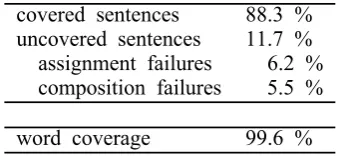
The number of rules we have implemented is shown in Table 1. We used the Penn Treebank (Marcus, 1994) Section 22 (1,527 sentences) to develop and evaluate the proposed method and Section 23 (2,144 sentences) as the final test set.
We measured the coverage of the construc-tion of TDL semantic representaconstruc-tions, in the manner described in a previous study (Bos et al., 2004). Although the best method for strictly evaluating the proposed method is to measure the agreement between the obtained semantic representations and the intuitions of the speaker/writer of the texts, this type of evaluation could not be performed because of insufficient resources. Instead, we measured the rate of successful derivations as an indica-tor of the coverage of the proposed system.
[image:6.595.305.522.304.425.2]un-Table 2: Coverage with respect to the test set covered sentences 88.3 %
uncovered sentences 11.7 % assignment failures 6.2 % composition failures 5.5 %
[image:7.595.308.516.64.251.2]word coverage 99.6 %
Table 3: Error analysis: the development set
# assignment failures 103
# unimplemented words 61
# TDL unsupporting words 17
# nonlinguistic HPSG lexical items 25
# composition failures 72
# unsupported compositions 20
# invalid assignments 36
# nonlinguistic parse trees 16
seen sentences are assigned TDL semantic rep-resentations. Although this number is slightly less than 92.3%, as reported by Bos et al., (2004), it seems reasonable to say that the pro-posed method attained a relatively high cover-age, given the expressive power of TDL.
The construction of TDL semantic represen-tations failed for 11.7% of the sentences. We classified the causes of the failure into two types. One of which is application failure of the assignment rules (assignment failure); that is, no assignment rules are applied to a num-ber of HPSG lexical items, and so no TD-LESs are assigned to these items. The other is application failure of the composition rules (composition failure). In this case, a type mis-match occurred in the composition, and so a TDLES was not derived.
Table 3 shows further classification of the causes categorized into the two classes. We manually investigated all of the failures in the development set.
Assignment failures are caused by three fac-tors. Most assignment failures occurred due to the limitation in the number of the assignment rules (as indicated by “unimplemented words” in the table). In this experiment, we did not implement rules for infrequent HPSG lexical items. We believe that this type of failure will be resolved by increasing the number of
ref($1)[]
[lecture($2,$3) & past($3) & agent($2,$1) & content($2,$4) & ref($5)[]
[every($6)[ball($6,$4)] [see($7,$4) &
present($4) & agent($7,$5) & theme($7,$6) &
tremendously($7,$4) & ref($8)[]
[ref($9)[groove($9,$10)] [be($11,$4) &
present($4) & agent($11,$8) & in($11,$9) & when($11,$7)]]]]]
Figure 6: Output for the sentence: “When you’re in the groove, you see every ball tremendously,” he lectured.
assignment rules. The second factor in the table, “TDL unsupported words”, refers to ex-pressions that are not covered by the current theory of TDL. In order to resolve this type of failure, the development of TDL is required. The third factor, “nonlinguistic HPSG lexical items” includes a small number of cases in which TDLESs are not assigned to the words that are categorized as nonlinguistic syntactic categories by the HPSG parser. This problem is caused by ill-formed outputs of the parser.
The composition failures can be further clas-sified into three classes according to their causative factors. The first factor is the ex-istence of HPSG schemata for which we have not yet implemented composition rules. These failures will be fixed by extending of the def-inition of our composition rules. The sec-ond factor is type mismatches due to the un-intended assignments of TDLESs to lexical items. We need to further elaborate the as-signment rules in order to deal with this prob-lem. The third factor is parse trees that are linguistically invalid.
The error analysis given above indicates that we can further increase the coverage through the improvement of the assignment/composition rules.
[image:7.595.96.271.87.165.2] [image:7.595.73.292.215.329.2]represent entities, events and situations. For example, $3 represents a situation and $2 represents the lecturing event that exists in $3. past($3) requires that the sit-uation is past. agent($2,$1) requires that the entity $1 is the agent of $2. content($2,$4) requires that $4 (as a set of possible worlds) is the content of $2. be($11,$4) refers to $4. Finally, every($6)[ball($6,$4)][see($7,$4) ...] represents a generalized quantifier “every ball”. The index $6 serves as an antecedent both for bound-variable anaphora within its scope and for E-type anaphora out-side its scope. The entities that correspond to the two occurrences of “you” are represented by $8 and $5. Their unification is left as an anaphora resolution task that can be easily solved by existing statistical or rule-based methods, given the structural information of the TDL semantic representation.
5 Conclusion
The present paper proposed a method by which to translate HPSG-style outputs of a robust parser (Miyao et al., 2005) into dynamic se-mantic representations of TDL (Bekki, 2000). We showed that our implementation achieved high coverage, approximately 90%, for real text of the Penn Treebank corpus and that the resulting representations have sufficient expres-sive power of contemporary semantic theory involving quantification, plurality, inter/intra-sentential anaphora and presupposition.
In the present study, we investigated the possibility of achieving robustness and descrip-tive adequacy of semantics. Although previ-ously thought to have a trade-off relationship, the present study proved that robustness and descriptive adequacy of semantics are not in-trinsically incompatible, given the transparency between syntax and discourse semantics.
If the notion of robustness serves as a cri-terion not only for the practical usefulness of natural language processing but also for the validity of linguistic theories, then the compo-sitional transparency that penetrates all levels of syntax, sentential semantics, and discourse semantics, beyond the superficial difference be-tween the laws that govern each of the levels, might be reconsidered as an essential principle
of linguistic theories.
References
Timothy Baldwin, John Beavers, Emily M. Bender, Dan Flickinger, Ara Kim and Stephan Oepen (to appear) Beauty and the Beast: What running a broad-coverage precision grammar over the BNC taught us about the grammar ? and the cor-pus, In Linguistic Evidence: Empirical, Theoreti-cal, and Computational Perspectives, Mouton de Gruyter.
Daisuke Bekki. 2000. Typed Dynamic Logic for Compositional Grammar, Doctoral Dissertation, University of Tokyo.
Daisuke Bekki. 2005. Typed Dynamic Logic and Grammar: the Introduction, manuscript, Univer-sity of Tokyo,
Johan Bos, Stephen Clark, Mark Steedman, James R. Curran and Julia Hockenmaier. 2004. Wide-Coverage Semantic Representations from a CCG Parser, In Proc. COLING ’04, Geneva.
Ann Copestake, Dan Flickinger, Ivan A. Sag and Carl Pollard. 1999. Minimal Recursion Seman-tics: An introduction, manuscript.
Ann Copestake and Dan Flickinger. 2000. An open-source grammar development environ-ment and broad-coverage English grammar using HPSG In Proc. LREC-2000, Athens.
Jeroen Groenendijk and Martin Stokhof. 1991. Dy-namic Predicate Logic, In Linguistics and Philos-ophy 14, pp.39-100.
Julia Hockenmaier and Mark Steedman. 2002. Ac-quiring Compact Lexicalized Grammars from a Cleaner Treebank, In Proc. LREC-2002, Las Pal-mas.
Mitch Marcus. 1994. The Penn Treebank: A revised corpus design for extracting predicate-argument structure. In Proceedings of the ARPA Human Language Technolog Workshop, Prince-ton, NJ.
Yusuke Miyao, Takashi Ninomiya and Jun’ichi Tsu-jii. 2005. Corpus-oriented Grammar Develop-ment for Acquiring a Head-driven Phrase Struc-ture Grammar from the Penn Treebank, in IJC-NLP 2004, LNAI3248, pp.684-693. Springer-Verlag.
Carl Pollard and Ivan A. Sag. 1994. Head-Driven Phrase Structure Grammar, Studies in Contem-porary Linguistics. University of Chicago Press, Chicago, London.