Lattice Statistics and Dynamics within Cluster Variation Method
Yasunori Yamada
1,*and Tetsuo Mohri
21Department of Materials Processing, Graduate School of Engineering, Tohoku University, Sendai 980–8577, Japan 2Institute for Materials Research, Tohoku University, Sendai 980–8577, Japan
The conventional Cluster Variation Method (CVM) does not explicitly consider both lattice vibration and local lattice relaxation effects. As discussed in the previous studies, these deficiencies result in overestimation of order-disorder transformation temperatures for the Cu-Au phase diagram. In the present paper, we propose modified CVM which explicitly takes both the effects mentioned above into account. By em-ploying the present modified CVM, we evaluated both lattice vibration and local lattice relaxation effects, and estimated free energy of mixing for Cu-Au disordered phase at a finite temperature. [doi:10.2320/matertrans.MBW201504]
(Received October 14, 2015; Accepted January 20, 2016; Published March 25, 2016)
Keywords: cluster variation method, lattice vibration, local lattice relaxation, free energy of mixing
1. Introduction
Cluster Variation Method (CVM) provides a hierarchy structure for approximation of entropy in terms of a basic cluster which is the largest cluster in its formula. Usually, CVM approximations are termed based on their basic clus-ters. For example, when basic cluster is a pair (tetrahedron) cluster, the approximation is referred to as pair (tetrahedron) approximation. Since the time when Kikuchi1) had proposed Cluster Variation Method (CVM), various applications of CVM have been proposed such as coherent interface2), SRO hardening3), effective pair interaction energy4), diffuse inten-sity scattering5), phase equilibria and phase diagram6–9), and coupling with PFM10,11). In particular, a number of studies for phase diagram calculation6–8) have been conducted because CVM yields more reasonable transformation temperature than Brag-Williams approximation as shown in Ref. 12).
However, as discussed in the previous study6), the conven-tional CVM overestimates order-disorder transformation temperatures for Cu-Au system. It is pointed out that one of the causes of this overestimation is the neglect of local lattice relaxation which is a structural relaxation due to mixing of different sized-atoms6,9). Essentially, the conventional CVM is designed for a fixed lattice system where atomic displace-ments are not allowed. Then, local lattice relaxation, as well as lattice vibration, is not explicitly considered.
In order to incorporate atomic displacements into a CVM formula, Kikuchi et al.13) and Finel14,15) proposed Continuous Displacement Cluster Variation Method (CDCVM) and Gaussian CVM, respectively. However, CDCVM requires an intractable number of variational parameters for three-dimen-sional calculations. To the best of authors knowledge, there is no report about a CDCVM for three-dimensional system be-yond the pair approximation16) although it is inevitable to em-ploy at least tetrahedron approximation for order-disorder transformation on a fcc system12). While Gaussian CVM has less restriction about the number of variational parameters, it has not been developed for multi-component system yet. Hence, Gaussian CVM considers only vibrational free energy for a single component system, but not local lattice
relax-ation.
In the present paper, we propose an alternative model of CVM in order to overcome the above problems. The present CVM can consider a local lattice relaxation and vibrational free energy without variational parameters describing atomic distributions around a lattice point, which makes it easy to apply the present model to a three-dimensional system.
By employing the present CVM, we estimate a free energy of mixing of Cu-Au disordered phase at finite temperature within tetrahedron approximation. In addition, we evaluate energy contributions of both local lattice relaxation and lat-tice vibration to the free energy of mixing.
2. Calculation Model
We described only an outline of derivation procedure of the present CVM due to the restriction of the number of pages. The details of the derivation procedure will be reported else-where.
First, we define a Hamiltonian H[p, q, σ] as the function of
p, q and σ, where p and q are vectors representing momen-tums and positions of atoms, respectively, and σ is a configu-ration of spin variables σn over the lattice points n, i.e. σ = (σ1, σ2, σ3, ...). A spin variable σn represents an atomic spe-cies. Then, the Hamiltonian H[p, q, σ] is constituted by the kinetic energy K[p, σ] and potential energy U[q, σ],
H[p,q,σ]=K[p,σ]+U[q,σ]. (1)
Kinetic energy K[p, σ] is given by K[p,σ]= n i=31pni2/2Mσn, where pni is momentum on n- lattice point and Mσn is a mass of atomic species represented by σn. The index i indicates the coordinate axes of orthogonal system, i = 1, 2, 3.
Here, we approximate potential function by the second or-der Taylor expansion around lattice position q0,
U[q,σ]≈U0+vt(q−q0)+1
2(q−q
0)tW(q−q0), (2)
where
U0 ≡U[q0,σ], v≡ ∂U[q0,σ]
∂qni ni
, W≡ ∂2U[q0,σ]
∂qni∂qm j ni,m j .
(3) *
Graduate Student, Tohoku University. Corresponding author, E-mail: [email protected]
Equation (2) is written in matrix form, where v is a vector and
W is a matrix. q0 indicates a vector of all lattice positions and
qni is an atomic position of nth- lattice point in i- direction.
It is important to notice that atoms are treated as distin-guishable particles associated with lattice position q0 in eq. (2). In this circumstance, all states of the system are de-scribed in a continuous real and momentum space and a dis-crete space spanned by spin variables. Then, we define a par-tition function Z as
Z = 1
(2π )3|L| Trσ exp −
H[p,q,σ]
kBT n∈L 3
i=1
dpnidqni, (4)
where L is a set of all atoms, |L| is the number of all atoms, h is Plank constant and ℏ = h/2π, and Trσ indicates a configura-tional sum over σ. By using Gaussian integral with respect to
p and q, eq. (4) can be reduced to the following equation,
Z=Tr
σ exp −
U0[σ]+Ur[σ]+Fv[σ]
kBT , (5)
where
U0[σ]=U[q0,σ], (6)
Ur[σ]≡ −1 2v
tW−1v (7)
and
Fv[σ]=k BT
3|L|
k=1 ln ωk
kBT . (8)
It is worth pointing out that the functions U 0[σ], U r[σ] and
F v[σ] indicate formation energy for a fixed lattice, local lat-tice relaxation energy and vibrational free energy, respective-ly. In eq. (8), ωk is an angular frequency of kth- harmonic oscillator, and derived from following characteristic equation,
det|D−ωk2I|=0, (9) where I is an identical matrix and
D=
M1
σnMσm
∂2U[q0,σ]
∂qni∂qm j
ni,m j
. (10)
It is impossible to obtain exact values of eqs. (7) and (8) except for a perfect crystal, because we cannot describe an atomic configuration of an entire lattice in the thermodynam-ic limit. Then, we approximate eqs. (7) and (8) by using Möbius inversion formula17,18). In the beginning of this ap-proximation, we introduce a Hamiltonian Hα[pα, qα, σα]
as-sociated with each cluster, where cluster α is defined as a set of lattice points, pα and qα are vectors of momentums and
positions of α- cluster, respectively, and σα is a configuration of spin variables involved in α- cluster. A Hamiltonian Hα[pα, qα, σα] is given by Hα[pα, qα, σα] = Kα[pα, σα] + Uα[qα, σα],
where Kα[pα, σα] and Uα[qα, σα] are kinetic energy and
po-tential energy, respectively, with Kα[pα, σα] = n∈a 3i=1pni2/2Mσn. The definition of Uα[qα, σα] is shown
in the next section. By replacing H[p, q, σ] by Hα[pα, qα, σα]
in eq. (3), we define U0
α[σα], Urα[σα] and Fvα[σα] in a similar
manner with eqs. (6), (7) and (8). Here, we approximate the functions U 0[σ], U r[σ] and F v[σ] by using a truncation of Möbius inversion formula. This scheme is similar to the for-mulation of conventional CVM by An19). We define new functions u0
α [σα], urα [σα] and fαv [σα] by the following
equa-tion,
xα= β⊆α
(−1)|α|−|β|Xβ, (11)
where β is sub-set of α, namely, sub-cluster of α- cluster. The number of atoms in α- and β- clusters are denoted by |α| and
|β|, respectively. In eq. (11), xα corresponds to u0α [σα], urα [σα]
or fv
α [σα], and Xβ corresponds to Uβ0[σβ], Uβr[σβ] or Fβv[σβ].
According to Möbius inversion formula, the function X of an entire system is given by the summation of xα over all α-
clusters,
X=
α
xα, (12)
where X corresponds to U 0[σ], U r[σ] or F v[σ]. For a given set Γ, if |xα | < ∞ for α ∈ Γ and xα ≈ 0 for α Γ, we can
ap-proximate eq. (12) by the following equation,
X≈
α∈Γ
xα. (13)
For an approximation of CVM, Γ is given by a set of basic clusters and all their sub-clusters. Thereby, the partition func-tion Z in eq. (5) can be approximated by the following equa-tion.
Z≈Tr
σ exp
−kB1T α∈Γ(u 0
α[σα]+urα[σα]+fαv[σα]) (14)
The function u0
α [σα], urα [σα] and fαv [σα] are invariant under
translation. If we consider a thermodynamic limit, a free en-ergy function can be obtained by using variation principle20) as
F
|L| ≈{minρ[σ]}Trσ ρ[σ]
0∈α∈Γ|1α|(u
0
α[σα]+urα[σα]+fαv[σα])
+kBT
|L| lnρ[σ] ,
(15)
where ρ[σ] is a probability function of σ and satisfies a nor-malization condition, 0 represents origin of a lattice and min{ρ[σ]} indicate minimization operators with respect to {ρ[σ]}. It should be noted that Trσρ[σ] = 1. By using eqs. (11) and (13), the entropy term (kBT/|L|)lnρ[σ] in eq. (15) is ap-proximated by
kBT
|L| lnρ[σ]≈ −T
0∈α∈Γ sc
α[σα] (16)
where sc
α= β⊆α(−1)|α|−|β|Sβc with Scβ=−kBlnρβ[σβ]. In
eq. (16), ρβ[σβ] indicates a partial probability of β- cluster
which is defined by
ρβ[σβ]= Tr
σL\β
where trace Trσα\β is taken over all configuration of σα\β ,
where α\ β is the set which consists of the elements of α ex-cluding the elements of β, i.e. α\β={n|n∈α∧n β}. By substituting eqs. (16) and (17) into eq. (15), the free energy function is obtained as
F
|L| ≈{minρ[σ]}0∈α∈Γ 1
|α|Trσα
ρα[σα](u0α[σα]+urα[σα]
+fαv[σα]−T scα[σα]).
(18)
For minimization process, we ignore the restriction by eq. (17), but consider normalization condition Trσβρβ[σβ]=1
and geometrical condition Trσα\βρα[σα]=ρβ[σβ] for α, β ∈ Γ.
Then, we can replace min{ρ[σ]} by min{ρα[σα]}α∈Γ in eq. (18) un-der the normalization and geometrical conditions. In most cases, our main interest in thermal properties is under a con-stant pressure P. Then, Gibbs free energy G is often more useful than Helmholtz free energy F. By Legendre transfor-mation, Gibbs free energy G is obtained by the following equation,
G
|L| ≈{ρα[σminα]}α∈Γ,V0 ∈α∈Γ
1
|α|Trσα
ρα[σα](u0α[σα]+urα[σα]
+fαv[σα]−T scα[σα])+ PV
|L|
(19)
where V is a volume of the system. Hence, the free energy function, which explicitly considers both local lattice relax-ation and lattice vibrrelax-ational effects, is derived.
3. Calculation Condition
We calculated the free energy of Cu-Au disordered phase on fcc lattice. We employed tetrahedron approximation of CVM. The basic clusters were given by tetrahedron clusters which consist of only first nearest neighbors. A function X per atom was given by X/|L| ≈ 5X1 − 6X2 + 2X4, where X1, X2 and
X4 indicate the function Xα of point, pair and tetrahedron
clus-ters, respectively.
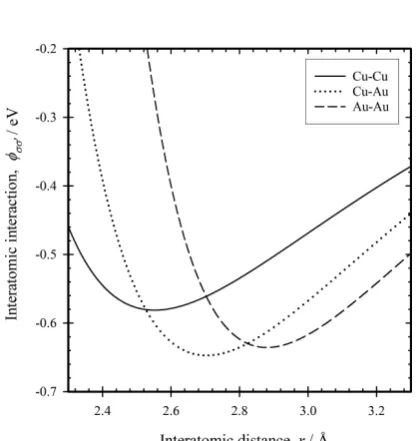
Potential energy was given by a pair approximaiton within the first nearest neighbors. The pair interaction energy was described by the empirical Lennard-Jones potential as
φσσ[r]= e0
σσ
κσσ −λσσ
λσσ
r0
σσ r
κσσ
−κσσ
r0
σσ r
λσσ
, (20) where σ and σ denote spin variables, r the interatomic dis-tance, and e0
σσ, r0σσ, κσσ and λσσ are potential energy
param-eter whose values employed for the present study are shown in Table 1. We determined these parameters by fitting with cohesive energy, lattice constant and bulk modulus of Cu, Cu3Au, CuAu, CuAu3 and Au, as shown in Table 2. The re-sultant Lennard-Jones potential is plotted in Fig. 1.
The potential energy Uα[qα, σα] of α- cluster was defined
by the following equation,
Uα[qα,σα]=
n∈αm∈α
m>n
φσnσm[rnm]
+ n∈α
∗
mα
{n,m}is first nerest neighbor
φ0σnσm[q{n}],
[image:3.595.303.550.204.295.2](21)
Table 1 Potential energy parameters of Lennard-Jones potential.
(σ, σ) (Cu,Cu) (Cu,Au), (Au,Cu) (Au,Au)
e0
σσ [eV] 0. 581174 0. 647235 0. 635631
r0
σσ [Å] 2. 552392 2. 703572 2. 879656
κσσ0 7. 615058 7. 313971 9. 949710
[image:3.595.306.548.358.534.2]λ0σσ 3. 413229 4. 650768 4. 297272
Table 2 Lattice constant, cohesive energy and bulk modulus. cal. and exp. indicate the calculated results by the present Lennard-Jones poten-tial and experimental data9), respectively.
Lattice constant
a/ Å
Cohesive energy Ec / eV
Bulk modulus B / GPa
Cu(fcc) cal. 3.61 3.487 137.2
(exp.) (3.62) (3.49) (138)
Cu3Au(L12) cal. 3.751 3.643 150.4
(exp.) (3.74) (3.64) (148)
CuAu(L10) cal. a = 3.968
c = 3.674 3.747 161.8
(exp.) (a = 3.966)
(c = 3.673) (3.74) (163)
CuAu3(L12) cal. 3.983 3.779 168.9
(exp.) (3.98) (3.79) (170)
Au(fcc) cal. 4.072 3.814 171.9
(exp.) (4.08) (3.81) (171)
[image:3.595.322.531.546.767.2]where rnm is interatomic distance between atoms n and m, i.e.
rnm = ‖q{n} − q{m}‖, and φ0σnσm[q{n}] is a mean interaction en-ergy. We define φ0σnσm[q{n}] as
φ0σnσm[q{n}] =
σm
ρ2[(σn, σm)]
ρ1[(σn)] φσnσm[rnm]. (22)
where rnm= q{n}−q0{m} , and ρ1[(σn)] and ρ2[(σn, σm)] de-note the partial probability of point and pair cluster. In eq. (21), the summation of the first term is taken over all pair clusters in α- cluster, and the summation of the second term is taken over all the first nearest neighbors between the atoms inside and outside α- cluster. It is important to note that a potential energy Uα[qα, σα] defined by eq. (21) satisfies the
following equation,
0∈α∈Γ 1
|α|Trσαρ[σα]u 0 α[σα]=
{0,m}∈Γ
Trσ{0,m}ρ[σ{0,m}]φσ0σm[r0m].
(23) Then, the formation energy for a fixed lattice is given by the summation of interatomic potentials. We note that this is akin to the description of energy by the conventional CVM.
Here, the potential function Uα[qα, σα] is well-defined,
and the Gibbs free energy is given by eq. (19). We also evalu-ated enthalpy and entropy by H/|L| ≈
0∈α∈Γ (1/|α|)Trσα ρα[σα](uα0 [σα] + urα [σα]) + 3kBT + PV/|L| and
S = (H − G)/T, respectively. The volume V of the system is given as the function of lattice constant a, i.e. V = |L|a3/4. The pressure is assigned as P = 0. The atomic mass of Cu and Au are given by 63.55 and 197.0 (g/mol), respectively.
4. Results and Discussion
In the present paper, a configurational entropy, local lattice relaxation energy and vibrational free energy are approximat-ed by eqs. (11) and (13). The approximatapproximat-ed function of con-figurational entropy is equivalent to that of the conventional CVM, while the approximation of both local lattice relax-ation energy and vibrrelax-ational free energy by eqs. (11) and (13) have not been attempted. Then, we need to discuss the valid-ity of these approximations, i.e. F v[σ] ≈
α∈Γ fαv [σα] and
U r[σ] ≈
α∈Γurα [σα].
First, in order to examine the validity of the approximation of vibrational free energy, we calculated a standard free ener-gy of a pure Cu and Au. For a single component system, a free energy is given by the summation of formation energy and vibrational free energy. An equilibrium state is given by min-imizing eq. (19) with respect to lattice constant a under ur
α [σ],
sc α [σ] = 0.
For comparison, we obtained an analytical solution of the vibrational free energy Fv
AS within quasi-harmonic
approxi-mation in classical statistics. By using Fourier transform of position q, eqs. (8) and (9) can be solved by the following equation,
Fv AS =kBT
k
3
l=1
ln ωl[k]
kBT (24)
coupled with det|Ddy[k] − ωl[k]2I| = 0, where Ddy[k] is 3 by 3
matrix which is given by Ddy[k] =
(1/M) m(∂2U/∂q0i∂qm j)e−ik
t(q
{0}−q{m})
i,j . k is a wave vector
and the summation in eq. (24) is taken over all wave vectors
k in the first Brillouin zone. Then, a free energy of the
analyt-ical solution is given by GAS =
minV n m<nφσnσm+FvAS+PV . In order to solve the
above equations numerically, we used 16 × 16 × 16 sampling points.
Figures 2 (a) and (b) show the temperature dependency of the standard free energy Gst, where Gst = G[T] − G[298.15K] for Cu and Au, respectively. In these figures, the solid line indicates calculated result by the present CVM, the open cir-cles indicate the analytical solutions and the solid circir-cles show experimental data21,22). The calculated results by CVM are consistent with the ones by the analytical solution. This agreement justifies the present approximation of vibrational free energy by eqs. (11) and (13), i.e. F v ≈
α∈Γfαv . On the
other hand, both the calculated results deviate from experi-mental data. The reason for this deviation is interpreted as follows. The vibrational free energy depends on elastic prop-erties. However, for the pair approximation of potential ener-gy, the elastic stiffness is restricted by the Cauchy relation
C12 = C44. In addition, for the first nearest neighbor approxi-mation, the elastic stiffness is restricted by the relation C12 = 1/2C11 because of the symmetry of fcc. Then, it is difficult to reproduce elastic properties of Cu and Au by using a first nearest neighbor approximation.
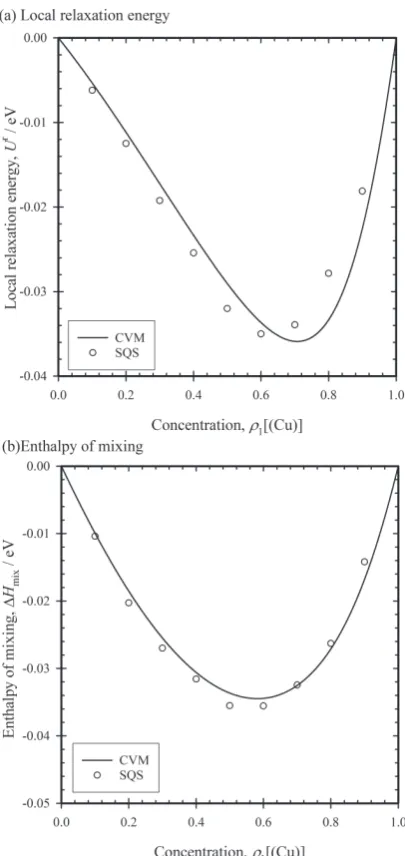
Next, we examined the validity of the approximation of local lattice relaxation through eqs. (11) and (13), i.e. U r ≈ α∈Γurα . We calculated enthalpy of mixing for a random
phase at 0 K. In this condition, vibrational free energy and configurational entropy become zero, i.e. fv
α = 0 and scα = 0 in
eq. (19). For a random phase, partial probabilities of pair and tetrahedron cluster are given by a product of partial probabil-ities of their lattice points. The enthalpy of the mixing is de-fiend by ΔHmix = H − ρ1[(Cu)]HCu − ρ1[(Au)]HAu, where HCu and HAu are cohesive energy of pure Cu and Au, respectively, and H is enthalpy at a stable state. The stable state was ob-tained by minimizing the enthalpy with respect to a lattice constant a.
For the comparison, we performed a simple atomistic cal-culation with SQS23). We made nine SQSs which consisted of 10 × 10 × 10 multiples of fcc cells and contained 4000 atoms. The concentration of each SQS is from 10%Cu to Au-90%Cu. Table 3 shows short-range order parameters of the nine SQSs. The total enthalpy is given by HSQS[q, a] =
n m<n ϕσn σm[rnm] + PV, where rnm = ‖qn − qm‖. A stable
position qs and stable lattice constant as are determined by minimization of HSQS with respect to q and a. Local lattice relaxation energy Ur
SQS is defined by USQSr =HSQS[q0,as]−
HSQS[qs,as].
the results, the present CVM is in reasonable agreement with SQS. In the present CVM, anharmonicity of Lennard-Jones potential is not considered for a given lattice constant because
of second order Taylor expansion of potential energy by eq. (2). In addition, we employed the approximation by eqs. (11) and (13), i.e. U r ≈
α∈Γurα . On the other hand, the
calculation with SQS are more reasonable because it does not employ these two approximations. Then, the agreement be-tween CVM and SQS justifies the second order Taylor expan-sion and the approximation U r ≈
α∈Γurα for the present
in-teratomic potential function.
Therefore, we conclude that both the approximations of vi-brational free energy and local lattice relaxation, F v ≈
α∈Γfαv
and U r ≈
α∈Γurα , are rationalized.
Next, we calculated Cu-Au disordered phase at 800 K. In this calculation, the formation energy, configurational entro-py, local lattice relaxation energy and vibrational free energy are considered. An equilibrium state is given by minimization of eq. (19) with respect to lattice constant a and partial prob-abilities {ρα[σα]}α∈Γ. We calculated Gibbs free energy of
[image:5.595.325.528.67.496.2]mix-ing ΔGmix which is defined by ΔGmix = G − ρ1[(Cu)]GCu − ρ1[(Au)]GAu, where G is a Gibbs free energy at an equilibrium state, and GCu and GAu are the Gibbs free energy of a pure Cu Fig. 2 Standard free energy of (a) Cu and (b) Au.
Table 3 Short-range order parameters of SQSs. The short-range order pa-rameters ηi of i-th nearest neighbor pair are defined by Warren-Cowley
short-range order parameter, i.e. ηi=1−ρi2[(Cu,Au)]/(ρ1[(Au)]ρ1[(Cu)]), where ρi
2[(Cu,Au)] is partial probability of ith- nearest neighbor pair.
at%Cu a1 a2 a3 a4 a5
10 0.0000 0.0000 0.0000 0.0037 −0.0026
20 0.0000 0.0000 0.0000 −0.0044 −0.0023
30 0.0000 0.0000 −0.0001 0.0036 −0.0020
40 0.0000 0.0000 0.0000 0.0082 −0.0025
50 0.0000 0.0000 0.0000 0.0005 −0.0005
60 0.0000 0.0000 0.0000 0.0082 −0.0025
70 0.0000 0.0000 −0.0001 0.0036 −0.0020
80 0.0000 0.0000 0.0000 −0.0044 −0.0023
90 0.0000 0.0000 0.0000 0. 0037 −0.0026
[image:5.595.63.279.67.503.2] [image:5.595.45.291.590.720.2]and Au which were shown in Fig. 2.
Figure 4 shows the concentration dependency of the ΔGmix, ΔHmix and Smix = (ΔHmix − ΔGmix)/T. In this figure, three lines indicate the calculated results by CVM, and the symbols (○, ● and ▲) indicate experimental data24). The calculated re-sults are in good agreement with the experimental data.
Shown in Fig. 5 are the estimated contributions of forma-tion energy for a fixed lattice U 0, local lattice relaxation ener-gy U r, vibrational free energy F v and configurational entropy −TS c to the free energy of mixing ΔG
mix. It is one of the ad-vantages of the present CVM that free energy function can be separated into each energy term, i.e. U 0, U r, F v and −TS c.
In Fig. 5, one can see that the major contributions to ΔGmix are the formation energy for a fixed lattice U 0 and configura-tional entropy −TS c. However, the contribution of a vibra-tional free energy to the free energy of mixing is small al-though the temperature dependences of free energies for pure constituents shown in Figs. 2 (a) and (b) are by no means re-alized without vibrational free energy. Besides, it is noted that it is quite a difficult task to separate the vibrational effect from other terms. A lattice vibration leads to an expansion of lattice constant and a change of potential energy U[q0, σ]. Then, it causes the change of values of formation energy U 0
and local lattice relaxation energy U r. On the other hand, the contribution of local lattice relaxation energy U r is negative and not small. This fact is one of the reasons for the overesti-mation of transforoveresti-mation temperature by the conventional CVM6) which does not consider local lattice relaxation as was mentioned in the Introduction. Local lattice relaxation is caused by mixing of atoms of different size. For Cu-Au disor-dered phase, local lattice relaxation energy is not small as shown in Fig. 5 because the difference of atomic radius be-tween Cu and Au is fairly large, which is larger than 12%. While, when long- and short-range order parameters become higher, a local lattice relaxation energy should become small-er, and then it reaches zero for a perfect ordered phase. For Cu-Au system, order-disorder transformations, i.e. L12 -disor-der and L10-disorder transformation, are first order transfor-mation. Then, long- or short-range order parameters change drastically before and after the transformation. These facts indicate that the local lattice relaxation energy of disordered phase is negative and much larger than that of ordered phase. The transformation temperature depends on a difference of free energy Ψ between ordered and disordered phase for a given chemical potential μσ, where Ψ = G − σ μσNσ and Nσ
Fig. 4 Gibbs free energy ΔGmix, enthalpy ΔHmix and entropy ΔSmix of mix-ing for Cu-Au system at 800 K.
Fig. 5 Free energy contribution of each energy term to Gibbs free energy of mixing for Cu-Au system at 800 K.
[image:6.595.317.532.350.558.2] [image:6.595.47.290.364.558.2] [image:6.595.149.447.605.762.2]is the number of σ- atoms. In that circumstance, a tempera-ture dependency of a free energy Ψ is described as Fig. 6 for a given chemical potential. When we consider a local lattice relaxation, the free energy curves change the relative position as shown in Figs. 6 (a) and (b). In this manner, transformation temperature decreases.
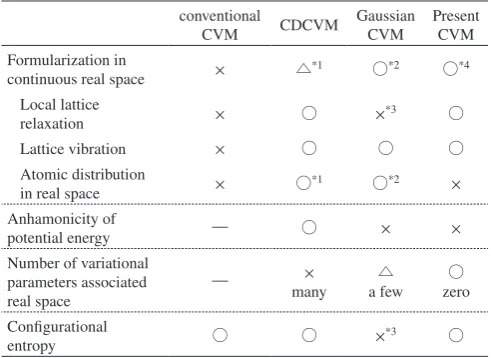
Finally, we summarized various advantageous and disad-vantageous features among present CVM, conventional CVM, CDCVM and Gaussian CVM in Table 4. (1) The con-ventional CVM is not formulated in continuous real space, while the present CVM is derived from the partition function in continuous real and momentum spaces. (2) Gaussian CVM considers only lattice vibration but not local lattice relaxation because it has not developed for multi component system. In the present CVM, on the other hand, the partition function is defined also in the discrete space of spin variables. Then, multi component system can be considered, and consequently the local lattice relaxation is taken into account. (3) One of the bottlenecks for an application of CDCVM to three-dimen-sional system is an intractable number of variational parame-ters. In the present CVM, local lattice relaxation energy and vibrational free energy are derived by integrating the partition function. Then, variational parameters associated with real space are not required. (4) The present CVM cannot consider atomic distribution and anharmonicity of potential energy.
5. Conclusion
We propose a modified CVM which explicitly consider
lo-cal lattice relaxation and lattice vibration without variational parameters associated with real space.
By using present CVM, we calculated (1) standard free en-ergy of pure Cu and Au, and (2) enthalpy of mixing of ran-dom phase. Both calculations are in agreement with analyti-cal solution and SQS. Finally, we estimated (3) free energy of mixing for Cu-Au disordered phase at 800 K. A contribution of local lattice relaxation to the free energy of mixing is not small in comparison with configurational entropy and forma-tion energy for a fixed lattice.
Acknowledgments
This work was supported by Grant-in-Aid for JSPS Fel-lows 25-2373 and JSPS Grant-in-Aid for Scientific Research (B) 26289227.
REFERENCES
1) R. Kikuchi: Phys. Rev. 81 (1951) 988–1003. 2) M. Asta: Acta Mater. 44 (1996) 4131–4136.
3) T. Mohri, D. de Fontaine and J. M. Sanchez: Metall. Trans. A 17 (1986) 189–194.
4) J. M. Sanchez, V. Pierron-Bohnes and F. Mejía-Lira: Phys. Rev. B 51 (1995) 3429–3437.
5) T. Mohri: J. Phase Equilib. Diff. 32 (2011) 537–542.
6) T. Mohri, K. Terakura, S. Takizawa and J. M. Sanchez: Acta Metall. Mater. 39 (1991) 493–501.
7) J. M. Sanchez, J. R. Barefoot, R. N. Jarrett and J. K. Tien: Acta Metall. 32 (1984) 1519–1525.
8) M. Enomoto and H. Harada: Metall. Trans. A 20 (1989) 649–664. 9) S. -H. Wei, A. A. Mbaye, L. G. Ferreira and Alex Zunger: Phys. Rev. B
36 (1987) 4163–4185.
10) J. C. Wang, M. Osawa, T. Yokokawa, H. Harada and M. Enomoto: Comp. Mater. Sci. 39 (2007) 871–879.
11) T. Mohri, M. Ohno and Y. Chen: J. Phase Equilib. Diff. 27 (2006) 47– 53.
12) D. de Fontaine, eds. by H. Ehrenreich, F. Seitz and T. David: Solid State Physics, (Academic Press, 1979) pp. 173–175.
13) R. Kikuchi and A. Beldjenna: Phys. A 182 (1992) 617–634. 14) A. Finel: Prog. Theor. Phys. Supplement 115 (1994) 59–68.
15) A. Finel and R. Tétot: Stability of Materials, eds. by A. Gonis, P. E. A. Turchi and J. Kudrnovský, (Springer, US, 1996) pp. 197–203. 16) R. Kikuchi: J. Phase Equilib. 19 (1998) 412–421.
17) G. C. Rota: Z. Wahrsch. Verw. Gebiete 2 (1964) 340–368.
18) J. H. van Lint and R. M. Wilson: A Course in Combinatorics, (Cam-bridge university press, New York, 2001) pp. 333–350.
19) G. An: J. Stat. Phys. 52 (1988) 727–734.
20) D. Ruelle: Commun. Math. Phys. 5 (1967) 324–329.
21) R. Hultgren, P. D. Desai, D. T. Hawkins, M. Gleiser and K. K. Kelley: Selected Values of the Thermodynamic Properties of the Elements, (American Society for Metals, Metals Park, Ohio, 1973) pp. 47–53. 22) R. Hultgren, P. D. Desai, D. T. Hawkins, M. Gleiser and K. K. Kelley:
Selected Values of the Thermodynamic Properties of the Elements, (American Society for Metals, Metals Park, Ohio, 1973) pp. 149–159. 23) A. Zunger, S. H. Wei, L. G. Ferreira and J. E. Bernard: Phys. Rev. Lett.
65 (1990) 353–356.
[image:7.595.46.292.151.330.2]24) R. Hultgren, P. D. Desai, D. T. Hawkins, M. Gleiser and K. K. Kelley: Selected Values of the Thermodynamic Properties of Binary Alloys, (American Society for Metals, Metals Park, Ohio, 1973) pp. 258–271. Table 4 Comparision of features between the conventional CVM,
CD-CVM, Gaussian CVM and the present CVM. The symbols without anno-tation mean as follows. ×: not consider, ○: consider. (*1 real space is di-vited by quasi-lattice poins, and atomic distribution is approximated as denses of those quasi-lattice poins. *2 atomic distribution is given by Gaussian distribution in continuous real space. *3 Gaussian CVM has not been extended to multi component system. *4 free energy function is de-rived from partition function in continuous real space.)
conventional
CVM CDCVM
Gaussian CVM
Present CVM Formularization in
continuous real space × △*1 ○*2 ○*4
Local lattice
relaxation × ○ ×*3 ○
Lattice vibration × ○ ○ ○
Atomic distribution
in real space × ○*1 ○*2 ×
Anhamonicity of
potential energy ― ○ × ×
Number of variational parameters associated
real space ―
×
many a few△ zero○
Configurational