Evaluation of Age Hardening Behavior Using Composite Rule
and Microstructure Observation in Al-Si-Mg Alloy Castings
Mitsuaki Furui
1, Tomoyuki Kitamura
2;*, Tatsuya Ishikawa
2;*,
Susumu Ikeno
1, Seiji Saikawa
3and Nobuyuki Sakai
31Graduate School of Science and Engineering for Research, University of Toyama, Toyama 930-8555, Japan
2Graduate School of Science and Engineering for Education, University of Toyama, Toyama 930-8555, Japan
3Ahresty Corporation, Toyohashi 441-3114, Japan
Al-Si hypoeutectic alloys have excellent castability and sufficient strength in combination with other alloying elements. Especially, Al-Si alloy containing Mg used for high-quality die-casting is well-known as a high strength alloy brought by the appropriate heat treatment and consequential precipitation hardening of Mg2Si intermediate phase. T6-heat treatment must be applied for maximum strength, but solution at
high temperature and quenching treatment often conduct the product deformation and extra cost for fabrication. Therefore only artificial aging (T5-heat treatment) at comparatively lower temperature is mainly applied to industrial die-casting products. However, there are few studies on age hardening characteristics supplied by T5-heat treatment to Si hypoeutectic alloys. To understand the age hardening behavior of Al-10 mass%Si-0.5 mass%Mg and Al-Al-10 mass%Si-0.8 mass%Mg alloys in detail, microstructure observation and hardness measurement were performed. These alloys quenched in iced water, naturally aged at room temperature and artificially aged at 423–523 K, showed conspicuously age hardening behavior. Age hardening of Al-Si-Mg alloy generally considered to be the main cause of the precipitation-based hardening in phase, nevertheless it was seen that precipitation occurred in-Al+Si eutectic phase. Consequently, from the microstructure observation using SEM, it’s thought that the age hardening of these alloys was mainly composed of the hardness change in-Al+Si eutectic phase.
[doi:10.2320/matertrans.MB201010]
(Received September 13, 2010; Accepted February 21, 2011; Published April 27, 2011)
Keywords: aluminum-silicon-magnesium alloy casting, age hardening behavior, composite rule,-aluminum+silicon eutectic phase
1. Introduction
The basic composition of aluminum based alloys for casting and die-casting is Al-Si systems. Also, the multi-component system alloys that contain a small amount of Cu, Mg, Zn and Ni, etc., are used as a material for cast metal. These Al-Si system alloys have an excellent balance of mechanical properties and castability compared with Al-Mn and Al-Cu system alloys, etc. It is usually used in the Al-Si-Mg alloy to make enough mechanical properties that appear with T6 condition by the solution heat treatment and the
artificial aging treatment.1)In Al-Si-Mg system alloys for a
high-quality die-casting, a solution treatment at high temper-ature such as T6 heat treatment has been avoided industrially because of problems concerning the manufacturing cost and the deformation by quenching strain. Instead, T5 heat treatment of the artificial aging at comparatively lower temperature has mainly been performed. Regarding global environmental concerns, further improvement of the T5 heat treatment condition is needed for fabricating the high quality die-casting parts from social demand including the
automo-tive light-weightening to reduce the CO2emission.2,3)
In the present study, an Al-10 mass%Si hypoeutectic alloy containing a small amount of Mg was cast into a copper made mold with the Y-shaped cavity. Al-10 mass%Si hypoeutectic alloy is the base composition of ADC12 aluminum alloy which is standardized and widely used in the aluminum die-cast industry. This paper will report on the influence of microstructure and age hardening characteristics when the aging treatment is performed under the various temperatures and the Mg contents.
2. Experimental Procedure
2.1 Material
The target composition of casting is Al-10 mass%Si-0.5 mass%Mg and Al-10 mass%Si-0.8 mass%Mg alloys.
The Mg2Si equivalent is about 0.8 mass% in 0.5 mass%Mg
containing alloy and about 1.3 mass% in 0.8 mass%Mg containing alloy. Al-20 mass%Si alloy, pure Mg and pure Al with industrial purity were used for the ingot fabrication, and the alloys were weighed so that the total was 2 kgf.
2.2 Casting procedure
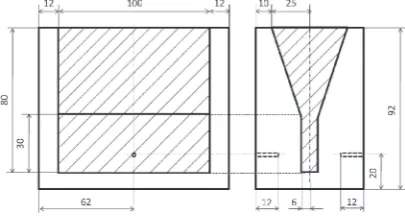
The copper mold with the Y-shaped cavity was prepared as shown in Fig. 1. Boron nitride was spread on the inside surface of the mold as mold wash. The temperatures of the mold and the center part of the casting were measured by alumel-chromel thermocouple with the diameter of 0.2 mm. Based on the target composition, measured ingots were put into a graphite crucible, and were melted at 993 K using the electric furnace. After the melting, pure Mg was added to the
Fig. 1 Dimension of copper mold with Y-block cavity shape. *Graduate Student, University of Toyama
[image:1.595.324.527.660.769.2]molten metal. Pouring began when the temperatures of molten metal and mold were dropped to 953 K and 433– 443 K respectively. After the pouring, the casting was released from the mold for 10 s when the temperature of casting dropped to 773 K. Immediately after that, the casting was then water-quenched at 273 K for 10 s. The dimension of casting obtained was 100 mm length, 12 mm width and 30 mm height in the sample part. The chemical composition of casting used in this investigation is listed in Table 1. Si and Mg, the main alloying elements, have been added as a target composition. The cooling rate during the solidification was
measured by Cmethod4)using the alumel-chromel
thermo-couple with the 0.2 mm diameter inserted into the sample part of casting. Cooling rate in 0.5 mass%Mg and 0.8 mass%Mg containing alloys is 12.5 K/s. The plate sample with the dimension of 10 mm width, 12 mm height and 2 mm thick-ness was cut from the sample part of casting.
2.3 Aging treatment
According to the process of the T5 treatment that is being adopted in an industrial field, the samples were naturally aged at room temperature for 172.8 ks before they were heated for three artificial aging temperatures at 423 K, 473 K and 523 K for various durations until 1920 ks. After the aging heat treatment, the samples were air-cooled.
2.4 Hardness measurement
The plate sample surface was mechanically polished by emery papers with grit numbers from #500 to #1200 using water as the lubricant. The ground samples were then buffed
using a diamond paste with a diameter of 1mm. Vickers
hardness was measured by a micro hardness test machine under an indentation load of 4.9 N and a time of 20 s. Each
primary-Al and-Al+Si eutectic phases were separately
measured under the load of 0.098 N. In particular, primary
-Al and -Al+Si eutectic phases were accurately indented
with unaffecting condition from another indentation.
2.5 Microstructure observation
The aged sample with specular surface was applied to metallographic observation. Following the polishing oper-ation, the etching of polished sample was done using 1 mass% hydrofluoric acid aqueous solution. The micro-structure was observed using an optical microscope (OM).
The volume fractions of -Al and-Al+Si eutectic phases
were measured from the microstructures by the image processing software installed in the personal computer. In addition to the foregoing microstructure observation, the sample was mechanically ground using the diamond paste. After the polishing operation, microstructure observation in high magnification and elementary analysis were carried out using the scanning electron microscope (SEM).
3. Result and Discussion
3.1 Age hardening
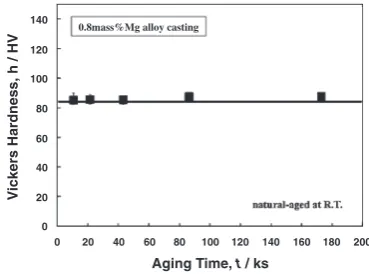
Figures 2 and 3 show the hardness variation in natural aging condition of 0.5%Mg and Al-10%Si-0.8%Mg alloy castings. According to these results, age hardening that originated in the natural aging was not able to be confirmed clearly. Therefore, it can be said that the influence of the natural aging on age hardening is extremely low. If under-aging at low temperature proceeds in the alloy
system that hardens by the precipitation of Mg2Si phase,
a negative effect in two-stage aging behavior5,6) seems to
appear in Al-10%Si-0.5%Mg alloy casting. In Al-Si-Mg system alloys, the influence of cooling rate during solid-ification, aging treatment condition and alloy composition on the positive and negative effects of two-step aging has to be examined in the near future.
The isothermal age hardening curve of Al-10%Si-0.5%Mg alloy castings aged at 423 K, 473 K and 523 K is shown in Fig. 4. The aging peak hardness and the time to reach it increases with decreasing aging temperature. Its aging behavior corresponds to the typical aging temperature dependence in age hardenable materials.
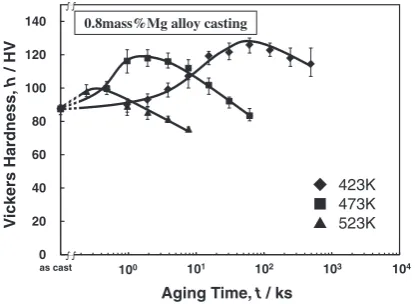
[image:2.595.334.517.71.208.2]In the case of Al-10%Si-0.8%Mg alloy casting as shown in Fig. 5, the aging behavior was similar to the case of Al-10%Si-0.5%Mg alloy casting. As-solution treated hardness of 0.8 mass%Mg containing alloy casting is about 7 HV higher than that of 0.5 mass%Mg containing alloy casting. Table 1 Chemical composition in mass% of Al-10 mass%Si-Mg alloy
castings used.
Si Mg Zn Fe Mn Ti Al
Al-10%Si-0.5%Mg 9.94 0.51 <0:01 0.16 <0:01 0.01 bal.
Al-10%Si-0.8%Mg 9.81 0.87 <0:01 0.16 <0:01 0.01 bal.
V
ickers Hardness, h / HV
Aging Time, t / ks
0 20 40 60 80 100 120 140 160 180 200 0
20 40 60 80 100 120 140
0.5mass%Mg alloy casting
Fig. 2 Hardness variations against natural aging time in Al-10 mass%Si-0.5 mass%Mg alloy casting.
V
ickers Hardness, h / HV
Aging Time, t / ks
0 20 40 60 80 100 120 140 160 180 200 0
20 40 60 80 100 120 140
0.8mass%Mg alloy casting
[image:2.595.47.291.94.138.2] [image:2.595.332.517.259.396.2]Also, the time to peak hardness gets shorter at all aging temperatures, and the hardness of Al-10%Si-0.8%Mg alloy casting is larger than that of Al-10%Si-0.5%Mg alloy casting
in all aging temperatures. M. Tsukuda7)et al.reported that
the strengthening of Al-7 mass%Si alloy under T6 treatment occurred with the Mg addition up to 0.7 mass%. It is thought that the reason for difference of age hardening behavior in 0.5 mass%Mg and 0.8 mass%Mg containing alloys, the age precipitation hardening is promoted with the increasing of
Mg content. M. Kitada8) and C. R. Barrett9) said that the
addition of Mg to Al-Si alloy induced the increasing of nucleation speed through the artificial aging.
3.2 Microstructure
[image:3.595.66.271.71.225.2]To examine the age hardening behavior in Fig. 4 and Fig. 5, the phase constituent was observed by OM and SEM equipped with energy dispersive X-ray spectroscopy (EDX). Optical micrograph, secondary electron image from SEM, and elemental mapping from EDX in Al-10 mass%Si-0.8 mass%Mg alloy casting are shown in Fig. 6. Figure 6(a)
shows that-Al phase occurred as a primary crystal takes on
the dendritic form in hypoeutectic composition. -Al+Si
eutectic phase occurs in the clearance between-Al phases.
As-cast structure consisting of two phases is the typical characteristic in Al-Si alloy with hypoeutectic composition.
3.3 Composite rule
To examine the dependence of-Al and-Al+Si eutectic
phases on the aging behavior, each hardness in these phases was measured separately against the aging time. Figure 7 shows the variation of Vickers hardness for structure
phases of -Al and -Al+Si eutectic in Al-10
mass%Si-0.8 mass%Mg alloy castings isothermal-aged at 423 K.
Hardness of -Al phase is lower than that of average
hardness in the sample, but the hardness variation of -Al
phase with aging time has the same tendency as that of
average in the sample. Solid solubility of Mg2Si to -Al
phase in the casting decreases suddenly with temperature drops from 1.85 mass% (0.68 mass%Mg and 1.16 mass%Si) at 868 K of pseudo binary eutectic point. It seems that the
hardness occurs through the precipitation of Mg2Si phase
with the aging treatment. On the other hand, variation of
-Al+Si eutectic phase with aging time has the same tendency as that of average hardness in the sample. Age hardening in-Al phase defined as the subtraction hardness from the condition of peak-aged to as-cast is 20 HV, which is the small 0
20 40 60 80 100 120 140
423K 473K 523K
0.5mass%Mg alloy casting
Aging Time, t/ ks
V
ickers Hardness,
h
/ HV
101 102 103 104
100
as cast
Fig. 4 Isothermal age hardening curves of Al-10 mass%Si-0.5 mass%Mg alloy casting aged at 423 K, 473 K and 523 K.
0 20 40 60 80 100 120 140
423K 473K 523K
0.8mass%Mg alloy casting
Aging Time, t/ ks
V
ickers Hardness,
h
/ HV
101 102 103 104
100 as cast
Fig. 5 Isothermal age hardening curves of Al-10 mass%Si-0.8 mass%Mg alloy casting aged at 423 K, 473 K and 523 K.
Fig. 6 (a) Optical microstructure, (b) secondary electron image and, (c) and (d) elemental mapping of Al and Si in Al-10 mass%Si-0.8 mass%Mg alloy casting.
0 20 40 60 80 100 120 140 160
V
ickers Hardness,
h
/ HV
Aging Time, t / ks
aged at 423K
as cast 100 101 102 103
[image:3.595.305.547.71.267.2] [image:3.595.65.273.282.434.2] [image:3.595.321.528.332.486.2]value, but that in -Al+Si eutectic phase is about 55 HV. From this result, it is thought that age hardening in 0.8 mass%Mg containing alloy casting mainly depends on
the hardness variation in-Al+Si eutectic phase. It is easy to
assume that the precipitates in-Al solid solution are Mg2Si
phase. In fact, there is no precipitate in -Al phase in the
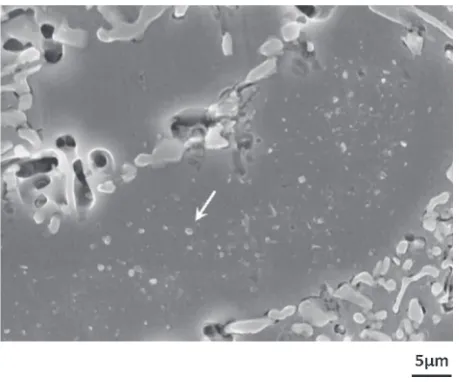
condition of 423 K aging by SEM observation. It seems that the primary cause of hardening is the solid-solution
harden-ing by Mg and Si atoms as-Al phase. Figure 8 shows the
existence of precipitates in -Al phase of Al-10
mass%Si-0.8 mass%Mg alloy casting over-aged at 673 K for 3.6 ks. The contrast of precipitates indicated by the white arrow was observed. However, the precipitates have not been observed in -Al+Si eutectic phase with aging treatment using OM and SEM yet. On the other hand, in squeeze-cast and rheo-cast A356 alloy with the hypoeutectic composition same as Al-10 mass%Si-Mg alloy used in this study, S. W. Youn et al.10,11) reported that the age hardening response was
observed in-Al+Si eutectic phase similarly in-Al phase.
Figure 9 shows the variation of Vickers hardness for
structure phases of -Al and -Al+Si eutectic in
Al-10 mass%Si-0.8 mass%Mg alloy castings aged at 473 K.
The variations of average hardness and partial hardness in
-Al and -Al+Si eutectic phases with aging time have the
same tendency in the case of 423 K aging as shown in Fig. 7.
Maximum hardness of -Al phase aged at 423 K is about
90 HV, but that of-Al+Si eutectic phase is about 150 HV.
There is a large difference between the hardness of structure
phases. It is thought that the volume fractions of-Al and
-Al+Si eutectic phases seemed to affect the age hardening behavior, therefore, general composite rule about hardness was applied in this study;
HVcal¼HVVfþHVeVfe ð1Þ
where HVcal is calculated hardness by composite rule, HV
and HVeare measured hardness in-Al and-Al+Si eutectic
phases, Vfand Vfeare volume fraction of-Al and-Al+Si
eutectic phases. Figure 10 shows the calculated hardness based on the composite rule and measured average hardness in Al-10 mass%Si-0.8 mass%Si alloy casting aged at 423 K,
in addition to the variation of volume fraction of -Al+Si
eutectic phase with aging time.-Al+Si eutectic phase has
constant volume fraction of about 0.4. The hardness of
-Al+Si eutectic phase was changed remarkably with the aging
time, though the volume fraction of-Al+Si eutectic phase
had no change. It shows that some reactions contributed
to hardening were generated in -Al+Si eutectic phase.
Variation of hardness calculated by the composite rule from
volume fraction and hardness in-Al and-Al+Si eutectic
phases with the aging time was similar to that of average hardness measured in the sample. The variation of hardness calculated by the composite rule shown in Fig. 11 was similar to that of average hardness measured in Al-10 mass%Si-0.8 mass%Mg alloy casting aged at 473 K.
4. Conclusion
Age hardening behavior of Al-10 mass%Si alloy castings with 0.5 mass%Mg and 0.8 mass%Mg aged at various temperatures was evaluated from the microstructure obser-vation and the composite rule. From the investigation results, the following conclusions have been obtained.
Fig. 8 SEM image of-Al phase in Al-10 mass%Si-0.8 mass%Mg alloy casting over-aged at 673 K for 3.6 ks.
0 20 40 60 80 100 120 140 160
V
ickers Hardness,
h
/ HV
aged at 473K
Aging Time, t / ks
as cast 100 101 102 103
Fig. 9 Variation of Vickers hardness for structure phases of-Al and -Al+Si eutectic in Al-10 mass%Si-0.8 mass%Mg alloy casting isothermal-aged at 473 K.
0 20 40 60 80 40 60 80 100 120 140 160
V
ickers Hardness,
h
/ HV
V
o
lume Fraction (%)
Aging Time, t / ks
as cast 100 101 102 103
aged at 473K
[image:4.595.55.285.71.262.2](b) (a)
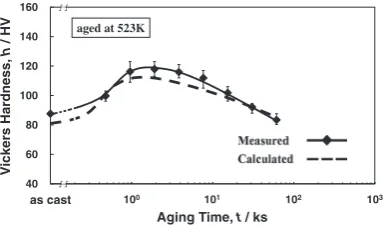
[image:4.595.321.527.72.229.2] [image:4.595.323.526.290.460.2](1) Al-10 mass%Si alloy casting with 0.5 mass%Mg and 0.8 mass%Mg obviously showed the age hardening behavior. (2) The age hardening curves calculated from the composite rule in Al-10 mass%Si alloy casting with 0.5 mass%Mg and 0.8 mass%Mg were almost in agreement with those of the measurements, respectively.
(3) Each age hardening of Al-10 mass%Si alloy casting with 0.5 mass%Mg and 0.8 mass%Mg were mainly composed of
the hardness change in the-Al+Si eutectic phase.
Acknowledgement
We are grateful to Mr. Daitetsu Aoki and Mr. Kazuhiro Hoshi (Kumagaya Works, Ahresty Corporation) for the chemical analysis of Al-10 mass%Si-Mg system alloy castings.
REFERENCES
1) N. Nishi: J. JFS80(2008) 677–683.
2) D. L. Zhang, L. H. Zheng and D. H. StJohn: J. Light Met.2(2002) 27–36.
3) S. B. Hassan and V. S. Aigbodion: J. Alloy. Compd. 486 (2009) 309–314.
4) R. W. Ruddle: The Solidification of Castings, Inst. Metals, (1957). 5) H. Suzuki, M. Kanno and G. Ito: J. JILM30(1980) 609–616. 6) M. Murayama and K. Hono: Acta Mater.47(1999) 1537–1548. 7) M. Tsukuda, M. Harada, T. Suzuki and S. Koike: J. JILM28(1978)
109–115.
8) M. Kitada: Elementary Metal Physics, (AGNE, 1978) pp. 153–158. 9) C. R. Barrett, W. D. Nix and A. S. Tetelman: The Principles of
Engineering Materials, (BAIFUKAN, 1980) pp. 115–118. 10) S. W. Youn and C. G. Kang: Mater. Sci. Eng. A425(2006) 28–35. 11) S. W. Youn and C. G. Kang: Mater. Chem. Phys.100(2006) 117–123.
101 102 103
100
as cast
V
ickers Hardness,
h
/ HV
Aging Time, t/ ks
40 60 80 100 120 140 160
[image:5.595.73.266.73.187.2]aged at 523K