Munich Personal RePEc Archive
Reason-based choice and
context-dependence: An explanatory
framework
Dietrich, Franz and List, Christian
Paris School of Economics, CNRS, London School of Economics
May 2015
Reason-based choice and context-dependence:
An explanatory framework
Franz Dietrich & Christian List
⇤ This version: 26 May 2015Abstract
We introduce a “reason-based” framework for explaining and predicting individual choices. It captures the idea that a decision-maker focuses on some but not all prop-erties of the options and chooses an option whose motivationally salient propprop-erties he/she most prefers. Reason-based explanations allow us to distinguish between two kinds of context-dependent choice: the motivationally salient properties may (i) vary across choice contexts, and (ii) include not only “intrinsic” properties of the options, but also “context-related” properties. Our framework can accommodate boundedly rational and sophisticatedly rational choice. Since properties can be recombined in new ways, it also offers resources for predicting choices in unobserved contexts. Keywords: Rational choice, reasons, context-dependence, bounded and sophisticated rationality, prediction of choice.
1
Introduction
How can we explain an agent’s choices? The classical theory of rational choice does so by ascribing to the agent a preference relation over the options – in the simplest case, an ordering. This preference relation explains the agent’s choices if, in every choice context, the agent chooses the most preferred option among the feasible ones.1 The choices are then said to berationalized by the preference relation. When choices involve uncertainty, we must ascribe beliefs as well as preferences to the agent, such that the agent always
⇤
Contact details: F. Dietrich, Paris School of Economics & CNRS, CES-Centre d’Economie de la Sorbonne, Maison des Sciences Economiques, 106-112 Boulevard de l’Hˆopital, 75647 Paris cedex 13, France; URL:<http://www.franzdietrich.net>. C. List, London School of Economics, Departments of Government and Philosophy, London WC2A 2AE, U.K.; URL:<http://personal.lse.ac.uk/LIST>.
1
chooses an expectation-maximizing option, but the logic of the explanation is similar. Though elegant and influential, this theory has some well-known problems:
An empirical problem: It cannot accommodate all empirically documented patterns of choices. As psychologists and behavioural economists have amply shown, people often choose in ways that cannot be naturally rationalized by any preference relation over the options. For example, people are susceptible to framing effects, often satisfice rather than optimize, and follow social norms that are not in line with the constraints of classical rational choice theory (e.g., Camerer et al. 2004). We give some illustrations later.
An explanatory problem: Even when there is a preference relation over the op-tions that rationalizes an agent’s choices, it is far from clear whether this can be viewed as a genuine explanation of those choices. For a start, many economists adopt a be-haviouristic interpretation of preferences and treat preference relations merely asformal representationsof choices and not as genuinely explanatory. But aside from this concern, when we are asked, “why did you choose teaching rather than banking as your career”, simply saying “because I preferred one to the other” is not very illuminating. We are expected to give reasons for our choices, as philosophers and psychologists have long emphasized (e.g., Shafiret al. 1993; Lenman 2011). A better explanation might be that we perceive teaching as a way of making a social contribution and promoting learning, while we perceive banking as a way of making money and supporting the economy’s status quo; and we rank the first bundle of properties more highly than the second.
A predictive problem: A less widely recognized problem is that the classical theory is limited in its ability to predict an agent’s future choices (see Bermudez 2009). If we simply ascribe a preference relation to the agent, based on his or her past choices, then we can predict future choices only in special cases: namely when this preference relation already ranks the options involved. This is only the case when these options are ones the agent has encountered before, unless we can somehow extrapolate the agent’s preferences to them. When the options are genuinely new, such an extrapolation is difficult. This limitation is a byproduct of the parsimonious informational basis of classical choice theory.
are not further unpacked, and agents have preferences over them. In reality, however, each option has numerous properties, and an agent focuses only on some, but not all, of these properties in making his or her choices. Recall the example of teaching versus bank-ing. An agent might perceive the first option as the property bundle “contributing to society and promoting learning” and the second as the property bundle “making money and supporting the economy’s status quo”. Our framework captures the idea that agents perceive the options in terms of “motivationally salient” properties. Choices are then made, not based on fixed preferences over options, but based on more fundamental pref-erences over motivationally salient property bundles (cf. Lancaster 1966, Gorman 1980).
We lift two common but problematic assumptions. One is that the agents whose choices we seek to explain perceive the options in the same way as we, the modellers, do. In our framework, we can express different hypotheses about how an agent perceives the options, and ask what choice behaviours these hypotheses would predict. A second as-sumption which we lift is that an agent will always perceive the same options in the same way, irrespective of the choice context. In our framework, an agent’s perception of the options may depend on the context in two ways. First, the motivationally salient prop-erties may vary from context to context. We call this phenomenon “context-variance”. It arguably plays a role in framing effects. Second, the motivationally salient properties may go beyond “intrinsic” properties of the options and may include “context-related” properties. Examples are whether an option conforms to a context-specific social norm (e.g., is it polite in that context?), whether it is above average quality among the avail-able options, or whether the choice menu offers luxury options. We call this phenomenon “context-relatedness”. It arguably plays a role in certain sophisticated choice behaviours, such as non-consequentialist or norm-following behaviours.
The move from options as primitives to options that are perceived as bundles of properties also yields new resources for predicting an agent’s future choices: properties can be recombined in new ways, and an agent’s attitudes towards certain property instantiations in the past can give us evidence for his or her attitudes towards new instantiations of those properties.
1.1
Related literature
This paper contributes to the literature on models of individual choice and especially the rationalization of choice functions. For a comprehensive overview of rationalization theory, see Bossert and Suzumura (2010). There are, by now, many papers which propose non-classical models of individual choice, prompted by the shortcomings of classical rational choice theory (see, among others, Sen 1993; Suzumura and Xu 2001; Kalai et al. 2002; Gaertner and Xu 2004; Manzini and Mariotti 2007, 2012; Mandler et al. 2012; and Cherepanov et al. 2013). However, none of these works explain choices in the “reason-based” way developed here, nor in terms of the two orthogonal kinds of context-dependence we identify.2
In economics, the closest precursors to the present paper are perhaps two pairs of papers by Salant and Rubinstein (2008) and Bernheim and Rangel (2009), and by Bossert and Suzumura (2009) and Bhattacharyya, Pattanaik, and Xu (2011). As we dis-cuss later, they each cover one of our two kinds of context-dependent choice. An impor-tant precursor in psychology is Shafir, Simonson, and Tversky’s work on “reason-based choice” (1993). They proposed that “when faced with the need to choose, decision makers often seek and construct reasons in order to resolve the conflict and justify their choice” (p. 11). Our paper can be viewed as a formalization of this reason-based approach.
There are also several related works on property-based preferences, the logic of prefer-ences, and preference change. In consumer theory, Lancaster (1966) and Gorman (1980) developed the idea that an agent’s preferences over consumption goods depend on their characteristics. In philosophy, von Wright (1963) studied the logic of preferences, still influencing current work (e.g., Liu 2010); and Pettit (1991) and de Jongh and Liu (2009) discussed the dependence of an agent’s preferences on properties of the options.
In our own previous work, we developed a model of how reasons, or motivationally salient properties, relate to preferences, and used this model to study preference change (Dietrich and List 2011, 2013a, 2013b). Osherson and Weinstein (2012) proposed a formal logic of preferences based on reasons. Unlike these earlier papers, the present paper (i) focuses on the explanation of choice, not preference, (ii) treats motivationally salient properties, not as exogenously given, but as endogenously determined by the choice context, and (iii) considers not only “intrinsic” properties of the options, but also properties related to the choice context.
2
2
The classical theory of rational choice
2.1
The basics
We begin by reviewing the basics of classical rational choice theory. The central concept is that of an agent’schoice function. This assigns, to each choice context, the option(s) chosen by the agent in that context. The aim is to explain or “rationalize” a given choice function by ascribing to the agent a preference relation over the options. This “rationalization” is successful if, in each choice context, the agent chooses the most preferred option(s) in that context, according to the given preference relation.
It is natural to view the choice function as theexplanandum – the observable object that we seek to explain – and the preference relation as theexplanans – the theoretical object that does the explaining. However, as noted in the introduction, many choice theorists avoid using the language of “explanation”, because they interpret the pref-erence relation behaviouristically, as a mere representation of the choice function: a convenient way to express its informational content. Elsewhere, we have argued against this behaviouristic interpretation (Dietrich and List 2012).
Formally, the observable primitives of the classical theory are the following:
• A non-empty set X ofoptions. Typical elements arex, y, z, ...
• A non-empty set K of contexts (sometimes called “menus”), where each element K 2K is a non-empty set K ✓ X of feasible options. In the simplest case, K is the set of all non-empty subsets ofX.
• Achoice function C :K!2X, which assigns to each contextK 2K a non-empty
set of “chosen options” in K (i.e., C(K) ✓ K). If the chosen setC(K) contains more than one option, this means that several options are tied for choice.
The choice function C is rationalizable by a preference relation if there exists a binary relation% onX such that, for all contextsK 2K,
C(K) ={x2K :x%yfor all y2K}.
A simple example illustrates these definitions. Here, the setX consists of an apple, a banana, and a coconut; the setK consists of all non-empty subsets ofX; and the choice functionC is as follows:
• C({apple, banana, coconut}) ={apple};
• C({apple, coconut}) ={apple};
• C({banana, coconut}) ={banana};
• C({apple}) ={apple};
• C({banana}) ={banana};
• C({coconut}) ={coconut}.
This choice function can be rationalized by a (complete and transitive) preference relation %which satisfies
apple banana coconut.
As is standard, is the strict part of%, and⇠ is the indifference part.
2.2
When is a choice function rationalizable by a preference relation?
Not all logically possible choice functions can be rationalized by a preference relation. For instance, if an agent chooses an apple from the set{apple, banana, coconut}and a banana from the set{apple, banana}, then no preference relation will rationalize this pat-tern of choices. To be consistent with the first choice, i.e.,C({apple, banana, coconut}) =
{apple}, the preference relation would have to rank the apple at least weakly above all three fruits. But then the apple would also have to be chosen from the set{apple, banana}, which contradicts the second choice, i.e.,C({apple, banana}) ={banana}.
From the perspective of scientific method, the fact that not all choice functions can be rationalized by a preference relation is good news. It means that the hypothesis that an agent’s choices are based on a preference relation is falsifiable; it is not a tautology (at least once the set of options has been fixed). The following classic result gives necessary and sufficient conditions for a choice function to be rationalizable by a preference relation.
Proposition 1 (Richter 1971) A choice function C is rationalizable by a preference relation if and only if it satisfies the axiom of Revelation Coherence.
To state that axiom, let us say that an option x is chosen weakly over an option y in contextK if x, y2K andx2C(K). Further,x ischosen strictly over y inK if, in addition,y /2C(K).
Revelation Coherence For all contexts K 2Kand any feasible optionx2K, if, for every optiony2K, there is a contextK0
Revelation Coherence does not guarantee that the binary relation that rationalizes a given choice function satisfies any further properties such as acyclicity or transitivity. For that, the choice function must satisfy stronger conditions, such as theWeak Axiom of Revealed Preference(e.g., Samuelson 1948; Bossert and Suzumura 2010). The details need not concern us here. What matters for our purposes is a general point: if, and only if, a choice function satisfies certain structural conditions, it can be rationalized by a preference relation.
2.3
Bounded versus sophisticated rationality
There are at least two familiar kinds of choice behaviours which conflict with the struc-tural conditions just mentioned and which the classical theory therefore cannot accom-modate – at least not without significant adjustments.
Cases of bounded rationality: As is empirically well established, human decision-makers often violate conditions such as Revelation Coherence or the Weak Axiom of Revealed Preference due to framing effects, menu-dependent choice, susceptibility to nudges, the use of heuristics, unawareness, and other psychological phenomena. For example, a mere redescription of the options can lead to choice reversals. In Tversky and Kahneman’s framing experiments (e.g., 1981), participants reversed their choices over the same pair of options when their description was slightly modified, even though the experimenters were careful not to change any information conveyed. Similarly, policy makers are well aware that subtle changes in the decision environment, such as a change from an “opt-out” to an “opt-in” default in an insurance scheme, can greatly affect people’s choices (Thaler and Sunstein 2008). Decision-makers also often satisfice rather than optimize or use simple heuristics (Gigerenzeret al. 2000). An example is someone whose rule of thumb for buying a banana is to choose one whose size is above the average of the batch on offer. None of these choices can be rationalized by a preference relation over the options, unless we redescribe the options in a complicated way.
for a university reform when the dean and president have respected the relevant proce-dures in the run-up to the vote, but votes against it when there has been a procedural breach. Assume that the reform and its consequences would be the same in both cases. If the options are “reform” and “no reform”, we cannot rationalize this choice behaviour by a preference relation. To accommodate it, we would, at least, have to “re-individuate” the options by building some features of the choice context into them.
We suggest that the classical theory’s difficulty in handling these cases, and its in-ability to distinguish bounded from sophisticated rationality, stems from the lack of a model of how agents perceive the options in any given choice context. When we provide such a model, a unified explanation of many of the challenging phenomena can be given.
3
Our framework, informally explained
3.1
The idea of a reason-based explanation of choice
Our basic idea is the following. When an agent chooses between several options in some context, e.g., yoghurts in a supermarket, he or she perceives each option not as a primitive object, but as a bundle of properties. Although each option can have many properties, the agent considers not all of them, but only a subset: the motivationally salient properties. In the supermarket, these may include whether the yoghurt is fruit-flavoured, low-fat, and free from artificial sweeteners, but exclude whether the yoghurt has an odd (as opposed to even) number of letters on its label (an irrelevant property) and whether it has been sustainably produced (a property ignored by many consumers). The agent then makes his or her choice on the basis of afundamental preference relation over property bundles. He chooses one option over another in the given context, e.g., a low-fat cherry yoghurt over a full-fat, sugar-free vanilla yoghurt, if and only if his fundamental preference relation ranks the set of motivationally salient properties of the first option, say {low-fat, fruit-flavoured}, above the set of the second, say {full-fat, vanilla-flavoured, artificially sweetened}.
We call an agent’s choice behaviour reason-based explicable if it can be explained in this way. More precisely, areason-based explanation attributes two things to an agent:
• amotivational salience function, which assigns to each choice context the properties that the agent cares about in that context: the “motivationally salient” properties; and
We call the pair consisting of a motivational salience function and a fundamental pref-erence relation areasons structure. According to a reason-based explanation, the agent perceives the options in each context through the lens of the motivationally salient properties in that context; and the agent then chooses an option whose bundle of moti-vationally salient properties he or she most prefers.
Later, we axiomatically characterize all choice functions that admit a reason-based explanation. Technically, reason-based explanation is a new rationalization concept. But given our emphasis on the idea ofexplaining choices, we use the term “explanation” rather than “rationalization”.
3.2
How the context matters
In our framework, the motivationally salient properties that occur in a reasons structure may be of up to three kinds:
• option properties, which options have independently of the choice context and which are thus “intrinsic” to the options;
• relational properties, which options have relative to the context; and
• context properties, which are properties of the context alone.
Examples of option properties are “fruit-flavoured” and “low-fat” (in yoghurts); these depend solely on the yoghurt itself. Examples of relational properties are whether a yoghurt is the only cherry yoghurt on display, or the cheapest; these depend also on the other available yoghurts. Examples of context properties are whether the available yoghurts include premium brands (this depends only on the menu) and whether there is background music (this depends on features of the context over and above the menu).
Reason-based explanations can capture two kinds of context-dependent motivation:
Context-variance: Here, the context affects which properties are motivationally salient, so that the agent cares about different properties in different contexts. For example, some contexts make the agent diet-conscious, others not.
Many non-classical forms of choice can be subsumed under these two kinds of context-dependence. Arguably, bounded rationality, such as susceptibility to framing and nudg-ing, often involves context-variant motivation. Sophisticated rationality, such as norm-following or non-consequentialism, often involves context-related motivation. By con-trast, classically rational choice excludes both kinds of context-dependence. Of course, we do not claim that variance is always boundedly rational or that context-relatedness is always sophisticated. The key point is that reason-based explanations can be given for a variety of choice behaviours that cannot be rationalized by a preference relation in the classical way.
3.3
A common objection
Before we present our framework formally, it is worth addressing one common objection. Since we take agents toperceive options as bundles of motivationally salient properties, a critic might ask why we do not simplydefineeach option as a bundle of motivationally salient properties. Should we not define the set X as the set of all such bundles? A choice context would then be a set of property bundles among which the agent can choose. Everything else would remain classical.
There are, however, three problems that this proposal would fail to address (see Bhattacharyyaet al. 2011 for some similar observations):
• First, we, the modellers, do not know in advance how the agent will perceive each option in a given context. The motivationally salient properties can be inferred, at most, after observing the agent’s choice behaviour.
• Second, an agent may perceive the same option through the lens of different prop-erties in different contexts, for instance when certain properties are motivationally salient in some contexts but not in others. This second problem, together with the first, illustrates that, while we may treat options as observable primitives, we cannot equally treat an option’s motivationally salient properties as an observable primitive. The notion of motivational salience is invoked in our explanation of the agent’s choices; it is not part of our pre-theoretic description of those choices.
To address these problems, we must have a way of distinguishing between an option in the “objective” sense, as viewed from the “Olympian” perspective of the modeller, and an option in the “subjective” sense, as perceived by the agent whose choice behaviour we seek to explain. Our framework allows us to draw this distinction. We can think of each element of the original set X as an option in the “objective” sense. And we can think of each option’s bundle of motivationally salient properties in a given context as the option in the “subjective” sense, as perceived by the agent.
4
Our framework, formally defined
4.1
Observable primitives
We are now in a position to present our framework formally. The observable primitives are exactly the same as in the classical theory. As before, we have a non-empty set X of options; a non-empty set K of contexts, each of which offers a non-empty set of feasible options (a subset of X); and a choice function C : K ! 2X, which assigns to
each contextK 2K a non-empty set of chosen options among the feasible ones inK. We permit only one small generalization, which is, however, optional. Readers who do not like this generalization may ignore it; all our results also hold without it. We do not require that each context beidentified with its set of feasible options. Instead, we merely require that itinduce a set of feasible options. Thus a context K 2K need not be a subsetK ✓X; it must merelypick out such a subset. This permits (but of course does not require) the existence of distinct contexts that offer the same options.
Specifically, each context K could be a pair (Y,λ), whereY is the feasible set (with Y ✓X) andλis a parameter that specifies some further features of the environment (as in the notion of a “frame” or “ancillary condition”, as defined in Salant and Rubinstein 2008 and Bernheim and Rangel 2009; see Section 6.4 below). This parameter could represent a cue given to the agent, a specification of a “default” option, some priming before the choice, the cultural environment, some background music, or the room tem-perature – even a state of the agent such as “sober” or “drunk”. We might distinguish, for instance, between a supermarket with classical music in the background and the same supermarket with pop music, where there is no difference in the goods on offer.
4.2
Properties
Our next step is to define properties. At first, we might be tempted to define a property simply as a feature that an option may or may not have, so that each property picks out a subset ofX consisting of those options that have the property. The property “being a fat-free yoghurt” can be modelled like this. If X is the set of all possible goods in a supermarket, this property can be identified with the subset ofX consisting of all fat-free yoghurts. However, this definition of properties is insufficiently general. As already noted, we want to allow for the possibility that an agent’s choices may be driven by properties that relate to the choice context.
We therefore define properties as features of option-context pairs, i.e., as features of pairs of the form (x, K), where x is an option and K is a choice context. Formally, a property is an abstract object, P, that picks out a subset [P] ✓ X ⇥K called its extension, consisting of all option-context pairs that “have” or “satisfy” the property (thus properties are binary here). Note that X ⇥ K is the set of all option-context pairs.3 We assume that the extension of any property is distinct from∅(the empty set) and fromX⇥K(the universal set). This rules out properties that are never satisfied or always satisfied.
Our definition allows distinct properties to have the same extension. This is use-ful for capturing framing effects in which the description of a property matters. For example, the properties “80% fat-free” and “20% fat” (in foods) have the same exten-sion but different descriptions and may sometimes prompt different responses. In many applications, however, it suffices to identify properties with their extensions.
We can now formalize the distinction between option properties, context properties, and relational properties.
Option properties: These are properties whose possession by an option-context pair depends only on the option, not on the context; they are in this sense “intrinsic” to the option. Examples are “fat-free” and “vanilla-flavoured” (in yoghurts). Formally,P is an option property if
(x, K)2[P],(x, K0)2[P] for allx2X andK, K02K.
Context properties: These are properties whose possession by an option-context pair depends only on the context, not on the option. Examples are “offering more than one feasible option”, “offering a Rolls Royce among the feasible options”, and – if contexts
3
specify the choice environment over and above the feasible set – the time (“it’s evening”), the temperature (“it’s a hot day”), or a default (“the status quo is such-and-such”). Formally,P is a context property if
(x, K)2[P],(x0, K)2[P] for allx, x02X andK 2K.
Relational properties: These are properties whose possesion by an option-context pair depends on both the option and the context. Examples are “not being the largest piece of cake offered” and “being the most expensive car on the market”. Formally, P is arelational property if it is neither an option property nor a context property.
We call properties that are not option propertiescontext-related and properties that are not context propertiesoption-related. Relational properties are context-related and option-related.
4.3
An example
To illustrate how properties can affect choices, we give an example to which we will refer repeatedly. We introduce this example in a pre-theoretic way, and only later show how it can be explained in our framework. The example concerns the choice of fruit at a dinner party, as in Sen’s well-known story of a polite dinner-party guest (Sen 1993).
LetX contain different fruits: apples, bananas, chocolate-covered pears, and possibly others. Each kind of fruit comes in up to three sizes: big, medium, and small. A choice context is a non-empty feasible setK ✓ X, consisting of fruits currently in the basket (so, in this example, we require only the classical notion of a context). The set of possible contexts isK= 2X\{∅}. We consider the following properties:
• “big”, “medium”, and “small”: the option properties of being a big, medium, and small fruit, respectively;
• “chocolate-offering”: the context property of offering at least one chocolate-covered fruit among the feasible options;
• “polite”: the relational property of not being the last available fruit of its kind, i.e., not being the last apple in the basket, the last banana, and so on.
Bon-vivant Bonnie always chooses a largest available fruit. For anyK, she chooses
C(K) ={x2K :x is largest inK},
where “medium” is larger than “small”, and “big” is larger than both other sizes.
Polite Pauline politely avoids choosing the last available fruit of its kind and only secondarily cares about a fruit’s size. For anyK, she chooses
C(K) ={x2K :x is largest inK⇤ ifK⇤6=∅and largest inK if K⇤ =∅},
whereK⇤
is the set of all fruits inK that are not the last available ones of their kind.
Chocoholic Coco picks any fruit indifferently when no chocolate-covered fruit is avail-able, but otherwise chooses a largest available fruit, because the smell of chocolate makes him hungry. For anyK, he chooses
C(K) = (
K ifKcontains no chocolate-covered fruit,
{x2K :xis largest inK} otherwise.
Weak-willed William makes the same polite choices as Pauline when no chocolate-covered fruit is available, and the same “greedy” choices as Bonnie otherwise, as the smell of chocolate makes him lose his inhibitions. For anyK, he chooses
C(K) = 8 > <
> :
{x2K :xis largest inK⇤
} if "
Kcontains no chocolate-covered fruit andK⇤
6
=∅
# ,
{x2K :xis largest inK} otherwise,
whereK⇤
is again the set of fruits inK that are not the last available ones of their kind.
4.4
Reason-based explanations
As already anticipated, a choice function admits areason-based explanation if it can be explained by attributing areasons structure to the agent. We now make this precise.
Prelationalof relational properties. Our specification ofP can be viewed as a background hypothesis to the effect that no properties outside P make a difference to the agent’s choices, while at least some of the properties inside P might do so.4 Any subset of P is called aproperty bundle. The following notation is useful. For any optionx and any contextK, we write
• P(x, K) for the bundle of all properties of (x, K), formally{P 2P : (x, K)2[P]};
• P(x) for the bundle of option properties ofx, formallyP(x, K)\Poption; and
• P(K) for the bundle of context properties ofK, formally P(x, K)\Pcontext.
A reasons structure: Areasons structure, R, is a pair (M, ) consisting of:
• A motivational salience function M (formally a function from K into 2P
), which assigns to each context K 2K a setM(K) ofmotivationally salient properties in context K. We require the functionM to satisfy aninvariance constraint: if two contexts K andK0
are such thatP(K)=P(K0
), thenM(K)=M(K0 ).
• A fundamental preference relation over property bundles (formally a binary relation on 2P
, on which we initially impose no restrictions). We write > and ⌘ for the strict and indifference relations induced by .
The functionM specifies which properties the agent cares about in each context, and the relation specifies how he or she cares about these properties, by ranking different property bundles relative to one another. The invariance constraint on M prevents an empirically ungrounded ascription of motivational differences across contexts. It requires that any two contexts that have the same context properties induce the same motivationally salient properties. So, if we wish to hypothesize that the agent cares about different properties in contexts K and K0
, we must be able to point to some difference in context properties that lies behind this motivational difference. Contexts that do not differ in their context properties should be motivationally indistinguishable.
How reasons explain choices: According to the reasons structure R= (M, ):
• The agentperceives any optionxin any contextK as the bundle of motivationally salient properties of (x, K), denotedxK =P(x, K)\M(K).
4
• In any contextK, the agent willchoosethe options which, when perceived in terms of their motivationally salient properties in that context, are ranked most highly by his or her fundamental preference relation, formally
CR(K) ={x2K :xK yK for all y2K}.
We call CR
(formally a function fromK into 2X) the choice function induced by R.5 (If is insufficiently well-behaved,CR
(K) may be empty for someK, so that
CR
may only be an improper choice function.)
A choice functionC : K! 2X is reason-based explicable if there there exists a reasons
structureR(relative to the set P of properties) which induces that choice function (i.e.,
C =CR
). We then callR areason-based explanation forC. Whether a choice function admits a reason-based explanation depends on the underlying setP of properties. We return to the significance of this dependence later.
4.5
Revisiting the example
The four choice functions in our example all admit a reason-based explanation, where
P= {big, medium, small, chocolate-offering, polite}.
Bon-vivant Bonnie’s choice function can be explained by the reasons structure
R= (M, ) where, for each context K,
M(K) ={big, medium, small}(so M is a constant function),
and the preference relation places the three singleton property bundles{big},{medium}, and{small}in the linear order satisfying
5
Note that the agent’s fundamental preference relation over property bundles, which does not depend on the context, induces, for each contextK, a context-specific preference relation over options %K, defined as follows: for any x andy in X, x %K y , xK yK. The choice function CM can therefore equivalently be defined as follows: for eachK,
CR
(K) ={x2K:x%Kyfor ally2K}.
{big}>{medium}>{small}.6
For instance, in a contextK that offers only a small appleaand a big bananab, Bonnie perceives the two fruits as
aK =P(a, K)\M(K) ={small},
bK =P(b, K)\M(K) ={big},
and chooses the banana over the apple, because{big}>{small}.
Polite Pauline’s choice function can be explained by the reasons structure R = (M, ) where, for each contextK,
M(K) ={big, medium, small, polite}(so, again,M is a constant function),
and the preference relation places the property bundles{big, polite},{medium, polite},
{small, polite}, {big},{medium}and{small} in the linear order satisfying
{big, polite}>{medium, polite}>{small, polite}>{big}>{medium}>{small}.
For instance, if only two small apples a and a0
and one big banana b are available in contextK, Pauline perceives the three fruits as
aK =P(a, K)\M(K) ={small, polite},
a0K =P(a 0
, K)\M(K) ={small, polite},
bK =P(b, K)\M(K) ={big},
and chooses one of the apples rather than the banana, because{small, polite}>{big}.
Chocoholic Coco’s choice function can be explained by the reasons structure R= (M, ) where, for each contextK,
M(K) = 8 > > > > <
> > > > :
∅ if no chocolate-covered fruit is available inK, i.e., chocolate-offering2/P(K),
{big, medium, if a chocolate-covered fruit is available in K, small} i.e., chocolate-offering2P(K),
and the preference relation is the same as Bonnie’s, with the additional stipulation that∅⌘∅. For instance, in a context without a tempting chocolate-covered fruit, Coco picks any fruit indifferently, because he perceives every fruit as the same empty property bundle∅, where ∅⌘∅.
6
Weak-willed William’s choice function can be explained by the reasons structure
R= (M, ) where, for each context K,
M(K) = 8 > > > > <
> > > > :
{big, medium, if no chocolate-covered fruit is available inK, small, polite} i.e., chocolate-offering2/P(K),
{big, medium, if a chocolate-covered fruit is available in K, small} i.e., chocolate-offering2P(K),
and the preference relation is the same as Pauline’s. So, if contextK offers only two small applesaanda0
and one big bananab, then, undisturbed by any smell of chocolate, William perceives these fruits as Pauline does and politely chooses a small apple. If a small chocolate-covered pear is added to the basket, he forgets about politeness and perceives the fruits as Bonnie does, choosing the big banana.
4.6
Two kinds of context-dependence
We say that an agent’s motivation, according to the reasons structureR= (M, ), is
• context-variant ifM is a non-constant function (i.e.,M(K) is not the same for all K 2K), andcontext-invariant otherwise;
• context-related if the motivationally salient properties that are specified by M include context-related properties (i.e., M(K) contains at least one relational or context property for some K 2K), andcontext-unrelated otherwise.
In our example, Polite Pauline displays context-related motivation: the relational prop-erty “polite” is motivationally salient for her. By contrast, Chocoholic Coco displays context-variant motivation: the properties that are motivationally salient for him vary with the context. Weak-willed William displays both kinds of context-dependent mo-tivation: he sometimes cares about the relational property “polite”, and he also cares about different properties in different contexts. Bon-vivant Bonnie, finally, illustrates the classical case of fully context-independent motivation.
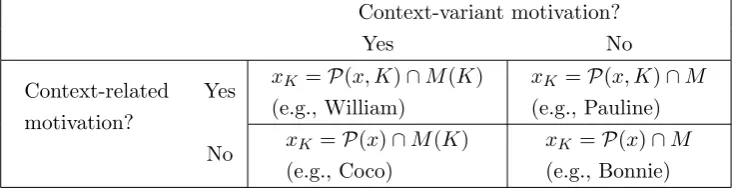
How do the two kinds of context-dependence affect an agent’s perception of the op-tions in each context? Table 1 shows how a given optionx is perceived in context K, depending on which of the two kinds of context-dependence are present. Generally, when both kinds of context-dependence may be present, optionxis perceived in contextK as xK =P(x, K)\M(K). This may depend on the context in two places: first, in the set
Context-variant motivation?
Yes No
Context-related motivation?
Yes xK =P(x, K)\M(K) (e.g., William)
xK =P(x, K)\M
(e.g., Pauline)
No xK =P(x)\M(K) (e.g., Coco)
xK =P(x)\M
[image:20.595.115.482.112.206.2](e.g., Bonnie)
Table 1: The agent’s perception of optionxin contextK
instance of context-dependence disappears, andP(x, K) can be replaced byP(x). Here, M(K) contains only option properties, so that P(x, K)\M(K) = P(x)\M(K). If the agent’s motivation is context-invariant, the second instance of context-dependence disappears, andM(K) can be replaced by a fixed setM of motivationally salient prop-erties. Here, the motivational salience function is constant, so that the first component of the reasons structure (M, ) can be identified with a fixed set M. In the context-independent case, finally, the agent’s perception of optionx in context K simplifies to xK =P(x)\M.
From a classical perspective, agents with context-variant motivation – e.g., whose motivation varies as a result of subtle environmental features like the smell of chocolate – would count as boundedly rational. Bonnie exemplifies the case of classical rational-ity: her motivation is completely context-independent. Pauline displays sophisticated rational behaviour: she considers not only properties of the options, but also context-related properties, such as politeness. William tries to display the same sophisticated behaviour, but is susceptible to variations in motivation across different contexts. Coco, finally, focuses only on option properties, but, like William, lacks a stable motivation.
5
When does a choice function admit a reason-based
explanation?
5.1
An axiomatic characterization
In what follows, we state three jointly necessary and sufficient conditions which a choice function C : K ! 2X must satisfy to admit a reason-based explanation. In line with
set of properties we have at our disposal in constructing this explanation. Our axioms are jointly less restrictive ifPis rich than if it is sparse: it is easier to give a reason-based explanation if we have lots of properties at our disposal than if we have only a few.
We begin with an “intra-context” axiom. It says that the agent’s choice in any context does not distinguish between options that have the same properties in that context:
Axiom 1 For all contexts K 2K and all optionsx, y2K, ifP(x, K) =P(y, K), then x2C(K),y2C(K).
The second axiom is an “inter-context” axiom. It says that if two contexts offer the same feasible property bundles, the agent chooses options instantiating the same property bundles in those contexts:
Axiom 2 For all contextsK, K0
2K, if{P(x, K) :x2K}={P(x, K0
) :x2K0
}, then
{P(x, K) :x2C(K)}={P(x, K0
) :x2C(K0 )}.7
Axioms 1 and 2 jointly imply that choice is based on the properties in P, but they do not yet imply any maximizing behaviour.8 This gap is filled by our third axiom, a variant of Richter’s original axiom of Revelation Coherence, as introduced in Section 2. Unlike Richter’s axiom, ours is formulated at the level of property bundles, not options. We adapt some revealed-preference terminology. For any property bundlesS andS0
:
• S isfeasible in contextK if S=P(x, K) for some feasible option x2K;
• S ischosen in contextK if S=P(x, K) for some optionx2C(K);
• S is revealed weakly preferred to S0
(formally S %C S0
) if, in some context, S is chosen while S0
is feasible.
Axiom 3 Whenever a property bundle S ✓ P is feasible in a context K 2 K and is revealed weakly preferred to every feasible property bundle in context K, thenS is
7
This is distinct from requiring that the same options be chosen in those contexts. The axiom further requires no relationship between choices in contexts with different context properties, i.e., where P(K)6=P(K0
), since such contexts automatically offer different feasible property bundles. 8
chosen in contextK.9 Note the following:
Lemma 1 Axiom 3 strengthens Axiom 2.
We can now state our main characterization theorem:
Theorem 1 A choice function C admits a reason-based explanation if and only if it satisfies Axioms 1 and 3 (and therefore 2).10
This result holds for every underlying set P of properties. We can thus use our framework to assess whether a given choice function admits a reason-based explanation relative to different sets of properties. We can ask, for instance: can we explain a car buyer’s choice function by reference to a set of colour-related properties? By reference to a set of status-related properties? Or by reference to a set of sustainability- and price-related properties? In each case, our axioms, interpreted in terms of the relevant setP, provide the required conditions.11
Reason-based explanations need not be unique. For a given choice function C, there may exist more than one reasons structureR such that C = CR
. This non-uniqueness can be reduced if we impose further restrictions on the admissible reasons structures. In Appendix A, we state some additional characterization results, identifying conditions under which a choice function admits a reason-based explanation that is restricted to only one, or none, of the two kinds of context-dependence we have introduced. Different reason-based explanations for the same choice function are by no means equivalent: they attribute a different motivational psychology to the agent and may lead to different predictions for novel choice contexts, as shown in Section 7.
9
Like Axiom 2, this axiom imposes “inter-context” contraints only among contexts with the same context properties, because all contexts in which a given property bundle is feasible must have the same context properties. One must not interpret the revealed-preference relation%C
as representing funda-mental preferences. When the agent revealed-prefers bundleS to bundleS0
by choosingS over S0 in some context, only somesubsets ofS andS0
are usually motivationally salient, and the fundamental preference is held between these, not betweenSandS0
. The revealed-preference relation%C
over prop-erty bundles induces a context-variant revealed-preference relation%C
Kover options:xisrevealed weakly preferredtoyin contextK(x%CKy) if and only ifP(x, K)%
C
P(y, K). In classical choice theory, with-out properties, it is hard to define an interesting notion of context-variant revealed preference. Classical revealed preferences are context-invariant and fail to rationalize many observable choice behaviours.
10
Axioms 1 and 3 are jointly equivalent to the requirement that, for everyK2Kand everyx2K, if P(x, K) is revealed weakly preferred toP(y, K) for everyy2K, thenx2C(K).
11
5.2
The choice-behavioural falsifiability of reason-based explanations
A key desideratum on any scientific theory is its falsifiability: it must be possible for the theory to be false. A theory that can “explain” everything does not explain anything. Theories of individual choice should be no exception. Choice theorists typically focus onchoice-behavioural falsifiability. Although we think that there is no strong scientific reason to restrict the empirical evidence base to choice behaviour alone (which would exclude, for instance, other psychological data), we temporarily follow convention and focus on choice-behavourial falsifiability too (cf. Dietrich and List 2012). How do reason-based explanations fare in this respect?
To answer this question, we must distinguish between two different senses in which reason-based explanations offer a theory of choice. On one interpretation, the specific reason-based explanation that we give for an agent’s choices is our theory. On another interpretation, thereason-based framework in its entirety is our theory.12
A specific reason-based explanation as a theory: If an agent’s choice functionCis the observable object that we seek to explain, then the specific reasons structureRthat we attribute to the agent can be viewed as the theory that we offer as an explanation. This theory, which we labelTR, has the form:
“Ris the agent’s reasons structure (which implies C =CR ).”
This theory is clearly choice-behaviourally falsifiable. In particular, it is falsified if R
fails to induceC (i.e., CR6
=C) and corroborated otherwise (i.e.,CR =C).
The reason-based framework as a theory: The broader message of our framework is that choices are “reason-based”. Applying this to a particular agent, we can view the assertion that the agent’s choice function C admits some reason-based explanation as our theory. Here, the theory, which we labelT9R, has the form:
“There is someR (relative to setP of properties) such that
Ris the agent’s reasons structure (which implies C =CR ).”
Whether this theory is choice-behaviourally falsifiable depends on the setPof properties relative to which it is asserted. If we are sufficiently disciplined in our specification of P, then T9R is choice-behaviourally falsifiable. With respect to many reasonable specifications of P (e.g., P = {big, medium, small, chocolate-offering, polite} in our
12
example), only some but not all choice functions satisfy our axioms for reason-based explicability. Hence T9R is falsified if the agent’s choice function violates our axioms, andcorroborated otherwise. Note thatT9R is equivalent to the conjunction of Axioms 1, 2, and 3. By contrast, if we specify the setP too permissively, thenT9Rmay become choice-behaviourally unfalsifiable, as shown in the next subsection.
5.3
The significance of our auxiliary hypothesis
We have noted that the specification ofP is a crucial auxiliary hypothesis. It deems all properties that are outside that set irrelevant to the agent’s choices. This allows us to rule out reason-based explanations that are too far-fetched – for instance, because they invoke properties which do not plausibly matter psychologically, such as whether there is an even (rather than odd) number of letters on the yoghurt label. Far-fetched explanations, in turn, may not generate reliable predictions of future choices, as discussed later.
Let us illustrate how reason-based explicability will become too permissive and thereby substantively unilluminating if we specifyP too liberally. Suppose, for instance, we takeP to include all properties of the form:
P(x,K): “The option-context pair is (x, K)”,
where x is an option and K a context in which x is feasible. Let PX⇥K be the set of all such maximally specific properties – “maximally specific” because the extension of P(x,K) consists solely of the pair (x, K). It it easy to see that any logically possible choice functionC will admit a reason-based explanation wheneverP ◆PX⇥K. Simply defineR= (M, ) as follows:
• M(K) =PX⇥K for every contextK;
• for any optionsxandyand any context K, {P(x,K)} {P(y,K)}if and only ifxis weakly chosen over y in contextK.
In other words, Axioms 1 to 3 become vacuous whenP ◆ PX⇥K, so thatT9R becomes a tautology relative to such a setP.
properties from the setP, unless we have a special reason to include them. Recall that our goal is to identify properties that could make a psychologically plausible difference to the agent’s choices.
5.4
Does the reliance on an auxiliary hypothesis make reason-based
explanations
ad hoc
?
The reliance on an auxiliary hypothesis, encoded byP, does not render the notion of reason-based explanationad hoc. It is well known since the works of Duhem and Quine that practically all scientific theories rest on some auxiliary hypotheses. When we test a theory empirically, we are, in effect, testing its conjunction with certain auxiliary hypotheses. Any apparently disconfirming evidence will seldom suffice to falsify the theory by itself, but will falsify it only relative to those auxiliary hypotheses. A stubborn supporter of the theory can always insist that the theory is correct and respond to the evidence by revising the auxiliary hypotheses.
This is famously illustrated by a 19th century episode from physics. It then be-came evident that Mercury’s orbit deviated from the one predicted by Newton’s theory. But rather than admitting that Newton’s theory was falsified by this observation, some scholars, such as the mathematican Urbain Le Verrier, postulated the existence of an additional planet (“Vulcan”), whose gravitational influence would allow us to accommo-date Mercury’s orbit within Newton’s theory. Eventually, of course, Newton’s theory became overwhelmed with recalcitrant evidence, and it was superseded by Einstein’s.
Our claim is that the theory of individual choice is not different from other scientific theories in its reliance on auxiliary hypotheses. This is often insufficiently acknowledged. We have heard some people suggest (e.g., in discussions of this paper) that the classical notion of rationalization by a preference relation is purely choice-behavioural and free from auxiliary hypotheses. But this is simply not true. The key auxiliary hypothesis of classical rational choice theory is its specification of the options. Although the options are usually treated as exogenously given, the modeller is implicitly asserting an auxiliary hypotheses when he or she specifies them. Just as our notion of reason-based explicability becomes choice-behaviourally unfalsifiable when the setP of properties is specified too permissively, so the classical notion of rationalizability by a preference relation becomes equally unfalsifiable when the setX of options is specified too fine-grainedly.
To illustrate, let C (a function from K into 2X) be any choice function. Simply
respecify the options as follows. LetX0
be the set of all pairs of the form (x, K), where x is an option in X and K is a context in whichx is feasible. Let K0
replacing every original contextK inK with
K0 ={(x, K) :x2K}.
Suppose we now reinterpret the original choice functionC as a functionC0
fromK0 into 2X0
in the following way: for eachK0 in K0
, let
C0(K0) ={(y, K) :y=C(K), whereK is the context inK to whichK0 corresponds}.
Then C0
will of course be rationalizable by a preference relation on X0
, because each respecified option occurs in precisely one context. And this is so, whether or not the orginal choice function C was rationalizable by a preference relation on X. Crucially, from a choice-behavioural perspective, the functionsC andC0
are indistinguishable. The upshot is this: by representing an agent’s choices in terms of a sufficiently fine-grained set of options, we can always “rationalize” any choice behaviour by a preference relation. And so, the hypothesis that the agent’s choices are rationalizable by a pref-erence relation is choice-behaviourally falsifiable only in conjunction with an auxiliary hypothesis, namely a hypothesis concerning the nature of the options. This issue is of-ten swept under the carpet. (For a notable exception, which includes a more elaborate formal argument for the point we have just made, see Bhattacharyyaet al. 2011.) Our framework makes the role played by auxiliary hypotheses transparent.
5.5
Criteria for selecting an explanation in cases of non-uniqueness
We have clarified the sense in which reason-based explanations are choice-behaviourally falsifiable. But we still need to comment on their possible non-uniqueness, relative to choice-behavioural evidence. How can we select a reason-based explanation when the same choice function can be explained in more than one way?13 This question matters because different explanations give different accounts of the agent’s motivational psychology, by attributing different reasons structures to him or her. These, in turn, may lead to different predictions for the agent’s future choices, as discussed in Section 7. There are at least three kinds of criteria for deciding which reasons structureR= (M, ) to attribute to the agent when there are multiple competing ones:
13
Choice-behavioural difference-making criteria: These require that, as far as possible:
(i) the motivational salience function M deem only those properties motivationally salient that make an observable difference to the agent’s choice behaviour, and
(ii) the fundamental preference relation over property bundles be systematically de-rived from the agent’s choice behaviour.
The goal is to minimize behaviourally ungrounded ascriptions of motivation and funda-mental preference. We give one example of such a criterion in Appendix A.3.
Non-choice data: Verbal reports or neurophysiological data, such as responses to property-related stimuli, may help us test hypotheses about
(i) which properties are motivationally salient for the agent in context K and thus belong to M(K),
(ii) which context properties causally affect motivational salience, so that M(K) may vary as contexts K vary in those properties, and
(iii) which property bundles the agent fundamentally prefers to which others.
One might hypothesize that human beings have better conscious access to how they perceive the options in a given contextK and therefore to the properties inM(K) than to the context properties that affect whatM(K) is (i.e., those properties which, in an empirical study, might be significant explanatory variables for M). Some changes in M(K) might be due to subconscious influences, as in framing or nudging effects. If so, verbal reports may be more relevant to questions (i) and (iii) than to question (ii).
Parsimony criteria: We may try to select aparsimonious reasons structure, where
(i) the setsM(K) of motivationally salient properties generated byM are (a) as small as possible and (b) as unchanging as possible across differentK, and
(ii) the relation is as sparse as possible (e.g., defined over the fewest possible property bundles).
constantly as the entire setP and the fundamental preference relation as the revealed preference relation %C over property bundles. This makes the sets M(K) unchanging
but very large, and hence perhaps psychologically implausible. Conversely, making each M(K) small might require context-variance.
5.6
Classical rationalizability as a special case
Finally, we wish to note that the notion of rationalizability by a preference relation can be recovered as a special case of reason-based explicability. Simply takeP =PX, defined
as the set of all properties of the form
Px: “The option isx”,
where x is an element of X. The extension of each such property Px is the set of all
option-context pairs in whichx is the option (i.e., [Px] ={(x, K) :K 2K}). Then the
choice function C is classically rationalizable by a preference relation if and only if it can be explained by the reasons structureR= (M, ), where
• M(K) =PX for every contextK; and
• for any optionsxandyand any contextK, {Px} {Py}if and only ifxis weakly
chosen overy in some contextK.
Of course, this reason-based explanation would be unilluminating, since it would always cite an option’s “being that option” as the reason for choosing it. Nonetheless, the present formal observations help us compare the notion of reason-based explanation with its classical counterpart.
6
Some applications
To illustrate the generality of our framework, we briefly show how it can accommodate some much-discussed non-classical choice behaviours.
6.1
Framing e
ff
ects
whether these are framed in terms of the number of lives lost or in terms of the number of lives saved. For instance, saving m out of n lives (while not saving the remaining n m) is the same as losingn mout of nlives (while saving the remainingm). Yet, people’s choice dispositions may depend on the wording used.
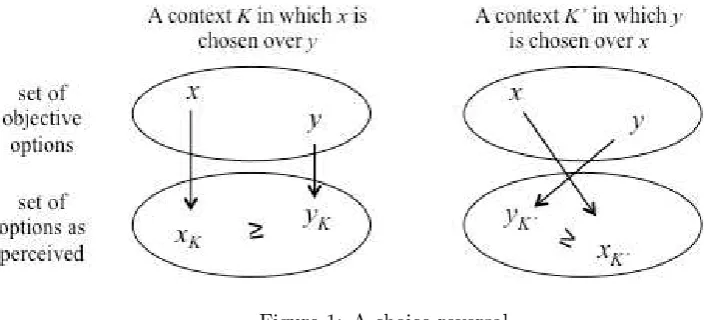
Formally, a framing effect can be understood as a special kind of choice reversal. A choice reversal occurs when there are contextsK andK0
and optionsxandysuch that xis chosen overy inK andyis chosen over xin K0
, where at least one choice is strict. SupposeR= (M, ) is the agent’s reasons structure in our framework. Then there may be two possible sources of choice reversals (as well as mixtures of the two).
• One possible source iscontext-variance. Here, the two contextsK andK0
in which a choice reversal occurs induce different sets of motivationally salient properties M(K)6=M(K0
), where bothM(K) and M(K0
) contain only option properties.
• Another possible source of a choice reversal is context-relatedness. Here, contexts
K andK0
induce the same set of motivationally salient propertiesM(K) =M(K0 ), but this set contains some relational or context properties that distinguish between x andyin the two contexts.
In either case, the agent prefersxto y as perceived in context K, and prefersy to xas perceived in context K0
[image:29.595.106.459.428.588.2], as illustrated in Figure 1.
Figure 1: A choice reversal
Since framing effects are usually thought to be sub-rational or sub-conscious, we may define a framing effect as a choice reversal whose source is context-variance (not context-relatedness).14 We may then define theframe in each context K simply as the
14
set of context properties ofK, formallyP(K).15
6.2
Checklists or “take-the-best” heuristics
Choices by checklist or “take-the-best” heuristics have received much attention in recent work in economics and psychology. Gigerenzer et al. (2000) give several empirical examples of such choice procedures, and Mandler et al. (2012) offer a formal analysis. For a related logical analysis, see also de Jongh and Liu (2009). Under a checklist or “take-the-best” approach, the agent considers a list of criteria by which the options can be distinguished and places the criteria in some order of importance. For any set of feasible options, the agent first compares the options in terms of the first criterion; if there are ties, he or she moves on to the second criterion; if there are still ties, he or she moves on to the third; and so on.
In our framework, we can explain such choice behaviour by a reasons structure R= (M, ) with a lexicographic fundamental preference relation , where property bundles are ranked on the basis of some order of importance over properties. To illustrate, let P1, P2, P3, ... denote the first, second, third, ..., properties in this order (assuming a finiteP). We can then define the fundamental preference relation as follows: for any property bundlesS1 andS2, letS1 S2 if and only if eitherS1 =S2 or there is somen such that (i)Pn 2S1, (ii)Pn 2/ S2, and (iii) S1\{P1, ..., Pn 1}=S2\{P1, ..., Pn 1}.
A lexicographic fundamental preference relation can be combined with either variant or invariant motivation, and with either related or context-unrelated motivation. This opens up greater generality than usually acknowledged in standard discussions of checklists or “take-the-best” heuristics. (For a generalization of the checklist model to variable checklists, see Manzini and Mariotti 2012.)
6.3
Non-consequentialism
A non-consequentialist agent makes a choice in a given context not just on the basis of the chosen option itself (the “consequence”), but also on the basis of what the choice
15
IfKandK0
offer the same feasible options, then the difference in frame can only be due to differences in context beyond the feasible set, which presupposes our generalized (“non-extensional”) notion of context (similar to the one in Salant and Rubinstein 2008). IfKandK0
context is or how each option relates to it (the “act of choosing the option”). Any context-related motivation can thus be viewed as a form of non-consequentialism. Many moral theories, such as deontological ones, recommend non-consequentialist forms of choice.
More narrowly, we may describe a non-consequentialist as someone who cares about whether each option is “permissible” or “norm-conforming” in a given context. The relevant criterion may be, for example, politeness, legality, or moral permissibility in the context. Let us introduce a relational propertyP such that any option-context pair (x, K) satisfiesP if and only if the choice ofxis deemed permissible or norm-conforming in context K. If P is in every M(K) and the fundamental preference relation ranks property bundles that includeP above bundles that do not, the agent will always choose a permissible or norm-conforming option, unless no such option is feasible.
Note that this could not generally be modelled without context-related motivation. (For earlier discussions of non-consequentialist choices, see, e.g., Suzumura and Xu 2001 and Gaertner and Xu 2004.)
6.4
The two kinds of context-dependence in the literature
Before turning to the prediction of choices in novel contexts, we want to discuss briefly how our framework relates to some earlier work on context-dependent choice. We focus on two pairs of papers: first, Salant and Rubinstein (2008) and Bernheim and Rangel (2009); second, Bossert and Suzumura (2009) and Bhattacharyya, Pattanaik, and Xu (2011). Although these works do not distinguish between our two kinds of context-dependence, we can interpret each as studying one of these two kinds.
Salant and Rubinstein (hereafter S&R) and Bernheim and Rangel (hereafter B&R) develop two related frameworks in which choices are affected by an external factor. In each framework, choice contexts are described as pairs (Y,λ) of a feasible setY and an environmental parameterλ, which is the “frame” in S&R or the “ancillary condition” in B&R. The two frameworks can be interpreted as models of context-variant rather than context-related motivation. S&R’s frame captures “information that is irrelevant in the rational assessment of the alternatives, but nonetheless affects choice” (p. 1287). B&R’s ancillary condition captures normatively irrelevant features affecting choice.16 Despite the similarity between the notions of a frame and an ancillary condition, there are formal and interpretational differences between S&R and B&R. S&R focus on the behavioural
16
implications of frame-dependence, B&R on choice-based welfare judgments.17
Bossert and Suzumura (hereafter B&S) and Bhattacharyya, Pattanaik, and Xu (here-after B&P&X) investigate what we would describe as context-relatedness. B&S assume that, in any given choice context, a feasible option may or may not be compatible with some exogenously given “norms”. In our example, picking the only available apple would violate a politeness norm. B&S axiomatically characterize those choice functions which are norm-conditionally rationalizable: there exists a preference relation over options such that, in any context, the agent chooses the most preferred norm-compatible feasible op-tion. One may think of such a rationalization as being “partially reason-based”. Each norm gives rise to a context-related property: the property of obeying that norm. Every property of this kind is taken to be desirable and motivationally salient in each context. The agent’s choice of a norm-compatible option is then explained by the fact that the option has all such properties (i.e., of obeying the norms in question). By contrast, the question of which optionamong the norm-compatible ones is chosen is not explained in terms of reasons (properties), but in terms of a classical preference relation over primitive options. B&P&X take a different approach. Like us, they model the agent’s perception of the options, yet not by invoking properties, but by refining the notion of an option via adding certain relevant information about the context. To describe Polite Pauline in our example, the options (fruits) would have to be refined by including the information of whether or not the context offers another fruit of the same kind. This refinement is carried out via a technical construction.18 B&P&X show that an agent whose choices among refined options are fully rational may nonetheless look irrational if his or her choice function is defined over non-refined options.
We thus note that while each of the two forms of context-dependence has been studied separately, the previous literature does not offer a joint framework accomodating both.
17
Deeply rooted in the behaviourist tradition, B&R propose to base judgments about an agent’s welfare solely on the agent’s choices, arguing that such welfare judgments may be possible even in cases in which they cannot be based on classical revealed preferences because choice is not rationalizable by a preference relation. Our own view is that welfare is not reducible to either choices or preferences (whether revealed or not). Welfare is a distinct concept, which we do not address in this paper.
18
For B&P&X, a refined option is not simply an option-context pair (x, K), since this potentially contains too much information. Rather, B&P&X define refined options as certain equivalence classes of such pairs. In the limiting, classical case, the context is totally irrelevant, so that any pairs (x, K) and (x, K0
7
Predicting choices in novel contexts
Standard choice theory is limited in its ability to predict choices in novel, previously un-observed contexts (see Bermudez 2009). In most empirical sciences, we make predictions about future (or otherwise unobserved) events, based on past observations. Astronomers predict future solar eclipses or paths of comets based on past trajectories of the relevant celestial bodies; epidemiologists predict future epidemics based on past epidemiological data; and econometricians use past data of the economy to predict its future. In choice theory, by contrast, observations and predictions are often taken to be the same thing: the choice function is the observedand predicted object at once.
Genuine predictions would have to be about choice contexts outside the observed domain, perhaps with feasible options that the agent has not previously encountered. If we rationalize choices simply by a preference relation on a given set of options, it is not easy to extrapolate this preference relation to new options (though suitable extrapola-tions are sometimes constructed in consumer theory).19 On the classical approach, we can make only two rather limited kinds of predictions:
• Any choice function on a given set of contexts can predict choices when the same contexts recur in the future. But here the preference relation does no work, since even a not-yet-rationalized choice function entails the same predictions.
• A preference relation might be used to predict choices in “new” contexts when those contexts involve only options over which the preference relation is already defined. We would then predict that the agent will maximize the same preference relation over the feasible options.
These limitations are a consequence of the parsimonious informational basis of classical choice theory. We now show that the additional resources of our reason-based model allow us to move beyond these limitations.20
7.1
A framework for predictions
Suppose that we have observed the agent’s choices, not for the entire domain K of contexts, but only for some subdomain Ko ✓ K. We call Ko the domain of observed
19
For discussions of predictions in classical revealed-preference theory, see, e.g., Varian (2006) and Blundell (2005).
20
contexts. We then write Co to denote the agent’s choice function restricted to that subdomain and call it theobserved choice function. Formally, Co is a function fromKo into 2X. The agent’s “full” choice function C, which we have not yet observed, is an
extension ofCo to the domain K.
The new contexts outside the observed domain (i.e., those inK\Ko) may offer options that were not offered by any of the contexts in Ko. Formally, the set X of all options can be a proper superset of the setXo of previously observed options.21
Our goal is to predict as much of the “true” choice functionCas possible, on the basis of the observed choice function Co. A choice predictor is a choice function π on some domain D✓K, where typically Ko✓D✓K. For each K in D, π(K) is the predicted choice in contextK. The predictor isaccurate if it predicts the agent’s choices correctly in all contexts inD, i.e., if π(K) =C(K) for allK inD.
As noted above, if we were to explain the observed choice function Co simply by attributing a preference relation to the agent, this would leave any options outside the setXo unranked and would therefore allow us to define predictors only for “old” contexts K 2Ko or for “new” contexts K 62 Ko containing only “old” options from Xo. Our reason-based