A Joint Model for Discovery of Aspects in Utterances
Asli Celikyilmaz
Microsoft
Mountain View, CA, USA
Dilek Hakkani-Tur
Microsoft
Mountain View, CA, USA
Abstract
We describe a joint model for understanding user actions in natural language utterances. Our multi-layer generative approach uses both labeled and unlabeled utterances to jointly learn aspects regarding utterance’s target do-main (e.g. movies), intention (e.g., finding a movie) along with other semantic units (e.g., movie name). We inject information extracted from unstructured web search query logs as prior information to enhance the generative process of the natural language utterance un-derstanding model. Using utterances from five domains, our approach shows up to 4.5% im-provement on domain and dialog act perfor-mance over cascaded approach in which each semantic component is learned sequentially and a supervised joint learning model (which requires fully labeled data).
1 Introduction
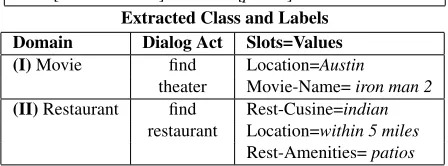
Virtual personal assistance (VPA) is a human to machine dialog system, which is designed to per-form tasks such as making reservations at restau-rants, checking flight statuses, or planning weekend activities. A typical spoken language understanding (SLU) module of a VPA (Bangalore, 2006; Tur and Mori, 2011) defines a structured representation for utterances, in which the constituents correspond to meaning representations in terms of slot/value pairs (see Table 1). While targetdomaincorresponds to the context of an utterance in a dialog, the dialog act represents overall intent of an utterance. The
slotsare entities, which are semantic constituents at the word or phrase level. Learning each component
Sample utterances on ’plan a night out’ scenario (I)Show me theaters in [Austin] playing [iron man 2]. (II)I’m in the mood for [indian] food tonight, show me the ones [within 5 miles] that have [patios].
Extracted Class and Labels Domain Dialog Act Slots=Values (I)Movie find Location=Austin
theater Movie-Name=iron man 2 (II)Restaurant find Rest-Cusine=indian
[image:1.612.313.537.268.351.2]restaurant Location=within 5 miles Rest-Amenities=patios Table 1: Examples of utterances with corresponding se-mantic components, i.e., domain, dialog act, and slots.
is a challenging task not only because there are no
a priori constraints on what a user might say, but also systems must generalize from a tractably small amount of labeled training data. In this paper, we argue that each of these components are interdepen-dent and should be modeled simultaneously. We build a joint understanding framework and introduce a multi-layer context model for semantic representa-tion of utterances of multiple domains.
Although different strategies can be applied, typically a cascaded approach is used where each semantic component is modeled sepa-rately/sequentially (Begeja et al., 2004), focusing less on interrelated aspects, i.e., dialog’s domain, user’s intentions, and semantic tags that can be shared across domains. Recent work on SLU (Jeong and Lee, 2008; Wang, 2010) presents joint modeling of two components, i.e., the domain and slot or dialog act and slot components together. Furthermore, most of these systems rely on labeled training utterances, focusing little on issues such as information sharing between the discourse and word level components across different domains, or variations in use of language. To deal with
pendency and language variability issues, a model that considers dependencies between semantic components and utilizes information from large bodies of unlabeled text can be beneficial for SLU.
In this paper, we present a novel generative Bayesian model that learns domain/dialog-act/slot semantic components as latent aspects of text ut-terances. Our approach can identify these semantic components simultaneously in a hierarchical frame-work that enables the learning of dependencies. We incorporate prior knowledge that we observe in web search query logs as constraints on these latent as-pects. Our model can discover associations between words within a multi-layered aspect model, in which some words are indicative of higher layer (meta) as-pects (domain or dialog act components), while oth-ers are indicative of lower layer specific entities.
The contributions of this paper are as follows: (i) construction of a novel Bayesian framework for semantic parsing of natural language (NL) utter-ances in a unifying framework in§4,
(ii) representation of seed labeled data and informa-tion from web queries as informative prior to design a novel utterance understanding model in§3 &§4, (iii) comparison of our results to supervised sequen-tial and joint learning methods on NL utterances in §5. We conclude that our generative model achieves noticeable improvement compared to discriminative models when labeled data is scarce.
2 Background
Language understanding has been well studied in the context of question/answering (Harabagiu and Hickl, 2006; Liang et al., 2011), entailment (Sam-mons et al., 2010), summarization (Hovy et al., 2005; Daum´e-III and Marcu, 2006), spoken lan-guage understanding (Tur and Mori, 2011; Dinarelli et al., 2009), query understanding (Popescu et al., 2010; Li, 2010; Reisinger and Pasca, 2011), etc. However data sources in VPA systems pose new challenges, such as variability and ambiguities in natural language, or short utterances that rarely con-tain contextual information, etc. Thus, SLU plays an important role in allowing any sophisticated spo-ken dialog system (e.g., DARPA Calo (Berry et al., 2011), Siri, etc.) to take the correct machine actions. A common approach to building SLU framework
is to model its semantic components separately, as-suming that the context (domain) is given a pri-ori. Earlier work takes dialog act identification as a classification task to capture the user’s intentions (Margolis et al., 2010) and slot filling as a sequence learning task specific to a given domain class (Wang et al., 2009; Li, 2010). Since these tasks are con-sidered as a pipeline, the errors of each component are transfered to the next, causing robustness issues. Ideally, these components should be modeled si-multaneously considering the dependencies between them. For example, in a local domain application, users may require information about a sub-domain (movies, hotels, etc.), and for each sub-domain, they may want to take different actions (finda movie,call
a restaurant orbook a hotel) using domain specific attributes (e.g.,cuisine typeof a restaurant,titlesfor movies orstar-ratingof a hotel). There’s been little attention in the literature on modeling the dependen-cies of SLU’s correlated structures.
Only recent research has focused on the joint modeling of SLU (Jeong and Lee, 2008; Wang, 2010) taking into account the dependencies at learn-ing time. In (Jeong and Lee, 2008), a triangular chain conditional random fields (Tri-CRF) approach is presented to model two of the SLU’s components in a single-pass. Their discriminative approach rep-resents semantic slots and discourse-level utterance labels (domain or dialog act) in a single structure to encode dependencies. However, their model re-quires fully labeled utterances for training, which can be time consuming and expensive to generate for dynamic systems. Also, they can only learn depen-dencies between two components simultaneously.
approach represent common co-occurrence patterns (dependencies) between semantic tags S (Fig. 2). Concretely, correlated topics eliminate assignment of semantic tags to segments in an utterance that belong to other domains, e.g., we can discover that
”Show me vegan restaurants in San Francisco”has a low probably of outputting amovie-actorslot. Be-ing generative, our model can incorporate unlabeled utterances and encode prior information of concepts.
3 Data and Approach Overview
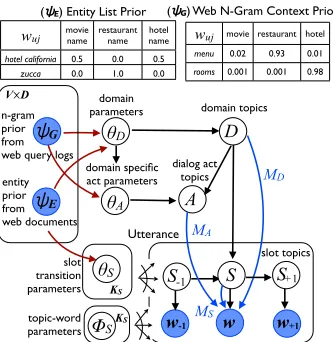
Here we define several abstractions of our joint model as depicted in Fig. 1. Our corpus mainly contains NL utterances (”show me the nearest dim-sum places”) and some keyword queries (”iron man 2 trailers”). We represent each utteranceuas a vec-torwu of Nu word n-grams (segments), wuj, each of which are chosen from a vocabularyW of fixed-sizeV. We use entity lists obtained from web sources (explained next) to identify segments in the corpus. Our corpus contains utterances from KD=4 main domains:∈ {movies, hotels, restaurants, events}, as well as out-of-domainotherclass. Each utterance has onedialog act(A) associated with it. We assume a fixed number of possible dialog actsKA for each domain. Semantic Tags, slots (S) are lexical units (segments) of an utterance, which we classify into two types: domain-independent slots that are shared across all domains, (e.g., location, time, year, etc.), and domain-dependent slots, (e.g. movie-name, actor-name, restaurant-name, etc.). For tractability, we consider a fixed number of latent slot typesKS. Our algorithm assigns domain/dialog-act/slot labels to each topic at each layer in the hierarchy using la-beled data (explained in§4.)
We represent domain and dialog act components as meta-variables of utterances. This is similar to author-topic models (Rosen-Zvi et al., 2004), that capture author-topic relations across documents. In that case, words are generated by first selecting an author uniformly from an observed author list and then selecting a topic from a distribution over words that is specific to that author. In our model, each utterance u is associated with domain and dialog act topics. A word wuj in u is generated by first selecting a domain and an act topic and then slot topic over words ofu. The domain-dependent slots
in utterances are usually not dependent on the di-alog act. For instance, while”find [hugo] trailer”
and”show me where [hugo] is playing”have both a movie-name slot (”hugo”), they have different di-alog acts, i.e., find-trailer and find-movie, respec-tively. We predict posterior probabilities for domain
˜
P(d ∈ D|u) dialog act P˜(a ∈ A|ud) and slots ˜
P(sj ∈S|wuj, d, sj−1)of wordswuj in sequence. To handle language variability, and hence dis-cover correlation between hierarchical aspects of ut-terances1, we extract prior information from two web resources as follows:
Web n-Grams (G). Large-scale engines such as Bing or Google log more than 100M search queries each day. Each query in the search logs has an as-sociated set of URLs that were clicked after users entered a given query. The click information can be used to infer domain class labels, and there-fore, can provide (noisy) supervision in training do-main classifiers. For example, two queries (”cheap hotels Las Vegas” and ”wine resorts in Napa”), which resulted in clicks on the same base URL (e.g., www.hotels.com) probably belong to the same do-main (”hotels” in this case).
movie rest. hotel event other
ψGd| = P(wj d=hotel|wj=‘room’)
Given query logs, we compile sets of in-domain queries based on their base URLs2. Then, for each vocabulary item
wj ∈ W in our corpus, we calculate frequency of
wj in each set of in-domain queries and represent each word (e.g., ”room”) as a discrete normalized probability distribution ψj
G over KD domains
{ψd|j
G}∈ ψ
j
G. We inject them as nonuniform priors
over domain and dialog act parameters in§4. Entity Lists (E). We limit our model to a set ofnamed-entityslots (e.g., movie-name, restaurant-name) andnon-named entityslots (e.g., restaurant-cuisine, hotel-rating). For each entity slot, we ex-tract a large collection of entity lists through the url’s on the web that correspond to our domains, such as movie-names listed on IMDB, restaurant-names on OpenTable, or hotel-ratings on tripadvisor.com.
1Two utterances can be intrinsically related but contain no
common terms, e.g.,”has open bar”and”serves free drinks”.
2We focus on domain specific search engines such as
slot transition parameters
slot topics dialog act
topics
!A domain specific act parameters n-gram
prior from web query logs
entity prior from web documents
domain topics domain
parameters
Utterance
w w+1
wuj movie restaurant hotel menu 0.02 0.93 0.01
rooms 0.001 0.001 0.98
(ψG) Web N-Gram Context Prior (ψE) Entity List Prior
V⨉D
wuj moviename restaurantname hotel name
hotel california 0.5 0.0 0.5
zucca 0.0 1.0 0.0
S
w-1
S+1 S-1
D
A
!D
!S
KS ψG
"SKS topic-word parameters
ψE
MD
MA
[image:4.612.99.266.64.235.2]MS
Figure 1:Graphical model depiction of theMCM.D,A,Sare domain, dialog act and slot in a hierarchy, each consisting of
KD, KA, KS components. Shaded nodes indicate observed
variables. Hyper-parameters are omitted. Sample informative priors over latent topicsψE andψG are shown. Blue arrows
indicate frequency of vocabulary terms sampled for each topic.
We represent each entity list as observed nonuniform priorsψEand inject them into our joint learning pro-cess asV sparse multinomial distributions over la-tent topics D, and S to ”guide” the generation of utterances (Fig. 1 top-left table), explained in§4.
4 Multi-Layer Context Model -MCM
The generative process of our multi-layer context model (MCM) (Fig. 1) is shown in Algorithm 1. Each utteranceuis associated with d = 1..KD multino-mial domain-topic distributionsθd
D. Each domaind, is represented as a distribution over a = 1, .., KA dialog actsθdaA (θdD →θdaA). In ourMCMmodel, we assume that each utterance is represented as a hidden Markov model withKS slot states. Each state gen-erates n-grams according to a multinomial n-gram distribution. Once domainDu and act Aud topics are sampled foru, a slot state topic Sujd is drawn to generate each segmentwuj of u by considering the word-tag sequence frequencies based on a sim-ple HMM assumption, similar to the content models of (Sauper et al., 2011). Initial and transition prob-ability distributions over the HMM states are sam-pled from Dirichlet distribution over slotsθSds. Each slot state s generates words according to multino-mial word distributionφsS. We also keep track of the frequency of vocabulary termswj’s in aV×KD ma-trixMD. Every time awjis sampled for a domaind, we increment its count, a degree of domain bearing
words. Similarly, we keep track of dialog act and slot bearing words inV ×KAandV ×KSmatrices,
MA andMS(shown as red arrows in Fig 1). Being Bayesian, each distributionθDd,θadA, andθSdsis sam-pled from a Dirichlet prior distribution with different parameters, described next.
Algorithm 1 Multi-Layer Context Model Generation 1: foreach domaind←1, ..., KD
2: draw domain dist.θd
D∼Dir(α?D)†,
3: for each dialog-acta←1, ..., KA
4: draw dialog act dist.θdaA ∼Dir(α?A), 5: for each slot types←1, ..., KS
6: draw slot dist.θds
S ∼Dir(α?S).
7: endfor
8: drawφsS ∼Dir(β)for each slot types←1, ..., KS.
9: foreach utteranceu←1, ...,|U|do
10: Sample a domainDu∼Multi(θDd) and,
11: and act topicAud∼Multi(θdaA).
12: forwordswuj,j←1, ..., Nudo
13: - DrawSujd∼Multi(θ
Du,Su(j−1)d
S )‡.
14: - Samplewuj∼Multi(φSujd).
15: end for
16: end for
†Dir(α?
D),Dir(α?A),Dir(α?S)are parameterized based on prior knowledge.
‡Here HMM assumption over utterance words is used.
asymmetric Dirichlet topic priorsα=(αm1,...,αmK) where each kth topic has a prior weight αk=αmk, with varying base measurem=(m1,...,mk)3.
We update parameter vectors of Dirichlet domain prior αu?D={(αD·ψDu1),..., αD·ψuKD D}, where αD is the concentration parameter for domain Dirichlet distribution and ψuD={ψDud}KD
d=1 is the base mea-sure which we obtain from various resources. Be-cause base measure updates are dependent on prior knowledge of corpus words, each utteranceu gets a different base measure. Similarly, we update the parameter vector of the Dirichlet dialog act and slot priorsαu?
A={(αA·ψAu1),...,(αA·ψuKA A)} and
αu?S ={(αS·ψSu1),...,(αS·ψuKS S)}using base measures
ψAu={ψAua}KA
a=1andψSu={ψSus} KS
s=1respectively. Before describing base measure update for do-main, act and slot Dirichlet priors, we explain the constraining prior knowledge parameters below:
? Entity List Base Measure(ψj
E): Entity
fea-tures are indicative of domain and slots and MCM
utilizes these features while sampling topics. For instance, entities hotel-name ”Hilton” and location
”New York” are discriminative features in classi-fying ”find nice cheap double room in New York Hilton”into correct domain (hotel) and slot ( hotel-name) clusters. We represent entity lists correspond-ing to known domains as multinomial distributions
ψEj, where each ψEd|j is the probability of entity-wordwj used in the domain d. Some entities may belong to more than one domain, e.g.,”hotel Cali-fornia”can either be a movie, or song or hotel name.
? Web n-Gram Context Base Measure (ψGj ): As explained in§3, we use the web n-grams as ad-ditional information for calculating the base mea-sures of the Dirichlet topic distributions. Normal-ized word distributionsψGj over domains were used as weights for domain and dialog act base measure.
? Corpus n-Gram Base Measure (ψCj): Sim-ilar to other measures, MCM also encodes n-gram constraints as word-frequency features extracted from labeled utterances. Concretely, we cal-culate the frequency of vocabulary items given domain-act label pairs from the training labeled ut-terances and convert there into probability mea-sures over domain-acts. We encode conditional
3
See (Wallach, 2008) Chapter 3 for analysis of hyper-priors on topic models.
probabilities {ψadC|j}∈ψjC as multinomial distribu-tions of words over domain-act pairs, e.g., ψadC|j=
P(d=”restaurant”, a=”make-reservation”|”table”). Base measure update: Theα-base measures are used to shape Dirichlet priorsαu?D,αu?A andαu?S . We update the base measures of each sampled domain
Du =dgiven each vocabularywj as:
ψdjD = (
ψEd|j, ψEd|j >0
ψGd|j, otherwise (1)
In (1) we assume that entities (E) are more indica-tive of the domain compared to other n-grams (G) and should be more dominant in sampling decision for domain topics. Given an utteranceu, we calcu-late its base measureψudD =(PNu
j ψ dj D)/Nu.
Once the domain is sampled, we update the prior weight of dialog actsAud=a:
ψAaj=ψCad|j∗ψdG|j (2)
and slot componentsSujd=s:
ψSsj =ψEd|j (3)
Then we update their base measures for a givenuas:
ψAua=(PNu
j ψ aj
A)/NuandψusS =( PNu
j ψ sj S)/Nu. 4.1 Inference and Learning
The goal of inference is to predict the domain, user’s act and slot distributions over each segment given an utterance. TheMCMhas the following set of pa-rameters: domain-topic distributionsθdD for eachu, the act-topic distributionsθdaA for each domain topic
d of u, local slot-topic distributions for each do-main θS, and φs
S for slot-word distributions. Pre-vious work (Asuncion et al., 2009; Wallach et al., 2009) shows that the choice of inference method has negligible effect on the probability of testing doc-uments or inferred topics. Thus, we use Markov Chain Monte Carlo (MCMC) method,specifically Gibbs sampling, to model the posterior distribution
PMCM(Du, Aud, Sujd|αu?D, αu?A, αu?S , β) by obtaining samples (Du, Aud, Sujd) drawn from this distribu-tion. For each utteranceu, we sample a domainDu and actAud and hyper-parametersαD andαA and their base measuresψDud,ψuaA (from Eq. 1,2):
θDd = N d
u +αDψDud
Nu+αu?D
; θdaA = Na|ud+α Aψud
D
Nud+αu?A (4)
The Nd
slot stateSujd, we assume that utterance is generated by the HMM model associated with the assigned domain. For each segmentwuj in u, we sample a slot stateSujdgiven the remaining slots and hyper-parametersαS,βand base measureψSus(Eq. 3) by:
p(Sujd=s|w,Du,S−(ujd)αuS?, β)∝
Nk ujd+β
N(k.)+V β ∗(N
Du,Su(j−1)d
s +αSψusS )∗
NDu,s
Su(j+1)d+I(Suj−1, s) +I(Suj+1, s) +αSψ
us S
NDu,s
(.) +I(Suj−1, s) +KDα u? S
(5)
The Nujdk is the number of times segment wuj is generated from slot state s in all utterances as-signed to domain topic d, NDu,s1
s2 is the
num-ber of transitions from slot state s1 to s2, where s1 ∈{Su(j−1)d,Su(j+1)d},I(s1, s2)=1 if slots1=s2.
4.2 Semantic Structure Extraction withMCM
During Gibbs sampling, we keep track of the fre-quency of draws of domain, dialog act and slot in-dicating n-gramswj, in MD, MA and MS matri-ces, respectively. These n-grams are context bearing words (examples are shown in Fig.1.). For givenu
the predicted domaind∗uis determined by:
d∗u= arg maxdP˜(d|u) = arg maxd[θDd ∗QNu
j=1 MDjd
MD]
and predicted dialog act byarg maxaP˜(a|ud∗):
a∗u = arg maxa[θdA∗a∗QNu
j=1 MAja
MA] (6)
For each segmentwuj inu, its predicted slot are de-termined byarg maxsP(sj|wuj, d∗, sj−1):
s∗uj = arg maxs[p(Sujd∗ =s|.)∗QNu
j=1 ZSjs
ZS] (7)
5 Experiments
We performed several experiments to evaluate our proposed approach. Before presenting our results, we describe our datasets as well as two baselines.
5.1 Datasets, Labels and Tags
Our dataset contains utterances obtained from di-alogs between human users and our personal assis-tant system. We use the transcribed text forms of
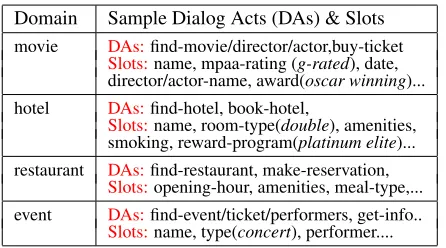
Domain Sample Dialog Acts (DAs) & Slots movie DAs:find-movie/director/actor,buy-ticket
Slots:name, mpaa-rating (g-rated), date, director/actor-name, award(oscar winning)... hotel DAs:find-hotel, book-hotel,
Slots:name, room-type(double), amenities, smoking, reward-program(platinum elite)... restaurant DAs:find-restaurant, make-reservation,
Slots:opening-hour, amenities, meal-type,... event DAs:find-event/ticket/performers, get-info..
[image:6.612.312.535.49.173.2]Slots:name, type(concert), performer.... Table 2: List of domains, dialog acts and semantic slot tags of utterance segments. Examples for some slots val-ues are presented in parenthesis asitalicized.
the utterances obtained from (acoustic modeling en-gine) to train our models4. Thus, our dataset con-tains 18084 NL utterances, 5034 of which are used for measuring the performance of our models. The dataset consists of five domain classes, i.e, movie, restaurant, hotel, event, other, 42 unique dialog acts and 41 slot tags. Each utterance is labeled with a domain, dialog act and a sequence of slot tags cor-responding to segments in utterance (see examples in Table 1). Table 2 shows sample dialog act and slot labels. Annotation agreement, Kappa measure (Cohen, 1960), was around 85%.
We pulled a month of web query logs and ex-tracted over 2 million search queries from the movie, hotel, event, and restaurant domains. We also used generic web queries to compile a set of’other’ do-main queries. Our vocabulary consists of n-grams and segments (phrases) in utterances that are ex-tracted using web n-grams and entity lists of§3. We extract distributions of n-grams and entities to inject as prior weights for entity list base (ψEj) and web n-gram context base measures (ψGj ) (see§4).
5.2 Baselines and Experiment Setup
We evaluated two baselines and two variants of our joint SLU approach as follows:
?Sequence-SLU: A traditional approach to SLU
extracts domain, dialog act and slots as seman-tic components of utterances using three sequential models. Typically, domain and dialog act detec-tion models are taken as query classificadetec-tion, where a given NL query is assigned domain and act la-bels. Among supervised query classification
meth-4We submitted sample utterances used in our models as
movie restaurant movie, theater,
ticket, matinee, fandango
menu, table, dinner, togo kids-friendly chinese, coffee
D1 D2
find-movieA1 find-review A2
reservation A3
check-menuA 4
movie-name S1
actor-name S2
iron man 2, hugo, muppets
descendants
rest-nameS3 cuisineS4 Sk
tom hanks, angelina jolie,
cameron reviews, critics ratings, mpaa, breath-taking scary, ticket
iron-man 2, oscar winner
kid-friendly reserve, table
wait-time
menu, list, vine list, check, hotpot
nearest, city center, Vancouver, New York amici, zucca
new york bagel starbucks
chinese, vietnamese,
italian, fast food
DO
M
AIN
DIAL
O
G
A
CTS
location
SL
O
TS
[image:7.612.78.303.64.186.2]domain in-dependent slots
Figure 2: Sample topics discovered by Multi-Layer Context Model (MCM). Given samples of utterances,MCMis able to in-fer a meaningful set of dialog act (A) and slots (S), falling into broad categories of domain classes (D).
ods, we used theAdaboost, utterance classifica-tion method that starts from a set of weak classifiers and builds a strong classifier by boosting the weak classifiers. Slot discovery is taken as a sequence la-beling task in whichsegments in utterances are la-beled (Li, 2010). For segment labeling we use Semi-Markov Conditional Random Fields (Semi-CRF) (Sarawagi and Cohen, 2004) method as a benchmark in evaluating semantic tagging performance.
?Tri-CRF: We used Triangular Chain CRF (Jeong
and Lee, 2008) as our supervised joint model base-line. It is a state-of-the art method that learns the sequence labels and utterance class (domain or dia-log act) as meta-sequence in a joint framework. It encodes the inter-dependence between the slot se-quencesand meta-sequence label (d ora) using a triangular chain (dual-layer) structure.
?Base-MCM: Our first version injects an
informa-tive prior for domain, dialog act and slot topic dis-tributions using information extracted from only la-beled training utterances and inject as prior con-straints (corpus n-gram base measure ψjC) during topic assignments.
?WebPrior-MCM: Our full model encodes
distri-butions extracted from labeled training data as well as structured web logs as asymmetric Dirichlet pri-ors. We analyze performance gain by the informa-tion from web sources (ψGj and ψEj) when injected into our approach compared toBase-MCM.
We inject dictionary constraints as features to train supervised discriminative methods, i.e., boosting and Semi-CRF in Sequence-SLU, and
Tri-CRFmodels. For semantic tagging, dictionary
constraints apply to the features between individual
segments and their labels, and for utterance classifi-cation (to predict domain and dialog acts) they apply to the features between utterance and its label. Given a list of dictionaries, these constraints specify which label is more likely. For discriminative methods, we use several named entities, e.g., Movie-Name, Restaurant-Name, Hotel-Name, etc., non-named en-tities, e.g., Genre, Cuisine, etc., and domain inde-pendent dictionaries, e.g., Time, Location, etc.
We train domain and dialog act classifiers via Icsiboost (Favre et al., 2007) with 10K iterations using lexical features (up to 3-n-grams) and con-straining dictionary features (all dictionaries). For feature templates of sequence learners, i.e., Semi-CRF and Tri-Semi-CRF, we use current word, bi-gram and dictionary features. For Base-MCM and
WebPrior-MCM, we run Gibbs sampler for 2000
iterations with the first 500 samples as burn-in.
5.3 Evaluations and Discussions
We evaluate the performance of our joint model on two experiments using two metrics. For domain and dialog act detection performance we present results in accuracy, and for slot detection we use the F1 pair-wise measure.
Experiment 1. Encoding Prior Knowledge: A common evaluation method in SLU tasks is to mea-sure the performance of each individual semantic model, i.e., domain, dialog act and semantic tagging (slot filling). Here, we not only want to demon-strate the performance of each component ofMCM
but also their performance under limited amount of labeled data. We randomly select subsets of labeled training dataULi ⊂ULwith different samples sizes,
niL={γ∗nL}, wherenLrepresents the sample size ofULandγ={10%,25%,..}is the subset percentage. At each random selection, the rest of the utterances are used as unlabeled data to boost the performance ofMCM. The supervised baselines do not leverage the unlabeled utterances.
The results reported in Figure 3 reveal both the strengths and some shortcomings of our ap-proach. When the number of labeled data is small (niL ≤25%*nL), our WebPrior-MCM has a better performance on domain and act predic-tions compared to the two baselines. Compared to
Sequence-SLU, we observe 4.5% and 3%
10 25 50 75 100
91 92 93 94 95 96
% Labeled Data
Accurac
y
%
Utterance Domain Performance
20 40 60 80 100 82
83 84 85 86 87 88
% Labeled Data
Accurac
y
%
Dialog Act Performance
20 40 60 80 100 65
70 75 80 85
% Labeled Data
F
-Measure
Semantic Tag (Slot) Performance
[image:8.612.318.536.277.373.2]Sequence-SLU Tri-CRF Base-MCM WebPrior-MCM
Figure 3:Semantic component extraction performance measures for various baselines as well as our approach with different priors.
models, whereas our gain is 2.6% and 1.7% over
Tri-CRFmodels. As the percentage of labeled
ut-terances in training data increase,Tri-CRF perfor-mance increases, howeverWebPrior-MCMis still comparable withSequence-SLU. This is because we utilize domain priors obtained from the web sources as supervision during generative process as well as unlabeled utterances that enable handling language variability. Adding labeled data improves the performance of all models however supervised models benefit more compared toMCMmodels.
AlthoughWebPrior-MCM’s domain and dialog act performances are comparable (if not better than) the other baselines, it falls short on the semantic tagging model. This is partially due to the HMM assumption compared to the supervised conditional model’s used in the other baselines, i.e., Semi-CRF
inSequence-SLUandTri-CRF). Our work can
be extended by replacing HMM assumption with CRF based sequence learner to enhance the capa-bility of the sequence tagging component ofMCM.
Experiment 2. Less is More? Being Bayesian, our model can incorporate unlabeled data at train-ing time. Here, we evaluate the performance gain on domain, act and slot predictions as more unlabeled data is introduced at learning time. We use only 10% of the utterances as labeled data in this experiment and incrementally add unlabeled data (90% of la-beled data are treated as unlala-beled).
The results are shown in Table 3.n%(n=10,25,..) unlabeled data indicates that the WebPrior-MCM
is trained usingn% of unlabeled utterances along with training utterances. Adding unlabeled data has a positive impact on the performance of all three
se-Table 3: Performance evaluation results of
WebPrior-MCM using different sizes of unlabeled utterances at learning time.
Unlabeled Domain Dialog Act Slot % Accuracy Accuracy F-Measure
10% 94.69 84.17 52.61
25% 94.89 84.29 54.22
50% 95.08 84.39 56.58
75% 95.19 84.44 57.45
100% 95.28 84.52 58.18
mantic components whenWebPrior-MCMis used. The results show that our joint modeling approach has an advantage over the other joint models (i.e.,
Tri-CRF) in that it can leverage unlabeled NL
ut-terances. Our approach might be usefully extended into the area of understanding search queries, where an abundance of unlabeled queries is observed.
6 Conclusions
References
A. Asuncion, M. Welling, P. Smyth, and Y. W. Teh. 2009. On smoothing and inference for topic models.UAI. S. Bangalore. 2006. Introduction to special issue of
spo-ken language understanding in conversational systems. InSpeech Conversation, volume 48, pages 233–238. L. Begeja, B. Renger, Z. Liu D. Gibbon, and
B. Shahraray. 2004. Interactive machine learning techniques for improving slu models. InProceedings of the HLT-NAACL 2004 Workshop on Spoken Lan-guage Understanding for Conversational Systems and Higher Level Linguistic Information for Speech Pro-cessing.
Pauline M. Berry, Melinda Gervasio, Bart Peintner, and Neil Yorke-Smith. 2011. Ptime: Personalized assis-tance for calendaring. InACM Transactions on Intel-ligent Systems and Technology, volume 2, pages 1–40. D. Blei, A. Ng, and M. Jordan. 2003. Latent dirichlet
allocation.Journal of Machine Learning Research. J. Cohen. 1960. A coefficient of agreement for nominal
scales. In Educational and Psychological Measure-ment, volume 20, pages 37–46.
H. Daum´e-III and D. Marcu. 2006. Bayesian query fo-cused summarization.
M. Dinarelli, A. Moschitti, and G. Riccardi. 2009. Re-ranking models for spoken language understanding. Proc. European Chapter of the Annual Meeting of the Association of Computational Linguistics (EACL). B. Favre, D. Hakkani-T¨ur, and Sebastien Cuendet.
2007. Icsiboost. http://code.google.come/ p/icsiboost.
S. Harabagiu and A. Hickl. 2006. Methods for using textual entailment for question answering. pages 905– 912.
E. Hovy, C.Y. Lin, and L. Zhou. 2005. A be-based multi-document summarizer with query interpretation. Proc. DUC.
M. Jeong and G. G. Lee. 2008. Triangular-chain con-ditional random fields. EEE Transactions on Audio, Speech and Language Processing (IEEE-TASLP). X. Li. 2010. Understanding semantic structure of noun
phrase queries. Proc. of the Annual Meeting of the Association of Computational Linguistics (ACL). P. Liang, M. I. Jordan, and D. Klein. 2011. Learning
dependency based compositional semantics.
A. Margolis, K. Livescu, and M. Osterdorf. 2010. Do-main adaptation with unlabeled data for dialog act tag-ging. InProc. Workshop on Domain Adaptation for Natural Language Processing at the the Annual Meet-ing of the Association of Computational LMeet-inguistics (ACL).
D. Mimno, W. Li, and A. McCallum. 2007. Mixtures of hierarchical topics with pachinko allocation. Proc. ICML.
A. Popescu, P. Pantel, and G. Mishne. 2010. Semantic lexicon adaptation for use in query interpretation.19th World Wide Web Conference (WWW-10).
D. Ramage, D. Hall, R. Nallapati, and C. D. Man-ning. 2009. Labeled lda: A supervised topic model for credit attribution in multi-labeled corpora. Proc. EMNLP.
J. Reisinger and M. Pas¸ca. 2009. Latent variable models of concept-attribute attachement. Proc. of the Annual Meeting of the Association of Computational Linguis-tics (ACL).
J. Reisinger and M. Pasca. 2011. Fine-grained class la-bel markup of search queries. InProc. of the Annual Meeting of the Association of Computational Linguis-tics (ACL).
M. Sammons, V. Vydiswaran, and D. Roth. 2010. Ask not what textual entailment can do for you... InProc. of the Annual Meeting of the Association of Computa-tional Linguistics (ACL), Uppsala, Sweden, 7. S. Sarawagi and W. W. Cohen. 2004. Semimarkov
conditional random fields for information extraction. Proc. NIPS.
C. Sauper, A. Haghighi, and R. Barzilay. 2011. Content models with attitude. In Proc. of the Annual Meet-ing of the Association of Computational LMeet-inguistics (ACL).
G. Tur and R. De Mori. 2011. Spoken language under-standing: Systems for extracting semantic information from speech. Wiley.
H. Wallach, D. Mimno, and A. McCallum. 2009. Re-thinking lda: Why priors matter.NIPS.
H. Wallach. 2008. Structured topic models for language. Ph.D. Thesis, University of Cambridge.
Y.Y. Wang, R. Hoffman, X. Li, and J. Syzmanski. 2009. Semi-supervised learning of semantic classes for query understanding from the web and for the web. InThe 18th ACM Conference on Information and Knowledge Management.