Learning High-Level Planning from Text
S.R.K. Branavan, Nate Kushman, Tao Lei, Regina Barzilay Computer Science and Artificial Intelligence Laboratory
Massachusetts Institute of Technology
{branavan, nkushman, taolei, regina}@csail.mit.edu
Abstract
Comprehending action preconditions and ef-fects is an essential step in modeling the dy-namics of the world. In this paper, we ex-press the semantics of precondition relations extracted from text in terms of planning oper-ations. The challenge of modeling this con-nection is to ground language at the level of relations. This type of grounding enables us to create high-level plans based on language ab-stractions. Our model jointly learns to predict precondition relations from text and to per-form high-level planning guided by those rela-tions. We implement this idea in the reinforce-ment learning framework using feedback au-tomatically obtained from plan execution at-tempts. When applied to a complex virtual world and text describing that world, our rela-tion extracrela-tion technique performs on par with a supervised baseline, yielding an F-measure of 66% compared to the baseline’s 65%. Ad-ditionally, we show that a high-level planner utilizing these extracted relations significantly outperforms a strong, text unaware baseline – successfully completing 80% of planning tasks as compared to 69% for the baseline.1
1 Introduction
Understanding action preconditions and effects is a basic step in modeling the dynamics of the world. For example, having seeds is a precondition for growingwheat. Not surprisingly, preconditions have been extensively explored in various sub-fields of AI. However, existing work on action models has largely focused on tasks and techniques specific to individual sub-fields with little or no interconnection between them. In NLP, precondition relations have been studied in terms of the linguistic mechanisms
1The code, data and experimental setup for this work are available at http://groups.csail.mit.edu/rbg/code/planning
A pickaxe, which is used to harvest stone, can be made from wood.
(a)
Low Level Actions for: wood→pickaxe→stone
step 1: move from (0,0) to (2,0) step 2: chop tree at: (2,0) step 3: get wood at: (2,0) step 4: craft plank from wood step 5: craft stick from plank
step 6: craft pickaxe from plank and stick
· · ·
step N-1: pickup tool: pickaxe
step N: harvest stone with pickaxe at: (5,5) (b)
Figure 1: Text description of preconditions and effects (a), and the low-level actions connecting them (b).
that realize them, while in classical planning, these relations are viewed as a part of world dynamics. In this paper, we bring these two parallel views to-gether, grounding the linguistic realization of these relations in the semantics of planning operations.
The challenge and opportunity of this fusion comes from the mismatch between the abstractions of human language and the granularity of planning primitives. Consider, for example, text describing a virtual world such as Minecraft2 and a formal de-scription of that world using planning primitives. Due to the mismatch in granularity, even the simple relations betweenwood,pickaxeandstonedescribed in the sentence in Figure 1a results in dozens of low-level planning actions in the world, as can be seen in Figure 1b. While the text provides a high-level description of world dynamics, it does not provide sufficient details for successful plan execution. On the other hand, planning with low-level actions does not suffer from this limitation, but is computation-ally intractable for even moderately complex tasks. As a consequence, in many practical domains, plan-ning algorithms rely on manually-crafted high-level
2
http://www.minecraft.net/
abstractions to make search tractable (Ghallab et al., 2004; Lekav´y and N´avrat, 2007).
The central idea of our work is to express the se-mantics of precondition relations extracted from text in terms of planning operations. For instance, the precondition relation between pickaxe and stone de-scribed in the sentence in Figure 1a indicates that plans which involve obtaining stone will likely need to first obtain a pickaxe. The novel challenge of this view is to model grounding at the level of relations, in contrast to prior work which focused on object-level grounding. We build on the intuition that the validity of precondition relations extracted from text can be informed by the execution of a low-level planner.3 This feedback can enable us to learn these relations without annotations. Moreover, we can use the learned relations to guide a high level planner and ultimately improve planning performance.
We implement these ideas in the reinforcement learning framework, wherein our model jointly learns to predict precondition relations from text and to perform high-level planning guided by those rela-tions. For a given planning task and a set of can-didate relations, our model repeatedly predicts a se-quence of subgoals where each subgoal specifies an attribute of the world that must be made true. It then asks the low-level planner to find a plan be-tween each consecutive pair of subgoals in the se-quence. The observed feedback – whether the low-level planner succeeded or failed at each step – is utilized to update the policy for both text analysis and high-level planning.
We evaluate our algorithm in the Minecraft virtual world, using a large collection of user-generated on-line documents as our source of textual information. Our results demonstrate the strength of our relation extraction technique – while using planning feed-back as its only source of supervision, it achieves a precondition relation extraction accuracy on par with that of a supervised SVM baseline. Specifi-cally, it yields an F-score of 66% compared to the 65% of the baseline. In addition, we show that these extracted relations can be used to improve the performance of a high-level planner. As baselines
3
If a planner can find a plan to successfully obtain stone after obtaining a pickaxe, then a pickaxe is likely a precondition for stone. Conversely, if a planner obtains stone without first obtaining a pickaxe, then it is likely not a precondition.
for this evaluation, we employ the Metric-FF plan-ner (Hoffmann and Nebel, 2001),4as well as a text-unaware variant of our model. Our results show that our text-driven high-level planner significantly out-performs all baselines in terms of completed plan-ning tasks – it successfully solves 80% as compared to 41% for the Metric-FF planner and 69% for the text unaware variant of our model. In fact, the per-formance of our method approaches that of an ora-cle planner which uses manually-annotated precon-ditions.
2 Related Work
Extracting Event Semantics from Text The task
of extracting preconditions and effects has previ-ously been addressed in the context of lexical se-mantics (Sil et al., 2010; Sil and Yates, 2011). These approaches combine large-scale distributional techniques with supervised learning to identify de-sired semantic relations in text. Such combined ap-proaches have also been shown to be effective for identifying other relationships between events, such as causality (Girju and Moldovan, 2002; Chang and Choi, 2006; Blanco et al., 2008; Beamer and Girju, 2009; Do et al., 2011).
Similar to these methods, our algorithm capital-izes on surface linguistic cues to learn preconditions from text. However, our only source of supervision is the feedback provided by the planning task which utilizes the predictions. Additionally, we not only identify these relations in text, but also show they are valuable in performing an external task.
Learning Semantics via Language Grounding
Our work fits into the broad area of grounded lan-guage acquisition, where the goal is to learn linguis-tic analysis from a situated context (Oates, 2001; Siskind, 2001; Yu and Ballard, 2004; Fleischman and Roy, 2005; Mooney, 2008a; Mooney, 2008b; Branavan et al., 2009; Liang et al., 2009; Vogel and Jurafsky, 2010). Within this line of work, we are most closely related to the reinforcement learn-ing approaches that learn language by interactlearn-ing with an external environment (Branavan et al., 2009; Branavan et al., 2010; Vogel and Jurafsky, 2010; Branavan et al., 2011).
Text (input):
A pickaxe, which is used to harvest stone, can be made from wood.
Precondition Relations:
pickaxe stone wood pickaxe
Plan Subgoal Sequence:
initial state
stone (goal)
wood (subgoal 1)
[image:3.612.88.288.100.225.2]pickaxe (subgoal 2)
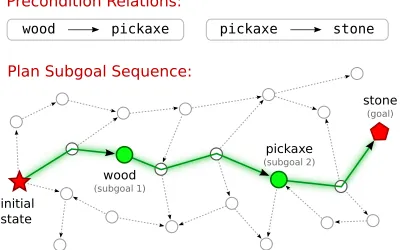
Figure 2: A high-level plan showing two subgoals in a precondition relation. The corresponding sentence is shown above.
The key distinction of our work is the use of grounding to learn abstract pragmatic relations, i.e. to learn linguistic patterns that describe relationships between objects in the world. This supplements pre-vious work which grounds words to objects in the world (Branavan et al., 2009; Vogel and Jurafsky, 2010). Another important difference of our setup is the way the textual information is utilized in the situated context. Instead of getting step-by-step in-structions from the text, our model uses text that de-scribes general knowledge about the domain struc-ture. From this text, it extracts relations between objects in the world which hold independently of any given task. Task-specific solutions are then con-structed by a planner that relies on these relations to perform effective high-level planning.
Hierarchical Planning It is widely accepted that
high-level plans that factorize a planning prob-lem can greatly reduce the corresponding search space (Newell et al., 1959; Bacchus and Yang, 1994). Previous work in planning has studied the theoretical properties of valid abstractions and proposed a number of techniques for generating them (Jonsson and Barto, 2005; Wolfe and Barto, 2005; Mehta et al., 2008; Barry et al., 2011). In gen-eral, these techniques use static analysis of the low-level domain to induce effective high-low-level abstrac-tions. In contrast, our focus is on learning the ab-straction from natural language. Thus our technique is complementary to past work, and can benefit from human knowledge about the domain structure.
3 Problem Formulation
Our task is two-fold. First, given a text document describing an environment, we wish to extract a set of precondition/effect relations implied by the text. Second, we wish to use these induced relations to determine an action sequence for completing a given task in the environment.
We formalize our task as illustrated in Figure 2. As input, we are given a world defined by the tuple hS, A, Ti, whereSis the set of possible world states, Ais the set of possible actions andT is a determin-istic state transition function. Executing actionain statescauses a transition to a new states0according toT(s0|s, a). States are represented using proposi-tional logic predicatesxi ∈ X, where each state is simply a set of such predicates, i.e.s⊂X.
The objective of the text analysis part of our task is to automatically extract a set of valid precondi-tion/effect relationships from a given document d. Given our definition of the world state, precondi-tions and effects are merely single term predicates, xi, in this world state. We assume that we are given a seed mapping between a predicate xi, and the word types in the document that reference it (see Table 3 for examples). Thus, for each predicate pair hxk, xli, we want to utilize the text to predict
whetherxk is a precondition for xl; i.e.,xk → xl. For example, from the text in Figure 2, we want to predict that possessing a pickaxe is a precondition for possessing stone. Note that this relation implies the reverse as well, i.e. xlcan be interpreted as the effect of an action sequence performed on statexk.
Each planning goalg∈Gis defined by a starting statesg0, and a final goal statesgf. This goal state is represented by a set of predicates which need to be made true. In the planning part of our task our objec-tive is to find a sequence of actions~athat connectsg0 tosgf. Finally, we assume documentddoes not con-tain step-by-step instructions for any individual task, but instead describes general facts about the given world that are useful for a wide variety of tasks.
4 Model
subgoal is represented by a single-term predicate, xi, that needs to be set in the corresponding world
state – e.g.have(wheat)=true. Thus the set of possible subgoals is defined by the set of all possi-ble single-term predicates in the domain. In contrast to low-level plans, the transition between these sub-goals can involve multiple low-level actions. Our al-gorithm for textually informed high-level planning operates in four steps:
1. Use text to predict the preconditions of each subgoal. These predictions are for the entire domain and are not goal specific.
2. Given a planning goal and the induced pre-conditions, predict a subgoal sequence that achieves the given goal.
3. Execute the predicted sequence by giving each pair of consecutive subgoals to a low-level planner. This planner, treated as a black-box, computes the low-level plan actions necessary to transition from one subgoal to the next.
4. Update the model parameters, using the low-level planner’s success or failure as the source of supervision.
We formally define these steps below.
Modeling Precondition Relations Given a
docu-mentd, and a set of subgoal pairshxi, xji, we want
to predict whether subgoalxi is a precondition for
xj. We assume that precondition relations are
gener-ally described within single sentences. We first use our seed grounding in a preprocessing step where we extract all predicate pairs where both predicates are mentioned in the same sentence. We call this set theCandidate Relations. Note that this set will con-tain many invalid relations since co-occurrence in a sentence does not necessarily imply a valid precon-dition relation.5 Thus for each sentence,w~k,
asso-ciated with a givenCandidate Relation, xi → xj,
our task is to predict whether the sentence indicates the relation. We model this decision via a log linear distribution as follows:
p(xi →xj |w~k, qk;θc)∝eθc·φc(xi,xj, ~wk,qk), (1)
where θc is the vector of model parameters. We compute the feature function φc using the seed
5
In our dataset only 11% ofCandidate Relationsare valid.
Input: A documentd, Set of planning tasksG,
Set of candidate precondition relationsCall, Reward functionr(), Number of iterationsT
Initialization:Model parametersθx= 0andθc= 0.
fori= 1· · ·Tdo
Sample valid preconditions:
C← ∅
foreachhxi, xji ∈Calldo
foreachSentencew~kcontainingxiandxjdo
v∼p(xi→xj|w~k, qk;θc)
ifv= 1thenC=C∪ hxi, xji
end end
Predict subgoal sequences for each taskg.
foreachg∈Gdo
Sample subgoal sequence~xas follows:
fort= 1· · ·ndo
Sample next subgoal: xt∼p(x|xt−1, sg0, s
g f, C;θx)
Construct low-level subtask fromxt−1toxt Execute low-level planner on subtask
end
Update subgoal prediction model using Eqn. 2
end
Update text precondition model using Eqn. 3
end
Algorithm 1: A policy gradient algorithm for pa-rameter estimation in our model.
grounding, the sentencew~k, and a given dependency parseqk of the sentence. Given these per-sentence decisions, we predict the set of all valid precondi-tion relaprecondi-tions,C, in a deterministic fashion. We do this by considering a preconditionxi →xj as valid
if it is predicted to be valid by at least one sentence.
Modeling Subgoal Sequences Given a planning
goalg, defined by initial and final goal statessg0and sgf, our task is to predict a sequence of subgoals ~x which will achieve the goal. We condition this de-cision on our predicted set of valid preconditionsC, by modeling the distribution over sequences~xas:
p(~x|sg0, sgf, C;θx) = n
Y
t=1
p(xt|xt−1, sg0, sgf, C;θx),
p(xt|xt−1, sg0, s
g
f, C;θx) ∝ e
θx·φx(xt,xt−1,sg0,sgf,C).
con-trast to Equation 1 where the predictions are goal-agnostic, these predictions are goal-specific. As be-fore,θxis the vector of model parameters, andφxis
the feature function. Additionally, we assume a spe-cial stop symbol,x∅, which indicates the end of the subgoal sequence.
Parameter UpdateParameter updates in our model
are done via reinforcement learning. Specifically, once the model has predicted a subgoal sequence for a given goal, the sequence is given to the low-level planner for execution. The success or failure of this execution is used to compute the reward signalrfor parameter estimation. This predict-execute-update cycle is repeated until convergence. We assume that our reward signalrstrongly correlates with the cor-rectness of model predictions. Therefore, during learning, we need to find the model parameters that maximize expected future reward (Sutton and Barto, 1998). We perform this maximization via stochastic gradient ascent, using the standard policy gradient algorithm (Williams, 1992; Sutton et al., 2000).
We perform two separate policy gradient updates, one for each model component. The objective of the text component of our model is purely to predict the validity of preconditions. Therefore, subgoal pairs hxk, xli, where xl is reachable from xk, are given positive reward. The corresponding parameter up-date, with learning rateαc, takes the following form:
∆θc ←αcr
φc(xi, xj, ~wk, qk)−
Ep(xi0→xj0|·)
φc(xi0, xj0, ~wk, qk)
. (2)
The objective of the planning component of our model is to predict subgoal sequences that success-fully achieve the given planning goals. Thus we di-rectly use plan-success as a binary reward signal, which is applied to each subgoal decision in a se-quence. This results in the following update:
∆θx←αxr X
t
φx(xt, xt−1, sg0, s
g f, C)−
Ep(x0t|·) h
φx(x0t, xt−1, sg0, s
g f, C)
i , (3)
wheretindexes into the subgoal sequence andαxis the learning rate.
fish iron
shears bucket
milk string
seeds wool
iron door bone meal
fishing rod wood
plank
stick
fence
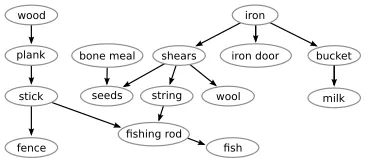
Figure 3: Example of the precondition dependencies present in the Minecraft domain.
Domain #Objects #Pred Types #Actions
Parking 49 5 4
Floortile 61 10 7
Barman 40 15 12
[image:5.612.334.518.56.135.2]Minecraft 108 16 68
Table 1: A comparison of complexity between Minecraft and some domains used in the IPC-2011 sequential satis-ficing track. In the Minecraft domain, the number of ob-jects, predicate types, and actions is significantly larger.
5 Applying the Model
We apply our method to Minecraft, a grid-based vir-tual world. Each grid location represents a tile of ei-ther land or water and may also contain resources. Users can freely move around the world, harvest resources and craft various tools and objects from these resources. The dynamics of the world require certain resources or tools as prerequisites for per-forming a given action, as can be seen in Figure 3. For example, a user must first craft abucket before they can collectmilk.
Defining the Domain In order to execute a
tradi-tional planner on the Minecraft domain, we define the domain using the Planning Domain Definition Language (PDDL) (Fox and Long, 2003). This is the standard task definition language used in the Inter-national Planning Competitions (IPC).6 We define as predicates all aspects of the game state – for ex-ample, the location of resources in the world, the re-sources and objects possessed by the player, and the player’s location. Our subgoalsxiand our task goals sgf map directly to these predicates. This results in a domain with significantly greater complexity than those solvable by traditional low-level planners. Ta-ble 1 compares the complexity of our domain with some typical planning domains used in the IPC.
6
[image:5.612.317.535.181.247.2]Low-level Planner As our low-level planner we employ Metric-FF (Hoffmann and Nebel, 2001), the state-of-the-art baseline used in the 2008 In-ternational Planning Competition. Metric-FF is a forward-chaining heuristic state space planner. Its main heuristic is to simplify the task by ignoring op-erator delete lists. The number of actions in the so-lution for this simplified task is then used as the goal distance estimate for various search strategies.
FeaturesThe two components of our model
lever-age different types of information, and as a result, they each use distinct sets of features. The text com-ponent featuresφcare computed over sentences and
their dependency parses. The Stanford parser (de Marneffe et al., 2006) was used to generate the de-pendency parse information for each sentence. Ex-amples of these features appear in Table 2. The se-quence prediction component takes as input both the preconditions induced by the text component as well as the planning state and the previous subgoal. Thus φx contains features which check whether two
sub-goals are connected via an induced precondition re-lation, in addition to features which are simply the Cartesian product of domain predicates.
6 Experimental Setup
DatasetsAs the text description of our virtual world, we use documents from the Minecraft Wiki,7 the
most popular information source about the game. Our manually constructed seed grounding of pred-icates contains 74 entries, examples of which can be seen in Table 3. We use this seed grounding to iden-tify a set of 242 sentences that reference predicates in the Minecraft domain. This results in a set of 694Candidate Relations. We also manually anno-tated the relations expressed in the text, identifying 94 of theCandidate Relations as valid. Our corpus contains 979 unique word types and is composed of sentences with an average length of 20 words.
We test our system on a set of 98 problems that involve collecting resources and constructing ob-jects in the Minecraft domain – for example, fish-ing, cooking and making furniture. To assess the complexity of these tasks, we manually constructed high-level plans for these goals and solved them us-ing the Metric-FF planner. On average, the
execu-7
http://www.minecraftwiki.net/wiki/Minecraft Wiki/
Words
Dependency Types
Dependency Type×Direction Word×Dependency Type
Word×Dependency Type×Direction
Table 2: Example text features. A subgoal pairhxi, xji is first mapped to word tokens using a small grounding table. Words and dependencies are extracted along paths between mapped target words. These are combined with path directions to generate the text features.
Domain Predicate Noun Phrases
have(plank) wooden plank, wood plank
have(stone) stone, cobblestone
have(iron) iron ingot
Table 3: Examples in our seed grounding table. Each predicate is mapped to one or more noun phrases that de-scribe it in the text.
tion of the sequence of low-level plans takes 35 ac-tions, with 3 actions for the shortest plan and 123 actions for the longest. The average branching fac-tor is 9.7, leading to an average search space of more than1034possible action sequences. For evaluation purposes we manually identify a set of Gold Rela-tionsconsisting of all precondition relations that are valid in this domain, including those not discussed in the text.
Evaluation MetricsWe use our manual annotations
to evaluate the type-level accuracy of relation extrac-tion. To evaluate our high-level planner, we use the standard measure adopted by the IPC. This evalu-ation measure simply assesses whether the planner completes a task within a predefined time.
BaselinesTo evaluate the performance of our
rela-tion extracrela-tion, we compare against an SVM classi-fier8trained on theGold Relations. We test the SVM baseline in a leave-one-out fashion.
To evaluate the performance of our text-aware high-level planner, we compare against five base-lines. The first two baselines – FF and No Text – do not use any textual information. TheFF base-line directly runs the Metric-FF planner on the given task, while theNo Text baseline is a variant of our model that learns to plan in the reinforcement learn-ing framework. It uses the same state-level features
8
✘
✘
Seeds for growing wheat can be obtained by breaking tall grass
(false negative)
[image:7.612.172.441.54.121.2]Sticks are the only building material required to craft a fence or ladder.
Figure 4: Examples of precondition relations predicted by our model from text. Check marks (3) indicate correct predictions, while a cross (8) marks the incorrect one – in this case, a valid relation that was predicted as invalid by our model. Note that each pair of highlighted noun phrases in a sentence is aCandidate Relation, and pairs that are not connected by an arrow were correctly predicted to be invalid by our model.
200 100 150
50
Figure 5: The performance of our model and a supervised SVM baseline on the precondition prediction task. Also shown is the F-Score of the full set ofCandidate Rela-tionswhich is used unmodified byAll Text, and is given as input to our model. Our model’s F-score, averaged over 200 trials, is shown with respect to learning iterations.
as our model, but does not have access to text. TheAll Textbaseline has access to the full set of 694Candidate Relations. During learning, our full model refines this set of relations, while in contrast theAll Textbaseline always uses the full set.
The two remaining baselines constitute the upper bound on the performance of our model. The first,
Manual Text, is a variant of our model which directly uses the links derived from manual annotations of preconditions in text. The second,Gold, has access to the Gold Relations. Note that the connections available toManual Text are a subset of the Gold
links, because the text does not specify all relations.
Experimental DetailsAll experimental results are
averaged over 200 independent runs for both our model as well as the baselines. Each of these tri-als is run for 200 learning iterations with a max-imum subgoal sequence length of 10. To find a low-level plan between each consecutive pair of sub-goals, our high-level planner internally uses Metric-FF. We give Metric-FF a one-minute timeout to find such a low-level plan. To ensure that the comparison
Method %Plans
FF 40.8
No text 69.4
All text 75.5
Full model 80.2
Manual text 84.7
[image:7.612.359.493.187.286.2]Gold connection 87.1
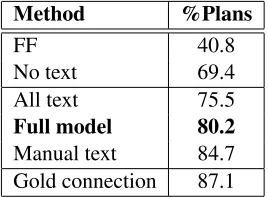
Table 4: Percentage of tasks solved successfully by our model and the baselines. All performance differences be-tween methods are statistically significant atp≤.01.
between the high-level planners and the FF baseline is fair, the FF baseline is allowed a runtime of 2,000 minutes. This is an upper bound on the time that our high-level planner can take over the 200 learning it-erations, with subgoal sequences of length at most 10 and a one minute timeout. Lastly, during learning we initialize all parameters to zero, use a fixed learn-ing rate of 0.0001, and encourage our model to ex-plore the state space by using the standard-greedy exploration strategy (Sutton and Barto, 1998).
7 Results
Relation Extraction Figure 5 shows the
perfor-mance of our method on identifying preconditions in text. We also show the performance of the super-vised SVM baseline. As can be seen, after 200 learn-ing iterations, our model achieves an F-Measure of 66%, equal to the supervised baseline. These results support our hypothesis that planning feedback is a powerful source of supervision for analyzing a given text corpus. Figure 4 shows some examples of sen-tences and the corresponding extracted relations.
Planning Performance As shown in Table 4 our
[image:7.612.82.293.190.314.2]0% 20% 40% 60% 80% 100% No text
All text Full model Manual text Gold
Easy Hard 71%
64%
59%
48%
31%
88% 89% 91%
[image:8.612.343.505.54.184.2]94% 95%
Figure 6: Percentage of problems solved by various mod-els on Easy and Hard problem sets.
extracted text relations does indeed impact planning performance. A similar conclusion can be reached by comparing the performance of our model and the
Manual Textbaseline.
The difference in performance of 2.35% between
Manual TextandGoldshows the importance of the precondition information that is missing from the text. Note that Gold itself does not complete all tasks – this is largely because the Markov assump-tion made by our model does not hold for all tasks.9 Figure 6 breaks down the results based on the dif-ficulty of the corresponding planning task. We mea-sure problem complexity in terms of the low-level steps needed to implement a manually constructed high-level plan. Based on this measure, we divide the problems into two sets. As can be seen, all of the high-level planners solve almost all of the easy problems. However, performance varies greatly on the more challenging tasks, directly correlating with planner sophistication. On these tasks our model outperforms the No Text baseline by 28% and the
All Textbaseline by 11%.
Feature AnalysisFigure 7 shows the top five
pos-itive features for our model and the SVM baseline. Both models picked up on the words that indicate precondition relations in this domain. For instance, the worduseoften occurs in sentences that describe the resources required to make an object, such as “bricks are items used to craft brick blocks”. In ad-dition to lexical features, dependency information is also given high weight by both learners. An example
9
When a given task has two non-trivial preconditions, our model will choose to satisfy one of the two first, and the Markov assumption blinds it to the remaining precondition, preventing it from determining that it must still satisfy the other.
path has word "craft"
path has dependency type "partmod" path has word "equals"
path has word "use"
path has dependency type "xsubj" path has word "use"
path has word "fill"
path has dependency type "dobj" path has dependency type "xsubj" path has word "craft"
Figure 7: The top five positive features on words and dependency types learned by our model (above) and by SVM (below) for precondition prediction.
of this is a feature that checks for the direct object dependency type. This analysis is consistent with prior work on event semantics which shows lexico-syntactic features are effective cues for learning text relations (Blanco et al., 2008; Beamer and Girju, 2009; Do et al., 2011).
8 Conclusions
In this paper, we presented a novel technique for in-ducing precondition relations from text by ground-ing them in the semantics of plannground-ing operations. While using planning feedback as its only source of supervision, our method for relation extraction achieves a performance on par with that of a su-pervised baseline. Furthermore, relation grounding provides a new view on classical planning problems which enables us to create high-level plans based on language abstractions. We show that building high-level plans in this manner significantly outperforms traditional techniques in terms of task completion.
Acknowledgments
[image:8.612.74.298.57.178.2]References
Fahiem Bacchus and Qiang Yang. 1994. Downward refinement and the efficiency of hierarchical problem solving.Artificial Intell., 71(1):43–100.
Jennifer L. Barry, Leslie Pack Kaelbling, and Toms Lozano-Prez. 2011. DetH*: Approximate hierarchi-cal solution of large markov decision processes. In
IJCAI’11, pages 1928–1935.
Brandon Beamer and Roxana Girju. 2009. Using a bi-gram event model to predict causal potential. In Pro-ceedings of CICLing, pages 430–441.
Eduardo Blanco, Nuria Castell, and Dan Moldovan. 2008. Causal relation extraction. InProceedings of the LREC’08.
S.R.K Branavan, Harr Chen, Luke Zettlemoyer, and Regina Barzilay. 2009. Reinforcement learning for mapping instructions to actions. In Proceedings of ACL, pages 82–90.
S.R.K Branavan, Luke Zettlemoyer, and Regina Barzilay. 2010. Reading between the lines: Learning to map high-level instructions to commands. InProceedings of ACL, pages 1268–1277.
S. R. K. Branavan, David Silver, and Regina Barzilay. 2011. Learning to win by reading manuals in a monte-carlo framework. InProceedings of ACL, pages 268– 277.
Du-Seong Chang and Key-Sun Choi. 2006. Incremen-tal cue phrase learning and bootstrapping method for causality extraction using cue phrase and word pair probabilities.Inf. Process. Manage., 42(3):662–678. Marie-Catherine de Marneffe, Bill MacCartney, and
Christopher D. Manning. 2006. Generating typed dependency parses from phrase structure parses. In
LREC 2006.
Q. Do, Y. Chan, and D. Roth. 2011. Minimally super-vised event causality identification. InEMNLP, 7. Michael Fleischman and Deb Roy. 2005. Intentional
context in situated natural language learning. In Pro-ceedings of CoNLL, pages 104–111.
Maria Fox and Derek Long. 2003. Pddl2.1: An ex-tension to pddl for expressing temporal planning do-mains. Journal of Artificial Intelligence Research, 20:2003.
Malik Ghallab, Dana S. Nau, and Paolo Traverso. 2004.
Automated Planning: theory and practice. Morgan Kaufmann.
Roxana Girju and Dan I. Moldovan. 2002. Text mining for causal relations. InProceedigns of FLAIRS, pages 360–364.
J¨org Hoffmann and Bernhard Nebel. 2001. The FF plan-ning system: Fast plan generation through heuristic search. JAIR, 14:253–302.
Thorsten Joachims. 1999. Advances in kernel meth-ods. chapter Making large-scale support vector ma-chine learning practical, pages 169–184. MIT Press. Anders Jonsson and Andrew Barto. 2005. A causal
approach to hierarchical decomposition of factored mdps. InAdvances in Neural Information Processing Systems, 13:10541060, page 22. Press.
Mari´an Lekav´y and Pavol N´avrat. 2007. Expressivity of strips-like and htn-like planning. Lecture Notes in Artificial Intelligence, 4496:121–130.
Percy Liang, Michael I. Jordan, and Dan Klein. 2009. Learning semantic correspondences with less supervi-sion. InProceedings of ACL, pages 91–99.
Neville Mehta, Soumya Ray, Prasad Tadepalli, and Thomas Dietterich. 2008. Automatic discovery and transfer of maxq hierarchies. In Proceedings of the 25th international conference on Machine learning, ICML ’08, pages 648–655.
Raymond J. Mooney. 2008a. Learning language from its perceptual context. InProceedings of ECML/PKDD. Raymond J. Mooney. 2008b. Learning to connect
lan-guage and perception. InProceedings of AAAI, pages 1598–1601.
A. Newell, J.C. Shaw, and H.A. Simon. 1959. The pro-cesses of creative thinking. Paper P-1320. Rand Cor-poration.
James Timothy Oates. 2001. Grounding knowledge in sensors: Unsupervised learning for language and planning. Ph.D. thesis, University of Massachusetts Amherst.
Avirup Sil and Alexander Yates. 2011. Extract-ing STRIPS representations of actions and events. In Recent Advances in Natural Language Learning (RANLP).
Avirup Sil, Fei Huang, and Alexander Yates. 2010. Ex-tracting action and event semantics from web text. In
AAAI 2010 Fall Symposium on Commonsense Knowl-edge (CSK).
Jeffrey Mark Siskind. 2001. Grounding the lexical se-mantics of verbs in visual perception using force dy-namics and event logic. Journal of Artificial Intelli-gence Research, 15:31–90.
Richard S. Sutton and Andrew G. Barto. 1998. Rein-forcement Learning: An Introduction. The MIT Press. Richard S. Sutton, David McAllester, Satinder Singh, and Yishay Mansour. 2000. Policy gradient methods for reinforcement learning with function approximation. InAdvances in NIPS, pages 1057–1063.
Adam Vogel and Daniel Jurafsky. 2010. Learning to follow navigational directions. InProceedings of the ACL, pages 806–814.
Alicia P. Wolfe and Andrew G. Barto. 2005. Identify-ing useful subgoals in reinforcement learnIdentify-ing by local graph partitioning. InIn Proceedings of the Twenty-Second International Conference on Machine Learn-ing, pages 816–823.