D - T r e e G r a m m a r s
O w e n R a m b o w C o G e n T e x , Inc. 840 H a n s h a w R o a d
I t h a c a , N Y 14850 o w e n @ c o g e n t ex. c o m
K . V i j a y - S h a n k e r D e p a r t m e n t of C o m p u t e r
I n f o r m a t i o n S c i e n c e U n i v e r s i t y of D e l a w a r e
N e w a r k , D E 19716 v i i a y © u d e l , e d u
D a v i d W e i r S c h o o l o f C o g n i t i v e &
C o m p u t i n g S c i e n c e s U n i v e r s i t y of S u s s e x B r i g h t o n , B N 1 9 H Q , U K . d a v i d , w e i r ~ c o g s , susx. ac. u k
A b s t r a c t
DTG are designed to share some of the advantages of TAG while overcoming some of its limitations. DTG involve two com- position operations called subsertion and sister-adjunction. The most distinctive fea- ture of DTG is that, unlike TAG, there is complete uniformity in the way that the two DTG operations relate lexical items: subsertion always corresponds to comple- mentation and sister-adjunction to modi- fication. Furthermore, DTG, unlike TAG, can provide a uniform analysis for wh-
movement in English and Kashmiri, des- pite the fact that the wh element in Kash- miri appears in sentence-second position, and not sentence-initial position as in Eng- lish.
1
Introduction
We define a new grammar formalism, called D-Tree Grammars (DTG), which arises from work on Tree- Adjoining Grammars (TAG) (Joshi et al., 1975). A salient feature of TAG is the extended domain of lo- cality it provides. Each elementary structure can be associated with a lexical item (as in Lexicalized TAG (LTAG) (Joshi ~ Schabes, 1991)). Properties related to the lexical item (such as subcategoriza- tion, agreement, certain types of word order varia- tion) can be expressed within the elementary struc- ture (Kroch, 1987; Frank, 1992). In addition, TAG remain tractable, yet their generative capacity is suf- ficient to account for certain syntactic phenomena that, it has been argued, lie beyond Context-Free Grammars (CFG) (Shieber, 1985). TAG, however, has two limitations which provide the motivation for this work. The first problem (discussed in Section 1.1) is that the TAG operations of substitution and ad- junction do not map cleanly onto the relations of complementation and modification. A second pro- blem (discussed in Section 1.2) has to do with the inability of TAG to provide analyses for certain syn- tactic phenomena. In developing DTG we have tried
to overcome these problems while remaining faith- ful to what we see as the key advantages of TAG (in particular, its enlarged domain of locality). In Sec- tion 1.3 we introduce some of the key features of DTG and explain how they are intended to address the problems that we have identified with TAG. 1,1 D e r i v a t i o n s a n d D e p e n d e n c i e s
In LTAG, the operations of substitution and adjunc- tion relate two lexical items. It is therefore natural to interpret these operations as establishing a di- rect linguistic relation between the two lexical items, namely a relation of complementation (predicate- argument relation) or of modification. In purely CFG-based approaches, these relations are only im- plicit. However, they represent important linguistic intuition, they provide a uniform interface to se- mantics, and they are, as Schabes ~ Shieber (1994) argue, important in order to support statistical pa- rameters in stochastic frameworks and appropriate adjunction constraints in TAG. In many frameworks, complementation and modification are in fact made explicit: LFG (Bresnan & Kaplan, 1982) provides a separate functional (f-) structure, and dependency grammars (see e.g. Mel'~uk (1988)) use these no- tions as the principal basis for syntactic represen- tation. We will follow the dependency literature in referring to complementation and modification as syntactic dependency. As observed by Rambow and Joshi (1992), for TAG, the importance of the dependency structure means that not only the deri- ved phrase-structure tree is of interest, but also the operations by which we obtained it from elementary structures. This information is encoded in the deri- vation tree (Vijay-Shanker, 1987).
However, as Vijay-Shanker (1992) observes, the TAG composition operations are not used uniformly: while substitution is used only to add a (nominal) complement, adjunction is used both for modifica- tion and (clausal) complementation. Clausal com- plementation could not be handled uniformly by substitution because of the existence of syntactic phenomena such as long-distance wh-movement in English. Furthermore, there is an inconsistency in
the directionality of the operations used for comple- mentation in TAG@: nominal complements are sub- stituted into their governing verb's tree, while the governing verb's tree is adjoined into its own clausal complement. The fact that adjunction and substitu- tion are used in a linguistically heterogeneous man- ner means that (standard) "lAG derivation trees do not provide a good representation of the dependen- cies between the words of the sentence, i.e., of the predicate-argument and modification structure.
adore
S
~
adore
Mary / OBJ\
s e e mhotdog c l a i m
S
U
~
[MOD I sUBJ
Mary / OBJ \
s e e mspicy he hotdog claim
I MOD
M O D ~ M O D I SUBJ
small
spicy
smallhe
Figure 1: Derivation trees for (1): original definition (left); Schabes & Shieber definition (right)
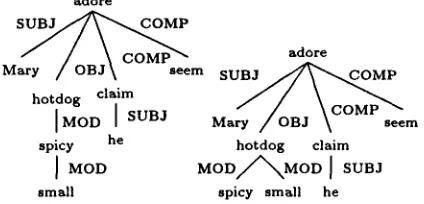
For instance, English sentence (1) gets the deriva- tion structure shown on the left in Figure 11 .
(1) Small spicy hotdogs he claims Mary seems to adore When comparing this derivation structure to the dependency structure in Figure 2, the following pro- blems become apparent. First, both adjectives de- pend on hotdog, while in the derivation structure small is a daughter of spicy. In addition, seem de- pends on claim (as does its nominal argument, he), and adore depends on seem. In the derivation struc- ture, seem is a daughter of adore (the direction does not express the actual dependency), and claim is also a daughter of adore (though neither is an argument of the other).
claim
SUB J ~ " ~ O M P
he
s e e mI COMP
adore
S U B ~ B J
Mary
hotdog
MOD ~ . ~ O D
s p i c y
small
Figure 2: Dependency tree for (1)
Schabes & Shieber (1994) solve the first problem
1For clarity, we depart from standard TAG notational practice and annotate nodes with lexemes and arcs with grammatical function:
by distinguishing between the adjunction of modi- fiers and of clausal complements. This gives us the derivation structure shown on the right in Figure 1. While this might provide a satisfactory treatment of modification at the derivation level, there are now three types of operations (two adjunctions and sub- stitution) for two types of dependencies (arguments and modifiers), and the directionality problem for embedded clauses remains unsolved.
In defining DTG we have attempted to resolve these problems with the use of a single operation (that we call subsertion) for handling Ml comple- mentation and a second operation (called sister-
adjunction) for modification. Before discussion
these operations further we consider a second pro- blem with TAG that has implications for the design of these new composition operations (in particular, subsertion).
1.2 P r o b l e m a t i c C o n s t r u c t i o n s f o r TAG TAG cannot be used to provide suitable analyses for certain syntactic phenomena, including long- distance scrambling in German (Becket et hi., 1991), Romance Clitics (Bleam, 1994), wh-extraction out of complex picture-NPs (Kroch, 1987), and Kashmiri wh-extraction (presented here). The problem in de- scribing these phenomena with TAG arises from the fact (observed by Vijay-Shanker (1992)) that adjoi- ning is an overly restricted way of combining structu- res. We illustrate the problem by considering Kash- miri wh-extraction, drawing on Bhatt (1994). Wh- extraction in Kashmiri proceeds as in English, ex- cept that the wh-word ends up in sentence-second position, with a topic from the matrix clause in sentence-initial position. This is illustrated in (2a) for a simple clause and in (2b) for a complex clause.
(2) a. rameshan kyaa dyutnay t s e
RameshzRG whatNOM g a v e
yOUDAT
What did you give Ramesh?
b. rameshan kyaal chu baasaan [ ki
RameshzRG what is believeNperf that
me kor ti]
IZRG do
What does Ramesh beheve that I did?
Since the moved element does not appear in sentence-initial position, the TAG analysis of English wh-extraction of Kroch (1987; 1989) (in which the matrix clause is adjoined into the embedded clause) cannot be transferred, and in fact no linguistically plausible TAG analysis appears to be available.
[image:2.612.80.292.187.289.2] [image:2.612.321.540.453.543.2]two trees from a set must be in a dominance rela- tion in the derived tree. MCTAG with Domination Links (MCTAG-DL) (Becker et al., 1991) are multi- component systems t h a t allow for the expression of dominance constraints. However, MCTAG-DL share a further problem with MCTAG: the derivation struc- tures cannot be given a linguistically meaningful in- terpretation. Thus, they fail to address the first pro- blem we discussed (in Section 1.1).
1.3 T h e DTG A p p r o a c h
Vijay-Shanker (1992) points out t h a t use of ad- junction for clausal complementation in TAG corre- sponds, at the level of dependency structure, to sub- stitution at the foot node s of the adjoined tree. Ho- wever, adjunction (rather than substitution) is used since, in general, the structure t h a t is substituted m a y only form part of the clausal complement: the remaining substructure of the clausal complement appears above the root of the adjoined tree. Un- fortunately, as seen in the examples given in Sec- tion 1.2, there are cases where satisfactory analyses cannot be obtained with adjunction. In particular, using adjunction in this way cannot handle cases in which parts of the clausal complement are required to be placed within the structure of the adjoined tree.
T h e DTG operation of subsertion is designed to overcome this limitation. Subsertion can be viewed as a generalization of adjunction in which com- ponents of the clausal complement (the subserted structure) which are not substituted can be inters- persed within the structure that is the site of the subsertion. Following earlier work (Becket et al., 1991; Vijay-Shanker, 1992), DTG provide a mecha- nism involving the use of domination links (d-edges) t h a t ensure that parts of the subserted structure that are not substituted dominate those parts that are. Furthermore, there is a need to constrain the way in which the non-substituted components can be interspersed 3. This is done by either using ap- propriate feature constraints at nodes or by means of subsertion-insertion constraints (see Section 2).
We end this section by briefly commenting on the other DTG operation of sister-adjunction. In TAG, modification is performed with adjunction of modi- fier trees t h a t have a highly constrained form. In particular, the foot nodes of these trees are always daughters of the root and either the leftmost or rightmost frontier nodes. T h e effect of adjoining a
2In these cases the foot node is an argument node of the lexical anchor.
SThis was also observed by Rambow (1994a), where an integrity constraint (first defined for an tD/LP version of TAG (Becket et aJ., 1991)) is defined for a MCTAG-DL version called V-TAG. However, this was found to be in- sufficient for treating both long-distance scrambling and long-distance topicalization in German. V-TAG retains adjoining (to handle topicalization) for this reason.
tree of this form corresponds (almost) exactly to the addition of a new (leftmost or rightmost) subtree below the node t h a t was the site of the adjunction. For this reason, we have equipped DTG with an ope- ration (sister-adjunction) t h a t does exactly this and nothing more. From the definition of DTG in Sec- tion 2 it can be seen that the essential aspects of Schabes & Shieber (1994) t r e a t m e n t for modifica- tion, including multiple modifications of a phrase, can be captured by using this operation 4.
After defining DTG in Section 2, we discuss, in Section 3, DTG analyses for the English and Kash- miri d a t a presented in this section. Section 4 briefly discusses DTG recognition algorithms.
2 D e f i n i t i o n o f D - T r e e G r a m m a r s
A d - t r e e is a tree with two types of edges: domi- nation edges ( d - e d g e s ) and i m m e d i a t e domination edges ( i - e d g e s ) . D-edges and i-edges express domi- nation and immediate domination relations between nodes. These relations are never rescinded when d- trees are composed. Thus, nodes separated by an i-edge will remain in a mother-daughter relationship t h r o u g h o u t the derivation, whereas nodes separated by an d-edge can be equated or have a path of any length inserted between t h e m during a derivation. D-edges and i-edges are not distributed arbitrarily in d-trees. For each internal node, either all of its daughters are linked by i-edges or it has a single daughter t h a t is linked to it by a d-edge. Each node is labelled with a terminal symbol, a nonterminal symbol or the e m p t y string. A d-tree containing n d-edges can be decomposed into n + 1 c o m p o n e n t s containing only i-edges.
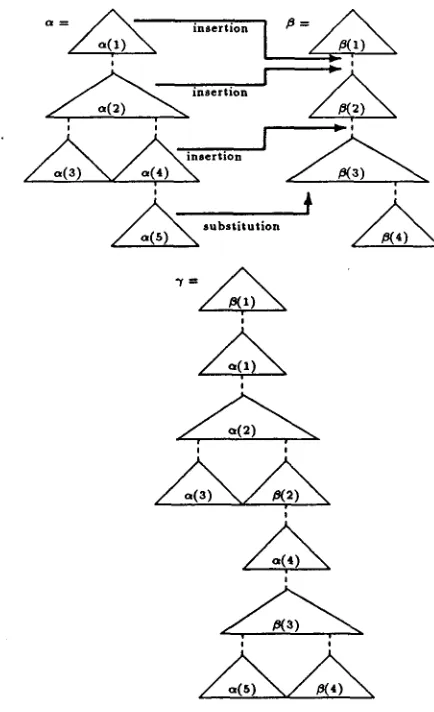
D-trees can be composed using two operations: s u b s e r t i o n and s i s t e r - a d j u n c t i o n . When a d-tree a is subserted into another d-tree/3, a component of a is substituted at a frontier nonterminal node (a s u b s t i t u t i o n n o d e ) of/3 and all components of a that are above the substituted component are in- serted into d-edges above the substituted node or placed above the root node. For example, consider the d-trees a and /3 shown in Figure 3. Note that components are shown as triangles. In the compo- sed d-tree 7 the component a(5) is substituted at a substitution node in /3. T h e components, a(1), a(2), and a(4) of a above a(5) drift up the path in/3 which runs from the substitution node. These components are then i n s e r t e d into d-edges in/3 or above the root of/3. In general, when a component c~(i) of some d-tree a is inserted into a d-edge bet- ween nodes ~/1 and r/2 two new d-edges are created, the first of which relates r/t and the root node of a(i), and the second of which relates the frontier
4Santorini and Mahootian (1995) provide additional evidence against the standard TAG approach to modifi- cation from code switching data, which can be accounted for by using sister-adjunction.
a = ~ insertion [
t
~
insertion
[i i
!
~
substitution
p i
!
t
!
Figure 3: Subsertion
node of a ( i ) t h a t d o m i n a t e s the s u b s t i t u t e d com- ponent to T/2. It is possible for c o m p o n e n t s above the s u b s t i t u t e d node to drift arbitrarily far up the d-tree and distribute themselves within d o m i n a t i o n edges, or above the root, in any way t h a t is c o m p a t i - ble with the d o m i n a t i o n relationships present in the s u b s t i t u t e d d-tree. DTG provide a m e c h a n i s m called s u b s e r t i o n - i n s e r t l o n c o n s t r a i n t s to control w h a t can a p p e a r within d-edges (see below).
T h e second composition operation involving d- trees is called sister-adjunction. W h e n a d-tree a is sister-adjoined at a node y in a d-tree fl the com- posed d-tree 7 results f r o m the addition to /~ of a as a new leftmost or r i g h t m o s t sub-d-tree below 7/. Note t h a t sister-adjunction involves the addition of exactly one new i m m e d i a t e d o m i n a t i o n edge and t h a t severM sister-adjunctions can occur at the s a m e node. S i s t e r - a d j o i n i n g c o n s t r a i n t s specify where d-trees can be sister-adjoined and whether they will be right- or left-sister-adjoined (see below).
A DTG is a four tuple
G = (VN, VT, S, D)
whereVN
andVT
are the usual n o n t e r m i n a l and termi-nal alphabets, S E V~ is a distinguished nonter- m i n a l and D is a finite set of e l e m e n t a r y d-trees. A DTG is said to be l e x i c a l i z e d if each d-tree in the g r a m m a r has at least one t e r m i n a l node. T h e e l e m e n t a r y d-trees of a g r a m m a r G have two addi- tionM annotations: subsertion-insertion constraints and sister-adjoining constraints• These will be de- scribed below, b u t first we define simultaneously DTG derivations and subsertion-adjoining trees (SA- trees), which are partial derivation structures t h a t can be interpreted as representing dependency in- f o r m a t i o n , the i m p o r t a n c e of which was stressed in the introduction 5.
Consider a DTG
G = (VN, VT,S, D).
In defining SA-trees, we assume s o m e n a m i n g convention for the e l e m e n t a r y d-trees in D a n d s o m e consistent or- dering on the c o m p o n e n t s and nodes of e l e m e n t a r y d-trees in D. For each i, we define the set of d-trees TI(G) whose derivations are c a p t u r e d by SA-trees of height i or less. LetTo(G)
be the set D of elemen- t a r y d-trees of G. M a r k all of the c o m p o n e n t s of each d-tree inTo(G) as
being s u b s t i t u t a b l e 6. Only com- p o n e n t s m a r k e d as s u b s t i t u t a b l e can be s u b s t i t u t e d in a subsertion operation. T h e SA-tree for ~ ETo(G)
consists of a single node labelled by the e l e m e n t a r y d-tree n a m e for a .
For i > 0 let ~ ( G ) be the union of the set ~ - I ( G ) with the set of all d-trees 7 t h a t can be produced as follows. Let a E D and let 7 be the result of subser- ting or sister-adjoining the d-trees 71,- •., 7k into a where 71, • -., 7k are all in T i - I ( G ) , with the subser- tions taking place at different s u b s t i t u t i o n nodes in as the footnote. Only s u b s t i t u t a b l e c o m p o n e n t s of 7 1 , . . - , 3'k can be s u b s t i t u t e d in these subsertions. Only the new c o m p o n e n t s of 7 t h a t c a m e f r o m a are m a r k e d as s u b s t i t u t a b l e in 7. Let V l , . . . , ~'k be the SA-trees for 7 1 , . . - , 7 k , respectively. T h e SA-tree r for 7 has root labelled by the n a m e for a and k sub- trees r t , . •., rk. T h e edge f r o m the root of r to the root of the subtree ri is labelled by li (1 < i < k) de- fined as follows. Suppose t h a t 71 was subserted into a and the root of r / i s labelled by the n a m e of some c~ ~ E D. Only c o m p o n e n t s of a ~ will have been m a r - ked as s u b s t i t u t a b l e in 7/- Thus, in this subsertion some c o m p o n e n t c J ( j ) will have been s u b s t i t u t e d at a node in a with address n. In this case, the la- bel l~ is the pair (j, n). Alternatively, 7i will have
S I)ue to space limitations, in the following definiti- ons we are forced to be somewhat imprecise when we identify a node in a derived d-tree with the node in the elementary d-trees (elementary nodes) from which it was derived. This is often done in TAG literature, and hope- fully it will be clear what is intended.
eWe will discuss the notion of substitutability further in the next section. It is used to ensure the $A-tree is a tree. That is, an elementary structure cannot be
subserted into more than one structure since this would
[image:4.612.79.296.55.411.2]been d-sister-adjoined at some node with address n in a, in which case
li
will be the pair (d, n) where d e { left, right }.T h e t r e e s e t
T(G)
generated by G.is defined as the set of trees 7 such that: 7' E T/(G) for some i 0; 7 ~ is rooted with the nonterminal S; the frontier of 7' is a string in V~ ; and 7 results from the removal of all d-edges from 7'. A d-edge is removed by merging the nodes at either end of the edge as long as they are labelled by the same symbol. T h e s t r i n g l a n g u a g eL(G) associated with G is the set of terminal strings
appearing on the frontier of trees inT(G).
We have given a reasonably precise definition of SA-trees since they play such an i m p o r t a n t role in the motivation for this work. We now describe infor- mally a structure t h a t can be used to encode a DTG derivation. A derivation graph for 7 E
T(G) results
from the addition of insertion edges to a SA-tree r for 7. T h e location in 7 of an inserted elementary component a ( i ) can be unambiguously determined by identifying the source of the node (say the node with address n in the elementary d-tree a ' ) with which the root of this occurrence of a ( i ) is merged with when d-edges are removed. T h e insertion edge will relate the two (not necessarily distinct) nodes corresponding to appropriate occurrences of a and a ' and will be labelled by the pair (i, n).Each d-edge in elementary d-trees has an associa- ted subsertion-insertion constraint (SIC). A SIC is a finite set of elementary node addresses (ENAs). An I=NA ~} specifies some elementary d-tree a E D, a component of a and the address of a node within that component of a. If a ENA y/is in the SIC asso- ciated with a d-edge between 7z and r/2 in an elemen- tary d-tree a then ~/cannot appear properly within the path t h a t appears from T/t to T/2 in the derived tree 7 E
T(G).
Each node of elementary d-trees has an associa- ted sister-adjunction constraint (SAC). A SAC is a finite set of pairs, each pair identifying a direction (left or right) and an elementary d-tree. A SAC gi- ves a complete specification of what can be sister- adjoined at a node. If a node ~/is associated with a SAC containing a pair (d, a ) then the d-tree a can be d-sister-adjoined at r/. By definition of sister- adjunction, all substitution nodes and all nodes at the top of d-edges can be assumed to have SACs that are the empty-set. This prevents sister-adjunction at these nodes.
In this section we have defined "raw" DTG. In a more refined version of the formalism we would as- sociate (a single) finite-valued feature structure with each node 7. It is a m a t t e r of further research to de- termine to what extent SICs and SACs can be stated globally for a g r a m m a r , rather than being attached
7Trees used in Section 3 make use of such feature structures.
to d-edges/nodes s. See the next section for a brief discussion of linguistic principles from which a gram- mar's SICs could be derived.
3
L i n g u i s t i c E x a m p l e s
In this section, we show how an account for the d a t a introduced in Section 1 can be given with DTG.
3.1 G e t t i n g D e p e n d e n c i e s R i g h t : E n g l i s h
S I
a o !
s
N P V P [fro: + 1 0 !
vP[fin: +]
v s v
I
I
c l a i m - , s e e m s S'
NP S
o ( h o t d o g s )
t S.
~P vP[~:
+l
(Mary) l
vP[fin:
-I
V N P
I
I
to adore e s
i ! !
vP[rm: +1
vP[f~: -I
Figure 4: D-trees for (1)
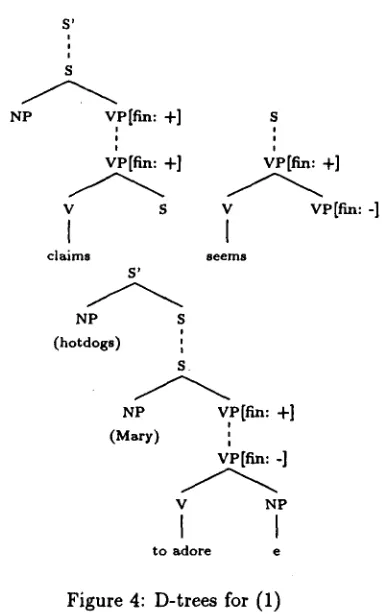
In Figure 4, we give a DTG t h a t generates sent- ence (1). Every d-tree is a projection from a lexical anchor. T h e label of the maximal projection is, we assume, determined by the morphology of the an- chor. For example, if the anchor is a finite verb, it will project to S, indicating t h a t an overt syntactic ("surface") subject is required for agreement with it (and perhaps case-assignment). Furthermore, a finite verb m a y optionally also project to S' (as in the d-tree shown for
claims), indicating that a
wh-
moved or topicalized element is required. The fi- nite verbseems also projects to S, even though it
does not itself provide a functional subject. In the case of the toadore tree, the situation is the in-
verse: the functional subject requires a finite verbSin this context, it might be beneficiM to consider the expression of a feature-based lexicalist theory such as HPSG in DTG, similar to the compilation of HPSG to TAG (Kasper et al., 1995).
[image:5.612.335.526.168.475.2]to agree with, which is signaled by the fact that its component's root and frontier nodes are labelled S and VP, respectively, but the verb itself is not finite and therefore only projects to VP[-fin]. Therefore, the subject will have to raise out of its clause for agreement and case assignment. The direct object of to adore has wh-moved out of the projection of the verb (we include a trace for the sake of clarity).
S'
N P S
N' N P V P
A d j P A d j P N he V S
I i I
I
Adj Adj hotdogs claims N P V P
small spicy M a r y seems VP
V N P
I
t
to adore e
Figure 5: Derived tree for (1)
We add SlCs to ensure that the projections are respected by components of other d-trees that may be inserted during a derivation. A SIC is associa- ted with the d-edge between VP and S node in the s e e m s d-tree to ensure that no node labelled S ~ can be inserted within it - i.e., it can not be filled by with a wh-moved element. In contrast, since both the subject and the object of to adore have been moved out of the projection of the verb, the path to these arguments do not carry any SIC at all 9.
We now discuss a possible derivation. We start out with the most deeply embedded clause, the ad- ores clause. Before subserting its nominal argu- ments, we sister-adjoin the two adjectival trees to the tree for hotdogs. This is handled by a SAC asso- ciated with the N' node that allows all trees rooted in AdjP to be left sister-adjoined. We then sub- sert this structure and the subject into the to adore d-tree. We subsert the resulting structure into the s e e m s clause by substituting its maximal projection node, labelled VP[fin: -], at the VP[fin: -] frontier node of seems, and by inserting the subject into the d-edge of the s e e m s tree. Now, only the S node of the s e e m s tree (which is its maximal projection) is substitutable. Finally, we subsert this derived struc-
9We enforce island effects for wh-movement by using a [+extract] feature on substitution nodes. This corre- sponds roughly to the analysis in TAG, where islandhood is (to a large extent) enforced by designating a particular node as the foot node (Kroch & Joshi, 1986).
ture into the claims d-tree by substituting the S node of s e e m s at the S complement node of claims, and by inserting the object of adores (which has not yet been used in the derivation) in the d-edge of the claims d-tree above its S node. The derived tree is shown in Figure 5. The SA-tree for this derivation corresponds to the dependency tree given previously in Figure 2.
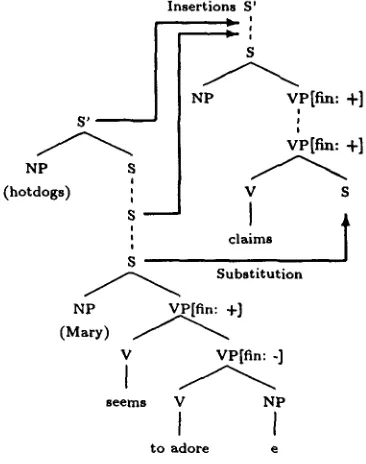
Note that this is the only possible derivation invol- ving these three d-trees, modulo order of operations. To see this, consider the following putative alternate derivation. We first subsert the to adore d-tree into the s e e m s tree as above, by substituting the anchor component at the substitution node of seems. We insert the subject component of fo adore above the anchor component of seems. We then subsert this derived structure into the c l a i m s tree by substitu- ting the root of the subject component of to adore at the S node of c l a i m s and by inserting the S node of the s e e m s d-tree as well as the object component of the to adore d-tree in the S'/S d-edge of the claims d-tree. This last operation is shown in Figure 6. The resulting phrase structure tree would be the same as in the previously discussed derivation, but the deri- vation structure is linguistically meaningless, since to adore world have been subserted into both s e e m s and claims. However, this derivation is ruled out by the restriction that only substitutable components can be substituted: the subject component of the adore d-tree is not substitutable after subsertion into the s e e m s d-tree, and therefore it cannot be substi- tuted into the c l a i m s d-tree.
S ~
N P S
i
(hotdogs) t
S
! S
Substitution
N P ~ + l
(Mary)
V VP[fin: -]
seems V N P
I
I
to adore e Insertions S'
S
N P V P [fm: +1 J i V P [fin: + ]
V S
'
t
claims
Figure 6: An ill-formed derivation
[image:6.612.98.279.158.349.2] [image:6.612.344.527.422.654.2]central role in ruling out the derivation. We observe in passing t h a t the SIC associated to the d-edge in the s e e m s d-tree also rules out this derivation. The derivation requires t h a t the S node of s e e m s be in- serted into the SI/S d-edge of c l a i m s . However, we would have to stretch the edge over two components which are b o t h ruled out by the SIC, since they vio- late the projection from s e e m s to its S node. Thus, the derivation is excluded by the independently mo- tivated Sits, which enforce the notion of projection. This raises the possibility that, in g r a m m a r s that ex- press certain linguistic principles, substitutability is not needed for ruling out derivations of this nature. We intend to examine this issue in future work.
3.2 G e t t i n g W o r d O r d e r R i g h t : K a s h m i r i
[ twO~:: -~ NP VP
!
(ramesha~) ' F top:-'1
' / w S : - I
Aux VP
( c h u )
NP VP
e V V P _
I
b a a s a a n
[image:7.612.318.520.161.466.2] [image:7.612.86.267.244.626.2]fin:"
[ tw°~:: q] NP VP
(kyaa)
' I"
tol):"1
COMP VP
(ki)
NP VP
(m~) ~
NP VP
I
I
e V
I
kor
Figure 7: D-trees for (2b)
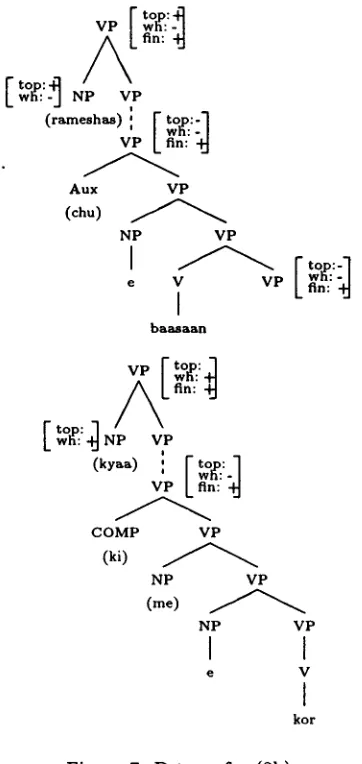
Figure 7 shows the m a t r i x and embedded clauses for sentence (2b). We use the node label VP throug- hout and use features such as top (for topic) to diffe- rentiate different levels of projection. Observe that in both trees an argument has been fronted. Again,
we will use the SlCs to enforce the projection from a lexical anchor to its m a x i m a l projection. Since the direct object of k o r has wh-moved out of its clause, the d-edge connecting it to the m a x i m a l projection of its verb has no SIC. T h e d-edge connecting the maximal projection of b a a s a a n to the Aux compo- nent, however, has a SIC t h a t allows only VP[wh: +, top: -] nodes to be inserted.
v r
+1
~ L
fi,,: +J
. VP ~n5:
rameshas ~ f i n : +J
Aux VP
¢hu
I
vp
e ~ f ~ V p
[ fin:' -t,,J
tw°~:: -]
b a a a a a n
C O M P V P
ki NP VP
me NP VP
I
I
e V
I
kor
Figure 8: Derived d-tree for (2b)
T h e derivation proceeds as follows. We first sub- sert the embedded clause tree into the m a t r i x clause tree. After that, we subsert the nominal arguments and function words. T h e derived structure is shown in Figure 8. T h e associated SA-tree is the desired, semantically motivated, dependency structure: the embedded clause depends on the m a t r i x clause.
In this section, we have discussed examples where the elementary objects have been obtained by pro- jecting from lexical items. In these cases, we over- come both the problems with TAG considered in Section 1. T h e SlCs considered here enforce the same notion of projection t h a t was used in obtai- ning the elementary structures. This m e t h o d of ar- riving at SlCs not only generalizes for the English and Kashmiri examples but also appears to apply to the case of long-distance scrambling and topicaliza- tion in German.
4
R e c o g n i t i o n
It is straightforward to ".~lapt the p o l y n o m i a l - t i m e El<Y-style recognition algorithm for a lexicalized UVG-DI. of Rarnbow (1994b) for DTG. T h e entries in this array recording derivations of substrings of input contain a set of elementary nodes along with a multi-set of c o m p o n e n t s t h a t m u s t be i n ~ r t e d above during b o t t o m - u p recognition. These c o m p o n e n t s are added or removed at substitution and insertion. T h e algorithm simulates traversal of a derived tree; checking for SICS and SACs can be done easily. Bec- anse of lexicalization, the size of these multi-sets is p o l y n o m i a l l y bounded, from which the p o l y n o m i a l t i m e and space complexity of the algorithm follows. For practical purposes, especially for lexicalized g r a m m a r s , it is preferable to incorporate some ele- m e n t of prediction. We are developing a p o l y n o m i a l - t i m e Earley style parsing algorithm. T h e parser re- turns a parse forest encoding all parses for an input string. T h e p e r f o r m a n c e of this parser is sensitive to the g r a m m a r and input. Indeed it a p p e a r s t h a t for g r a m m a r s t h a t lexicalize CFG and for English g r a m - m a r (where the structures are similar to the I_TAG developed at University of Pennsylvania ( X T A G Re- search G r o u p , 1995)) we obtain cubic-time comple- xity.
5
C o n c l u s i o n
DTG, like other formalisms in the TAG family, is lexi- calizable, b u t in addition, its derivations are t h e m - selves linguistically meaningful. In future work we intend to e x a m i n e additional linguistic data, refining aspects of our definition as needed. We will also s t u d y the f o r m a l properties of DTG, and complete the design of the Earley style parser.
A c k n o w l e d g e m e n t s
We would like to t h a n k Rakesh B h a t t for help with the K a s h m i r i data. We are also grateful to T i l m a n Becker, Gerald G a z d a r , Aravind Joshi, Bob Kasper, Bill Keller, T o n y Kroch, Klans Netter and the ACL- 95 referees. R, a m b o w was s u p p o r t e d by the North Atlantic T r e a t y Organization under a G r a n t awar- ded in 1993, while at T A L A N A , Universitd Paris 7.
R e f e r e n c e s
T. Becket, A. Joshi, & O. Rainbow. 1991. Long distance scrambling and tree adjoining grammars. In EACL- 91, 21-26.
R. Bhatt. 1 9 9 4 . Word order and case in Kashmiri. Ph.D. thesis, Univ. Illinois.
T. Bleam. 1994. Clitic climbing in spanish: a GB per- spective. In T A G + Workshop, Tech. Rep. TALANA- RT-94-01, Universit~ Paris 7, 16-19.
J. Bzesnan & R. Kapl~n. 1982. Lexical-functional gram- mar: A formM system for grammatical representa~ tion. It, J. Bresnan, ed., The Mental Representation o] Grammatical Relations. MIT Press.
R. Frank. 1992. Syntactic Locality and Tree Adjoining Grammar: Grammatical, Acquisition and Processing Perspectives. Ph.D. thesis, Dept. Comp. & Inf. Sc., Univ. Pennsylvania.
A. Joshi. 1987. An introduction to tree adjoining gram- mars. In A. Manaster-Ramer, ed., Mathematica o] Language, 87-114.
A. Joshi, L. Levy, & M. Takahashi. 1975. Tree adjunct grammars. J. Comput. Syst. Sci., 10(1):136-163. A. Joshi & Y. Schabes. 1991. Tree-adjoining grammars
and lexicalized grammars. In M. Nivat & A. Podelski, eds., Definability and Recognizability o/Sets of Trees.
R. Kasper, E. Kiefer, K. Netter, & K. Vijay-Shanker 1995. Compilation of HPSG to TAG. In ACL-95. A. Kroch. 1987. Subjacency in a tree adjoining gram-
mar. In A. Manaster-Ramer, ed., Mathematics o/Lan- guage, 143-172.
A. Kroch. 1989. Asymmetries in long distance extrac- tion in a Tree Adjoining Grammar. In Mark Baltin & Anthony Kroch, editors, Alternative Conceptions of Phrase Structure, 66-98.
A. Kroch & A. Joshi. 1986. Analyzing extraposition in a tree adjoining grammar. In G. Huck & A. Ojeda, eds., Syntax ~ Semantics: Discontinuous Constitu- ents, 107-149.
I. Mel'~uk. 1988. Dependency Syntax: Theory and Prac- tice.
O. Rambow. 1994. Formal and Computational Aspects olNaturol Language Syntax. Ph.D. thesis, Dept. Corn- put. & Inf. Sc., Univ. Pennsylvania.
O. Rambow. 1994. Multiset-Valued Linear Index Gram- mars. In ACL-94, 263-270.
O. Rainbow & A. Joshi. 1992. A formal look at de- pendency grammars and phrase-structure grammars, with special consideration of word-order phenomena. In 1stern. Workshop on The Meaning-Text Theory, Darmstadt. Arbeitspapiere der GMD 671, 47-66. B. Santorini & S. Mahootian. 1995. Codeswitching and
the syntactic status of adnominal adjectives. Lingua, 95.
Y. Schabes & S. Shieber. 1994. An alternative con- ception of tree-adjoining derivation. Comput. Ling., 20(1):91-124.
S. Shieber. 1985. Evidence against the context-freeness of natural language. Ling. ~ Phil., 8:333-343. K. Vijay-Shanker. 1987. A Study o] Tree Adjoining
Grammars. Ph.D. thesis, Dept. Comput. & Inf. Sc., Univ. Pennsylvania.
K. Vijay-Shanker. 1992. Using descriptions of trees in a tree adjoining grammar. Comput. Ling., 18(4):481- 517.