A N O P T I M A L T A B U L A R
P A R S I N G A L G O R I T H M
M a r k - J a n N e d e r h o f *
University of Nijmegen, Department of Computer Science
Toernooiveld, 6525 ED Nijmegen, The Netherlands
markj
an~cs, kun.nl
A b s t r a c t
In this p a p e r we relate a n u m b e r of parsing algorithms which have been developed in very different areas of parsing theory, and which include deterministic algo- rithms, t a b u l a r algorithms, and a parallel algorithm. We show t h a t these algorithms are based on the same underlying ideas.
By relating existing ideas, we hope to provide an op- portunity to improve some algorithms based on features of others. A second purpose of this p a p e r is to answer a question which has come up in the area of t a b u l a r pars- ing, namely how to obtain a parsing algorithm with the property t h a t the table will contain as little entries as possible, but without the possibility t h a t two entries represent the same subderivation.
I n t r o d u c t i o n
Left-corner (LC) parsing is a parsing s t r a t e g y which has been used in different guises in various areas of com- puter science. Deterministic LC parsing with k symbols of lookahead can handle t h e class of LC(k) g r a m m a r s . Since LC parsing is a very simple parsing technique and at the same time is able to deal with left recursion, it is often used as an alternative to top-down (TD) parsing, which cannot handle left recursion and is generally less efficient.
Nondeterministic LC parsing is the foundation of a very efficient parsing algorithm [7], related to T o m i t a ' s algorithm and Earley's algorithm. It has one disad- vantage however, which becomes noticeable when the g r a m m a r contains m a n y rules whose right-hand sides begin with the same few g r a m m a r s symbols, e.g.
A ~ c~f~l I ~f~2 I . . .
where ~ is not the e m p t y string. After an LC parser has recognized the first symbol X of such an c~, it will as next step predict all aforementioned rules. This amounts to much nondeterminism, which is detrimental b o t h to the time-complexity and the space-complexity. *Supported by the Dutch Organisation for Scientific Re- search (NWO), under grant 00-62-518
A first a t t e m p t to solve this problem is to use predic- tive LR ( P L R ) parsing. P L R parsing allows simulta- neous processing of a common prefix c~, provided t h a t the left-hand sides of the rules are the same. However, in case we have e.g. the rules A --* c~t31 and B --~ ~/32, where again ~ is not the e m p t y string b u t now A ~ B, then P L R parsing will not improve the efficiency. We therefore go one step further and discuss extended LR (ELR) and common-prefix (CP) parsing, which are al- gorithms capable of simultaneous processing of all com- mon prefixes. E L R and CP parsing are the foundation of t a b u l a r parsing algorithms and a parallel parsing al- g o r i t h m from the existing literature, but they have not been described in their own right.
To the best of the a u t h o r ' s knowledge, the various parsing algorithms mentioned above have not been dis- cussed together in the existing literature. The main purpose of this p a p e r is to make explicit the connec- tions between these algorithms.
A second purpose of this p a p e r is to show t h a t CP and E L R parsing are obvious solutions to a problem of t a b u l a r parsing which can be described as follows. For each parsing algorithm working on a stack there is a realisation using a parse table, where the parse table allows sharing of c o m p u t a t i o n between different search paths. For example, T o m i t a ' s algorithm [18] can be seen as a t a b u l a r realisation of nondeterministic LR parsing. At this point we use the t e r m state to indicate the symbols occurring on the stack of the original algo- rithm, which also occur as entries in the parse table of its t a b u l a r realisation.
which m a y lead to work being r e p e a t e d during parsing. Furthermore, the parse forest (a c o m p a c t representa- tion of all parse trees) which is o u t p u t by a t a b u l a r algorithm m a y in this case not be optimally dense.
We conclude t h a t we have a tradeoff between the case t h a t the g r a m m a r allows almost deterministic parsing and the case t h a t the stack algorithm is very nondeter- ministic for a certain g r a m m a r . In the former case, so- phistication leads to less entries in the table, and in the latter case, sophistication leads to more entries, pro- vided this sophistication is realised by an increase in the n u m b e r of states. This is c o r r o b o r a t e d by empirical d a t a from [1, 4], which deal with t a b u l a r LR parsing.
As we will explain, CP and E L R parsing are more deterministic t h a n m o s t other parsing algorithms for m a n y g r a m m a r s , b u t their t a b u l a r realizations can never c o m p u t e the same subderivation twice. This rep- resents an o p t i m u m in a range of possible parsing algo- rithms.
This p a p e r is organized as follows. First we discuss nondeterministic left-corner parsing, and d e m o n s t r a t e how c o m m o n prefixes in a g r a m m a r m a y be a source of bad p e r f o r m a n c e for this technique.
T h e n , a multitude of parsing techniques which ex- hibit b e t t e r t r e a t m e n t of c o m m o n prefixes is dis- cussed. These techniques, including nondeterministic P L R , ELR, and CP parsing, have their origins in theory of deterministic, parallel, and t a b u l a r parsing. Subse- quently, the application to parallel and t a b u l a r parsing is investigated more closely.
Further, we briefly describe how rules with e m p t y right-hand sides complicate the parsing process.
T h e ideas described in this p a p e r can be generalized to head-driven parsing, as argued in [9].
We will take some liberty in describing algorithms from the existing literature, since using the original de- scriptions would blur the similarities of the algorithms to one another. In particular, we will not t r e a t the use of lookahead, and we will consider all algorithms work- ing on a stack to be nondeterministic. We will only describe recognition algorithms. Each of the algorithms can however be easily extended to yield parse trees as a side-effect of recognition.
T h e notation used in the sequel is for the most p a r t s t a n d a r d and is summarised below.
A context-free g r a m m a r G = (T, N, P, S) consists of two finite disjoint sets N and T of nonterminals and terminals, respectively, a s t a r t symbol S E N , and a finite set of rules P. Every rule has the form A --* c~, where the left-hand side (lhs) A is an element from N and the right-hand side (rhs) a is an element from V*, where V denotes ( N U T ) . P can also be seen as a relation on N × V*.
We use symbols A, B, C , . . . to range over N, symbols a, b, c , . . . to range over T, symbols X, ]I, Z to range over V, symbols c~, [3, 7 , - . . to range over V*, and v, w, x , . . . to range over T*. We let e denote the e m p t y string. T h e
notation of rules A --* a l , A --* a 2 , . . , with the same lhs is often simplified to A ~ c~1]a21...
A rule of the form A --~ e is called an epsilon rule. We assume g r a m m a r s do not have epsilon rules unless stated otherwise.
T h e relation P is extended to a relation ~ on V* × V* as usual. T h e reflexive and transitive closure of ~ is denoted by --**.
We define: B L A if and only if A --* B e for some a. T h e reflexive and transitive closure of / is denoted by / * , and is called the left-corner relation.
We say two rules A --* a l and B --* a2 have a com- mon prefix [3 if c~1 = [3"/1 and a2 = [3'/2, for some '/1 and '/2, where [3 ¢ e.
A recognition algorithm can be specified by means of a push-down a u t o m a t o n A = (T, Alph, Init, ~-, Fin), which m a n i p u l a t e s configurations of the form ( F , v ) , where F E Alph* is the stack, constructed from left to right, and v • T* is the remaining input.
T h e initial configuration is (Init, w), where Init E Alph is a distinguished stack symbol, and w is the input. T h e steps of an a u t o m a t o n are specified by means of the relation ~-. Thus, ( F , v ) ~- ( F ' , v ' ) denotes t h a t ( F ' , v ' ) is obtainable from (F, v) by one step of the a u t o m a t o n . T h e reflexive and transitive closure of ~- is denoted by F-*. T h e input w is accepted if (Init, w) F-* (Fin, e), where Fin E Alph is a distinguished stack symbol.
L C p a r s i n g
For the definition of left-corner (LC) recognition [7] we need stack symbols (items) of the form [A --~ a • [3], where A --~ c~[3 is a rule, and a ¢ e. ( R e m e m b e r t h a t we do not allow epsilon rules.) The informal meaning of an item is "The p a r t before the dot has just been recognized, the first symbol after the dot is to be rec- ognized next". For technical reasons we also need the items [S' ~ . . S ] and [S' --~ S .], where S' is a fresh symbol. Formally:
I LC = {[A --* a • f ] l A --* a f • P t A(c~ ¢ e V A -- S')} where p t represents the augmented set of rules, consist- ing of the rules in P plus the e x t r a rule S t --~ S. A l g o r i t h m 1 ( L e f t - c o r n e r )
A L e = ( T , I Lc, Init,~-, Fin), Init = IS' ---* • S], Fin = [S t --* S .]. Transitions are allowed according to the following clauses.
1. (FIB --* f • C'/], av) ~-
(F[B --~/3 • CT][A ~ a • ~], v) where there is A --* ac~ • P~ such t h a t A [* C 2. (F[A --~ a • aft], av) ~- (F[A --* c~a •/3], v) 3. (FIB ~ [3 • C ' / ] [ d ~ ~ .], v)
( r i b ~ f • C'/][D ---, A • 6], v) where there is D ~ A5 • p t such t h a t D L* C 4. (FIB --* [3 • A'/][A ---* a .], v) ~- (FIB ~ f A • '/], v)
called top-down ( T D ) filtering. T D filtering makes sure t h a t subderivations t h a t are being c o m p u t e d b o t t o m - up m a y eventually grow into subderivations with the re- quired root. T D filtering is not necessary for a correct algorithm, but it reduces nondeterminism, and guar- antees the correct-prefix property, which means t h a t in case of incorrect input the parser does not read past the first incorrect character.
E x a m p l e 1 Consider the g r a m m a r with the following rules:
E ---* E + T [ T T E [ T T ~ T * F I T * * F I F F ---* a
It is easy to see t h a t E / E , T Z E , T L T, F / T. The relation L* contains g but from the reflexive closure it also contains F L* F and from the transitive closure it also contains F L* E.
T h e recognition of a * a is realised by:
[ E ' --* • E-I- a , a
1 [E'--~ • E ] [ F - - * a • ] * a 2 [ E ' - - * • E ] [ T ~ F • ] * a 3 [ E ' - - ~ Q E ] [ T - - * T . * F ] * a 4 [ E ' ~ • E ] [ T ~ T . • F ] a 5 [ E ' ~ . E I [ T - - * T . • F ] [ F - - - * a e ]
6 [E' ---* • E][T ---* T * F •] 7 [ E ' ~ • E ] [ E ~ T • ]
8 [ E ' ~ E • ]
Note t h a t since the a u t o m a t o n does not use any looka- head, Step 3 m a y also have replaced [T ---* F •] by any other item besides [T --* T • • F] whose rhs starts with T and whose lhs satisfies the condition of top- down filtering with regard to E, i.e. by [T --~ T • * * F ] ,
[E ~ T . T El, or [E ~ T •]. []
LC parsing with k symbols of lookahead can handle deterministically the so called LC(k) g r a m m a r s . This class of g r a m m a r s is formalized in [13]. 1 How LC pars- ing can be improved to handle c o m m o n s u ~ x e s effi- ciently is discussed in [6]; in this p a p e r we restrict our attention to c o m m o n prefixes.
PLR, ELR, and CP parsing
In this section we investigate a n u m b e r of algorithms which exhibit a b e t t e r t r e a t m e n t of common prefixes. P r e d i c t i v e L R p a r s i n g
Predictive LR ( P L R ) parsing with k symbols of looka- head was introduced in [17] as an algorithm which yields efficient parsers for a subset of the LR(k) g r a m m a r s [16] and a superset of the LC(k) g r a m m a r s . How determin- istic P L R parsing succeeds in handling a larger class of g r a m m a r s (the P L R ( k ) g r a m m a r s ) t h a n the LC(k) g r a m m a r s can be explained by identifying P L R parsing 1In [17] a different definition of the LC(k) grammars may be found, which is not completely equivalent.
for some g r a m m a r G with LC parsing for some gram- m a r G t which results after applying a transformation called left-factoring.
Left-factoring consists of replacing two or more rules A ~ a/31 [a/32[... with a c o m m o n prefix a by the rules A ~ h A ' and A' --* ~311f~2[..., where A' is a fresh non- terminal. The effect on LC parsing is t h a t a choice between rules is postponed until after all symbols of a are completely recognized. Investigation of the next k symbols of the remaining input m a y then allow a choice between the rules to be m a d e deterministically.
The P L R algorithm is formalised in [17] by trans- forming a P L R ( k ) g r a m m a r into an LL(k) g r a m m a r and then assuming the s t a n d a r d realisation of LL(k) parsing. W h e n we consider nondeterministic top-down parsing instead of LL(k) parsing, then we obtain the new formulation of nondeterministic PLR(0) parsing below.
We first need to define a n o t h e r kind of item, viz. of the form [A --* ~] such t h a t there is at least one rule of the form A --* a/3 for some ft. Formally:
I PLR = {[A ---* ~] [ A --* a/3 • p t A ( a # e V A = S')} Informally, an i t e m [A --* ~ a • I PLa represents one or more items [A --~ cr •/3] • I e.
A l g o r i t h m 2 ( P r e d i c t i v e LR)
A PLR = (T, I PLR, Init, F-, Fin), Init = [S' --~ ], Fin = [S t --~ S], and F- defined by:
1. (F[B --~/3], av) F-
(rib
-~/3][A -~ ~ ] , , )where there are A --~ a s , B ---* tiC7 • p t such that A L * C
2. (F[A --* a], av) F-
(r[A
--, ~a], v) where there is A ~ haft • P+3. (FIB--*/3][A -* a], v) b
(rOB--,/3][0--,
A], v) where A --* cr • P t a n d where there are D A~f, B --~ f?C7 • p t such t h a t D / * C4. (F[B --*/3][A --, a ] , v ) ~- (F[B --*/~A], v)
where A --~ a • pT and where there is B --~/3A7 • p t
E x a m p l e 2 Consider the g r a m m a r from E x a m p l e 1. Using Predictive LR, recognition of a * a is realised by:
[E' ~ ] a * a
[E'
][F
a]
• a
[E' --~ ][T ---* F] * a [E' --* ][T --* T] * a [E' --* ][T ~ T .] a
:
[E'
E]
E x t e n d e d L i t p a r s i n g
An extended context-free g r a m m a r has right-hand sides consisting of a r b i t r a r y regular expressions over V. This requires an LR parser for an extended g r a m m a r (an ELR parser) to behave differently from normal LR parsers.
T h e behaviour of a normal LR parser upon a reduc- tion with some rule A --* a is very simple: it pops la[ states from the stack, revealing, say, state Q; it then pushes s t a t e goto(Q, A). (We identify a s t a t e with its corresponding set of items.)
For extended g r a m m a r s the b e h a v i o u r upon a reduc- tion cannot be realised in this way since the regular expression of which the rhs is composed m a y describe strings of various lengths, so t h a t it is unknown how m a n y states need to be popped.
In [11] this p r o b l e m is solved by forcing the parser to decide at each call goto(Q, X ) w h e t h e r
a) X is one more symbol of an i t e m in Q of which some symbols have already been recognized, or w h e t h e r b) X is the first symbol of an i t e m which has been
introduced in Q by means of the closure function. In the second case, a s t a t e which is a variant of g o t o ( Q , X ) is pushed on top of s t a t e Q as usual. In the first case, however, s t a t e Q on t o p of the stack is replaced by a variant of goto(Q, X ) . This is safe since we will never need to return to Q if after some more steps we succeed in recognizing some rule correspond- ing with one of the items in Q. A consequence of the action in the first case is t h a t upon reduction we need to p o p only one state off the stack.
Further work in this area is r e p o r t e d in [5], which treats nondeterministic E L R parsing and therefore does not regard it as an obstacle if a choice between cases a) and b ) cannot be uniquely made.
We are not concerned with extended context-free g r a m m a r s in this paper. However, a very interesting algorithm results from E L R parsing if we restrict its ap- plication to ordinary context-free g r a m m a r s . (We will maintain the name "extended LR" to stress the origin of the algorithm.) This results in the new nondetermin- istic ELR(0) algorithm t h a t we describe below, derived from the formulation of E L K parsing in [5].
First, we define a set of items as
I = {[A --* c~ •/3] I A --* 4/3 E p t } Note t h a t I LC C I. If we define for each Q G I:
closure(Q) -=
Q U { [ A - - * . a ] I [ B - - * / 3 . C T ] E Q A A Z * C }
then the goto function for LR(0) parsing is defined by g o t o ( q , x ) =
closure({[A ---* a X •/3] I [A ~ a • X/3] E Q}) For E L R parsing however, we need two goto func- tions, goto I and goto2, one for kernel items (i.e. those
in I LC) and one for nonkernel items (the others). These are defined by
g o t o l ( Q , X ) =
closure({[A --* a X • fl] I [A ---* (~ • X/3] E Q A ( a # e V A = S ' ) } ) goto2(Q,X ) =
closure({[A ~ X •/3] I [A --* • X/3] 6 Q A A # S'}) At each shift (where X is some terminal) and each re- duce with some rule A --* a (where X is A) we m a y non- deterministically apply gotol, which corresponds with case a ) , or goto2, which corresponds with case b ) . Of course, one or b o t h m a y not be defined on Q and X, because gotoi(Q, X ) m a y be @, for i E {1, 2}.
Now r e m a r k t h a t when using goto I and goto2, each reachable set of items contains only items of the form A --* a •/3, for some fixed string a , plus some nonkernel items. We will ignore the nonkernel items since they can be derived from the kernel items by means of the closure function.
This suggests representing each set of items by a new kind of item of the form [{Az, A 2 , . . . , A,~} --* a], which represents all items A --* a • /3 for some /3 and A E {A1, A 2 , . . . , An}. Formally:
I ELR .~ {[A ---+ a] ] 0 C A G {A I A --* a f t E p t } A ( 4 # E v a = { s ' } ) }
where we use the symbol A to range over sets of non- terminals.
A l g o r i t h m 3 ( E x t e n d e d L R )
A ELR = (T, I ELR, Init, t-, Fin), Init = [{S'} --* ], Fin = [{S'} --* S], and t- defined by:
1.
( r i d -./31,
( r i d -./3][a' -. a],v)
where A' = { A I 3A ~ aa, S --~ flC'y 6 p t [ B E A A A Z* C]} is n o n - e m p t y
2. ( r i d
a],
( r i d 'where A' = { A E A [ A ---* daft E p t } is n o n - e m p t y 3. (F[A --* fl][A' --. a],v) t- (F[A --*/3][A" --. A],v)
where there is A --* a E p t with A E A ' , and A" -~ {D 1 3 0 ---* A6, B --*/3C7 E P t [ B 6 A A D Z* C ] } i s n o n - e m p t y
4. (F[A --. fl][A' ---, a ] , v ) }- (F[A" --* flA],v)
where there is A --* a E p t with A E A', and A" = { B E A I B --*/3A',/E p t } is n o n - e m p t y
Note t h a t Clauses 1 and 3 correspond with goto 2 and t h a t Clauses 2 and 4 correspond with goto 1.
E x a m p l e 3 Consider again the g r a m m a r from E x a m - ple 1. Using the E L R algorithm, recognition of a * a is realised by:
[{E'} -* ]
a a[{E'}
][{F}
6]
a
[{E'} --* ][{T} --* F] a [{E'} --* ][{T, E} --* T] a [{E'} --* ][{T} --* T *] a
Comparing these configurations with those reached by the P L R recognizer, we see that here after Step 3 the stack element [{T, E} ~ T] represents both [T ---* T • • F] and [T --, T • * * F], but also [E --* T .] and [E -~ T • T E], so that nondeterminism is even further
reduced. []
A simplified E L R algorithm, which we call the pseudo E L R algorithm, results from avoiding reference to A in Clauses 1 and 3. In Clause 1 we then have a simplified definition of A ~, viz. A ~ = {A [ 3A --* as, B ---* tiC'7 E P t [ a l* C]}, and in the same way we have in Clause 3 the new definition A " = {D [ 3D ~ AS, B --~ ~C~( E Pt[D [* C]}. Pseudo E L R parsing can be more easily realised than full E L R parsing, but the correct-prefix property can no longer be guaranteed. Pseudo E L R parsing is the foundation of a tabular algorithm in [20]. C o m m o n - p r e f i x p a r s i n g
One of the more complicated aspects of the E L R algo- rithm is the treatment of the sets of nonterminals in the left-hand sides of items. A drastically simplified algorithm is the basis of a tabular algorithm in [21]. Since in [21] the algorithm itself is not described but only its tabular realisation, 2 we take the liberty of giv- ing this algorithm our own name: common-prefix (CP) parsing, since it treats all rules with a common prefix simultaneously, a
The simplification consists of omitting the sets of nonterminals in the left-hand sides of items:
I Cp = {[--* s] [ A ~ s/3 e p t } A l g o r i t h m 4 ( C o m m o n - p r e f i x )
A t;r = (T, I cP, Init, ~-, Fin), Init = [--*], Fin = [---+ S], and I- defined by:
i. (F[---* /3], av) ~ (F[---* /3][4_. a], v)
where there are A --~ a s , B --~/3C'7 E p t such t h a t A L * C
2. ( r [ - ~ a], av) ~ ( r [ - ~ sa], v) where there is A --~ sa~3 E p t 3. (F[--~/3][4_. s], v) F- (F[--~ fl][--. A], v)
where there are A --* a, D -* A6, B --* /3C'7 E p t such that D / * C
4. (V[-~/3][4_, s], v) F- (V[--*/3A], v) where there are A --* s , B --~/3A'7 E p t
The simplification which leads to the CP algorithm inevitably causes the correct-prefix property to be lost. E x a m p l e 4 Consider again the grammar from Exam- ple 1. It is clear that a ÷ a T a i s not a c o r r e c t string according to this grammar. The CP algorithm m a y go through the following sequence of configurations:
2An attempt has been made in [19] but this paper does not describe the algorithm in its full generality.
3The original algorithm in [21] applies an optimization concerning unit rules, irrelevant to our discussion.
1
2 F]
3 [--*][-* T] 4 [--*][-* E]
5 E
6 E
7
E
0 ¢
+]
÷][--, F]
T]
T T]
a ÷ a T a ÷ a T a ÷ a T a ÷ a T a ÷ a T a a T a
Ta
Ta
~a
a
10 E r a]
We see that in Step 9 the first incorrect symbol T is read, but recognition then continues. Eventually, the recog- nition process is blocked in some unsuccessful configu- ration, which is guaranteed to happen for any incorrect input 4. In general however, after reading the first incor- rect symbol, the algorithm may perform an unbounded number of steps before it halts. (Imagine what happens for input of the f o r m a + a T a ÷ a + a + . . . + a . ) []
Tabular parsing
Nondeterministic push-down a u t o m a t a can be realised efficiently using parse tables [1]. A parse table consists of sets Ti,j of items, for 0 < i < j _~ n, where al . . . a n represents the input. The idea is that an item is only stored in a set Ti,j if the item represents recognition of the part of the input ai+l • • • aj.
We will first discuss a tabular form of CP parsing, since this is the most simple parsing technique discussed above. We will then move on to the more difficult ELR technique. Tabular P L R parsing is fairly straightfor- ward and will not be discussed in this paper.
T a b u l a r C P p a r s i n g
CP parsing has the following tabular realization: A l g o r i t h m 5 ( T a b u l a r c o m m o n - p r e f i x ) P
c
Sets T i j of the table are to be subsets of I . Start with an empty table. Add [-*] to T0,0. Perform one of the following steps until no more items can be added. 1. Add [--~ a] to T~-i,i for a = al and [--*/3] E Tj,i-i
where there are A --* an, B --* /3C'7 E P? such that A / * C
2. Add [-~ sa] to Tj,i for a = ai and [--* a] E Tj,l-i where there is A --* an/3 E p t
3. Add [--* A] to Tj# for [--* a] e Tj,i and [-*/3] E Th,j where there are A --~ s , D --* AS, B --* /3C'7 E p t such that D / * C
4. Add [--~/3A] to Th,i for [--* s] E Tj,i and [---~/3] E Th,j where there are A --* s , B --*/3A 7 E p t
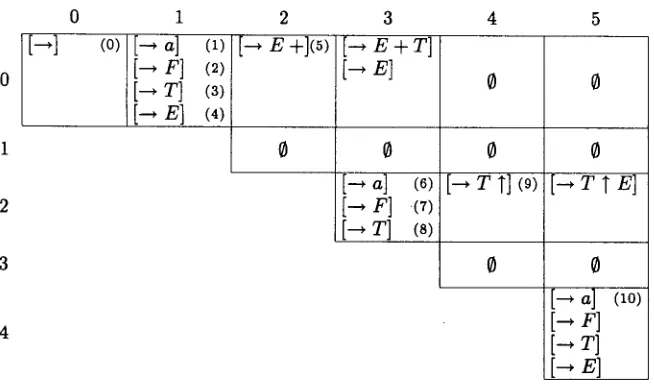
Report recognition of the input if [--~ S] E T0,n. For an example, see Figure 1.
0 1 2
[--.] (0) [-*[-*[--*[--* T]E]F]a] (4)(3)(2)(1) [--. E +](5)
1
0
3
[--* E + T]
E]
[4 a]
(6)
[--* F] (7) [--* T] (s)
Figure 1: Tabular
0
[--* T T] (9)
CP parsing without top-down filtering (i.e. without the checks concerning the left-corner relation / * ) is the main algorithm in [21].
W i t h o u t the use of top-down filtering, the references to [---~/9] in Clauses 1 and 3 are clearly not of much use any more. When we also remove the use of these items, then these clauses become:
[--* T T E]
Consider again the g r a m m a r from Example 1 and the (incorrect) in- put a + a T a. After execution of the tabular common-prefix al- gorithm, the table is as given here. The sets Tj,i are given at the j - t h row and i-th column.
The items which correspond with those from Example 4 are labelled with (0), ( 1 ) , . . . These labels also indicate the order in which these items are added to the table.
1. Add [--+ a] to Tc-I,C for a = ai where there is A --* ac~ • p t
3. Add [--* A] to Tj,i for [--+ o~] • Tj,i where there are A ---* a, D --* A6 • pt
[--*
a]
(Io)T]
[--, E]
CP parsing
However, for certain i there may be many [A ~ /9] • Tj,c-1, for some j , and each may give rise to a different A' which is non-empty. In this way, Clause 1 may add several items [A' --~ a] to Tc-I,C, some possibly with overlapping sets A'. Since items represent computation of subderivations, the algorithm may therefore compute the same subderivation several times.
In the resulting algorithm, no set Tc,j depends on a n y set Tg,h with g < i. In [15] this fact is used to construct a parallel parser with n processors P o , . . . , Pn-1, with each Pi processing the sets Ti,j for all j > i. T h e flow of d a t a is strictly from right to left, i.e. items computed by Pc are only passed on to P 0 , . . . , Pc-1.
T a b u l a r E L R p a r s i n g
The tabular form of E L R parsing allows an optimiza- tion which constitutes an interesting example of how a tabular algorithm can have a property not shared by its nondeterministic origin. 5
First note that we can compute the columns of a parse table strictly from left to right, that is, for fixed i we can compute all sets Tj,c before we compute the sets Tj,C-F1 •
If we formulate a tabular E L R algorithm in a naive way analogously to Algorithm 5, as is done in [5], then for example the first clause is given by:
1. Add [A' --. a] to Tc-1,c for a = ac and [A ~ / 9 ] • Tj,c-1
where A ' -- { A ] 3 A --~ a(~,B --+ /9C~ • P t [ B • A A A Z* C]} is non-empty
5This is reminiscent of the admissibility tests [3], which are applicable to tabular realisations of logical push-down automata, but not to these automata themselves.
We propose an optimization which makes use of the fact t h a t all possible items [A --+/9] • Tj,i-1 are already present when we compute items in Ti-l,i: we compute one single item [A' -+ hi, where A' is a large set com- puted using all [A --+ /9] • Tj,i-1, for any j . A similar
[image:6.612.74.401.52.244.2]t o Tj, i •
[A ---* c~] • Tj,i-1
• A i A -~ c~a/9 • p t } is non-empty optimization can be made for the third clause.
A l g o r i t h m 6 ( T a b u l a r e x t e n d e d L R )
Sets T / j of the table are to be subsets of I ELR. Start with an e m p t y table. Add [{S'} ~ ] to T0,0. For i ---- 1 , . . . , n, in this order, perform one of the following steps until no more items can be added.
1. Add [A' --. a] to T i - l # for a = ai
where A' = {A I 3 j 3 [ A --*/9] • T j , i - 1 3 A ----, ha, B ---* /9C0' • p t [ B • A A A Z* C]} is non-empty
2. Add [A' --* aa] for a = ai and
where A' = {A
3. Add [A" --. A] to Tj,i for [A' --* a ] E Tj,i where there is A --+ a E p t with A E A', and A" = {D [ 3h3[A --* /9] E TtL,j3D ----, A6, B ----, /9C',/ E
p t [ B E A A D Z* C]} is non-empty
4. Add [A" --./gA] to Th,i for [A' --* a] E Tj,/ and
[A --,/9] • Th,j
where there is A --* a • p t with A • A', and A" = {B • A ] B --~/9A7 • p t } is non-empty
from a certain input position. For input position i these nonterminals D are given by
Si = {D ] 3j3[A ~ fl] E Td,i
3B --, tiC"/e P t [ B E A A D Z* C]} Provided each set Si is c o m p u t e d just after comple- tion of the i-th column of the table, the first and third clauses can be simplified to:
1. Add [A' ~ a] t o T i - l , i for a = a i
where A ' = {A [ A --~ a a E p t } M Si-1 is n o n - e m p t y 3. Add [A" ---, A] to Tj,i for [A' --, ~] E Tj,i
where there is A --, a E p t with A E A', and A " = {D [ D ~ A5 E p t } N Sj is n o n - e m p t y
which m a y lead to more practical implementations. Note t h a t we m a y have t h a t the t a b u l a r E L R algo- r i t h m manipulates items of the form [A --~ a] which would not occur in a n y search p a t h of the nondeter- ministic E L R algorithm, because in general such a A is the union of m a n y sets A ' of items [A ~ --~ a] which would be m a n i p u l a t e d at the same input position by the nondeterministic algorithm in different search paths.
W i t h minor differences, the above t a b u l a r E L R algo- rithm is described in [21]. A t a b u l a r version of pseudo E L R parsing is presented in [20]. Some useful d a t a structures for practical implementation of t a b u l a r and non-tabular PLR, E L R and C P parsing are described
in [S],
F i n d i n g a n o p t i m a l t a b u l a r a l g o r i t h m
In [14] Schabes derives the LC algorithm from LR pars- ing similar to the way t h a t E L R parsing can be derived from LR parsing. T h e LC algorithm is obtained by not only splitting up the goto function into goto 1 and goto 2 but also splitting up goto~ even further, so t h a t it non- deterministically yields the closure of one single kernel item. (This idea was described earlier in [5], and more recently in [10].)
Schabes then argues t h a t the LC algorithm can be determinized (i.e. m a d e more deterministic) by manip- ulating the goto functions. One application of this idea is to take a fixed g r a m m a r and choose different goto functions for different parts of the g r a m m a r , in order to tune the parser to the g r a m m a r .
In this section we discuss a different application of this idea: we consider various goto functions which are global, i.e. which are the same for all parts of a g r a m m a r . One example is E L R parsing, as its goto~ function can be seen as a determinized version of the goto 2 function of LC parsing. In a similar way we obtain P L R parsing. Traditional LR parsing is obtained by taking the full determinization, i.e. by taking the normal goto function which is not split up. 6
6Schabes more or less also argues that LC itself can be obtained by determinizing TD parsing. (In lieu of TD pars- ing he mentions Earley's algorithm, which is its tabular realisation.)
We conclude t h a t we have a family consisting of LC, PLR, ELR, and LR parsing, which are increasingly de- terministic. In general, the more deterministic an algo- r i t h m is, the more parser states it requires. For exam- ple, the LC algorithm requires a n u m b e r of states (the items in I Lc) which is linear in the size of the gram- mar. By contrast, the LR algorithm requires a n u m b e r of states (the sets of items) which is exponential in the size of the g r a m m a r [2].
The differences in the n u m b e r of states complicates the choice of a t a b u l a r algorithm as the one giving op- timal behaviour for all g r a m m a r s . If a g r a m m a r is very simple, then a sophisticated algorithm such as LR m a y allow completely deterministic parsing, which requires a linear n u m b e r of entries to be added to the parse table, measured in the size of the g r a m m a r .
If, on the other hand, the g r a m m a r is very ambigu- ous such t h a t even LR parsing is very nondeterministic, then the t a b u l a r realisation m a y at worst add each state to each set T i j , so t h a t the more states there are, the more work the parser needs to do. This favours sim- ple algorithms such as LC over more sophisticated ones such as LR. Furthermore, if more t h a n one state repre- sents the same subderivation, then c o m p u t a t i o n of t h a t subderivation m a y be done more t h a n once, which leads to parse forests (compact representations of collections of parse trees) which are not optimally dense [1, 12, 7]. Schabes proposes to tune a parser to a g r a m m a r , or in other words, to use a combination of parsing tech- niques in order to find an o p t i m a l parser for a certain g r a m m a r . 7 This idea has until now not been realised. However, when we t r y to find a single parsing algorithm which performs well for all g r a m m a r s , then the tabu- lar E L R algorithm we have presented m a y be a serious candidate, for the following reasons:
• For M1 i, j , and a at most one i t e m of the form [A --, ct] is added to Tij. Therefore, identical sub- derivations are not c o m p u t e d more t h a n once. (This is a consequence of our optimization in Algorithm 6.) Note t h a t this also holds for the t a b u l a r CP algo- rithm.
• E L R parsing guarantees the correct-prefix property, contrary to the CP algorithm. This prevents com- p u t a t i o n of all subderivations which are useless with regard to the already processed input.
• E L R parsing is more deterministic t h a n LC and P L R parsing, because it allows shared processing of all common prefixes. It is hard to imagine a practical parsing technique more deterministic t h a n E L R pars- ing which also satisfies the previous two properties. In particular, we argue in [8] t h a t refinement of the LR technique in such a way t h a t the first p r o p e r t y above holds whould require an impractically large n u m b e r of L R states.
Epsilon rules
Epsilon rules cause two problems for bottom-up pars- ing. The first is non-termination for simple realisations of nondeterminism (such as backtrack parsing) caused by hidden left recursion [7]. The second problem occurs when we optimize TD filtering e.g. using the sets Si: it is no longer possible to completely construct a set Si be- fore it is used, because the computation of a derivation deriving the empty string requires Si for TD filtering but at the same time its result causes new elements to be added to S~. Both problems can be overcome [8].
Conclusions
We have discussed a range of different parsing algo- rithms, which have their roots in compiler construction, expression parsing, and natural language processing. We have shown that these algorithms can be described in a common framework.
We further discussed tabular realisations of these al- gorithms, and concluded that we have found an opti- mal algorithm, which in most cases leads to parse tables containing fewer entries than for other algorithms, but which avoids computing identical subderivations more than once.
Acknowledgements
The author acknowledges valuable correspondence with Klaas Sikkel, Ran6 Leermakers, Franqois Barth61emy, Giorgio Satta, Yves Schabes, and Fr6d@ric Voisin.
References
[1] S. Billot and B. Lang. The structure of shared forests in ambiguous parsing. In 27th Annual Meet- ing of the ACL, 143-151, 1989.
[2] M. Johnson. The computational complexity of GLR parsing. In M. Tomita, editor, Generalized LR Parsing, chapter 3, 35-42. Kluwer Academic Publishers, 1991.
[3] B. Lang. Complete evaluation of Horn clauses: An automata theoretic approach. Rapport de Recherche 913, Institut National de Recherche en Informatique et en Automatique, Rocquencourt, France, November 1988.
[4] M. Lankhorst. An empirical comparison of gener- alized LR tables. In R. Heemels, A. Nijholt, and K. Sikkel, editors, Tomita's Algorithm: Extensions and Applications, Proc. of the first Twente Work- shop on Language Technology, 87-93. University of Twente, September 1991. Memoranda Informatica 91-68.
[5] R. Leermakers. How to cover a grammar. In 27th Annual Meeting of the ACL, 135-142, 1989. [6] R. Leermakers. A recursive ascent Earley
parser. Information Processing Letters, 41(2):87- 91, February 1992.
[7] M.J. Nederhof. Generalized left-corner parsing. In
Sixth Conference of the European Chapter of the ACL, 305-314, 1993.
[8] M.J. Nederhof. A multidisciplinary approach to a parsing algorithm. In K. Sikkel and A. Ni- jholt, editors, Natural Language Parsing: Methods and Formalisms, Proc. of the sixth Twente Work- shop on Language Technology, 85-98. University of Twente, 1993.
[9] M.J. Nederhof and G. Satta. An extended theory of head-driven parsing. In this proceedings. [10] P. Oude Luttighuis and K. Sikkel. Generalized LR
parsing and attribute evaluation. In Third Inter- national Workshop on Parsing Technologies, 219- 233, Tilburg (The Netherlands) and Durbuy (Bel- gium), August 1993.
[11] P.W. Purdom, Jr. and C.A. Brown. Parsing
extended LR(k) grammars. Acta Informatica,
15:115-127, 1981.
[12] J. Rekers. Parser Generation for Interactive Envi- ronments. PhD thesis, University of Amsterdam, 1992.
[13] D.J. Rosenkrantz and P.M. Lewis II. Deterministic left corner parsing. In IEEE Conference Record of the 11th Annual Symposium on Switching and Automata Theory, 139-152, 1970.
[14] Y. Schabes. Polynomial time and space shift- reduce parsing of arbitrary context-free grammars. In 29th Annual Meeting of the ACL, 106-113, 1991. [15] K. Sikkel and M. Lankhorst. A parallel bottom- up Tomita parser. In 1. Konferenz "Verarbeitung Natiirlicher Sprache", 238-247, Nfirnberg, October 1992. Springer-Verlag.
[16] S. Sippu and E. Soisalon-Soininen. Parsing The- ory, Vol. H: LR(k) and LL(k) Parsing, EATCS Monographs on Theoretical Computer Science, volume 20. Springer-Verlag, 1990.
[17] E. Soisalon-Soininen and E. Ukkonen. A method for transforming grammars into LL(k) form. Acta Informatica, 12:339-369, 1979.
[18] M. Tomita. Efficient Parsing for Natural Lan- guage. Kluwer Academic Publishers, 1986.
[19] F. Voisin. CIGALE: A tool for interactive grammar construction and expression parsing. Science of
Computer Programming, 7:61-86, 1986.
[20] F. Voisin. A bottom-up adaptation of Earley's
parsing algorithm. In Programming Languages
Implementation and Logic Programming, Interna- tional Workshop, LNCS 348, 146-160, Orl@ans, France, May 1988. Springer-Verlag.