Effects of Cross-Linking Agent on Apatite-Forming Ability and Mechanical
Property of Organic-Inorganic Hybrids Based on Starch
Toshiki Miyazaki
1;*1, Shouji Yasunaga
1;*2, Eiichi Ishida
2,
Masahiro Ashizuka
1and Chikara Ohtsuki
31Graduate School of Life Science and Systems Engineering, Kyushu Institute of Technology, Kitakyushu 808-0196, Japan 2Faculty of Engineering, Kyushu Institute of Technology, Kitakyushu 804-8550, Japan
3Graduate School of Engineering, Nagoya University, Nagoya 464-8603, Japan
So-called bioactive ceramics can directly bond to living bone through the apatite layer formed on their surfaces in the body. However, hard and brittle character of ceramics limits their clinical applications to low loaded portions. The apatite deposition on the bioactive ceramics is known to be triggered by a catalytic effect of silanol (Si-OH) groups formed on their surfaces and by release of calcium ions (Ca2þ) that increases degree of supersaturation of the surrounding fluid with respect to the apatite. It is expected that organic modification of these components would produce bioactive materials with mechanical properties analogous to natural bone. We previously reported that bioactive organic-inorganic hybrids can be prepared from starch by modification with glycidoxypropyltrimethoxysilane (GPS) that provides with Si-OH groups and calcium chloride that releases calcium ions. In this study, we examined effect of synthetic conditions of the hybrids on their bioactivity and mechanical properties. We prepared several hybrids with different content of divinylsulfone as a cross-linking agent. Their bioactivity was examined in simulated body fluid (SBF, Kokubo solution) with inorganic ion concentrations nearly equal to those of human extracellular fluid. Materials that form the apatite on their surfaces in SBF are known to have a potential to show the bone-bonding. It was found that the added cross-linking agent did not decrease apatite-forming ability of the hybrids in SBF. Mechanical properties of the hybrids were further evaluated by a tensile test. Tensile strength and Young’s modulus increased with increasing content of divinylsulfone.
[doi:10.2320/matertrans.48.317]
(Received August 31, 2006; Accepted November 17, 2006; Published February 25, 2007)
Keywords: organic-inorganic hybrid, starch, apatite, simulated body fluid, bioactivity, mechanical property, divinylsulfone, cross-linking agent, glycidoxypropyltrimethoxysilane, calcium chloride
1. Introduction
Generally artificial materials implanted into bone defects cannot bond to bone, since they are encapsulated by fibrous collagen tissues and consequently isolated from the sur-rounding bone. This is a normal reaction to protect our bodies. In contrast, specific kinds of ceramics such as Bioglass, sintered hydroxyapatite and glass ceramics A-W containing oxyfluorapatite and wollastonite in glassy matrix, are known to have the ability to make direct bond to living bone when implanted into bone defects.1,2) They are called bioactive ceramics and have been already subjected to clinical applications as important bone substitutes. However, the problem is that their fracture toughness is lower and their young’s modulus is higher than that of natural bone. This limits their clinical application to low loaded conditions. Materials exhibiting high flexibility as well as high bio-activity are therefore required for novel bone substitutes.
It is known that the essential requirement for artificial materials to show bioactivity is deposition of a bone-like apatite layer on their surfaces in the body environment.3,4) This apatite deposition can be well reproduced even in an acellular simulated body fluid (SBF, Kokubo solution) with inorganic ion concentrations similar to those of human extracellular fluid.5–7)Mechanism of the apatite formation on materials in body environment has been investigated by using glasses and sol-gel-derived oxide gels. Results of these studies show that silanol (Si-OH) group that formed on the
materials and calcium ion (Ca2þ) that released from the materials are essential components to induce apatite depo-sition in the body environment.8,9) Design of organic-inorganic hybrids by modification of these components with flexible organic polymers is expected to solve the problem of the bioactive ceramics.
Several research groups have attempted development of bioactive organic-inorganic hybrids from various organic polymers by modification with Si-OH groups and Ca2þ. Polydimethylsiloxane (PDMS),10,11) gelatin,12) poly(tetra-methylene oxide) (PTMO),13) polymethylmethacrylate (PMMA),14,15) poly(hydroxyethyl methacrylate),16) algi-nate,17)polycaprolactone18)and so on have been reported as organic polymers for a component of bioactive hybrids. We have paid attention on starch as an organic polymer. Starch is a natural polysaccharide which is known as a constituent of various kinds of crops. Starch-based materials have been attracting much attention as novel bone substitutes.19,20)We have recently reported that bioactive organic-inorganic hybrids can be synthesized from starch by modification with alkoxysilane and calcium salt.21)It is known that addition of cross-linking agent can improve mechanical strength of organic polymers. We expect that bioactive hybrids with different mechanical properties can be designed through the cross-linking.
In this study, we synthesized organic-inorganic hybrids from starch by addition of divinylsulfone as a cross-linking agent as well as alkoxysilane and calcium salt. Effect of the cross-linking agent on bioactivity and mechanical properties of the hybrids was also investigated.
2. Materials and Methods
Potato starch (Nacalai Tesque, Inc., Japan) was dissolved in dimethylsulfoxide (DMSO, (CH3)2SO, Wako Pure Chemi-cal Industries, Ltd., Japan). Calcium chloride (CaCl2, Nacalai Tesque, Inc., Japan), glycidoxypropyltrimethoxysilane (GPS, CH2(O)CHCH2O(CH2)3Si(OCH3)3, Chisso Co., Japan), di-vinylsulfone (DS, CH2=CHSO2CH=CH2, Wako Pure Chemical Industries, Ltd., Japan) as a cross-linking agent and ultrapure water were then added to the solution. The prepared sol was subsequently poured into a Teflondish and
kept in vacuo at room temperature for 3 days, in order to
remove bubbles in the solution. It was then dried in air atmosphere at 60C for 21 days. Compositions of the prepared gels were indicated in Table 1.
The obtained bulk gels were cut into rectangular speci-mens of10101mm3section, and then soaked in 30 cm3 of SBF (Naþ142.0, Kþ5.0, Mg2þ1.5, Ca2þ2.5, Cl147.8, HCO3 4.2, HPO42 1.0 and SO42 0.5 molm3).5–7) The fluid was prepared by dissolving reagent-grade chemicals of NaCl, NaHCO3, KCl, K2HPO43H2O, MgCl26H2O, CaCl2 and Na2SO4in ultrapure water and buffering at pH 7.40 with tris(hydroxymethyl)aminomethane ((CH2OH)3CNH2) and appropriate volume of hydrochloric acid (HCl). All the reagents to prepare SBF were supplied from Nacalai Tesque, Inc., Japan. The temperature of the solution was kept at 36.5C. After soaking in SBF, the specimens were removed from the fluid, washed gently with ultrapure water and dried at room temperature.
The surface structural features of the specimens before and after soaking in SBF were examined by scanning electron microscopy (SEM; S-3500N, Hitachi Co., Japan) attached with energy-dispersive X-ray diffraction (EDX; EMAX energy, Horiba Co., Japan), Fourier-transform infrared spec-troscopy (FT-IR; Spectrum GX2000R, PerkinElmer Ltd., England), and thin-film X-ray diffraction (TF-XRD; MXP3V, Mac Science Ltd., Japan). In the FT-IR, the obtained hybrids or starch powder were pulverized, and mixed with KBr powder in mass ratio of1 : 100. A thin film was prepared by pressing the mixed powder, which was then subjected to the measurement. In the TF-XRD, the angle of the incident beam was fixed at 1 against the surface of the specimen, and the measurements were performed using a step scanning mode with 0.02steps and 1 sec at each step. For the SEM observation, a thin film of gold was coated on the surfaces of the specimens using a sputtering method.
Mechanical properties of the hybrids were assessed by a tensile test. Dumbbell-shaped specimens 115 mm in length,
60:4mm in width at center and 251mm in width at edge were prepared by the method above described. The
specimens were subjected to the tensile test by using Instron-type material testing machine (Model AG-I, Shimadzu Co., Japan) according to JIS 7127. Cross-head speed was fixed at 1.0 mm/min. Five specimens were tested for each composi-tion, and average tensile strength and Young’s modulus were calculated.
[image:2.595.312.537.71.425.2]3. Results and Discussion
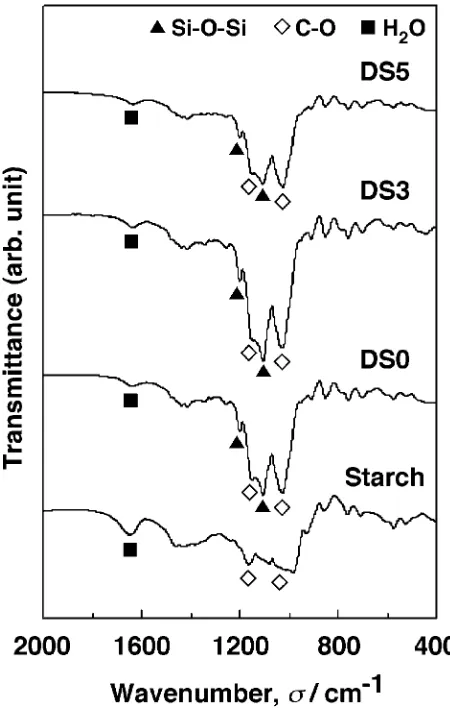
Figure 1 shows FT-IR spectra of the GPS-starch-CaCl2 hybrids and starch powder as a reference. For all the hybrids, peaks assigned to C-O bond were observed at 1040 and 1150 cm1 and those assigned to Si-O-Si bond were at 1200 cm1.22–24) In addition, peaks assigned to water that absorbed to starch were observed at 1640 cm1. These results indicate that both GPS and starch are successfully incorpo-rated into the hybrids.
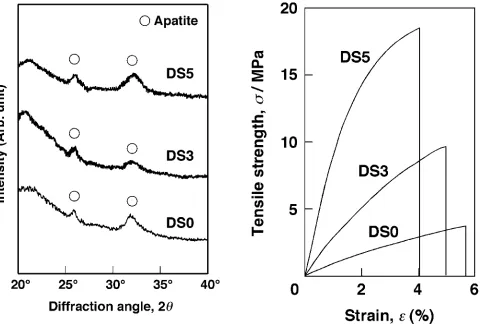
Figure 2 shows TF-XRD patterns of the surfaces of the GPS-starch-CaCl2 hybrids, which were soaked in SBF for 7 days. Broad peaks assigned to low-crystalline hydroxyapatite were observed at 26 and 32. Figure 3 shows SEM photo-graphs of the surfaces of the GPS-starch-CaCl2 hybrids, which were soaked in SBF for 7 days. The surfaces of all the hybrids were covered with fine particles of the apatite. Size of the particles formed on the hybrids without divinylsulfone was about 1mm. The particle size showed tendency to decrease with increase in content of divinylsulfone.
Table 1 Compositions of the GPS-starch-CaCl2hybrids.
Sample Mass ratio Molar ratio
Starch/(Starch+GPS) DS/Starch CaCl2/GPS H2O/GPS
DS0 0.50 0 0.05 2
DS3 0.50 0.03 0.05 2
DS5 0.50 0.05 0.05 2
GPS: Glycidoxypropyltrimethoxysilane DS: Divinylsulfone
[image:2.595.47.292.84.153.2]Figure 4 shows stress-strain curves of the representative specimens with different content of divinylsulfone. Measured tensile strength, strain at failure and Young’s modulus were summarized in Table 2. Tensile strength and Young’s
modulus increased and strain at fracture decreased with increase in content of divinylsulfone. It is noted that the mechanical properties of the specimens can be easily controlled according to content of divinylsulfone.
Fig. 2 TF-XRD patterns of the surfaces of the GPS-starch-CaCl2hybrids after soaking in SBF for 7 days.
Fig. 3 SEM photographs of the surfaces of the GPS-starch-CaCl2hybrids after soaking in SBF for 7 days.
[image:3.595.56.298.71.389.2]Fig. 4 Representative stress-strain curves of the GPS-starch-CaCl2hybrids before soaking in SBF.
Table 2 Mechanical properties of the GPS-starch-CaCl2hybrids.
Sample Tensile strength,/MPa Strain at fracture,"(%) Young’s modulus, E/MPa
DS0 3:70:7 5:70:7 19020
DS3 9:72:3 5:00:4 29232
[image:3.595.315.540.72.391.2] [image:3.595.72.529.452.602.2] [image:3.595.43.550.661.714.2]Organic-inorganic hybrids can be obtained from starch by addition of alkoxysilane and calcium salts as well as divinylsulfone. Tensile strength and Young’s modulus of the hybrids increases with increasing content of divinylsul-fone. The added divinylsulfone bonds to OH groups in polysaccharides to form cross-linking as shown in the following equation:25,26)
2R-OHþCH2=CHSO2CH=CH2
!R-OCH2CH2SO2CH2CH2O-R ð1Þ
R means alkyl group in the polysaccharides. Generally, mechanical strength and Young’s modulus of organic polymers have tendency to increase with increasing cross-linking, when breakage of the polymer chain does not occur.27,28) The results of the tensile test shown in Fig. 4 support the assumption that the added divinylsulfone makes cross-linkage to the starch. We can see that mechanical properties of the organic-inorganic hybrids can be easily controlled by the degree of the cross-linkage.
The obtained starch-based hybrids are found to form the apatite on their surfaces in SBF, irrespective of divinylsul-fone content. This means that addition of divinylsuldivinylsul-fone as cross-linking agent does not make adverse effect on their bioactivity. The formed apatite has low crystallinity much similar to bone apatite as shown in Figs. 2 and 3. It has been revealed that artificial materials that form the apatite on their surfaces in SBF can directly bond to bone.3,4,7,29) Therefore the hybrids obtained in this study would show bone-bonding ability after implantation in bone defects. It is reported that natural bone has degree of crystallinity ranging from 59 to 67%.30) Although the degree of crystallinity of the apatite layer formed in SBF has not been revealed, it would have analogous degree of crystallinity to the bone, judging from the result that it gives broad XRD patterns similar to the bone. Previous findings show that Si-OH groups trigger heteroge-neous nucleation of apatite by a catalytic effect.8,9) Si-OH groups would be also formed on the surface of the starch-based hybrids by hydrolysis of GPS after soaking in SBF:
CH2(O)CHCH2O(CH2)3Si(OCH3)3þ3H2O
!CH2(O)CHCH2O(CH2)3Si(OH)3þ3CH3OH ð2Þ
The formed Si-OH groups would dissociate into negatively charged units, since pH of SBF (7.40) is much higher than the isoelectric point of the silica (2:0):
Si-OHþOHSi-OþH
2O ð3Þ
The negative charged groups would selectively bind to Ca2þ in SBF:
2(Si-O)þCa2þ!(Si-O)
2Ca ð4Þ
Si-OþCa2þ!(Si-O)Caþ ð5Þ
The formed calcium silicate complex would play as nucleation site of the apatite, as previously reported.31,32) The apatite formation is significantly enhanced by the release of Ca2þions, which increase the degree of supersaturation of the surrounding fluid with respect to the apatite. Once the apatite nuclei are formed, they spontaneously grow into a continuous layer by consuming Ca2þ and phosphate ions from the surrounding fluid, since SBF is already super-saturated with respect to the apatite, even under normal
conditions:
10Ca2þþ6PO43þ2OH!Ca10(PO4)6(OH)2 ð6Þ
The combined effect of Si-OH groups and Ca2þ ions would contribute to the rapid apatite formation in SBF.
Particle size of the apatite formed on the hybrids in SBF showed tendency to decrease with increase in content of divinylsulfone (see Fig. 3). The added divinylsulfone con-tains sulfonyl group (-SO2-). It is reported that sulfonic groups (-SO3H) induce the heterogeneous nucleation of the apatite in body environment.33,34)The sulfonyl groups in the divinylsulfone would also act as site of the heterogeneous apatite nucleation. Consequently, the increase in amount of the site of the apatite nucleation, e.g. Si-OH groups and sulfonyl groups, would lead to smaller particle size of the apatite.
Bioactive organic-inorganic hybrids with different me-chanical properties can be designed from starch by chemical modification with alkoxysilane and calcium salt. In addition, it is reported that gelatin gels cross-linked with water-soluble carbodiimide show slower bioresorption in subcutaneous tissues of rats than those without the cross-linkage.35)This suggests that degree of cross-linkage also governs rate of bioresorption in body environment. This type of hybrids is expected to be useful for not only bone substitutes but also scaffolds in bone tissue engineering.
4. Conclusions
We examined effect of cross-linking agent on bioactivity and mechanical properties of organic-inorganic hybrids in the system GPS-starch-CaCl2. Bulk gels of the hybrid were successfully obtained even by addition of divinylsulfone with different content as a cross-linking agent. Bone-like apatite formation was observed on the surfaces of the hybrids after soaking in SBF, irrespective of divinylsulfone content. This means that the bioactivity of the hybrids is not suppressed by the added cross-linking agent. Tensile strength and Young’s modulus of the hybrids increased with increasing content of divinylsulfone. The obtained organic-inorganic hybrids are expected to be promising as bioactive bone substitutes with mechanical properties analogous to those of natural bone.
REFERENCES
1) L. L. Hench: J. Am. Ceram. Soc.74(1991) 1487–1510. 2) L. L. Hench: J. Am. Ceram. Soc.81(1998) 1705–1728. 3) H.-M. Kim: J. Ceram. Soc. Japan109(2001) S49–S57.
4) T. Kokubo, H. M. Kim and M. Kawashita: Biomaterials24(2003) 2161–2175.
5) T. Kokubo, H. Kushitani, S. Sakka, T. Kitsugi and T. Yamamuro: J. Biomed. Mater. Res.24(1990) 721–734.
6) S. B. Cho, K. Nakanishi, T. Kokubo, N. Soga, C. Ohtsuki, T. Nakamura, T. Kitsugi and T. Yamamuro: J. Am. Ceram. Soc.78(1995) 1769–1774.
7) T. Kokubo and H. Takadama: Biomaterials27(2006) 2907–2915. 8) C. Ohtsuki, T. Kokubo and T. Yamamuro: J. Non-Cryst. Solids143
(1992) 84–92.
9) P. Li, C. Ohtsuki, T. Kokubo, K. Nakanishi, N. Soga and K. de Groot: J. Biomed. Mater. Res.28(1994) 7–15.
10) K. Tsuru, C. Ohtsuki, A. Osaka, T. Iwamoto and J. D. Mackenzie: J. Mater. Sci. Mater. Med.8(1997) 157–161.
(1999) 1127–1132.
12) L. Ren, K. Tsuru, S. Hayakawa and A. Osaka: Biomaterials23(2002) 4765–4773.
13) N. Miyata, K. Fuke, Q. Chen, M. Kawashita, T. Kokubo and T. Nakamura: Biomaterials23(2002) 3033–3040.
14) T. Miyazaki, C. Ohtsuki, M. Kyomoto, M. Tanihara, A. Mori and K. Kuramoto: J. Biomed. Mater. Res.67A(2003) 1417–1423. 15) C. Ohtsuki, T. Miyazaki, M. Kyomoto, M. Tanihara and A. Osaka:
J. Mater. Sci. Mater. Med.12(2001) 895–899.
16) T. Miyazaki, C. Ohtsuki and M. Tanihara: J. Nanosci. Nanotech.3
(2003) 511–515.
17) K. Hosoya, C. Ohtsuki, T. Kawai, M. Kamitakahara, S. Ogata, T. Miyazaki and M. Tanihara: J. Biomed. Mater. Res. Part A71A(2004) 596–601.
18) S. H. Rhee: Biomaterials25(2004) 1167–1175.
19) S. C. Mendes, R. L. Reis, Y. P. Bovell, A. M. Cunha, C. A. van Blitterswijk and J. D. de Bruijn: Biomaterials22(2001) 2057–2064. 20) I. Espigares, C. Elvira, J. F. Mano, B. Vazquez, R. J. San and R. L. Reis:
Biomaterials23(2002) 1883–1895.
21) T. Miyazaki, S. Yasunaga, E. Ishida, M. Ashizuka and C. Ohtsuki: J. Japan Soc. Powder and Powder Metallurgy 52 (2005) 360–363 (in Japanese).
22) J. Lin, J. A. Siddiqui and R. M. Ottenbrite: Polym. Adv. Tech.12
(2001) 285–292.
23) J. M. Fang, P. A. Fowler, J. Tomkinson and C. A. S. Hill: Carbohydrate Polym.47(2002) 245–252.
24) M. Xiaofei, Y. Jiugao and F. Jin: Polym. Int.53(2004) 1780–1785. 25) D. Capitani, M. A. Del Nobile, G. Mensitieri, A. Sannino and A. L.
Segre: Macromolecules33(2000) 430–437.
26) F. Lionetto, A. Sannino, G. Mensitieri and A. Maffezzoli: Macromol. Symp.200(2003) 199–207.
27) R. O. Ebewele:Polymer Science and Technology, (CRC Press, Boca Raton, 1996) p. 363.
28) R. B. Seymour and C. E. Carraher Jr.:Polymer Chemistry, (Mercel Dekker Inc., New York, 2000) pp. 494–496.
29) S. Fujibayashi, M. Neo, H. M. Kim, T. Kokubo and T. Nakamura: Biomaterials24(2003) 1349–1356.
30) J. D. Termine and A. S. Posner: Calc. Tiss. Res.1(1967) 8–23. 31) H. Takadama, H. M. Kim, T. Kokubo and T. Nakamura: J. Ceram. Soc.
Japan108(2000) 118–121.
32) H. Takadama, H. M. Kim, T. Kokubo and T. Nakamura: J. Am. Ceram. Soc.85(2002) 1933–1936.
33) T. Kawai, C. Ohtsuki, M. Kamitakahara, T. Miyazaki, M. Tanihara, Y. Sakaguchi and S. Konagaya: Biomaterials25(2004) 4529–4534. 34) I. B. Leonor, H.-M. Kim, F. Balas, M. Kawashita, R. L. Reis, T.
Kokubo and T. Nakamura:BioceramicsVol. 17, ed. by P. Li, K. Zhang and C. W. Colwell, Jr., (Trans Tech Publications Ltd., Switzerland, 2004) pp. 453–456.