R e m o v i n g Left R e c u r s i o n from C o n t e x t - F r e e G r a m m a r s
R o b e r t C. M o o r e M i c r o s o f t R e s e a r c h O n e M i c r o s o f t W a y R e d m o n d , W a s h i n g t o n 9 8 0 5 2
b o b m o o r e @ m i c r o s o f t . corn
A b s t r a c t
A long-standing issue regarding algorithms t h a t ma- nipulate context-free grammars (CFGs) in a "top- down" left-to-right fashion is that left recursion can lead to nontermination. An algorithm is known that transforms any CFG into an equivalent non- left-recursive CFG, but the resulting grammars are often too large for practical use. We present a new m e t h o d for removing left recursion from CFGs t h a t is both theoretically superior to the standard algo- rithm, and produces very compact non-left-recursive CFGs in practice.
1 I n t r o d u c t i o n
A long-standing issue regarding algorithms t h a t ma- nipulate context-free grammars (CFGs) in a "top- down" left-to-right fashion is that left recursion can lead to nontermination. This is most familiar in the case of top-down recursive-descent parsing (Aho et al., 1986, pp. 181-182). A more recent motivation is t h a t off-the-shelf speech recognition systems are now available (e.g., from Nuance Communications and Microsoft) t h a t accept CFGs as language models for constraining recognition; but as these recogniz- ers process CFGs top-down, they also require t h a t the CFGs used be non-left-recursive.
The source of the problem can be seen by consid- ering a directly left-recursive g r a m m a r production such as A -4 A s . Suppose we are trying to parse, or recognize using a speech recognizer, an A at a given position in the input. If we apply this pro- duction top-down and left-to-right, our first subgoal will be to parse or recognize an A at the same input position. This immediately puts us into an infinite recursion. The same thing will happen with an indi- rectly left-recursive grammar, via a chain of subgoals t h a t will lead us from the goal of parsing or recogniz- ing an A at a given position to a descendant subgoal of parsing or recognizing an A at t h a t position.
In theory, the restriction to non-left-recursive CFGs puts no additional constraints on the lan- guages t h a t can be described, because any CFG can in principle be transformed into an equivalent non-left-recursive CFG. However, the s t a n d a r d algo-
rithm for carrying out this transformation (Aho et al., 1986, pp. 176-178) (Hopcroft and Ullman, 1979, p. 9 6 ) - - a t t r i b u t e d to M. C. Panll by Hopcroft and Ullman (1979, p. 106)--can produce transformed grammars that are orders of magnitude larger than the original grammars. In this paper we develop a number of improvements to Panll's algorithm, which help somewhat but do not completely solve the prob- lem. We then go on to develop an alternative ap- proach based on the left-corner grammar transform, which makes it possible to remove left recursion with no significant increase in size for several grammars for which Paull's original algorithm is impractical.
2 N o t a t i o n a n d T e r m i n o l o g y
G r a m m a r nonterminals will be designated by "low order" upper-case letters (A, B, etc.); and termi- nals will be designated by lower-case letters. We will use "high order" upper-case letters (X, Y, Z) to denote single symbols that could be either ter- minals or nonterminals, and Greek letters to denote (possibly empty) sequences of terminals a n d / o r non- terminals. Any production of the form A --4 a will be said to be an A-production, and a will be said to be an expansion of A.
We will say t h a t a symbol X is a direct left corner
of a nonterminal A, if there is an A-production with X as the left-most symbol on the right-hand side. We define the left-corner relation to be the reflexive transitive closure of the direct-left-corner relation, and we define the proper-left-corner relation to be the transitive closure of the direct-left-corner rela- tion. A nonterminal is left recursive if it is a proper left corner of itself; a nonterminal is directly left re- cursive if it is a direct left corner of itself; and a nonterminal is indirectly left recursive if it is left re- cursive, but not directly left recursive.
3 T e s t G r a m m a r s
We will test the algorithms considered here on three large, independently-motivated, natural-language grammars. T h e C T g r a m m a r 1 was compiled into a CFG from a task-specific unification grammar
1Courtesy of J o h n Dowding, SRI International
G r a m m a r size Terminals Nonterminals Productions LR nonterminals
Productions for LR nonterminals
Toy CT ATIS P T
G r a m m a r G r a m m a r G r a m m a r G r a m m a r 88
40 16 55 4 27
55,830 1,032 3,946 24,456 535 2,211
16,872
357
192
4,592
91,109
67,904 47 38 15,039 33 14,993
Table 1: G r a m m a r s used for evaluation.
written for CommandTalk (Moore et al., 1997), a spoken-language interface to a military simulation system. The ATIS g r a m m a r was extracted from an internally generated treebank of the DARPA ATIS3 training sentences (Dahl et al., 1994). T h e P T gram- mar 2 was extracted from the Penn Treebank (Mar- cus et al., 1993). To these grammars we add a small "toy" grammar, simply because some of the algo- rithms cannot be run to completion on any of the "real" grammars within reasonable time and space bounds.
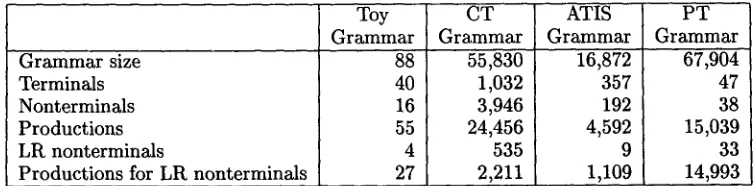
Some statistics on the test grammars are con- tained in Table 1. T h e criterion we use to judge effectiveness of the algorithms under test is the size of the' resulting grammar, measured in terms of the total number of terminal and nonterminal symbols needed to express the productions of the grammar. We use a slightly nonstandard metric, counting the symbols as if, for each nonterminal, there were a single production of the form A --+ a l I ..- [ a,~. This reflects the size of files and d a t a structures typ- ically used to store grammars for top-down process- ing more accurately t h a n counting a separate occur- rence of the left-hand side for each distinct right- hand side.
It should be noted t h a t the C T g r a m m a r has a very special property: none of the 535 left recursive nonterminals is indirectly left recursive. T h e gram- mar was designed to have this p r o p e r t y specifically because Paull's algorithm does not handle indirect left recursion well.
It should also be noted t h a t none of these gram- mars contains empty productions or cycles, which can cause problems for algorithms for removing left recursion. It is relatively easy to trasform an arbi- t r a r y CFG into an equivalent g r a m m a r which does not contain any of the probelmatical cases. In its initial form the P T grammar contained cycles, but these were removed at a cost of increasing the size of the grammar by 78 productions and 89 total sym- bols. No empty productions or cycles existed any- where else in the original grammars.
2Courtesy of Eugene Charniak, Brown University
4 Paull's A l g o r i t h m
Panll's algorithm for eliminating left recursion from C F G s attacks the problem by an iterative procedure for transforming indirect left recursion into direct left recursion, with a subprocedure for eliminating direct left recursion, This algorithm is perhaps more familiar to some as the first phase of the textbook algorithm for transfomrming C F G s to Greibach nor- real form (Greibach, 1965). 3 The subprocedure to eliminate direct left recursion performs the following transformation (Hopcroft and UUman, 1979, p. 96):
Let
A Aa11...
IAa
be the set of all directly left recursive A- productions, and let
I/?s
be the remaining A-productions. Replace all these productions with
A --+/71 [ / ? I A ' [ ... [/?8 [/?sA', and
A ' --+ az [ a l A ' [ . . . I as [ a s A ' ,
where A ~ is a new nonterminal not used elsewhere in the grammar.
This transformation is embedded in the full algo- rithm (Aho et al., 1986, p. 177), displayed in Fig- ure 1.
[image:2.612.152.529.92.185.2]Assign an ordering A 1 , . . . , A,~ to the nonterminals of the g r a m m a r .
for i := 1 to n do begin for j :-- 1 to i - 1 do begin
for each production of the form
Ai ~ Aja
do begin removeAi -+ Aja
from the g r a m m a rfor each production of the form Aj -~/~ do begin add Ai --~/~a to the g r a m m a r
end end end
transform the Ai-productions to eliminate direct left recursion end
Figure 1: Paull's algorithm.
G r a m m a r Description G r a m m a r Size original toy g r a m m a r 88 PA, "best" ordering 156 PA, lexicographical ordering 970 PA, "worst" ordering 5696
Table 2: Effect of nonterminal ordering on Paull's algorithm.
corners. Any direct left recursion for t h a t nonter- minal is then eliminated by the first transformation discussed.
T h e difficulty with this a p p r o a c h is t h a t the it- erated substitutions can lead to an exponential in- crease in the size of the g r a m m a r . Consider the g r a m m a r consisting of the productions Az -+ 0 I 1, plus
Ai+z -+ AiO I Ail
for I < i < n. It is easy to see t h a t Paull's algorithm will transform the g r a m m a r so t h a t it consists of all possible Ai-productions with a binary sequence of length i on the right-hand side, for 1 < i < n, which is exponentially larger t h a n the original g r a m m a r . Notice t h a t the efficiency of PauU's algorithm crucially depends on the ordering of the nonterminals. If the ordering is reversed in the g r a m m a r of this example, Paull's algorithm will make no changes, since the g r a m m a r will already satisfy the condition t h a t all the direct left corners of each nonterminal strictly follow t h a t nonterminal in the revised ordering. T h e t e x t b o o k discussions of Paull's algorithm, however, are silent on this issue.In the inner loop of Panll's algorithm, for nonter- minals
Ai
and Aj, such t h a t i > j andAj
is a direct left corner of Ai, we replace all occurrences of Aj as a direct left corner of Ai with all possible expansions ofAj.
This only contributes to elimination of left recursion from the g r a m m a r ifAi
is a left-recursive nonterminal, andAj
]ies on a p a t h t h a t makesAi
left recursive; t h a t is, if Ai is a left corner of A3 (in
addition to Aj being a left corner of
Ai).
We could eliminate replacements t h a t are useless in removing left recursion if we could order the nonterminals of the g r a m m a r so that, if i > j and Aj is a direct left corner ofAi,
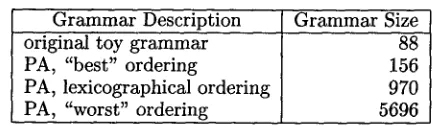
then Ai is also a left corner of Aj. We can achieve this by ordering the nonterminals in de- creasing order of the n u m b e r of distinct left corners they have. Since the left-corner relation is transitive, if C is a direct left corner of B, every left corner of C is also a left corner o f / 3 . In addition, since we defined the left-corner relation to be reflexive, B is a left corner of itself. Hence, if C is a direct left corner of B, it must follow B in decreasing order of n u m b e r of distinct left corners, unless B is a left corner of C.Table 2 shows the effect on Paull's algorithm of ordering the nonterminals according to decreasing n u m b e r of distinct left corners, with respect to the toy g r a m m a r . 4 In the table, "best" means an or- dering consistent with this constraint. Note t h a t if a g r a m m a r has indirect left recursion, there will be multiple orderings consistent with our constraint, since indirect left recursion creates cycles in the the left-corner relation, so every nonterminal in one of these cycles will have the same set of left corners. Our "best" ordering is simply an arbitrarily chosen
[image:3.612.176.443.100.368.2] [image:3.612.206.422.302.365.2]original grammar PA
LF L F + P A
L F + N L R G + P A
CT G r a m m a r ATIS G r a m m a r
55,830
62,499
54,991
59,797
57,924
16,872 > 5,000,000 11,582 2,004,473 72,035
P T G r a m m a r 67,904 > 5,000,000 37,811 > 5,000,000 > 5,000,000
Table 3: G r a m m a r size comparisons with Panll's algorithm variants
ordering respecting the constraint; we are unaware of any m e t h o d for finding a unique best ordering, other than trying all the orderings respecting the constraint.
As a neutral comparison, we also ran the algo- rithm with the nonterminals ordered lexicographi- cally. Finally, to test how bad the algorithm could be with a really poor choice of nonterminal ordering, we defined a "worst" ordering to be one with i n c r e a s - ing numbers of distinct left corners. It should be noted t h a t with either the lexicographical or worst ordering, on all of our three large grammars Panll's algorithm exceeded a cut-off of 5,000,000 g r a m m a r symbols, which we chose as being well beyond what might be considered a tolerable increase in the size of the grammar.
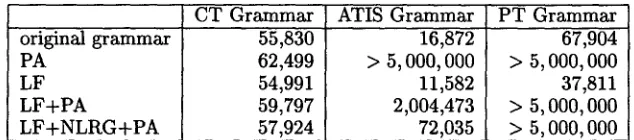
Let PA refer to Paull's algorithm with the non- terminals ordered according to decreasing number of distinct left corners. T h e second line of Table 3 shows the results of running PA on our three large grammars. T h e C T grammar increases only mod- estly in size, because as previously noted, it has no indirect left recursion. Thus the combinatorial phase of Paull's algorithm is never invoked, and the in- crease is solely due to the transformation applied to directly left-recursive productions. With the ATIS grammar and P T grammar, which do not have this special property, Panll's algorithm exceeded our cut- off, even with our best ordering of nonterminals.
Some additional optimizations of Panll's aglo- rithm are possible. One way to reduce the num- ber of substitutions made by the inner loop of the algorithm is to "left factor" the g r a m m a r (Aho et al., 1986, pp. 178-179). T h e left-factoring transfor- mation (LF) applies the following grammar rewrite schema repeatedly, until it is no longer applicable:
L F : For each nonterminal A, let a be the longest nonempty sequence such t h a t there is more t h a n one grammar production of the form A --+ a~. Replace the set of all productions
A - + a f t 1 , . . . , A - + a ~ n with the productions
A -+ a A ' , A ' --~ ill, . . . , A ' --~ fin,
where A' is a new nonterminal symbol.
With left factoring, for each nonterminal A there will be only one A-production for each direct left corner of A, which will in general reduce the number of substitutions performed by the algorithm.
T h e effect of left factoring by itself is shown in the third line of Table 3. Left factoring actually re- duces the size of all three grammars, which m a y be unintuitive, since left factoring necessarily increases the number of productions in the grammar. How- ever, the transformed productions axe shorter, and the grammar size as measured by total number of symbols can be smaller because common left factors are represented only once.
T h e result of applying PA to the left-factored grammars is shown in the fourth line of Table 3 ( L F + P A ) . This produces a modest decrease in the size of the non-left-recursive form of the C T gram- mar, and brings the nomleft-recursive form of the ATIS g r a m m a r under the cut-off size, b u t the non- left-recursive form of the P T grammar still exceeds the cut-off.
T h e final optimization we have developed for Paull's algorithm is to transform the grammar to combine all the non-left-recursive possibilities for each left-recursive nonterminal under a new nonter- minal symbol. This transformation, which we might call "non-left-recursion grouping" (NLRG), can be defined as follows:
N L R G : For each left-recursive nontermi- nal A, let a l , . . . , a n be all the expansions of A t h a t do not have a left recursive non- terminal as the left most symbol. If n > 1, replace the set of productions
A - ~ a l , . . . , A --~ a,~
with the productions
A ~ A ~,A ~ a l , . . . , A ~ - ~ a n , where A t is a new nonterminal symbol.
Since all the new nonterminals introduced by this transformation will be non-left-recursive, Paull's al- gorithm with our best ordering will never substitute the expansions of any of these new nonterminals into the productions for any other nonterminal, which in general reduces the number of substitutions the algorithm makes. We did not empirically measure
[image:4.612.183.500.95.165.2]original g r a m m a r L F
L F + N L R G + P A LC
LCLR
L F ÷ L C L n
L F + N L R G + L C L R
C T G r a m m a r ATIS G r a m m a r P T G r a m m a r 55,830
54,991 57,924 762,576 60,556 58,893 57,380
16,872 11,582 72,035 287,649 40,660 13,641 12,243
67,904 37,811 > 5,000,000 1,567,162 1,498,112 67,167 50,277
Table 4: G r a m m a r size comparisons for LC transform variants
the effect on g r a m m a r size of applying the N L R G transformation by itself, but it is easy to see t h a t it increases the g r a m m a r size by exactly two sym- bols for each left-recursive nontermina] to which it is applied. Thus an addition of twice the n u m b e r of left-recursive nontermina]s will be an u p p e r bound on the increase in the size of the g r a m m a r , but since not every left-recursive nonterminal necessarily has more t h a n one non-left-recursive expansion, the in- crease m a y be less t h a n this.
T h e fifth line of Table 3 ( L F + N L R G + P A ) shows the result of applying LF, followed by NLRG, fol- lowed by PA. This produces another modest de- crease in the size of the non-left-recursive form of the C T g r a m m a r and reduces the size of the non- left-recursive form of the ATIS g r a m m a r by a factor of 27.8, compared to L F ÷ P A . T h e non-left-recursive form of the P T g r a m m a r remains larger t h a n the cut-off size of 5,000,000 symbols, however.
5 L e f t - R e c u r s i o n E l i m i n a t i o n B a s e d o n t h e L e f t - C o r n e r T r a n s f o r m
An alternate approach to eliminating left-recursion is based on the left-corner (LC) g r a m m a r transform of Rosenkrantz and Lewis (1970) as presented a n d modified by Johnson (1998). Johnson's second form of the LC transform can be expressed as follows, with expressions of the form A-a, A - X , and A - B being new nonterminals in the transformed g r a m m a r :
1. If a terminal symbol a is a proper left corner of A in the original g r a m m a r , add A -4 a A - a to the transformed g r a m m a r .
2. If B is a proper left corner of A and B --+ X ~ is a production of the original g r a m m a r , add A - X -+ ~ A - B to the t r a n s f o r m e d g r a m m a r . 3. If X is a proper left corner of A and A --+ X ~
is a production of the original g r a m m a r , add A - X -+ ~ to the t r a n s f o r m e d g r a m m a r . In Rosenkrantz a n d Lewis's original LC transform, schema 2 applied whenever B is a left corner of A, including all cases where B = A. In Johnson's ver- sion schema 2 applies when B -- A only if A is a proper left corner of itself. Johnson then introduces
schema 3 handle the residual cases, without intro- ducing instances of nonterminals of the form A - A t h a t need to be allowed to derive the e m p t y string.
T h e original purpose of the LC transform is to allow simulation of left-corner parsing by top-down parsing, but it also eliminates left recursion from any noncyclic CFG. 5 Fhrthermore, in the worst case, the total n u m b e r of symbols in the transformed gram- m a r cannot exceed a fixed multiple of the square of the n u m b e r of symbols in the original g r a m m a r , in contrast to Paull's algorithm, which exponentiates the size of the g r a m m a r in the worst case.
Thus, we can use Johnson's version of the LC transform directly to eliminate left-recursion. Be- fore applying this idea, however, we have one gen- era] i m p r o v e m e n t to make in the transform. Johnson notes t h a t in his version of the LC transform, a new nontermina] of the form A - X is useless unless X is a proper left corner of A. We further note t h a t a new nonterminal of the form A - X , as well as the orginal nonterminal A, is useless in the transformed g r a m m a r , unless A is either the top nonterminal of the g r a m m a r or a p p e a r s on the right-hand side of an original g r a m m a r production in other t h a n the left-most position. This can be shown by induction on the length of top-down derivations using the pro- ductions of the transformed g r a m m a r . Therefore, we will call the original nonterminals meeting this condition "retained nontermina]s" and restrict the LC transform so t h a t productions involving nonter- minals of the form A - X are created only if A is a retained nonterminal.
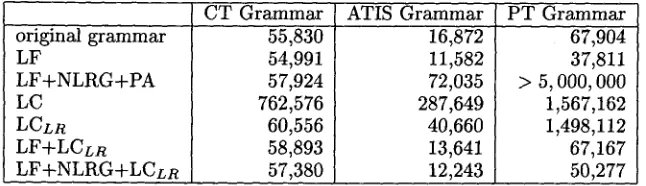
Let LC refer to Johnson's version of the LC trans- form restricted to retained nonterminals. In Table 4 the first three lines repeat the previously shown sizes for our three original g r a m m a r s , their left-factored form, and their non-left-recursive form using our best variant of Panll's algorithm ( L F + N L R G + P A ) . T h e fourth line shows the results of applying LC to the three original g r a m m a r s . Note t h a t this pro- duces a non-left-recursive form of the P T gram- m a r smaller t h a n the cut-off size, but the non-left- recursive forms of the C T and ATIS g r a m m a r s are
[image:5.612.157.480.94.187.2]considerably larger than the most compact versions created with Paull's algorithm.
We can improve on this result by noting that, since we are interested in the LC transform only as a means of eliminating left-recursion, we can greatly reduce the size of the transformed grammars by ap- plying the transform only to left-recursive nonter- minals. More precisely, we can retain in the trans- formed grammar all the productions expanding non- left-recursive nonterminals of the original grammar, and for the purposes of the LC transform, we can treat nomleft-recursive nonterminals as if they were terminals:
1. If a terminal symbol or non-left-recursive non- terminal X is a proper left corner of a re- tained left-recursive nonterminal A in the orig- inal grammar, add A -+ X A - X to the trans- formed grammar.
2. If B is a left-recursive proper left corner of a retained left-recursive nonterminal A and B --~ X/~ is a production of the original grammar, add
A - X -~ ~ A - B to the transformed grammar. 3. If X is a proper left corner of a retained left-
recursive nonterminal A and A --~ X/~ is a pro- duction of the original grammar, add A - X --~
to the transformed grammar.
4. If A is a non-left-recursive nonterminal and A -~ /3 is a production of the original grammar, add A -~/~ to the transformed grammar.
Let LCLR refer to the LC transform restricted by these modifications so as to apply only to left- recursive nonterminals. The fifth line of Table 4 shows the results of applying LCLR to the three orig- inal grammars. LCLR greatly reduces the size of the non-left-recursive forms of the CT and ATIS gram- mars, but the size of the non-left-recursive form of the P T grammar is only slightly reduced. This is not surprising if we note from Table 1 that almost all the productions of the P T grammar are produc- tions for left-recursive nonterminals. However, we can apply the additional transformations that we used with Paull's algorithm, to reduce the num- ber of productions for left-recursive nonterminals before applying our modified LC transform. The effects of left factoring the grammar before apply- ing LCLR (LF+LCLR), and additionally combining non-left-recursive productions for left-recursive non- terminals between left factoring and applying LCLR
(LF+NLRG+LCLR), are shown in the sixth and seventh lines of Table 4.
With all optimizations applied, the non-left- recursive forms of the ATIS and P T grammars are smaller than the originals (although not smaller than the left-factored forms of these grammars), and the non-left-recursive form of the CT gram- mar is only slightly larger than the original. In all
cases, LF+NLRG+LCLR produces more compact grammars than L F + N L R G + P A , the best variant of Paull's algorithm--slightly more compact in the case of the CT grammar, more compact by a factor of 5.9 in the case of the ATIS grammar, and more compact by at least two orders of magnitude in the case of the P T grammar.
6 C o n c l u s i o n s
We have shown that, in its textbook form, the standard algorithm for eliminating left recur- sion from CFGs is impractical for three diverse, independently-motivated, natural-language gram- mars. We apply a number of optimizations to the algorithm--most notably a novel strategy for order- ing the nonterminals of the g r a m m a r - - b u t one of the three grammars remains essentially intractable. We then explore an alternative approach based on the LC grammar transform. With several optimiza- tions of this approach, we are able to obtain quite compact non-left-recursive forms of all three gram- mars. Given the diverse nature of these grammars, we conclude that our techniques based on the LC transform are likely to be applicable to a wide range of CFGs used for natural-language processing.
R e f e r e n c e s
A. V. Aho, R. Sethi, and J. D. Ullman. 1986.
Compilers: Principles, Techniques, and Tools.
Addison-Wesley Publishing Company, Reading, Massachusetts.
D. A. Da.hl et al. 1994. Expanding the scope of the ATIS task: the ATIS-3 corpus. In Proceedings o/ the Spoken Language Technology Workshop, pages 3-8, Plainsboro, New Jersey. Advanced Research Projects Agency.
S. A. Greibach. 1965. A new normal-form theorem for context-free phrase structure grammars. Jour- nal of the Association for Computing Machinery,
12(1):42-52, January.
J. E. Hopcroft and J. D. Ullman. 1979. Introduc- tion to Automata Theory, Languages, and Com- putation. Addison-Wesley Publishing Company, Reading, Massachusetts.
M. Johnson. 1998. Finite-state approximation of constraint-based grammars using left-corner grammar transforms. In Proceedings, COLING- ACL '98, pages 619-623, Montreal, Quebec, Canada. Association for Computational Linguis- tics.
M. P. Marcus, B. Santorini, and M. A. Marcinkiewicz. 1993. Building a large anno- tated corpus of English: The Penn Treebank.
Computational Linguistics, 19(2):313-330, June. R. Moore, J. Dowding, H. Bratt, J. M. Gawron,
A spoken-language interface for battlefield simu- lations. In Proceedings of the Fifth Conference on Applied Natural Language Processing, pages 1-7, Washington, DC. Association for Computational Linguistics.