G e n e r a t i n g
T e x t w i t h a T h e o r e m
P r o v e r
Ivfin I.
G a r i b a y School of C o m p u t e r Science U n i v e r s i t y o f C e n t r a l F l o r i d aO r l a n d o , F L i g a r i b a y @ c s . u c f . e d u
A b s t r a c t
The process of documenting designs is tedious and often error-prone. We discuss a system that au- tomatically generates documentation for the single step transition behavior of Statecharts with particu- lar focus on the correctness of the result in the sense that the document will present all and only the facts corresponding to the design being documented.
Our approach is to translate the Statechart into a propositional formula, then translate this formula into a natural language report. In the later transla- tion pragmatic effects arise due to the way the in- formation is presented. Whereas such effects can be difficult to quantify, we account for them within an abstract framework by applying a series of transfor- mations on the structure on the report while pre- serving soundness and completeness of the logical content. The result is an automatically generated hypertext report that is both logically correct and, to a relatively high degree of confidence, free of mis- leading implicatures.
1 I n t r o d u c t i o n
Producing technical documentation is a time- consuming and expensive task. For instance, Re- iter et al. (1995), report cases of engineers expend- ing five hours on documentation for each hour spent on design and of airplane documentation sets which weigh more than the actual airplane being docu- mented. Part of the reason for this problem is the gap between Computer Aided Design (CAD) tools and similar tools for assisting the documentation of those designs. Since research efforts focus primarily in the former, this situation is likely to get worse as the CAD tools get more powerful while documenta- tion tools lag far behind.
In this paper we address the matter of automatic generation of technical documentation (Reiter et al., 1992; Reiter et al., 1995; RSsner and Stede, 1992; Svenberg, 1994; Punshon et al., 1997) by studying the problem of automatically generating documents describing the single step transition behavior of Stat- echarts.
From a natural language generation (NLG) per-
Statechart
Content Planning Question tree + Tree transformations
Text Planning i Hypermxt ~s implicit text planner (user)[
~ Theoreml
, _?_T;_ J
I.oa!izatioo Tomp,ato I
Hyper-t exit DocumentFigure 1: Conceptual view Of the system.
spective, this problem is distinguished in that the formal correctness of the document being generated is crucial while felicitousness of the style is rela-
tively unimportant. This leads us to a solution
based on formally verifiable theorem-proving tech- niques which allows us to approach strategic NLG is- sues within a highly abstract and conceptually clear framework.
The system takes a statechart in the form of a labeled directed graph and translates it into a set of propositional formulae defining its transition be- havior. A hyper-text natural language document is generated on-demand from this set of formulae in response to the reader's interaction with the appli- cation.
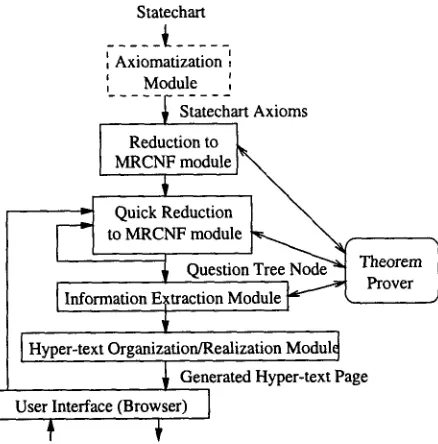
Figure 1 depicts a comparative (Moore and Paris, 1993; Paris et al., 1991; Hovy, 1988) conceptual view of the system while Fig. 2 shows the system archi- tecture. A prototype has been fully implemented with the exception of the statechart axiomatization module, x
2 A L o g i c a l S e m a n t i c s
for
S t a t e c h a r t s
The graphical language of statecharts as proposed by David Harel (Harel et al., 1987; Harel and Naa- mad, 1996), has been widely recognized as a impor- tant tool for analyzing complex reactive systems. It has been implemented in commercial applica- tions like STATEMATE (Harel and Politi, 1998)
1A full description of this algorithmic t r a n s l a t i o n of a stat- echart from its graphical f o r m a l i s m to t h e propositional logic i n p u t f o r m a t used in this work is d e s c r i b e d in G a r i b a y (2000).
[image:1.612.330.537.222.306.2]Statechart
. . . t . . . ~ Axlomatlzatlon ) ' I . . . I Module '
[ Statechart Axioms
Reduction to ~
I
MRCNF module I N , • ~I - I to CN,
module
I Question Tree ,ode ~
[Information
Eitraction Module
~'~ k.Hyper-text Organization/Realization Modul~
Generated Hyper-text Page
User Interface (Browser)
]Theorem ] Prover
Figure 2: System architecture of the theorem prover
based generator. T h e dotted box is not imple-
mented.
"rv
IMAGE
WOR HNG { PIC OFF
SOUND
o J V h m N (
Figure 3: Example Statechart.
and R H A P S O D Y from ilogix (I-Logix Inc., 2000) and has been adopted as a part of the Unified Mod- eling Language (UML Revision Task Force, 1999; Booch, 1999), an endeavor to standardize a language of blueprints for software.
Statecharts (Fig. 3) are an extension of conven- tional finite state machines in which the states may
have a hierarchical structure. A configuration is de-
fined as a maximal set of non-conflicting states which
are active at a given time. A transition connects
states and is labeled with the set of events that trig- ger it, and a second set of events t h a t are generated
when the transition is taken. A step of the statechart
relates the current configuration and the events t h a t are active to the next configuration and the events t h a t are generated. A configuration and the set of
events t h a t are active is referred to as a status.
We capture a step of a statechart as a pair of propositional models, one for the current status and
( ( T V ~ W O R K I N G v W A I T I N G )
( T V . n e x t ~ W O R K I N G . n e x t V W A I T I N G , n e x t )
( W O R K I N G --~ ~ W A I T I N G ) ( W O R K I N G . n e x t --~ ~ W A I T I N G . n e x t ) ( W A I T I N G --~ ~ W O R K I N G ) ( W A I T I N G . n e x t --+ ~ W O R K I N G . n e x t )
( W O R K I N G ~ I M A G E A S O U N D )
( W O R K I N G . n e x t ~ I M A G E . n e x t A S O U N D . n e x t )
• .. )
( ( T V ) A
( ( W O R K I N G A P I C T U R E A P I C - O F F A W A I T I N G . n e x t ) V ( W O R K I N G ^ ~ ( P I C T U R E A P I C - O F F ) A
( ( I M A G E A P I C T U R E A P I C - O F F A W A I T I N G . n e x t ) V ( I M A G E A ~ ( P I C T U R E A P I C - O F F ) A
( ( P I C T U R E A P I C - O F F A W A I T I N G . n e x t ) V ( P I C T U R E A T X T A M U T E . n e x t A T E X T . n e x t ) V ( P I C T U R E A ~ O F F A 9 T X T A P I C T U R E . n e x t ) )
• .. )))
Figure 4: Section of the propositional logic transla- tion of the example statechart (Fig. 3).
one for the next status. In practice, we incorpo- rate this into a single model with two versions of each propositional variable: P for the t r u t h value in
the current status and Pn for the t r u t h value in the
next status 2. A full description of the algorithm for translating statecharts to sets of formulae can be found in Garibay (2000). For a example of this translation see Fig. 4.
3
T h e M i n i m u m C l a u s a l T h e o r y of
t h e S t a t e c h a r t s
At this point, we have a formula t h a t entails the the- ory of the single step transition behavior of a Stat- echart. We can fulfill our requirement of generat- ing a sound and complete report just by translating this formula into English. However, this approach presents a number of problems. For instance, the AND and O R connectives do not in general have the same meaning in English as they do in logic (Gazdar, 1979), furthermore, unlike in the logical formula the scope of the connectives in English is not, in gen- eral, well defined (Holt and Klein, 1999). To mini- mize the ambiguity, we need to take the formula to a form with minimal nesting of operators.
Potentially a more significant problem is the fact t h a t much of the t h e o r y (the formula plus all its logi- cal consequences) is obtainable only via complicated inferences. Since the reader understands the trans- lation of the formula at an intuitive level, making only limited inferences, a direct translation will fail to communicate the entire theory. Hence, we would like to take the formula to a form t h a t is closed, in some sense, under logical consequences.
We address b o t h issues by using what we refer to
as minimal (fully) resolved conjunctive normal form
(MRCNF). A formula is in a M R C N F if and only if
[image:2.612.350.575.78.221.2] [image:2.612.113.332.80.302.2] [image:2.612.111.329.368.481.2]it is in conjunctive normal form (CNF) and is closed under resolution, absorption and tautology (Fitting, 1990; Rogers and Vijay-Shanker, 1994). T h e clo- sure under resolution is effectively a finite approx- imation of closure under consequence, that is, ev- ery clause that is a logical consequence of the the- ory entailed by the formula is a direct consequence of some clause in the MRCNF. T h e other two op- erations guarantee minimality in size by removing clauses t h a t are trivially true (tautology), and those that are proper super-sets of another (absorption). Hence, the translation will communicate not only the initial facts but also those inferred by resolution. Moreover, a formula in this form is just a conjunc- tion of disjunctions--eliminating the scoping prob- lem. If we interpret the disjunctions as implications, the translation into English will be just a sequence of implicative sentences that are to be interpreted conjunctively--a typical structure for such informa- tion in English.
4 O r g a n i z i n g t h e H y p e r - t e x t
R e p o r t : T h e Q u e s t i o n T r e e
A formula in M R C N F is organized in a way that resembles a sequence of implicative sentences. The problem now is the size of this sequence. Large to begin with, its size is increased by the transforma- tion to CNF and closure under resolution. Hence, the translation of M R C N F directly into a sequence of statements would present an uninterpretable se- quence of facts. If they are going to be understood by the reader there is a need for some kind of struc- ture. T h e correct organization depends heavily on the reader's goals and expectations. However, be- yond the assumption t h a t the reader's generic goal is to obtain information about the transition behav- ior of the statechart under consideration, we do not make any assumptions about what the particular reader's goals may be. Instead we present the report as a hyper-text document and allow the reader to in- teractively refine their goal by following hyper-links. Effectively, the reader's queries focus the theory of the statechart in a particular aspect of its behavior 3. In this way, as in Reiter et al. (1992) and Levine et al. (1991), we use hyper-text as an implicit text planner, in the sense that we account for every pos- sible model of the user/system interaction and let the actual reader decide which goal to pursue.
We will call the reader's selections
choices.
Eachchoice the reader makes narrows the information we have to convey, limiting it to all and only the part that is logically consistent with that choice. We will
say that the reader
refines
the theory by makingthe choice. At each point, the choices available to the reader are all the propositional variables that
3In a p r o c e s s t h a t will be precisely d e s c r i b e d shortly.
the theory is contingent upon. The reader effec- tively fixes the valuation of one of these variables to true or false. T h e system then adds the reader's choice to the t h e o r y and recalculates the MRCNF. If the newly obtained theory remains contingent upon some variables, the reader then will have available a new set of choices. If not, the reader will have
reached a set of
non-contingent facts
(henceforthfacts)
which are consequences of all the previous choices.While this process makes the information more accessible by giving it a logical structure, it does nothing to reduce the size of the report. We resolve this by generating the document on demand. While the refinement process (the core computation for on- demand generation) can potentially be very expen- sive in terms of time, the fact t h a t we are adding sin- gleton clauses to an already minimum set of clausal consequences allows us to use a simplified form of the theorem prover with asymptotic time complex- ity linear in the number of clauses.
We can visualize the process of the reader mak-
ing choices as navigating a
question tree,
in whicheach branch is labeled with a choice and each node contains the theory of the Statechart as refined by the path of choices from the root to that node. In this tree, a reader's choice is equivalent to the ques- tion: " W h a t are the circumstances/situations if X is true/false?." T h e root is the full theory of the transition behavior of the Statechart. T h e children of a node are obtained by fixing the valuation of each of its contingent propositional variables in turn and recomputing the MRCNF. The leaves are non- contingent theories (those containing only facts) a
Conceptually, the labels of each path from the root to a leaf together with each one of the facts in that leaf corresponds to all and only the valuations which are models of the original theory. Therefore, the question tree is sound and complete in the logical sense.
5 G e n e r a t i n g t h e H y p e r - t e x t P a g e
u n d e r P r a g m a t i c C o n s i d e r a t i o n s :
I n f o r m a t i o n E x t r a c t i o n M o d u l e
This tree turns out to provide a useful framework to address pragmatic issues--those that arise princi- pally from the structure of the report itself (Gazdar, 1979). By addressing these issues in the context of the question tree, rather than in its realization as a report, we abstract away from a great deal of sub- tle semantic detail that would otherwise obscure the analysis. Our approach consists of applying a se- ries of transformations that resolve these issues while
4In general t h i s s t r u c t u r e is a d i r e c t e d acyclic g r a p h w h i c h R e i t e r et al. call t h e question space ( R e i t e r et al., 1995), b u t since we work w i t h a tree t h a t s p a n s it, we prefer question tree.
preserving logical soundness and completeness of the document.
5.1 P r o m o t i n g f a c t s
In the question tree, the facts are either reported at the end of a chain of choices or are encoded in the choices themselves. A sequence of these choices is analogous to a chain of nested implications in which the antecedents are the choices made by the user and the consequence is the theory as refined by the choices. This refinement continues until we obtain a non-contingent t h e o r y - - o n e in which all variables
have valuations. Thus, the chain of implications
eventually leads to a set of facts as its final con- sequence. T h e pragmatic problem in this case re- lates to the amount of information to be provided
(Grice's Maxim of Quantity (Grice, 1975)). This
maxim states t h a t speakers will make their contri- bution as informative as is required, but not more informative than t h a t (Gazdar, 1979). Under this assumption, reporting a fact as a consequence of a sequence of choices explicitly denies that this fact is a consequence of any prefix of t h a t sequence, in con- trast to the logical semantics of implication. Such implicatures, while not consequences of the logical content, are valid inferences t h a t people make on the basis of well established expectations about the communicative act.
To avoid this false implicature, we present the facts to the reader as soon as they become available, that is, as soon as they become non-contingent in the theory. T h e transformation, in this case, moves the facts from the leaves to the interior nodes. This transformation does not change the set of models represented in the tree simply because the move- ment of facts does not eliminate any path of the tree. Hence, the transformation preserves soundness and completeness of the tree.
In practice, the facts are just the singleton clauses of a theory, therefore we can realize this transforma- tion by simply reporting singleton clauses as soon as they appear in the theory.
5.2 R e p o r t i n g f a c t s o n l y o n c e
On the other hand, facts in a theory are also facts in every consistent refinement of t h a t theory. Hence, reporting all the facts at each node of the question tree leads us to report many of them repeatedly. In effect, every fact reported in a node will be reported in each of its children as well. This repetition of facts violates the "upper-bound" of Q u a n t i t y - - i t reports more than is relevant. In this case Quantity requires us to report only information t h a t is "new".
In general, what is new will depend not only on what is reported but on inferences the reader is likely to have made (McDonald, 1992). We have, however, already committed to being explicit; our assumption is t h a t the reader makes essentially no inferences,
that they know all and only what we have explicitly reported. Therefore, we can satisfy the upper bound of Quantity by reporting each fact exactly once on each b r a n c h - - w h e n it first becomes non-contingent. To do this, we simply keep a list of all facts t h a t have been reported in the current branch; this is the extent of our model of the user.
This transformation does not change the set of models represented in the tree, since it only elimi- nates repeated literals.
5.3 P r o m o t i n g s i n g l e l e v e l i m p l i c a t i o n s
One of the difficulties in using Quantity is to deter- mine what information is "required". At each node of the question tree we have a current theory to re- port. T h e issue, in essence, is what to report at t h a t node and what to report at its descendents. On one hand, it seems clear t h a t we are, at least, required to report the non-contingent facts at each node. On the other hand, we don't want to report the whole theory at the root.
Our intuition is t h a t the degree to which facts are relevant is inversely proportional to the diffi-
culty of interpreting them. Under these circum-
stances, un-nested implications (i.e., binary disjunc- tions) are simple enough t h a t the reader is likely to expect them to be reported. From the perspective of the question tree, this suggest, t h a t in addition to the facts at a node, we should also report, as im- plications, the facts at its non-contingent children (those t h a t are leaves). We refer to the choices lead-
ing to non-contingent theories as conclusive choices.
These are reported as single-level implications ("If X then (some sequence of facts~"). This has the effect of promoting the leaves of the tree to their parent pages.
Note t h a t a choice t h a t is conclusive at some page will also be conclusive at each page in the subtree rooted at t h a t page (or, rather, at each page reached by a sequence of choices consistent with t h a t choice). In keeping with the principle of reporting a fact ex- actly once along each path, we must avoid reporting the implication at the descendent pages. To this end, after reporting each of the conclusive choices on a page, we report the remainder of the tree be- low t h a t page under an "Otherwise" choice in which the theory has been refined with the complements of the conclusive choices. This has the effect of dra- matically restructuring the tree: each of the non- contingent leaves is promoted to the highest page at which the choice t h a t selects it becomes conclusive. Once again this transformation reorganizes the branches of the question tree without changing the set of models it represents.
~ f a r :
* ( t h e c u r r e n t c o n f i g u r a t i o n d o e s n o t i n c l u d e t h e s t a t e WORKING) * ( t h e e v e n t OFF i s n o t a c t i v e ) .
F a c t s :
* t h e n e x t c o n f i g u r a t i o n w i l l n o t i n c l u d e t h e s t a t e ~URKING. I n d e p e n d e n t o f f w h e t h e r :
* the e v e n t PIC-OFF i s a c t i v e , D e p e n d s o n w h e t h e r :
* t h e c u r r e n t c o n f i g u r a t i o n i n c l u d e s t h e s t a t e s SON a n d SOP. t h e e v e n t MUTE Is active.
C h o i c e s :
e I f t h e c u r r e n t c o n f i g u r a t i o n i n c l u d e s t h e s t a t e SUN [ t h e n . . . ]
* If the current c o n f i g u r a t i o n duel not include the state SON ~ teen... ] * If the current c o n f i g u r a t i o n includes the state SOP [ then... ]
* I f t h e c u r r e n t c o n f i g u r a t i o n d o e s n o t i n c l u d e t h e s t a t e SOP [ t h e n . . . ] * If the e v e n t MUTE iS active [ then.,. ]
* I f t h e e v e n t MUTE i s n o t a c t i v e [ t h e n . . . ]
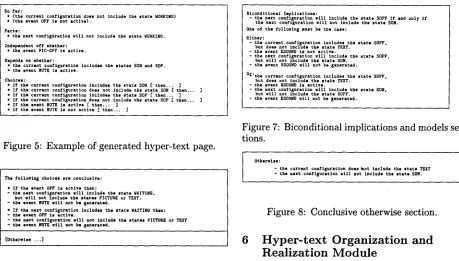
Figure 5: Example of generated hyper-text page.
The f o l l o w i n g c h o i c e s a r e c o n c l u s i v e : * I f t h e e v e n t OFF i s a c t i v e t h e n :
- t h e n e x t c o n f i g u r a t i o n wlll i n c l u d e t h e s t a t e WAITING, b u t e l l l n o t i n c l u d e ¢hm s t a t e s PICTURE o r TEXT. - t h e e v e n t h'UTE r i l l n o t b e g e n e r a t e d .
* I f t h e n e x t c o n f i g u r a t i o n t n c l u d e l t h e s t a t e WAITING t h e n :
t h e e v e n t OFF lw a c t i v e .
- t h e n e x t c o n f i g u r a t i o n s i l l n o t i n c l u d e t h e s t a t e s PICTURE o r TEXT - t h e e v e n t NUTE w i l l n o t b e g e n e r a t e d .
[ O t h e r w i s e . . . ]
Figure 6: Conclusive choices section (up), non-
conclusive otherwise section (bottom).
conclusive choice. To find the remainder of the tree to be reported under the "Otherwise" case we ex- tend the current theory with the negation of each of the conclusive choices. If the resulting theory is in- consistent we will say t h a t the conclusive choices are
exhaustive, if the result is a contingent theory we will
say that the conclusive choices are non-exhaustive
with non-conclusive otherwise, and if the result is
a non-contingent theory we will say t h a t the con-
clusive choices, in this case, are non-exhaustive with
conclusive otherwise.
5.4 A g g r e g a t i n g p a i r s o f s i n g l e c o n d i t i o n a l s
It frequently happens that, at some page, two con- clusive choices lead to the same model. In this case, we would report t h a t each implies (among other things) the other. However, these two implications can be aggregated to form a biconditional. Further- more, Quantity requires us to select the strongest connective that applies in any such case because if a weaker connective is selected it suggests that no
stronger one applies (a scalar implicature). Con-
sequently, we are actually compelled to aggregate these two facts into a single biconditional.
In practice, we use the theorem prover to either prove or disprove, for every implication, whether its converse is a theorem of the current theory. If proved then the biconditional is reported.
B i c o n d i t i o n a l I | p l i c a t i o n s :
- t h e n e x t c o n f i g u r a t i o n r i l l i n c l u d e t h e s t a t e $OFF i f a n d o n l y i f t h e n e x t c o n f i g u r a t i o n w i l l n o t i n c l u d e t h e s t a t e SON. One o f ~he f o l l o w i n g m u s t b e t h e c a s e :
Either:
- t h e c u r r e n t c o n f i g u r a t i o n i n c l u d e s t h e , t a t s SOFF, b u t d o e s n o t i n c l u d e t h e s t a t e TEXT.
- t h e e v e n t ESOUNU t ~ n o t a c t i v e .
- t h e n e x t c o n f i g u r a t i o n r i l l i n c l u d e t h e s ~ a t e SOFF, b u t w i l l n o t i n c l u d e t h e s t a t e SON.
- the event ESOUND will not be generated.
O~:the current c o n f i g u r a t i o n Includel the state SUFF,
h u t d o e s n o t i n c l u d e t h e s t a t e TEXT. - t h e e v e n t ESOUND i s a c t i v e .
- t h e n e x t c o n f i g u r a t i o n wlll i n c l u d e t h e s t a t e SON,
but wlll not include the state SDFF. - the event ESOOND .Iii not be generated.
Figure 7: Biconditional implications and models sec- tions.
O t h e r W i s e :
- t h e c u r r e n t c o n f i g u r a t i o n d o e s ~ o t i n c l u d e t h e i r a t e TEXT - t h e n e x t c o n f i g u r a t i o n w i l l n o t i n c l u d e t h e s t a t e SON.
Figure 8: Conclusive otherwise section.
6 H y p e r - t e x t O r g a n i z a t i o n a n d
R e a l i z a t i o n M o d u l e
T h e organization of the h y p e r - t e x t page generated from each node of the question tree visited by the user is shown in Fig. 5. At the top of the page we report (parenthetically) the set of choices that have led to this page. Next we report all of the new facts obtained from the current theory as described in sec- tions 5.1 and 5.2. Then, the propositions that the theory is no longer dependent on (those which no longer occur in the theory ) followed by the list of propositions on which it does depend. Finally we present the choices or, if there are any, the conclu- sive choices. In the first (Fig. 5), each choice is pre- sented as an implicative sentence with a hyper-text link leading to another page (another node of the question tree). In the second (Fig. 6 top), we present the set of conclusive choices followed by one of the three possible cases (described in Section 5.3) for the "Otherwise" case. If the conclusive choices are exhaustive (the otherwise case is inconsistent), we report the biconditional implications (Section 5.4) followed by the final models (Fig 7). If they are ex- haustive with a conclusive otherwise, we report the otherwise as another conclusive choice (Fig 8). Fi- nally, if they are exhaustive with a non-conclusive otherwise, we report only an otherwise hyper-link (Fig 6 bottom).
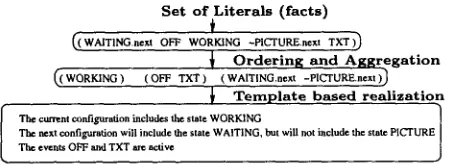
The realization module is, in essence, a pattern matching and template filling process. It's basic component simply translates facts into fixed English language sentences. 5 Facts are represented by lit- erals. These are classified into the following cate-
gories: current state, current event, next state, and
next event and the literais in each category are syn-
5With added html mark-up.
[image:5.612.76.535.77.338.2]S e t o f L i t e r a l s ( f a c t s ) t
((WAITING.next OFF WORKING -PICTURE,next TXT)]
O r d e r i n g a n d A g g r e g a t i o n
((WORKING) (~)FF TXT) (WAITING.next -PICTUga.ne~,))
T e m p l a t e b a s e d r e a l i z a t i o n
The cur~n! configuration includes ti~ state WORKING
The next configuration will include the state WAITING, but will not include tbu state PICTURE
J
The cv©nts OFF and TXT an: active
Figure 9: Example of realization.
tactically aggregated (Dalianis, 1999). The process is illustrated in Figure 9.
R e f e r e n c e s
Grady Booch. 1999. UML in action. Communica-
tions of the ACM, 42(10).
Hercules Dalianis. 1999. Aggregation in natural language generation. Computational Intelligence,
15(4):384-414.
Melvin Fitting. 1990. First-order Logic and Au-
tomated Theorem Proving. Springer-Verlag, New
York.
Iv£n Ibargiien Garibay. 2000. Automatic genera- tion of natural language documentation from stat- echarts. Master's thesis, University of Central Florida.
Gerald Gazdar. 1979. Pragmatics: Implicature,
Presupposition, and Logical Form. Academic
Press.
H. Paul Grice. 1975. Logic and conversation. In Peter Cole and Jerry L. Morgan, editors, Syntax
and Semantics: Speech Acts, volume 3, pages 41-
58. Academic Press.
David Harel and Amnon Naamad. 1996. The STATEMATE semantics of statecharts. A C M
Transactions on Software Engineering and
Methodology, 5(4):293-333, Oct.
David Harel and Machal Politi. 1998. Modeling Reactive Systems with Statecharts: The STATE-
MATE Approach. McGraw-Hill. QA 76.9 .$88
H3677 1998.
D. Harel, A. Pnueli, J. P. Schmidt, and R. Sherman. 1987. On the formal semantics of statecharts. In
Symposium on Logic in Computer Science, pages
54-64. Computer Society of the IEEE, Computer Society Press, June.
Alexander Holt and Ewan Klein. 1999. A semantically-derived subset of english for hard- ware verification. In Proceedings of the 37th An- nual Meeting of the Association for Computa- tional Linguistics.
Eduard H. Hovy. 1988. Generating Natural Lan-
guage under Pragmatic Constraints. Lawrence
Erlbaum Associates.
I-Logix Inc. 2000. http://www.ilogix.com.
John Levine, Alison Cawsey, Chris Mellish,
Lawrence Poynter, Ehud Reiter, Paul Tyson, and John Walker. 1991. IDAS: Combining hypertext and natural language generation. In Third Euro- pean Workshop on Natural Language Generation,
pages 55-62, Innsbruck, Austria.
David D. McDonald. 1992. Type-driven suppres- sion of redundancy in the generation of inference- rich reports. In R. Dale, E. Hovy, D. RSsner, and O. Stock, editors, Aspects of Automated Nat-
ural Language Generation, volume 587 of Lec-
ture Notes in Artificial Intelligence, pages 73-88.
Springer-Velag.
Johanna D. Moore and C6cile L. Paris. 1993. Plan- ning text for advisory dialogues: Capturing inten- tional and rhetorical information. Computational
Linguistics, 19(4):651-694.
C~cile L. Paris, William R. Swartout, and William C. Mann, editors. 1991. Natural Lan- guage Generation in Artificial Intelligence and
Computational Linguistics. Kluwer Academic
Publishers.
J. M. Punshon, J. P. Tremblay, P. G. Sorenson, and P. S. Findeisen. 1997. From formal specifications to natural language: A case of study. In 12th IEEE International Conference Automated Soft-
ware Engineering, pages 309-310, Incline Village,
Nevada; USA, November. IEEE Computer Soci- ety.
Ehud Reiter, Chris Mellish, and John Levine. 1992. Automatic generation of on-line documentation in the IDAS project. In Third Conference on Ap- plied Natural Language Processing (ANLP-1992),
pages 64-71, Trento, Italy.
Ehud Reiter, Chris Mellish, and John Levine. 1995. Automatic generation of technical documentation.
Applied Artificial Intelligence, 9(3):259-287.
James Rogers and K. Vijay-Shanker. 1994. Obtain- ing trees from their descriptions: An application to tree-adjoining grammars. Computational Intel-
ligence, 10:401-421.
D. RSsner and M. Stede. 1992. Customizing rst for the automatic production of technical man- uals. In R. Dale et al., editors, Aspects of Auto-
mated Natural Language Generation, number 587
in Lecture Notes in Artificial Intelligence, pages 199-214, Berlin. Springer Verlag.
S. Svenberg. 1994. Representing conceptual and lin- guistic knowledge for multi-lingual generation in a technical domain. In Proceedings of the 7th In- ternational Workshop on Natural Language Gen-
eration, pages 245-248, Kennebunkport.
UML Revision Task Force, 1999. OMG Unified Mod- eling Language Specification , v. 1.3. Document
[image:6.612.109.334.80.163.2]