M e s s a g e C l a s s i f i c a t i o n i n t h e C a l l C e n t e r
Stephan Busemann, Seen Schmeier~ R o m a n G. Arens
DFKI GmbH
Stuhlsatzenhausweg 3, D-66123 Saarbriicken, Germany
e-mail: {busemann, schmeier, arens}@dfki.de
Abstract
C u s t o m e r care in technical domains is increasingly based on e-mail communication, allowing for the re- production of approved solutions. Identifying the customer's problem is often time-consuming, as the problem space changes if new p r o d u c t s are launched. This p a p e r describes a new approach to the classifi- cation of e-mail requests based on shallow text pro- cessing and machine learning techniques. It is im- plemented within an assistance s y s t e m for call center agents t h a t is used in a commercial setting.
1
I n t r o d u c t i o n
Customer care in technical domains is increasingly based on e-mail communication, allowing for the re- production of approved solutions. For a call cen- ter agent, identifying the c u s t o m e r ' s p r o b l e m is of- ten time-consuming, as the p r o b l e m space changes if new products are launched or existing regulations are modified. T h e typical t a s k of a call center agent processing e-mail requests consists of the following steps:
R e c o g n i z e t h e p r o b l e m ( s ) : read and understand the e-mail request;
S e a r c h a s o l u t i o n : identify and select predefined text blocks;
P r o v i d e t h e s o l u t i o n : if necessary, customize text blocks to m e e t the current request, and send the text.
This task can p a r t l y be a u t o m a t e d by a system suggesting relevant solutions for an incoming e-mail. This would cover the first two steps. T h e last step can be delicate, as its p r i m a r y goal is to keep the customer satisfied. Thus h u m a n intervention seems m a n d a t o r y to allow for individual, customized an- swers. Such a system will
• reduce the training effort required since agents d o n ' t have to know every possible solution for every possible problem;
• increase the agents' p e r f o r m a n c e since agents can more quickly select a solution a m o n g several offered t h a n searching one;
• improve the quality of responses since agents will behave m o r e homogeneously - b o t h as a group and over time - and c o m m i t fewer errors.
Given t h a t free t e x t a b o u t a r b i t r a r y topics m u s t be processed, in-depth approaches to language un- derstanding are not feasible. Given further t h a t the topics m a y change over time, a top-down a p p r o a c h to knowledge modeling is out of the question. R a t h e r a combination of shallow text processing ( S T P ) with statistics-based machine learning techniques (SML) is called for. S T P gathers partial information a b o u t text such as p a r t of speech, word stems, negations, or sentence type. These types of information can be used to identify the linguistic properties of a large training set of categorized e-mails. SML techniques are used to build a classifier t h a t is used for new, incoming messages. Obviously, the change of topics can be a c c o m m o d a t e d by adding new categories and e-mails and producing a new classifier on the basis of old and new data. We call this replacement of a classifier "relearning".
This p a p e r describes a new approach to the clas- sification of e-mail requests along these lines. It is i m p l e m e n t e d within the I C e - M A I L system, which is an assistance s y s t e m for call center agents t h a t is currently used in a commercial setting. Section 2 describes i m p o r t a n t properties of the input data, i.e. the e-mail texts on the one hand, and the categories on the other. These properties influenced the s y s t e m architecture, which is presented in Section 3. Vari- ous publicly available SML systems have been tested with different m e t h o d s of S T P - b a s e d preprocessing. Section 4 describes the results. T h e i m p l e m e n t a t i o n and usage of the s y s t e m including the graphical user interface is presented in Section 5. We conclude by giving an outlook to further expected i m p r o v e m e n t s
(Section 6).
2
D a t a C h a r a c t e r i s t i c s
A closer look at the d a t a the I C e - M A I L s y s t e m is processing will clarify the task further. We carried out experiments with unmodified e-mail d a t a accu- m u l a t e d over a period of three months in the call center database. T h e total a m o u n t was 4777 e-mails.
We used 47 categories, which contained at least 30 documents. This m i n i m u m a m o u n t of documents turned out to render the category sufficiently dis- tinguishable for the SML tools. T h e d a t a b a s e con- tained 74 categories with at least 10 documents, but the selected ones covered 94% of all e-malls, i.e. 4490 documents.
It has not yet generally been investigated how the t y p e of d a t a influences the learning result (Yang, 1999), or under which circumstances which kind of preprocessing and which learning algorithm is most appropriate. Several aspects must be considered: Length of the documents, morphological and syn- tactic well-formedness, the degree to which a docu- ment can be uniquely classified, and, of course, the language of the documents.
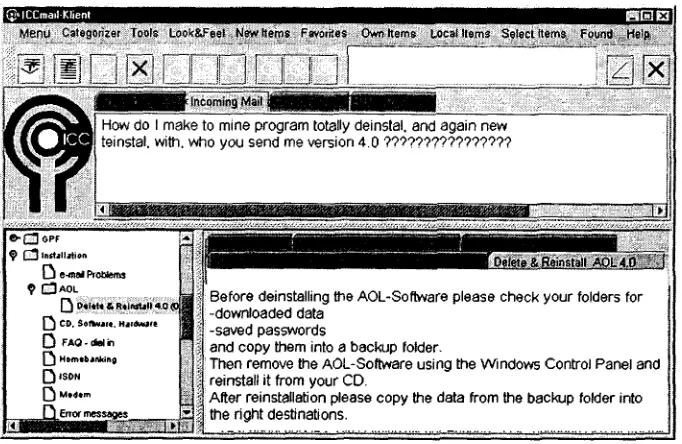
In our application domain the documents differ very much from documents generally used in bench- m a r k tests, for example the Reuters corpus 1. First of all, we have to deal with G e r m a n , whereas the Reuters d a t a are in English. T h e average length of our e-mails is 60 words, whereas for documents of Reuters-21578 it is 129 words. T h e n u m b e r of cat- egories we used compares to the t o p 47 categories of the Reuters T O P I C S category set. While we have 5008 documents, T O P I C S consists of 13321 in- stances 2. The Reuters documents usually are mor- phologically and syntactically well-formed. As e- mails are a more spontaneously created and infor- mal type of document, they require us to cope with a large a m o u n t of jargon, misspellings and gram- matical inaccuracy. A drastic example is shown in Figure 2. The bad conformance to linguistic stan- dards was a m a j o r argument in favor of S T P instead of in-depth syntactic and semantic analysis.
T h e degree to which a d o c u m e n t can be uniquely classified is h a r d to verify and can only be inferred from the results in general terms. 3 It is, however, dependent on the ability to uniquely distinguish the classes. In our application we encounter overlapping and non-exhaustive categories as the category sys- t e m develops over time.
3 Integrating Language Technology
W i t h M a c h i n e
Learning
S T P and SML correspond to two different
paradigms. S T P tools used for classification tasks promise very high recall/precision or accuracy val- ues. Usually h u m a n experts define one or several t e m p l a t e structures to be filled automatically by ex- tracting information from the documents (cf. e.g. (Ciravegna et al., 1999)). Afterwards, the partially
lhttp ://~wv. research, a~t. com/'le~is/reuters21578.
html
2We took only uniquely classified documents into a c c o u n t .
3Documents containing multiple requests can at present only be treated manually, as described in Section 5.
filled templates are classified by h a n d - m a d e rules. T h e whole process brings a b o u t high costs in analyz- ing and modeling the application domain, especially if it is to take into account the problem of changing categories in the present application.
SML promises low costs b o t h in analyzing and modeling the application at the expense of a lower accuracy. It is independent of the domain on the one hand, but does not consider any domain specific knowledge on the other.
By combining b o t h methodologies in I C e - M A I L , we achieve high accuracy and can still preserve a use- ful degree of domain-independence. S T P m a y use b o t h general linguistic knowledge and linguistic al- gorithms or heuristics a d a p t e d to the application in order to e x t r a c t information from texts t h a t is rele- vant for classification. T h e input to the SML tool is enriched with t h a t information. The tool builds one or several categorizers 4 t h a t will classify new texts.
In general, SML tools work with a vector represen- tation of data. First, a relevancy vector of relevant features for each class is c o m p u t e d (Yang and Ped- ersen, 1997). In our case the relevant features con- sist of the user-defined o u t p u t of the linguistic pre- processor. T h e n each single document is translated into a vector of numbers isomorphic to the defining vector. Each entry represents the occurrence of the corresponding feature. More details will be given in Section 4
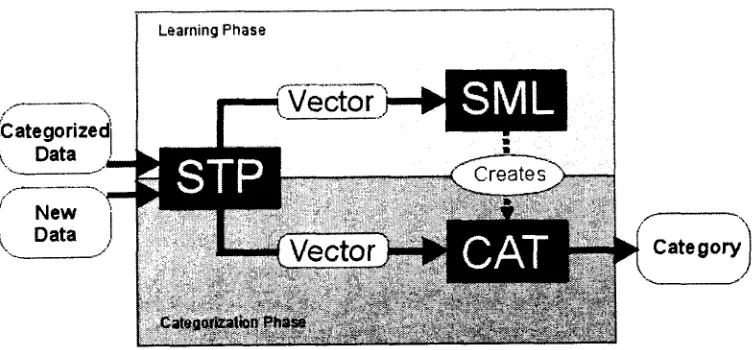
T h e I C e - M A I L architecture is shown in Figure 1. T h e workflow of the system consists of a learning step carried out off-line (the light gray box) and an online categorization step (the dark gray box). In the off-line part, categorizers are built by processing classified d a t a first by an S T P and then by an SML tool. In this way, categorizers can be replaced by the system a d m i n i s t r a t o r as she wants to include new or remove expired categories. T h e categorizers are used on-line in order to classify new documents after they have passed the linguistic preprocessing. T h e resulting category is in our application associated with a s t a n d a r d text t h a t the call center agent uses in her answer. T h e on-line step provides new clas- sified d a t a t h a t is stored in a dedicated ICe-MAIL database (not shown in Figure 1). T h e relearning step is based on d a t a from this database.
3.1 S h a l l o w T e x t Processing
Linguistic preprocessing of text documents is car- ried out by re-using sines, an information extrac- tion core system for real-world G e r m a n text pro- cessing ( N e u m a n n et al., 1997). T h e fundamental design criterion of sines is to provide a set of basic, powerful, robust, and efficient S T P components and
C a t e
gorY)
J
Figure 1: Architecture of the ICC-MAIL System.
generic linguistic knowledge sources t h a t can eas- ily be customized to deal with different tasks in a flexible manner, sines includes a t e x t tokenizer, a lexical processor and a chunk parser. T h e chunk parser itself is subdivided into three components. In the first step, phrasal fragments like general nominal expressions and verb groups are recognized. Next, the dependency-based structure of the fragments of each sentence is computed using a set of specific sen- tence patterns. Third, the grammatical functions are determined for each dependency-based structure on the basis of a large subcategorization lexicon. T h e present application benefits from the high mod- ularity of the usage of the components. Thus, it is possible to run only a subset of the components and to tailor their output. The experiments described in Section 4 make use of this feature.
3.2 Statistics-Based Machine Learning
Several SML tools representing different learning paradigms have been selected and evaluated in dif- ferent settings of our domain:
Lazy Learning: Lazy Learners are also known as memory-based, instance-based, exemplar- based, case-based, experience-based, or k- nearest neighbor algorithms. T h e y store all documents as vectors during the learning phase. In the categorization phase, the new document vector is compared to the stored ones and is categorized to same class as the k-nearest neigh- bors. The distance is measured by computing e.g. the Euclidean distance between the vectors. By changing the number of neighbors k or the kind of distance measure, the amount of gener- alization can be controlled.
We used IB (Aha, 1992), which is part of the M L C + + library (Kohavi and Sommerfield, 1996).
Symbolic Eager Learning: This type of learners constructs a representation for document vec- tors belonging to a certain class during the learning phase, e.g. decision trees, decision rules or probability weightings. During the catego- rization phase, the representation is used to as- sign the appropriate class to a new document vector. Several pruning or specialization heuris- tics can be used to control the amount of gen- eralization.
We used ID3 (Quinlan, 1986), C4.5 (Quinlan, 1992) and C5.0, R I P P E R (Cohen, 1995), and the Naive Bayes inducer (Good, 1965) con- tained in the MLCq-q- library. ID3, C4.5 and C5.0 produce decision trees, R I P P E R i s a rule- based learner and the Naive Bayes algorithm computes conditional probabilities of the classes from the instances.
Support Vector Machines ( S V M s ) : SVMs are described in (Vapnik, 1995). SVMs are binary learners in t h a t they distinguish positive and negative examples for each class. Like eager learners, they construct a representation dur- ing the learning phase, namely a hyper plane supported by vectors of positive and negative examples. For each class, a categorizer is built by computing such a hyper plane. During the categorization phase, each categorizer is applied to the new document vector, yielding the prob- abilities of the document belonging to a class. The probability increases with the distance of thevector from the hyper plane. A document is said to belong to the class with the highest probability.
We chose SVM_Light (Joachims, 1998).
N e u r a l N e t w o r k s : Neural Networks are a special kind of "non-symbolic" eager learning algo-
[image:3.612.133.511.74.249.2]rithm. T h e neural network links the vector el- ements to the document categories The learn- ing phase defines thresholds for the activation of neurons. In the categorization phase, a new document vector leads to the activation of a sin- gle category. For details we refer to (Wiener et al., 1995).
In our application, we tried out the Learning Vector Quantization (LVQ) (Kohonen et al., 1996). LVQ has been used in its default config- uration only. No a d a p t a t i o n to the application domain has been made.
4 E x p e r i m e n t s a n d R e s u l t s
We describe the experiments and results we achieved with different linguistic preprocessing and learning algorithms and provide some interpretations.
We start out from the corpus of categorized e- mails described in Section 2. In order to normalize the vectors representing the preprocessing results of texts of different length, and to concentrate on rel- evant material (cf. (Yang and Pedersen, 1997)), we define the relevancy vector as follows. First, all doc- uments are preprocessed, yielding a list of results for each category. From each of these lists, the 100 most frequent results - according to a T F / I D F mea- sure - are selected. T h e relevancy vector consists of all selected results, where doubles are eliminated. Its length was a b o u t 2500 for the 47 categories; it slightly varied with the kind of preprocessing used.
During the learning phase, each document is pre- processed. The result is m a p p e d onto a vector of the same length as the relevancy vector. For ev- ery position in the relevancy vector, it is determined whether the corresponding result has been found. In t h a t case, the value of the result vector element is 1, otherwise it is 0.
In the categorization phase, the new document is preprocessed, and a result vector is built as described above and handed over to the categorizer (cf. Fig- ure 1).
While we tried various kinds of linguistic prepro- cessing, systematic experiments have been carried out with morphological analysis (MorphAna), shal- low parsing heuristics (STP-Heuristics), and a com- bination of b o t h (Combined).
M o r p h A n a : Morphological Analysis provided by sines yields the word stems of nouns, verbs and adjectives, as well as the full forms of unknown words. We are using a lexicon of approx. 100000 word stems of G e r m a n ( N e u m a n n et al., 1997).
S T P - H e u r i s t i c s : Shallow parsing techniques are used to heuristically identify sentences contain- ing relevant information. T h e e-mails usually contain questions a n d / o r descriptions of prob- lems. T h e manual analysis of a sample of
the d a t a suggested some linguistic constructions frequently used to express the problem. We ex- pected t h a t content words in these construc- tions should be particularly influential to the categorization. Words in these constructions are extracted and processed as in MorphAna,
and all other words are ignored. 5 T h e heuris- tics were implemented in I C C - M A I L using sines. T h e constructions of interest include negations at the sentence and the phrasal level, yes-no and wh-questions, and declaratives immediately preceding questions. Negations were found to describe a state to be changed or to refer to missing objects, as in I cannot read my email
or There is no correct date. We identified t h e m t h r o u g h negation particles. 8 Questions most of- ten refer to the problem in hand, either directly, e.g. How can I start my email program. ~ or in- directly, e.g. Why is this the case?. The lat- ter most likely refers to the preceding sentence, e.g. M y system drops my e-mails. Questions are identified by their word order, i.e. yes-no ques- tions s t a r t with a verb and wh-questions with a wh-particle.
C o m b i n e d : In order to emphasize words found relevant by the S T P heuristics without losing other information retrieved by MorphAna, the previous two techniques are combined. E m p h a - sis is represented here by doubling the number of occurrences of the tokens in the normaliza- tion phase, thus increasing their T F / I D F value.
Call center agents judge the performance of I C C -
M A I L most easily in terms of accuracy: In what per-
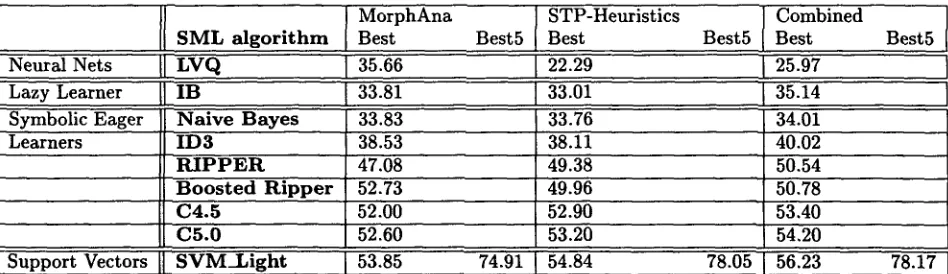
centage of cases does the classifier suggest the correct text block? In Table 1, detailed information about the accuracy achieved is presented. All experiments were carried out using 10-fold cross-validation on the d a t a described in Section 2.
In all experiments the SVM_Light system outper- formed other learning algorithms, which confirms Yang's (Yang and Liu, 1999) results for SVMs fed with Reuters data. T h e k-nearest neighbor algo- r i t h m IB performed surprisingly badly although dif- ferent values o f k were used. For IB, ID3, C4.5, C5.0, Naive Bayes, R I P P E R and SVM_Light, linguis- tic preprocessing increased the overall performance. In fact, the m e t h o d performing best, SVM_Light, gained 3.5% by including the task-oriented heuris- tics. However, the boosted R I P P E R and LVQ scored a decreased accuracy value there. For LVQ the de- crease m a y be due to the fact t h a t no a d a p t a t i o n s to
5If no r e s u l t s were f o u n d t h i s way, MorphAna was applied i n s t e a d .
Neural Nets Lazy Learner Symbolic Eager Learners
Support Vectors []
S M L a l g o r i t h m
L V Q
IB
N a i v e B a y e s I D 3
R I P P E R
B o o s t e d R i p p e r C4.5
C 5 . 0 S V M _ L i g h t
MorphAna
Best Best5
35.66 33.81 33.83 38.53 47.08 52.73 52.00 52.60
53.85 74.91
STP-Heuristics
Best Best5
22.29 33.01 33.76 38.11 49.38 49.96 52.90 53.20
54.84 78.05
Combined
Best Best5
25.97 35.14 34.01 40.02 50.54 50.78 53.40 54.20
56.23 78.17
Table 1: Results of Experiments. Most SML tools deliver the best result only. SVM_Light produces ranked results, allowing to measure the accuracy of the top five alternatives (Best5).
the domain were made, such as adapting the number of codebook vectors, the initial learning parameters or the number of iterations during training (cf. (Ko- honen et al., 1996)). Neural networks are rather sen- sitive to misconfigurations. T h e boosting for RIP- P E R seems to run into problems of overfitting. We noted t h a t in six trials the accuracy could be im- proved in
Combined
compared toMorphAna,
b u t in four trials, boosting led to deterioration. This effect is also mentioned in (Quinlan, 1996).These figures are slightly lower t h a n the ones re- ported by (Neumann and Schmeier, 1999) that were obtained from a different d a t a set. Moreover, these data did not contain multiple queries in one e-mall. It would be desirable to provide explanations for the behavior of the SML algorithms on our data. As we have emphasized in Section 2, general methods of explanation do not exist yet. In the application in hand, we found it difficult to account for the ef- fects of e.g. ungrammatical text or redundant cate- gories. For the time being, we can only offer some speculative and inconclusive assumptions: Some of the tools performing badly - IB, ID3, and the Naive Bayes inducer of the M L C + + library - have no or little pruning ability. W i t h rarely occurring data, this leads to very low generalization rates, which again is a problem of overfitting. This suggests t h a t a more canonical representation for the many ways of expressing a technical problem should be sought for. Would more extensive linguistic preprocessing help?
Other tests not reported in Table 1 looked at im- provements through more general and sophisticated S T P such as chunk parsing. T h e results were very discouraging, leading to a significant decrease com- pared to
MorphAna.
We explain this with the bad compliance of e-mall texts to grammatical standards (cf. the example in Figure 2).However, the practical usefulness of chunk parsing or even deeper language understanding such as se-
mantic analysis may be questioned in general: In a moving domain, the coverage of linguistic knowledge will always be incomplete, as it would be too expen- sive for a call center to have language technology experts keep pace with the occurrence of new t o ~ ics. Thus the preprocessing results will often differ for e-mails expressing the same problem and hence not be useful for SML.
As a result of the tests in our application domain, we identified a favorite statistical tool and found t h a t task-specific linguistic preprocessing is encouraging, while general S T P is not.
5 I m p l e m e n t a t i o n a n d U s e
In this section we describe the integration of the ICC-MAIL system into the workflow of the call cen- ter of AOL Bertelsmann Online GmbH & Co. KG, which answers requests about the G e r m a n version of AOL software. A client/server solution was built t h a t allows the call center agents to connect as clients to the ICe-MAIL server, which implements the system described in Section 3. For this purpose, it was necessary to
• connect the server module to AOL's own Sybase database t h a t delivers the incoming mail and dispatches the outgoing answers, and to I c e - MAIL'S own database t h a t stores the classified e-mall texts;
• design the GUI of the client module in a self- explanatory and easy to use way (cf. Figure 2).
The agent reads in an e-mall and starts ICe-MAIL using GUI buttons. She verifies the correctness of the suggested answer, displaying and perhaps se- lecting alternative solutions. If the agent finds the appropriate answer within these proposals, the asso- ciated text is filled in at the correct position of the answer e-mall. If, on the other hand, no proposed solution is found to be adequate, the ICe-MAIL tool can still be used to manually select any text block
[image:5.612.97.571.73.210.2]0" ~ GPF ~) ~ In~allatice,
~AOL.
[~CD, $o'el~alt, Ha~du~te
~ ) FAO - (fmlln
r~ i$ON [~ Me4em
Before deinstalling the AOL-Soltware please check your folders for -downloaded data
-saved passwords
and copy them into a backup folder.
Then remove the AOL-Software using the Windows Control Panel and reinstall it from your CD.
Alter reinstallation please copy the data from the b a c ~ p folder into the dght destinations.
Figure 2: T h e G U I of the I C e - M A I L Client. All labels and texts were translated by the authors. T h e English input is based on the following original text, which is similarly awkward though understandable: Wie mache ich zurn mein Programm total deinstalieren, und wieder neu instalierem, mit, wen Sic m i r senden Version 4.0 ??????????????. The suggested answer text is associated with the category n a m e d "Delete & Reinstall AOL 4.0". Four alternative answers can be selected using the tabs. T h e left-hand side window displays the active category in context.
from the database. T h e I C e - M A I L client had to pro- vide the functionality of the tool already in use since an additional tool was not acceptable to the agents, who are working under time pressure.
In the answer e-mail window, the original e-mail is automatically added as a quote. If an e-mail con- tains several questions, the classification process can be r e p e a t e d by marking each question a n d iteratively applying the process to the marked part. T h e agent can edit the suggested texts before sending t h e m off. In each case, the classified text together with the se- lected category is stored in the I C e - M A I L d a t a b a s e for use in future learning steps.
O t h e r features of the I C e - M A I L client module in- clude a spell checker and a history view. T h e latter displays not only the previous e-mails of the same author but also the solutions t h a t have been pro- posed and the elapsed time before an answer was sent.
T h e assumed average time for an agent to an- swer an e-mail is a bit more t h a n two minutes with AOL's own mail processing system. ~ W i t h the I C C -
MAIL system the complete cycle of fetching the mail,
checking the proposed solutions, choosing the ap- propriate solutions, inserting additional text frag- ments and sending the answer back can p r o b a b l y be achieved in half the time. Systematic tests sup-
~This system does not include a u t o m a t i c analysis of mails.
porting this claim are not completed yet, s but the following preliminary results are encouraging:
• A test under real-time conditions at the call- center envisaged the use of the I C e - M A I L sys- t e m as a mail tool only, i.e. without taking ad- vantage of the s y s t e m ' s intelligence. It showed t h a t the surface and the look-and-feel is ac- cepted and the functionality corresponds to the real-time needs of the call center agents, as users were slightly faster t h a n within their usual en- vironment.
• A preliminary test of the throughput achieved by using the S T P and SML technology in I c e - MAIL showed t h a t experienced users take about 50-70 seconds on average for one cycle, as de- scribed above. This figure was gained through experiments with three users over a duration of a b o u t one hour each.
Using the system with a constant set of categories will improve its accuracy after repeating the off-line learning step. If a new category is introduced, the accuracy will slightly decline until 30 documents are manually classified and the category is automatically included into a new classifier. Relearning m a y take place at regular intervals. The definition of new cat- egories must be fed into ICe-MAIL b y a "knowledge
[image:6.612.152.493.80.302.2]engineer", who maintains the system. The effects of new categories and new d a t a have not been tested yet.
The optimum performance of ICe-MAIL can be achieved only with a well-maintained category sys- tem. For a call center, this may be a difficult task to achieve, espescially under severe time pressure, but it will pay off. In particular, all new categories should be added, o u t d a t e d ones should be removed, and redundant ones merged. Agents should only use these categories and no others. The organizational structure of the team should reflect this by defin- ing the tasks of the "knowledge engineer" and her interactions with the agents.
6 C o n c l u s i o n s a n d F u t u r e W o r k
We have presented new combinations of S T P and SML methods to classify unrestricted e-mail text ac- cording to a changing set of categories. The current accuracy of the ICC-MAIL system is 78% (correct so- lution among the top five proposals), corresponding
t o an overall performance of 73% since ICC-MAIL
processes only 94% of the incoming e-mails. T h e accuracy improves with usage, since each relearning step will yield better classifiers. The accuracy is ex- pected to approximate t h a t of the agents, but not improve on it. W i t h ICe-MAIL, the performance of an experienced agent can approximately be doubled. The system is currently undergoing extensive tests at the call center of AOL Bertelsmann Online. De- tails about the development of the performance de- pending on the t h r o u g h p u t and change of categories are expected to be available by mid 2000.
Technically, we expect improvements from the fol- lowing areas of future work.
• Further task-specific heuristics aiming at gen- eral structural linguistic properties should be defined. This includes heuristics for the identi- fication of multiple requests in a single e-mail that could be based on key words and key phrases as well as on the analysis of the doc- ument structure.
• Our initial experiments with the integration of GermaNet (Hamp and Feldweg, 1997), the evolving German version of WordNet, seem to confirm the positive results described for Word- Net (de Buenaga Rodriguez et al., 1997) and will thus be extended.
• A reorganization of the existing three-level cate- gory system into a semantically consistent tree structure would allow us to explore the non- terminal nodes of the tree for multi-layered SML. This places additional requirements on the knowledge engineering task and thus needs to be thoroughly investigated for pay-off.
• Where system-generated answers are acceptable to customers, a straightforward extension of ICe-MAIL can provide this functionality. For the application in hand, this was not the case.
The potential of the technology presented extends beyond call center applications. We intend to ex- plore its use within an information broking assis- tant in document classification. In a further indus- trial project with German Telekom, the ICC-MAIL technology will be extended to process multi-lingual press releases. T h e nature of these documents will allow us to explore the application of more sophis- ticated language technologies during linguistic pre- processing.
A c k n o w l e d g m e n t s
We are grateful to our colleagues Giinter Neumann, Matthias Fischmann, Volker Morbach, and Matthias Rinck for fruitful discussions and for support with sines modules. This work was partially supported by a grant of the Minister of Economy and Commerce of the Saarland, Germany, to the project ICC.
R e f e r e n c e s
David W. Aha. 1992. Tolerating noisy, irrelevant and novel attributes in instance based learning al- gorithms. International Journal of Man-Machine Studies, 36(1), pages 267-287.
Fabio Ciravegna, Alberto Lavelli, Nadia Mana, Jo- hannes Matiasek, Luca Gilardoni, Silvia Mazza, Massimo Ferraro, William J.Black, Fabio RJ- naldi, and David Mowatt. 1999. Facile: Classi- fying texts integrating p a t t e r n matching and in- formation extraction. In Proceedings of IJCAI'99, Stockholm, pages 890-895.
William W. Cohen. 1995. Fast effective rule induc- tion. In Proceedings of the Twelfth International Conference on Machine Learning, Lake Tahoe, California.
Manuel de Buenaga Rodriguez, Jose Maria Gomez- Hidalgo, and Belen Diaz-Agudo. 1997. Using WordNet to complement training information in text categorization. In Proceedings of the Second International Conference on Recent Advances in Natural Language Processing, Montreal, Canada.
I.J. Good. 1965. The Estimation of Probabilities. An Essay on Modern Bayesian Methods. MIT- Press.
Birgit Hamp and Helmut Feldweg. 1997. GermaNet - a lexical-semantic net for German. In Proceed- ings of A CL workshop Automatic Information Ex- traction and Building of Lexical Semantic Re- sources for NLP Applications, Madrid, Spain
T h o r s t e n Joachims. 1998. Text categorization with support vector machines - learning with meany relevant features. In Proceedings of the Euro-
pean Conference on Machine Learning (ECML), Chemnitz, Germany, pages 137-142.
Ronny Kohavi and Dan Sommerfield, 1996.
MLC++ Machine Learning library in C++.
http://www.sgi.com/Technology/mlc.
Teuvo Kohonen, Jussi Hynninen, Jari Kangas, Jorma Laaksonen, and Kari Torkkola. 1996. LVQ-PAK the learning vector quantization pro- gram package. Technical Report A30, Helsinki University of Technology.
G/inter Neumann, Rolf Backofen, Judith Baur, Markus Becket, and Christian Braun. 1997. An information extraction core system for real world German text processing. In Proceedings of 5th ANLP, Washington, pages 209-216.
G/inter Neumann and Sven Schmeier. 1999. Com- bining shallow text processing and macine learn- ing in real world applications. In Proceedings of IJCAI workshop on Machine Learning for Infor- mation Filtering, Stockholm, pages 55-60.
J.R. Quinlan. 1986. Induction of Decision Trees.
Reprinted in Shavlik, Jude W. and Dietterich, Thomas G, Readings in machine learning. Ma- chine learning series. Morgan Kaufmann (1990) J.R. Quinlan. 1992. C4.5: Programs for Machine
Learning. Morgan Kaufmann, San Mateo, Cali- fornia.
J.R. Quinlan. 1996. Bagging, Boosting and C4.5. In
Proceedings of AAAI'96, Portland, pages 725-730. Vladimir N. Vapnik. 1995. The Nature of Statistical
Learning Theory. Springer.
E.D. Wiener, J. Pedersen, and A.S. Weigend. 1995. A neural network approach to topic spotting. In
Proceedings of the SDAIR.
Y. Yang and Xin Liu. 1999. A re-examination of text categorization methods. In Proceedings of A CMSIGIR Conference on Research and Devel- opment in Information Retrieval, Berkley, Calfor- nia.
Y. Yang and J.P. Pedersen. 1997. A comparative study on feature selection. In Proceedings of the Fourteenth International Conference on Machine Learning (ICML '97).