Automatically Generating Wikipedia Articles:
A Structure-Aware Approach
Christina Sauper and Regina Barzilay
Computer Science and Artificial Intelligence Laboratory Massachusetts Institute of Technology
{csauper,regina}@csail.mit.edu
Abstract
In this paper, we investigate an ap-proach for creating a comprehensive tex-tual overview of a subject composed of in-formation drawn from the Internet. We use the high-level structure of human-authored texts to automatically induce a domain-specific template for the topic structure of a new overview. The algorithmic innova-tion of our work is a method to learn topic-specific extractors for content selection jointly for the entire template. We aug-ment the standard perceptron algorithm with a global integer linear programming formulation to optimize both local fit of information into each topic and global co-herence across the entire overview. The results of our evaluation confirm the bene-fits of incorporating structural information into the content selection process.
1 Introduction
In this paper, we consider the task of automatically creating a multi-paragraph overview article that provides a comprehensive summary of a subject of interest. Examples of such overviews include ac-tor biographies from IMDB and disease synopses from Wikipedia. Producing these texts by hand is a labor-intensive task, especially when relevant in-formation is scattered throughout a wide range of Internet sources. Our goal is to automate this pro-cess. We aim to create an overview of a subject – e.g., 3-M Syndrome– by intelligently combining relevant excerpts from across the Internet.
As a starting point, we can employ meth-ods developed for multi-document summarization. However, our task poses additional technical chal-lenges with respect to content planning. Gen-erating a well-rounded overview article requires proactive strategies to gather relevant material,
such as searching the Internet. Moreover, the chal-lenge of maintaining output readability is mag-nified when creating a longer document that dis-cusses multiple topics.
In our approach, we explore how the high-level structure of human-authored documents can be used to produce well-formed comprehensive overview articles. We select relevant material for an article using a domain-specific automatically generated content template. For example, a tem-plate for articles about diseases might contain di-agnosis, causes, symptoms, and treatment. Our system induces these templates by analyzing pat-terns in the structure of human-authored docu-ments in the domain of interest. Then, it produces a new article by selecting content from the Internet for each part of this template. An example of our system’s output1is shown in Figure 1.
The algorithmic innovation of our work is a method for learning topic-specific extractors for content selection jointly across the entire template. Learning a single topic-specific extractor can be easily achieved in a standard classification frame-work. However, the choices for different topics in a template are mutually dependent; for exam-ple, in a multi-topic article, there is potential for redundancy across topics. Simultaneously learn-ing content selection for all topics enables us to explicitly model these inter-topic connections.
We formulate this task as astructured classifica-tion problem. We estimate the parameters of our model using the perceptron algorithm augmented with an integer linear programming (ILP) formu-lation, run over a training set of example articles in the given domain.
The key features of this structure-aware ap-proach are twofold:
1This system output was added to Wikipedia athttp://
en.wikipedia.org/wiki/3-M syndrome on June 26, 2008. The page’s history provides examples of changes performed by human editors to articles created by our system.
Diagnosis . . . No laboratories offering molecular genetic testing for prenatal diagnosis of 3-M syndrome are listed in the GeneTests Laboratory Directory. However, prenatal testing may be available for families in which the disease-causing mutations have been identified in an affected family member in a research or clinical laboratory.
Causes Three M syndrome is thought to be inherited as an autosomal recessive genetic trait. Human traits, including the classic genetic diseases, are the product of the interaction of two genes, one received from the father and one from the mother. In recessive disorders, the condition does not occur unless an individual inherits the same defective gene for the same trait from each parent. . . .
Symptoms . . . Many of the symptoms and physical features associated with the disorder are apparent at birth (congenital). In some cases, individuals who carry a single copy of the disease gene (heterozygotes) may exhibit mild symptoms associated with Three M syndrome.
Treatment . . . Genetic counseling will be of benefit for affected individuals and their families. Family members of affected indi-viduals should also receive regular clinical evaluations to detect any symptoms and physical characteristics that may be potentially associated with Three M syndrome or heterozygosity for the disorder. Other treatment for Three M syndrome is symptomatic and supportive.
Figure 1: A fragment from the automatically created article for 3-M Syndrome.
• Automatic template creation: Templates are automatically induced from human-authored documents. This ensures that the overview article will have the breadth ex-pected in a comprehensive summary, with content drawn from a wide variety of Inter-net sources.
• Joint parameter estimation for content se-lection: Parameters are learned jointly for all topics in the template. This procedure op-timizes both local relevance of information for each topic and global coherence across the entire article.
We evaluate our approach by creating articles in two domains: Actors and Diseases. For a data set, we use Wikipedia, which contains articles simi-lar to those we wish to produce in terms of length and breadth. An advantage of this data set is that Wikipedia articles explicitly delineate topical sec-tions, facilitating structural analysis. The results of our evaluation confirm the benefits of structure-aware content selection over approaches that do not explicitly model topical structure.
2 Related Work
Concept-to-text generation and text-to-text gener-ation take very different approaches to content se-lection. In traditional concept-to-text generation, a content planner provides a detailed template for what information should be included in the output and how this information should be organized (Re-iter and Dale, 2000). In text-to-text generation, such templates for information organization are not available; sentences are selected based on their salience properties (Mani and Maybury, 1999). While this strategy is robust and portable across
domains, output summaries often suffer from co-herence and coverage problems.
In between these two approaches is work on domain-specific text-to-text generation. Instances of these tasks are biography generation in sum-marization and answering definition requests in question-answering. In contrast to a generic sum-marizer, these applications aim to characterize the types of information that are essential in a given domain. This characterization varies greatly in granularity. For instance, some approaches coarsely discriminate between biographical and non-biographical information (Zhou et al., 2004; Biadsy et al., 2008), while others go beyond binary distinction by identifying atomic events – e.g., oc-cupation and marital status – that are typically in-cluded in a biography (Weischedel et al., 2004; Filatova and Prager, 2005; Filatova et al., 2006). Commonly, such templates are specified manually and are hard-coded for a particular domain (Fujii and Ishikawa, 2004; Weischedel et al., 2004).
Our work is related to these approaches; how-ever, content selection in our work is driven by domain-specific automatically induced templates. As our experiments demonstrate, patterns ob-served in domain-specific training data provide sufficient constraints for topic organization, which is crucial for a comprehensive text.
3 Method
The goal of our system is to produce a compre-hensive overview article given a title – e.g., Can-cer. We assume that relevant information on the subject is available on the Internet but scattered among several pages interspersed with noise.
We are provided with a training corpus consist-ing ofndocumentsd1. . . dnin the same domain
– e.g.,Diseases. Each documentdihas a title and
a set of delineated sections2si1. . . sim. The
num-ber of sectionsmvaries between documents. Each sectionsij also has a corresponding headinghij –
e.g.,Treatment.
Our overview article creation process consists of three parts. First, a preprocessing step creates a template and searches for a number of candidate excerpts from the Internet. Next, parameters must be trained for the content selection algorithm us-ing our trainus-ing data set. Finally, a complete ar-ticle may be created by combining a selection of candidate excerpts.
1. Preprocessing (Section 3.1) Our prepro-cessing step leverages previous work in topic segmentation and query reformulation to pre-pare a template and a set of candidate ex-cerpts for content selection. Template gen-eration must occur once per domain, whereas search occurs every time an article is gener-ated in both learning and application.
(a) Template Induction To create a con-tent template, we cluster all section headings hi1. . . him for all documents
di. Each cluster is labeled with the most
common heading hij within the
clus-ter. The largestkclusters are selected to become topicst1. . . tk, which form the
domain-specific content template. (b) Search For each document that we
wish to create, we retrieve from the In-ternet a set of r excerptsej1. . . ejr for
each topictj from the template. We
de-fine appropriate search queries using the requested document title and topicstj.
2. Learning Content Selection (Section 3.2) For each topictj, we learn the corresponding
topic-specific parameterswjto determine the
2In data sets where such mark-up is not available, one can
employ topical segmentation algorithms as an additional pre-processing step.
quality of a given excerpt. Using the percep-tron framework augmented with an ILP for-mulation for global optimization, the system is trained to select the best excerpt for each document di and each topic tj. For
train-ing, we assume the best excerpt is the original human-authored textsij.
3. Application(Section 3.2) Given the title of a requested document, we select several ex-cerpts from the candidate vectors returned by the search procedure (1b) to create a com-prehensive overview article. We perform the decoding procedure jointly using learned pa-rametersw1. . .wkand the same ILP
formu-lation for global optimization as in training. The result is a new document withkexcerpts, one for each topic.
3.1 Preprocessing
Template Induction A content template speci-fies the topical structure of documents in one do-main. For instance, the template for articles about actors consists of four topicst1. . . t4: biography,
early life, career, and personal life. Using this template to create the biography of a new actor will ensure that its information coverage is con-sistent with existing human-authored documents.
We aim to derive these templates by discovering common patterns in the organization of documents in a domain of interest. There has been a sizable amount of research on structure induction ranging from linear segmentation (Hearst, 1994) to content modeling (Barzilay and Lee, 2004). At the core of these methods is the assumption that fragments of text conveying similar information have simi-lar word distribution patterns. Therefore, often a simple segment clustering across domain texts can identify strong patterns in content structure (Barzi-lay and Elhadad, 2003). Clusters containing frag-ments from many docufrag-ments are indicative of top-ics that are essential for a comprehensive sum-mary. Given the simplicity and robustness of this approach, we utilize it for template induction.
We cluster all section headingshi1. . . himfrom
all documents di using a repeated bisectioning
We determine the average number of sections
kover all documents in our training set, then se-lect theklargest section clusters as topics. We or-der these topics ast1. . . tkusing a majority
order-ing algorithm (Cohen et al., 1998). This algorithm finds a total order among clusters that is consistent with a maximal number of pairwise relationships observed in our data set.
Each topictj is identified by the most frequent
heading found within the cluster – e.g., Causes. This set of topics forms the content template for a domain.
Search To retrieve relevant excerpts, we must define appropriate search queries for each topic
t1. . . tk. Query reformulation is an active area of
research (Agichtein et al., 2001). We have exper-imented with several of these methods for draw-ing search queries from representative words in the body text of each topic; however, we find that the best performance is provided by deriving queries from a conjunction of the document title and topic – e.g.,“3-M syndrome” diagnosis.
Using these queries, we search using Yahoo! and retrieve the first ten result pages for each topic. From each of these pages, we extract all possible excerpts consisting of chunks of text between stan-dardized boundary indicators (such as<p> tags). In our experiments, there are an average of 6 ex-cerpts taken from each page. For each topictj of
each document we wish to create, the total number of excerptsrfound on the Internet may differ. We label the excerptsej1. . . ejr.
3.2 Selection Model
Our selection model takes the content template
t1. . . tk and the candidate excerpts ej1. . . ejr for
each topic tj produced in the previous steps. It
then selects a series ofkexcerpts, one from each topic, to create a coherent summary.
One possible approach is to perform individ-ual selections from each set of excerptsej1. . . ejr
and then combine the results. This strategy is commonly used in multi-document summariza-tion (Barzilay et al., 1999; Goldstein et al., 2000; Radev et al., 2000), where the combination step eliminates the redundancy across selected ex-cerpts. However, separating the two steps may not be optimal for this task — the balance between coverage and redundancy is harder to achieve when a multi-paragraph summary is generated. In addition, a more discriminative selection strategy
is needed when candidate excerpts are drawn di-rectly from the web, as they may be contaminated with noise.
We propose a novel joint training algorithm that learns selection criteria for all the topics simulta-neously. This approach enables us to maximize both local fit and global coherence. We implement this algorithm using the perceptron framework, as it can be easily modified for structured prediction while preserving convergence guarantees (Daum´e III and Marcu, 2005; Snyder and Barzilay, 2007).
In this section, we first describe the structure and decoding procedure of our model. We then present an algorithm to jointly learn the parame-ters of all topic models.
3.2.1 Model Structure The model inputs are as follows:
• The title of the desired document
• t1. . . tk— topics from the content template • ej1. . . ejr — candidate excerpts for each
topictj
In addition, we define feature and parameter vectors:
• φ(ejl)— feature vector for thelth candidate
excerpt for topictj
• w1. . .wk— parameter vectors, one for each
of the topicst1. . . tk
Our model constructs a new article by following these two steps:
Ranking First, we attempt to rank candidate excerpts based on how representative they are of each individual topic. For each topictj, we induce
a ranking of the excerpts ej1. . . ejr by mapping
each excerptejlto a score:
scorej(ejl) =φ(ejl)·wj
Candidates for each topic are ranked from high-est to lowhigh-est score. After this procedure, the posi-tionlof excerpt ejl within the topic-specific
can-didate vector is the excerpt’s rank.
Optimizing the Global Objective To avoid re-dundancy between topics, we formulate an opti-mization problem using excerpt rankings to create the final article. Givenktopics, we would like to select one excerptejl for each topictj, such that
the rank is minimized; that is,scorej(ejl)is high.
commonly used in generation and summarization applications where the selection process is driven by multiple constraints (Marciniak and Strube, 2005; Clarke and Lapata, 2007).
We represent excerpts included in the output using a set of indicator variables, xjl. For each
excerpt ejl, the corresponding indicator variable
xjl = 1if the excerpt is included in the final
doc-ument, andxjl= 0otherwise.
Our objective is to minimize the ranks of the excerpts selected for the final document:
min
k
X
j=1
r
X
l=1
l·xjl
We augment this formulation with two types of constraints.
Exclusivity Constraints We want to ensure that exactly one indicatorxjlis nonzero for each topic
tj. These constraints are formulated as follows:
r
X
l=1
xjl = 1 ∀j∈ {1. . . k}
Redundancy Constraints We also want to
pre-vent redundancy across topics. We define
sim(ejl, ej0l0)as the cosine similarity between
ex-cerpts ejl from topic tj and ej0l0 from topic tj0.
We introduce constraints that ensure no pair of ex-cerpts has similarity above 0.5:
(xjl+xj0l0)·sim(ejl, ej0l0)≤1
∀j, j0 = 1. . . k ∀l, l0 = 1. . . r
If excerpts ejl and ej0l0 have cosine similarity
sim(ejl, ej0l0) > 0.5, only one excerpt may be
selected for the final document – i.e., either xjl
or xj0l0 may be 1, but not both. Conversely, if
sim(ejl, ej0l0) ≤ 0.5, both excerpts may be
se-lected.
Solving the ILP Solving an integer linear pro-gram is NP-hard (Cormen et al., 1992); however, in practice there exist several strategies for solving certain ILPs efficiently. In our study, we employed
lp solve,3an efficient mixed integer programming solver which implements the Branch-and-Bound algorithm. On a larger scale, there are several al-ternatives to approximate the ILP results, such as a dynamic programming approximation to the knap-sack problem (McDonald, 2007).
3http://lpsolve.sourceforge.net/5.5/
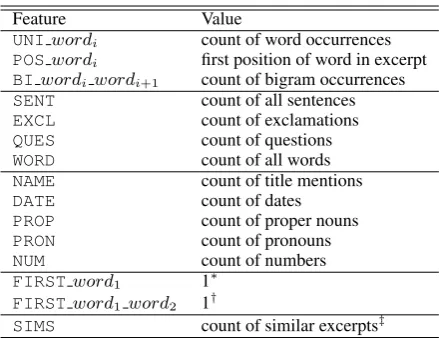
Feature Value
UNIwordi count of word occurrences
POSwordi first position of word in excerpt
BIwordiwordi+1 count of bigram occurrences
SENT count of all sentences
EXCL count of exclamations
QUES count of questions
WORD count of all words
NAME count of title mentions
DATE count of dates
PROP count of proper nouns
PRON count of pronouns
NUM count of numbers
FIRSTword1 1∗
FIRSTword1 word2 1†
[image:5.595.307.527.60.229.2]SIMS count of similar excerpts‡
Table 1: Features employed in the ranking model.
∗
Defined as the first unigram in the excerpt.
†
Defined as the first bigram in the excerpt.
‡
Defined as excerpts with cosine similarity>0.5
Features As shown in Table 1, most of the fea-tures we select in our model have been employed in previous work on summarization (Mani and Maybury, 1999). All features except the SIMS
feature are defined for individual excerpts in isola-tion. For each excerptejl, the value of theSIMS
feature is the count of excerpts ejl0 in the same
topictj for whichsim(ejl, ejl0) > 0.5. This
fea-ture quantifies the degree of repetition within a topic, often indicative of an excerpt’s accuracy and relevance.
3.2.2 Model Training
Generating Training Data For training, we are given n original documents d1. . . dn, a content
template consisting of topicst1. . . tk, and a set of
candidate excerptseij1. . . eijr for each document
di and topic tj. For each section of each
docu-ment, we add the gold excerpt sij to the
corre-sponding vector of candidate excerptseij1. . . eijr.
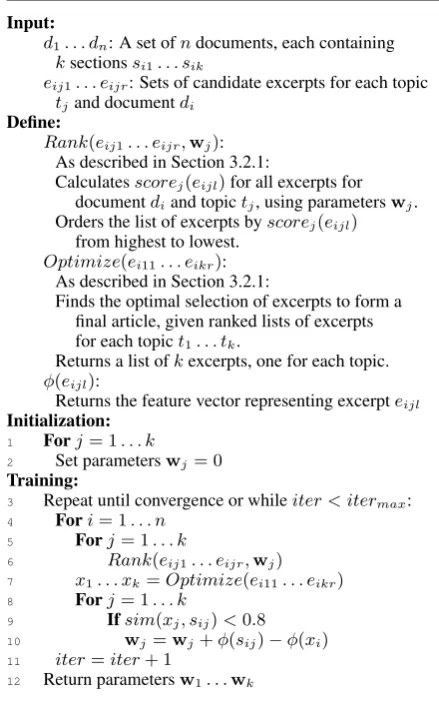
This excerpt represents the target for our training algorithm. Note that the algorithm does not re-quire annotated ranking data; only knowledge of this “optimal” excerpt is required. However, if the excerpts provided in the training data have low quality, noise is introduced into the system. Training Procedure Our algorithm is a modification of the perceptron ranking algo-rithm (Collins, 2002), which allows for joint learning across several ranking problems (Daum´e III and Marcu, 2005; Snyder and Barzilay, 2007). Pseudocode for this algorithm is provided in Figure 2.
ranks all excerpts from the candidate excerpt vector eij1. . . eijr for document di and topic
tj. Excerpts are ordered by scorej(ejl) using
the current parameter values. We also define
Optimize(eij1. . . eijr), which finds the optimal
selection of excerpts (one per topic) given ranked lists of excerptseij1. . . eijr for each documentdi
and topictj. These functions follow the ranking
and optimization procedures described in Section 3.2.1. The algorithm maintainsk parameter vec-torsw1. . .wk, one associated with each topic tj
desired in the final article. During initialization, all parameter vectors are set to zeros (line 2).
To learn the optimal parameters, this algorithm iterates over the training set until the parameters converge or a maximum number of iterations is reached (line 3). For each document in the train-ing set (line 4), the followtrain-ing steps occur: First, candidate excerpts for each topic are ranked (lines 5-6). Next, decoding through ILP optimization is performed over all ranked lists of candidate ex-cerpts, selecting one excerpt for each topic (line 7). Finally, the parameters are updated in a joint fashion. For each topic (line 8), if the selected excerpt is not similar enough to the gold excerpt (line 9), the parameters for that topic are updated using a standard perceptron update rule (line 10). When convergence is reached or the maximum it-eration count is exceeded, the learned parameter values are returned (line 12).
The use of ILP during each step of training sets this algorithm apart from previous work. In prior research, ILP was used as a postprocess-ing step to remove redundancy and make other global decisions about parameters (McDonald, 2007; Marciniak and Strube, 2005; Clarke and La-pata, 2007). However, in our training, we inter-twine the complete decoding procedure with the parameter updates. Our joint learning approach finds per-topic parameter values that are maxi-mally suited for the global decoding procedure for content selection.
4 Experimental Setup
We evaluate our method by observing the quality of automatically created articles in different do-mains. We compute the similarity of a large num-ber of articles produced by our system and sev-eral baselines to the original human-authored arti-cles using ROUGE, a standard metric for summary quality. In addition, we perform an analysis of
edi-Input:
d1. . . dn: A set ofndocuments, each containing
ksectionssi1. . . sik
eij1. . . eijr: Sets of candidate excerpts for each topic
tjand documentdi
Define:
Rank(eij1. . . eijr,wj): As described in Section 3.2.1:
Calculatesscorej(eijl)for all excerpts for documentdiand topictj, using parameterswj. Orders the list of excerpts byscorej(eijl)
from highest to lowest.
Optimize(ei11. . . eikr): As described in Section 3.2.1:
Finds the optimal selection of excerpts to form a final article, given ranked lists of excerpts for each topict1. . . tk.
Returns a list ofkexcerpts, one for each topic.
φ(eijl):
Returns the feature vector representing excerpteijl
Initialization:
1 Forj= 1. . . k
2 Set parameterswj= 0
Training:
3 Repeat until convergence or whileiter < itermax:
4 Fori= 1. . . n
5 Forj= 1. . . k
6 Rank(eij1. . . eijr,wj)
7 x1. . . xk=Optimize(ei11. . . eikr)
8 Forj= 1. . . k
9 Ifsim(xj, sij)<0.8
10 wj=wj+φ(sij)−φ(xi)
11 iter=iter+ 1
[image:6.595.304.524.63.419.2]12 Return parametersw1. . .wk
Figure 2: An algorithm for learning several rank-ing problems with a joint decodrank-ing mechanism.
tor reaction to system-produced articles submitted to Wikipedia.
pro-Avg. Excerpts Avg. Sources
Amer. Film Actors
Search 2.3 1
No Template 4 4.0
Disjoint 4 2.1
Full Model 4 3.4
Oracle 4.3 4.3
Diseases
Search 3.1 1
No Template 4 2.5
Disjoint 4 3.0
Full Model 4 3.2
[image:7.595.76.286.62.200.2]Oracle 5.8 3.9
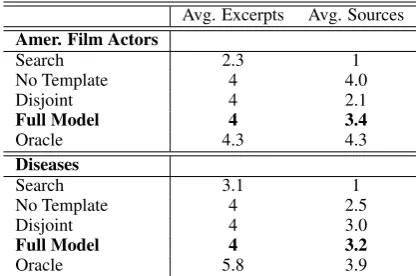
Table 2: Average number of excerpts selected and sources used in article creation for test articles.
cedure (Section 3.1) for evaluation.
Baselines Our first baseline, Search, relies solely on search engine ranking for content selec-tion. Using the article title as a query – e.g., Bacil-lary Angiomatosis, this method selects the web page that is ranked first by the search engine. From this page we select the firstkparagraphs wherek
is defined in the same way as in our full model. If there are less than k paragraphs on the page, all paragraphs are selected, but no other sources are used. This yields a document of comparable size with the output of our system. Despite its sim-plicity, this baseline is not naive: extracting ma-terial from a single document guarantees that the output is coherent, and a page highly ranked by a search engine may readily contain a comprehen-sive overview of the subject.
Our second baseline, No Template, does not use a template to specify desired topics; there-fore, there are no constraints on content selection. Instead, we follow a simplified form of previous work on biography creation, where a classifier is trained to distinguish biographical text (Zhou et al., 2004; Biadsy et al., 2008).
In this case, we train a classifier to distinguish domain-specific text. Positive training data is drawn from all topics in the given domain cor-pus. To find negative training data, we perform the search procedure as in our full model (see Section 3.1) using only the article titles as search queries. Any excerpts which have very low sim-ilarity to the original articles are used as negative examples. During the decoding procedure, we use the same search procedure. We then classify each excerpt as relevant or irrelevant and select the k
non-redundant excerpts with the highest relevance
confidence scores.
Our third baseline, Disjoint, uses the ranking perceptron framework as in our full system; how-ever, rather than perform an optimization step during training and decoding, we simply select the highest-ranked excerpt for each topic. This equates to standard linear classification for each section individually.
In addition to these baselines, we compare against anOraclesystem. For each topic present in the human-authored article, the Oracle selects the excerpt from our full model’s candidate ex-cerpts with the highest cosine similarity to the human-authored text. This excerpt is the optimal automatic selection from the results available, and therefore represents an upper bound on our excerpt selection task. Some articles contain additional topics beyond those in the template; in these cases, the Oraclesystem produces a longer article than our algorithm.
Table 2 shows the average number of excerpts selected and sources used in articles created by our full model and each baseline.
Automatic Evaluation To assess the quality of the resulting overview articles, we compare them with the original human-authored articles. We use ROUGE, an evaluation metric employed at the Document Understanding Conferences (DUC), which assumes that proximity to human-authored text is an indicator of summary quality. We use the publicly available ROUGE toolkit (Lin, 2004) to compute recall, precision, and F-score for ROUGE-1. We use the Wilcoxon Signed Rank Test to determine statistical significance.
Analysis of Human EditsIn addition to our auto-matic evaluation, we perform a study of reactions to system-produced articles by the general pub-lic. To achieve this goal, we insert automatically created articles4 into Wikipedia itself and exam-ine the feedback of Wikipedia editors. Selection of specific articles is constrained by the need to find topics which are currently of “stub” status that have enough information available on the Internet to construct a valid article. After a period of time, we analyzed the edits made to the articles to deter-mine the overall editor reaction. We report results on 15 articles in the Diseases category5.
4In addition to the summary itself, we also include proper
citations to the sources from which the material is extracted.
5We are continually submitting new articles; however, we
Recall Precision F-score
Amer. Film Actors
Search 0.09 0.37 0.13∗
No Template 0.33 0.50 0.39∗
Disjoint 0.45 0.32 0.36∗
Full Model 0.46 0.40 0.41
Oracle 0.48 0.64 0.54∗
Diseases
Search 0.31 0.37 0.32†
No Template 0.32 0.27 0.28∗
Disjoint 0.33 0.40 0.35∗
Full Model 0.36 0.39 0.37
[image:8.595.351.482.61.168.2]Oracle 0.59 0.37 0.44∗
Table 3: Results of ROUGE-1 evaluation.
∗
Significant with respect to our full model forp≤0.05.
†
Significant with respect to our full model forp≤0.10.
Since Wikipedia is a live resource, we do not repeat this procedure for our baseline systems. Adding articles from systems which have previ-ously demonstrated poor quality would be im-proper, especially in Diseases. Therefore, we present this analysis as an additional observation rather than a rigorous technical study.
5 Results
Automatic Evaluation The results of this evalu-ation are shown in Table 3. Our full model outper-forms all of the baselines. By surpassing the Dis-jointbaseline, we demonstrate the benefits of joint classification. Furthermore, the high performance of both our full model and the Disjoint baseline relative to the other baselines shows the impor-tance of structure-aware content selection. The
Oracle system, which represents an upper bound on our system’s capabilities, performs well.
The remaining baselines have different flaws: Articles produced by the No Template baseline tend to focus on a single topic extensively at the expense of breadth, because there are no con-straints to ensure diverse topic selection. On the other hand, performance of the Search baseline varies dramatically. This is expected; this base-line relies heavily on both the search engine and individual web pages. The search engine must cor-rectly rank relevant pages, and the web pages must provide the important material first.
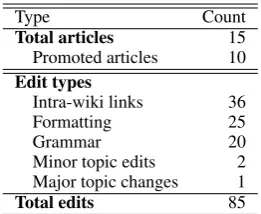
Analysis of Human Edits The results of our ob-servation of editing patterns are shown in Table 4. These articles have resided on Wikipedia for a period of time ranging from 5-11 months. All of them have been edited, and no articles were re-moved due to lack of quality. Moreover, ten au-tomatically created articles have been promoted
Type Count
Total articles 15
Promoted articles 10
Edit types
Intra-wiki links 36
Formatting 25
Grammar 20
Minor topic edits 2 Major topic changes 1
[image:8.595.77.284.62.202.2]Total edits 85
Table 4: Distribution of edits on Wikipedia.
by human editors from stubs to regular Wikipedia entries based on the quality and coverage of the material. Information was removed in three cases for being irrelevant, one entire section and two smaller pieces. The most common changes were small edits to formatting and introduction of links to other Wikipedia articles in the body text.
6 Conclusion
In this paper, we investigated an approach for cre-ating a multi-paragraph overview article by select-ing relevant material from the web and organiz-ing it into a sorganiz-ingle coherent text. Our algorithm yields significant gains over a structure-agnostic approach. Moreover, our results demonstrate the benefits of structured classification, which out-performs independently trained topical classifiers. Overall, the results of our evaluation combined with our analysis of human edits confirm that the proposed method can effectively produce compre-hensive overview articles.
This work opens several directions for future re-search. Diseases and American Film Actors ex-hibit fairly consistent article structures, which are successfully captured by a simple template cre-ation process. However, with categories that ex-hibit structural variability, more sophisticated sta-tistical approaches may be required to produce ac-curate templates. Moreover, a promising direction is to consider hierarchical discourse formalisms such as RST (Mann and Thompson, 1988) to sup-plement our template-based approach.
Acknowledgments
References
Eugene Agichtein, Steve Lawrence, and Luis Gravano. 2001. Learning search engine specific query transformations for question answering. InProceedings of WWW, pages 169– 178.
Regina Barzilay and Noemie Elhadad. 2003. Sentence align-ment for monolingual comparable corpora. In Proceed-ings of EMNLP, pages 25–32.
Regina Barzilay and Lillian Lee. 2004. Catching the drift: Probabilistic content models, with applications to genera-tion and summarizagenera-tion. InProceedings of HLT-NAACL, pages 113–120.
Regina Barzilay, Kathleen R. McKeown, and Michael El-hadad. 1999. Information fusion in the context of multi-document summarization. InProceedings of ACL, pages 550–557.
Fadi Biadsy, Julia Hirschberg, and Elena Filatova. 2008. An unsupervised approach to biography production using wikipedia. InProceedings of ACL/HLT, pages 807–815. James Clarke and Mirella Lapata. 2007. Modelling
com-pression with discourse constraints. In Proceedings of EMNLP-CoNLL, pages 1–11.
William W. Cohen, Robert E. Schapire, and Yoram Singer. 1998. Learning to order things. InProceedings of NIPS, pages 451–457.
Michael Collins. 2002. Ranking algorithms for named-entity extraction: Boosting and the voted perceptron. In Pro-ceedings of ACL, pages 489–496.
Thomas H. Cormen, Charles E. Leiserson, and Ronald L. Rivest. 1992. Intoduction to Algorithms. The MIT Press. Hal Daum´e III and Daniel Marcu. 2005. A large-scale
explo-ration of effective global features for a joint entity detec-tion and tracking model. InProceedings of HLT/EMNLP, pages 97–104.
Dina Demner-Fushman and Jimmy Lin. 2007. Answer-ing clinical questions with knowledge-based and statisti-cal techniques.Computational Linguistics, 33(1):63–103. Elena Filatova and John M. Prager. 2005. Tell me what you do and I’ll tell you what you are: Learning occupation-related activities for biographies. In Proceedings of HLT/EMNLP, pages 113–120.
Elena Filatova, Vasileios Hatzivassiloglou, and Kathleen McKeown. 2006. Automatic creation of domain tem-plates. InProceedings of ACL, pages 207–214.
Atsushi Fujii and Tetsuya Ishikawa. 2004. Summarizing en-cyclopedic term descriptions on the web. InProceedings of COLING, page 645.
Jade Goldstein, Vibhu Mittal, Jaime Carbonell, and Mark Kantrowitz. 2000. Multi-document summarization by sentence extraction. In Proceedings of NAACL-ANLP, pages 40–48.
Marti A. Hearst. 1994. Multi-paragraph segmentation of ex-pository text. InProceedings of ACL, pages 9–16. Chin-Yew Lin. 2004. ROUGE: A package for automatic
evaluation of summaries. InProceedings of ACL, pages 74–81.
Inderjeet Mani and Mark T. Maybury. 1999. Advances in Automatic Text Summarization. The MIT Press.
William C. Mann and Sandra A. Thompson. 1988. Rhetor-ical structure theory: Toward a functional theory of text organization.Text, 8(3):243–281.
Tomasz Marciniak and Michael Strube. 2005. Beyond the pipeline: Discrete optimization in NLP. InProceedings of CoNLL, pages 136–143.
Ryan McDonald. 2007. A study of global inference algo-rithms in multi-document summarization. InProceedings of EICR, pages 557–564.
Vivi Nastase and Michael Strube. 2008. Decoding wikipedia categories for knowledge acquisition. InProceedings of AAAI, pages 1219–1224.
Vivi Nastase. 2008. Topic-driven multi-document summa-rization with encyclopedic knowledge and spreading acti-vation. InProceedings of EMNLP, pages 763–772. Dragomir R. Radev, Hongyan Jing, and Malgorzata
Budzikowska. 2000. Centroid-based summarization of multiple documents: sentence extraction, utility-based evaluation, and user studies. In Proceedings of ANLP/NAACL, pages 21–29.
Ehud Reiter and Robert Dale. 2000. Building Natural Lan-guage Generation Systems. Cambridge University Press, Cambridge.
Benjamin Snyder and Regina Barzilay. 2007. Multiple as-pect ranking using the good grief algorithm. In Proceed-ings of HLT-NAACL, pages 300–307.
Ralph M. Weischedel, Jinxi Xu, and Ana Licuanan. 2004. A hybrid approach to answering biographical questions. In
New Directions in Question Answering, pages 59–70. Fei Wu and Daniel S. Weld. 2007. Autonomously
semanti-fying wikipedia. InProceedings of CIKM, pages 41–50. Ying Zhao, George Karypis, and Usama Fayyad. 2005.
Hierarchical clustering algorithms for document datasets.
Data Mining and Knowledge Discovery, 10(2):141–168. L. Zhou, M. Ticrea, and Eduard Hovy. 2004.