Original citation:
Moreno, Yamir, Baronchelli, Andrea, Chater, Nick, Christiansen, Morten H. and
Pastor-Satorras, Romualdo. (2013) Evolution in a changing environment. PLoS ONE , Vol.8
(No.1). Article no. e52742.
Permanent WRAP url:
http://wrap.warwick.ac.uk/527078
Copyright and reuse:
The Warwick Research Archive Portal (WRAP) makes the work of researchers of the
University of Warwick available open access under the following conditions.
This article is made available under the Creative Commons
Attribution-NonCommercial-NoDerivs 3.0 Unported (CC BY-NC-ND 3.0) license and may be reused according to the
conditions of the license. For more details see:
http://creativecommons.org/licenses/by-nc-nd/3.0/
A note on versions:
The version presented in WRAP is the published version, or, version of record, and may
be cited as it appears here.
Andrea Baronchelli1, Nick Chater2, Morten H. Christiansen3,4, Romualdo Pastor-Satorras5*
1Laboratory for the Modeling of Biological and Socio-technical Systems, Northeastern University, Boston, Massachusetts, United States of America,2Behavioural Science Group, Warwick Business School, University of Warwick, Coventry, United Kingdom,3Department of Psychology, Cornell University, Ithaca, New York, United States of America,4Santa Fe Institute, Santa Fe, New Mexico, United States of America,5Departament de Fisica i Enginyeria Nuclear, Universitat Politecnica de Catalunya, Barcelona, Spain
Abstract
We propose a simple model for genetic adaptation to a changing environment, describing a fitness landscape characterized by two maxima. One is associated with ‘‘specialist’’ individuals that are adapted to the environment; this maximum moves over time as the environment changes. The other maximum is static, and represents ‘‘generalist’’ individuals not affected by environmental changes. The rest of the landscape is occupied by ‘‘maladapted’’ individuals. Our analysis considers the evolution of these three subpopulations. Our main result is that, in presence of a sufficiently stable environmental feature, as in the case of an unchanging aspect of a physical habitat, specialists can dominate the population. By contrast, rapidly changing environmental features, such as language or cultural habits, are a moving target for the genes; here, generalists dominate, because the best evolutionary strategy is to adopt neutral alleles not specialized for any specific environment. The model we propose is based on simple assumptions about evolutionary dynamics and describes all possible scenarios in a non-trivial phase diagram. The approach provides a general framework to address such fundamental issues as the Baldwin effect, the biological basis for language, or the ecological consequences of a rapid climate change.
Citation:Baronchelli A, Chater N, Christiansen MH, Pastor-Satorras R (2013) Evolution in a Changing Environment. PLoS ONE 8(1): e52742. doi:10.1371/ journal.pone.0052742
Editor:Yamir Moreno, University of Zaragoza, Spain
ReceivedJune 29, 2012;AcceptedNovember 16, 2012;PublishedJanuary 10, 2013
Copyright:ß2013 Baronchelli et al. This is an open-access article distributed under the terms of the Creative Commons Attribution License, which permits unrestricted use, distribution, and reproduction in any medium, provided the original author and source are credited.
Funding:AB and RP-S acknowledge financial support from the Spanish MEC (FEDER), under project FIS2010-21781-C02-01, and the Junta de Andalucia, under project No. P09-FQM4682. RP-S acknowledges additional support through ICREA Academia, funded by the Generalitat de Catalunya. The funders had no role in study design, data collection and analysis, decision to publish, or preparation of the manuscript.
Competing Interests:The authors have declared that no competing interests exist.
* E-mail: [email protected]
Introduction
The issue of the evolution and adaptation in a changing environment has recently become hotly debated in the context of climate change and its effects on the extinction rates and the alteration of the distribution of species [1–4], but it is crucial in many domains. A classical example is given by lactose tolerance, where the advent of dairying created an environmental pressure in favor of this genetic trait, that in turn further increased the benefit of dairying, in a positive feedback loop [5]. Furthermore, it has been argued that this so-called Baldwin effect [6] may apply to many other aspects of the human evolution, such as the evolution of a language faculty. Here, an established linguistic convention would create a selective pressure, enhancing the reproductive fitness of those individuals that happen by chance to learn it faster or better. Over time, less environmental exposure would therefore be needed and what was originally a linguistic convention would eventually become encoded in the genes of the whole population [7]. On the other hand, it has been argued that language is a moving target which changes too rapidly for genes to follow [8]. This paper provides an analytical framework for addressing these issues.
The study of evolution and adaptation in a fluctuating environment from the perspective of population genetics has been hampered by the mathematical difficulty of the problem [9]. Various modeling attempts have focused on the conditions leading to adaptation, or lack thereof, from the perspective of the Baldwin effect (e.g. [10,11]), or on species distributions in the presence of environmental stresses (e.g. [12–14]), but a general picture is still
lacking. These models, in fact, while useful and interesting, are usually defined in terms of a large number of parameters, which compromise the possibility of studying them thoroughly from an analytical point of view, or of achieving fundamental insights into the problem at hand. Other work has instead followed the quasi-species approach [15–18], but also these models are in general characterized by considerable mathematical complexity.
specific feature of the environment [11]. However, specialization comes with a cost, reducing the flexibility of the specialized genome [25]. Even a slight environmental change might cause problems to the offspring inheriting a genetic machinery evolved for the original, but now different, environment. The new individual would in fact bemisaligned (maladapted) and her fitness would be lowered. For this reason we include in the model also a third kind of genomes, namely the neutrals (or ‘‘generalists’’ [26]), for which the fitness of an individual is independent of the specific environment. Note that working with just one environmental feature corresponds to the assumption, standard when modeling complex biological phenom-ena [27], that different features of the environment have roughly independent impacts on fitness.
The dynamics of the model is defined in terms of evolutionary rules that depend on three basic parameters: The genetic mutation ratem, the rate of environmental change‘, and a parameter p, indicating the probability that an environmental change could lead to conditions favorable for previously maladapted individuals. As we will see, the probability p turns out to induce only small corrections in the biological limitp?0. In terms of the remaining parametersm and‘, a non-trivial mean-field phase diagram can be drawn, exhibiting different phase transitions, akin to the so-called ‘‘error catastrophe’’ [28], as a function ofmfor small and large values of the rate of environmental change. This phase diagram describes the general conditions for microevolutionary adaptation in the presence of environmental stresses, and explains different empirical observations of adaptation in changing environments in a single framework.
Results
Model definition
The model is defined in terms of three different types, namelyS,
N, and M, that represent Specialized, generalist/Neutral, and Maladapted individuals, respectively. Our aim is to describe a population in which the environment changes. Thus, thinking in terms of a theoretical fitness landscape [29], we assume that it exhibits a maximum whose position changes whenever there is an environmental variation, i.e., the maximum represents a moving target. The main simplification of our model, as opposed to standard quasi-species approximations [15,18], consists in consid-ering the class of specialistsSnot as afixedgenome, but as thesetof those genomes which are closer to the maximum of the fitness landscape, whatever the position of this maximum might be. In this theoretical fitness landscape we assume also the presence of a secondary, local, maximum, of lower height, representing the neutral genomes which are not affected by environmental changes. The position of this secondary maximum is considered static, since neutrals do not react to changes in the environment. From this perspective, our model borrows from quasi-species models in multiple-peaked landscapes [30], with the proviso that the absolute maximum moves in time, and we do not focus on fixed genomes, but on the set of those close to the maxima.
In mathematical terms, the classScan thus be described as the set of genomes that are close to the principal maximum, by a distanceES. Analogously, speciesNrepresents the set of genomes
close to the perfectly neutral genome (the secondary fixed maximum), by a distance EN. Finally, the setM is composed of
the remaining possible genomes. We assume a haploid reproduc-tion system, with a fitness for each classfa, satisfying the restriction
fMvfNvfS. We consider these fitnesses as constant, independent of the environmental changes. At a mean-field level, assuming homogeneous mixing, the dynamics of the model is defined as follows (see Fig. 1): Reproduction is performed by selecting an
individual with probability proportional to its fitness, as in standard haploid models (i.e., the Moran process [31]). The individual then produces an offspring which is equal to itself with probability 1{m, and that mutates to a different type with probability m. Conservation of individuals is achieved in reproduction by eliminating a randomly chosen individual. Crucially, all genetic mutations are assumed to be harmful, because the probability that they will lead to an increase of fitness is negligible [32]. Therefore, a genome of type S or N, when mutating, reproduces into a typeM, whileM genomes always reproduce intoMindividuals. Environmental changes correspond to a shift of the position of the principal maximum of the fitness landscape. This shift is assumed to take place at each time step with a small probability l, and produces different effects on the three speciesS,N andM. Specifically, a changing environmental does not, by assumption, affect the neutralsN. But the shift is mainly unfavorable toSindividuals, which were best adapted to the previous position of the maximum. This effect is implemented by selecting, with probabilityrS, a specialized individual that will become maladapted, i.e., of classM. Finally, the shift could have a beneficial effect on other previously maladapted individuals, who were, in genomic space, far from the previous position of the principal maximum but are now close to its present one. This effect, which we assume to be rarer, is implemented by choosing with a small probability p a maladapted individual (with probability rM), which will become specialized. Note that we neglect backward genetic mutations fromMgenomes to eitherS
or N species. Thus, we are considering the most common scenarios in which beneficial mutations are much less frequent than harmful ones (see for example [33,34]). Moreover, from the rules of the model, the population size n is constant. This restriction is not problematic for our purposes, since we are interested only in the ratios between the population densities of the different species. In what follows, however, we will consider the limit of an infinite population,n??, so that the presence ofSand
Mindividuals can be assumed to be non-zero at the outset due to generic variability in the population, even thought they may be few in number. As we will see, the solution to our equations does not depend on the initial fractions of the different genomes.
Mean-field rate equations
[image:3.612.316.417.563.633.2]Let us defineraas the density of individuals in statea[½S,N,M, satisfying the normalization condition Para~1. At the mean-field level, disregarding spatial fluctuations and stochastic fluctu-ations, and in the limit ofn??, a mathematical description of our model can be readily obtained in terms of rate equations for the
Figure 1. Schematic representation of the model definition.In reproduction, the number of offspring is, of course, proportional to the fitness of the parent genome. Genetic mutations happen with probability m, and are detrimental, and leading to offspring in the maladapted class. Environmental changes occur with probability l, independently from the state of the population. Such changes typically damage specialists, but also favor previously maladapted individuals. The latter case is however less frequent, and it is therefore modulated by a further probabilityp.
variation of the densitiesra. To construct those, we consider that a genomeaincreases its number (i) when an individualais chosen for reproduction and her offspring replaces an individual belonging to a genome b=a, without any mutation, i.e., with
probability (1{m), or (ii) when a mutation event leads an individual with genomeb=ato reproduce intoa. Conversely, a
genome a decreases when one individual belonging to it is randomly selected for replacement. Additionally,Sgenomes may decrease their number due to a damaging change of the environment, while they can increase their number through a (rarer) beneficial environmental change. The corresponding rate equations take thus the form, writing explicitly all contributions to the change to eachra,
_ r rS~fSrS
w (1{rS)(1{m){ fSrS
w rSm
{fNrN
w rS(1{m){ fNrN
w rSm{ fMrM
w rS{‘rSz‘prM,
_ r
rM~{fSrS
w rM(1{m)z fSrS
w (1{rM)m{ fNrN
w rM(1{m)
zfNrN
w (1{rM)mz fMrM
w (1{rM)z‘rS{‘prM,
_ r
rN~{fSrS
w rN(1{m){ fSrS
w rNmz fNrN
w (1{rN)(1{m){
fNrN
w rNm{ fMrM
w rN,
where we have definedrateof environmental change‘~l=(1{l), the average fitness of the populationw~P
afara, and we have performed
an irrelevant rescaling of units of time. After some algebraic manipulations, the previous equations can be simplified to the form:
_ r
rS~rSh{1z(1{m)ff^S{‘izp‘rM, ð1aÞ
_ r
rN~rNh{1z(1{m)^ffNi, ð1bÞ
_ r
rM~rMh{1z(1{m)^ffM{p‘izmz‘rS, ð1cÞ
where we have defined^ffa~fa=w.
Equations (1) completely define the dynamics of the model at the mean field level. In the following we will analyze their solution in different limits.
Analytical solution
In the long term steady state, the solutions of this dynamical system are obtained by imposing the conditionsrr_S~rr_
N~rr_M~0
on Eqs. (1), solving the ensuing algebraic equations, and checking for the stability of the solutions, by looking at the eigenvalues of the Jacobian matrix, evaluated at the respective solution. The solutions obtained this way in the general casepw0turn out to be quite complex, so in order to simplify the resulting expressions, we choose particular values of the fitnesses, namelyfS~2,fN~1
andfM~0:5, respecting their natural ordering. Solutions for other
values can be obtained using the same steps.
Case p=0. The algebraic equations ruling the steady state,
obtained from Eqs. (1) by setting to zero the time derivatives, can be solved using a standard computational software package. This results in three sets of solutions, taking the form
S1
rN~0
rS~{
ffiffiffiffiffiffiffiffiffiffiffiffiffiffiffiffiffiffiffiffiffiffiffiffiffiffiffiffiffiffiffiffiffiffiffiffiffiffiffiffiffiffiffiffiffiffiffiffiffiffiffiffiffiffiffiffiffiffiffiffiffiffiffiffiffiffiffiffiffiffiffiffiffiffiffiffiffiffiffiffiffiffiffiffiffiffiffiffiffiffiffiffiffi
2‘(m(4{8p)z12p{3)z(3{4m)2z(4p‘z‘)2
q
z4m{2p‘z‘{3 6(p‘z‘z1)
rM~
ffiffiffiffiffiffiffiffiffiffiffiffiffiffiffiffiffiffiffiffiffiffiffiffiffiffiffiffiffiffiffiffiffiffiffiffiffiffiffiffiffiffiffiffiffiffiffiffiffiffiffiffiffiffiffiffiffiffiffiffiffiffiffiffiffiffiffiffiffiffiffiffiffiffiffiffiffiffiffiffiffiffiffiffiffiffiffiffiffiffiffiffiffi
2‘(m(4{8p)z12p{3)z(3{4m)2z(4p‘z‘)2
q
z4mz4p‘z7‘z3 6(p‘z‘z1)
0 B B B B B B B @ , S2
rN~0
rS~
ffiffiffiffiffiffiffiffiffiffiffiffiffiffiffiffiffiffiffiffiffiffiffiffiffiffiffiffiffiffiffiffiffiffiffiffiffiffiffiffiffiffiffiffiffiffiffiffiffiffiffiffiffiffiffiffiffiffiffiffiffiffiffiffiffiffiffiffiffiffiffiffiffiffiffiffiffiffiffiffiffiffiffiffiffiffiffiffiffiffiffiffiffi
2‘(m(4{8p)z12p{3)z(3{4m)2z(4p‘z‘)2
q
{4mz2p‘{‘z3 6(p‘z‘z1)
rM~ {
ffiffiffiffiffiffiffiffiffiffiffiffiffiffiffiffiffiffiffiffiffiffiffiffiffiffiffiffiffiffiffiffiffiffiffiffiffiffiffiffiffiffiffiffiffiffiffiffiffiffiffiffiffiffiffiffiffiffiffiffiffiffiffiffiffiffiffiffiffiffiffiffiffiffiffiffiffiffiffiffiffiffiffiffiffiffiffiffiffiffiffiffiffi
2‘(m(4{8p)z12p{3)z(3{4m)2z(4p‘z‘)2 q
z4mz4p‘z7‘z3 6(p‘z‘z1)
0 B B B B B B B @ , S3
rN~2‘(mpzmzp){2m{‘z1
(2p{1)‘z1
rS~{ 2mp‘
2p‘{‘z1
rM~{ 2m(‘{1)
(2p{1)‘z1 0 B B B B B B B @ :
Solution S1 describes a rS density that is negative in the
parameter region pw0, i.e., it is an ‘‘unphysical’’ solution that does not describe any realistic scenario. SolutionS2has nonzero densities in the whole parameter space, while solution S3 is physical only in the region
R~ 0vmv1
2^0vpv 1{2m
2mz2^Ԥ
2m{1 2(mpzmzp){1
: ð2Þ
In order to find the relative stability of the physical solutionsS2 andS3, we consider the Jacobian matrix of the equation system Eqs. (1), taking the form
J~
{4(m{1)ðrMz2rNÞ rMz2rNz4rS
ð Þ2{‘{1
8(m{1)rS rMz2rNz4rS
ð Þ2
4(m{1)rS rMz2rNz4rS
ð Þ2zp‘
8(m{1)rN rMz2rNz4rS
ð Þ2 {
2(m{1)ðrMz4rSÞ
rMz2rNz4rS
ð Þ2{1
2(m{1)rN rMz2rNz4rS
ð Þ2
4(m{1)rM rMz2rNz4rS
ð Þ2
z‘ 2(m{1)rM rMz2rNz4rS
ð Þ2
{2(m{1)ðrNz2rSÞ rMz2rNz4rS
ð Þ2{p‘
{1 0 B B B B B B B B B @ 1 C C C C C C C C C A :
N
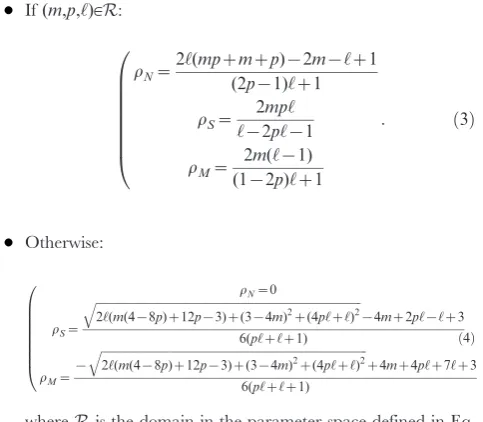
If(m,p,‘)[R:rN~2‘(mpzmzp){2m{‘z1 (2p{1)‘z1
rS~ 2mp‘
‘{2p‘{1
rM~ 2m(‘{1) (1{2p)‘z1
0 B B B B B B B @
: ð3Þ
N
Otherwise:rN~0
rS~
ffiffiffiffiffiffiffiffiffiffiffiffiffiffiffiffiffiffiffiffiffiffiffiffiffiffiffiffiffiffiffiffiffiffiffiffiffiffiffiffiffiffiffiffiffiffiffiffiffiffiffiffiffiffiffiffiffiffiffiffiffiffiffiffiffiffiffiffiffiffiffiffiffiffiffiffiffiffiffiffiffiffiffiffiffiffiffiffiffiffiffiffiffi 2‘(m(4{8p)z12p{3)z(3{4m)2z(4p‘z‘)2 q
{4mz2p‘{‘z3 6(p‘z‘z1)
rM~
{
ffiffiffiffiffiffiffiffiffiffiffiffiffiffiffiffiffiffiffiffiffiffiffiffiffiffiffiffiffiffiffiffiffiffiffiffiffiffiffiffiffiffiffiffiffiffiffiffiffiffiffiffiffiffiffiffiffiffiffiffiffiffiffiffiffiffiffiffiffiffiffiffiffiffiffiffiffiffiffiffiffiffiffiffiffiffiffiffiffiffiffiffiffi 2‘(m(4{8p)z12p{3)z(3{4m)2z(4p‘z‘)2 q
z4mz4p‘z7‘z3 6(p‘z‘z1)
0 B B B B B B B @
ð4Þ
whereRis the domain in the parameter space defined in Eq. (2).
The analytical solutions given by Eqs. (3) and (4) are quite complex, and it is difficult to extract direct interpretations from them. However, the behavior of the solutions can be understood in the biologically relevant region of small p. Fig. 2 shows the densitiesraas a function ofmor‘, at fixed‘andmrespectively, for two values of p, along with the value of the total fitness
w~P
arafa. In the upper left corner plot for each value ofp, we
consider the case m~0:05, representative of the biologically relevant scenario of small mutation rate. When ‘ is very small, most of the population stays aligned with the environmental feature andrS*1. As‘ increases, maladapted genomes appear and eventually overcome the specialized genes. At a definite value of‘, however, a discontinuity takes place and neutral individuals suddenly appear and become the majority of the population, while the density of both maladapted and specialists decreases. The decrease in specialists is larger for larger values ofp. Thus, for sufficiently large‘and smallm, trying to catch up with the rapidly evolving environmental feature is not a viable strategy, since the
risk of producing a maladapted offspring becomes destructive. Interestingly the strategy adopted by the majority of the individuals guarantees the maximum average fitness in any given region of the(‘,m)plane, for every value ofp. For large values of
m(lower left plots), the situation is qualitatively different. For small
[image:5.612.69.556.61.253.2]‘, maladapted and neutral individuals are almost equally numerous. When ‘ increases beyond a threshold, neutral individuals again appear suddenly, but they are unable to overcome maladapted genomes. Only for large values ofp are neutrals capable to prevail over the specialists. The right plots for each value ofpin Fig. 2 show the evolution of the species’ densities as a function ofmfor fixed‘. In this case, for small‘neutrals are absent from the system, and there is a simple competition between specialists and maladapted, the former being predominant for small genetic mutation rates, but going extinct for largem. On the other hand, when the rate of environmental change is sufficiently large, we enter a new scenario in which neutrals are predominant for smallm. Beyond a mutation rate threshold, however, neutrals suddenly become extinct, and their population is replaced by maladapted genomes, while specialists decrease their density for large m. Interestingly, in this region of large ‘, specialists can survive even for very large mutation rates, close to1, due to the effect of a nonzerop that prevents their complete elimination. Fig. 3 shows the complete picture of the relative species’ abundances as as a function of m and ‘ for the previously considered values ofp.
Casep~0. A more precise mathematical characterization of the phenomenology discussed above, and in particular of position of the transitions taking place for different values ofmand‘, can be obtained in the particular case p~0. Here, qualitative arguments allow us to solve the model in a much simpler way, for general values of fS, fN and fM. This analysis, moreover,
reveals the role ofpin the dynamics of our model. The relevant equations in thep~0case read
_ r
[image:5.612.59.301.310.521.2]rS~rSh{1z(1{m)ff^S{‘i, ð5aÞ Figure 2. Species densities at the steady state for smallp.Densities ofS(blue), N(green) andM(gray) genomes as a function of the environmental mutation rate‘for fixedm, and as a function ofmfor fixed‘. The left panel corresponds top~0:05, and the right panel top~0:10. Dashed orange lines represent the average fitness of the population.
_ r
rN~rN {1z(1{m)^ffN
h i
, ð5bÞ
_ r
rM~rMh{1z(1{m)ff^Mizmz‘rS: ð5cÞ
To find their solution, we argue as follows: Ifmis very close to1, all terms in square brakets in Eqs. (5) will be negative. Therefore, the only stable solution will berS~rN~0,rM~1, for any value of‘. Under this conditions, the quantities within square brackets in Eqs. (5a) and (5b) take the form {1{‘z(1{m)fS=fM and
{1z(1{m)fN=fM, respectively. Decreasing the value ofm, the
first solution withrMv1will take place for the first of these values that become zero. This occurs when m is smaller than either
mc,1(‘)~1{(‘z1)fM=fSormc,2~1{fM=fN, respectively. Since
fMvfN, we have0vmc,2v1, and this transition will always be physical. However, for‘w‘c,1~(fS{fM)=fM, we havemc,1(‘)v0 and it is not physical. In this case, when ‘w‘c,1, ifmvmc,2, rS decays exponentially, and in the long time limit rS~0; the existence of a non-zerorN solution imposes{1z(1{m)^ffN~0,
or w~(1{m)fN, from where the restricted normalization
condition rNzrM~1 leads to the solution rN~1{m=mc,2
rM~m=mc,2, andrS~0. In the case‘v‘c,1, which densityrSor
rNbecomes first non-zero depends on which threshold,mc,1(‘)or
mc,2 is larger. Thus, if‘w‘c,2~(fS{fN)=fN, then mc,2wmc,1(‘). Therefore, when decreasingm, the first density to take a non-zero value isrN.rSdecays again exponentially, so the solution is the same as in the case ‘§‘c,1. Finally, for ‘v‘c,2, rS is the first density to become non-zero when mvmc,1. The steady state solution comes from imposing{1{‘z(1{m)^ffS~0, leading to
w~fS(1{m)=(‘z1). In this region, the factor in square brackets
in Eq. (5b) becomes negative, indicating an exponential decay and a corresponding steady state valuerN~0. We are therefore led to
the solution, using the normalization condition,
rS~(mc,1(‘){m)=½‘c,1(1{mc,1(‘)),rM~1{rS.
The final solution in this case can thus be summarized as follows:
N
For‘v‘c,2~(fS{fN)=fN– Ifmvmc,1(‘)~1{(‘z1)fM=fS
rS~ fM fS{fM
mc,1(‘){m 1{mc,1(‘)
, rM~1{rS, rN~0: ð6Þ
– Ifm§mc,1(‘)
rS~rN~0, rM~1: ð7Þ
N
For‘§‘c,2~(fS{fN)=fN:– Ifmvmc,2~1{fM=fN
rN~1{ m mc,2
, rM~ m
mc,2
, rS~0: ð8Þ
– Ifm§mc,2
[image:6.612.64.553.60.258.2]rS~rN~0, rM~1: ð9Þ
Fig. 4 sketches the phase diagram, as a function of mand ‘, resulting from the previous equations. The different scenarios for small and large values of ‘ are now explicit. For small ‘v‘c,2, specialist individuals (in theN class) are able to survive, and even dominate the population, as long as the mutation rate is small. In fact, for mvmc,3(‘)~mc,1(‘){‘c,1½1{mc,1(‘)=2, the density of specialists is larger than the density of maladapted individuals. For larger m, the density of specialized genomes decreases, until it reaches the‘-dependent thresholdmc,1(‘), leading to a continuous, second order, phase transition (akin to the error catastrophe in Figure 3. Species densities at the steady state for smallp.Densities ofS(blue), N(green) andM(gray) genomes as a function of the environmental mutation rate‘and the genetic mutation ratem, for fixed valuesp~0:05(left) andp~0:1(right). Fitness values arefS~2,fN~1and fM~0:5.
[image:6.612.317.557.318.608.2]quasispecies models [28]) beyond which the whole population becomes maladapted and thus prone to eventual extinction. In all of this region of small ‘, neutral individuals are irrelevant. For smallm, specialists perform much better, while for largemonly maladapted individuals survive.
When‘increases, a different picture emerges. For fixed, small
mvmc,2, the explicit behavior ofrS as a function of‘, reads we can obtain from Eq. (6)
rS~ fM
(‘z1)(fS{fN)
fS
fM
(1{m){1{‘
, ð10Þ
for ‘v‘c,2, and zero otherwise. Thus, when crossing ‘c,2, the density of specialized individuals experiences a first order transition to extinction, with a jump of magnitude
DrS~fN(1{m){fM fS{fM
: ð11Þ
The sudden extinction of specialized individuals coincides with the abrupt emergence of neutrals, in a related first order transition for
rN with an associated jump
DrN~fN(1{m){fM fN{fM
: ð12Þ
In this large‘region, neutrals are able to cope with environmental change if the mutation rate is sufficiently small, again up to a maximum mutation rate mc,1, after which rN continuously
becomes zero and only maladapted individuals can survive. These discontinuous transitions as a function of ‘ at fixed m are reminiscent of the phenomenology observed in quasispecies models with higher order replication mechanisms [35]. We note, however, that transition as a function of m at fixed ‘ are all continuous.
Fig. 5 shows the proportions of the three genomes along with the average fitness as function ofmfor fixed‘, and as a function of
‘at fixedm(left panel), and the general scenario as a function of bothmand‘(right panel). As it is clear, while an abrupt transition occurs at the level of the genome frequencies at‘c,2 (‘c,2~1 in Fig. 5), the average fitness w exhibits a continuous behavior, decreasing monotonously from the maximumw~fSform~‘~0
tow~fM for large values ofm(when all the other genomes simply
[image:7.612.59.267.65.265.2]mutate into M). When m is fixed (left column, left panel), increasing‘causes an increase ofMgenomes and a simultaneous decrease inrSandw. As‘~‘c,2, howeverSgenomes disappear as the neutral genomes abruptly appear. The latter guarantees a constant value ofw.M genomes are constantly created due to the genetic mutation rate, but their fitness is lower so they do not Figure 4. Phase diagram for the casep~0.The most abundant
genome is indicated by a larger name in each region. The average fitness of the population decreases along the arrows.
[image:7.612.65.553.430.677.2]doi:10.1371/journal.pone.0052742.g004
Figure 5. Species densities at the steady state for smallp.Left panel: Genome densities as a function of the environmental mutation rate‘for fixedm, and as a function ofmfor fixed‘. Fitness values are chosen asfM~2,fN~1andfM~0:5. Hence,‘c,2~1,mc,s~0:5andmc,1~(1{‘)=2, implying0:5ƒwƒ2(see main text). Right panel: Densities ofS(blue),N(green) andM(gray) genomes as a function of the environmental mutation rate‘and the genetic mutation ratem.
reproduce frequently. This scenario is stable, and any further increase inldoes not produce any effect. The role ofmis better understood at fixed values of ‘. When ‘v‘c,2 (top panel) increasing m deteriorates the fitness of the population since S
genomes are substituted by M ones, which eventually become fixed (rM~1asm~mc,1~0:725in figure). A similar behavior is observed for‘w‘c,2(bottom panel), but here theMgenomes take the place of theN genomes, till the latter disappear atmc,2~0:5 for the values of the simulations.
The crucial difference between the casesp=0andp~0, as can be observed from the comparison of Figs. 2 and 5 is the effect of a positive density of specialists for largemand‘. In the casep~0, the density rS goes to zero after the corresponding transition, specialist being unable to cope with extreme genetic and/or environmental rates of change. In the presence of a non-zero p, signaling the possibility of collateral beneficial effects of an environmental change to previously maladapted individuals, susceptible individuals are still able to thrive in an situation combining both fast genetic and environmental change (see lower right plots in Fig. 2). This effect is due to the feedback mechanism induced by the parameterp, that allows the replenishment of theS
individuals from previously maladapted individuals. Their prev-alence is however relatively small, and comparatively negligible with respect to the predominant species, eitherNorM, especially in the case of small populations. Finally, it is worth noting that, while the prevalence ofMgenomes is stable in our model, it can be interpreted as a metastable state leading to extinction in a multi-species scenario.
Discussion
The model presented in this paper shows that a genetic adaptation to a specific form of an environmental feature is profitable only as long as the rate of change in the environment is not too fast. Indeed, a phase transition determines the onset of a different regime in which a neutral strategy is advantageous. The critical value of the environmental rate separating the two phases is proportional to the difference between the fitness of the neutral and specialist individuals. This analysis is the consequence of the simplicity of the model that, in contrast to previous modeling attempts, allows us not only to outline a qualitative scenario, but also to characterize quantitatively and in a transparent way the role of the different parameters, in the hope that future experimental work will be able to test these findings.
The analysis proposed here provides a framework for under-standing a range of empirical finding. As mentioned above, for
example, lactose tolerance did become genetically encoded [5] while language is a moving target for the genes, that appears to change too fast to allow genetic adaptation [8]. In the same way, agricultural practices that determine an increased presence of malaria are linked to genetic mutations that cause malaria reduction [36–38], and bioinformatic methods have recently shown that climate has been an important selective pressure acting on candidate genes for common metabolic disorders [39]. Another particularly significant example comes from biology, where the diversity and temporal variability of a population of hosts determines the pressure for parasites to specialize on one host or to become generalists on a wide range of hosts [40], as it has been experimentally shown for example in parasites Brachiola algerae
infecting Aedes aegypti mosquitoes [26]. Our model coherently predicts also that specialized genomes would decrease their fitness if the mutation rate of the corresponding environmental feature increases (Fig. 5). Interestingly, this is what has been observed in relation to climate change, the consequence being a diminished robustness against competitors and natural enemies, which, in a multi-species scenario, could eventually lead to extinction [3].
In summary, we have introduced an evolutionary model that captures a wide array of natural scenarios in which genes evolve against a potentially changing environment. These results have been obtained using strong simplifying assumptions that can be relaxed in future work. For example, a natural extension of the model could consider a more complex network of environment-gene interactions, including the possibility of feedback between genes and the rate of change in the environment. Such a generalization could lead to important results and a richer phenomenology [41,42], as well as enlarge the range of applicability of the model [43], even though it may reduce the mathematical tractability of the resulting equations. Likewise, the fitness of each genome could depend, for example, on its relative abundance in the population, instead of being a constant parameter. Finally, the equations we have derived apply in the case of very large populations; a possible extension could consider the effects of fluctuations in small groups. The framework we have put forth is general and allows these and other aspects (such as the effects of spatial fluctuations in finite dimensions) to be addressed in a principled way.
Author Contributions
Conceived and designed the experiments: AB NC MHC RP-S. Performed the experiments: AB RP-S. Analyzed the data: AB RP-S. Wrote the paper: AB NC MHC RP-S.
References
1. Pounds JA, Fogden MPL, Campbell JH (1999) Biological response to climate change on a tropical mountain. Nature 398: 611–615.
2. Parmesan C, Yohe G (2003) A globally coherent fingerprint of climate change impacts across natural systems. Nature 421: 37–42.
3. Thomas CD, Cameron A, Green RE, Bakkenes M, Beaumont LJ, et al. (2004) Extinction risk from climate change. Nature 427: 145–148.
4. Sinervo B, Me´ndez-de-la-Cruz F, Miles DB, Heulin B, Bastiaans E, et al. (2010) Erosion of lizard diversity by climate change and altered thermal niches. Science 328: 894–899.
5. Beja-Pereira A, Luikart G, England PR, Bradley DG, Jann OC, et al. (2003) Gene-culture coevolution between cattle milk protein genes and human lactase genes. Nature Genetics 35: 311–313.
6. Baldwin J (1896) A new factor in evolution. The American Naturalist 30: 441– 451.
7. Pinker S (2003) Language as an adaptation to the cognitive niche. In: Christiansen MH, Kirby S, editors. Language evolution. Oxford: Oxford University Press. p. 16.
8. Christiansen MH, Chater N (2008) Language as shaped by the brain. Behav Brain Sci 31: 489–509.
9. Gillespie J (1994) The Causes of Molecular Evolution. Oxford Series in Ecology and Evolution. Oxford: Oxford University Press.
10. Ancel L (1999) A quantitative model of the Simpson-Baldwin effect. Journal of Theoretical Biology 196: 197–209.
11. Chater N, Reali F, Christiansen MH (2009) Restrictions on biological adaptation in language evolution. Proc Natl Acad Sci USA 106: 1015.
12. Lynch M, Gabriel W, Wood AM (1991) Adaptive and demographic responses of plankton populations to environmental change. Limnology and Oceanography 36: 1301–1312.
13. Burger R, Lynch M (1995) Evolution and extinction in a changing environment: A quantitative-genetic analysis. Evolution 49: 151–163.
14. Chevin LM, Lande R, Mace GM (2010) Adaptation, plasticity, and extinction in a changing environment: Towards a predictive theory. PLoS Biol 8: e1000357. 15. Nilsson M, Snoad N (2000) Error thresholds for quasispecies on dynamic fitness
landscapes. Phys Rev Lett 84: 191–194.
16. Nilsson M, Snoad N (2002) Optimal mutation rates in dynamic environments. Bulletin of Mathematical Biology 64: 1033–1043.
17. Ancliff M, Park JM (2009) Maximum, minimum, and optimal mutation rates in dynamic environments. Phys Rev E 80: 061910.
18. Ancliff M, Park JM (2010) Optimal mutation rates in dynamic environments: The eigen model. Phys Rev E 82: 021904.
20. Sella G, Hirsh AE (2005) The application of statistical physics to evolutionary biology. Proc Natl Acad Sci USA 102: 9541–9546.
21. Nowak M (2006) Evolutionary dynamics: exploring the equations of life. Cambridge, MA: Belknap Press.
22. de Vladar H, Barton N (2011) The contribution of statistical physics to evolutionary biology. Trends in Ecology & Evolution 26: 424–432.
23. Ohtsuki H, Nowak MA, Pacheco JM (2007) Breaking the symmetry between interaction and replacement in evolutionary dynamics on graphs. Phys Rev Lett 98: 108106.
24. Traulsen A, Claussen JC, Hauert C (2005) Coevolutionary dynamics: From finite to infinite populations. Phys Rev Lett 95: 238701.
25. Ebert D (1998) Experimental evolution of parasites. Science 282: 1432. 26. Legros M, Koella J (2010) Experimental evolution of specialization by a
microsporidian parasite. BMC Ev Biol 10: 159.
27. Baronchelli A, Felici M, Loreto V, Caglioti E, Steels L (2006) Sharp transition towards shared vocabularies in multi-agent systems. Journal of Statistical Mechanics: Theory and Experiment 2006: P06014.
28. Eigen M, McCaskill J, Shuster P (1989) The molecular quasispecies. Advances in Chemical Physics 75: 149.
29. Wright S (1932) The roles of mutation, inbreeding, crossbreeding and selection in evolution. Proceedings of the Sixth International Congress on Genetics 1: 356–366.
30. Saakian DB, Mun˜oz E, Hu CK, Deem MW (2006) Quasispecies theory for multiple-peak fitness landscapes. Phys Rev E 73: 041913.
31. Moran P (1962) The Statistical Processes of Evolutionary Theory. Oxford: Clarendon Press.
32. Sawyer S, Parsch J, Zhang Z, Hartl D (2007) Prevalence of positive selection among nearly neutral amino acid replacements in drosophila. Proceedings of the National Academy of Sciences 104: 6504.
33. Eyre-Walker A, Keightley P (2007) The distribution of fitness effects of new mutations. Nature Reviews Genetics 8: 610–618.
34. Sanjua´n R, Moya A, Elena S (2004) The distribution of fitness effects caused by singlenucleotide substitutions in an RNA virus. Proceedings of the National Academy of Sciences of the United States of America 101: 8396.
35. Wagner N, Tannenbaum E, Ashkenasy G (2010) Second order catalytic quasispecies yields discontinuous mean fitness at error threshold. Phys Rev Lett 104: 188101.
36. Wiesenfeld S (1967) Sickle-cell trait in human biological and cultural evolution. Science 157: 1134.
37. Saunders M, Hammer M, Nachman M (2002) Nucleotide variability at g6pd and the signature of malarial selection in humans. Genetics 162: 1849–1861. 38. Laland K, Odling-Smee J, Myles S (2010) How culture shaped the human
genome: bringing genetics and the human sciences together. Nature Reviews Genetics 11: 137–148.
39. Hancock A, Witonsky D, Gordon A, Eshel G, Pritchard J, et al. (2008) Adaptations to climate in candidate genes for common metabolic disorders. PLoS Genetics 4: e32.
40. Crill W, Wichman H, Bull J (2000) Evolutionary reversals during viral adaptation to alternating hosts. Genetics 154: 27.
41. Lande R, Arnold S (1983) The measurement of selection on correlated characters. Evolution 87: 1210–1226.
42. Kirkpatrick M (2009) Patterns of quantitative genetic variation in multiple dimensions. Genetica 136: 271–284.