CREATIVE TECHNOLOGY BACHELOR THESIS REPORT
TEACHING DEEP LEARNING
MODELS TO COUNT BASED ON
SYNTHETIC DATA
van den Brink, G.C. (Corjan) [email protected] s1733826
Supervisor: Dr. Andreas Kamilaris
Abstract
Training deep convolutional neural networks requires a significant amount of data. Solving the
need for real-world training data that is hard and expensive to create, this research project tries
to design both a deep convolutional neural network and a synthetic dataset for training. Using
synthetic data in training solves the need for big real-world datasets. In this training, a
customized deep neural network allows for a more tailored approach to learning and
generalizing the training. The context is a regression problem dealing with counting houses on
satellite images. As a result, this research presents a combined model able to count houses on
images in a real-world testing dataset with an average counting error of 3 for images with a
number of houses in range [0, 38]. The combined model consists of a deep convolutional neural
network and a linear regression model. This research concludes that creating a custom model is
a good, but complicated, way of solving specific counting problems and that the method of
creating synthetic data is very important in arriving at a good solution.
Acknowledgements
This project was supervised by Dr. Andreas Kamilaris, who I’d like to thank for this interesting
and broadening experience into the field of deep learning. His instructions, feedback and
connections to colleagues were important to defining useful experiments. In his patience I was
able to explore and research this area within this project.
I’d like to thank Max Van Vugt as he laid the foundation for this thesis in the preparatory work he
did at the end of his thesis. His work provided a backbone to this project.
Thanks to Ir. Richard Bults as coordinator for the graduation projects inside the Creative
Technology studies at the University of Twente for allowing a smooth application for this project
and his other organising work around the theses this semester.
Thanks to Faiza Bukhsh for being my critical observer and for allowing me to improve my work
Table of Contents
Abstract... 1
Acknowledgements ... 1
Table of Contents ... 2
List of Figures ... 3
Chapter 1 - Introduction ... 4
Chapter 2 – State of the Art... 6
Discussion ... 6
Preliminary conclusion ...10
Chapter 3 - Methods and Techniques ...11
Chapter 4 Ideation ...13
Orientation ...13
Preparatory work ...14
Tinkering ...15
Research ...15
Requirements ...16
Chapter 5 Realisation...18
Baseline model ...18
Custom model ...20
Chapter 6 Evaluation...25
Per model ...25
Project ...32
Chapter 7 – Conclusion ...33
Chapter 8 – Future Work ...35
Appendix 1 - model and training experiments tree ...36
Appendix 2 - data experiments tree ...37
Appendix 3 - VGG baseline network architecture ...38
Appendix 4 - custom template model visualisation ...39
Appendix 5 – result graphs of training and validation on real data per model ...40
List of Figures
Figure 1 Synthetic data version 1 (Max) examples ...14
Figure 2 Validation data examples with added labels (Max) on top ...15
Figure 3 Synthetic data version 2 examples ...19
Chapter 1 - Introduction
In recent years, research in the field of deep learning has advanced enormously. Deep learning
enables training of a neural network or model, which is capable of learning relations in data at a
level that humans can most of the time not attain. Applications of this relatively new technology
are already being implemented in various aspects of daily life. Still, most of these applications
exist based on training with real-world datasets. To train a deep learning model or deep neural
network well, data should be provided in big quantities [1], [2]. However, in a lot of cases, this
data does not exist at all or in big enough quantities in the real world [3]. So, it must be gathered
and labelled, which is very labour-intensive, error-prone and therefore costly. Especially in the
case of counting problems (i.e. problems where a model learns to count a certain object based
on its occurrence in the provided training data) this type of data is hard to come by and very
challenging and time-consuming to create.
A solution to this is to train the deep neural networks on synthetic data that replaces the needed
real-world training dataset. This synthetic data should be representative of the type of data that
would be used in training with real-world data [4]. The training should be generalized by the
network to be applicable in the real world [1], [4]. This solution provides the ability to train the
deep neural networks also in situations where real data is hard to come by and in general,
should simplify training these networks by not requiring as much real data for the training.
In this report, the use of synthetic (visual) data in the training of a deep convolutional neural
network in solving regression problem dealing with counting will be explored. The application of
this technology in the context of this research is very novel and shows great promise. By
exploring this problem and trying to find a solution that is based on other recent findings and
ideas this should be beneficial to future research in this area. The solution should present a
working deep convolutional neural network, trained on designed synthetic data. The process of
designing both the model and the data, should lead to an answer to the following research
question. This answer should define or help define a method for creating synthetic data together
with a deep convolutional neural network that uses this data in its training.
In what way should a deep convolutional neural network be designed to train on synthetic data
in a regression problem dealing with counting while being able to generalize its knowledge well
Two different aspects are identified in this main question. First, designing a deep convolutional
neural network that will train to generalize well on instances of real-world data. Second,
designing synthetic data for training the model on. An important aspect of answering the
research question is connected to designing and testing the influence of different iterations of
synthetic data. Both the neural network and the synthetic data will be investigated throughout
this thesis by doing experiments based in a defined context. The context of this assignment will
be to count houses on satellite images of suburbs in Tanzania. This was inspired by the Open
AI Tanzania challenge from werobotics1.
This thesis builds on some work done by Max van Vugt [5]. He investigated the use of deep
learning with synthetic data in the context of a categorisation problem dealing with forest fires
and started preparing work in the context of this project. By preparing the validation data, a
simple synthetic dataset and investigating on the regression problem by training some models
from literature, he set the first steps in this project.
From his work, he concluded that creating synthetic images to train deep convolutional neural
networks is a method that needs lots of tailoring before being applicable to different sort of
problems. Therefore, it would be difficult to apply the method that worked well in solving his
classification problem to this new regression problem. Additionally, the models he used seemed
to not be able to learn and predict properly on his data. Throughout this project parts of his
research are reused and improved upon.
Chapter 2 – State of the Art
Discussion
In the process of answering the introduced research question, the first step is doing literature
research. The exact process of doing research will be explained in chapter 3 and 4. This
state-of-the-art chapter is a review of the most important literature background for this project. In this
review, first, the terminology in the question is addressed. This entails the subjects of deep
learning, convolutional neural networks, counting problems, and synthetic data. These are
explored by looking at some fundamental and early research in the field of deep learning. These
more fundamental papers are useful as they usually define what the ideas or intentions behind
the specific concepts are, which is useful to keep in mind during the project. This fundamental
research opens two paths, that can be taken to find a solution for the counting problem faced.
Either using existing pre-trained networks or using a more custom self-built network are
discussed to show both these paths. Surrounding research provides insights for making design
choices when this second option is considered. Building an understanding of what the field is
about and how designs for networks are justified will lead to a preliminary conclusion to the
central question.
Advancements in deep learning
For understanding the general terminology in the research field of deep learning, a review paper
of LeCun, Bengio, and Hinton (2015) provides a useful summary. They describe the
advancements in this area of machine learning in a simple way, enabling the basic
understanding of some key topics. Their focus is on the method of supervised learning as most
current research is based on this type of training. In supervised learning, the deep neural
networks train to learn labelled representations.
For a long time, the field of machine learning focused on trying to find optimal feature extractors
to detect and recognize patterns in data. However, deep learning is able to find these on its own
and has now been adopted in most of the image and language recognition areas as it simplifies
the task of extracting interesting features in data [6].
ConvNets
Convolutional neural networks (for short ConvNets or CNN’s) are a variant of neural networks
which include convolutional layers. ConvNets were another big step forward in the field of deep
every neuron in the next layer (these are called fully connected layers). Convolutional layers are
especially useful for feature extraction. They ‘look’ at a local area of the data to find something that LeCun et al. (2015) call “motifs”. These motifs are found by a “filter bank” which creates a “feature map” showing the specific motifs. The filter banks vary for every feature map and in this
way different motifs can be detected. The idea is that by pooling these convolutional layers,
similar features get merged and a more robust recognition system is created. Stacking the
convolutional and pooling operations on top of each other several times creates a recognition
system similar to the biological vision system [7]. ConvNets can recognize complex
representations by distinguishing basic motifs and combining these into more complex features.
In the context of this review, these complex representations are objects in an image.
Counting with ConvNets
In a paper by Seguì, Pujol, and Vitria (2015) a counting problem is combined with convolutional
neural networks. The sort of counting problem explored is a counting problem that falls under
‘weakly’ supervised learning. This is claimed to be the first problem where only the number of
countable objects is given. Other researches have investigated the problem of counting objects,
but in a different way; first segmenting the data and then counting these segments [9], [10]. The
hypothesis in this paper is, that using ConvNets the network learns what it is counting.
Therefore, it should be able to make accurate predictions on the count of specific objects based
on very simple labelling.
This hypothesis is tested by counting even numbers in random visualizations containing both
odd and even numbers from the MNIST dataset for written digits [11]. To test in different
contexts, the paper also deals with the counting problem of pedestrians on camera images; a
specific problem that multiple researchers have paid attention to [12].
The research of Seguì et al. concludes that the task of counting even numbers in pictures where
both odd and even numbers are present enables the trained network to be able to distinguish
between odd and even as well as being able to categorize individual digits. This last task is a
“more different” task than the original counting problem. It shows that counting problems using
ConvNets can be a very powerful training setup.
Additionally, Seguì et al. test to see where the model detects the features and from this, it
shows that ConvNets trained in a counting problem can locate the features of interest. This
Synthetic data
Seguì et al. (2015) use synthetic data for their pedestrian counting problem. The reason they
give is “scarce image availability”. They use an empty street as background and paste in human
shapes from the UCSD dataset [13].
In a paper of Rahnemoonfar and Sheppard (2017) the main reason given for using synthetic
data is that it cuts down on the costs connected to labelling the large amounts of data needed
for training neural networks.
Their paper deals with counting crops for the agriculture industry; in this case, tomatoes. The
synthetic data is created in two layers. The background layer is built up using general green and
brown coloured circles as foliage. This background is blurred to prevent the neural network
paying attention to forms or other details in this layer. The next layer consists of tomatoes,
depicted by red circles which overlap and have illumination and scale differences.
Synthetic data is usually a simple representative of the important features in the real data. In
this way, the model should be able to learn these features and by generalizing this knowledge it
should be able to apply it to the real data.
Published ConvNets
Applying ConvNets to computer vision problems is not a new practice [1], [14]. Therefore, it is
good to consider the path of re-using existing, researched work to solve the proposed problem.
With the publication of the ImageNet database [15], the deep learning community has known
classification competitions that have boosted the research in this field. These competitions
inspire researchers to design highly accurate but computationally light models. In the
competition of 2010, Krizhevsky, Sutskever, and Hinton (2012) performed well with their deep
neural network AlexNet and later published an accompanying paper with insights on
performance, overfitting, and learning. This acted as inspiration for winners of later iterations of
the ImageNet competition as it describes elements that are now natural to the use of
convolutional networks [16]. Simonyan and Zisserman (2014) were inspired to create a series of
networks named VGG, which feature stacked convolutional layers with small filter sizes to
imitate single convolutional layers with large filter sizes. This cuts down on the number of
learned weights, decreasing the computational cost significantly while having no loss or even an
increase in effectiveness.
At Google, a series of networks named Inception [17] was created which also performed very
cutting down on the costs of the computations while achieving high accuracy on classifying
images [18].
Some of these well-known ConvNets can be used in transfer learning by applying the
pre-trained network to a new problem [3], [19]. As the networks are already pre-trained well to recognize
patterns apparent in the data, this can sometimes be a high-performing yet computationally light
process as the only training that must be done is fitting the network to your data. This requires
significantly fewer operations than training a network from scratch. However, the databases
used for training determine what these networks are good at recognizing. This might not always
be useful in dealing with synthetic data as synthetic data usually is a much simpler and abstract
recreation of the real data.
Creating a neural network
While re-using might work in some cases, it can be that the solution arrived at is not the best
solution available. Creating a custom network is therefore an interesting option to look at.
For designing an own ConvNet that will be able to train on the proposed data while also being
able to generalize its knowledge onto some different scope of real data, a set of challenges is
recognized. First, the real data should be analysed to look what type of layers would be useful in
the model of the neural network. Then, these layers together should be able to arrive at a
conclusion about what it is this data represents, this being a count of some object in this specific
case. At last, it is not enough for the network to only count well inside the scope of the provided
training data as a representation of the real data, as generalizing into the scope of real data will
be required for a successful solution to the proposed problem.
In using synthetic data for training a neural network, overfitting onto the training data is
something that should be prevented. In that case the generalization to the real data is poor or
non-existent. One solution to this problem is using a significant dropout rate (>35%) in the final
fully connected layer(s) in a ConvNet [4], [20]. Dropout introduces a chance to ‘drop’ certain neurons with their connections while training. This creates a more ‘robust’ network as more
active neurons cannot always play a role in recognizing the same features. A more robust
network is able to generalize better, which means that it is not overfitting to the training data
[21].
Creating a custom network generates a lot of freedom by enabling the creator to tailor its design
to the proposed problem. However, in doing so, complicated challenges might be encountered
Preliminary conclusion
A counting problem can be a very useful way for a ConvNet to learn about data. As this data is
not always abundantly present, synthetic data is a good alternative to investigate more
thoroughly. Two options are found when looking into approaches of designing a deep neural
network to solve a counting problem.
First, an existing, published model could be used in transfer learning to utilize the well-trained
nature of these type of models. This will guarantee good feature recognition and makes training
very easy. However, this approach may not be as useful in dealing with simpler, synthetic data.
Second, designing an own network is also an option and enables a more problem-tailored
design. Keeping in mind findings of research about performance, overfitting, and specifics on
learning will help in designing a robust network trained on synthetic data, that is able to
generalize its training to real situations. This might be more complicated and will cost more
Chapter 3 - Methods and Techniques
This project is carried out in different phases: orientation, tinkering, research, experimentation
and evaluation. These phases are defined roughly beforehand together with the supervisor and
given form according to the design process of graduation projects within the Creative
Technology studies, where applicable. These phases define the following chapters in this report.
The phases ‘orientation’, ‘experimentation’ and ‘evaluation’ will be the next chapters, called respectively according convention ‘ideation’, ‘realisation’ and ‘evaluation’. In the chapter ‘ideation’ the mentioned phases ‘tinkering’ and ‘research’ will be described. The chapters ‘conclusion’ and ‘future work’ that follow ‘evaluation’ conclude this report.
Orientation, tinkering and research
As the subject of deep learning and synthetic data is outside the scope of the Creative Bachelor
curriculum, the first step is orientation. This is necessary to get to know the subject, learn its
terminology and the infrastructure that is required to interact with it. After some general
orientation into deep learning, this is focused more onto the context of the project itself and the
research phase starts. The research phase is essential in producing a state-of-the-art, providing
knowledge and inspiration useful to the experimentation phase. Going from orientation to
research, a tinkering phase is necessary to get comfortable applying gained insights into
experiments in this project.
In the preliminary conclusion of the state-of-the-art, two possible solutions are mentioned to the
stated counting problem: the first, re-purposing published research; the second, creating a
custom model to find a solution. Combined the tinkering and research phase yield a published
model that is used to set a baseline. After this, the experimentation phase begins in which
multiple cases are tested on their performance.
Experimentation
The goal of the experimentation phase is to find a method yielding better results in generalizing
the training on the synthetic data to real-world situations than the baseline model. This starts
with a customized version of the baseline model according to findings in research that should
improve its performance. Research from the state-of-the-art or other encountered research
along the way help define new experiments. Additionally, the results of each experiment are
evaluated and provide a direction for following experiments to further improve either the model,
the training process or the synthetic data. This iterative process ends in finding a customized
Evaluation
As a last step in this project, the evaluation phase is defined to reflect on this project as well as
Chapter 4 Ideation
The ideation phase defines the start of this project. It features a quick introduction to the field of
deep learning with deep convolutional neural networks, deals with the preparatory work of Max
and explores the environment in which the experiments of this project will take place. Additional
to the theoretic side, a tinkering phase is in place to get some experience in working with the
training of these models, allowing for a simple workflow to be defined. The literature research in
the research phase yields the state-of-the-art that provides essential knowledge to the following
steps of this research. As a last step, some requirements from Max’ project are applied to this
project to guide it in producing something that can be used if needed for future work.
Orientation
Deep learning with convolutional networks
As a first step in deciding to choose this subject as graduation project, some orientation into the
field of deep learning was required to see if this would be feasible for a bachelor’s project. The
supervisor provided links to basic and advanced materials on deep learning, such as online
courses and other written material. Attached was also the paper of Rahnemoonfar, and
Sheppard (2017) which was one of the fundamental inspirations for this project. After accepting
this project, the objective of this first phase was to be able to understand this research paper.
This orientation step in combination with the following steps mentioned in the ideation phase,
were all important in achieving this goal, and even later during the experimenting in the
realisation phase new insights into this paper were gained.
As part of this first orientation into the subject of deep learning within the specific branch of
ConvNets, two online courses were key to forming an understanding of this field of research.
Using the series ‘Machine learning & deep learning fundamentals’ from a YouTube channel
called deeplizard2 as well as some other material on the general subject of deep learning, an
understanding of this first part of the topic was formed. This was required for a more specific
course on ConvNets from Andrew Ng, one of the best researchers in this field, called
‘Convolutional Neural Networks (Course 4 of the Deep Learning Specialization)’ from the
deeplearning.ai YouTube channel3.
Programming infrastructure
After gaining basic knowledge of the deep learning field, it proved helpful to practise with the
material in order to gain experience and better understand what would be required from me in
the later phases of this project. The infrastructure best fit for this project was the Python library
Keras4 under Python 3.65 and Tensorflow r1.146 operating on a Linux Ubuntu 16.04LTS7
system. To interact with the code the interactive Python notebook Jupyter Notebook8 was used,
which allowed for a very user-friendly and convenient way of interacting with deep learning
applications. This infrastructure followed from requests of the supervisor as well as from the
followed course on using Keras called ‘Keras - Python Deep Learning Neural Network API’ from
the deeplizard9 YouTube channel. This course also helped come to a baseline model in the
tinkering phase.
Preparatory work
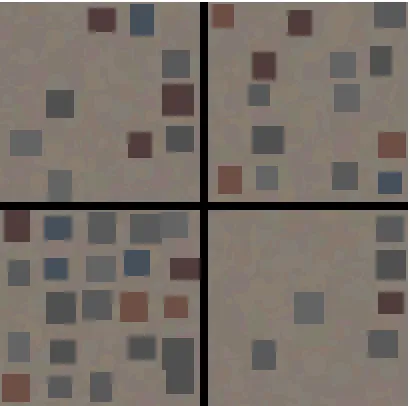
Parallel to learning to understand literature, a
slightly easier task was to understand the
preparatory work done by Max in the graduation
project before this one. Reading his report and
diving into his code allowed for a better look into the
process of Max. His steps were considered in the
earliest phases of this project. His main
contributions to this project are a simple method for
creating synthetic images (examples in Figure 1
Synthetic data version 1 (Max) example) using the
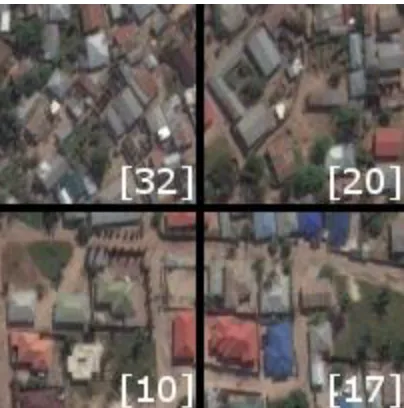
Pillow fork (v6) of the PIL library for Python10, the
labelled validation data (example in Figure 2 (next
page), this shows labels on top that usually are put in a separate file leaving the validation
images clean without text) and some early work using published models or derivatives of
published models to try for some results in the context of this project.
[image:15.612.336.541.311.514.2]4https://keras.io 5https://www.python.org 6https://www.tensorflow.org 7http://nl.releases.ubuntu.com/16.04/ 8https://jupyter.org/ 9https://www.youtube.com/playlist?list=PLZbbT5o_s2xrwRnXk_yCPtnqqo4_u2YGL 10https://pillow.readthedocs.io/en/stable/
In his experiments, Max concluded that his model
was not working as it always predicted the same
value resulting in a high error. In trying to re-use his
code, lack of documentation and issues with
versioning meant his code for training a model could
only be used as inspiration. Looking at the parts of
Keras he used in trying to define a model based on
literature, it seems there might be bugs in using the
chosen Inception networks in the current version of
Keras. This meant that for the tinkering phase
another published network has been chosen.
Max’ other work has seen more use. The code for
creating synthetic data has been adapted into something featuring more options based on
experiments and the validation data has been used throughout the whole project but will be
evaluated in the evaluation chapter.
Tinkering
As part of the course for learning to work with Keras, some assignments accompanied the
mentioned Keras tutorial series. These dealt with categorising cats versus dogs in images using
a published pre-trained network called VGG16 [16]. The same model was picked for creating a
baseline result based on a comparative study of well-known published networks [18], previous
experience in working with the model during the orientation phase and its relatively
straightforward structure. This baseline model was a standard VGG16 network with an
ImageNet [15] pre-training and featured a fully connected layer of size 768 and a dropout layer
of 35%, keeping 65% of these nodes randomly during training in the last layers. These last
layers were chosen the same as in the model used for the research of Rahnemoonfar, and
Sheppard (2017). In every layer the ReLU (Rectified Linear Unit [22]) activation was used and
for training RMSprop [23] was used as an optimizer. After some reading and seeing common
practise of people in this field it seemed this choice would yield the best results normally.
Research
Parallel to tinkering, after the first encounters with the theories behind deep learning and
ConvNets, more research went into understanding the field of deep learning and the use of
[image:16.612.338.540.70.274.2]ConvNets in counting problems. It proves to be a very active and young research field. The
result of this phase was an earlier version of the state-of-the-art from which chapter 2 is derived
as well as a workplan for the second half of this 20-week-long project.
The use of most of this research would be to supply knowledge and experience for the
experimenting phase. In this phase different customized models are iteratively tested to improve
upon the baseline result. This is in line with the second path defined in the preliminary
conclusion of the state-of-the-art review. This path was chosen for several reasons. Training
using ImageNet would provide the model with filters that were too complex for the relatively
simple synthetic data used in training. In the earlier layers of the model, it was important to
experiment with different sizes of filters as it might yield an approach that would better fit the
context of this project. These experiments are documented in the next chapter. These
experiments will help in answering the research question in the end.
Requirements
In Max’ report, several requirements are mentioned and based on the requests made during this
project, his requirements are applied to this project when suitable. These requirements are
mostly about the produced code, synthetic data and model.
1. A program must be written to simulate images.
a. The images made using the program should be representative of the key
features found in the real data to provide valuable training to the deep neural
network.
b. The program must be written in Python and make use of some type of image
creation/manipulation library.
c. The code must be useable for other researchers, use clear semantics and stick
to one type of coding convention.
d. The program does not require a user interface; it is assumed that the user is
familiar with Python.
e. The program must be able to create multiple images with an amount specified by
the user.
f. The program must be able to save the generated images to a specified folder on
the user’s computer
2. A deep neural network must be created that can be trained on the simulated data and
validated on real data.
a. The neural network must be able to successfully learn to count from simulated
b. The neural network must be made using some deep learning environment
c. The neural network must be able to display its predictions to the user.
d. The predictions should be ordered by error and be displayed by the best and
worst, allowing for detection of patterns in wrong predictions.
e. The neural network must allow the user to input new data and make predictions
Chapter 5 Realisation
The realisation of this project consisted of several weeks of experiments to improve the results
of the model in predicting on the real data. The training of the model, the model itself and the
synthetic data have been improved iteratively in experiments. This chapter will show all
experiments while next chapter will evaluate on the experiments and the choices for improving
along the way. As reasoning for why experiments are done was a key aspect of this phase in
the project, reasoning of certain parts of design will be shown in this chapter, while the
evaluation in next chapter will show a discussion of results and critical notes for the experiments
in cases where things could have gone better or other choices (should) have been considered.
For the overview of all experiments see ‘Appendix 1 - model and training experiments tree’ and ‘Appendix 2 - data experiments tree’. In the first category, improvements on the model and the
training method are put. This process has been the focus in this project. Parallel to that the
synthetic data has been improved, which is documented using different versions of the synthetic
data. The experiments will be documented in chronological order. Before experiments start
using a different version of data in training, the improvements to the synthetic data will be
documented as well. Results of the experiments are evaluated using a quantifier for the error
called mean squared error (MSE), this calculation is described by the formula 𝑚𝑠𝑒 =
1
𝑛∑ (𝑌𝑖− 𝑌̂𝑖) 2 𝑛
𝑖=1 , with 𝑛 the sample size, and 𝑌𝑖− 𝑌̂𝑖 the error between label and prediction.
For this and the next chapter, training and validation graphs are put in ‘Appendix 5 – result graphs of training and validation on real data per model’. These are used as indication for the model’s performance in both training and testing (validation on real images). Training results are indicative of the model’s capability of understanding its training dataset, while testing results show the model’s capability in generalizing this training to real situations.
Baseline model
Before April – Pre-Baseline model
Using the synthetic data and validation data provided by Max and the model described in the
Tinkering section (see Appendix 3
-
VGG baseline network architecture for a full visualization)a baseline performance was set. The results for this model were positive because it was able to
count the rectangles in the synthetic data accurately. In contrast, trying to generalize this
knowledge to the real data resulted in a very large error. The model failed in understanding the
April – Synthetic data version 2, creating a more representative synthetic dataset
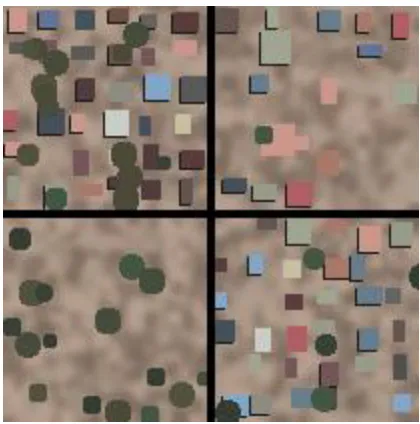
The goal of synthetic data is to be a feature-wise
representation of the real data. As a first step in
improving upon the results of the baseline model,
an attempt was taken at improving the synthetic
data (see examples in Figure 3) as Max’ version
was very basic. Various things were added and
improved:
• The number of generated images was
increased from 1000 to 2000. Increasing
this amount means the model sees more
diverse range of possible scenarios and
should be better at generalizing to
situations not previously encountered.
• The grid in which the houses are placed, was changed from a 5x5 grid to a 6x6 grid,
changing the image dimensions to 102x102px. Looking at the validation data, the range
in which the images are picked is between 0 and 40 houses. To create a more
representative training set, also higher density images are added to the training set.
While dealing with a regression problem should enable the model to extrapolate its
knowledge, it seemed useful to also train on high density images.
• Overlapping in generation of houses was fixed as this had been mentioned to be
undesirable in the report of Max but was still appearing in his data generation.
• The colour scheme of the data was updated to reflect the colours of the real data better,
also creating more colourful images overall.
• Using these newly picked colours, the background generation was updated to be more
representable of the background in the real data. Backgrounds are generated using the
method mentioned in Rahnemoonfar, and Sheppard (2017).
• A possibility was added to generate bigger houses. In the real data most houses are not
only rectangular, but have different shapes consisting of multiple rotated rectangles
connected to each other. These bigger houses occupy a 2x2 section of the grid and are
[image:20.612.330.540.89.301.2]generated using several random rectangles in the same colour.
• Trees are randomly added to the images using colours from the real data set. This is
because trees might also be recognised as houses by the model and in this way the
training should prepare the model to distinguish between houses and trees.
• After analysing images of Tanzanian suburbs, shadows are recognized as a key feature
of the dataset. Therefore, shadows are added to the generated houses with a chance of
about 80%.
April – Baseline model
The baseline model was trained on the second version of synthetic data to create the official
baseline result. The performance of this model was used in comparison to later results to
evaluate performances of later models.
Custom model
Late April – CustomV1, defining a first custom version of the baseline
Custom model version 1 is the first custom adaptation of VGG16 (see full model architecture
template (version 2) in Appendix 4 - custom template model visualisation). Featuring two
convolutional layers of respectively 7x7 and 5x5 filter size, and a 3x3 (stride 2) max pooling
layer as first three layers. These layers were chosen inspired by the paper of Rahnemoonfar,
and Sheppard (2017). The first big convolutional layer should recognize the obvious rectangular
features of a house, while the following layers condense this information into a prediction of the
total amount of houses. Version 1 features two fully connected layers of size 768 before the last
layer, in combination with a dropout of 35% that is standard for every model from now on except
otherwise mentioned. All custom models use ReLU as activation in all layers and Adam as
optimizer for training, except otherwise mentioned.
Late April – CustomV2, testing one fully connected layer versus two
This alternative to version 1 features only one last fully connected layer with 768 nodes.
Training this model did not yield significantly different result than the first version. As the first
model contained more variables, its training used more time. Models from now on use one fully
connected layer of size 768 at the end, except otherwise mentioned.
Late April – CustomV3, testing RMSprop and sigmoid versus Adam and ReLU
This experiment tests using RMSprop [23] as optimizer and the sigmoid11 activation function in
order to check their performance against the chosen Adam [24] and ReLU combination. It
shows no learning during training and after being unable to fix this problem, following
experiments use the latter, working combination.
Start of May – CustomV4, finalizing workflow and adding data augmentation
After re-evaluating the structure of the last layers, version 4 fixes an applied, but uncommon
practice. In previous versions, the output volume of the last pooling layer is directly connected to
the fully connected layers and just flattened before the dropout layer. This is changed to the
common practice of first flattening the output volume of the last pooling layer before fully
connecting these nodes. This change is also included in the baseline model before the final
baseline result is generated.
Version 4 also introduces the practice of augmenting training data. This means the model will
not only be trained on the images provided in the synthetic dataset in the way they are
generated, but also in ways that are slightly different. Augmentations that are applied (in small
amounts) are colour shifting, introducing image skewing, rotation and horizontal and vertical
flipping. This makes the generated dataset even more representative of the real world as it
should also enable the model to learn to recognise houses from the real dataset that are slightly
dissimilar to the synthetic data, for example houses that are rotated. The data augmentation is
applied in all following experiments and in the training associated to the results of the baseline
model.
May – CustomV5, testing 65% dropout rate
Version 5 is version 4 with a very high dropout rate of 65%.
May – CustomV6, replacing big convolutional layers with several smaller convolutional
layers
Version 6 tries to implement a practice to decrease the number of variables in a network by
replacing the big convolutional layers with smaller ones. The two first, large convolutional layers
are replaced by 3 3x3 convolutional layers. This is not exactly equivalent as 3 3x3 layers
resemble only one 7x7, but this simplification is also part of the experiment.
May – CustomV7, testing version 4 with two convolutional layers
Version 7 is version 4 with two fully connected layers, like version 1.
May – CustomV8, testing 65% dropout rate under new training variables
Version 8 is the same as version 5, but before training, the training variables are tuned and
learning rate is decreased. For the first time predictions are visualised to see what the model
May – CustomV9, comparing 50% dropout rate to 65%
Version 9 is version 8 with a dropout of 50%. The prediction visualisation is expanded by a
visualisation of the best and worst predictions for the validation data. From now on, this is used
to find common features in the worst predictions to improve the training process and synthetic
data.
Late May – CustomV10, comparing 35% dropout rate to 50% and 65%
Version 10 is version 4 under training conditions of version 8. Five iterations of improving the
synthetic data are done using this experimental setup.
Late May – Synthetic data version 3, testing small improvements to version 2 data
Several additions and improvements are implemented in the code for generating synthetic data,
testing the effect by training the custom model 10 and reviewing the results of predicting on the
validation dataset.
Version 3.1, introducing larger (n=10k) set and adding grass to background
• Generated set is 10k images large• Implements randomized grass coloured shapes in the background
• Puts trees on grid between houses to prevent putting trees in houses, trees are still
allowed to overlap houses and can appear in big houses as they occupy a 2x2
section of the grid
Version 3.2, large set improves generation of grass, trees and small houses
• Generated set is 10k images large• Improves grass creation by randomizing generated shapes better
• Increases smallest size of small houses
• Implements switch statement for generating images with relatively few trees versus
images with relatively large amount of trees
Version 3.3, small set to test adding more green colour to background
• Generated set is 2k images large• Implements switch statement for the colours used in background and grass creation,
resulting in sand-coloured backgrounds with grass patches (standard) and green
backgrounds with sand patches
• Improves big house generation by assuring that big house segments are always
Version 3.4, small set to test blurring final image
• Generated set is 2k images large• Puts a final blur over the generated image
Version 3.5, large set without blur to test adding fences to data
• Generated set is 10k images large• Removes blur from version 3.4
• Implements random shadow coloured lines in the image to resemble fences
June – CustomV11, test stride (5, 5) in the first convolutional layer
Version 11 is the first in a row of experiments that change the stride value in the first few layers.
This version implements a stride (5, 5) for the first 7x7 convolutional layer. A bigger stride would
allow the model to scan the images with less overlapping filters and this could help in situations
where the model counts houses twice. Implementing a stride makes the output of a layer
smaller as less output values are generated. In this experiment the structure of the model is not
changed other than its first layer.
June – CustomV12, test stride (3, 3) in two first layers
Version 12 implements strides of (3, 3) in both first convolutional layers. As this decreases the
output volume significantly, the first max pooling layer is removed, and the final fully connected
layer is decreased in size to 256 nodes.
June – CustomV13, test stride (4, 4) in two first layers
This experiment tests the impact of stride (4, 4) in the first layer of version 12.
June – CustomV14, stride (5, 5) in two first layers with shallower model
This experiment tests the impact of stride (5, 5) in the first layer of version 12. It removes a set
of 2 3x3 convolutional layers and a 2x2 max pooling layer at the end to account for a decrease
in output volume of the earlier layers.
End of June – Synthetic data version 3.6, test removing additional green in the
background
Combining the best results of the experiments with custom model version 10, a synthetic data
version was created in which the switch for green with sand patches background was removed
End of June – CustomV12 with linear regression model
Together with using the data version 3.6 in combination with custom model version 12, which
produces the best results yet. This model combines the deep convolutional neural network with
a linear regression model. Taking the output of the ConvNet and putting it through a linear
regression model yields the final prediction. The linear regression model is implemented using
the LinearRegression class from the scikit-learn (v.0.21.2) library12.
Chapter 6 Evaluation
The first part of this chapter follows up on chapter 5, where all experiments and their structural
changes were described. This will explain design choices, mention decisions considering the
flow of the project, discuss errors made in the experiments and finally evaluates the project.
Per model
Per model the thoughts behind the experiments and some reconsiderations after the fact are
described.
Pre-Baseline model
The pre-baseline model acts as the first baseline. However, as the workflow for saving results is
not yet defined during this experiment, recordings of this experiment are made afterwards. After
this first result experimental iterations are already made, defeating the purpose of a baseline in
one way, but providing a more representative result as a baseline in the end.
It is concluded after seeing the performance of this model that it has a very hard time
interpreting the real data. And thus, a more detailed and complex version of synthetic data is
tested.
Synthetic data version 2
In the second version of the synthetic data several drastic changes are made to the synthetic
data. These have not all been individually tested. When tested they were not recorded for the
same reason of the pre-baseline model. The changes made to the data are ones that do not
always follow from findings in experiments, but rather follow from intuition about learning in deep
learning models and trying to make the synthetic data more representable of the real data
based on what is seen in this real data.
Baseline model
The baseline model knows several iterations before becoming a baseline result. This is the
result of being thrown in the deep quite quickly after a relatively short tinkering phase. In this
tinkering phase, practices around training a ConvNet were still very new and several base
requirements had to be met before continuing to the experiments phase. While setting up the
training environment properly and implementing ways to save the results of the experiments,
some attention also went out to improving the synthetic data. As the workflow that allowed
further experiments to take place was refined enough, the synthetic data had been improved
baseline result of generalisation to real data very much by decreasing the error in case of
testing the model on real data.
CustomV1
This model was defined because training from scratch without the pre-training on the ImageNet
data was preferred but difficult with the via Keras implemented VGG16 network. The
pre-training of the model based on the ImageNet data equipped the model with very good filters for
looking at data that is found in the ImageNet database. The ImageNet dataset mostly consists
of real images of organic objects, like cats and dogs, or real-life objects, like cars and boats. In
the tinkering phase with the categorization problem of cats and dogs, this allowed the model to
quickly apply its pre-training to the supplied organic retraining data and allowed for achieving a
high accuracy. However, the synthetic data in this project requires another sort of filters as it is
mostly made up of simple colours and simple shapes. Using the advanced pre-trained
knowledge would probably introduce too much knowledge of the real world and disallow the
model to distinguish only houses.
CustomV2
As different models in literature used multiple fully connected layers in the end to arrive at a
conclusion, the first model was compared to the second to see if this would also improve the
results in this case. Using less variables did not influence the results significantly and caused
shorter training times. This led to the conclusion of making this the standard.
CustomV3
The third experiment would have been very useful if executed correctly. The reason this version
would not converge during training was that the input images were not normalized. This
normalization will only find place after trying to use sigmoid on version 12 and understanding
that sigmoid cannot deal with the values in the network in the same way as ReLU can. Sigmoid
deals with numbers between 0 and 1 and ReLU functions between 0 and the maximum number
at that moment. This means, the experiments are still valid, but this experiment has no value as
it fails to compare two setups. It shows however, that applying sigmoid to a regression model
might be complicated as outputs of predictions are not between 0 and 1 and therefore the model
is unable to decrease its error.
CustomV4
In the fourth experiment the final layers are implemented properly. Due to this error the earlier
models should only be taken as indication. Additionally, to enhance training, the synthetic
example. The introduction of this data augmentation means the data is very diverse and thus
creates a more challenging training environment. This results in a high error in validating on real
images.
CustomV5
This experiment tries to make generalization better by using a very large dropout value. This
65% was suggested by the supervisor because of its mention in the paper of Rahnemoonfar,
and Sheppard (2017). However, what they meant with the dropout value of 65% they use (which
they mention under section 4.1), is what they explain at the end of section 3.4 where they
mention that “[s]ixty-five percent of connections were randomly kept while training the network.”
As version 4 and 5 both show similar results and training on the synthetic data seems even
more difficult for this model, this experiment fails to show the usefulness of such high dropout
value.
CustomV6
In networks like Inception and VGG only convolutional layers with small filters of 3x3 are used to
represent larger filters, stacking two 3x3 convolutional layers should perform similar to a 5x5
convolutional layer, but saves on quite a bit of variables [16, section 2.3]. This experiment tests
this by replacing the first two convolutional layers by 3 3x3 convolutional layers. This is not a
one-to-one conversion, but also tests if maybe a shallower option would perform better. Training
this model is easier, but its results are slightly worse than the models with the large
convolutional layers.
CustomV7
Like the first experiment, this one tests if more fully connected layers at the end could improve
the results. Here it seems to matter as in comparison to version 4, the training converges better
and the result has a smaller error. Although version 7 improves upon version 4, implementing a
second fully connected layer did not prove useful for the final version 12.
CustomV8
The error in all previous custom experiments has never been smaller than the baseline result in
experiments with a model that would be comparable and adheres to common practice around
fully connected layers. Therefore version 8 tries to improve the result of version 5 by decreasing
the learning rate in training (to 0.0001) to see if this means the model will be more successful in
training valuable knowledge. From the results it seems the model is now performing much better
are defined to see the result of smaller dropout values, as this one still uses the extreme
dropout value that was not proven useful in version 5.
CustomV9
Using the new training setup from version 8, this experiment tries version 4 with a dropout of
50%. This is the most extreme dropout value tested in Rahnemoonfar, and Sheppard (2017),
which was not picked as it showed worse performance than the value of 35%. To improve the
results of this and future experiments, a best versus worst visualisation is added. In analysing
the worst images for common features, representing these features in the synthetic data might
prepare the model better for future predictions. This is what happens in the next experiment.
CustomV10
This experiment is the exact same as version 4 but uses the improved training variables
introduced in version 8. The dropout value of 35% means training is not too challenging to
perform well on real data. The performance of this model trained on the second version of the
synthetic data is an improvement over the baseline result. To see if this can be improved
further, the synthetic data is modified five times to improve the predictions on the real data.
Synthetic data version 3
Because testing the model has led to a model that performs better than the baseline model,
several tests are run with a new version of synthetic data. These experiments aim to improve
the models feature recognition in the real data, to prevent false positives and counting features
that are not houses.
Version 3.1
In the background of the real images, this new version adds some randomized green
patches in the background to prepare the model for houses that might be placed on
grass and could stay undetected before. Putting the trees on the grid cleans up the
training set by preventing houses to be overlapped too much by the random placement
of the trees which would make it more difficult for the model to know what it is exactly
counting. The new method allows only partial overlapping of small houses as the trees
will only be put between houses, overlapping only with some of their foliage.
Version 3.2
To improve the training set more, the changes in the May version 1 data are tuned
slightly. A different tree generation method is tested to allow for a better representation
on images of regular suburban areas with about 15 – 25 houses on them. Worst
predictions after training on both first versions of data are unclear images with high
density areas (30+ houses), images of green areas with less than 5 houses and images
that feature a road or fenced areas. Both first sets are 10k images large and this allows
for better training.
Version 3.3
Implementing a switch between green with sand patches background and the standard
sand with green patches background is tested. The reason for this change is that there
are several images with no houses on them in the validation set, that have high counts
as predictions. However, after training on this set, the results do not show this
improvement convincingly.
Version 3.4
To imitate the blur apparent on most images in the validation set, this experimental
dataset tests the effect of blurring the synthetic data. The results are worse than the
other version 3 datasets, but the model performs well on the high-density images that
are the most unclear images of the dataset. This shows that it might be possible to deal
with images of lower resolutions by creating low resolution training data.
Version 3.5
To achieve better results the final test on version 10 adds fences to the May version 3
images. This improves the results of the model slightly and proves that adding features
to the data can be useful to prepare the model for these features in the real dataset.
However, the overall improvement achieved by this tinkering with the data is smaller
than initially hoped and the model is not yet capable enough to give good indications of
the number of houses found on the images in the dataset.
CustomV11
Trying to improve the predictions of the model, a new set of experiments is defined. In these last
experiments the first layers are tested with different strides. A different stride could help to scan
for only houses better and would prevent double counting if that would occur, although double
counting did probably not occur in most cases as it was not found in analysing the worst results.
This version has similar results to version 10 trained on blurred synthetic data version 3 (May
version 4).
Applying a less extreme stride to the first two convolutional layers is tested against version 11
and shows much better results. Analysing the worst predictions introduces the suspicion that the
validation data is labelled incorrectly in some cases and some of the predictions make more
sense than the labelling itself. A new labelling is made, but as there is no documentation on
what should be labelled, this labelling is too strict and does not improve the results.
Version 12 is also tested with sigmoid activations and upon better inspection shows the need for
normalisation of the input data as mentioned in version 3. No new sigmoid experiments are
carried out after applying the normalisation.
CustomV13 and CustomV14
Both version 13 and 14 make use of the new, strict labelling. Comparing to version 12, these
experiments both predict better on this interpretation of the validation dataset. To test against
version 12, bigger strides are applied for the first layer. For version 14 the results are interesting
as its structure has been modified quite heavily, making the model shallower than the others.
The findings of these experiments are not comparable to the rest of the experiments as they use
a different validation labelling.
Synthetic data version 3.6
Evaluating the results of tests with the five earlier mentioned version 3 datasets, dataset 6 is
defined. Using a 10k large dataset is required in training the latter models and a bigger set could
be even better, although not tested. The change from May version 3 with the switch for
background colours is removed as this introduced an error and removing it should lead to the
best results yet.
CustomV12 with linear regression model
Analysing the final predictions, a certain trend is recognized. This probably means that the
model can roughly estimate the number of houses but also encounters uncommon features in
the validation data that influence the final prediction. This trend could be resolved applying a
linear regression model after the deep learning model. Applying this linear model, yields the
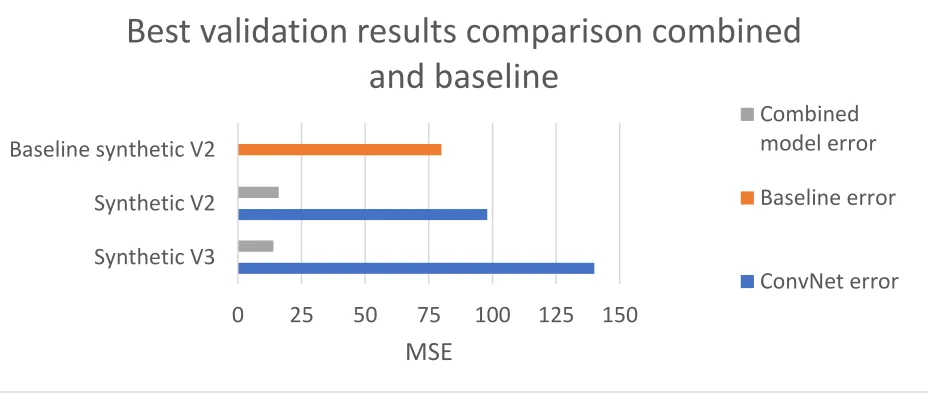
best results yet. As the final solution, this combination of models achieves a validation error of
average. The results for this model are shown in Figure 4 (next page). This model provides a
[image:32.612.74.538.120.320.2]satisfactory indication of the amount to houses in real-world images based on synthetic training.
Figure 4 Best validation results combined model (for v2 versus v3 synthetic data)
0
25
50
75
100
125
150
Synthetic V3
Synthetic V2
Baseline synthetic V2
MSE
Best validation results comparison combined
and baseline
Combined
model error
Baseline error
Project
The project is evaluated in three different parts: preparation, experimentation and evaluation.
Preparation
At the start of this project, a lot of preparatory work had to be done. The work of Max was
supplied, but there was no documentation on his code, which limited the ability of transferring
his work. Due to a lack of experience and knowledge in this field, the initial research was very
broad and forming an intuition was a tough task. After several guided tutorials and reading
about the matter, a basic knowledge and skill was acquired which served as the preparation and
introduction to the subject matter.
Experimentation
Experiments at the start of this phase are more tinkering than guided experiments and find
place under conditions that allow the results to only be indicative. The earlier experiments
provide an environment that enables the following experiments to take place and produce
results. Throughout the project errors are made due to inexperience and lack of knowledge. At
the end of the project, training some of the earlier recorded models again, the results differ from
the ones recorded when doing the experiments for the first time. However, a certain intuition
and skill in doing experiments with ConvNets is acquired and finally a good result is achieved.
Evaluation
Due to the complexity of the problem, the experiments took place till right before the final
presentation and sometimes left little room to evaluate properly in between. This should
sometimes have gotten more attention, which would have allowed for a more focused and
organised approach. Evaluating at the end, the process to a solution is also a process of
learning to understand just a bit about deep learning with ConvNets. This is not a bad thing but
Chapter 7 – Conclusion
In the conclusion, an answer to the main research question should be defined based on the
findings of the project. The research question will be repeated here for clarity:
In what way should a deep convolutional neural network be designed to train on synthetic data
in a regression problem dealing with counting while being able to generalize its knowledge well
in real-world test situations?
First, it should be mentioned that this project only provides start of an answer to this question
and that research in this area is evolving in the meantime to propose new and innovative ways
which define better answers to this question already. Some of these will be mentioned in the
next chapter.
This research compares transfer-learning a published model, VGG16, to a custom-built model
that implements and tests some suggestions from other research done in this area. From this
comparation, it is concluded that creating a customized model, while complicated, probably
yields a better solution to a specific problem than a general published network.
Key findings in this research project are about synthetic data (1) and creating a custom model
(2).
1. Starting with a very simple synthetic dataset (version 1) to train a deep ConvNet to train
it for looking at complicated real data is not very effective. Training on more
representative and more complex synthetic data provides a better result when testing
the model on real data. Designing synthetic data is a complicated task and should be
done while iteratively testing the alterations made to the data. Keeping in mind that
adding features in the synthetic data also creates a more challenging training
environment.
2. One of the biggest challenges in creating a custom model is overfitting. Applying a
dropout and some structural decisions about small fully connected layers help in battling
this. Using big filters and strides in the earlier layers in the final model seem beneficial to
the model’s capability in predicting on real data. Training variables, like learning rate, are
an important part of the model optimisation.
In the end a model is defined that can indicate the number of houses on images in the provided
validation dataset. After the output of the deep learning model, a linear regression model is
of 3 on average. This performance is acceptable for the purposes of this project in this
experimental setting and with the provided validation set.
The requirements mentioned in Requirements are met by designing a custom model capable of
indicating the amount of houses on real data images, based on training with generated synthetic
data representative of this type of real data. Additionally, the code produced in this project will
be made retrievable and will be clean and documented well enough for learned users to be able
Chapter 8 – Future Work
While this work presents a final experimental, customised model that performs acceptably,
better results can be achieved by taking this work further and experimenting within this context
in a more structured way and with better contextual data. Several recommendations for future
work are defined:
1. Before building on this research, define a better, higher resolution validation dataset. As
this dataset is key part of this research, significantly more attention should be given to
acquiring and labelling this data, before continuing to experiment with models to test on
this data. The current validation dataset should not be reused without an effort to better
define and document the ground truth for this context.
2. In this project a very simple way of generating synthetic data is chosen to investigate.
Using this basic generation, improvements are made resulting in a synthetic dataset that
is more representative of the real data, but still quite abstract. This might limit the
model’s capability to understand the real data and might not be the best approach in this
sort of problems that deal with more complicated or diverse real data. Other methods
also considerable for future work: a hybrid version using cut out houses from real
situations, similar to the validation data or generating data using 3D programs [25] or
more realistic generation tools than the one used in this project.
3. Counting problems are quite new problems and the applied method of training the model
to count is just one of the possibilities. Another quite new and promising method of
counting uses training to generate density maps from input images, of which predictions
for the count are made instead of directly inferring the count from the image [26]. This
could be investigated in a context like the one in this project, by counting houses on
satellite images of bigger parts of cities instead of in the range of 40 houses.
4. The method of stacking two different models to arrive at better predictions should be
kept in mind when continuing this work. Using clearer validation images might already
solve the need for this practice, but in this project it allowed for a much better result in
the end.
After this project the accompanying code and datasets are made accessible for future work.
Mail the author of this report or the supervisor if there is interest in the code, datasets or other
Appendix 1 - model and training experiments tree
Baseline model VGG16, ImageNet pre-training,
FC768, DO35 Use Adam optimizer, ReLu activation from for following
experiments
CustomV1, simplified own version of VGG16, 2x FC768,
DO35
CustomV2, like V1 but 1x FC768
CustomV4, like V2 but uses proper flattening before last FC
layer.
Use data augmentation from now on
CustomV5 test V4 with DO65 CustomV7, test V4 with 2 FC layers
CustomV8 test V4 with DO65 but (from now on) better training variables (learning rate)
CustomV9 test V4 with DO50 and slightly tuned image input
size
CustomV10 test V4 with DO35
Trained using 5 improving versions of synthetic data
CustomV3, test V2 with RMSProp optimizer and sigmoid
activation
CustomV6, replace starting 7x7 and 5x5 by 3 3x3 convolutional
layers
CustomV11, V4 with stride 5 in first convolutional layer
CustomV12, improves on V11, stride 3 in first and second convolutional layer, FC256 instead of FC768, removes first
3x3 stride 2 max pooling layer
CustomV12 with added Linear Regression model CustomV13, V12 with stride 4 in
first layer