
University of Warwick institutional repository: http://go.warwick.ac.uk/wrap
A Thesis Submitted for the Degree of PhD at the University of Warwick
http://go.warwick.ac.uk/wrap/67147
This thesis is made available online and is protected by original copyright.
Please scroll down to view the document itself.
Covariate-invariant Gait Recognition using Random
Subspace Method and its Extensions
by
Yu Guan
Thesis
Submitted to the University of Warwick
for the degree of Doctor of Philosophy
Doctor of Philosophy
The Department of Computer Science
Contents
List of Tables vi
List of Figures ix
Acknowledgments xiv
Declarations xv
Abstract xvi
Chapter 1 Introduction 1
1.1 Biometrics . . . 1
1.2 Human Identification at a Distance using Gait . . . 2
1.3 Contributions and Thesis Outline . . . 4
1.3.1 Contributions . . . 4
1.3.2 Thesis Outline . . . 7
1.4 List of Publications . . . 8
Chapter 2 Literature Review 10 2.1 Categories of Gait Recognition Algorithms . . . 10
2.1.1 Model-based Representation . . . 11
2.1.2 Appearance-based Representation . . . 11
2.2.1 Challenges . . . 13
2.2.2 Databases . . . 15
2.3 Related Work . . . 18
2.3.1 Gait Recognition with Speed Covariate . . . 18
2.3.2 Gait Recognition with Camera Viewpoint Covariate . . . 20
2.3.3 Gait Recognition with other Unknown Covariates . . . 22
2.3.4 Gait-based Fusion Methods . . . 25
2.3.5 Gait Recognition from Low Frame-rate Videos . . . 26
2.4 Fundamental Knowledge for This Thesis . . . 27
2.4.1 Gait Feature Templates . . . 27
2.4.2 Subspace Learning . . . 29
2.5 Random Subspace Method (RSM): Properties and Applications . . . 30
Chapter 3 Robust Speed-Invariant Gait Recognition using Random Subspace Method (RSM) 33 3.1 Problem Statement and Motivation of using RSM . . . 34
3.2 Speed-invariant Gait Recognition System . . . 36
3.2.1 Random Subspace Construction . . . 36
3.2.2 Local Enhancer 1 (LE1) . . . 37
3.2.3 Classification by Majority Voting . . . 38
3.3 Experiments . . . 41
3.3.1 Cross-speed Walker Identification on the CASIA-C Dataset . . . . 42
3.3.2 Cross-speed Walker/Runner Identification in the Fixed-mode on the OU-ISIR-A Dataset . . . 44
3.3.3 Cross-mode Runner Identification on the OU-ISIR-A Dataset . . . 46
3.3.4 Discussion . . . 48
Chapter 4 Tackling the Elapsed Time Covariate using Multimodal-RSM 49
4.1 Problem Statement and Motivation . . . 49
4.2 Gait Recognition . . . 51
4.2.1 Gait Feature Templates . . . 51
4.2.2 RSM for Gait Recognition . . . 52
4.3 Face Recognition . . . 54
4.3.1 Face Cropping . . . 54
4.3.2 Face Identification . . . 54
4.4 Fusion Strategy . . . 56
4.5 Experiments . . . 57
4.5.1 Identification using Single Modality . . . 58
4.5.2 Tackling the Elapsed Time Covariate using Multimodal-RSM . . . 59
4.5.3 Algorithms Comparison . . . 60
4.6 Summary . . . 61
Chapter 5 Gait Recognition from Extremely Low Quality Videos through Incor-porating Model-based Information into RSM 65 5.1 Problem Statement and Motivation . . . 66
5.2 Incorporating Model-based Information into RSM . . . 68
5.2.1 AGI for Low Frame-rate Videos . . . 68
5.2.2 RSM for Low Resolution Videos . . . 69
5.2.3 Model-based Method for Low Quality Videos . . . 70
5.2.4 Fusion with Model-based Information . . . 71
5.2.5 Diversity Measurement . . . 73
5.3 Experimental Evaluation . . . 75
5.3.1 Dataset and Configuration . . . 75
5.3.2 The Effect of Random Feature Number . . . 76
5.3.4 Algorithms Comparison . . . 80
5.4 Summary . . . 81
Chapter 6 Reducing the Effect of Unknown Covariates using RSM-based Hybrid Decision-level Fusion (RSM-HDF) 85 6.1 Challenges, Problem Formulation, and Solution . . . 86
6.1.1 Gait Recognition Challenges . . . 87
6.1.2 Problem Formulation: A Dynamic Feature Selection Problem . . . 88
6.1.3 Classifier Ensemble Solution and its Extensions . . . 92
6.2 Extensions of RSM . . . 95
6.2.1 Local Enhancer 2 (LE2) . . . 96
6.2.2 Classification by Hybrid Decision-level Fusion (HDF) . . . 98
6.3 Experiments . . . 100
6.3.1 Datasets . . . 100
6.3.2 Parameter Settings . . . 101
6.3.3 Time Complexity Analysis . . . 103
6.3.4 Performance Gain Analysis . . . 103
6.3.5 Algorithms Comparison . . . 104
6.3.6 In Tackling the Clothing Challenges . . . 106
6.4 Summary . . . 107
Chapter 7 Robust View-Invariant Gait Recognition through Unitary Projected RSM-HDF (UP-RSM-HDF) 112 7.1 Problem Statement and Proposed UP-RSM-HDF . . . 112
7.1.1 UP-RSM . . . 114
7.1.2 UP-RSM based LE2 and LE3 . . . 115
7.2 Experiments . . . 118
7.2.1 Dataset and Experimental Settings . . . 118
7.3 Summary . . . 125
Chapter 8 Conclusion and Further Works 126
8.1 Thesis Summary . . . 126
List of Tables
1.1 Thesis chapters and the corresponding publications . . . 9
3.1 Algorithms comparison in terms of rank-1 CCR(%) on the CASIA-C dataset.
fn,fs, andfqdenote the speed types of the three probe sets (i.e., normal, s-low, and fast);fbis the bag-carrying probe set; the speed type of the gallery set isfn(i.e., normal). . . 43 3.2 The rank-1 CCR(%) distribution of DCM [Kusakunniran et al., 2012a] in
the cross-speed walking gait recognition. G/P denotes the speeds of the
gallery/probe. . . 43
3.3 The rank-1 CCR(%) distribution of the method 2DPCA+2DLDA in the
cross-speed walking gait recognition. G/P denotes the speeds of the gallery/probe. 43
3.4 The rank-1 CCR(%) distribution of RSM (our method) in the cross-speed
walking gait recognition. G/P denotes the speeds of the gallery/probe. . . . 44
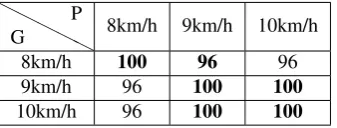
3.5 The rank-1 CCR(%) distribution of the method 2DPCA+2DLDA in the
cross-speed running gait recognition. G/P denotes the speeds of the gallery/probe. 45
3.6 The rank-1 CCR(%) distribution of RSM (our method) in the cross-speed
running gait recognition. G/P denotes the speeds of the gallery/probe. . . . 45
3.7 The general average rank-1 CCR(%) of RSM (our method) in the
4.1 Experimental settings on the TUM-GAID dataset [Hofmann et al., 2014].
Abbreviation note : N - Normal, B - Backpack, S - Shoe, TN - Time+Normal,
TB - Time+Backpack, TS - Time+Shoe. . . 55
4.2 The rank-1 CCRs (%) by using single modality on the 6 probes from the
TUM-GAID dataset. . . 58
4.3 The rank-1 CCR statistics (%) over 10 runs of our multimodal-RSM system 60
4.4 Algorithms comparison in terms of rank-1/rank-5 CCRs (%). Avg. denotes
the weighted average. . . 61
5.1 Datasets configuration. DB-high/DB-low has low/high gait fluctuations;
DB-outdoor has high levels of segmentation errors, and camera viewpoint
covariate. . . 76
5.2 Rank-1 CCR (%) of Model 1/Model 2 on the three datasets, given both the
probe and gallery videos with frame-rate at 1 fps and resolution of32×22
pixels. . . 78
5.3 Algorithms comparisons in terms of rank-1 CCR (%) on DB-high/DB-low,
given both the probe and gallery videos with frame-rate at 1 fps and
resolu-tion of32×22pixels. . . 81
6.1 12 pre-designed experiments on the USF dataset . . . 99
6.2 List of clothes used in the OU-ISIR-B dataset (Abbreviation: Name) . . . . 99
6.3 Different clothing combinations in the OU-ISIR-B dataset . . . 99
6.4 Performance statistics in terms of rank-1 CCRs (%) for 10 runs on the USF
dataset . . . 102
6.5 Running Time (Seconds) on the USF dataset . . . 102
6.6 Rank-1 CCRs (%) of our methods on the USF dataset . . . 102
6.7 Algorithms comparison in terms of rank-1/rank-5 CCRs (%) on the USF
6.8 Performance statistics in terms of rank-1 CCRs (%) for 10 runs on the
OU-ISIR-B dataset . . . 110
6.9 Algorithms comparison in terms of rank-1 CCRs (%) on the OU-ISIR-B dataset . . . 110
7.1 Settings of training/evaluation set . . . 120
7.2 The rank-1 CCR (%) of cross-view gait recognition using UP-RSM-HDF(LE2,LE3); G/P denotes the views of gallery/probe. . . 120
7.3 Algorithm comparison with rank-1 CCR (%) for probe view36◦ . . . 121
7.4 Algorithm comparison with rank-1 CCR (%) for probe view54◦ . . . 122
7.5 Algorithm comparison with rank-1 CCR (%) for probe view72◦ . . . 122
7.6 Algorithm comparison with rank-1 CCR (%) for probe view90◦ . . . 123
7.7 Algorithm comparison with rank-1 CCR (%) for probe view108◦ . . . 123
7.8 Algorithm comparison with rank-1 CCR (%) for probe view126◦ . . . 124
List of Figures
1.1 Biometric systems . . . 2
1.2 (a) CCTV images for the robbery case in Denmark [Larsen et al., 2008],
left: the perpetrator, right: the suspect; (b) CCTV images for the burglary
case in UK [Bouchrika et al., 2011], left: the perpetrator, right: the suspect. 3
1.3 The process of suppressing false votes (i.e., the effect of irrelevant features) 6
2.1 Gait representations for a subject on the OU-ISIR-LP dataset [Iwama et al.,
2012], (a) the original gait silhouettes (b)-(g) the 6 period-based feature
templates from left to right: GEI [Han and Bhanu, 2006], GEnI [Bashir
et al., 2009], MGEI [Bashir et al., 2010a], CGI [Wang et al., 2012],
G-FI [Lam et al., 2011], and FDF (with 0, 1, and 2 times frequency
ele-ments)[Makihara et al., 2006] . . . 12
2.2 GEIs of one subject walking in different walking conditions from the USF
gait dataset [Sarkar et al., 2005]. (a) is the GEI in normal condition.
(b)-(g) are the GEIs under the influences of (b) viewpoint, (c) walking surface,
(d) viewpoint and walking surface, (e) carrying condition, (f) carrying
con-dition and viewpoint, (g) elapsed time, shoe type, clothing, and walking
surface. . . 14
2.3 GEI examples from CASIA-B dataset [Yu et al., 2006] of a subject from
2.4 Gait images with different speeds from the OU-ISIR-A dataset[Makihara
et al., 2012] . . . 15
2.5 Gait images with several different clothes types from the OU-ISIR-B dataset
[Hossain et al., 2010] . . . 16
2.6 Gait images from CASIA-B dataset [Yu et al., 2006] of a subject from view
0◦to180◦, with an interval of18◦; . . . 16
2.7 Gait images from CASIA-C dataset [Tan et al., 2006] of a subject collected
at night environment using infrared cameras two different walking
condi-tions: normal walking and carrying condition, from left to right . . . 17
2.8 Gait images from TUM-GAID dataset [Hofmann et al., 2014] of a
subjec-t wisubjec-th six differensubjec-t walking condisubjec-tions: normal walking (in Jan.), wisubjec-th a
backpack (in Jan.), with a different pair of shoes (in Jan.), normal
walk-ing (in April), with a backpack (in April), with a different pair of shoes (in
April), from left to right . . . 18
2.9 Gait images in the outdoor environment from the USF dataset [Sarkar et al.,
2005] . . . 18
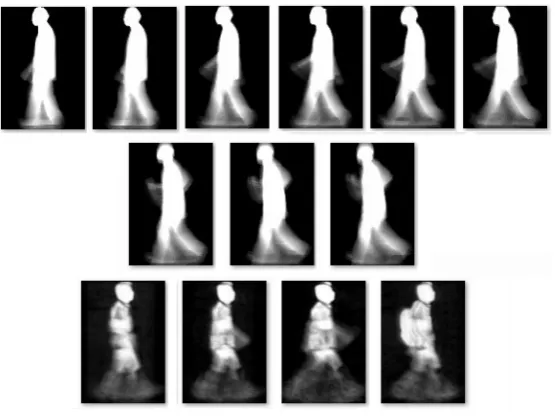
3.1 GEI samples from the OU-ISIR-A and CASIA-C datasets. Top row: GEIs
from OU-ISIR-A dataset with walking speed ranging from 2km/h to
7k-m/h (from left to right with an 1k7k-m/h interval); middle row: GEI samples
from OU-ISIR-A dataset with running speed ranging from 8km/h to 10
k-m/h (from left to right with 1kk-m/h interval); bottom row: from CASIA-C
dataset, the GEIs with slow/normal/fast walking speed, and a GEI sample
with a bag (from left to right). . . 34
3.2 Gait-based RSM . . . 40
3.3 The rank-1 CCR (%) distribution of the method 2DPCA+2DLDA in
cross-mode gait recognition, i.e., to identify unknown runners given the gallery
3.4 The rank-1 CCR (%) distribution of RSM (our method) in cross-mode gait
recognition, i.e., to identify unknown runners given the gallery of walkers. . 47
4.1 Gait images from the TUM-GAID dataset for a subject in 6 different
con-ditions. (a): normal; (b): backpack; (c): coating shoes; (d): elapsed time
+ normal; (e): elapsed time + backpack; (f): elapsed time + coating shoes.
Top row includes the gait RGB images while the bottom row includes the
corresponding GEIs. . . 50
4.2 The multimodal-RSM framework . . . 52
4.3 The process of generating the 3 feature templates, i.e.,T-Gait, Gait, Face . 53 4.4 Unimodal vs. Multimodal. . . 60
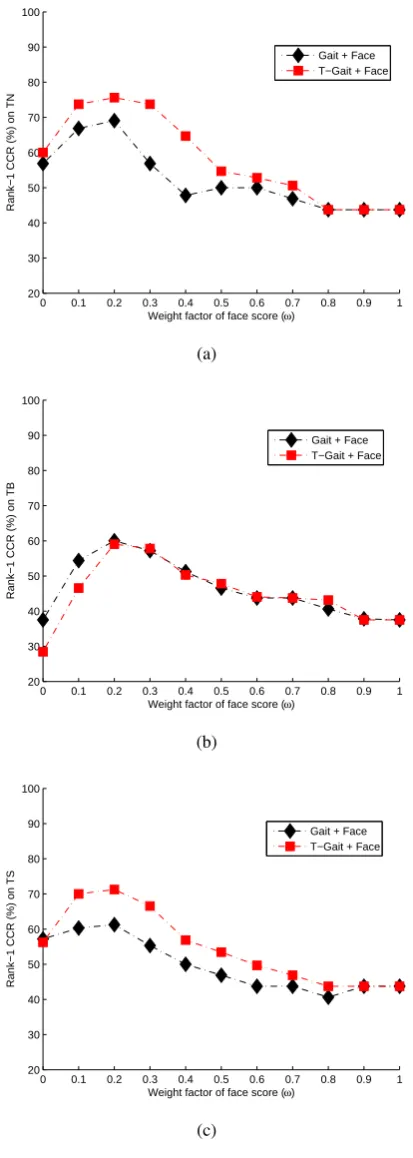
4.5 Using multimodal-RSM to tackle the elapsed time challenges on probes
TN, TB, and TS. . . 63
4.6 Using multimodal-RSM on probes N, B, and S. . . 64
5.1 Extremely low quality gait sequences (derived from videos with frame-rate
at 1 fps and resolution of32×22pixels). Top/middle row: from the indoor
OU-ISIR-D [Makihara et al., 2012] database with low/large gait
fluctua-tions; bottom row: from the outdoor USF database [Sarkar et al., 2005]. In
each row, the rightmost image is the AGI corresponding to the whole gait
sequence. . . 67
5.2 The process of generating feature vectors for model-based methods. . . 70
5.3 The rank-1 CCR distribution (%) with respect to the number of random
features (s), given both the probe and gallery videos with frame-rate at 1 fps and resolution of32×22pixels. . . 77
5.4 On DB-high, performance distributions with respect to the weight of
5.5 On DB-low, performance distributions with respect to the weight of
model-based information (ω). (a)-(d) are based on classifier ensemble with random feature numbers={20,40,80,160}, respectively. . . 83 5.6 On DB-outdoor, performance distributions with respect to the weight of
model-based information (ω). (a)-(d) are based on classifier ensemble with random feature numbers={20,40,80,160}, respectively. . . 84
6.1 GEI samples of the same subject from the USF gait dataset [Sarkar et al.,
2005]. First row: (a) gallery sample in normal condition. Second row:
probe samples under the influences of (b) viewpoint, (c) walking surface,
(d) viewpoint and walking surface, (e) carrying condition, (f) carrying
con-dition and viewpoint, (g) elapsed time, shoe type, clothing, and walking
surface. . . 86
6.2 An example on modelling the covariate effect by image difference between
the gallery GEI (i.e., Fig.6.1(a)) and a probe GEI (i.e., Fig.6.1(e)) . . . 87
6.3 Difference images between the gallery GEI Fig.6.1(a) and the probe images
Fig.6.1(b)-Fig.6.1(g) . . . 87
6.4 Normalised Euclidean distances from gallery sample Fig. 6.1(a) to probe
samples Fig.6.1(b)-Fig.6.1(g) based on different projection directions . . . 88
6.5 An example of hypergeometric distribution application in classical urn
prob-lem . . . 90
6.6 RSM-based HDF . . . 96
6.7 Data samples from (a) the USF dataset [Sarkar et al., 2005], and (b) the
OU-ISIR-B dataset[Hossain et al., 2010] . . . 99
6.8 On the performance sensitivity to the parameters on the USF dataset: (a)
6.9 The general ratioΓˆof between false votes to true votes distribution over the
12 probe sets on the USF dataset . . . 109
6.10 Performance distribution with respect to 31 probe clothes types on the
OU-ISIR-B dataset . . . 111
7.1 The concept of unitary projection . . . 113
7.2 GEIs in the CASIA-B dataset [Yu et al., 2006] from36◦ to144◦ with an
interval of18◦ . . . 114
7.3 UP-RSM-HDF . . . 115
Acknowledgments
First and foremost, I would like to take this opportunity to express my deepest gratitude
and respect to my supervisor Prof. Chang-Tsun Li, who constantly gave me support during
my PhD time at the University of Warwick. I benefitted greatly from his encouragement,
constructive advices, and financial support. I feel lucky to work with him, and look forward
to maintaining the collaboration in the future.
My parents, Dr. Huaimin Guan, Mrs Cuihua Wang also deserve my cordial
grati-tude. Their love, support and encouragement have always been the source of my strength
and the reason I have progressed this far. I also appreciate the support from my younger
brother, Mr. Xin Guan, who cooks delicious food for me everyday during the last year of
my PhD!
For my PhD research, I would like express my sincere thanks to Prof. Fabio Roli
(PRA Lab, University of Cagliari, Italy), Prof. Massimo Tistarelli (CV Lab, University of
Sassari, Italy), Prof. Liang Wang (NLPR, CASIA, China), and Prof. Tieniu Tan (NLPR,
CASIA, China) for inviting me for academic visiting. I benefitted a lot from the valuable
research experience from their labs. I would also like to thank the colleagues at Warwick,
particularly, faculty members Dr. Abhir Bhalerao, Dr. Victor Sanchez and PhD students
Miss Xingjie Wei, Mr. Yi Yao, Mr. Antonis Mouhtaropoulos, Mr. Ruizhe Li, Mr. Ning Jia,
Mr. Xufeng Lin, Mr. Alaa Khadidos, Mr. Xin Guan, Mr. Muhammad Hilmi Kamarudin,
Mr. Roberto Leyva, and Mr. Qiang Zhang. I get motivated a lot from them.
Yu Guan
Declarations
This thesis is submitted to the University of Warwick in partial fulfillment of the
require-ments for admission to the degree of Doctor of Philosophy. The work presented here is my
own, except where specifically stated otherwise, and was performed in the Department of
Computer Science at the University of Warwick under the supervision of Professor
Chang-Tsun Li during the period Oct. 2010 to Aug. 2014. The research materials have not been
submitted, either in the same or different form, to this or any other university for a degree.
Abstract
Compared with other biometric traits like fingerprint or iris, the most significant advantage of gait is that it can be used for remote human identification without cooperation from the subjects. The technology of gait recognition may play an important role in crime prevention, law enforcement, etc. Yet the performance of automatic gait recognition may be affected by covariate factors such as speed, carrying condition, elapsed time, shoe, walking surface, clothing, camera viewpoint, video quality, etc. In this thesis, we propose a random subspace method (RSM) based classifier ensemble framework and its extensions for robust gait recognition.
Covariates change the human gait appearance in different ways. For example, speed may change the appearance of human arms or legs; camera viewpoint alters the human visual appearance in a global manner; carrying condition and clothing may change the ap-pearance of any parts of the human body (depending on what is being carried/wore). Due to the unpredictable nature of covariates, it is difficult to collect all the representative training data. We claim overfitting may be the main problem that hampers the performance of gait recognition algorithms (that rely on learning). First, for speed-invariant gait recognition, we employ a basic RSM model, which can reduce the generalisation errors by combining a large number of weak classifiers in the decision level (i.e., by using majority voting).
We find that the performance of RSM decreases when the intra-class variations are large. In RSM, although weak classifiers with lower dimensionality tend to have better generalisation ability, they may have to contend with the underfitting problem if the dimen-sionality is too low. We thus enhance the RSM-based weak classifiers by extending RSM to multimodal-RSM. In tackling the elapsed time covariate, we use face information to en-hance the RSM-based gait classifiers before the decision-level fusion. We find significant performance gain can be achieved when lower weight is assigned to the face information. We also employ a weak form of multimodal-RSM for gait recognition from low quality videos (with low resolution and low frame-rate) when other modalities are unavailable. In this case, model-based information is used to enhance the RSM-based weak classifiers. Then we point out the relationship of base classifier accuracy, classifier ensemble accuracy, and diversity among the base classifiers. By incorporating the model-based information (with lower weight) into the RSM-based weak classifiers, the diversity of the classifiers, which is positively correlated to the ensemble accuracy, can be enhanced.
impact on unimodal systems. We model the effect of various unknown covariates as a par-tial feature corruption problem with unknown locations in the spapar-tial domain. By making some assumptions in ideal cases analysis, we provide the theoretical basis of RSM-based classifier ensemble in the application of covariate-invariant gait recognition. However, in real cases, these assumptions may not hold precisely, and the performance may be affected when the intra-class variations are large. We propose a criterion to address this issue. That is, in the decision-level fusion stage, for a query gait with unknown covariates, we need to dynamically suppress the ratio of the false votes and the true votes before the majority voting. Two strategies are employed, i.e., local enhancing (LE) which can increase true votes, and the proposed hybrid decision-level fusion (HDF) which can decrease false votes. Based on this criterion, the proposed RSM-based HDF (RSM-HDF) framework achieves very competitive performance in tackling the covariates such as walking surface, clothing, and elapsed time, which were deemed as the open questions.
The factor of camera viewpoint is different from other covariates. It alters the hu-man appearance in a global hu-manner. By employing unitary projection (UP), we form a new space, where the same subjects are closer from different views. However, it may also give rise to a large amount of feature distortions. We deem these distortions as the corrupt-ed features with unknown locations in the new space (after UP), and use the RSM-HDF framework to address this issue. Robust view-invariant gait recognition can be achieved by using the UP-RSM-HDF framework.
Chapter 1
Introduction
1.1
Biometrics
Biometrics is the study of identifying subjects based on their physiological or behavioural
traits. Physiological traits include face, iris, fingerprint, DNA, palm print, hand geometry,
etc. while behavioral traits include gait, typing rhythm, signature, etc. A biometric trait
needs to satisfy the following properties [Jain et al., 2004b]:
• Universality: each individual should have the trait.
• Distinctiveness: individuals can be well separated by the trait.
• Permanence: the trait should be sufficiently invariant over a period of time.
• Collectability: the trait can be measured quantitatively.
A biometric system based on a certain trait may have either a verification or an
iden-tification mode, depending on the application context [Jain et al., 2004b]. In the verification
mode, the system validates the claimed identity (of a subject) by comparing the query
bio-metric trait with his/her own reference trait stored in the system’s database. The system
conducts a one-to-one comparison to determine whether the claim is true or not.
Identity
Database
Feature Extraction
1 subject
N subject
features 1 to N
Matching
features
Database
Feature
Extraction True/False
1 subject
1 subject
features 1 to 1
Matching
features claimed
identity
Query Data
Query Data
Identification System Verification
[image:21.595.123.519.107.373.2]System
Figure 1.1: Biometric systems
In the identification mode, the system recognises a subject by searching all the biometric
templates of all subjects in the database for a match. The system conducts a one-to-many
comparison for a subject’s identity. Biometric identification is used more frequently in the
applications of law enforcement, e.g., latent fingerprint identification, human gait
identifi-cation. The flowcharts of both modes are shown in Fig. 1.1, and this thesis falls into the
category of biometric identification.
1.2
Human Identification at a Distance using Gait
Human identity recognition is fundamental to human life, and the technology of human
identification and tracking from a distance may play an important role in crime prevention,
law enforcement, search for missing people (e.g., missing children or people with
(a) (b)
Figure 1.2: (a) CCTV images for the robbery case in Denmark [Larsen et al., 2008], left: the perpetrator, right: the suspect; (b) CCTV images for the burglary case in UK [Bouchrika et al., 2011], left: the perpetrator, right: the suspect.
government buildings, streets and shopping malls for the afore-mentioned purposes. In
2013, the British security industry authority (BSIA) estimated there are up to 5.9 million
CCTV cameras nationwide, and that is around 1 every 11 people [Barrett, 2013]. Because
of the need for sufficient manpower to supervise such a large number of CCTVs, the need
for automatic human identification systems is acute.
Recently, a number of reports (e.g.,[Larsen et al., 2008] [Bouchrika et al., 2011])
suggested that behavioral biometrics, gait recognition, can be used for human
identifica-tion from CCTV footage. In [Larsen et al., 2008], based on a checklist for forensic gait
analysis, Larsen et al. managed to identify a bank robber in Denmark by matching
surveil-lance footage, as illustrated in Fig. 1.2(a). Fig. 1.2(b) shows a gait recognition scenario
in UK where a burglar was identified through gait analysis from a podiatrist [Bouchrika
et al., 2011]. These pieces of gait-based evidences proved their usefulness by providing
incriminating evidence, leading to convictions in a court of law. However, for automatic
gait recognition, covariate factors like camera viewpoint, carrying condition, clothing, etc.
may limit the performance. In this thesis, we aim to propose automatic gait recognition
1.3
Contributions and Thesis Outline
Our objective in this thesis is to propose gait recognition algorithms that are less sensitive
to covariate factors such as shoe, carrying condition, clothing, walking surface, view angle,
elapsed time, speed, video quality, etc. In this thesis, we view the effect of most of the
afore-mentioned covariates as a partial feature corruption problem with unknown locations,
and propose a framework based on the concept of random subspace method (RSM) [Ho,
1998]. To address the problems caused by some covariates (such as clothing, walking
surface, elapsed time, large view angel), we further propose several extensions of the RSM
framework.
1.3.1 Contributions
The contributions of this thesis are listed as follows.
Gait Recognition Challenges Modelling and an Unified Solution
We treat the effect of most of covariates as a partial feature corruption problem with
un-known locations. That is, various covariates (e.g., shoe, carrying condition, clothing, speed,
elapsed time, etc.) only affect parts of the silhouette in the spatial domain. Due to
unpre-dictable nature of the corrupted feature locations, it is difficult to use a single fixed classifier
for robust gait recognition. We provide a classifier ensemble solution for addressing this
is-sue, and point out its potential extensions. More theoretical details can be found in Chapter
6.
Gait-based Random Subspace Method (RSM): a Basic Model
We propose a basic RSM model for gait recognition. Initially, two dimensional principle
component analysis (2DPCA) is used for feature decorrelation. A large number of
ran-dom subspaces are constructed, with each subspace spanned by a subset of 2DPCA basis
fur-ther enhanced with supervised methods (e.g., two-dimensional linear discriminant analysis
(2DLDA) for the basic model), and we refer this process as to local enhancing (LE). The
final classification decision is achieved by majority voting among the output labels from the
base/weak classifiers corresponding to the random subspaces. We use this basic RSM
mod-el for speed-invariant gait recognition in Chapter 3. This basic modmod-el outperforms other
state-of-the-art algorithms significantly, which demonstrates its effectiveness.
RSM Extension 1: Multimodal-RSM
We extend the basic RSM model to multimodal-RSM. That is, we enhance the RSM-based
weak classifiers by using the classification score of other information to update the
gait-based classification score for each random subspace. In Chapter 4, we fuse face information
into the RSM-based gait recognition system to tackle the elapsed time covariate. In Chapter
5, for gait recognition in low-quality videos where face information is unreliable, we instead
use model-based information to enhance the RSM-based weak classifiers. We also study the
relationship of base classifier accuracy, classifier ensemble accuracy, and diversity among
the base classifiers.
RSM Extension 2: RSM-based Hybrid Decision-level Fusion (RSM-HDF)
We propose RSM-based hybrid decision-level fusion (RSM-HDF) strategy for improving
the performance of biometric (identification) systems. We construct a new criterion to
dynamically suppress the ratio of false votes and true votes before the majority voting. Two strategies are employed, i.e., the afore-mentioned LE which can increase true votes,
and the proposed HDF which can decrease false votes.
For each subspace, the random features are further enhanced by LE using two
dif-ferent supervised methods (LE1, and LE2). In a random subspace with irrelevant features,
LE would lead to label assignment (from the corresponding classifier) in a relatively
ran-dom manner. Based on the same irrelevant features, a classifier pair corresponding to LE1
Adaptive Feature Selection
39 :relevant feature
Same?
:irrelevant feature
Random feature selection
LE1-based classification
LE2-based classification
Y
N
One label based on
relevant features
(used for voting) Label 1
Label 2
Two labels based on
irrelevant features
(redundancy)
Figure 1.3: The process of suppressing false votes (i.e., the effect of irrelevant features)
the ”AND” rule, classifier pairs with different output labels are deemed as invalid votes
and simply discarded, which can suppress the false votes effectively. The afore-mentioned
process is illustrated in Fig. 1.3.1, and HDF is the majority voting after discarding the false
votes. As presented in Chapter 6, we use RSM-HDF to tackle the covariates like walking
surface, clothing, elapsed time, and observe that its performance is much higher than other
state-of-the-art algorithms.
RSM Extension 3: Unitary Projected RSM-HDF (UP-RSM-HDF)
Camera viewpoint is different from other covariates, and cannot be simply deemed as a
partial feature corruption problem in the spatial domain. Based on 2DLDA-based unitary
projection (UP), we form a new space, where the same subjects are closer from different
views. The trained UP matrix can transform gait from different views onto a common space
before the matching is performed.
Although UP may make the multi-view samples of a subject closer in the new space,
it may also give rise to significant feature distortions. We deem these distortions as the
corrupted features with unknown locations in the new space (after UP) and use RSM-HDF
to address this issue. In Chapter 7, we use UP-RSM-HDF for cross-view gait recognition,
In Tackling the Open Issues
Covariates such as (large changes in) view, clothing, walking surface, elapsed time, etc.
were deemed as the most challenging factors, which would significantly change the gait
appearance. We model the effect of these factors as a partial feature corruption problem
(in certain domains) with a large amount of irrelevant features. For query gaits in
differ-ent walking conditions, these irrelevant features vary in terms of size and locations. We
propose HDF to filter out the false votes (corresponding to the irrelevant features), before
the majority voting. We employ the proposed RSM-HDF and UP-RSM-HDF to address
the hard problems and our methods can achieve very competitive performance against the
afore-mentioned challenging factors, much higher than other state-of-the-art algorithms.
1.3.2 Thesis Outline
The rest of this thesis is organised as follows. In Chapter 2, first we review the relevant
liter-ature of gait recognition on feliter-ature representation categories, challenges, databases, various
algorithms against different covariates. We also introduce some fundamental knowledge on
feature templates, subspace learning, and the concept of RSM. In Chapter 3, we
intro-duce the basic model of gait-based RSM and use it for speed-invariant gait recognition. In
Chapter 4, we extend RSM to multimodal-RSM. We incorporate face information into the
RSM-based gait classifiers to tackle the elapsed time challenges. In Chapter 5, we use a
similar form of multimodal-RSM. We incorporate model-based information into the
RSM-based weak classifiers for robust gait recognition in low quality videos (low frame-rate and
low resolution). A study on the relationship of base classifier accuracy, classifier ensemble
accuracy, and diversity among the base classifiers is also provided. In Chapter 6, we model
the effect of covariates as a partial feature corruption problem with unknown locations and
provides the theoretical basis of RSM-based classifier ensemble method. A new criterion,
which is to suppress the ratio of false votes and true votes, for improved decision-level
fu-sion is proposed. This framework, namely RSM-HDF, is used to tackle difficult tasks with
cross-view gait recognition as a partial feature corruption problem with unknown locations
in a feature space constructed through unitary projection. Chapter 8 concludes this thesis
and suggests directions for future research.
1.4
List of Publications
We provide the full publication list for my PhD research on gait recognition as follows:
1. Y. Guan,C.-T. Li, and F. Roli, ”On Reducing the Effect of Covariate Factors in Gait Recognition: a Classifier Ensemble Method”. IEEE Trans. Pattern Analysis and Machine Intelligence, (T-PAMI), vol.37, no. 99, 2015
2. Y. Guan,Y. Sun, C.-T. Li, and M. Tistarelli, ”Human Gait Identification from Ex-tremely Low Quality Videos: an Enhanced Classifier Ensemble Method”. IET Bio-metrics. vol. 3, issue 2, pp 84-93, June, 2014
3. Y. Guan,X. Wei, and C.-T. Li, ”On the Generalization Power of Face and Gait in Gender Recognition”,International Journal of Digital Crime and Forensics (IJDCF). vol. 6, no. 1, pp 1-8, Jan. 2014
4. Y. Guan,, X. Wei, C.-T. Li, and Y. Keller, ”People Identification and Tracking through Fusion of Facial and Gait Features,”International Workshop on Biometrics (BIOMET), Sofia, Bulgaria, 23-24 June, 2014 (Invited Paper)
5. Y. Guan,X. Wei, C.-T. Li, G. L. Marcialis, F. Roli and M. Tistarelli, ”Combining Gait and Face for Tackling the Elapsed Time Challenges” in Proc. the 6th IEEE International Conference on Biometrics: Theory, Applications and Systems (BTAS), Washington DC, USA, Sept. 2013
Thesis Chapters Publications Content
Chapter 3 Paper 6 RSM: the basic model
Chapter 4 Paper 5 Multimodal-RSM
Chapter 5 Paper 2, 7 A weak form of Multimodal-RSM
Chapter 6 Paper 1, 9, 10 The theoretical basis of RSM and RSM-HDF
Chapter 7 - UP-RSM-HDF
Table 1.1: Thesis chapters and the corresponding publications
7. Y. Guan,C.-T. Li and S. D. Choudhury,“Robust Gait Recognition from Extremely Low Frame-Rate Videos,”in Proc. International Workshop on Biometrics and Foren-sics (IWBF), Lisbon, Portugal, Apr. 2013.
8. Y. Guan,C.-T. Li and Y. Hu, “An Adaptive System for Gait Recognition in Multi-View Environments,”in Proc. the 14th ACM Multimedia and Security Workshop (MMSec), Coventry, UK, Sept. 2012.
9. Y. Guan,C.-T. Li and Y. Hu, “Robust Clothing-Invariant Gait Recognition,”in Proc. the 8th International Conference on Intelligent Information Hiding and Multimedia Signal Processing (IIH-MSP), Piraeus-Athens, Greece, July, 2012.
10. Y. Guan,C.-T. Li and Y. Hu, “Random Subspace Method For Gait Recognition,”in Proc. IEEE International Conference on Multimedia and Expo Workshop (ICMEW) , Melbourne, Australia, July 2012.
11. Y. Guan,C.-T. Li and Y. Hu, “Gait Recognition under Carrying Condition: a Static Dynamic Fusion Method,”in Proc. SPIE Optics, Photonics and Digital Technologies for Multimedia Applications, Brussels, Belgium, Apr. 2012.
Most chapters of this thesis (i.e., Chapters 3-6) are highly related to some of the
Chapter 2
Literature Review
2.1
Categories of Gait Recognition Algorithms
Existing gait recognition algorithms can be roughly divided into two categories:
model-based and appearance-model-based approaches. Model-model-based methods aim to model the human
body structure for recognition, while appearance-based approaches can perform
classifica-tion regardless of the underlying body structure. Although model-based methods may
per-form well in some challenging cases (e.g., when the view change is large [Goffredo et al.,
2010]), they generally have lower performance than appearance-based methods. One major
reason is that when affected by self-occlusion, low resolution or other factors, it is often
difficult to estimate the body parameters precisely, and in this case they only provide
lim-ited information for recognition. Compared with model-based methods, appearance-based
approaches can more general and most of them use the whole gait image as input features.
Owing to the large number of features, a common approach adopted by appearance-based
algorithms is to perform dimensionality reduction. In this section, we introduce the feature
2.1.1 Model-based Representation
Niyogi and Adelson proposed one of the earliest model-based representation, i.e., a
five-stick model representing the body structure [Niyogi and Adelson, 1994]. In [Bobick and
Johnson, 2001], a recognition model was proposed based on the static body and stride
pa-rameters. Lee and Grimson fitted ellipses to seven regions of body and used the
correspond-ing parameters as gait signature [Lee and Grimson, 2002]. Cunado et al. modelled the gait
as moving pendulum and extracted the features from the hip angular motion [Cunado et al.,
2003]. Wagg and Nixon studied the model-based features through a statistical analysis and
found that most recognition power lies in static body shape parameters and cadence [Wagg
and Nixon, 2004]. Yam et al. proposed a model for walking gait and running gait
recogni-tion, which uses the signature derived from the angular motion of thighs and knees [Yam
et al., 2004]. Wang et al. used distances between boundary pixels to silhouette centroid
as model-based gait features [Wang et al., 2003a]. In [Kale et al., 2004b], the widths of
outer contour were used to represent the body structure. Most recently, after estimating the
poses of lower limbs, Goffredo et al. extracted model-based features based on the rectified
angular measurements and trunk spatial displacements for view-invariant gait recognition
[Goffredo et al., 2010].
2.1.2 Appearance-based Representation
One of the simplest appearance-based representation is the aligned binary gait silhouette.
Sarkar et al. proposed the gait recognition baseline method, and they used spatial-temporal
correlation on the aligned binary gait silhouettes [Sarkar et al., 2005]. However, such three
dimensional video classification problems often incur high computational complexity and
tend to be less robust to segmentation errors. To deal with these dilemmas, period-based
gait appearance templates were proposed in recent works that encode the information of
the frames from a gait cycle into a single image and formulate gait recognition as a two
dimensional image classification problem. On the OU-ISIR-LP dataset, consisting of more
(a)
(b) (c) (d) (e) (f) (g)
Figure 2.1: Gait representations for a subject on the OU-ISIR-LP dataset [Iwama et al., 2012], (a) the original gait silhouettes (b)-(g) the 6 period-based feature templates from left to right: GEI [Han and Bhanu, 2006], GEnI [Bashir et al., 2009], MGEI [Bashir et al., 2010a], CGI [Wang et al., 2012], GFI [Lam et al., 2011], and FDF (with 0, 1, and 2 times frequency elements)[Makihara et al., 2006]
period-based gait appearance templates including gait energy image (GEI)[Han and Bhanu,
2006], gait entropy image (GEnI) [Bashir et al., 2009], masked GEI based on GEnI (MGEI)
[Bashir et al., 2010a], chrono-gait image (CGI) [Wang et al., 2012], gait flow image
(G-FI)[Lam et al., 2011], and frequency-domain feature (FDF) [Makihara et al., 2006]. The
gait silhouettes and the corresponding six appearance templates from a subject are listed in
Fig. 2.1. Out of these six templates, GEI can be computed by averaging silhouettes over a
gait cycle. GEnI can be obtained by calculating the entropy for every pixel over a gait cycle.
MGEI can be created by masking the GEI with a pair-wise mask generated by each pair of
probe and gallery GEnIs. After encoding the temporal information among gait frames by
a colour mapping function, CGI can be obtained by compositing the colour encoded gait
contour images in a gait cycle. Based on an optical flow field from silhouettes representing
motion information, GFI can be computed by averaging the binarised flow images over a
gait cycle. FDF can be generated by applying a discrete Fourier transform of the temporal
axis to the silhouette images in a gait cycle. More details of these feature templates can
be found in [Iwama et al., 2012],[Han and Bhanu, 2006],[Bashir et al., 2009],[Bashir et al.,
et al., 2012] showed that when there are no covariates, best performance can be achieved
by using GEI.
Recently, several local feature based templates were also proposed. The local
fea-tures of afore-mentioned basic templates (e.g., GEI) were extracted to form new gait
tem-plates for recognition. In [Liu et al., 2012], HOG-GEI was proposed by extracting
his-togram of oriented gradients (HOG) on GEI. In [Tao et al., 2007], [Huang et al., 2010],
[Xu et al., 2012], [Guan et al., 2015], Gabor filters were used to extract the local features
of GEI along five scales and eight orientations. Compared with the basic templates (e.g.,
GEI), the corresponding local feature based templates can yield certain level of performance
improvement.
Since our contribution in this thesis is not to propose new gait templates, we only
employ two most popular feature templates, i.e., GEI and Gabor-filtered GEI, and more
details can be found in Chapter 2.4.1.
2.2
Gait Recognition Challenges and Databases
In this section, we introduce gait recognition challenges and the commonly used gait
databas-es consisting of imagdatabas-es with thdatabas-ese challenging factors for algorithm evaluation.
2.2.1 Challenges
In real-world scenarios, the walking conditions between the probe and gallery images are
not always the same. Walking conditions may change due to different covariate factors,
which can be divided into four categories:
1. speed,
2. camera viewpoint,
3. covariates with unpredictable effect, e.g., shoe type, carrying condition, clothing,
walking surface, elapsed time, etc.
(a) (b) (c) (d) (e) (f) (g)
Figure 2.2: GEIs of one subject walking in different walking conditions from the USF gait dataset [Sarkar et al., 2005]. (a) is the GEI in normal condition. (b)-(g) are the GEIs under the influences of (b) viewpoint, (c) walking surface, (d) viewpoint and walking surface, (e) carrying condition, (f) carrying condition and viewpoint, (g) elapsed time, shoe type, clothing, and walking surface.
Figure 2.3: GEI examples from CASIA-B dataset [Yu et al., 2006] of a subject from view
0◦to180◦, with an interval of18◦.
Since small changes in speed and camera viewpoint only have limited impact on gait
recog-nition ([Tan et al., 2006], [Yu et al., 2006]), it is more reasonable to evaluate several
rep-resentative speeds/views, instead of all the possible speeds/views. In OU-ISIR-A dataset
[Makihara et al., 2012], the walking speeds for evaluation are from 2km/h to 7km/h, with
an interval of 1km/h, while in CASIA-B dataset [Yu et al., 2006], the camera viewpoints for
evaluation are from0◦to180◦, with an interval of18◦. For detailed studies on the effect of
speed/viewpoint, we separate these two (relatively) controllable covariates from others.
Despite the effectiveness of GEIs, when the walking condition changes, matching
GEIs directly makes the classification prone to errors. Fig. 2.2 shows some GEIs of the
same subject walking in different walking conditions from the USF gait dataset [Sarkar
et al., 2005], while Fig. 2.3 demonstrates several GEIs of the same subject in different views
from the CASIA-B dataset [Yu et al., 2006]. We can see that covariates may substantially
Figure 2.4: Gait images with different speeds from the OU-ISIR-A dataset[Makihara et al., 2012]
2.2.2 Databases
OU-ISIR-A
The OU-ISIR-A dataset [Makihara et al., 2012] was constructed for evaluating
speed-invariant gait recognition algorithms. It was collected on a treadmill with a large range
of speeds (from 2km/h to10km/h) in terms of walking or running for 34 subjects. The
sub-jects were instructed to walk at six different speeds, ranging from 2km/h to 7km/h with an
interval of 1km/h, and to run at three different speeds, ranging from 8km/h to 10km/h with
an interval of 1km/h . Several gait images from this dataset are shown in Fig. 2.4.
OU-ISIR-B
The OU-ISIR-B dataset was constructed by Hossain et al. [Hossain et al., 2010] for studying
the effect of clothing on gait recognition. It includes 68 subjects walking on a treadmill with
up to 32 types of clothes combinations. Several gait images from this dataset are shown in
Fig. 2.5.
OU-ISIR-D
The OU-ISIR-D database [Makihara et al., 2012] consists of two datasets, namely, DB-high
(i.e., with small gait fluctuations) and low (i.e., with large gait fluctuations). For
DB-high/DB-low, there are 100 subjects (1 subject per sequence) for both the gallery and probe.
Figure 2.5: Gait images with several different clothes types from the OU-ISIR-B dataset [Hossain et al., 2010]
Figure 2.6: Gait images from CASIA-B dataset [Yu et al., 2006] of a subject from view0◦
to180◦, with an interval of18◦;
fps. This dataset is normally down-sampled in a spatial and temporal manner, and used to
test gait recognition algorithms on extremely low quality videos.
CASIA-B
The CASIA-B gait dataset [Yu et al., 2006] is a large multi-view gait dataset, which consists
of 124 subjects walking in the indoor environment with the cameras fixed at 11 viewpoints
[image:35.595.145.497.260.432.2]Figure 2.7: Gait images from CASIA-C dataset [Tan et al., 2006] of a subject collected at night environment using infrared cameras two different walking conditions: normal walking and carrying condition, from left to right
CASIA-C
The CASIA-C dataset [Tan et al., 2006] was collected at night time using infrared cameras,
with 153 subjects in three different speeds (i.e., slow/normal/fast walking) and a carrying
condition. Two gait images from this dataset are shown in Fig. 2.7.
TUM-GAID
This TUM-GAID dataset [Hofmann et al., 2014] simultaneously contains RGB images,
depth images, and audio of 305 subjects in total. In [Hofmann et al., 2014], Hofmann et
al. designed an experimental protocol (based on 155 subjects) to evaluate the robustness of
algorithms against covariate factors like shoe, carrying condition (5kg backpack), elapsed
time (January/April) which also potentially includes changes in clothing, lighting condition,
etc. Several gait images from this dataset are shown in Fig. 2.8.
USF
The USF dataset [Sarkar et al., 2005] is a large outdoor gait database consisting of 122
subjects. A number of covariate factors are considered: camera viewpoints, shoes, surface
types, carrying conditions, elapsed time, and clothing. Several gait images from this dataset
Figure 2.8: Gait images from TUM-GAID dataset [Hofmann et al., 2014] of a subject with six different walking conditions: normal walking (in Jan.), with a backpack (in Jan.), with a different pair of shoes (in Jan.), normal walking (in April), with a backpack (in April), with a different pair of shoes (in April), from left to right
Figure 2.9: Gait images in the outdoor environment from the USF dataset [Sarkar et al., 2005]
2.3
Related Work
In this section, we mainly introduce gait recognition algorithms that were designed to
re-duce the effect of the afore-mentioned covariates, i.e., speed, view, covariates caused by
low video quality, and other covariates with unpredictable nature such as clothing, carrying
condition, etc. We also introduce several methods on gait-based multimodal fusion, which
drew increasingly attentions recently.
2.3.1 Gait Recognition with Speed Covariate
Current speed-invariant gait recognition algorithms fall into two categories [Kusakunniran
et al., 2012a]: 1) methods relying on speed normalisation and, 2) methods relying on
speed-invariant features. The first category is to transform the features from different speeds into a
Bobick developed a stride normalisation procedure to map gait sequences across speeds. In
[Tsuji et al., 2010], Tsuji et al. applied the view transformation model concept [Makihara
et al., 2006] for walking speed-invariant gait recognition and claimed that the effect of speed
changes is similar to camera viewpoint changes to some extent.
The second category is to employ (relatively) walking speed-invariant features. Liu
and Sarkar developed a time normalised gait feature based on the hidden Markov model,
which suggests certain insensitiveness to walking speed changes [Liu and Sarkar, 2006].
In order to handle variations in walking speed, the feature template, head and torso
im-age (HTI) was proposed, which removes the unstable leg parts from silhouettes [Tan et al.,
2006]. In [Tan et al., 2007c],[Tan et al., 2007a], Tan et al. defined gait signatures through
projecting the silhouette onto different directions, and claimed that these signatures lead
to reasonable results in cross-speed walking gait recognition experiments. In
[Kusakunni-ran et al., 2009a], an adaptive weighting technique named weighted binary pattern (WBP)
was applied to the rescaled GEI. Competitive performance in the cross-speed walking gait
recognition tasks was observed. More recently, methods based on procrustes shape analysis
(PSA) [Kusakunniran et al., 2011][Kusakunniran et al., 2012a] have shown great potentials
in handling the large changes of walking speed. Kusakunniran et al. proposed higher-order
derivative shape configuration (HSC) to extract speed-invariant gait features from the
P-SA descriptors [Kusakunniran et al., 2011]. Based on the HSC framework, a differential
composition model (DCM) was proposed, which can adaptively assign weights to different
body parts [Kusakunniran et al., 2012a]. Compared with HSC, the introduction of DCM
delivers significant performance improvement (against large walking speed changes), yet
this adaptive weighting scheme has two limitations: 1) it requires an additional training set
that covers all the representative speeds; 2) it is highly correlated to the degree of speed
changes and required external information (e.g., video frame-rate) when the absolute
walk-ing speed is not available [Kusakunniran et al., 2012a]. Nevertheless, methods belongwalk-ing to
the second category can achieve reasonable performance in some gait recognition scenarios
Compared with walking gait recognition, there are only a few works on running
gait recognition [Yam et al., 2001],[Yam et al., 2002b],[Yam et al., 2002a],[Yam et al.,
2004],[Iosifidis et al., 2012], which was claimed to be more potent (than walking gait
recog-nition) [Yam et al., 2002a],[Yam et al., 2004],[Iosifidis et al., 2012]. For the cross-mode gait
recognition (e.g., to identify an unknown runner solely using the walking gallery), Yam et
al. [Yam et al., 2002a] reported that there is a unique mapping between the walking and
the running gait patterns for each subject. However, they also pointed out that the generic
mapping across the population does not exist, since walking/running is highly
individual-related. Based on their approach [Yam et al., 2002a], it is unlikely for the unknown runner
to be identified given only the walking gait gallery.
2.3.2 Gait Recognition with Camera Viewpoint Covariate
The covariate camera viewpoint may affect the gait features in a global manner. Although
performance may be relatively stable when the view changes are small (e.g., less than18◦),
it may drop significantly when the view differences between the reference gait (i.e., gallery)
and query gait (i.e., probe) are large (e.g., more than36◦) [Yu et al., 2006]. Given the fact
that camera viewpoint is one of the most common covariates in real-world scenarios, it is
desirable to have gait recognition algorithms that are less sensitive to large view changes.
Cross-view gait recognition methods can be roughly divided into three categories.
Methods belong to the first category [Ariyanto and Nixon, 2011] [Zhao et al., 2006] are
based on 3D reconstruction through images from multiple calibrated cameras. Although
promising performance can be achieved, one major limitation is that a fully controlled and
cooperative multiple camera environment is required, which may be less practical in
real-world surveillance scenarios.
Methods in the second category perform view normalisation on gait features before
matching. In [Goffredo et al., 2010], after estimating the poses of lower limbs, Goffredo et
al. extracted the rectified angular measurements and trunk spatial displacements as gait
this method has two disadvantages: 1) It has much lower accuracies than many other
meth-ods (e.g., [Bashir et al., 2010b],[Kusakunniran et al., 2009b],[Kusakunniran et al., 2010])
when the view change is small, since such model-based features only provide limited
infor-mation. 2) It is not applicable when the poses of the lower limbs are hard to estimate (e.g.,
frontal/back view). Recently, Kusakunniran et al. [Kusakunniran et al., 2013] proposed a
view normalisation framework based on domain transformation obtained through invariant
low-rank textures (TILT). They claimed that this method can normalise gaits from arbitrary
views to a common canonical view (close to the side view). Although reasonable results
can be achieved, it is not applicable when views are too different from the canonical view,
e.g., frontal/back view.
The third category is to learn the mapping/projection relationships of gaits across
views. The learning process relies on the training data that covers the views appearing in
the gallery and probe. Through the learned metric(s), gaits from two different views can
be projected onto the common subspace for matching. In [Makihara et al., 2006],
Mak-ihara et al. introduced the SVD-based view transformation model (VTM) to project gait
features from one view into another. To avoid oversizing and overfitting of VTM,
Kusakun-niran et al. used truncated SVD (TSVD) [KusakunKusakun-niran et al., 2009b]. After pointing out
the limitations of SVD-based VTM, Kusakunniran et al. reformulated VTM construction
as a regression problem [Kusakunniran et al., 2010]. Instead of using the global features
(e.g.,[Makihara et al., 2006],[Kusakunniran et al., 2009b]), local region of interest (ROI)
was selected based on local motion relationship to build VTMs through support vector
re-gression (SVR). In [Kusakunniran et al., 2012b], the performance was further improved by
replacing SVR with sparse regression (SR). Instead of projecting gait features onto a
com-mon space, Bashir et al. [Bashir et al., 2010b] used canonical correlation analysis (CCA) to
project gaits from two different views onto two subspaces with maximal correlation. The
correlation strength was employed as the similarity measure for identification. In
[Kusakun-niran et al., 2014], after claiming there may exist some weakly or uncorrelated information
partition the global gaits into multiple groups of gait segments. For feature extraction, they
performed CCA on these multiple groups [Kusakunniran et al., 2014], instead of the global
gait features as in [Bashir et al., 2010b]. Different from most works with multiple trained
projection matrices for different view pairs (e.g., [Makihara et al., 2006][Kusakunniran
et al., 2009b],[Kusakunniran et al., 2010],[Kusakunniran et al., 2012b],[Kusakunniran et al.,
2014],[Bashir et al., 2010b]), recently, Hu et al. proposed a novel unitary linear projection
named view-invariant discriminative projection (ViDP) [Hu et al., 2013]. The unitary nature
of ViDP makes cross-view gait recognition possible without knowing the query gait views.
For cross-view gait recognition, Hu proposed a novel gait representation named enhanced
Gabor gait (EGG) [Hu, 2013], which encodes both statistical property and structure
charac-teristics through a non-linear mapping. They used the regularised local tensor discriminant
analysis (RLTDA) for dimensionality reduction, which can capture the nonlinear manifolds
that are robust against view changes. Since RLTDA is sensitive to the initialisation, a
num-ber of RLTDA learners were further fused at score-level for higher performance. In [Hu,
2014], by considering the spatial structure information within each gait sample and local
geometry information among multiple gait samples, a classification method named
uncorre-lated multilinear sparse local discriminative canonical correlation analysis (UMSLDCCA)
was proposed for cross-view gait recognition. Compared with the other two categories of
cross-view gait recognition, the third category can be performed 1) in a less controlled and
non-cooperative environment and 2) when the views are significantly different from the side
view (e.g., frontal/back view).
2.3.3 Gait Recognition with other Unknown Covariates
Based on concatenated GEIs, Han and Bhanu used PCA and LDA for feature extraction
[Han and Bhanu, 2006]. In [Li et al., 2008], Li et al. proposed a discriminant locally
linear embedding (DLLE) framework for feature extraction, which can preserve the local
manifold structure. Both methods yield higher performance than the GEI matching method
analysis (CSA) and discriminant analysis with tensor representation (DATER), Xu et al.
extracted features directly from GEIs [Xu et al., 2006]. They demonstrated that the matrix
representation can yield much higher performance than the vector representation reported
in [Han and Bhanu, 2006]. Similarly, matrix-based marginal fisher analysis (MMFA) was
proposed to extract more discriminant features from GEIs to boost the performance [Xu
et al., 2007]. In [Tao et al., 2007], after convolving a number of Gabor functions with the
GEI representation, Tao et al. used the Gabor-filtered GEI as a new gait feature template.
They also proposed the general tensor discriminant analysis (GTDA) for extracting on the
high-dimensional Gabor features [Tao et al., 2007]. To preserve the local manifold structure
of the high-dimensional Gabor features, Chen et al. proposed a tensor-based Riemannian
manifold distance-approximating projection (TRIMAP) framework [Chen et al., 2010].
S-ince spatial misalignment may degrade the performance, based on Gabor representation,
image-to-class distance was utilised in [Huang et al., 2010] to allow feature matching to
be carried out within a spatial neighborhood. By using the techniques of universal
back-ground model (UBM) learning and maximum a posteriori (MAP) adaptation, Xu et al.
proposed the Gabor-based patch distribution feature (Gabor-PDF) in [Xu et al., 2012], and
the classification was performed based on locality-constrained group sparse representation
(LGSR). Compared with GEI features (e.g., [Han and Bhanu, 2006],[Xu et al., 2006]),
Ga-bor features (e.g., [Tao et al., 2007],[Huang et al., 2010],[Xu et al., 2012]) tend to be more
discriminant and can yield higher accuracies. However, due to the high dimensionality of
Gabor features, these methods normally require high computational costs. Recently, several
gait recognition methods based on sparse representation classification (SRC) [Wright et al.,
2009] were proposed. Lu et al. proposed the sparse reconstruction based metric learning
(SRML) method for gait recognition, which can minimise the intra-class sparse
reconstruc-tion errors and maximise the inter-class sparse reconstrucreconstruc-tion errors simultaneously [Lu
et al., 2014]. Sparse bilinear discriminant analysis (SBDA), which extends the matrix
rep-resentation based discriminant analysis methods (e.g.,[Xu et al., 2006],[Xu et al., 2007]) to
be gained for SRC-based methods when the training data is extensive enough to span the
conditions that might occur in the test set [Wright et al., 2009]. Based on gait training data
obtained in the normal condition, the accuracies in [Lu et al., 2014],[Lai et al., 2014] may
drop rapidly when the query gaits in significantly different walking conditions.
By using the ”cutting and fitting” scheme, Han and Bhanu [Han and Bhanu, 2006]
generated synthetic GEI templates to simulate the effect of the walking surface covariate. In
[Wang et al., 2012], Wang et al. proposed a feature template, named chrono-gait image
(C-GI), with the temporal information of the gait sequence encoded. Although results reported
in [Iwama et al., 2012],[Wang et al., 2012] suggest that CGI and GEI may have similar
performance in most cases, in tackling the carrying condition covariate, CGI outperforms
GEI significantly [Wang et al., 2012]. Liu and Sarker [Liu and Sarkar, 2006] employed the
population hidden Markov model (pHMM) to generate dynamics-normalised gait cycles for
gait recognition, and encouraging performance against the walking surface covariate was
observed.
Most existing algorithms perform unsatisfactorily when elapsed time is taken into
consideration, as elapsed time potentially also includes the changes of clothing, walking
surface, etc. Irrespective of other covariates, in [Matovski et al., 2012], Matovski et al.
investigated the effect of elapsed time on a small gait dataset and found that short term
elapsed time does not affect the recognition significantly. They claimed that clothing may be
the most challenging covariate factor for appearance-based methods [Matovski et al., 2012].
Based on a newly constructed gait dataset consisting 32 different clothes combinations,
Hossain et al. proposed an adaptive scheme for weighting different body parts in order
to reduce the effect of clothing [Hossain et al., 2010]. However, this method requires an
additional training set that covers all the possible clothes types, which is less practical in
2.3.4 Gait-based Fusion Methods
The performance of a gait recognition system is limited when facing large intra-class gait
variations, which may be attributed to walking surface, clothing, elapsed time, etc.
Mul-timodal fusion is a solution to reduce the error rate and has been widely applied to the
biometrics field [Jain et al., 2004b], e.g., face+fingerprint [Rattani et al., 2007], face+iris
[Wang et al., 2003b]. For human identification at a distance, it is natural to fuse gait and
face, which can be acquired using the same camera. Intuitively, gait is less sensitive to low
resolution, illumination, hair style, while face is robust to the changes or walking surface
and clothing. As such, gait and face may be complementary for recognition.
Compared with remote human identification based on gait or face recognition, the
technology for fusing gait and face is still at the early stage. In the work [Shakhnarovich
and Darrell, 2002], after applying canonical view rendering technique (CVRT), face and
gait information from multiple camera views were fused at the score level. By doing so,
sig-nificant performance improvement is observed. In [Kale et al., 2004a], Kale et al. showed
that even in a single camera environment, directly combining the scores of face and gait can
boost the overall performance. Based on population hidden Markov model (pHMM), Liu
and Sarkar selected gait stances for recognition in the outdoor environment [Liu and Sarkar,
2007]. Based on different fusion strategies, extensive experiments were conducted on
im-ages with variations in the walking surface and time. They found that the performance
is higher when fusing gait and face than intra-model fusion (i.e., face+face or gait+gait)
[Liu and Sarkar, 2007]. Since the reliability of face and gait varies with different
subject-camera distances, Geng et al. proposed an adaptive score-level fusion scheme [Geng et al.,
2007]. The weights of the face and gait scores are distance-driven. It has been empirically
shown to outperform score-level fusion with fixed weights in the multi-view environment.
In [Zhou and Bhanu, 2007], Zhou and Bhanu performed a score-level fusion of gait and
the enhanced side face image (ESFI). Compared with original side face image (OSFI), they
found that improving face image quality can further enhance the recognition rate. They
2008]. Recently, Alpha matte was used by Hofmann et al. to segment gait and face images
with better qualities, before a score-level fusion [Hofmann et al., 2012].
Gait can also be combined with gait from different feature spaces [Han and Bhanu,
2006] or cameras/sources [Matovski et al., 2012],[Hofmann et al., 2014]. In [Han and
Bhanu, 2006], GEI and synthetic GEI templates were generated from the same silhouettes
to different feature spaces, and they were fused in the score level. In [Hofmann et al.,
2014], GEI, depth, and audio information were fused to tackle the elapsed time challenges
and encouraging performance was achieved. In [Matovski et al., 2012], by concatenating
gait information from three cameras from different views into a new template, promising
results were achieved on a small temporal dataset.
2.3.5 Gait Recognition from Low Frame-rate Videos
In [Mori et al., 2010], phase synchronisation was used and gait probe videos with low
frame-rate were matched with high frame-rate gallery videos. However, this approach fails
whenever both the probe and gallery samples are from low frame-rate videos. Several
temporal reconstruction-based methods were proposed to deal with such dual low
frame-rate problem. In [Al-Huseiny et al., 2010], Al-Huseiny et al. proposed a level-set morphing
approach for temporal interpolation. In [Makihara et al., 2011], a temporal super resolution
(SR) method was employed to build a high frame-rate gait sequence period based on the
multiple periods of low frame-rate gait sequences. Based on [Makihara et al., 2011], Akae et
al. [Akae et al., 2011] applied an exemplar of high frame-rate image sequences to improve
the temporal SR quality. A unified framework of example-based and reconstruction-based
periodic temporal SR was proposed in [Akae et al., 2012]. It works well for gait recognition
from (dual) extremely low frame-rate videos (with small gait fluctuations). Most of these
works attempt to recover the high frame-rate gait sequences in the first place. However,
in the applications of human identification given extremely low frame-rate videos (e.g., 1
fps), they either have low performance due to the generated high levels of reconstruction
motion among the gait periods is the same, which is not feasible when there are large gait
fluctuations [Akae et al., 2012].
2.4
Fundamental Knowledge for This Thesis
2.4.1 Gait Feature Templates
Given the binary aligned silhouettes, several feature templates can be defined for
classifi-cation, as reviewed in Chapter 2.1.2. Since our contribution in this thesis is not to propose
new gait templates, we only employ two most popular feature templates, i.e., GEI and
Gabor-filtered GEI, which are introduced below.
GEI
GEI is a popular feature template widely used in recent gait recognition algorithms due to
simplicity and effectiveness. GEI is the average silhouette over one gait cycle, which
en-codes a number of binary silhouettes into a grayscale image, and it has two main advantages:
1) the segmentation noises can be smoothed; 2) the computational cost can be significantly
reduced [Han and Bhanu, 2006]. Given the aligned binary gait silhouette imagesBtfor the
tthframe in a sequence, GEI is defined as follows:
GEI= 1
T
T
X
t=1
Bt,
whereT is the number of frames in a gait cycle [Han and Bhanu, 2006].
Another form of GEI is to average the silhouettes over the whole gait sequence,
instead of cycles. It is often referred to as average gait image (AGI) [Veres et al., 2004],
which is defined as:
AGI= 1
ˆ
T
ˆ
T
X
t=1
Bt,

![Figure 2.4: Gait images with different speeds from the OU-ISIR-A dataset[Makihara et al.,2012]](https://thumb-us.123doks.com/thumbv2/123dok_us/9523969.457697/34.595.143.501.110.199/figure-gait-images-different-speeds-isir-dataset-makihara.webp)
![Figure 2.6: Gait images from CASIA-B dataset [Yu et al., 2006] of a subject from view 0to◦ 180◦, with an interval of 18◦;](https://thumb-us.123doks.com/thumbv2/123dok_us/9523969.457697/35.595.140.500.110.206/figure-gait-images-casia-dataset-subject-view-interval.webp)
![Figure 2.7: Gait images from CASIA-C dataset [Tan et al., 2006] of a subject collected atnight environment using infrared cameras two different walking conditions: normal walkingand carrying condition, from left to right](https://thumb-us.123doks.com/thumbv2/123dok_us/9523969.457697/36.595.148.497.113.251/collected-environment-infrared-different-conditions-walkingand-carrying-condition.webp)



![The construction of a selection index combining a major gene and quantitative traits : [microform] a thesis presented in partial fulfilment of the requirements for the degree of Master of Agricultural Science in Animal Science at Massey University](data:image/gif;base64,R0lGODlhAQABAIAAAP///wAAACH5BAEAAAAALAAAAAABAAEAAAICRAEAOw==)