warwick.ac.uk/lib-publications
A Thesis Submitted for the Degree of PhD at the University of Warwick
Permanent WRAP URL:
http://wrap.warwick.ac.uk/78507
Copyright and reuse:
This thesis is made available online and is protected by original copyright.
Please scroll down to view the document itself.
Please refer to the repository record for this item for information to help you to cite it.
Our policy information is available from the repository home page.
A Framework for Adaptive Personalised
e-Advertisements
By
Dana A. Al Qudah
A thesis submitted in partial fulfilment of the requirements for the degree of
Doctor of Philosophy in Computer Science
Supervisor: Dr A. I. Cristea
University of Warwick, Department of Computer Science
ii
Content
Content ... ii
List of Figures ...vi
List of Tables ... viii
Acknowledgements ...ix
Declaration ... xii
Publications ... xiii
Abstract ...xvi
Abbreviations and Acronyms ... xvii
Chapter 1 ... 1
1. Introduction ... 1
1.1. Background and Motivation... 1
1.2. Problem Statement and Challenges ... 3
1.3. Research Questions ... 3
1.4. Objectives ... 7
1.5. Thesis Outline ... 9
Chapter 2 ... 12
2. Background and Related Literature ... 12
2.1. Introduction ... 12
2.2. Personalisation and Adaptation in E-commerce and E-advertisements ... 13
2.2.1. Conceptual Frameworks of Personalised e-Advertisements and e-Commerce ... 17
2.2.2. E-advertisement and E-commerce models ... 20
2.3. Adaptive Hypermedia – Terminologies, Theories, Techniques, User modelling, Architecture and Case studies ... 29
2.3.1. Terminologies and Theories ... 29
2.3.2. User Modelling – Definition, Variables, Methods and Techniques ... 33
2.3.3. Adaptation Techniques and Taxonomies ... 40
2.3.4. Models and Frameworks of Adaptive Systems ... 44
2.4. Information Retrieval in Adaptive Recommendation systems ... 46
2.4.1. Personalised Information Retrieval Systems PIR – Definitions and Approaches ... 47
2.4.2. Definitions, Approaches in Data Mining ... 51
2.5. Gaps in the Literature Review ... 55
iii
3. Methodology ... 57
3.1. Overview of the Main Methodological Approaches ... 59
3.2. Generalities on the User Centric Methodology applied to Experiment Execution ... 61
3.3. The User Centric Design Approach ... 63
3.4. The User Centric Evaluation Approach ... 68
3.5. The Methodological Approaches for Experiments within the Thesis ... 71
3.6. Sample Size, Generalisability and Limitations ... 73
3.7. Qualitative and Quantitative Analysis of Results ... 78
3.8. Summary and Discussion ... 81
Chapter 4 ... 82
4. Concept of Adaptive E-advertising and Initial Theoretical Framework ... 82
4.1. Introduction ... 82
4.2. Experiment ... 83
4.3. Results ... 89
4.3.1. Questionnaire Results ... 89
4.3.2. Qualitative Results and the Requirements List ... 91
4.4. Early Stages of the Proposed Theoretical Model ... 94
4.5. Discussion ... 95
4.6. Suggested Theoretical Framework ... 97
4.7. Suggested Evaluations ... 100
4.8. Discussion ... 101
4.9. Conclusions ... 102
Chapter 5 ... 105
5. Initial Approach towards Personalised Adaptive E-advertisements ... 105
5.1. Introduction ... 105
5.2. Updated Theoretical Framework and Architecture ... 107
5.2.1. Theoretical Framework ... 107
5.2.2. Architecture ... 110
5.3. Initial Scenarios ... 113
5.4. MyAds: Proposed Technical Approach and Implementation ... 114
5.5. Experiment ... 118
5.5.1. Experiment Participants ... 118
5.5.2. Experimental Process ... 119
5.5.3. Research Questions for Investigation ... 120
5.5.4. Results ... 122
iv
Chapter 6 ... 132
6. The Extended Adaptive E-advertisement Concept ... 132
6.1. Introduction ... 132
6.2. Updated Theoretical Framework and Updated Architecture ... 134
6.3. System Design Focus Group Study ... 138
6.3.1. Experiment ... 140
6.3.2. Results and Detailed Requirements list... 141
6.4. Discussions and Conclusions on the Focus Group Experiment ... 148
6.5. Design of MyAds ... 149
6.6. Follow-up Analysis of Features Lacking in Commercial Websites ... 150
6.7. User Model ... 152
6.7.1. User Model Update Algorithm ... 153
6.7.2. Technical Representation and Features of User Models ... 156
6.8. Adaptation within MyAds ... 157
6.8.1. Proposed Approach: The Case Study of MyAds ... 157
6.8.2. Algorithmic and Formal Representation ... 158
6.9. User Interfaces ... 162
6.10. Discussions and Conclusions ... 180
Chapter 7 ... 182
7. Evaluation of Personalised Adaptive E-advertisements Delivery... 182
7.1. Introduction ... 182
7.2. Hypotheses ... 185
7.3. Experiment I ... 187
7.3.1. Quantitative Results ... 190
7.3.2. Qualitative Results ... 206
7.3.3. Log-files Results ... 210
7.3.4. Limitations of experiment I ... 211
7.4. Experiment II ... 212
7.4.1. Experimental setting ... 212
7.4.2. Results and analysis ... 213
7.4.3. Hypotheses Analysis ... 214
7.5. Discussions and Hypotheses Validation ... 235
7.6. Conclusions ... 239
Chapter 8 ... 242
8. Conclusions and Recommendations for Future Work ... 242
v
8.2. Research Objectives ... 246
8.3. Comparison between MyAds and other Adaptive Systems ... 254
8.4. Original Contributions ... 258
8.5. Challenges and Limitations ... 259
8.6. Recommendations for Future Work ... 260
References ... 262
Annex I : XML files and Database Schema ... 268
Annex II: Snippet code for various algorithms ... 274
User modelling Algorithms and Snippet Code ... 274
vi
List of Figures
Figure 2.1: Factors effecting personalised ads [32] ... 16
Figure 2.2: Schubert and Leimstoll summery for personalised e-commerce applications [36] ... 18
Figure 2.3: Sicilia framework for personalisation of e-commerce [37] ... 19
Figure 2.4: Suggested personalised advertising model by [28] ... 22
Figure 2.5: AdRosa Overview Method for Adaptive Advertising [15] ... 23
Figure 2.6: The MMB Layered Architecture [41] ... 24
Figure 2.7: Layered Architecture for Advertisements in On Demand TV [42] ... 25
Figure 2.8: Classical loop of User Modelling and Adaptation in Adaptive Systems by [19] ... 31
Figure 2.9: Generic architecture of adaptive hypermedia systems [52] ... 32
Figure 2.10: Adaptive Hypermedia Techniques by Brusilovsky [19] ... 41
Figure 2.11 : An Updated Taxonomy of Adaptation Techniques and Approaches[23] [22] ... 44
Figure 3.1: The user-centred methodology ... 63
Figure 3.2: Spider Diagram ... 65
Figure 4.1: A snapshot of the spider diagrams produced by the participants to design their systems ... 93
Figure 4.2: Early Stage of the theoretical framework ... 95
Figure 4.3: MyAds layered processing framework ... 97
Figure 4.4: MyAds Architecture ... 98
Figure 4.5: Suggested Home Page of MyAds ... 100
Figure 5.1: Proposed theoretical framework ... 109
Figure 5.2: Initial Architecture for MyAds ... 111
Figure 5.3: Process break down diagram for MyAds ... 114
Figure 5.4: The Use Case for MyAds ... 115
Figure 5.5: Home Page for MyAds ... 117
Figure 5.6: A Personalised Advertisement for a Female who is interested in Fashion ... 118
Figure 5.7: Users rating for MyAds ... 128
Figure 6.1: Theoretical Framework for Adaptive Advertising ... 136
Figure 6.2: MyAds System Architecture ... 138
Figure 6.3: Most common websites used by the group ... 142
Figure 6.4: Group opinion of online advertisement ... 143
Figure 6.5: Group Opinion on Facebook Ads ... 143
Figure 6.6: Group ideas of Amazon's best features ... 145
Figure 6.7: Group Ideas of Amazon's worse features ... 145
Figure 6.8: Adaptation Process ... 158
Figure 6.9: MyAds Home Page... 163
Figure 6.10: Part one of the registration form ... 164
Figure 6.11: part two of the registration form ... 165
Figure 6.12: Initial Recommendation based on directly stated Interests ... 166
Figure 6.13: Options for lack of interest ... 167
Figure 6.14: A new set of products is recommended based on interests ... 168
Figure 6.15: A new random set of recommendation ... 169
Figure 6.16: User has clicked on an Ad ... 170
Figure 6.17: User chooses to buy the product ... 171
vii
Figure 6.19: The new set of recommendation after the initial behaviour on the system ... 173
Figure 6.20: User show less interest in the product ... 174
Figure 6.21: User does not have any interest in the product ... 175
Figure 6.22: Sub-profile form ... 176
Figure 6.23: Recommendation list updated to include products related to sub profile ... 177
Figure 6.24: Product assigned to sub profile called “Talal” ... 178
Figure 6.25: Event creation and reminder on home page ... 179
Figure 7.1: Users‟ perceptions on MyAds least preferred features ... 209
Figure 7.2: Users‟ perception of MyAds‟ preferred features ... 210
viii
List of Tables
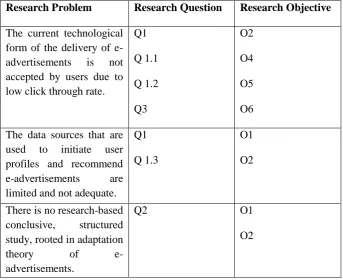
Table 1.1: Mapping research problems to research questions and objectives ... 9
Table 3.1: Different methodologies for human centric IS design, as described in [110] ... 67
Table 3.2: Cronbach's alpha scale for reliability values ... 81
Table 4.1: Questionnaire questions and answer range ... 87
Table 5.1: Results from descriptive statistics and significant tests ... 124
Table 6.1: Raw Data collected from the users and their interpretations ... 147
Table 6.2: List of System Requirements ... 148
Table 7.1: Results for usability questions for H1 ... 191
Table 7.2 Results for usefulness questions for H1 ... 192
Table 7.3: Combined H1 correlation between usability and usefulness ... 194
Table 7.4: Results for usefulness questions for H1.1 ... 196
Table 7.5: Results for usability questions for H1.1 ... 198
Table 7.6: Combined H1.1 correlation between usability and usefulness ... 199
Table 7.7 Usefulness answers for Hypothesis 1.2... 201
Table 7.8: Usability results for Hypothesis 1.2 ... 203
Table 7.9: Combined H1.2 correlation between usability and usefulness ... 203
Table 7.10: Usefulness results for Hypothesis 3 ... 204
Table 7.11: Usability results for Hypothesis 3 ... 205
Table 7.12: Combined H3 correlation between usability and usefulness ... 206
Table 7.13: Analysis of users‟ qualitative feedback ... 208
Table 7.14: Hypothesis 1.1 - follow up experiment descriptive statistics... 215
Table 7.15: Hypothesis 1.1 - follow up experiment statistical significance tests ... 217
Table 7.16: Hypothesis 1.2 part I - follow-up experiment ... 219
Table 7.17: Hypothesis 1.2 - follow up experiment statistical significance tests ... 222
Table 7.18: Hypothesis 1.2 part II - follow-up experiment ... 224
Table 7.19: Hypothesis 1.2 - follow up extended measures statistical significance tests ... 226
Table 7.20: Percentage of explicit via implicit UM ... 227
Table 7.21: User reflection of explicit via implicit UM... 228
Table 7.22: Independent Samples Test for H1.3 ... 230
Table 7.23: Independent Samples Test for H1.1 ... 232
Table 7.24: t-test Independent Samples Test for H1.2 ... 234
Table 8.1: Research Questions and their relationship to experiments ... 251
ix
Acknowledgements
I would first and foremost like to express my sincere gratitude and appreciation for my supervisor Dr. Alexandra Cristea. Her professional and academic advice has been the light of my academic journey. Without her guidance none of this would have been possible. I would also like to express my appreciation for her personal friendship, that of her husband Craig and her beautiful little one Edward. You all made me feel as part of your family, in the difficult times being away from home. I would also like to thank the University of Warwick for giving me the opportunity to be part of this distinguished research and academic institution. Dr. Mike Joy, Dr. Jane Sinclair and Dr. Maria Liakata; thank you for your remarks through the years they have been absolutely enlightening. This PhD would not have been possible without the funding and financial support of the University of Jordan. It has supported me through my years of study. A lot of the case studies have been conducted in the department of BIT in the faculty of Information Technology. I would like to express my gratitude to the staff and academics in the faculty.
Social and academic life has been much easier because of the long discussions and talks with my colleges Lei, Alaa, Suncica, Adam and Yiwei thank you very much.
I would like to express my appreciation to my friends Reem, Mona, Maram, Olfat, Aseel and her family; your academic and personal support has been exceptional and left me with many unforgettable memories.
Dr. Jonathan Foss and Dr. Mohammed Atari I would like to express my sincere gratitude for your academic remarks and personal friendship over the years, also for the help in proof reading the thesis. Ms. Lima Sabri, thank you for your help and support.
x Mum no words can express my appreciation for your care and kindness; you took over my job and looked after my son when I could not. You are our protecting angel I hope this will make you proud.
Jafar, my love, my rock and my partner for life, I thank you for all the patience and love, knowing how great you are always gave me peace to excel and shine. Talal my lovely little boy, nothing can make up for all those days away from you; hopefully this can contribute to your future.
xi To where the heart belongs;
Dad and Mum, Jafar and Talal,
To the dear people I lost through this PhD; my grandmother, uncle and aunt May your souls rest in peace
xii
Declaration
This thesis is submitted to the University of Warwick in support of my application for the degree of Doctor of Philosophy. I hereby declare that, except where acknowledged, the work in this thesis has been composed by myself, and has not been submitted elsewhere for the purpose of obtaining an academic degree.
Dana A. Al Qudah
Signature: ______________________________________
xiii
Publications
Below, the publications written during the PhD research are listed, and their connection to the current thesis is explained. The work presented (including data generated and data analysis) was carried out by the author. In all of these cases, the contribution by the author has been greater than 80%.
1. Al Qudah, D. A., A. I. Cristea, S. Hadzidedic, Al-Sayyad, R.M.H, S. AL-Saqqa (2015). A Taxonomy-based Evaluation of Personalized E-advertisement. 15th IEEE International Conference on Computer and Information Technology. Liverpool, UK: To appear
2. Al Qudah, D. A., A. I. Cristea, S. Hadzidedic, S. AL-Saqqa, A. Rodan and W. Yang (2015). Personalized E-advertisement Experience: Recommending User Targeted Ads. 12th International Conference on e-Business Engineering. Bejin, China: To appear.
3. Al Qudah, D. A., I. A. Cristea, L. Shi and J. f. Alqatawna (2015). Designing an Adaptive Online Advertisement System: A Focus Group Methodology. 10th International Conference on Computer Science & Education, Cambridge, UK.
4. Dana A. Al Qudah, Alexandra I. Cristea, Shi Lei, Rizik M.H Al-Sayyed, Amer Obeidah, (2014) " MyAds: A Social Adaptive System for Online Advertisement from Hypotheses to Implementation", Proceeding of the ICBG 2014 : International Conference on e-Business and e-Government. Zurich, Switzerland, P.P 154-160
5. Dana A. Al Qudah, Alexandra I. Cristea, (2013) "MyAds - A proposed adaptive social online advertising framework", JOEBM - Journal of Economics, Business and Management. Vol.1, No.4, P.P 401-406 ISSN: 2301-3567
xiv I have also co-authored another set of publications as follows;
1. Shi, L., Al Qudah, D., Qaffas, A., & Cristea, A. I. (2013). Topolor: a social personalized adaptive e-learning system. In User Modeling, Adaptation, and Personalization (pp. 338-340). Springer Berlin Heidelberg.
2. Shi, L., Gkotsis, G., Stepanyan, K., Al Qudah, D., & Cristea, A. I. (2013, January). Social personalized adaptive e-learning environment: Topolor-implementation and evaluation. In Artificial Intelligence in Education (pp. 708-711). Springer Berlin Heidelberg.
3. Shi, L., Al Qudah, D., & Cristea, A. I. (2013). Social e-learning in topolor: a case study.
The 7th IADIS Conference e-Learning 2013 (IADIS-EL). Prague, Czech Republic, 23-26 Jul 2013. IADIS Press.
4. Shi, L., Al Qudah, D., & Cristea, A. I. (2013, July). Designing social personalized adaptive e-learning. In Proceedings of the 18th ACM conference on Innovation and technology in computer science education (pp. 341-341). ACM.
5. Shi, L., Stepanyan, K., Al Qudah, D., & Cristea, A. I. (2013). Evaluation of social interaction features in topolor-a social personalized adaptive e-learning system. In Proceedings of 13th IEEE International Conference on Advanced Learning Technologies (ICALT 2013) (pp. 294-295). IEEE Computer Society.
6. Shi, L., Cristea, A. I., Foss, J. G., Al Qudah, D., & Qaffas, A. (2013). A social personalized adaptive e-learning environment: a case study in Topolor. IADIS International Journal on WWW/Internet, 11(3), 1-17.
7. Shi, L., Al Qudah, D., Qaffas, A., & Cristea, A. I. (2013). To build light gamification upon social interactions: requirement analysis for the next version of Topolor. In Proceedings of the Sixth York Doctoral Symposium on Computer Science and Electronics (YDS2013) (pp. 1-5). Department of Computer Science, University of York.
xv 9. Shi, L., Al Qudah, D., & Cristea, A. I. (2012, November). Apply the We! Design methodology in E-learning 2.0 system design: a pilot study. In 2012 Imperial College Computing Student Workshop (Vol. 28, pp. 123-128). Department of Computing, Imperial College London.
Prizes
1. Best paper presentation in the International Conference on Computer and Business Management ICCBM 2013.
xvi
Abstract
The art of personalised e-advertising relies on attracting the user‟s attention to the recommended product, as it relates to their taste, interest and data. Whilst in practice, companies attempt various forms of personalisation; research of personalised e-advertising is rare, and seldom routed on solid theory. Adaptive hypermedia (AH) techniques have contributed to the development of personalised tools for adaptive content delivery, mostly in the educational domain. This study explores the use of these theories and techniques in a specific field – adaptive e-advertisements. This is accomplished firstly by structuring a theoretical framework that roots adaptive hypermedia into the domain of e-advertising and then uses this theoretical framework as the base for implementing and evaluating an adaptive e-advertisement system called “MyAds”. The novelty of this approach relies on a systematic design and evaluation based on adaptive hypermedia taxonomy. In particular, this thesis uses a user centric methodology to design and evaluate the proposed approach. It also reports on evaluations that investigated users‟ opinions on the appropriate design of MyAds. Another set of evaluations reported on users‟ perceptions of the implemented system, allowing for a reflection on the users‟ acceptance level of e-advertising. The results from both implicit and explicit feedback indicated that users found the MyAds system acceptable and agreed that the implemented user modelling and AH features within the system contributed to achieving acceptance, within their e-advertisement experience due to the different personalisation methods.
xvii
Abbreviations and Acronyms
AEH Adaptive Educational Hypermedia
AH Adaptive Hypermedia
AHAM Adaptive Hypermedia Application Model
CSCL Computer Supported Collaborative Learning
CSS3 Cascading Style Sheets Version 3
DM Domain Model
GM Goal Model
GUI Graphical User Interface
HCI Human Computer Interaction
HTML 5 Hypertext Mark-up Language Version 5
kNN k- Nearest Neighbour
ITS Intelligent Tutoring Systems
IR Information Retrieval
LAOS Layered WWW AH Authoring Model and their Corresponding Algebraic Operators
PHP Hypertext Preprocessor, an open source general-purpose scripting language
PIR Personalised Information Retrieval
SLAOS Social Layered WWW AH Authoring Model and their Corresponding Algebraic Operators
SN Social Networks
1
Chapter 1
1.
Introduction
1.1.
Background and Motivation
Interdisciplinary research is considered challenging, as it needs to deal with two or more intersecting fields of work. Online advertising (or e-advertising) is one area of such interdisciplinary research that relies on two important areas, computer science and business and commerce, with the combination raising new important challenges. E- Advertisement falls under the umbrella of e-commerce. It includes several popular models for ad-focused sites, such as portals, search engines, sites supporting classifieds and information exchange [1]. E- advertisement aims at delivering a marketing message using the World Wide Web [2]. Recent numbers have shown that there are more than 2.9 billion internet users exploring various facilities and applications provided on the web [3].
2 exploring [4]. Similarly, other researchers suggest that users give little attention to advertisements, as they use minimum cognitive capabilities to process online advertisements [9-11].
Psychological theories suggest that customers usually tend to go through three different stages from the time they are exposed to advertisements, until the time they actually consider buying the suggested product or service.
3
1.2.
Problem Statement and Challenges
Summarising, this research addresses the following problems in relation to e-advertisements:
The current technological form of the delivery of e-advertisements is not accepted by users, as demonstrated in the previous literature [4], [1]. [7] and [8], where researchers indicated a lack of acceptance via a low click through-rate.
There is a clear demand for personalised advertisement. However:
o There is no research based on a conclusive, structured study, rooted in the adaptation theory for e-advertisements.
o The data sources that are used to initiate user profiles and recommend e-advertisements are limited and not adequate [18].
This research addresses the problem of rejected e-advertisements and aims to achieve users‟ acceptance of these advertisements, by providing the users with more personalised and adaptive ones. It also establishes a research–based study to link adaptation to e-advertisements. The acceptance of users is measured based on perceived usefulness, usability and, in specific cases, their needs and desires. This problem was addressed through establishing a theoretical framework that is based on previous extensive research of the literature. The theoretical framework found by the author of this thesis has then, instantiated the theoretical framework via an implemented system, called MyAds, which was built, based on user modelling and adaptation techniques, as well as machine learning and data mining algorithms.
1.3.
Research Questions
In order to address the problems above, the following research questions were formulated, to address each aspect of the problem and provide a better understanding of the contribution.
Q1: Can adaptive e-advertising lead to users’ acceptance in terms of being usable and useful
from a user perspective?
4 By users' acceptance, “demonstrable willingness within a user group to employ information technology for the tasks it is designed to support” [20] is used. Acceptance is used in this thesis based on usefulness and usability from a user perspective, and is further detailed in Chapter 3. The expectation was that users' acceptance of adaptive e-advertising, which caters to their needs, would be higher than the middle of the scale (representing indifference). Where possible, the users were asked to compare their acceptance between adaptive and non-adaptive e-advertising, with the expectation that the former would rank higher.
This question is posed, in order to gradually and systematically understand how the various aspects of personalisation affect the advertising process, and its main stakeholder, the user.
This research question addresses the two aspects of personalisation: the user and the adaptation performed for the user. As 'adaptation' is rather a broad term, this question needs to further divided, but prior to the sub-questions, the following terms are defined;
Usable: Usability is defined as “the extent to which a product can be used by specified users to achieve specified goals within a specified context of use” [21].
Useful: “the degree to which a user believes that using the system will enhance his or her performance” [20].
This work measures the perceived usability and usefulness, from a user perspective, as is stated above and is further detailed in Chapters 4, 5, 6 and 7.
Q1.1. What features from adaptive hypermedia users would want to have in
adaptive advertising and how are they related to user acceptance?
5 (higher than the middle of the scale) or not. The terms in this question are the same as those used in Q1.
Question Q1.1 is addressed in Chapter 2, theoretically by exploring the current state-of-the-art. In Chapter 4, an exploratory design experiment is further conducted to explore these features. In Chapter 5, practical developments of the features explored earlier are then evaluated. In Chapter 6, a revisited design experiment is conducted to generate an extended set of features, based on the results of the previous experiment. In Chapter 7, a large scale evaluation is conducted to assess the final set of adaptive features.
Q1.2. How can user modelling contribute to users’ acceptance of the e-advertising
experience?
As users are the central focus of this research, user profiling and modelling are paramount factors in assessing the user e-advertisement experience; this is further explored in Chapter 2 Section 2.3.2 from a theoretical angle.This question aims to identify the user modelling techniques that are used to construct user profiles.
Question Q1.2 is addressed in parallel to Question 1.1, as follows. From a design perceptive, it is targeted in Chapters 4 and 6 as an exploratory design experiment and a revisited design experiment, respectively. It is addressed from an implementation perspective, in Chapters 5 and 7, where user modelling and adaptive features were implemented and then evaluated.
Q1.3. What are the main sources of user information would users want to have for
adaptive advertising?
6 Question Q1.3 is addressed in parallel to Questions 1.1 and 1.2. From a user's perspective, it is addressed in Chapters 4 and 6, as an exploratory design experiment, and a revisited design experiment, respectively. From an implementation viewpoint, it is further explored in Chapters 5 and 7, where user modelling and adaptive features were implemented and then evaluated, respectively.
Q2: How can adaptive e-advertising be generated theoretically?
The field of personalised e-advertising has not been widely exploited theoretically, as there are different advertising models and different personalisation models, but not an intersecting interdisciplinary model to combine the two. It is important to establish if existing theories can be directly applied to online adaptive advertising, or if a new theory needs to be developed.
This research question is addressed in Chapter 2, by pointing out gaps in related work. Additionally, Chapter 4 introduces the theoretical framework, by exploring both the gaps in the literature and the outcomes from the exploratory study. In Chapter 5, the theoretical framework is then revisited to address the practicalities of design and system development. Chapter 6 finalises the framework, based on additional theoretical and practical work.
Q3: What technology is acceptable for e-advertising?
This question investigates the acceptable technological approach, as well as helps to generate the technological model for advertising. It also aims at testing the current, statof-thart e-advertising platforms and the proposed adaptive e-e-advertising platform.
7
1.4.
Objectives
Based on the above research questions, the following research objectives have been formed:
Objective 1: Conduct an extensive theoretical background study, to investigate the area of research that needs further exploring, by extracting the main gaps found in the literature and
focusing on the contribution on this area.
This is achieved through studying the previous literature on personalised e-advertisements, adaptive hypermedia and information retrieval. This objective works as an umbrella for all the research questions, as it generates the theoretical basis that the research is based upon. The outcomes of this objective is summarised in Chapter 2.
Objective 2: Conduct a series of experiments that investigate the appropriate approach and
features to design adaptive e-advertisements, and then test the practical development of these
features in an adaptive e-advertising system, addressing the acceptance of this form of ads in the
targeted evaluations.
Here, a systematic, research-oriented approach to introducing adaptation in e-commerce has been deployed. Based on the popular existent taxonomies, such as Brusilovsky's and Knutov's taxonomies [22, 23], this research explored which adaptive hypermedia features contribute to user acceptance. This objective addresses research question Q1, Q1.1, Q1.2 and Q1.3. The objective is covered in Chapters 4, 5, 6 and 7.
Objective 3: Propose a suitable (new or extended) theoretical framework/model for the adaptive
features necessary in advertising, such as a layered model.
8
Objective 4: Design, implement and update a dedicated system for testing the adaptive advertisements and measure the level of acceptance from the end users through the evaluation of
their subjective and objective feedback.
This objective answers research question Q3. The chapters that describe the implementation of this objective are 5 and 7.
Objective 5: Ensure that each research question is represented in the framework and in the delivery system.
In other words, use the framework to evaluate the system features acceptance, in terms of usability, usefulness, as well as, in the final large scale evaluation, users' satisfaction and desires, by analysing the social interaction conducted in the system, log files stored, and questionnaires answered by the users.
This objective is formed to address to all the research questions. The evaluations and the application of the objective can be found in Chapters 4, 5, 6 and 7.
Objective 6: Ensure that each step of the research is conducted based on established research
methodology.
This objective influences all other objectives, and helps to address, in a methodologically consistent way, all research questions. The methodological choices in this work are further described in more details in Chapter 3.
9
Table 1.1: Mapping research problems to research questions and objectives
Research Problem Research Question Research Objective
The current technological form of the delivery of e-advertisements is not accepted by users due to low click through rate.
Q1 Q 1.1 Q 1.2 Q3 O2 O4 O5 O6 The data sources that are
used to initiate user profiles and recommend e-advertisements are limited and not adequate.
Q1 Q 1.3
O1 O2
There is no research-based conclusive, structured study, rooted in adaptation theory of e-advertisements.
Q2 O1
O2
1.5.
Thesis Outline
The thesis is constructed of eight chapters in total that are organised as follows:
Chapter 1 is the introduction chapter, which is the current chapter that has introduced the problem statement and motivation; research questions and objectives and finally the thesis outline.
Chapter 2 is the literature review chapter. This chapter elaborates on the state-of-the-art in each different discipline of the research. The first section of the background study includes e-commerce and e-advertising theoretical and conceptual frameworks, as well as related e-advertising models, followed by research on adaptation, including user modelling techniques, models, approaches and adaptive hypermedia techniques. Chapter 2 also discusses the adaptive recommendation systems specification of information retrieval systems and their related techniques. The final section addresses the gaps found in the previous sections and summarises the chapter.
10 methodology of all research aspects is touched upon. In particular, the application of the methodology throughout all the experiments, and their logical progression, is discussed.
Chapter 4 establishes the concept of adaptive e-advertising used in this thesis, and the initial setting of the theoretical framework. The chapter starts with the description of an exploratory study that was conducted to extract an initial understanding on how an adaptive e-advertising system can be. The experiment was focused on the design process of the system. Then, by using the gaps in the related work and results from the exploratory study, the initial theoretical framework and system architecture are defined.
Chapter 5 describes the research that aimed to test and evaluate the initial reflection of the suggested framework, architecture and design, generated in Chapter 4. The first system iteration implementation is discussed, as well as an experiment to evaluate the theoretical framework, architecture and implemented features that are derived from the research objectives. Chapter 5 presents an expanded and more flexible version of the theoretical framework, which additionally encompasses functionality that was not originally addressed by the first implementation of MyAds. Moreover, the system architecture and its updated versions are also discussed, based on an improved architecture representation. Discussions for the enhanced version are discussed, by highlighting the features that were missing from the first version.
Chapter 6 discusses the final and foremost refined design of MyAds. It combines the set of user modelling and adaptation features that have been explored in the previous chapters with the new updated and modified features. It also presents the final update of the theoretical framework and architecture, which are necessary to emulate the extended set of adaptation features. It also present the focus group experiment conducted to finalise the design phase and generate a detailed requirements list. The chapter also describes the adaptation features that exist within MyAds and the user interfaces of MyAds, in a process breakdown approach.
11 more detailed context. A large-scale evaluation has been conducted, to emphasise the results concluded from earlier chapters. It elaborates about the results of two practical evaluations and discusses the results of these experiments.
12
Chapter 2
2.
Background and Related Literature
“Advertising maybe described as the science of arresting the human intelligence long enough to get money from it” said Stephen Bulter Leacock, as per the Crown‟s Book of Political Quotations (1982) as referenced in (Heath, 2012).
2.1.
Introduction
This Chapter aims at exploring the background literature through researching the theory that has inspired the production of this work and research. Also, the related work in the area of adaptive e-advertisements is explored to identify the gaps in the existing work. The state-of-the-art described in the literature is also identified. This is conducted so that areas of research that have not been well explored can be further investigated. This will eventually demonstrate how this research has contributed specifically to the field of adaptive advertisements.
As this work represents interdisciplinary research, this chapter covers the state-of-the-art for both areas; e-commerce and e-advertisement on the one hand, and adaptive hypermedia and personalisation on the other.
In relation to this research, this chapter aims at addressing research Objective 1 as follows;
Objective 1: Conduct an extensive theoretical background study, to investigate the area of research that needs further exploring, by extracting the main gaps found in the literature and
focusing on the contribution on this area.
13 The chapter is divided into six sections. The first section is the introduction that outlines the chapter. The second section is concerned with personalisation in e-commerce and e-advertisements – in terms of ideas, functionalities, frameworks and examples. The third section is the adaptive hypermedia section. This section addresses the user modelling techniques, models, approaches and data mining aspects related to constructing user models. It also discusses the techniques, functionalities, models, architecture and theoretical frameworks of adaptive hypermedia. It furthermore reviews different models and applications in adaptive hypermedia – mainly in the well explored research area of e-learning. The fourth section describes information retrieval systems and the personalised ones, their respective techniques and models. The final section is the summary, which highlights the gaps found in the literature and the areas that need further exploring so the contributions in relation to the literature can be explained.
2.2.
Personalisation and Adaptation in E-commerce and E-advertisements
14 consists of five main support areas; people, public policy, marketing and advertising, support services and business partnerships [26].
Online products serve as advertisements for themselves, because users can actually view them, look up pictures, and check specifications without the need for the physical presence in the store. This makes an e-commerce website also an “effective advertising tool” [27]. This leads to a
combination of two different business models. One is in the form of a warehouse system that can lead simultaneously to another model that serves as an advertisement platform. This research uses this approach to design and develop the adaptive delivery system for e-advertisements.
Whilst e-commerce is one of the most common activities online, the absence of human interaction often leads to a “one size fits all” approach, meaning that all customers will be served by the same
means [27]. As a reflection of minimum personalisation users tend to be reluctant to actually buy the products online [24]. Thus, with e-commerce evolving dramatically over the past years, users are now demanding more sophisticated and personalised advertisements [28]. In the domain of e-commerce, the emerging requisite for companies to provide personalisation was derived from their strategy to keep existing customers and win new ones via using personalisation as a tool for business loyalty strategies [29].
15 advertisement, numbers show that 48% of the customers found the advertisements shown to them rather annoying, because the personalised content delivered to the users did not actually address their needs, so the actual personalisation was weak and not well constructed. However, 36% of the customers took more time to actually explore and search the suggested advertisements so they can look further into the recommended advertisement and investigate if it matches their interests or not. [31].
As users using the web tend to be anonymous, personalised advertising can be a difficult task to achieve. In order to overcome such a problem, websites now tackle different approaches to harvest as much available information as possible about the users [32]. In this context, it has been found that profile-driven personalisation based on demographics, interests and social data seems to be an appropriate and fruitful type of personalised advertising [33]. This approach was used within the research by harvesting as much as possible data about the user so maximum personalisation can be achieved.
The main players in the advertising process as defined by Kazienko, are the publisher, advertiser, and in some case the advertising intermediate that links the publisher and the advertiser. These intermediates work as a connecting tool to certify that users get the appropriate advertisements – such as DoubleClick and Google AdSense – and deliver banners related to the publisher website [32]. The main factors that contribute to personalised web advertisements are described in Figure 2.1 below.
16
Figure 2.1: Factors effecting personalised ads [32]
As the Figure above illustrates, the main factors are; the content for both the publisher and the advertiser, historical and current behaviour of the users, features of the advertisements and, finally, the recently clicked-through advertisements [32].
The main technique used in personalisation in the domain of e-advertising is “customer profiling‖, to provide the ―one-to-one‖ marketing and advertising. These user profiles are categorised as
basic-, preferences- and rule profiles through the processes of modelling, data input, data processing and information output [29]. The previously mentioned approach is a general one that has also influenced the research in this thesis. Many approaches provided the ability to recommend appropriate products via filtering techniques, such as collaborative filtering, content-based filtering
17 collaborative filtering that is based on a mathematical formula, which calculates the similarity between the preferences of users and activities performed by different users, and therefore recommending products that are based on the matches between these users. Another filtering method is the rule-based filtering; it bases its recommendations on the user‟s direct input of information via system queries. Content based filtering takes place when companies suggest products that the user may show interest in, through examining the user‟s profile. Finally, the activity-based filtering is a filtering technique that focuses on understanding the users‟ patterns through the analysis of their online activity and then providing the recommendations based on these activities [30].
This lengthy introduction aimed at clarifying the research direction as well as giving a summarised idea about what is going to be discussed in the more detailed sub-sections. The highlight of the work is the focus on the importance of personalisation; particularly in the domain of e-commerce and e-advertisements. This is an important research contribution, as the current state-of-the-art lacks the structured frameworks and models.
2.2.1.Conceptual Frameworks of Personalised e-Advertisements and e-Commerce
The current state of the art has provided some conceptual frameworks that have been proposed to address the personalisation within e-commerce applications. These frameworks have introduced a cluster of features to offer the user a personalised experience. The reviewed frameworks are Schubert and Leimstoll [36], Sicilia [37] and Murthi and Sarkar [38].The frameworks discussed below also inspired the work presented in the thesis. Koutsabasis [24] has highlighted the importance of these frameworks due to the following:
The frameworks rely on practical work on personalisation and collect different observations and practices in e-commerce.
18
The frameworks have been evaluated through use cases that utilise the features presented by these frameworks.
The first framework to be discussed is the Schubert and Leimstoll. The framework is pretty simple as it summarises the main steps in a personalised e-commerce application. It also visualises the various functionalities of the cycle of the personalised features taking into consideration both explicit and implicit user profiles. It‟s particularly important that it can be used as a guideline for the design and implementation of a personalised e-commerce application. Figure 2.2 summaries the process of personalised e-commerce applications as described by [36]. The process is divided into four main steps. The first step includes the modelling of the user profile through deciding on the structure of the profile, source of data and metadata collected, and the storage type. Then the model starts inputting the data into the “data input controller”. This controller divides the profiles into explicit or implicit profiles. In the explicit profiles, parameters are collected through direct user input into variables. Here the framework provides identification, preference of the user and rating. The implicit profiles study the interaction of the user over the system and build both a transaction and an interaction profile to keep track of the user‟s behaviour. This approach is similar to the one used in MyAds (as described in Chapter 6). However, in the model, the data processing is then conducted, by mining the data and then carrying out content based filtering over the metadata tags of the products, before using this information to actually recommend products to the users.
19 The second framework is the Sicilia framework. This framework focuses on the goal of the e-commerce application. Some applications are marketing and advertising oriented and some are technical and functioning platforms. An important part of this framework is to distinguish which features to use base of the different purpose of the applications. This important for designers and, more precisely, students trying to understand the different stakeholders and business models around [37]. In Figure 2.3 the distinction is clear on what is used when marketing and advertising within e-commerce applications. The well advocated approaches include adaptive hypermedia, information and collaborative filtering, etc. All of these are important for the work presented in this thesis as it emphasises the importance of the approaches used.
Figure 2.3: Sicilia framework for personalisation of e-commerce [37]
20 All the previously mentioned frameworks provided an understanding of personalised e-commerce applications and made it clear that using a dedicated system for marketing and advertising is well acknowledged in the field of e-commerce.
2.2.2.E-advertisement and E-commerce models
As the previous Section focused on the theoretical and conceptual frameworks available, this Section addresses the actual “competitors” – or applications – that are working in the domain of personalised e-commerce and e-advertising. The models discussed in this Section are the ones that are mostly relevant to the approach used in the thesis. However, as the Section will explain in more detail there are not many models to actually discuss, since most of the models focus on the traditional approach of e-advertisement; banner advertisements. In this section, both research based and commercial based models and systems are discussed.
A variety of e-commerce models are implemented by various players, including the major ones, such as Amazon, eBay and Google. However, even amongst these, Google is the most successful in providing targeted advertisements, working not only as a search engine, but combining various e-commerce models [26].
In e-advertising, the models are constructed based on which party leads the advertisement management process. Thus, there are three main models: the broker-model, the portal model, and the advertiser model, each functioning differently.
The broker model facilitates the communication between the advertiser and the publisher. It works as the host and manager of the advertisements and displays them directly to the end-user. One problem with this type of model is that the personalisation is not as powerful as in other models, because the user‟s information is not adequate enough for targeting and personalisation [39].
21 used in the personalisation process [15]. A discussion of Google as a well-known example will follow later on in detail.
The advertiser model is another advertising model, where the publisher is large and famous enough to work as the publisher of its own advertisements and other companies‟ advertisements. A famous example is Amazon, which both publishes its own advertisements, as well as provides other businesses with advertisement space on its own platform [27, 40].
One of the successful e-commerce systems that provide personalisation for its customers is BroadVision. It adapts two personalisation strategies: the pull and push. The system leads the push strategy, by providing the recommendations and suggesting related applications and features for the customers. The pull strategy works the other way round, as it allows the customer to ask for information and then provides it in a personalised approach. Moreover, BroadVision provides a qualifier-matching filtering strategy that focuses on other stakeholders, i.e., the companies. This strategy allows the companies to target the delivered content to the users [27]. In MyAds, the adaptive delivery system explored through this thesis, there is a personalisation and adaptation process the user goes through. Adaptation starts from the moment users‟ login to the system till the moment they logout. It depends on multiple adaptation techniques rather than only on one filtering approach. Details of the functionality and adaptive features of MyAds can be found in Chapters 4, 5 and 6.
22
Figure 2.4: Suggested personalised advertising model by [28]
This model bases its main contribution on the idea of clustering the users based on categories – by mapping the advertisement content and the type of user. MyAds, the system presented in this thesis, deals with each case individually as it does not cluster any users.
In the system proposed by Zhou, Chen et al., each user‟s interest is measured separately from the
others. The system then collects previous purchasing history, by analysing the information for the session weblog file and carries out the matching. Personalisation patterns are constructed when the server is idle or off-line.
23
Figure 2.5: AdRosa Overview Method for Adaptive Advertising [15]
The Figure above demonstrates the process of generating personalised banner advertisements in AdRosa. MyAds, the adaptive personalised e-advertisement platform introduced in this thesis functions with a different approach. Although MyAds works as a brokerage system, similar to AdRosa, it does not use banner advertisements. It functions as a standalone system that collects users‟ information, by asking users direct questions, or via the logging-in option, via social networks, to generally extract whatever public available information can be collected. MyAds uses user modelling and adaptation techniques and provides the personalised recommendations based on a different set of adaptation techniques than those proposed within AdRosa. The model layering in AdRosa comes as one combined process, while MyAds is a layered model that provides adaptation based on the depth of the user‟s involvement with the system.
24 used to ensure that the personalised advertisements on web TV that are given to the viewers within program intervals are compatible with viewers‟ profiles, context and interests [41]. The model used in the MultiMedia Brokerage platform (MMB) stores two types of information; the viewers‟ profiles and the content of the current TV show being viewed, which are then jointly used to provide niche segmentation for future advertising. This platform operates as an electronic market, which provides an electronic exchange among the advertising agencies and the content providers. What makes this platform interesting is the layered architecture and model it uses, in order to deliver the proper advertisements, as shown below in Figure 2.6[41].
Figure 2.6: The MMB Layered Architecture [41]
The layered architecture above has also inspired the creation of MyAds, which also uses layers as a form of separating functionalities within a homogenous environment.
25 stakeholders are the content producers and the content distributors. The content producers are the advertisements agencies that are willing to provide targeted advertisements, while the content distributors are the hosts that provide viewers with on-demand TV. Figure 2.7 illustrates the process within the platform.
Figure 2.7: Layered Architecture for Advertisements in On Demand TV [42]
26 of recommendations. Detailed descriptions of MyAds features are discussed extensively in Chapter 6.
All the previously mentioned platforms are research-oriented. However, commercial systems such as Google, Amazon and Facebook have invested heavily not only in development, but also in research of which a discussion will follow. Additionally, not all of their methods and mechanisms are known, but this section describes the (comparatively little) published research.
The well-known Google platform provides a personalised e-advertising system called AdSense. This system branches into two domains: AdSense for content and AdSense for search. The AdSense for content is done by inserting a Google search box into the publisher‟s page (any website that needs a search box). The AdSense for content delivers the advertisements based on the publisher's website, which is analysed to adjust the presentation style to suit the publisher's content. The resulting ads appear in the “Ads by Google” page frame (or „i-frame‟). Using this advertising method ensures that personalised advertisements are also tailored to the publisher‟s content in the website, which is analysed regularly by Google. Google takes users‟ interactions with the publisher‟s site and analyses all the information provided to then provide personalised recommendations. This way, Google encourages publishers to insert the Google search box in their websites. Additionally, Google pays the publisher for each time this box is used.
To complete the cycle of personalisation, Google also provides another service, which is AdWords that functions as a keyword matching technique. This way Google matches the personalised advertisements to the keywords in the users‟ search. This approach of Google falls under the category of “ephemeral personalisation”, as it does not last long and is done per session, or per search [43].
27 Google. The precise details of Google‟s algorithms are unpublished (for commercial reasons) although a similar principle is achieved in MyAds by using TF-IDF and Jaccard similarity (to be described in Section 2.4).
Other commercial examples are Yahoo Search Marketing (YSM) and Microsoft AdCentre, which use the same technique of keywords matching. The disadvantages of their approach are the limited number of keywords that can be used, being ineffective for reaching a large volume of users, and mismatches between the advertisement and the keyword used [44].
Facebook offers a new model for advertisement, with a viewing percentage of Facebook users of 1 out of 5 (20%). This is relatively high in comparison to the huge number of advertisements ignored every day, and that constitutes one of the reasons to consider using social networks as an advertising tool. There are many ways for business promotion via social networks, by enabling users to post links, videos, pictures, fan pages, groups and even advertisements. Also, businesses can create their own pages, which users can like and share. Facebook carries out its targeting through looking at users‟ profiles and collecting all the demographics, gender preferences, location and interests and then displays them on their pages – these are recommendations Facebook uses for targeted segments. Nevertheless, these are all recommender systems, and not adaptive systems. Facebook is a recommender system with social interaction [8].
28 they are filtered (by removing stop words), and the remaining words are stored in the database. The query expansion module uses the expansion mechanism from many webpages and blogs. On the webpages, the content is standard and formally presented; while in blogs it is personal and informal. The second stage is building the user semantic core vector, by studying their behaviour in the system, using the ontology of each element and recording a score, followed by extracting the features of the users‟ publications on the blogs. Finally, the outcome from the previous step is calculated, to extract similarities and provide a recommendation [45]. This is an approach to recommend advertisements based on social interaction via blogs. The relationship between this system and the current research presented in this thesis is that it looks at ways to extract data from a social platform; this is what the current research also aims to do. It also aims at recommending the appropriate advertisement to the user.
29
2.3.
Adaptive Hypermedia – Terminologies, Theories, Techniques, User
modelling, Architecture and Case studies
Adaptive hypermedia is the backbone of this research due to the fact, that the theoretical framework established later in this research is inspired by the frameworks of adaptive hypermedia. Also the practical design, implementation and evaluation were inspired from the work done in this field of research. This research has also relied on the techniques and case studies explored in AH and the application domain of learning to be transferred into the domain of commerce and e-advertising. All this is to address the research questions in Chapter 1 (Section 1.3). AH is also used because it is a successful field of research with many solid background theories as well as practical models that makes it the way to personalisation. Furthermore adaptation in terms of the specific use of AH user modelling and adaptation techniques have not been well explored in the domain of e-commerce and e-advertising, so there is little work on this area. This section aims at highlighting the main ideas, theories, taxonomies and case studies that have helped in forming this research.
2.3.1.Terminologies and Theories
Brusilovsky (1996) defines adaptive hypermedia systems as “systems that reflect some features of the user in the user model and apply this model to adapt various visible aspects of the system to the
user.‖ Further, adaptive hypermedia is generally defined as the process of tailoring the content of the web-based system, derived from the data such as users‟ interests, backgrounds, demographics and cognitive abilities, etc. [46]. Adaptive hypermedia works best in applications that have different users with different goals, knowledge and backgrounds. The main use of adaptive hypermedia is to personalise hypermedia. The method adaptive hypermedia follows is to build a model for users‟ goals, preferences and knowledge and use this throughout their interaction to adapt aspects for their needs.
30 consider when forming the idea of the adaptive system to be built, and these were considered for designing the adaptive approach and selecting the controllers for the AH system as discussed further on this thesis.
Adaptive hypermedia has been very well explored in the domain of e-learning. However, this does not limit its applicability to many other domains such as information retrieval, commerce and e-libraries [29]. Adaptive hypermedia in e-learning systems usually means that each student will be presented with different content, relevant links and material, based on his or her knowledge of the subject. This has been used in this research approach by considering users demographics, interests and relevant products. Also, adaptive hypermedia can be applied to e-encyclopaedias, where the content of a certain article can be altered, based on the reader's knowledge and interests. Online catalogues or even museum guides can be adapted. based on the user‟s preferred path and interests [47].
Adaptive hypermedia was first used in the domain of e-learning. Brusilovsky elaborated about the progress of AH as he suggested that; scholars first focused on intelligent tutoring systems (ITS) which were introduced in the 1980s. These systems paid attention to the user and provided an extended set of user modelling features as well as adaptive features. They also included off-line and stand-alone educational systems. The user models connected to ITSs were usually more complex as they didn't rely on a network and a remote server to process the adaptation. ITS also were usually focussed on a specific educational domain [48].
Adaptive educational hypermedia (AEH) systems that started in the 1990s have tried to be more generic, but had quite primitive user models to begin with (e.g., based only on knowledge). This changed over time, also based on the development of fast Internet and server processing time [49].
31 non-structural, but these models always appear as the main controllers [47]. Scholars have updated these models to include goal models such as in [50]. A more detailed discussion is presented in Section
(2.3.4).
User models will be discussed later in Section 2.3.2, but in brief, they contain (and sometimes process) information about the user. Often, it can be a guessing game about who the target user is, and what information is pertinent to model, in order to achieve a good recommendation or adaptation. The most common attributes considered when constructing the user model are: knowledge, preferences, interests, cognitive/learning styles (particularly important in e-learning), background and navigation history [51].
The domain model is one of the essential models in adaptive hypermedia, as it functions as the backbone of the systems by containing all information content in the pages of the adaptive system, and is the basis for further adaptation to take place [47].
The presentation model takes into consideration the environmental aspects related to the adaptive systems, such as the browsing device, bandwidth capacity and window size [22] [50]. Figure 2.8 illustrates the main blueprint for adaptive systems [19].
Figure 2.8: Classical loop of User Modelling and Adaptation in Adaptive Systems by [19]
32 model, based also on the set of well-defined goals or rules (which constitute the goal model). Finally, the content is presented to the user, using a specific presentation model.
The goal model, first introduced in [50], is concerned with the reason for using adaptive systems and the added value of using this approach in web-based systems. The goals can be both local and global. The local goals change regularly, based on the user‟s changing needs, while the global goals are the set rules upon which the system is based [22].
Figure 2.9 presents a generic architecture of adaptive hypermedia systems [52]. It consists of the user model generator, where all the information about the user is processed and the initial and where the updated profiles are constructed. The decision making and personalisation engine is where the actual linkage between the user model and the content occurs. It aims at providing the adaptive content and the actual application interface, as the generated content is presented to the user, adapted to the technological parameters of the environment within which the system functions [52]. This architecture is particularly important for this research as it was used as the basis for the system architectures used to build MyAds. Details about architectures can be found in Sections 5.2 and 6.2.
Figure 2.9: Generic architecture of adaptive hypermedia systems [52]
33 that are adaptable, and systems that are adaptive. Adaptable systems are user-tuned systems, while adaptive systems are system-tuned [53, 54]. Adaptive systems use dynamic adaptation, driven by the system itself; the knowledge is contained within the system, and the user needs minimum effort to receive the personalised content. On the other hand, in adaptable systems, users control the process and functionality of the system; the knowledge is extended via the user; it gives the user the sense of control over the system. However, at a certain point, the user needs to do substantial work, as the complexity increases [55]. These seemingly different approaches for adaptation do not need to be used separately, as they can function together within one system. In e-advertisements, the research domain of this work, adaptive hypermedia serves as the structural theoretical foundation and the technical guidance for the delivery of personalised adaptive e-advertisements.
2.3.2.User Modelling – Definition, Variables, Methods and Techniques
User modelling is one of the key aspects of adaptive systems. It is fundamental to understand their purposes, design requirements and suggested architectures. The foremost objective of user modelling is to collect as much relevant data as possible about the user, and then tailor the content according to the users‟ different needs (or other parameters) [46, 51, 56]. User modelling is defined as “a representation of the user in an information system, in the form of information which the system collects and maintains in order to improve the quality of information access” [46]. The importance of user modelling lies in the fact that, with the large amount of information available online and the need for adequate time to process all this information, only relevant user data is to be considered and processed [18].
Hence, it is necessary to understand the different aspects in user modelling so the decision upon the appropriate approach to be used in this research can be selected. Furthermore, this section explores these different aspects so the justification upon the decisions made on the design, implementation and evaluation of the proposed approach can be clear.
![Figure 2.1: Factors effecting personalised ads [32]](https://thumb-us.123doks.com/thumbv2/123dok_us/9488409.454970/34.595.131.539.77.280/figure-factors-effecting-personalised-ads.webp)
![Figure 2.3: Sicilia framework for personalisation of e-commerce [37]](https://thumb-us.123doks.com/thumbv2/123dok_us/9488409.454970/37.595.173.494.308.520/figure-sicilia-framework-personalisation-e-commerce.webp)
![Figure 2.4: Suggested personalised advertising model by [28]](https://thumb-us.123doks.com/thumbv2/123dok_us/9488409.454970/40.595.133.535.72.313/figure-suggested-personalised-advertising-model.webp)
![Figure 2.5: AdRosa Overview Method for Adaptive Advertising [15]](https://thumb-us.123doks.com/thumbv2/123dok_us/9488409.454970/41.595.139.537.67.417/figure-adrosa-overview-method-adaptive-advertising.webp)
![Table 3.1: Different methodologies for human centric IS design, as described in [110]](https://thumb-us.123doks.com/thumbv2/123dok_us/9488409.454970/85.595.120.543.171.389/table-different-methodologies-human-centric-design-described.webp)