warwick.ac.uk/lib-publications
Original citation:Cullen, Stephen Michael (2016) Evaluation of the Autism Education Trust programme, 2015-2016. University of Warwick: Centre for Educational Development, Appraisal and Research (CEDAR).
Permanent WRAP URL:
http://wrap.warwick.ac.uk/78686
Copyright and reuse:
The Warwick Research Archive Portal (WRAP) makes this work by researchers of the University of Warwick available open access under the following conditions. Copyright © and all moral rights to the version of the paper presented here belong to the individual author(s) and/or other copyright owners. To the extent reasonable and practicable the material made available in WRAP has been checked for eligibility before being made available.
Copies of full items can be used for personal research or study, educational, or not-for-profit purposes without prior permission or charge. Provided that the authors, title and full bibliographic details are credited, a hyperlink and/or URL is given for the original metadata page and the content is not changed in any way.
A note on versions:
The version presented here is a working paper or pre-print that may be later published elsewhere. If a published version is known of, the above WRAP url will contain details on finding it.
1
Evaluation of the Autism
Education Trust programme,
2015-2016
Stephen M. Cullen
Centre for Educational Development, Appraisal and Research
(CEDAR), University of Warwick
Contents
Evaluation of the Autism Education Trust programme, 2015-2016 ... 1
Centre for Educational Development, Appraisal and Research (CEDAR), University of Warwick ... 1
1. Executive Summary ... 4
1.1 Introduction ... 4
1.2 Findings: ... 5
1.2.1 Schools and the AET Programme 2015-2016 ... 5
1.2.2 Parent and carer views of school autism provision ... 6
1.3 Observations and recommendations ... 7
2. Introduction ... 10
2.1 Background ... 10
2.2 The AET Programme 2015-2016 ... 10
2.3 The evaluation... 11
2.3.1 Data collection ... 12
2.4 This report ... 15
3. The School case-studies ... 17
3.1 Introduction ... 17
3.2 School 1 (Special secondary school) ... 17
3.2.1 School overview: school, staff member, training, pupils ... 17
3.2.2 Choosing to use the Progression Framework, September 2015 – January 2016 ... 20
3.2.3 Using the Progression Framework ... 20
3.2.4 The young people and use of the Progression Framework ... 22
3.2.5 Training impact ... 24
3.2.6 School 1 conclusions ... 25
3.3 School 2 (Mainstream primary school) ... 26
3.3.1 School overview: school, staff member, training, pupils ... 26
3.3.2 Choosing to use the Progression Framework, September 2015-January 2016 ... 28
3.3.3 Using the Progression Framework ... 29
3.3.4 The children and the use of the Progression Framework ... 31
3.3.5 Training impact ... 32
3.3.6 School 2 conclusions ... 34
3.4 School 3 (Mainstream primary school) ... 34
3.4.1 School overview: school, staff member, training, pupils ... 34
3.4.2 Choosing to use the Progression Framework, September 2015-January 2016 ... 37
3.4.3 Using the Progression Framework ... 38
3
3.4.5 Training impact ... 40
3.4.6 School 3 conclusions ... 41
3.5 School 4 (mainstream primary school) ... 42
3.5.1 School overview: school, staff member, training, pupils ... 42
3.5.2 Choosing to use the Progression Framework, September 2015-January 2016 ... 45
3.5.3 Using the Progression Framework ... 45
3.5.4 The children and the use of the Progression Framework ... 46
3.5.5 Training impact ... 48
3.5.6 School 4 conclusions ... 49
3.6 School 5 (Mainstream secondary school) ... 50
3.6.1 School overview: school, staff member, training, pupils ... 50
3.6.2 Choosing to use the Progression Framework, September 2015-January 2016 ... 51
3.6.3 Using the Progression Framework ... 52
3.6.4 The young people and the Progression Framework ... 53
3.6.5 Training impact ... 55
3.6.6 School 5 conclusions ... 56
4. The five case-study schools: overall conclusions ... 57
5 Parent and carer views ... 59
5.1 Parent and carer interviews ... 59
5.2 Parents’ experiences of difficulties related to their child’s schooling ... 59
5.2.1 Introduction ... 59
5.2.2 Unwillingness to accept children with autism into a school ... 60
5.2.3 A lack of understanding of autism on the part of individual teachers and head teachers .. 60
5.2.4 Failure to plan for transition ... 61
5.3 Parents’ views on what constitutes good practice in relation to school support for children with autism ... 62
5.3.1 Introduction ... 62
5.3.2 Schools working with parents ... 63
5.3.3 Positive impact of school practice ... 64
6 Conclusions ... 67
7. References ... 69
4
1. Executive Summary
1.1 Introduction
The Autism Education Trust (AET) training and support programme is now in its sixth year. There
have been two earlier rounds of the Programme – the AET Programme 2011-2013, and the AET Programme 2013-2015. The AET Programme 2011-13 established a hubs training model and introduced school years training for all school staff working with children and young people with autism. The 2013-15 Programme involved the development of new Early Years (EY) and Post-16 (P-16) training materials for workforces and settings supporting EY and P-16 children and young people
with autism. The Programme consisted of three tiers of training which were delivered via four EY and four P-16 training hubs. The 2013-15 Programme also involved the development and roll-out of National Standards and Competency Frameworks for EY and P-16 settings. In addition, guides for parents and carers on working with their children’s schools were produced.
The 2015-2016 Programme piloted a newly developed Progression Framework, and associated training module, designed for the AET by Autism Associates. The Progression Framework was a response to the need for research-based models that can be applied by school staff to track the progress of children and young people with autism. The Progression Framework that the schools
worked with in the Autumn term 2015, and the Spring term 2016, was a pilot version, including five of the seven areas of learning. The pilot Progression Framework was, at that stage, very much a work in development, and will be further developed as a result of the piloting process, feedback from stake holders, and the evaluation findings.
As with the earlier rounds of the AET Programme, the Centre for Educational Development,
Appraisal and Research (CEDAR), the University of Warwick, was contracted (following a competitive tendering process) to evaluate the 2015-2016 Programme. This evaluation consisted of the following elements:
Work with five schools – one special secondary school, one mainstream secondary school,
5
January 2016. The work enabled the development of highly detailed case studies of autism support in the schools.
The focus of the case-study work was, firstly, on the impact of training, on staff and pupils in
the schools.
In addition, the schools all utilised the pilot AET Progression Framework (PF), and the school
staff provided regular reflective feedback on its use.
Each school also nominated children with diagnoses of autism, whose progress over the
period was monitored, using the Progression Framework.
Parents and carers of children with autism from the case-study schools also took part in the
evaluation, in order to generate data on good, and bad, practice in relation to school support for children and young people with autism.
1.2 Findings:
1.2.1 Schools and the AET Programme 2015-2016
Work with the five case-study schools provided detailed accounts of day-to-day support for children and young people in three different types of school setting – mainstream primary, mainstream secondary, and special secondary provision. The learning from the case study schools that relates to enabling factors for the provision of good quality support for children and young people with autism involved the following points:
Support and wholehearted commitment from a school’s head teacher and senior
management team (SMT) was necessary for good autism provision. SENCOs, lead practitioners, teaching staff and TAs all need to be fully supported by management in their efforts to provide support for children and young people with autism.
All of the case-study schools had undertaken AET Schools Programme training at all
6
combined materials and knowledge from the NAS, local autism outreach teams, CAMHS, and the AET in order to develop their autism strategies.
The Progression Framework was successfully piloted in four of the five schools. It is
unclear as to why one school (School 2) had difficulties with incorporating the Progression Framework into their work. However, it might be of significance that School 2 piloted the Progression Framework with the youngest children of all the case-study schools. In addition, the training background of the staff was not as wide as some staff from the other schools.
External support and co-working characterised all the schools. Work with, and
support from parents and carers, and external agencies such as local CAMHS, and autism outreach teams, provided valuable support for staff and schools. In addition, some staff, for example from School 3, were able to draw upon a local schools network focused on autism.
1.2.2 Parent and carer views of school autism provision
Each school in the evaluation recruited parents/carers to the evaluation in order that their views on what constituted good, and bad, provision for their children with autism could be collected. Eleven parents were recruited in total, but only nine were able to be interviewed. The interviews focused
on the parents’ children, their experiences of their children at school (including schools other than the school currently attended), the background to their child/ren being diagnosed with autism, their progress at school, the parent/carer view of what constitutes a good relationship between home and school, what constitutes a good school for their child with autism, and difficulties they had experienced with school and their child/ren. The findings from the parent interviews were analysed
under two headings:
• Parents’ experiences of difficulties related to their child/ren’s schooling.
• Parents’ views on what constitutes good practice in relation to school support for children with autism.
7
• Unwillingness of schools to accept children with autism onto the school roll.
• Lack of understanding of autism on the part of individual teachers and head teachers.
• Failure to plan for transition, particularly between settings.
Parent views of what constituted good practice focused on the following areas:
Good communication between school and home, with daily contact between the
two being preferred.
School-home co-working and co-operation, with both settings able to learn from the
other.
Schools implementing positive changes which could be evidenced by identifiable
impact on the school experience for the children with autism.
1.3 Observations and recommendations
The evaluation makes the following observations and recommendations:
The value of autism training for school staff continues to be an important element of good
provision for children and young people with autism. The case-studies showed that, typically, schools combine AET Programme training, at all levels, with training, information and materials from other sources. The latter included, for example, local autism outreach teams, CAMHS teams, and the National Autistic Society (NAS). The practice of drawing upon
a variety of sources of training, support, advice, information, and materials makes it difficult to isolate the impact of AET Training. Nonetheless, the case-study school staff evidence provided good evidence of the high value school staff place upon the AET Programme, and reaffirmed the findings of previous evaluation reports on the ongoing AET Programme. AET Programme training can, therefore, be recommended for school settings seeking to
provide good autism support for children and young people.
The AET Progression Framework was successfully piloted in four of the five case-study
8
impact, and map the progression of children and young people in terms of both the quality of their school experience and learning journey. The AET Progression Framework was
regarded as a valuable addition by the schools. In the case of the school which abandoned use of the Progression Framework, there was still an intention to return to its use in the future. It may be that the difficulties that the school experienced reflected a need for further training and support for school staff. On balance, therefore, the Progression Framework can be recommended for use in schools where staff have good autism training and access to
supporting materials and information.
External support and co-working characterised all the case-study schools’ work with pupils
with autism. Local school networks, parents and carers, local CAMHS and autism outreach teams all provided highly valued support and advice. The earlier evaluation of the AET Programme, 2013-15 drew attention to the importance of support networks for all
settings, and the AET has begun the process of supporting the growth and development of
such networks. It is recommended that this approach should continue, with the ultimate
aim of ensuring that all settings should be in a position to be able to draw upon, and
participate in, external support.
One case study school (a special secondary school for young people with moderate learning
difficulties) was in the process of applying for NAS Accreditation, and the school’s
engagement with the AET Programme was part of that process. The process requires a great deal of staff time and preparation, however, it was seen by the school to confer numerous benefits, including the support of the school strategy to further develop its provision for young people with autism. It is recommended that the AET might consider developing an
accreditation system for schools and other settings.
Parents from the case study schools who took part in the evaluation provided detailed
accounts of good, and bad, experiences relating to the support of their children in schools, and nurseries. Parents greatly valued good, strong, two-way communications with schools about their children. They also valued schools having staff who were knowledgeable, trained, and understanding about their children’s needs, and who were willing to co-work
with parents to enable the best support for the children in school. It was also the case that parents were generally unaware that schools had undertaken AET training. It is
recommended that schools should be encouraged to fully inform parents and carers about
the training that school staff undertake in relation to supporting children and young
9
Parents were generally unaware of support that was available for them as parents and
carers of children and young people with autism. Similarly, they were unaware of sources of information and support available for parents and carers to work with schools, and other
settings, to ensure the best provision for their children. It is recommended that further outreach work be considered in relation to parents and carers. At a simple level, schools
that have accessed AET training and materials should be encouraged to share knowledge
of AET, and other, provision with parents and carers. Further, the AET might consider
advertising its work more widely to reach parents and carers who might have few
resources to draw upon.
The successful piloting of the AET Progression Framework suggests strongly that it will be
another useful tool for school staff working with children and young people with autism. In keeping with the AET’s established practice with regard to its training and autism support materials it is hoped that the Progression Framework will continue to be refined and
amended. It is recommended that the roll-out of the Progression Framework, and any subsequent developments of the framework, be incorporated in the continuing evaluation
10
2.
Introduction
2.1 Background
The Autism Education Trust’s (AET) training hubs Programme is now in its sixth year. There
have been two earlier rounds of the Programme – the AET Programme 2011-2013, and the
AET Programme 2013-2015. The AET Programme 2011-13 established the hubs training
model and introduced school years training for all school staff working with children and
young people with autism. The 2013-15 Programme involved the development of new Early
Years (EY) and Post-16 (P-16) training materials for workforces and settings supporting EY
and P-16 children and young people with autism. The Programme consisted of three tiers of
training which were delivered via four EY and four P-16 training hubs. The 2013-15
Programme also involved the development and roll-out of National Standards and
Competency Frameworks for EY and P-16 settings. In addition, guides for parents and carers
on working with their children’s schools were produced.
Both rounds of the AET Programme were evaluated by the Centre for Educational
Development, Appraisal and Research, the University of Warwick. The evaluations (Cullen,
M.A. et al 2012, 2013, Cullen, S.M. et al, 2014, 2015) showed that the AET Programme, the
training hubs model, and the training and support materials were all successful in delivering
well-regarded, high quality training to the workforce for children from Early Years to
Post-16. The success of the earlier Programmes led to further Department for Education (DfE)
funding for the AET Programme 2015-16.
2.2 The AET Programme 2015-2016
The 2015-2016 Programme introduced a newly developed Progression Framework,
designed for the AET by Autism Associates. The Progression Framework is a response to the
11
children and young people with autism. This need, in the wider context of Special
Educational Needs and Disability (SEND) provision, was identified as a research priority by
the DfE in March 2014
1. During 2015-2016 the Progression Framework was developed and
piloted by Autism Associates. The Progression Framework and the associated guidance is to
be rolled out at the end of February, 2016.
2.3 The evaluation
CEDAR was commissioned to evaluate the AET Programme 2015-2016. The evaluation focus
was described by the AET:
‘In response to feedback from Ofsted, the [evaluation] brief will include a focus on
school change and pupil outcomes arising from the embedding of previous
programmes. This strand would link closely with the development of progress
measures for pupils with autism [the Progression Framework]… The [evaluation]
report will focus on 4 schools who applied the [AET] training and track developments
from that training. Additionally the newly developed AET progression framework will
be trialled in respect of 20 pupils to track links between improved provision and
pupil outcomes. As well as evaluating the impact of the programme the data
gathered could be used as exemplars of the new progression framework.’
2The evaluation, then, consisted of the following elements:
Work with five schools – one special secondary school, one mainstream secondary
school, and three mainstream primary schools – over the period September 2015 to
1 Special educational needs and disability: research priorities and questions. Ref: DFE-00086-2014.
https://www.gov.uk/government/publications/special-educational-needs-and-disability-research-priorities-and-questions, accessed, 11 February 2016
12
the end of January 2016. The work enabled the development of highly detailed case
studies of autism support in the schools.
The focus of this work was, firstly, on the impact of AET, and other, training, on staff
and pupils in the schools.
In addition, the schools all utilised the pilot Progression Framework (PF), and the
school staff provided regular reflective feedback on the use of the Progression
Framework.
Each school also nominated children with diagnoses of autism, whose progress over
the period was monitored, using the Progression Framework
The schools also recruited parents/carers of the nominated children to the
evaluation in order that parent/carer experiences, and expectations of school
support for their children could be examined.
2.3.1
Data collection
All the AET school age hubs were asked to provide school contacts from their areas to enable the
recruitment of schools from a range of areas. In the event, after repeated calls for school contacts, 14 school contacts were provided, and all were invited to take part in the evaluation. The 14 represented two special secondary schools, one special primary and secondary school, one special primary school, three mainstream secondary schools, and seven mainstream primary schools. The schools were drawn from five of the AET school age hubs areas. Of the 14, five schools eventually
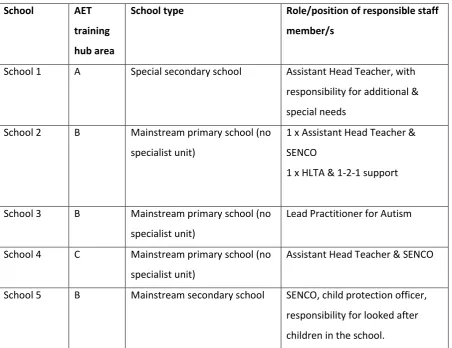
13 Table 1: Participating schools
School AET
training
hub area
School type Role/position of responsible staff
member/s
School 1 A Special secondary school Assistant Head Teacher, with
responsibility for additional & special needs
School 2 B Mainstream primary school (no specialist unit)
1 x Assistant Head Teacher & SENCO
1 x HLTA & 1-2-1 support
School 3 B Mainstream primary school (no specialist unit)
Lead Practitioner for Autism
School 4 C Mainstream primary school (no specialist unit)
Assistant Head Teacher & SENCO
School 5 B Mainstream secondary school SENCO, child protection officer, responsibility for looked after children in the school.
Each school was visited by a researcher from CEDAR at the beginning of the evaluation, and the relevant staff were interviewed. The interviews were recorded, with informed consent, and subsequently fully transcribed for analysis. The initial meeting was also used to plan the research, and to identify the children who would be the focus of the evaluation. As a result of these planning meetings each school was able to identify two children with autism (ten children in total) who would
benefit from the application of the pilot Progression Framework to track their progression during the evaluation period. The children were chosen on the basis of having a diagnosis of autism, of having different priorities in relation to their needs in each school, and on the basis of the children’s parents/carers being willing to give consent to their children being part of the research, and being
14
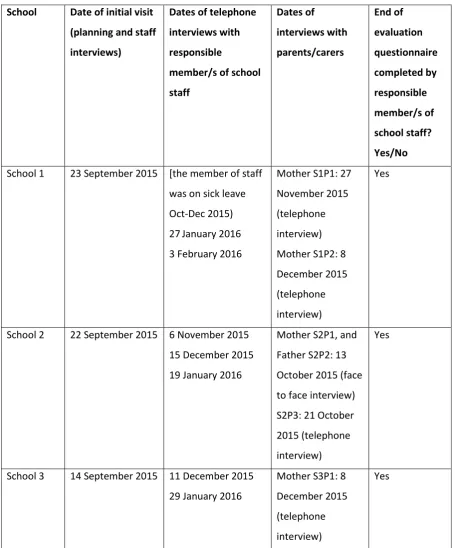
The evaluation design was centred on the need to develop detailed case studies of autism support in each school over a term and a half of the 2015-2016 school year. Table 2 summarises data collection
[image:15.595.71.527.192.741.2]for each school.
Table 2: Data collection
School Date of initial visit
(planning and staff
interviews)
Dates of telephone
interviews with
responsible
member/s of school
staff Dates of interviews with parents/carers End of evaluation questionnaire completed by responsible member/s of school staff? Yes/No
School 1 23 September 2015 [the member of staff
was on sick leave Oct-Dec 2015) 27January 2016 3 February 2016
Mother S1P1: 27
November 2015 (telephone interview) Mother S1P2: 8
December 2015 (telephone interview)
Yes
School 2 22 September 2015 6 November 2015 15 December 2015 19 January 2016
Mother S2P1, and Father S2P2: 13 October 2015 (face
to face interview) S2P3: 21 October 2015 (telephone interview)
Yes
School 3 14 September 2015 11 December 2015 29 January 2016
Mother S3P1: 8 December 2015
(telephone interview)
15 School 4 16 September 2015 19 October 2015
11 November 2015 7 December 2015
25 January 2015
Mother S4P1: 19 October 2015 (face to face interview)
Mother S4P2: 19 October 2015 (face to face interview)
Yes
School 5 17 September 2015 17 October 18 November 17 December
29 January
Mother S5P1: 10 December 2015 (telephone
interview)
Yes
Totals: 5 15 9 5
The initial teacher interviews averaged 45 minutes, while the subsequent, telephone, interviews were typically between 15-20 minutes. All interviews were recorded, with informed consent, and subsequently fully transcribed for analysis. The parent/carer interviews varied from 25 to 70 minutes in length, and were also recorded, with informed consent, and transcribed for analysis. The end of
evaluation questionnaire (Appendix 1) was completed in February 2016 by all the responsible school staff.
2.4 This report
This report aims to:
Provide detailed case studies of autism support in each school over a term and a half of the
2015-2016 school year. The case studies themselves are built around three areas:
o The experience of piloting of the Progression Framework in each school.
o Reflections on the value of AET, and other, training, along with current and future
training needs.
o The progress of the identified children with autism over the period of the evaluation,
and the relationship between the use of the Progression Framework and that
16
Provide overall conclusions from the five case-study schools
Provide an account of the parents/carers’ views of the needs of their children, and their
17
3.
The School case-studies
3.1 Introduction
Each of the five case studies provides background on the school, with particular attention being paid to the autism support training history of each school, and the role, experience and training of the responsible teacher. In addition, the backgrounds of the children who were part of the evaluation are also presented, with an examination of their needs, related to autism and otherwise. The piloting
of the Progression Framework is tracked, and closely linked to the support provided for the children in each school. In addition, training, both prior training, and possible future training needs, are examined. The intention is to provide rich, detailed accounts of support for children with autism, the piloting of the Progression Framework, and training needs in the five schools.
3.2 School 1 (Special secondary school)
3.2.1
School overview: school, staff member, training, pupils
3.2.1.1 The school
School 1 (S1) was a special secondary school for children and young people with moderate learning difficulties. Its school roll was 170, and pupils were aged 11-19. Although around one third of the pupils have a statement of autism, for the majority of them autism was not the primary need on their Statement of SEN, or Education Health and Care (EHC) plan. As the teacher (ST1) explained, ‘we
have quite a broad spectrum, and quite a broad range of ability […] so we run GCSE courses, and entry level courses, and we run BTecs as well’ (ST1).
3.2.1.2 The member of staff – experience, qualifications, and role
The member of staff who took part in the evaluation was an assistant head at the school and had responsibility for additional and exceptional needs. Her previous teaching experience was at a combination of mainstream and special secondary schools. Part of that experience had been in an
enhanced resource provision (ERP), which was ‘for students who were academically able enough for mainstream, but the issues around their autism meant that they couldn’t just go to mainstream school without that additional support’ (ST1). In the ERP, the teacher had acquired extensive experience of supporting children with autism in relation to a wide range of autism-related needs,
18
Birmingham, and was taking a part-time master’s degree in education with a specific focus on additional needs and autism. With this strong combination of experience and training, the teacher
had been recruited to the school in September 2013.
The assistant head’s recruitment was specifically linked by the school to an identified need to improve autism provision in the school. She explained her role and the existing support for children with autism in the school:
‘I came [here] as Assistant Head with responsibility for additional and exceptional needs, which is kind of the SENCo role, but with the fact that all of the children have got special needs, it’s a little bit different. So I oversee a variety of things; I oversee the autism provision, so we’ve got a Key Stage 3 class and a Key Stage 4 class, which is in this building
now. The Key Stage 3 class are mixed age group and they’re taught in that group all day every day and the teachers come to them so they’re not moving round the school quite so much and it’s quite a nurturing environment. They move round a bit for things like PE and cooking and stuff but they’re mostly in the classroom. The Key Stage 4 class works a little bit differently because what we […] actually when I came here the autism unit was just one
class, it wasn’t 2 separate classes, and so Year 7 – 11 in one class being taught by one teacher all day every day for what I quickly established that the progress being made by the students wasn’t up to scratch and you can’t give all of that broad range of students what they need in that age range in one room. So what we started to do we started bringing in
specialist teachers for the subjects so they weren’t having just the one teacher for
everything. And then we split into the 2 key stage classes so the older class, so Key Stage 4, they actually join the main school classes now for their lessons because we couldn’t offer them the broad curriculum without them doing that. Because we’ve got students in that
19
The changes that she outlined here were designed to widen the options and education available to the children with autism in the autism unit. In addition, she was in the process of enhancing whole
school CPD for staff and provision for all pupils.
3.2.1.3 Training and development strategy for the school in relation to autism provision
The assistant head’s strategy involved AET training for all staff and a project to achieve National Autistic Society (NAS) Autism Accreditation3. The AET Programme training was, in the assistant head’s plan, key to achieving Autism Accreditation. By September 2015, the entire school staff had undertaken Tier 2 AET training4, and 15 members of staff had completed Tier 3 training over two
sessions. In addition to the AET training, the assistant head had ‘backed up the AET level 3 training by doing whole school training on the National Autistic Society SPELL framework, so everybody is now using that’ 5(ST1) The assistant head saw the AET training as being crucial to the school’s intended bid to gain NAS accreditation. She also warmly welcomed the Progression Framework, hoping that it would enable effective tracking of support and the progress of pupils, in addition to
being a tool which could evidence good autism provision in relation to the NAS accreditation bid.
3.2.1.4 The pupils
The assistant head teacher had reviewed the pupils with autism, and, after consultation with their parents/carers, two pupils had been identified as the two pupils for tracking progress using the piloted Progression Framework. Although many more pupils had diagnosis of autism, it was felt that the piloting of the Progression framework would be most effective if a small range of key
progression targets were aimed at. The two pupils (S1P1 and S1P2) both had EHC plans. The first child (S1P1) was a student in Year 8 (Key Stage 3). He had experienced difficulties in mainstream schooling that were not alleviated by the school. However, he was eventually given a diagnosis of autism and moved to the special school. The second pupil (S1P2) was a student in Year 11 (Key Stage
4), and had been in mainstream schooling throughout primary school and for two and a half years of secondary schooling. S1P2’s general practitioner enabled a diagnosis of autism at an early age (less than two years old), but as the child’s mother explained, ‘she was always on the very edge of the developmental normal range’ so it proved difficult to obtain the support the child needed at a
3 See: http://www.autism.org.uk/professionals/accreditation.aspx (accessed, 29 February, 2016).
4 All the AET school level training in the schools in this report was undertaken before the 2016 revision of the
AET Schools Training, which replaced the designations ‘Tier 1, 2 and 3’ with descriptive titles.
20
mainstream school. The child had particular difficulties in social and friendship terms. Her additional needs include epilepsy, speech and language difficulties and dyspraxia.
3.2.2
Choosing to use the Progression Framework, September 2015 – January 2016
In her initial interview, ST1 explained how the piloting of the Progression Framework had come at the right time for the school. As part of the revision of autism support, and staff training that she had initiated in the school, the assistant head had developed a ‘Social Skills Profile’ tool to help track progress in that area for pupils with autism. The development of the in-house Social Skills Profile was of interest in itself, in that it represented a development that depended on the experience and
qualifications of the assistant head, drawing upon material provided by the local ‘Autism Outreach Service’, and AET Training material. ST1 explained:
‘Can I show you something else that I’ve done? When the students come into the school
now and put autism on their statement we complete one of these – for the recording it’s a “Triad of Challenge Profile”. We talk to the primary schools about the issues that they face regarding each of the areas, and it refers to a sensory profile and stress survey as well. So we do the sensory profile that came from the [local] Autism Outreach Service. And the stress survey came from the AET training.’ (ST1)
The combining of material from differing sources was a common occurrence in the schools that took part in the evaluation. Here, this in-house tool was a part of the ‘Progress Portfolio’ kept on each child, and was to be introduced in September 2015, but the assistant head decided that she would
trial the pilot Progression Framework in its place.
3.2.3
Using the Progression Framework
The initial face-to-face interview with ST1 (23 September 2015) was not followed by other interviews during the autumn term as the assistant head was off work for several weeks towards the end of the term. However, the Progression Framework was used, and, on return to work, the assistant head
21
The assistant head introduced the Progression Framework with 16 members of staff, who were members of the ‘Autism Focus Group’ in the school. The process started with a training session for
the 16 staff run by the assistant head and a member of the local autism outreach team. The assistant head explained:
‘We’ve got an Autism Focus Group in the school, so that the 16 [staff], including me, are the
Focus Group. And so I delivered a little bit of training on the Progression Framework. I had a bit of a play with it first, and then [name] from the Autism Outreach came to the training as well, and she was able to fill in any gaps that I was struggling with. And all of the staff were present with their laptops, and I’d e-mailed a copy of it out to them beforehand, so they were able to sit in the training session and follow what I was saying and look at how it
worked so that gave them the opportunity to get over the technical aspects of it whilst in a room and sharing together. So yeah they’ve gone off and done their own thing with it really. I haven’t reviewed it officially with all 16 yet because I’m waiting for the next … we’ve got another Autism Focus Group coming up in a few weeks’ time so that will be when we look at
a more formal evaluation of it to see how we can see it moving forward in school.
Informally, obviously, I’ve discussed it with various teachers to see what they’re doing.’ (ST1)
The focus was only on one section of the Progression Framework, in order to introduce staff to it without overwhelming them. As with the other school staff in the evaluation, there had been an
initial sense that the Progression Framework was ‘rather huge’ (ST1), but it was quickly appreciated that it was a flexible and varied tool kit that could be drawn upon as needed. The section the school focused on was the Social Skills section: ‘the Positive Relationships with Friendships section, and we chose six learning intentions that we wanted to work with […] working on strategies within the
classroom specifically for those learning intentions’ (ST1). This Progression Framework focus informed three areas of activity in the school:
‘We’ve got one teacher that set up a group that the children themselves have named Social Rangers, which is quite nice, so they meet once a week during an assembly time and look at
22
teachers are just using their tutor time and the less structured times of the day for work on the targets with the students and we are seeing some progress, so, good.’ (ST1)
For each child, six learning intentions were chosen. Progression Framework use proved to be highly valued for the focus it gave to work with the pupils on progressing their social and friendship skills. Box 1 provides the assistant head’s account of using the Progression Framework to structure successful autism support.
Box 1: The Progression Framework as a successful tool to support children with autism
I’ve spoken to the member of staff who does the Social Rangers and that’s working really, really well. And actually I’ve spoken to the students who are doing the Social Rangers Group and they really enjoy it. And they’re doing some really structured work on the individual targets, things like how to join in a conversation, joining a group and how to cope when people don’t agree with your
opinions and that sort of thing, building up from greetings and extending conversation. So they’re doing it in quite a formal way, which is working really well, and it’s mixed in with we’re also doing something called Lesson Study here and the teacher who’s running the Social Rangers is doing the Catering for Students with Autism as her lesson study, so the Progression Framework and the
lesson study have kind of combined so she’s running the group for 2 purposes they have married in together quite nicely. So that’s working very well indeed and I think what we’ll be looking at is to formalise some of the other work that’s going on around school in a similar way as this group, because that has been really successful. (ST1)
This is a good example of the use of the Progression Framework to provide a staged, step-by-step
map to structure support, and enable progression, for children with autism.
3.2.4
The young people and use of the Progression Framework
School 1 was unique among the five evaluation schools as it was a special secondary school with a comparatively large number of pupils with autism. As a result, the school was able to pilot the Progression Framework with the young people in the Social Rangers group, and throughout the
23
Just as the Progression Framework had enabled a ‘really structured work’ to be done with the pupils in the Social Rangers group, so the Progression Framework was proving useful for the same reasons
in working with S1P1:
‘He is definitely making good progress. The [Progression] Framework is helping because it gives us a bit of a structure to work with, because I think it was a bit woolly before. So, we are able to set him specific targets, and then we move on and set new ones, and the
[Progression] Framework helps you do that. Once you think he’s met one [target] we put in another one for him, and that works nicely.’ (ST1)
This is an example of the Progression Framework being used to track and to plan progress for a student. In the case of the second student, S1P2, the use of the Progression Framework was
temporarily suspended because progress was not being made as other issues needed to be addressed first:
‘We’ve done the same thing with [S1P2], but she’s a bit more of a complex character, and
we’re having a few difficulties. At the moment she’s struggling with … shall we call it “emotion regulation”, and there’s been a few incidents in school, so we’re having to make quite a lot of changes to her timetable, and I think the work we are doing on her social interactions [being tracked with the Progression Framework] has taken a little bit of a back seat while we’re trying to get her more settled, and get that side of things sorted out. But it
hasn’t disappeared altogether. We’re still using it, and it’s in the background, but other things have had to take priority over the last few weeks.’ (ST1).
The intention, then, was to return to the full use of the Progression Framework, once the other
issues had been settled. The school’s own flexibility was, in effect, being supported by the flexible nature of the Progression Framework.
24
targets from the Framework to report to the parents via the ‘annual review and through our Progress and Aspiration Reports’ (ST1).
3.2.5
Training impact
With the leadership of the assistant head, the school staff had taken part in various training activities. Foremost among these was AET training, but other sources of training and autism
information had been used. As part of the preparation for the NAS Autism Accreditation application, the school took advantage of AET training at Tiers 2 and 3 (see above at 3.2.1.3). In the interview with ST1 on 3rd February, 2016, she explained how the AET training had begun to impact on autism
provision in the school:
‘The AET [tier] 3 was really good, that was led by [name], and there was 16 of us, the same 16 as the Autism Focus Group, that did that. It’s really starting to have an impact in school.
In briefings in the morning we’re talking about behaviour and people say “I’ll write a Social Story for that” and things like that, whereas that wasn’t happening before. And also just a little bit more understanding of … You know sometimes if children are displaying challenging behaviours and just a little bit more understanding about it might have been a sensory thing or a change to routine and rather than telling them off there’s a bit more empathy around it.
So I think that’s going really, really well.’ (ST1)
In addition, the school had adopted the NAS Standards. The NAS standards had been chosen instead of the AET National Standards because of the goal of achieving NAS Accreditation. A plan was
developed to roll out the standards throughout the school, and, at the time of the interview, only a few of the standards needed more work. The intention was to achieve consistency of training, understanding, environment and support throughout the school.
25
‘It would be useful for some practical strategies to be included as a kind of action pack to go with the Progression Framework for each area. If this could be developed, the [Progression]
Framework would be even more useful.’ (ST1)
3.2.6
School 1 conclusions
School 1 had strong, senior management level, backing for the provision of good autism support. Under the leadership of the school’s assistant head teacher, the school had:
Developed a strategy to enable high levels of autism provision. The strategy involved whole
school AET Tier 2 training, and Tier 3 training for a core of 16 staff with specific autism responsibilities.
Begun to prepare for an application for NAS Autism Accreditation. AET training and materials
were an essential part of the preparation.
Successfully piloted the AET Progression Framework. The success of the school’s pilot had
led to the Progression Framework being integrated into the school’s recording, planning and
reporting schemes for pupils with autism.
The Progression Framework not only enabled the planning and tracking of individual pupils’
progress, but was also to be used to evidence that progress, and provide details of impact of support for individual pupils.
AET training and materials formed a central part to developments in the school, as did the
Progression Framework. The AET input was one element in the strengthening of autism provision in the school. The assistant head teacher had been recruited with a specific remit to improve autism provision, and she had extensive experience and qualifications in the area. In addition, the NAS
26
3.3 School 2 (Mainstream primary school)
3.3.1 School overview: school, staff member, training, pupils
3.3.1.1 The school
School 2 (S2) was a mainstream primary school, with 270 pupils on the school roll, from nursery to
Year 6. Two children in the school had diagnoses of autism, and at least five other children were believed to be displaying signs of autism. One of the latter group had additional learning difficulties.
3.3.1.2 The member/s of staff – experience, qualifications, and roles
Two members of staff were involved with the evaluation. The first (ST2) was the assistant head
teacher and SENCo. She had 11 years of teaching experience, and had been at the school for five years. Since taking over the post of SENCo, ST2 had undertaken a post-graduate course for SENCos at a local university, which she was in the process of completing at the start of the September 2015 school term. In addition, she was undertaking short courses focused on strategies to support children with Special Educational Needs and Disabilities (SEND).
The second member of staff (ST3) was the one-to-one support worker for a pupil with autism in Year 1, who was pre-verbal and had a diagnosis of autism. She had been with the school since November, 2014, and had moved from another mainstream school when a pupil with autism she was working with moved to a special school. ST3 had worked with the pupil in Year 1 since she entered the
Nursery class. There had been no transition plan in place when the child entered Nursery, and the school had only found out that the little girl would be joining it a week before the start of the September, 2014, term. As a result there was a delay before ST3 joined the school, but her experience of working as a one-to-one support for children with autism enabled a positive change for the child: ‘when I came I introduced lots of visual support and visual timetable and visual
prompts. And then we introduced PECS [Picture Exchange Communication System], and it just changed her life’ (ST3).
The two members of staff, then, combined extensive classroom experience, with some formal
27
particularly those with autism. The main autism-focused training had been provided by the AET Programme. The SENCo outlined the school’s AET training:
‘The whole school has had Level 1 [i.e., Tier 1] training, and we had that in January this year [2015]. And then myself and a TA who works very closely with the Year 1 child have had Level 2 training. And I have been on the Level 3 training. [ST3] had already had Level 1 and Level 2 before she came to this school, and now she’s done Level 3 as well.’ (ST2).
In addition, the Nursery staff had also take the AET Early Years Programme at Tier 1, as well as the AET School Programme, Tier 1.
3.3.1.3 Training and development strategy for the school in relation to autism provision
The SENCo did not envisage further whole school training. However, there was an intention to ensure that all new staff were trained to Tier 1, in either the School Programme or the Early Years Programme, depending on role. In addition, there was a hope that it would be possible to train more staff to Tier 2 of the Early Years or School Programmes. The key driver for this was the need to meet
the requirements of individual pupils as they entered the school, or received diagnoses of autism.
Beyond continuing training needs, the SENCo had identified the need to introduce and fully exploit the AET National Standards and Competency Frameworks. The impetus to this decision was her completion of the Tier 3 School Programme, and it was her intention to add the Standards and
Competency Framework to the school’s SEN Action Plan.
The SENCo’s development strategy for autism provision envisaged the creation of better physical spaces for pupils with autism. In particular, she wanted to ‘get this sensory room up and running,
28
The SENCo had also begun to improve communication and develop closer links with the parents and carers of pupils with autism. The aim was to build on the daily, informal, contacts that the
one-to-one support worker had with parents. An example was a special autism awareness assembly, part of the school’s autism awareness day, which was attended by parents of pupils with autism. The autism awareness day was seen to be a mode of how support for children with autism could be part of whole school developments. The SENCo said: ‘it was a lovely day, because all the Reception children were shown how [name of Reception pupil with autism] works throughout the day, and what the
PECS book is for, and the timetable is for, and why there’s things stuck up around the school’ (ST2). The one-to-one support worker also commented on the success of the day: ‘they [the pupils] were so sensible, and I was really pleased with that day, it was really good’ (ST3).
3.3.3.4 The pupils
Two pupils were identified by the SENCo to be part of the school’s piloting of the AET Progression Framework. The first pupil (S2P1) was a girl in Year 1, whose one-to-one support worker was ST3. She was diagnosed with autism in 2014, while she was in a nursery at a different school. Her speech development was delayed, but in February 2015 she began to use a small number of words. She also
needed assistance with dressing and undressing for PE, and in going to the toilet.
The second pupil (S2P2) was a boy in Year 2. His parents had felt that, from an early age their son had issues that needed support, but had experienced difficulty in getting that support. It was not until he started at the school’s Nursery that steps were taken, at the instigation of the school, to
seek a diagnosis for the pupil. The boy experienced high levels of anxiety, needed clear and predictable routine, was sensitive to noise, and needed suitable space to be quiet and calm. In Nursery, the school developed a reduced day for him, enabling him to avoid the beginning of the school day, and to leave after lunch. That had been progressed to a point where the pupil arrived at
school before the other pupils.
3.3.2 Choosing to use the Progression Framework, September 2015-January 2016
29
3.3.3 Using the Progression Framework
The initial face-to-face interview with ST2 and ST3 (22 September 2015) was followed by telephone interviews on 6 November, 2015 (with ST2 only), 15th December, 2015 (with ST2), and 19 January,
2016 (with ST2 and ST3), at which point the school had decided to abandon their piloting of the Progression Framework. In addition, the end of evaluation questionnaire was completed by ST2 and ST3 together.
The school was the only school of the five case study schools that decided to stop using the Progression Framework. As a result, the three telephone interviews provide an interesting insight
into possible difficulties that some schools may face in attempting to use the Progression Framework. During the September term, the school continued to work with the Progression Framework, albeit with reservations. It was hoped that as they became more familiar with the Framework, its value would become clearer. The telephone interviews in November and December,
2015, reflected this process. However, just before the end of the term, ST2 and ST3 decided that the school would no longer use the framework; that decision was discussed in the final telephone interview in January, 2016. Each stage is covered here.
3.3.3.1 Working with the Progression Framework over the September term, 2015
The central issue that the school had with the use of the Progression Framework was a need for more guidance related to achieving objectives. This issue remained constant throughout the
September term. The initial feedback from ST2 was ‘we were expecting a bit more information in terms of tips and such as to how to achieve a set target. We were expecting to go to this objective, this intention, and then it would be a case of either “look for this, this and this” […] suggestions on how to achieve’ progress (ST2). She added, ‘we already knew that was the area we wanted to work
on next – I think it was more a case of we wanted more direction’ (ST2). The two staff thought that the objectives, and the step-by-step approach were good, but that too much depended on the knowledge, qualifications and experience of staff. Although it was recognised that staff with little experience or knowledge should not be working, unsupported, with children with autism, it was felt
30
By the beginning of December, the school had begun to make less use of the Progression Framework. The Framework was not being used in a strongly structuring way, but in an ad hoc
fashion:
‘There’s not much direction on the information, and I kind of felt that we’d not used it to the best we could, we’re just dipping in and out of it because just by looking for the objectives it doesn’t give us any other guidance really. I think because of that we’re not using it as much
as we possibly should be, so we are just dipping in and out of it, thinking, right, here are the objectives, and we are just following it as we wish.’ (ST2)
The SENCo repeated her view that more was needed by way of directions and advice aimed at achieving the progress outcomes, and said that ‘to be honest, all it’s helping us to do is to word
[name] the objective’ (ST2).
3.3.3.2 Deciding to stop using the Progression Framework
The decision to stop using the Progression Framework was take at the very end of the September
term. An assessment was made that the use of the Progression Framework was not adding value to the work with the children. As such it was just another task – ‘we were doing those things regardless of that document [the Progression Framework], we were doing it anyway, and then it just became a paper exercise, and we’re ticking it, but, well, we’re doing it anyway’ (ST2).
The staff were asked what, in their view, could be added to the Progression Framework in order to make it more useful to them. They suggested two additions. Firstly, they would like to see more direction associated with attaining the goals for children. Secondly, they thought that there was a need for external support for schools choosing to adopt the Progression Framework. There was a
31
‘For this [the Progression Framework] to have worked, I think it would have been more helpful if, say, when [local autism outreach team] did come in we talked through the targets
that we were going for, and they would either say, right, this is how we could implement this, and then we reviewed that as it was moving on. I think that having somebody from the outside who does have that understanding, and then making sure it’s clear’. (ST2).
3.3.4 The children and the use of the Progression Framework
The two children – S2P1 and S2P2 – were in Year 1 and Year 2 respectively, and for both children, the SENCo thought that it would be appropriate if the focus was on a small number of progress
objectives: ‘I think that for one of the children [S2P2] we’ll probably just stick to one objective at a time, and then for the other child [S2P1] we think she could probably cope with more than just one or two objectives’ (ST2). The objectives were taken from the Progression Framework, and the focus for S2P1 was on social interaction and speech, language, and communication, while for S2P2 the
focus was on social interaction, relationships and friendships. Although the school stopped using the Progression Framework in relation work with the two children, it did, initially, help frame the
decisions relating to targets for the children.
Over the period of the evaluation, the SENCo, the one-to-one worker for each child, and the school
staff all worked to help the children achieve their goals. That work was carried out in conjunction with the parents of the children, and with outside agencies. For the little girl in Year 1 (S2P1), the September term saw notable progress:
‘The little girl [S2P1] has been making great progress in terms of speaking, she’s actually been saying words, and she’s using her PECS very much in terms of communicating. And she’s got a really good part in the Christmas nativity play as well, and she’s been happy with that, she’s a mouse in the nativity, and she’s coming out – so that’s been great in terms of her confidence in a whole group situation’ (ST3)
32
really helped her’ (ST2). Finally, during the September term, the child’s Statement was converted into an EHC Plan, ‘so, there are a lot of little elements just coming together’ (ST2). By the beginning
of the January term, the staff reported that ‘she’s becoming really independent, which is good’, (ST3).
The little boy’s progress was less pronounced over the period. The school staff and his one-to-one support focused on supporting him in social situations, and had identified progress as a result of
using social stories:
‘With the boy I’ve been doing small – at lunchtime because he struggles at lunchtime – we’ve been doing work on social stories but he’s really struggling with writing them down so what we’ve been doing is lots of talking about them, about when he’s having trouble he
comes and says ‘Mrs [name] can I ask you something?’ and it’s really nice that he’s got that and then I’ll draw a little cartoon about things that he’s talking to me about, quite visual, and it’s down there and it seems to be really helping because in class he’s coping with losing at games and at playtime when it’s time to come in he’s not getting so cross. So that feels really nice, like that’s working.’ (ST3)
Focused work (although not fully utilising the Progression Framework), support from all the adults around the children, co-working with parents, and with external support, were all important in enabling effective support for the two children.
3.3.5 Training impact
In the initial interview, the SENCo talked about the impact of AET training on school staff and the provision of autism support in the school. She explained that the whole school Tier 1 training had impacted upon the understanding and attitudes of staff towards autism. In addition, it had helped to
reinforce messages regarding differentiation in the classroom:
33
about that but TAs don’t automatically think about things like that. And also I think one of the big things was just to say it’s alright if they’re not all doing the same thing. I think giving
that back to the teachers and the TAs to say it’s alright if they’re not all going to doing the same thing, it’s okay, just giving them back because I think that’s a massive thing for us whereas ‘they should all be doing the same work’. Well no because they can’t access it. It’s fine, it’s alright, we understand. And I think for the Level 1 just giving them options and saying try this, try that it did put the staff’s minds at ease.’ (ST2)
The SENCo had undertaken all three tiers of the School Age training, and praised the ‘progression’ from one tier to the next. She was also reassured by the training that strategies that the school already had in place for pupils with autism were correct. She found Tier 3 of the training useful from
her position as the SENCO, and assistant head teacher:
‘The Level 3 was good in terms of thinking whole school and not just for one specific child. It was good to think about things we should be doing as a school and not just for children who are on the spectrum. It was the case that it’s just good practice. They are a few changes that we’re making this year, visual timetable, things like that, where we can help all
children.’ (ST2)
The training had also helped in reinforcing messages related to autism provision, and reasonable adjustment, that the SENCo was giving. She explained that compared to pre-training experience, the
34
3.3.6 School 2 conclusions
School 2 had strong commitment to proving good support for its pupils with autism. Staff, including one-to-one support workers had extensive experience of working with children with autism. The AET
Programme, at all three tiers, had provided invaluable training for school staff. Of the five case-study schools, School 2 was the only school not to continue with its piloting of the Progression Framework. In the end of evaluation questionnaire open question, the SENCo explained the difficulties that the school had experienced with the Progression Framework, and suggested how the difficulties might be overcome:
‘As a school, we did not find the AET programme Progression Framework as useful as we had hoped it would be. Having discussed this we feel that it may have been more useful I it was implemented by an outside agency [name of agency – local autism outreach service]. As a team we felt that the objectives/areas of learning were already our priorities, and therefore
the programme [Progression Framework] didn’t add much to the provision that we already had in place. It would have been useful if the programme came with a progression type chart, or how to assess that the objectives had been met.’ (ST2)
3.4 School 3 (Mainstream primary school)
3.4.1
School overview: school, staff member, training, pupils
3.4.1.1 The school
School 3 was a mainstream primary school with 250 pupils on the school roll, between the ages of 3
and 11. A large majority of the pupils were of ‘White British’ origin. The proportion of pupils
supported at school action plus or with a statement of special educational needs was above average. Similarly, the number of pupils eligible for additional funding (pupil premium) was above the
national average. There were two children who had diagnoses of autism, and six who were believed, by the school, to exhibit characteristics associated with autism.
3.4.1.2 The member of staff – experience, qualifications, and role
35
I oversee, and jump in where needed for the classroom teachers if they say, “this isn’t working – can we change it?”’. The Lead Practitioner had joined the school in 2011 as a one-to-one worker for a
child with severe complex needs, which included autism. ST4 had a wide range of training for her role, which had expanded since joining the school:
‘When I first came to the school, I had my level 2 NVQ supporting teaching and learning skills, and I finished my level 3 in the November of that first term. Since coming to the
school, I have been Tacpac trained, Intensive Interaction trained, team teacher trained, NCC medical background relating to autism, Retts syndrome, and similar, trained. Level 2, and Level 3 AET schools’ programme trained; SEN literacy trained; they’ve also given me Webster Stratton Classroom Management training.’ (ST4)
The child that ST4 had originally joined the school to support had, after two years, moved to a special school, but ST4 had remained with the school with a broadened remit.
3.4.1.3 Training and development strategy for the school in relation to autism provision.
The Lead Practitioner for Autism’s role encompassed direct classroom support for pupils with autism, and training and development support for school staff. Her role and remit were fully supported by the school’s senior management team. In terms of AET training, all the teaching staff, along with the Teaching Assistants (TAs) had undertaken the Tier 1 training. In addition, ST4 and the school’s head teacher, had undertaken AET Tier 2 training in November2014, and, subsequently, Tier
3 training. The Lead Practitioner then cascaded the Tier 2 training to other members of the school staff. This was done as an e-mailed document outlining key areas of the Tier 2 training. In addition, the Lead Practitioner was in the process of introducing the AET National Standards into the school. There school also has a programme of peer awareness events, including an ‘Autism Awareness Week’, with whole school and class-based activities and exercises.
A key driver for training at the school was the need to meet individual pupil’s needs. An example was the training undertaken prior to a little girl with SEND joining the school: ‘we’ve had additional training for the girl coming in. We’ve got additional training to meet her needs, so we’ve done CPR,
36
3.4.1.4 The pupils
The two pupils with diagnoses of autism were included in the evaluation. One child (S3P1) joined the
school nursery in September 2015, which she attended in the mornings only. This child has complex medical needs in addition to autism, but, as the Lead Practitioner commented: ‘she’s a bright little button, which is why she is in mainstream school’ (ST4). When the child is in school, ST4 works as her one-to-one support.
The second child (S3P2) was in Year 2, and had been in the school since he joined Reception. The Lead Practitioner described his progress from Reception until September 2015:
‘He came to us non-verbal, serious issues with his clothes, still does have very clear
obsessions which hindered his progress and development in all areas. We’ve gone from him throwing, kicking, would throw things and run away to a boy who’s very compliant. There are times when he’s mischievous; he does have a sense of humour. He’s now writing, he’s now reading, he’s counting up to 30, and he is very good with technology because as soon as
I’ve turned my back on him he’s changed what he’s doing. He will go to most members of staff now, whereas before he was fixated on just me and that was it, couldn’t leave his side. He’s now toilet trained as of this summer and will ask to go to the toilet now. At the
beginning of the week I just kept taking him but today he turned round to me and went ‘I need the toilet’. He is recognising more and more faces, he is playing alongside his peers,
still alongside but tolerates them and tolerates the noise more. He does know when somebody is not there with regards to one girl in another class because they go swimming together and he turned round to me one day and said ‘where is so and so gone?’ and I said ‘she’s just gone to the bathroom’. So he is making those links now. He’s in the classroom a
lot more, which he never was; he was always in that room next door [the Nurture Room]. In the classroom he will do his handwriting, computer work, PE, art.’ (ST4)