ISSN Online: 2160-8776 ISSN Print: 2160-8741
DOI: 10.4236/ojped.2017.74040 Dec. 28, 2017 353 Open Journal of Pediatrics
Flu Vaccine Coupled to Vitamin D Decrease the
Frequency of Lower Respiratory Tract
Infections (Randomized Controlled Trial)
C. Tayeh, P. Noun, A. Farah, Y. Khalife, G. Abi Fares,
M. Amm, H. Feghali, G. Nicolas, M. C. Fadous Khalife
*Holy Spirit University of Kaslik, University Hospital (UH)-Notre Dame Des Secours, Byblos, Lebanon
Abstract
Introduction: Influenza disease is one of the major health concerns in pedia-trics. One of the most recently suggested effects of vitamin D is preventing in-fectious diseases. The aim of our study was to compare flu vaccine effect to flu vaccine associated to vitamin D (100,000 UI per OS) in reducing respiratory tract infections in children. Patients and Methods: 347 healthy children aged 2 to 5 years randomly selected during fall 2012 and the following season fall 2013 were included; upper and lower respiratory tract infections following vac-cination were noted. Our results were analyzed using SPSS program (Chi-square and T-test). Results: Out of a total of 347 children included, 150 received flu vac-cine and 197 received flu vacvac-cine plus vitamin D. 88 children from both groups manifested upper respiratory tract infections and 64 had lower respiratory tract infections. The statistical analysis revealed no significant difference between the two groups concerning the upper respiratory tract infection (p = 0.207) and a significant difference between groups for the lower respiratory tract infection (p = 0.001). Conclusion: Coupling vitamin D to flu vaccine provides no pro-tection against upper respiratory infections but provides an effective strategy to decrease the rate of lower respiratory infections in children 2 - 5 years of age.
Keywords
Influenza, Flu Vaccine, Vitamin D, Upper and Lower Respiratory Tract
1. Introduction
Influenza has long been a major health problem in the general and especially pe-diatric population that over-goes important seasonal fluctuations. Cannel and Al How to cite this paper: Tayeh, C., Noun,
P., Farah, A., Khalife, Y., Abi Fares, G., Amm, M., Feghali, H., Nicolas, G. and Fadous Khalife, M.C. (2017) Flu Vaccine Coupled to Vitamin D Decrease the Fre-quency of Lower Respiratory Tract Infec-tions (Randomized Controlled Trial). Open Journal of Pediatrics, 7, 353-358.
https://doi.org/10.4236/ojped.2017.74040
Received: November 8, 2017 Accepted: December 25, 2017 Published: December 28, 2017
Copyright © 2017 by authors and Scientific Research Publishing Inc. This work is licensed under the Creative Commons Attribution International License (CC BY 4.0).
DOI: 10.4236/ojped.2017.74040 354 Open Journal of Pediatrics [1] suggested the hypothesis that seasonal variations of serum vitamin D concen-trations can affect the epidemic incidence of the flu.
On one side, vitamin D can increase the innate immune response and protect against infections of the respiratory tract, but few clinical studies have evaluated the relation between vitamin D and the seasonal flu. A clinical study has shown a decrease in the seasonal influenza infections in Japanese children receiving 1200 UI of vitamin D3 per day [2]. We have therefore decided to couple a loading dose of vitamin D (100,000 UI per OS) to the flu vaccine, and to compare the results to a group that was administered the vaccine only. We had to observe the effect of both on the incidence of the seasonal flu and upper respiratory tract in-fections as well as secondary lower respiratory tract inin-fections, over 2 winter sea-sons from September 2012 till the end of January 2014. The 347 previously healthy children, aged 2 to 5, were randomly selected out of 3 different pediatric doctors’ offices across Lebanon.
2. Tools and Methods
We have carried on a multi-centered, prospective study over the course of 2 winter seasons (years 2012-2013 & 2013-2014) with 347 children of both sexes. It took place in 3 private clinics of 3 pediatricians, taking into consideration varia-tions in climate, humidity, altitude, way of living, eating habits & more factors that could have a relation with vitamin D levels. The exclusion criteria were age (under 2 years or over 5 years), chronic intake of vitamin D, history of recent vi-tamin D supplementation during the last 3 months, history of allergy to the im-munization, recent viral, bacterial or parasitic infections, children with chronic respiratory diseases (asthma, cystic fibrosis, etc.), congenital diseases, chronic car-diac, renal, digestive, vascular, endocrine diseases, and finally patients who received recent immunosuppressive or chemotherapeutic agents during the previous year. Patients who met the inclusion criteria were divided into 2 groups: group A received only the influenza vaccine, group B received both a single dose of Vita-min D 100,000 IU orally coupled with the adVita-ministration of the Influenza vac-cine. Parents were informed of the study goals, possible side effects and follow up. An oral approval was documented before initiating the study. Belonging to a group or the other was performed according to a coin toss. The choice of the dose of 100,000 UI was made according to the European recommendations. Patients were followed up for 3 months only since the vaccine effect is the highest in this period. The age range of 2 to 5 years was chosen because it reflects the period of admission into collectivities, of adenoids hypertrophy and its function as a bac-terial/viral reservoir. This role starts to decrease beyond 5 year of age. The exclu-sion of the younger than 2 years was justified by their daily supplementation.
DOI: 10.4236/ojped.2017.74040 355 Open Journal of Pediatrics decrease in appetite, nausea, vomiting, and diarrhea as well as various infections divided into two categories: upper respiratory tract infections (otitis, sinusitis, ton-sillitis, ethmoiditis, etc.) and lower respiratory tract infections (laryngitis, bronchitis, pneumonia). No child was given more than one dose of vitamin D during the study.
Statistical analysis of the results was executed using the SPSS (version 16.00) program (SPSS Inc., Chicago, IL); the board containing continuous and discrete variables. The discrete variables were analyzed using the Chi square method, the continuous variables using the “r” test. Probability values of p ≤ 0.05 were con-sidered significant.
3. Results
The number of patients included in this study was 417, male gender was slightly more predominant (52.2%). The average age was 3.82 years with a standard dev-iation of 1.12. The average weight on presentation of the patients was 17.83 kg with a standard deviation of 5.16.
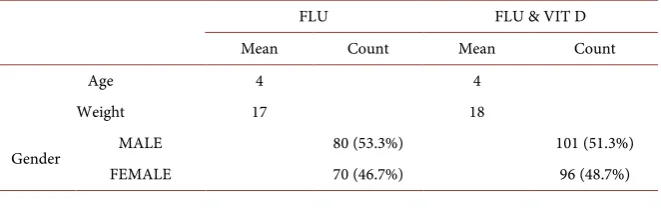
Group A included 150 children (43.2%) and group B included 197 children (56.8%). No statistical significance was noted when comparing the average age, gender distribution and average weight (Table 1).
Patients who had upper respiratory tract infections had similar distribution of gender and average age however had a lower average weight of 17 kg (p = 0.018) when compared to patients who did not have any upper respiratory tract infec-tion (18 kg).
Patients who suffered from lower respiratory tract infections were also analyzed in terms of age, weight and gender and no statistically significant difference was noted (p = 0.184, p = 0.108, p = 0.509 respectively).
However, significant results were shown on lower respiratory tract infections between the children who received the vaccine coupled to Vitamin D compared to children who received the isolated vaccine (p = 0.001 with the cross tabulation method).
4. Discussion
[image:3.595.209.540.630.734.2]Children are a sensitive target of infection, especially at a young age and after the weaning of maternal feeding which provides important protection; Children aged 2 - 5 years are most prone to infections due to their introduction to preschool/ nursery environments.
Table 1. The distribution of children.
FLU FLU & VIT D
Mean Count Mean Count
Age 4 4
Weight 17 18
Gender MALE 80 (53.3%) 101 (51.3%)
DOI: 10.4236/ojped.2017.74040 356 Open Journal of Pediatrics Numerous pediatricians recommend flu vaccine in order to decrease the rate of infection and its sequelae, the vaccine having shown positive results over the years.
Breast milk and formula lack Vitamin D. Therefore, supplementation is essen-tial and needed. It is currently a subject of interest considering its increasing role recently in the immune system, vascular among many others. The European rec-ommendations propose a supplementation of 100,000 UI during childhood and 200,000 UI during teenage years especially in winter season.
The aim of our study was to look for a synergistic effect of influenza vaccine combined with vitamin D. Our sample size consisted of 347 previously healthy children between 2 - 5 years, selected from three different out patients clinics across Lebanon taking into consideration variations in climate, altitude, eating habits and other factors.
The “Third National Health and Nutrition Examination Survey” revealed a sig-nificant association between vitamin D and upper respiratory tract infections [1]. However, in our study, patients who had upper respiratory tract infections had a lower average weight when compared to patients who did not have any upper respiratory tract infection.
A single Japanese study showed a decrease in the risk of children having in-fluenza after supplementation in vitamin D. In fact, a daily dose of 1200 UI of vitamin D was administered over the course of 3 months to 50% of children aged 6 to 15, compared to a control group. The study was a double blinded, randomized, performed in the faculty of medicine at the Jikel University in Tokyo [3].
In India, a study done on 150 children aged 2 to 5 years (similar to our group) divided into 2 groups, revealed a relationship between vitamin D deficiency and severe lower respiratory tract infections. A direct relationship between low dose of vitamin D and pneumonia was also mentioned [4].
Combining vitamin D and influenza vaccine can play an active role in the in-nate and acquired immune system by up-regulation of anti-microbial peptides, including defensins, and consequently protecting children against lower respi-ratory tract infections. Defensins would inhibit infections by blocking the he-magglutinin and the membrane fusion [5] [6].
DOI: 10.4236/ojped.2017.74040 357 Open Journal of Pediatrics Not dividing children into subgroups considering factors such as prematurity, socio-economic status, living area, siblings, iron deficiency anemia, gastroesopha-geal reflux disease that may play a role in recurrent respiratory infection might be a limitation in our study. However, our patients were healthy children and crite-ria of exclusion mentioned above were used.
The Other limitation can be the sample size. In addition, and serum concen-trations of 25-hydroxyvitamin D would have been useful to better correlate with the results of the study.
5. Conclusions and Perspectives
The WHO on an international level and the State on a national level recommend flu vaccination to any person at risk, specifically young children with risk factors of infections.
The American Academy of Pediatrics and the various Pediatric societies (Eu-ropean, Lebanese, etc.) recommend vitamin D supplementation, in order to cover vitamin D deficiency and due to its multiple benefits.
Our study proposes to combine two beneficial molecules proved to have a synergistic effect and represents a promising strategy in public health that we are publishing in hopes of encouraging more studies and eventually promoting the use of this coupling around the world.
References
[1] Cannell, J.J., Zasloff, M., Garland, C.F., Scragg, R. and Giovannucci, E. (2008) On the Epidemiology of Influenza. Virology Journal, 5, 29.
https://doi.org/10.1186/1743-422X-5-29
[2] Urashima, M., Segawa, T., Okazaki, M., Kurihara, M., Wada, Y. and Ida, H. (2010) Randomized Trial of Vitamin D Supplementation to Prevent Seasonal Influenza A in Schoolchildren. American Journal of Clinical Nutrition, 91, 1255-1260.
https://doi.org/10.3945/ajcn.2009.29094
[3] Jeffery, L.E., Burke, F., Mura, M., Zheng, Y., Qureshi, O.S., Hewison, M., Walker, L.S., Lammas, D.A., Raza, K. and Sansom, D.M. (2009) 1,25-Dihydroxyvitamin D3 and IL-2 Combine to Inhibit T Cell Production of Inflammatory Cytokines and Promote Development of Regulatory T Cells Expressing CTLA-4 and FoxP3. Jour-nal of Immunology, 183, 5458-5467. https://doi.org/10.4049/jimmunol.0803217 [4] Wayse, V., Yousafzai, A., Mogale, K. and Filteau, S. (2004) Association of
Subclini-cal Vitamin D Deficiency with Severe Acute Lower Respiratory Infection in Indian Children under 5 y. European Journal of Clinical Nutrition, 58, 563-567.
https://doi.org/10.1038/sj.ejcn.1601845
[5] Leikina, E., Delanoe-Ayari, H., Melikov, K., Cho, M.S., Chen, A., Waring, A.J., Wang, W., Xie, Y., Loo, J.A., Lehrer, R.I. and Chernomordik, L.V. (2005) Carbohy-drate-Binding Molecules Inhibit Viral Fusion and Entry by Crosslinking Membrane Glycoproteins. Nature Immunology, 6, 995-1001. https://doi.org/10.1038/ni1248 [6] Doss, M., White, M.R., Tecle, T., Gantz, D., Crouch, E.C., Jung, G., Ruchala, P.,
DOI: 10.4236/ojped.2017.74040 358 Open Journal of Pediatrics [7] Bahar-Shany, K., Ravid, A. and Koren, R. (2010) Upregulation of MMP-9 Produc-tion by TNFalpha in Keratinocytes and Its AttenuaProduc-tion by Vitamin D. Journal of Cellular Physiology, 222, 729-737.
[8] Brehm, J.M., Celedon, J.C., Soto-Quiros, M.E., Avila, L., Hunninghake, G.M., For-no, E., Laskey, D., Sylvia, J.S., Hollis, B.W., Weiss, S.T. and Litonjua, A.A. (2009) Serum Vitamin D Levels and Markers of Severity of Childhood Asthma in Costa Rica. American Journal of Respiratory and Critical Care Medicine, 179, 765-771. https://doi.org/10.1164/rccm.200808-1361OC