H- and H
2
-Cordial Labeling of Some Graphs
Freeda Selvanayagom, Robinson S. Chellathurai
Department of Mathematics, Scott Christian College, Nagercoil, India Email: [email protected], [email protected]
Received July 31, 2012; revised September 3, 2012; accepted September 25, 2012
ABSTRACT
In this paper we prove that the join of two path graphs, two cycle graphs, Ladder graph and the tensor product PnP2
are H2-cordial labeling. Further we prove that the join of two wheel graphs Wn and Wm, admits a H-
cordial labeling.
0 mod 4n m
0,1 0,1
Keywords: H-Cordial; H2-Cordial; Join of Two Graphs
1. Introduction
All graphs considered here are finite, simple and undi- rected. The origin of graph labelings can be attributed to Rosa. Several types of graph labeling have been investi- gated both from a purely combinatorial perspective as well as from an application point of view. Any graph labeling will have the following three common charac- teristics. A set of numbers from which vertex labels are chosen, number of vertices of G having label i under f. = number of edges of G having label i under f*.
fv i
fe i
The concept of cordial labeling was introduced by I. Cahit, who called a graph G is cordial if there is a vertex labeling f v G:
such that the induced label-
ing f:E G defined by
f xy f x f y , for all edges xyE G
andwith the following inequalities holding
0
1f f
v v 1 and ef
0 ef
1 1.In [1] introduced the concept of H-cordial labeling. [1] calls a graph H-cordial if it is possible to label the edges with the numbers from the set
1, 1 in such a way that, for some k, at each vertex v the sum of the labels on the edges incident with v is either k or –k and the inequalities
1f f
v k v k and ef
1 ef
1 1 are alsosatisfied where v i
and e(j) are respectively, the number of vertices labeled with i and the number of edges labeled with j. He calls a graph Hn-cordial if it is possible to label the edges with the numbers from the set in such a way that at each vertex v, the sum of the labels on the edges incident with v is in the set
and the inequalities
1, 2,,n
1, 2,,n vf
i vf
i 1 and
i 11 i n.
In [1] roved that is H-Cordial if and only if n > 2
p kn n,
nd
and “n” is even; a km n, ,mn is H-cordial if and only if n1 mod 4
, m is even and m > 2, n > 2.In [2] proved that kn is H-Cordial if and only if n0
or 3 mod 4
and n3.W ordial if and only if n is odd. kn
H
n is H-c is not
2-cordial if n1 mod 4
. Also [2] proved that every wheel has an H -cor ling.In [3] several variations of graph labeling such as gra
2
1 1 dial labe
ceful, bigraceful, harmonious, cordial, equitable, hum- ming etc. have been introduced by several authors. For definitions and terminologies in graph theory we refer to [4].
1.1. Definition: The join G = G1 + G2 of graph G1 and G2 with disjoint point sets V1 and V2 and edge sets E1 and E2 denoted by G = G1 + G2 is the graph union G1G2 together with all the edges joining v1, v2. If G1 is (p,q) graph and G2 is (p2,q2) graph then G1 + G2 is (p1 + p2, q1 + q2 + p1 + p2).
1.2. Definition: Let G1 = (V1, E1) and G2 = (V2, E2) be two graphs. The Cartesian product of G1 and G2 which is denoted by G1G2 is the graph with vertex set v = v1 × v2 consisting of vertices V
u
u u1, 2
,v
v v1, 2
u and v are adjacent in G1G2 whe u v and u2 adjacent to v2 or u1 adjacent to v1 and u2v2
.1.3. Definition: The tensor product GG1G of
gr ith disjoint point
never = 1
2 and 1
aphs G1 and G2 w sets
edge sets E1 and E2 is the graph with vertex set V1 V2 v1 and v2
such that (u1, u2) is adjacent to (v1, v2) whenever
u v1, 1
E1 and
u v2, 2
E2. If G1 is (p1, q1) graph and G2 is (p aph, thenin of tw
2, q2) gr 1G2 is a (P1P2, 2q1q2).
pe sults on
G
stigated som
In this pa r we have inve e re H-
and H2-cordial labeling for jo o graphs, Cartesian
f f are also satisfied for each i with
pr
oin of two path graphs P and Pm
beling whe .
he e e se
1
The edge matrix of Pn + Pm is given n Table 1.
In view of the above labeling pattern we give the poof as
h graphs P3 and P2. the edge label matrix of P3 + P is given by
1
v
oduct and tensor product of some graphs.
2. Main Results
v12.1. Theorem: The j admits a H -cordial la
n
nn m 1, 2 mod 4
2
Proof: Let v1, ,v2,vn and u1, ,u2,um are the
two vertex sets of the path graphs Pn and Pm. T dg of Pn and Pm
t E1 and E2 i union together
with all the edges joining the vertex sets vi and ui,
1, 2, , i n.
Define the edge labeling s the graph
:f E G
1,i
follows:
1) When n m 1 mod 4
Consider the join of two patUsing Table 1 2
2
3
v
v
1 2
u u
1 1
1 1
1 1
1 1
1
with respect to the above labeling total number of verti-ces labeled with
1 1
1
1 , 1 , 2s s s and 2 s are given by
1 4f
v n , vf
1 n 4, vf
2 n 3 and.
2 4f
v n
1
1
2
2f f f f
v v v v
1, differ by one.
The total number of edges labeled with 1 , 1 , 2s s s and 2s are given by
1
1
1 , 1 , 2 ( 2)
2
f f
n n
e e e e 0
2 f f
1
1
2
2f f
e ef e ef
1, differ by ne.
Hence the join of two path graphs P3 H2-cordial labeling.
graphs P4 and P2. U , the edge label ma ix of P + P is given by
v v v
o
and P2 admits a
2) When n m 2 mod 4
Consider the join of two path [image:2.595.381.464.89.173.2]sing Table 1 tr 4 2
Table 1. Edge matrix of Pn + Pm.
1 2
n v
v
1 2 m
u u u
1 1 1 2 1
21 2 2 2
1 2
1 2 1 2 2 3 1
,
m
m
n n n
m m
v u v u v u
v u v u v u
v u v u v u
u u u u u u u u
m 1 2
1 2 2 3
1
,
n n v v v v
v v
2
3
4
v
v
v
1 2 1 1
1 1
1 1
1 1
1 1
u u
1
In view of the above labeling pattern the total number of edges labeled with
1 1
1 1
1
1 , 1 , 2s s s
and 2s
are given by ef
1 n 2 ,ef
1 n 2 ,ef
2 0,ef
2 0
1
1
2
2f f f f
e e e e 0 by zero.
The total number of vertices labeled with , differ
1 , 1 , 2s s s and 2s are given by
1 4,
1 4,
2 5f n vf n vf n
v and
2 5f
v n .
1
1
2
2 0f f vf vf
v v
, differ by z o.
Thus in each cases we have
er
1
1
2
2 1f vf vf vf
v and
1
1
2
2 1f f f f
e e e e .
Hence the jo of two path graphs P4 and P2 admits a H2-cordial labeling of graphs.
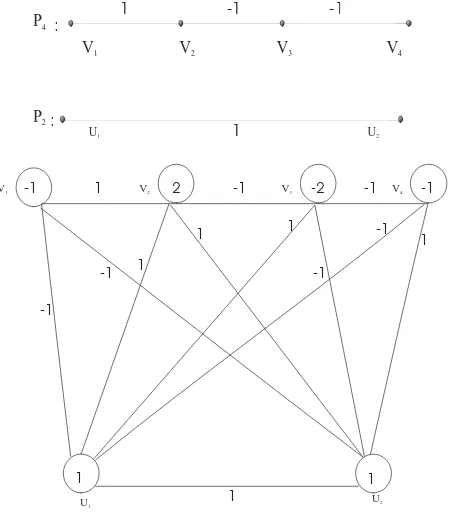
In Figure 1 illustrates the H -cordial lab
A ges receive the label +1
and the other six edges receive the . The in-duced vertex labels are given in the figure.
2.2. Theorem:The join of two cycle graphs Cn and Cm
ad
in
2 mong the twelve edges, six ed
eling on P4 + P2.
label 1
mits a H2-cordial labeling when
P4 :
V1 V2 V3 V4
1 -1 -1
P2:
U1 1 U2
-1 1 2 -1 -2 -1 -1
V1 V2 V3 V4
-1
-1 1
1 1
-1 -1
1
1 1
U1
U2
[image:2.595.312.537.465.722.2]1
1, 3 mod 4 , , 3
n m n m .
Proof: Let and are the
vertex set of c m edge sets
E1 and E2 of cn with all
the edges joi and
We note that
1, ,2 , n
v v v
ycles cn and c
is the graph union ning the vert
1, ,2 , m
u u u
respectively. The and cm together
ex sets v1, ,v2,vn
1, ,2 , m
u u u .
1 2V G p p and
1 2 1 2.E G q q p p
Define 1
The edge matrix table of
: 1,
f E G .
n m
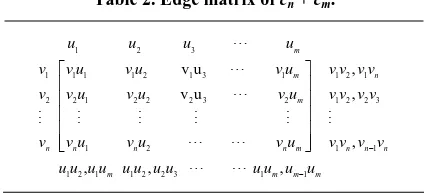
c c is given in Table 2. In view of the above labelin we give the proof as follows.
Case (1) when
Consid .
Using Table 2 the edge lable matrix of c3 and c4 is gi
11
f the above labeling pattern the total number of
g pattern
3 mod 4 , , 3
n m n m .
er the join of two cycle graphs c3 and c4
ven by
1
v
1 2 3 4
1 1 1 1
1
u u u u
2 v 3
v 1
1 1 1
1 1 1
11 11 1 1 11
11 1
In view o
edges labeled with 1 , 1 , 2s s s
nd 2 a s
are given by
1
2
1 , 1 , 2 0, 2 0.
2
f f f f
n n
e e e e
2
1
1
ef ef ef 2 ef 2 1 , differ
by one.
The total number vertices labeled with 1 , 1 , 2s s s
and 2s
are given by
1 5,
1 5,
2f f f
v n v n v n 5 and
2 6f
v n .
1
1
2
2f f f f
v v v v
1, diffe by one.
Thus in each cases we have
r
1
1
2
2f f f f
v v v v 1 and
1
1
2
2 1f f f f
e e e e .
Hence the join of t raphs c d c4 admits a
[image:3.595.65.277.638.735.2]wo cycle g 3 an H2-cordial labeling.
Table 2. Edge matrix of cn +
v
1 2, 1n v v v v
cm.
1 1 3 1
2 1 2 2 2 3 2
1 2
1 2 1 1 2 2 3 1 1
u v u , , , m m
n n n m
m
v u
v u v u v u
v u v u v u
u u u u u u u u u u u u
2 n v v
1 2 3
1 1 1 2
v
m
u u u u
v u v u
m m
1n, n1n v v v v
m 1 2, 23 v v v v
Case (2) when n m 1 mod
4 , ,
n m3.Consider the d c4.
Using Table 2 the edge label matrix of + c4 is given by join of two cycle graphs c5 an
c5
1
v
1 2 3 4
1
u u u u
2 3 4 5 v v v v
1 1 1
1 1 1 1
1 1 1 1
1 1 1 1
1 1 1 1 11 11
1 1 1 1
11
In view of the above labeling pattern the total number of edges labeled with
1 1 1 1 1 1 11
1 , 1 , 2s s s
and 2s
are given by
1 ,
22
f f
1 1
n n
1 , f 2 f 0.
e e e e
2
1
1
2
2 0f f f f
e e e e
, differ by zero.
1 , 1 , 2s s s
The total number of vertices labeled with and 2s
are given by
1 7,
1f f
v n v n 7
2 6,
2f f
v n v n 7
1
1
2
2f f f f
v v v v 1
, differ by one.
Thus in each cases we have
1
1
2
2f f f f
v v v v 1
and
1
1
2 1f f
e e ef 2 ef
.
Hence the join of two cycle graphs c5 and c4 admits a H2-cordial labeling.
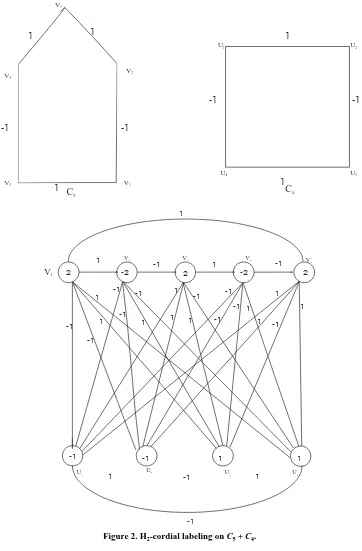
In Figure 2 illustrates the H2-cordial
C e the label
ourteen edges receive the label labeling on C5 +
4. Among the 29 edges, fifteen edges receiv +1 and the remaining f
1
. The induced vertex labels are given in the figure. 2.3. Theorem: The join of two wheel graphs W and Wm admits a H-cordial labeling when
n
0 mod 4
n m
,u
are the ver-. Proof: Let and
tex set of th ph W
an gether with all
the edges joini vertex set d
at 1, ,2 , n
v v v
e wheel gra
ng the
m
u . We note th
1, ,2
u u
n and Wm. n and Wm to
1, ,2
v v
mThe edge set E1 d E2 is the graph union of W
,vn an
1, ,2 ,
u u V G p1p2 and
1 2 1E G q q p p2.
Define f E G:
1, 1The edge matrix is given in .
In the view of the above labeling pattern we give the proof as follows:
when
Table 3
0 mod 4
n m
Consider the join of two wheel graphs W4 and W4. U g Table 3 the edge label matrix of W4 + W4 is given by
V1
V5
1 1
V2
U1
-1 -1
V5 V3
C5
U4 U3
U
1
-1 -1
1
C4
1
2
V1
U1 U2 U3 U4
2 2
1 -1 1
-1 -1 1 1
1
-1
-2 2 -2
1 V2 -1 V3 1 V4 -1 V5
-1 -1
1
1 -1
-1 1
-1 1
1 1
-1 -1
-1 -1 1
1
1 -1
[image:4.595.118.480.85.636.2]1
Figure 2. H2-cordial labeling on C5 + C4. Table 3. Edge matrix of Wn + Wm.
v 1 2, ,1 3 1n
n
v v v vv v
1 2
n v
v
1 2
1 1 1 2 1
2 1 2 2 2
1 2
1 2 1 3 1 1 2 2 3 1 1 2 1
,
m
m
m
n n n m
m m m m
u u u
v u v u v u
v u v u v u
v u v u v u
u u , u u u u u u u u u u u u u u uu
m m
1 2 2 3 2
1 2 1
, ,
,
n
n n n
v v v v v v
v v v v v v
v
4 1
In view of the above labeling pattern we give the proof as follows.
The total number of edges labeled with 1
2
3
4 v v v
1 2 3
1 1 1 1
1 1 1 1
1 1 1 1
1 1 1 1
1 11
u u u u
1 11 1 11 1 11 1 1
1 1 1
1 11
1 11
1s
and 1s are given by ef
1 n 2, ef
1 n 2
1
1f f
e e
0, differ by zero. Th tal num
of vertices labeled with
e to ber
1s and 1s are gi en by v
1 2f
v n and vf
1 n 2
1
1 0, differ byf f
v v
zer
Thus in each cases we have o.
1
1f f
v v 1 and
1
1 1f ef .
Hence the join of two wheel graphs w4 and w4 admits a
H-e
r in 4 +
[image:5.595.314.530.80.619.2]he twenty ceive the label +1 an
figure.
2.4 Theorem: known as ladder
gra .
where n is and
cordial labeling.
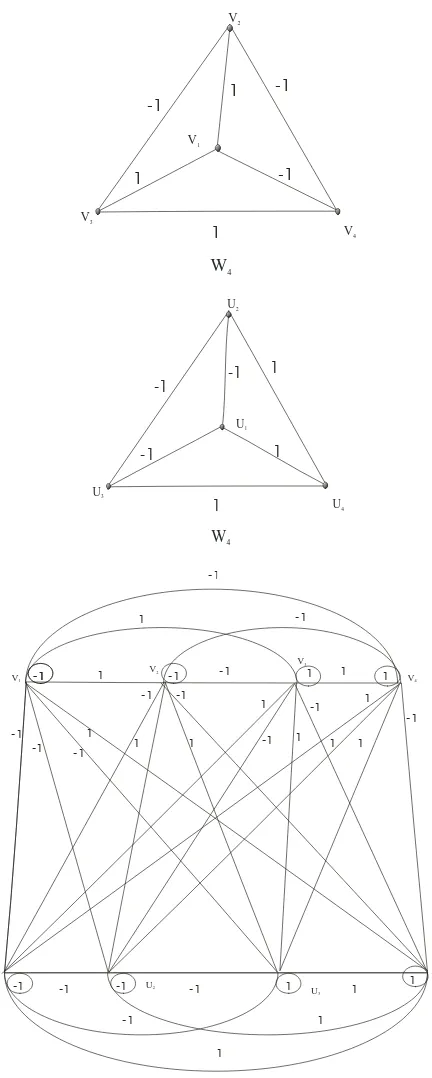
In Figure 3 illustrates the H-co dial label g on W W4. Among t eight edges, fourteen edges
re-d the other fourteen ere-dges receive the label 1. The induced vertex labels are shown in the
2
n
P P
(also
ven n
n
L
ph) is H2-Cordial labeling for e
Proof: Let G be the graph even i
2
n
P P and
ij 1, 2V G V n j be the
vertices of G.
1, 2, ,
We note that V G
2n and E G
3n2.Define f E G:
1, 1 as follows Case (1) When n0 mod 4
For 1i k, n 1
i1, k1
1f v v
For n 1 i k, n
1f v v
For 1i k,
1, 1 i k
1 n
i2,, k2
1f v v
For n1i k, n
n
2) when
i2,, k2
1f v v
For 1 i n 1
i1, i2
1f v v
For n 1 i
i1, i2
1f v v
Case ( For
2 mod 4 n
2 n 1i k,
i1, k1
1f v v
-1 1 -1
1 -1
1
V2
V3
V4 V1
W4
-1 -1 1
-1 1
1
U2
U3
U4
U1
W4
1
V1
V2
1 1
-1 V3 1 -1
V4
-1
-1 -1 -1
1 -1
1 1 -1
1
-1 -1
1
1
1 -1
1
-1 -1 1
U1 U2
U3
U4
-1 1
1
-1 1
-1 -1
-1 -1 1 1
Figure 3. H-cordial labeling on W4 + W4.
i2, k2
1f v v
For n 2 i k, n
i1, k1
1f v v
i2, k2
1f v v
1 i n 2 For
i1, i2
1 [image:5.595.88.259.94.179.2]For n
In view of the above defined labeling pattern we give the proof as follows.
The total number of edges labeled with
2 ,
n i
i1, i2
1f v v
1 , 1 , 2s s s
and 2s
are given by ef
1 n 2 ef
1 n 2 , 0
2 f
2 .
f
e e
1 1
2
2f f ef ef
The total number of vertices labeled with
0 , differ by zero.
e e
1sand1s, 2s and 2s are given by
1 1 4 2;
2 4 2, 2 4
f f
f f
v v n
v n v n
2.
1
1
2
2f f f f
v v v v
0 differ by zero.
Thus in each cases we have
1
1
2
2f f f f
v v v v 1
1
1
2
2f f f f
e e e e 1
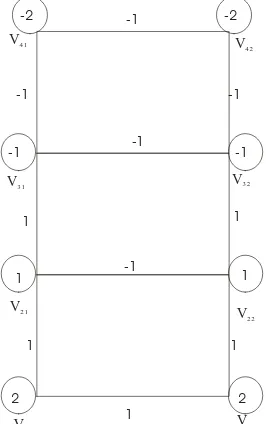
Hence the ladder graph PnP2 admits a H2-cordia labeling.
In Fig ling on
. Among the ten edges, five edges receive the la-nd other five edges receive the label
l
ure 4 illustrates the H2-cordial labe
4 2 bel +1 a
P P
1
. The in vertex labels are shown in the figure.
2.5 Theorem: The tensor product is H2-cor- dial labeling.
Proof: Let G be e graph and
be the verti-
ote that duced
2
n
P P
th PnP2
and j 1
G
i j 1 2,, , , 2
V u v i n
ces of G.
We n V G
2n and E G
2n2ne 1 two cases are to be con-
sidere
Defi f E:
G
1, d.V4 2
V4 1
-1
V3 1 V3 2
V2 2 2 1
V
-1
1
V
V11 1 2
-1
-2 -2
-1 -1
-1
-1 1
1
1 1
2 2
1 1
2 4 2
[image:6.595.315.487.88.295.2]Case
Figure 4. H -cordial labeling on P × P.
(1). When n is even For 1 i n
1, if i 1 mod 2
1, 1 2
1, if 1 mod
i i
f u v u v
i
2
For 1 i n
i 2f u v , 1 1
1, if 1 mod 2
1, if 2
i
i u v
i
When n is odd
1 modCase (2) For 1 i n
For
1 1 2
1, if 1, 3 mod 4 ,
1, if 0, 2 mod 4
i i
i f u v u v
i
1 i n
In view of the above defined labeling pattern we give the proof as follows.
The total number of edges labeled with
2 1 1
1, if 1, 3 mod 4 ,
1, if 0, 2 mod 4
i i
i f u v u v
i
1 , 1 , 2s s s
are given by ef
1 n 2 ef
1 n 2 and 2s,
2
2 0f f
e e .
1
1
2
2f f ef ef 0
e e
The total number of vertices labeled with
, differ by zero.
1 , 1 , 2s s s and 2sare given by
1 1 8 2;
2 4 2, 2 4
f f
f f
v v n
v n v n
2.
U V1 1 U V1 2
U V2 1
U V
4 1
U V2 2
U V1 2
U V4 2 -1
-1
-1
1
1 -1
-2 2
-2
-2 2
[image:6.595.348.482.421.720.2]1
Figure 5. H rdial labeling on P P2.
3 1
2
U V
U V5 1
-1
U V5 2
1 -1
2-co 1 1
[image:6.595.106.239.503.715.2]
1
1
2
2f f f f
v v v v
0 differ by zero.
Thus in each cases we have
1
1
2
f f f
v v v vf 2 1
1
1
2
2 1f f f f
e e e e
Hence the tensor product PnP2 admits a H2-cordial beling.
In Figure 5 illustrates the H2-cordial labeling on . Among the eight edges four edges receive the
nd the other four edges receive the label la
5 2
P P
label +1 a 1.
The induced vertex labels are shown in the figure.
3. Concluding Remarks
Here we investigate H- and H2-cordial labeling for join of path graphs, cycle graphs, wheel graphs, Cartesian
product and tensor product. Similar re
riv and in the context of dif-
fere op n area of research.
REFERENCES
[1] hs,” Bu
inatorics and Its Applications, Vol. 18, 1996, pp.
[2] M
[3] J. A. Gallian, “A Dynamic Survey of Graph Labeling,”
ombinations, Vol. 18, 2011.
sults can be de- ed for other graph families
nt graph labeling problem is an e
I. Cahit, “H-Cordial Grap lletin of the Institute of Comb
87-101.
. Ghebleh and R. Khoeilar, “A Note on ‘H-Cordial Graphs,’” Bulletin of the Institute of Combinatorics and
Its Applications, Vol. 31, 2001, pp. 60-68.
The Electronics Journal of C