
http://www.scirp.org/journal/nr ISSN Online: 2158-7086
ISSN Print: 2158-706X
DOI: 10.4236/nr.2017.812048 Dec. 29, 2017 788 Natural Resources
From the Challenges Imposed by Climate
Change to the Preservation of Ecosystem
Processes and Services
Rita Anastácio
*, Mário Jorge Pereira
Departamento de Biologia e CESAM, Universidade de Aveiro, Aveiro, Portugal
Abstract
Today, especially in countries that offer a satisfactory quality of life, it is easy to forget that we depend directly and indirectly on services provided by eco-systems such as quantity and quality of water, energy, food, health, and shel-ter. In less developed countries, the daily struggle for essential goods makes this dependency more real, despite the lack of knowledge, organization and/or fi-nancial resources to deal with the problems imposed on ecosystems by climate and anthropogenic changes. Protecting ecosystems by ensuring the services they provide has become highly dependent on our management capacity, our un-derstanding of its functioning, and our capacity for persuasion. Demographic pressure and individualism compromise the survival of various species, includ-ing our own, and create pressures under governments and the stability of nations. The notion of facing a global challenge has awakened in the scientific commu-nity the need to focus on developing global strategies that change the mind-sets of decision makers, industry, governments and markets. Global knowledge net-works and experts are being built to mitigate problems on a global scale. In this mini review, the authors make a brief visit to documents, intergovernmental initiatives, and platforms that have been built with the aim of contributing to promote a resolution for the global problems.
Keywords
Roads to Dignity, Essential Biodiversity Variables, Kyoto Protocol, IPCC, Ecosystem Services Profile, SDG’s
1. Introduction
Climate changes open new challenges to the ecosystem services, freely offered by nature but, usually, not perceived by people [1]. We all rely, directly or
indirect-How to cite this paper: Anastácio, R. and Pereira, M.J. (2017) From the Challenges Imposed by Climate Change to the Preser-vation of Ecosystem Processes and Services. Natural Resources, 8, 788-807.
https://doi.org/10.4236/nr.2017.812048
Received: November 20, 2017 Accepted: December 26, 2017 Published: December 29, 2017
Copyright © 2017 by authors and Scientific Research Publishing Inc. This work is licensed under the Creative Commons Attribution International License (CC BY 4.0).
DOI: 10.4236/nr.2017.812048 789 Natural Resources ly, on those services (e.g. water, energy, food, health, shelter), especially the poor-est, in particular from less developed countries from Africa, South America and Asia [2][3][4]. Climate changes have opened the opportunity for species to ex-plore new geographies, in land and sea, without the help of humans as carriers. These species are exploring new locations and are imposing a new equilibrium, changing services from which local populations are dependent.
Protecting ecosystems and ensuring their natural services, based on advised man-agement, is crucial in order to maintain and improve the quality of life. The de-mographic pressure and the absence of what each person needs and perceives is compromising our survival, and creates an enormous pressure on governments. In this extreme scenario, for local/regional populations the capability to survive is put at risk.
The movie “After Earth” is an example of how Earth and its nature can evolve into something without humans. People think it is possible to control everything in the world, but this is not the truth. The planet is resilient, and its life forms are also resilient, though mutable. A species can evolve or become extinct. Our spe-cies obeys to this axiom. So, we cannot control our environment forever. We can, however, use our advanced technology and knowledge to mitigate problems we face: our exponential growth, our demand for natural resources, diseases, among others. And, we may solve problems we created like pollution and cli-mate change—like the measure of banning the use of CFCs and the recovery of the ozone layer [5]—knowing that they are too challenging, too big, and too global to deal with. We are alone as a species to solve problems, and we face the complexity of not being together to achieve the goals that may reduce our diffi-culties.
The Social and Exact Sciences play a crucial role. It is because the scientific community is aware of the current and future challenges, which they have begun to focus in developing global strategies to change the mentality of governors, policy makers and important stakeholders in the industry and economics. Global entities preoccupied with climate change and pressures suffered by poor coun-tries related with lack of resources flourished in the last decades and are trying to make a change.
In this review something became very clear: people are building global effec-tive nets of expertise to mitigate global challenging and demanding problems. Biodiversity loss, famine (due to low agriculture yields, marine resources deple-tion), lack of fresh water and demand for areas to explore are some of them. Per-haps natural and intellectual resources need to be managed in a more global way, since there are so many disparities in the distribution of them. Roads to Dignity by 2030 [6] proposes (at the 125th topic) “to establish an online, global platform, building on and complementing existing initiatives, with the participation of all relevant stakeholders (…)”.
Sachs et al. [7][8] advocate a global network to supervise agriculture; Scholes
DOI: 10.4236/nr.2017.812048 790 Natural Resources discussion for the GEOBON (https://www.geobon.org) project (and other similar projects); there is already a Global Climate Observing System (GCOS—WMO
https://public.wmo.int/en/programmes/global-climate-observing-system)
that defined “Essential Climate Variables” (ECV), and more global networks will be needed, since global strategies work like emphasized by the IPCC [11].
Rands et al. [12] proposed the establishment of an Intergovernmental Science-
Policy Platform on Biodiversity and Ecosystem Services, which would help (they
advocated) to close knowledge gaps (about status, trends, functional importance of microorganisms, many plant groups and even vertebrates, about genetic di-versity and how different components of biodidi-versity contribute and relate to the provision of services or create resilience to environmental change) “and link science and economics to the policy step-change needed to conserve biodiversity”. These steps are called the “three tiers to halt biodiversity loss”. Jumping directly to the instrumental tier (Legislation, giving markets incentives and develop technolo-gy) is not recommended without ensuring the enabling tier (work with institu-tions and governance in order to develop awareness to change behavioural pat-terns in the society, through educational campaigns at schools and media, for ex-ample) [12].
Paetzold et al. [13] also advocated an Ecosystem Services Profile (EPS) frame-work—combined with cyclic assessments and management frameworks—to make ecosystem assessments to evaluate the status of its characteristics and services (e.g.assessing ecological quality) to provide information for decision and policy makers for an “adaptive management approach” of those ecosystems; de Groot
et al. [14] also emphasizes that a “coherent and integrated approach” for
ecosys-tem and landscape functions planning, management and decision-making simi-lar to what the ARIES-project is doing for Conservation International is challeng-ing but necessary.
As a species, our strategy of uniting efforts is, perhaps, our only way to over-come our extinction. Nevertheless, SOTW’s following statement gives a warning “Humanity’s ability to marshal the earth’s resources, along with the economic and political competition that drives governments, corporations, and individu-als, has meant that there have been few—if any—constraining factors on human actions. This lack of constraint may be the biggest threat to human survival” [15].
2. Context and Risks
What is the state of the World today? How can we think in conserving species or restore ecosystems, with so many other problems? And why should we care for the other species?
To think sustainability and in ecosystems conservation implies managing a global peace, with international agreements, with action priorities and a pro-found knowledge of the causes.
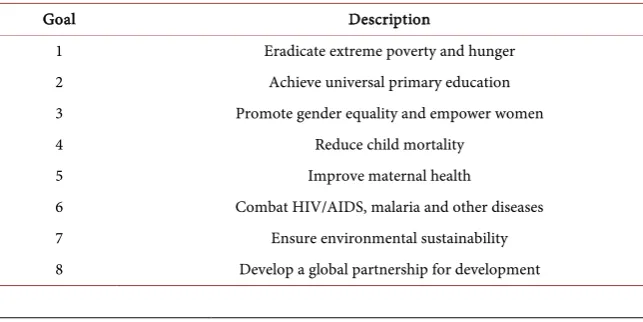
Na-DOI: 10.4236/nr.2017.812048 791 Natural Resources tions (UN) enabled a first tier for the global peace, since “they have helped end poverty for some, but not all”. The 8 MDGs (Table 1) worked, but they are still needed.
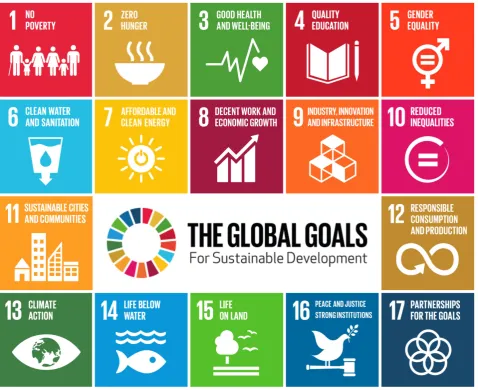
MDGs were improved by a new global agenda in 2015. Using them and the “six essential elements for delivering on the sustainable development goals”, the UN proposed the 17 “Sustainable development Goals”, SDGs (Figure 1), which are seen “as part of a new sustainable development agenda that must finish the job and leave no one behind”.
(http://www.un.org/sustainabledevelopment/development-agenda/).
Why is having this global agenda so important? Because we are aware we need it! We are living the Sustainability time. Schools explain the concept, people/consumers are more aware and concerned towards environment changes and biodiversity loss, governments are applying measures and companies are focusing more on their sustainability reports following organizations like the “Global Reporting Initiative (GRI)” (https://www.globalreporting.org/Pages/default.aspx). But, hav-ing intentions and SDGs per se is not an insurance that everything will turn in favour.
Changes are happening that can compromise the work of those concerned with SDGs and sustainability: lack of tolerance between different cultures with arising conflicts, illnesses developed by toxic pollutants (more and more concentrated in nature), and diseases related to resistant pathogens.
The Ehrlich Equation (also known as IPAT Equation, where I = PAT, mean-ing “I” the impact on the environment or demand for resources; “P” the popula-tion size; “A” the affluence factor; and “T” the technology factor), predicts an increase in the value of the impact on environment, since population, affluence and technology are increasing [16].
The world is not blind to problems derived by human population. The Global
Risks Report (GRR), is an example of that concern, being a “survey of the World
[image:4.595.208.530.579.740.2]Economic Forum’s multi stakeholder communities”, to know the perception of risks. A “global risk” is defined as “an uncertain event or condition that, if it oc-curs, can cause significant negative impact for several countries or industries
Table 1. Millennium development goals description
(http://www.un.org/millenniumgoals/poverty.shtml).
Goal Description
1 Eradicate extreme poverty and hunger
2 Achieve universal primary education
3 Promote gender equality and empower women
4 Reduce child mortality
5 Improve maternal health
6 Combat HIV/AIDS, malaria and other diseases
7 Ensure environmental sustainability
DOI: 10.4236/nr.2017.812048 792 Natural Resources
Figure 1. Sustainable development goals’ icons, at https://sustainabledevelopment.un.org/post2015/transformingourworld.
within the next 10 years” [17]. Risks are categorized by “risks of highest con-cern”, “risks of high impact and high likelihood” and “risks perceived to be most interconnected” [18]. In 2015 the “risks of highest concern (…) were fiscal crises in key economies, structurally high unemployment and underemployment, and the water crises”, for example. Also, as “trends to watch” were the “decline of trust in institutions, lack of leadership, persisting gender inequalities and data mis-management”; and experts added further concerns including “various forms of pollution, and accidents or abuse involving new technologies” [18].
One may ask: if stakeholders are aware of risks, why are governments resistant to adopt measures about climate change, and the loss of biodiversity?
Resistance to change is part of the human condition [19], and it would explain why climate negotiations are so difficult [15]. The report “Roads from Rio + 20, Pathways to achieve global sustainability goals by 2050” [20] shows the difficul-ties in managing politics to sustain “food, land and biodiversity” and “energy
DOI: 10.4236/nr.2017.812048 793 Natural Resources politics to manage these two spheres.
Many efforts have been taken, and many conferences and discussions have been prepared and attended by interested parties, and many reports emphasize similar preoccupations that one must ask: is it possible to achieve SDGs until 2050?
As some authors emphasize “strangely, we now find ourselves in an era of ‘sustainable’ marked by wildly proliferating claims of sustainability. Even as ad-jectives like ‘low-carbon’, ‘climate-neutral’, ‘environmentally friendly’, and ‘green’ abound, there is a remarkable absence of meaningful tests for whether particular governmental and corporate actions actually merit such descriptions” [15]. One must conclude that people don’t need more “green” definitions… people need more effective action from all countries. And people need that measures and plans for “meaningful tests” happen with some urgency.
3. The Demographic Problem and Its Consequences
“People want decent jobs, social protection, robust agricultural systems and rural prosperity, sustainable cities, inclusive and sustainable industrialization, resilient infrastructure and sustainable energy for all” [6].
The ecological concept of carrying capacity can be applied, in theory, to our species. Each ecosystem/area has its limitations in what concerns the provision of resources to a certain population. For humans, these limits are more difficult to understand, since humans can modify their environment with their technolo-gical and scientific advances [21]. The concept of “carrying capacity” is very important for us, since it gives us a notion of limitation. When considering “li-mitations”, projections based on the demographic and climate indicators are not in our favour. The IPCC [11] references that by 2020, between 75 - 250 million people in Africa will be subjected to water stress due to climate change, for ex-ample. It is our ingenuity to think that African countries problems are only Afri-ca’s problems. A place that offers so many problems to their people will lead them to migrate.
But how many are we? How many will we be? Human population is growing, and it is expected to reach 10.9 thousand million people by 2100 [22]. Projec-tions show that the less developed countries will contribute with 69 per cent of the human growth, being 249 per cent from least developed countries by 2100 (when compared to data from 2010). Africa is the continent with more expres-sion concerning this growth (Table 2).
DOI: 10.4236/nr.2017.812048 794 Natural Resources
Table 2. Global population and population by continents, in 2010 and in 2100 (estimates),
taken from the United Nations report, extracted from [22].
Total Population
(Millions) Population Change 2010-2100
Major Areas 2010 2100 (Millions) Absolute Relative to 2010 (%)
Global 6916 10,854 3938 57
Africa 1031 4185 3153 306
Asia 4165 4712 546 13
Europe 740 639 −101 −14
Latin America and Caribbean 596 736 140 23
North America 347 513 167 48
[image:7.595.209.539.103.270.2]Oceania 37 70 33 90
Table 3. Human ill-being and well-being categories [1].
Ill-Being Well-Being
No freedom , powerless Freedom of choice and action
Insecurity, conflict Security
No health care, no health Good health (physically, mentally, socially)
Poor social relations Good social relations
No (or not enough) basic materials Basic materials
4. What Are the Consequences of This Demographic
Growth?
1) Less food (meat, vegetables). Several human activities were developed in order to provide humans the capacity for living longer in one place. Agriculture and fishing techniques nowadays, are a result of several millenniums of experi-mentation and knowledge gathering. The degree of knowledge we have may be sufficient to feed all global population. But why is it not? And what does that imply for humans and ecosystems?
When agriculture appeared, a technological way to manipulate vegetable spe-cies, there were about 5 million people on the Planet [23]. Now, we have much more people to feed. The problem is that in some of the poorest and most crowded places, where progress is little, there are low yields and low productivity in agri-culture, which compromises food availability and security, and hinders the ef-forts to augment food security [24][25].
re-DOI: 10.4236/nr.2017.812048 795 Natural Resources veals that the Far East and the Pacific, as well as the Sub-Saharan Africa, showed in 2009 the highest values of undernourishment of 63% and 26%, respectively. Normally this leads people to destroy more habitats, jeopardizing their future (it’s a vicious cycle).
Raven et al. [23] refer that the advances in agricultural technology will not be sufficient to provide all the goods for the needs of a growing population that will aggravate the pressures already seen and made on ecosystems. They conclude that “no matter how striking the advances of agricultural science might be, they will never be adequate to eliminate hunger in a world in which the population is growing rapidly”.
Boy and Witt [29] emphasize that humans homogenized our crops, and in the 20th Century people relied on approximately 20 crop plants to provide “more than 90% of our global vegetable intake”, which scares when we think on the di-versity of 6000 food crops our ancestries raised [29]. Of course, we can still count with genetic modified organisms, but this also comprises risks to the economy, especially to the small farmers, and to the natural world (since genomes are ma-nipulated) [30].
2) Less Water available. Veldkamp et al. [31] use a global scale water scarcity assessment which takes in consideration the hydro-climatic variability but also the important temporal changes and the socioeconomic conditions. They found that from 17% (in 1960) to 45% (in 2000) of the total global population suffered of water shortage, and from 11.7% (1960) to 33.6% (2000) suffered of water stress. This means an increase in these two stressors. They also state that in that period, from 8.9% to 28.6% lived under both water shortage and stress condi-tions. This study demonstrates that the relative contribution of socio-economic change increased globally from 0% (in 1960) up to 76.2% (in 2000) for water short-age, and 82.5% for water stress, due to the continuous population growth that increased the water demand. In Africa, people suffer predominantly from water shortage. The study emphasizes the need for paying attention to climate varia-bility as a key factor for designing strategies to cope with current water scarcity problems [31]. This data increases the drama of future scenarios.
3) Drastic fragmentation of habitats and more pressure on wild species. Frag-mentation is increasing not only because humans occupy pristine land, or ex-plore pristine areas of the ocean, but also because they modify abiotic parame-ters. The more vulnerable species are, the more pressured they feel in their envi-ronment if any parameter changes. Predictions show that rising water tempera-tures, changes in ice cover, salinity, oxygen levels and circulation with implica-tions for marine and freshwater systems will happen [11]. Several studies indi-cate a decrease in ocean primary production [32]. This will limit the amount of available energy for higher trophic levels [33].
DOI: 10.4236/nr.2017.812048 796 Natural Resources 4) Pollution. Pollution is everywhere, since pollutants spread in the ecosystems. The poorer (subsistence farmers and artisanal fishermen) are already struggling against water scarcity and the lack of food, and they are not sufficiently resilient in scenarios of extreme weather events. Especially, because pressures on forests and marine ecosystems (perpetrated by the increase of the population, and by climate fluctuations) compromise food availability and security [33].
The demand for pesticides and fertilizers will increase, since more food supply is required [28]. This means an increase in pollution indices of the soil, aquifers, lakes, rivers and oceans. The pollutants will interfere with the quality of the ser-vices that ecosystems provide (provisioning, regulating and cultural serser-vices), therefore interfering with several species [11].
5) More and new diseases. An increase in fragmentation of ecosystems and an invasion of natural spots by communities is expected. This will lead to more en-counters between wild species and humans, and more contact between wild spe-cies and humans and their livestock [15]. Emerging infectious diseases (EIDs) are to be expected due to these contacts [36]. As the rate of contact between hu-mans, and their livestock and domesticated animals, and marine and land wild-life increases, the possibility of pathogens crossing land-sea and forest-rural area barriers also increases (Figure 2) [36].
6) More instability and dislocation of people. The “Roads to dignity by 2030” [6] emphasizes that “we are a mobile world, with more than 232 million interna-tional migrants, and almost 1 billion when internal migrants are counted”. People move in crises, because they need to find stability. By reducing the quality of life and well-being due to the ecosystems degradation, it is expected the migration of species (with disruption of habitats and niches) and people.
Governments must take measures to ensure that the elderly, women and child-ren that are running from protracted crises, find a safe path to equilibrium. Many women and their children face migrations alone and because “women are not always able to claim family assets, such as land, livestock, tools and machinery, previously owned by their husbands, especially if they are illiterate or insuffi-ciently aware of their legal rights” this has significant negative implications for food security [37].
5. Tackling Demographic Growth Problems
[image:9.595.113.539.631.704.2]Governance needs to deal with demography issues. This means adopting plans
DOI: 10.4236/nr.2017.812048 797 Natural Resources to protect populations as well as the ecosystems. Each country has to study its territory and plan the distribution of people and protected areas.
In order to guarantee the well-being of people, increasing their incomes is not always a good measure (though monetary independence is needed) [16]. Access to family planning and to education is essential to empower people to decide about how to manage their lives (age of the first child; number of children per women) [22], and about the environment in a more altruistic manner [16]. Em-powering women and future generations, providing them proper education conditions, is essential for a better, less poor world. This goal has to be taken as seriously as possible, especially because this “is the century of women”, and one needs “to include the poor, children, adolescents, youth and the aged, as well as the unemployed, rural populations, slum dwellers, persons with disabilities, in-digenous peoples, migrants, refugees and displaced persons, vulnerable groups and minorities” [6]. Globally, humankind needs to impose an “end to all forms of gender inequality, gender-based discrimination and violence against women and against children” [6] (UN, 2014).
Allowing oriented and controlled migration between countries is another meas-ure. Countries desired by people must arrange protocols to help migrants, includ-ing climate migrants, escapinclud-ing from protracted crisis. It is an important oppor-tunity to empower women and children running from poverty, providing them security and education. It does not mean that these people, in a near future, can’t go back to their original countries. It may function as a way to achieve some of the SDG goals. Migrations, nevertheless, have to be controlled because there are environmental and economical limitations in the receiving countries that must be respected. Some of the examples we have seen concerning climate migrants have implied aggravation of ecosystems degradation [15].
Exchanging skills between people of different countries may be taken more se-riously, in a global manner. Countries with better education systems could have more exchange students from undeveloped countries. And more organizations like the Blue Ventures (http://blueventures.org/), and AGRA, may help to deal with the hunger problem. The Alliance for a Green Revolution in Africa (AGRA,
http://www.agra.org/) develops programs for helping small-scale farmers and
their families to design and apply solutions to increase their yields, minimizing negative impacts on ecosystems. It aims at gathering information about African soils, to improve their management, since there are so many poor and degraded soils and unreliable water supplies that when combined with poor access to mar-kets, insufficient access to finance and credit and little government support, it jeo-pardizes the future of African people.
DOI: 10.4236/nr.2017.812048 798 Natural Resources providers, value chain participants, etc.—to share information and work towards common objectives” [27].
Improving agricultural yields using networking may be the best contribution of Science. A global agricultural monitoring network is needed
(https://www.earthobservations.org/cop_ag_gams_pp.shtml), since it enables mon-itoring the social, economic and environmental outcomes of agriculture, including food and nutrition security, human health, economic viability, social well-being and environmental sustainability [8].
Already in 2010, in an opinion article in Nature [7] authors argued about the importance of creating a method to compare between different agricultural me-thods, with quantifiable indicators (globally applicable metrics). The perspective was to be able to compare accurately different types of agricultural methods in order to plan strategies to improve the profitability of the more needy places [7]. They also emphasize that the network would help to create metrics for specific farming systems which would be of great importance to increase crop yields. This idea is compatible with FAO’s [38] suggestion of concentrating efforts to improve family farming activities in developing countries.
In a review about the demographic growth in the Science Magazine, Godfray
et al. [39] argue that, to cope with the feeding needs of 9 thousand million people,
the world can focus in five tasks: close the yield gap, increase production limits,
reduce waste, change diets, and expand aquaculture. Similarly, Foley [40] and the
team of specialists with whom he worked, analysing agriculture effects in eco-systems (38.6% or 50.2 million of km2 of terrestrial surface are used as pastures and cropping) propose, as well, five measures to solve the hunger problem: freeze agri-culture’s footprint, augment yields in already existent cropping lands, use water and technological resources more efficiently in every agricultural area, change di-ets to decrease protein demand, and reduce waste production.
All these authors [8][39][40] provide strategies to cope with the hunger prob-lem. But, one ought to be aware that demographic growth must be better balanced in the future, and that measures between nations, like the measures quoted here, are certainly being taken.
6. Tackling Climate Changes
Hearing about climate change in the media is not new for us. We all heard the debate about how our way of living has compromised climate stability. But, for common observers, the debate may seem a little bit out of proportion. Why must people worry so importantly about our share in changing climate? Is it that im-portant, arguing about if people are to blame, when Earth has historical episodes of climate instability?
re-DOI: 10.4236/nr.2017.812048 799 Natural Resources fers to “any change in climate over time, whether due to natural variability or as a result of human activity”.
Especially for Science, it is important to understand what the drivers of cli-mate change are. It is important to understand what humanity’s contribution to changes is. The debate of our participation on climate changes, was already sur-passed by the scientific community, and, perhaps by the most informed part of society: “In its most recent assessment, IPCC states unequivocally that the con-sensus of scientific opinion is that Earth’s climate is being affected by human ac-tivities”, like the pollution of the atmosphere with greenhouse gases (GHGs) [42] [43]. Oreskes [42][43] emphasizes that the “scientific consensus might, of course, be wrong”, and continues saying that if “the history of science teaches anything, it is humility, and no one can be faulted for failing to act on what is not known”. Accepting that we might have some guilt in Earth’s last transformation, is the first step to mobilize efforts to deal with the problem. And this acceptance has to come from all parts of society (not just from scientific community or altruistic people).
The estimated impacts of the increase of temperature expected on weather, water, food, ecosystems, and society between 2030 and 2080 was explored in the WEF [44], which is shown in Figure 3.
[image:12.595.211.538.399.606.2]Eastern Africa, for example, is expected to deal with several effects derived from climate change (Figure 4).
Figure 3. Possible impacts of global warming in different sectors (weather, water, food,
DOI: 10.4236/nr.2017.812048 800 Natural Resources
Figure 4. Climate change will augment effects like the proliferation of exotic species, sea level, temperatures, warm ENSO events,
extreme intra-continent weather events, and diminish rainfall on dry season, adapted from [45].
Moreover, it is discussed if there is any need to mitigate the global tempera-ture increasing, considering that the efforts are no longer sufficient to invert the patterns. Adaptation is advocated as the major strategy for the future genera-tions (Figure 5). Many experts believe that it is important continuing to reduce GHGs emissions, by developing less fossil fuels-dependent societies [41]. IPCC [41] explores measures concerning adaptation, and strategies to build resilience (see pages 21 to 25).
7. Tackling Biodiversity Loss
Today the concept of sustainability [46] is used for many fields. It shows that ef-forts from entities like UN to advocate global goals (MDGs) have been successful in uniting several nations for biodiversity and ecosystems conservation, sharing the scientific prospects.
The Aichi Biodiversity Targets result from the engagement of the world to preserve the biodiversity. They were designed to be reached by 2020 (has a first stage) [47][48][49][50] representing a full commitment to discontinue the loss of biodiversity. They are delivered as five strategic goals (Table 4), each defined by a group of targets (20 targets in total).
DOI: 10.4236/nr.2017.812048 801 Natural Resources
Figure 5. Summary of problems and measures to tackle climate changes.
Table 4. The five strategic Aichi biodiversity goals [47].
Strategic
goal Description of the SG
1 SG A “Address the underlying causes of biodiversity loss by mainstreaming biodiversity across government and society”
2 SG B “Reduce the direct pressures on biodiversity and promote sustainable use”
3 SG C “Improve the status of biodiversity by safeguarding ecosystems, species and genetic diversity”
4 SG D “Enhance the benefits to all from biodiversity and ecosystem services”
5 SG E “Enhance implementation through participatory planning, knowledge management and capacity building”
more specific and driving Parties for intended results, though they recognize the “biodiversity protection targets still lack baseline benchmarks and the kind of regular monitoring that would permit real tracking of trends”.
[image:14.595.208.546.398.561.2]DOI: 10.4236/nr.2017.812048 802 Natural Resources (the red, blue and green targets classification).
Van Vuuren et al. [20] proposed clear short-term policy priorities, like: acce-lerate sustainable agricultural intensification (by creating proper conditions); reduce hunger (by improving a more robust food system); mainstream biodiver-sity considerations in land-use/water-use planning and management; and pro-mote changes, such as in consumption patterns. Mace et al. [50] strongly em-phasize that “parties need to adopt a small set of focused, relevant, efficient, and achievable targets”, and they add that “these targets should have scientifically and socially appropriate outcomes and timescales, support biodiversity’s role in human well-being, be linked to legislative and regulatory processes, be relevant at global scales but reflect local and national interests, and be open to accurate and efficient reporting”. This last phrase is of capital importance. Taking this advice seriously is probably the only way to achieve the ambitious (but neces-sary) Convention on Biological Diversity’s (CBD) mission to “take effective and urgent action to halt the loss of biodiversity in order to ensure that by 2020 eco-systems are resilient and continue to provide essential services, thereby securing the planet’s variety of life, and contributing to human well-being, and poverty eradication” [48].
To be open to accurate and efficient reporting, parties must not only provide to supervisors information of their measures, but also, they must work an inter-nal network of collaboration, as demonstrated in Figure 6.
[image:15.595.67.528.462.692.2]In order to reduce species loss, Rands et al.[12] propose the “three intercon-necting priorities” (Figure 6) which are managing biodiversity as a public good, integrating biodiversity into public and private decision-making, and creating enabling conditions for policy implementation. This demands full commitment
Figure 6. Vision about the global action needed to manage biodiversity, adapted from the SDGs and from views and ideas from
DOI: 10.4236/nr.2017.812048 803 Natural Resources from governments, which resides upon the collective choice of engaging with the CBD mission, putting it above economic interests and pressures.
In politics and in the economic sphere, ecosystems must be valued properly at a regional and landscape levels, by making room for more participation experts in conservation measures [51]. Jackson [16] goes further into the idea: “above all, the new macro-economy will need to be ecologically and socially literate, ending the folly of separating economy from society and environment”. And this is urgent since “pressures on ecosystems will grow significantly worse during the first half of this century, unless human attitudes and actions change” [51].
8. Conclusions
Geology students know that Earth is a highly resilient system. Even when cata-strophic pressures occurred, such as the impact of meteorites, the planet showed the plasticity of its ecosystems, which were reorganized, maintaining a life-friendly functionality. In this dynamic planet, species can evolve or extinguish. Our subs-pecies belongs to this rule. Due to its capacity and ingenuity, the Homo sapiens cannot control the changes of Nature. However, technology and science can de-velop strategies to cope with the exponential growth of species, including ours, the production of food, the spread of diseases, the exploitation of resources, and the degree of pollution.
Tackling many problems that concern humanity is driven by global projects and agendas. Leading these efforts are universities, governments, stakeholders, and common people that learned about ecosystems fragility. Being prepared to survive in the future depends on humanity’s capacity to focus on achieving the SDGs. Global strategies have to be applied, supervised, publicized and taught to our future generations, because we are still learning how to manage ecosystems. Our goal is to use natural resources and services, damaging ecosystems as little as possible. Our goal is to stop being responsible for other species extinction. But, can we achieve these goals?
References
[1] MEA (Millennium Ecosystem Assessment) (2005) Ecosystems and Human Well-Being: Biodiversity Synthesis. World Resources Institute, Washington DC.
[2] Constanza, R., d’Arge, R., Groot, R., Farber, S., Grasso, M., Hannon, B., Limburg, K., Naeem, S., O’Neill, R.V., Paruelo, J., Raskin, R.G., Sutton, P. and van den Belt, M. (1997) The Value of the World’s Ecosystem Services and Natural Capital. Nature, 387, 253-260.https://doi.org/10.1038/387253a0
[3] Díaz, S., Fargione, J., Chapin III, F.S. and Tilman, D. (2006) Biodiversity Loss Threat-ens Human Well-Being. PLoS Biology, 4, 1300-1305.
https://doi.org/10.1371/journal.pbio.0040277
[4] Palmer, M.A. (2010) Water Resources: Beyond Infrastructures. Nature, 467, 534-535.
https://doi.org/10.1038/467534a
[5] Molina, M.J. and Rowland, F.S. (1974) Stratospheric Sink for Chlorofluorome-thanes: Chlorine Atom-Catalysed Destruction of Ozone. Nature, 249, 810-812.
DOI: 10.4236/nr.2017.812048 804 Natural Resources
[6] UN (2014) The Road to Dignity by 2030: Ending Poverty, Transforming All Lives and Protecting the Planet. A/69/700, Synthesis Report of the Secretary-General on the Post-2015 Sustainable Development Agenda, UN, New York.
[7] Sachs, J., Remans, R., Smukler, S., Winowiecki, L. andelman, S.J., Cassman, K.G., Castle, D., DeFries, R., Denning, G., Fanzo, J., Jackson, L.E., Leemans, R., Lehmann, J., Milder, J.C., Naeem, S., Nziguheba, G., Palm, C.A., Pingali, P.L., Reganold, J.P., Richter, D.D., Scherr, S.J., Sircely, J., Sullivan, C., Tomich, T.P. and Sanchez, P.A. (2010) Monitoring the World’s Agriculture. Nature, 466, 558-560.
https://doi.org/10.1038/466558a
[8] Sachs, J.D., Remans, R., Smukler, S.M., Winowiecki, L. andelman, S.J., Cassman, K.G., Castle, D., DeFries, R., Denning, G., Fanzo, J., Jackson, L.E., Leemans, R., Lehmann, J., Milder, J.C., Naeem, S., Nziguheba, G., Palm, C.A., Pingali, P.L., Re-ganold, J.P., Richter, D.D., Scherr, S.J., Sircely, J., Sullivan, C., Tomichr, T.P. and Sancheza, P.A. (2012) Effective Monitoring of Agriculture: A Response. Journal of Environmental Monitoring, 14, 738-742.
[9] Scholes, R.J., Mace, G.M., Turner, W., Geller, G.N., Jürgens, N., Larigauderie, A., Muchoney, D., Walther, B.A. and Mooney, H.A. (2008) Toward a Global Biodiver-sity Observing System. Science, 321, 1044-1045.
https://doi.org/10.1126/science.1162055
[10] Pereira, H.M., Ferrier, S., Walters, M., Geller, G.N., Jongman, R.H.G., Scholes, R.J., Bruford, M.W., Brummitt, N., Butchart, S.H.M., Cardoso, A.C., Coops, N.C., Dul-loo, E., Faith, D.P., Freyhof, J., Gregory, R.D., Heip, C., Höft, R., Hurtt, G., Jetz, W., Karp, D.S., McGeoch, M.A., Obura, D., Onoda, Y., Pettorelli, N., Reyers, B., Sayre, R., Scharlemann, J.P.W., Stuart, S.N., Turak, E., Walpole, M. and Wegmann, M. (2013) Essential Biodiversity Variables. Science, 339, 277-278.
https://doi.org/10.1126/science.1229931
[11] IPCC (2007) Climate Change 2007: Synthesis Report. In: Core Writing Team, Pa-chauri, R.K. and Reisinger, A., Eds., Contribution of Working Groups I, II and III to the 4th Assessment Report of the Intergovernmental Panel on Climate Change, IPCC, Geneva, 73 p.
[12] Rands, M.R.W., Adams, W.M., Bennun, L., Butchart, S.H.M., Clements, A., Coomes, D., Entwistle, A., Hodge, I., Kapos, V., Scharlemann, J.P.W., Sutherland, W.J. and Vi-ra, B. (2010) Biodiversity Conservation: Challenges beyond 2010. Science, 329, 1298-1303.
https://doi.org/10.1126/science.1189138
[13] Paetzold, A., Warren, P.H. and Maltby, L. (2010) A Framework for Assessing Eco-logical Quality Based on Ecosystem Services. Ecosystem Services—Bridging Ecolo-gy, Economy and Social Sciences. Ecological Complexity, 7, 273-281.
https://doi.org/10.1016/j.ecocom.2009.11.003
[14] De Groot, R.S., Alkemade, R., Braat, L., Hein, L. and Willemen, L. (2010) Chal-lenges in Integrating the Concept of Ecosystem Services and Values in Landscape Planning, Management and Decision Making. Ecological Complexity, 7, 260-272.
https://doi.org/10.1016/j.ecocom.2009.10.006
[15] SOTW (2015) State of the World 2015: Confronting Hidden Threats to Sustainabil-ity. Chapter 1, The Worldwatch Institute, Island Press. Washington DC.
[16] Jackson, T. (2011) Societal Transformations for a Sustainable Economy. Natural Resources Forum, 35, 155-164.https://doi.org/10.1111/j.1477-8947.2011.01395.x [17] WEF (2016) The Global Risks Report 2016. 11th Edition, World Economic Forum
DOI: 10.4236/nr.2017.812048 805 Natural Resources
[18] WEF (2015) Global Risks 2015. 10th Edition, World Economic Forum within the Framework of the Global Competitiveness and Benchmarking Network, World Economic Forum, Geneva, Ref: 090115.
http://reports.weforum.org/global-risks-2015/
[19] Watzlawick, P., Bavelas, J.B. and Jackson, D.D. (1967) Pragmatics of Human Com-munication, A Study of Interactional Patterns, Pathologies, and Paradoxes. WW Norton & Company, New York.
[20] Van Vuuren, D., Kok, M., van der Esch, S., Jeuken, M., Lucas, P., Prins, A.G., Al-kemade, R., van den Berg, M., Biermann, F., van der Grijp, N., Hilderink, H., Kram, T., Melamed, C., Pattberg, P., Scott, A., Stehfest, E., de Vries, B., te Velde, D.-W. and Wiggins, S. (2012) Roads from Rio+20. Pathways to Achieve Global Sustaina-bility Goals by 2050. Summary and Main Findings to the Full Report, PBL Nether-lands Environmental Assessment Agency, The Hague.
[21] Sadava, D., Hillis, D.M., Heller, H.C. and Berenbaum, M.R. (2011) Population Ecology. In: The Science of Biology, 9th Edition, Chapter 55, Sinauer Associates, Inc., Sunderland, 1167-1184.
[22] Andreev, K., Kantorová, V. and Bongaarts, J. (2013) Demographic Components of Future Population Growth. United Nations Department of Economic and Social Affairs, Population Division, Technical Paper No. 2013/3, United Nations, New York.
[23] Raven, P.H., Evert, R.F. and Eichhorn, S.E. (1992) Biology of Plants. 5th Edition, Section 6 Ecology and the Human Prospect, Chapter 31 Plants and People, Worth Publishers, New York, 686-711.
[24] Alexandratos, N. and Bruinsma, J. (2012) World Agriculture towards 2030/2050: The 2012 Revision. ESA Working Paper No. 12-03, Agricultural Development Eco-nomics Division, FAO, Rome.
[25] FAO, IFAD and WFP (2014) The State of Food Insecurity in the World 2014. Strengthening the Enabling Environment for Food Security and Nutrition. Food and Agriculture Organization of the United Nations, Rome.
[26] Holt-Gimenez, E. (2015) The Tragic Irony Is Having 70% of the World’s Farmers with Hungry. Interviewing Holt-Gimenez by Silva, A.R. in Público.
https://www.publico.pt/
[27] FAO (2014) Acting on Food Insecurity and Malnutrition: Food Security Commit-ment and Capacity Profile. Methodology Paper, Food and Agriculture Organization of the United Nations, Rome.
[28] Nature (2010) Food: The Growing Problem. Nature, 466, 546-547.
[29] Boy, G. and Witt, A. (2013) Invasive Alien Plants and Their Management in Africa. Synthesis Report of the UNEP/GEF Removing Barriers to Invasive Plant Manage-ment in Africa (RBIPMA) Project, ImpleManage-mented in Four African Countries (Ethi-opia, Ghana, Uganda and Zambia) between 2005 and 2010, Gutenberg Press Li-mited, Malta.
[30] Wilson, E.O. (2004) Is Natural Selection Always the Engine of Evolution? In: Bindé, J., Ed., 21st Century Debates: Where Are Values Going? UNESCO, 319-324. [31] Veldkamp, T.I.E., Wada, Y., de Moel, H., Kummu, M., Eisner, S., Aerts, J.C.J.H. and
Ward, P.J. (2015) Changing Mechanism of Global Water Scarcity Events: Impacts of Socioeconomic Changes and Inter-Annual Hydro-Climatic Variability. Global En-vironmental Change, 32, 18-29.https://doi.org/10.1016/j.gloenvcha.2015.02.011 [32] Boyce, D.G., Lewis, M.R. and Worm, B. (2010) Global Phytoplankton Decline over
DOI: 10.4236/nr.2017.812048 806 Natural Resources
[33] Anastácio, R.S.S., Azeiteiro, U.M.M. and Pereira, M.J.V. (2012) Climatic Changes, Nutrient Imbalance and Primary Productivity in Aquatic Ecosystems. Tropical Oceanography, 40, 1-16.https://doi.org/10.5914/tropocean.v40i1.5189
[34] Ceballos, G., Ehrlich, P.R., Barnosky, A.D., García, A., Pringle, R.M. and Palmer, T.M. (2015) Accelerated Modern Human-Induced Species Losses: Entering the Sixth Mass Extinction. Science Advanced, 1, e1400253.
https://doi.org/10.1126/sciadv.1400253
[35] Ceballos, G., Ehrlich, P.R. and Dirzo, R. (2017) Biological Annihilation via the On-going Sixth Mass Extinction Signaled by Vertebrate Population Losses and Declines.
PNAS, 114, E6089-E6096. http://www.pnas.org/cgi/doi/10.1073/pnas.1704949114 [36] Daszak, P., Cunningham, A.A. and Hyatt, A.D. (2001) Anthropogenic
Environ-mental Change and the Emergence of Infectious Diseases in Wildlife. Acta Tropica, 78, 102-116.
[37] FAO, IFAD and WFP (2015) The State of Food Insecurity in the World 2015. In:
Meeting the 2015 International Hunger Targets: Taking Stock of Uneven Progress, Food and Agriculture Organization of the United Nations, Rome, 56 p.
[38] FAO (2014) The State of Food and Agriculture: Innovation in Family Farming. Food and Agriculture Organization of the United Nations, Rome.
[39] Godfray, H.C.J., Beddington, J.R., Crute, I.R., Haddad, L., Lawrence, D., Muir, J.F., Pretty, J., Robinson, S., Thomas, S.M. and Toulmin, C. (2010) Food Security: The Challenge of Feeding 9 Billion People. Science, 327, 812-818.
https://doi.org/10.1126/science.1185383
[40] Foley, J. (2014) How to Feed 9 Billion. National Geographic, 14, 2-29. (In Portu-guese) https://pt.slideshare.net/pacadifam/national-geographic-portugalmaio2014 [41] IPCC (2014) Summary for Policymakers. In: Field, C.B., Barros, V.R., Dokken, D.J.,
Mach, K.J., Mastrandrea, M.D.,Bilir, T.E., Chatterjee, M., Ebi, K.L., Estrada, Y.O., Genova, R.C., Girma, B., Kissel, E.S., Levy, A.N., MacCracken,S., Mastrandrea, P.R. and White, L.L., Eds., Climate Change 2014: Impacts, Adaptation, and Vulnerabili-ty, Part A: Global and Sectoral Aspects, Contribution of Working Group II to the Fifth Assessment Report of the Intergovernmental Panel on Climate Change, Cam-bridge University Press, CamCam-bridge, New York, 1-32.
[42] Oreskes, N. (2004) The Scientific Consensus on Climate Change. Essay beyond the Ivory Tower. Science, 306, 1686.https://doi.org/10.1126/science.1103618
[43] Oreskes, N. (2005). The Scientific Consensus on Climate Change (Erratum). Science, 307, 355.
[44] WEF (2013) Global Risks 2013. 8th Edition, An Initiative of the Risk Response Network, World Economic Forum 2013, Ref: 301211.
[45] Case, M. (2006) Climate Change Impacts on East Africa: A Review of the Scientific Literature. WWF-World Wide Fund for Nature (Formerly World Wildlife Fund), Gland. http://agris.fao.org/agris-search/search.do?recordID=GB2013202275 [46] Brundtland, H. (1987) Our Common Future, From One Earth to One World. An
Overview by the World Commission on Environment and Development, Report of the WCED, Experts Group on Environmental Law, Oslo.
[47] CBD/UNEP (2010) Strategic Plan for Biodiversity 2011-2020 and the Aichi Biodi-versity Targets—Brochure. 2010 CBD/UNEP. https://www.cbd.int/sp/
DOI: 10.4236/nr.2017.812048 807 Natural Resources
Diversity at Its Tenth Meeting, Nagoya.
[49] UNEP, CBD, and COP (n/d) United Nations Decade on Biodiversity 2011-2020. Excerpt from COP Decision XI/2 (UNEP/CBD/COP/DEC/XI/2) Strategy for the Celebration of the United Nations Decade on Biodiversity 2011-2020.
[50] Mace, G.M., Perrings, C., Le Prestre, P., Cramer, W., Díaz, S., Larigauderie, A., Scholes, R.J. and Mooney, H.A. (2013) Science to Policy Linkages for the Post-2010 Biodi-versity Targets. In: Collen, B., Pettorelli, N., Baillie, J.E.M. and Durant, S.M., Eds.,
Biodiversity Monitoring and Conservation: Bridging the Gap between Global Com-mitment and Local Action, John Wiley & Sons, Ltd., New York, 291-310.
https://doi.org/10.1002/9781118490747.ch13
[51] MEA (Millennium Ecosystem Assessment) (2007) A Toolkit for Understanding and Action, Protecting Nature’s Services. Protecting Ourselves. Island Press, Washing-ton DC.
Acronyms
AGRA—Alliance for a Green Revolution in Africa; CBD—Convention on Biological Diversity; CFC—Chlorofluorocarbon;
EBV—Essential Biodiversity Variables; EID—Emerging Infectious Diseases; ENSO—El Niño-Southern Oscillation; EPS—Ecosystem Services Profile;
HIV/AIDS—Human Immunodeficiency Virus Infection/Acquired Immune De-ficiency Syndrome;
FAO—Food and Agriculture Organization of the United Nations; GCOS—Global Climate Observing System;
GCOS/WMO—Global Climate Observing System/World Meteorological Organi-zation;
GEOBON—Group on Earth Observations Biodiversity Observation Network; GHG—GreenHouse Gases;
GRI—Global Reporting Initiative; GRR—Global Risks Report;
GRR/WEF—Global Risks Report/World Economic Forum; IPCC—Intergovernmental Panel on Climate Change; MDG—Millennium Development Goals;
MEA—Millennium Ecosystem Assessment; SDG—Sustainable Development Goals; SOTW—State of the World;
SPB—Strategic Plan for Biodiversity; UN—United Nations;
![Table 3. Human ill-being and well-being categories [1].](https://thumb-us.123doks.com/thumbv2/123dok_us/24709.502351/7.595.209.539.103.270/table-human-ill-categories.webp)
![Figure 2. Chain of causes/effects that enable contacts between species and EID pathogens, adapted from [36]](https://thumb-us.123doks.com/thumbv2/123dok_us/24709.502351/9.595.113.539.631.704/figure-chain-causes-effects-contacts-species-pathogens-adapted.webp)

![Figure 4. Climate change will augment effects like the proliferation of exotic species, sea level, temperatures, warm ENSO events, extreme intra-continent weather events, and diminish rainfall on dry season, adapted from [45]](https://thumb-us.123doks.com/thumbv2/123dok_us/24709.502351/13.595.57.537.74.354/climate-proliferation-temperatures-extreme-continent-weather-diminish-rainfall.webp)
![Table 4. The five strategic Aichi biodiversity goals [47].](https://thumb-us.123doks.com/thumbv2/123dok_us/24709.502351/14.595.63.538.66.347/table-strategic-aichi-biodiversity-goals.webp)
![Figure 6. Vision about the global action needed to manage biodiversity, adapted from the SDGs and from views and ideas from several authors [12] [20] [39] [50]](https://thumb-us.123doks.com/thumbv2/123dok_us/24709.502351/15.595.67.528.462.692/figure-vision-global-action-needed-biodiversity-adapted-authors.webp)