CAVITY WALLS
A thesis presented for the degree of Doctor of Philosophy in Chemical Engineering
in the University of Canterbury, Christchurch, New Zealand.
by
LUFWENDO LISHOMWA
THESIS
(\C
~);)0
l
.~-ru\I ~• \:) j
\9T/
(r)f~)
"In this work, when i t shall be found that much is omitted, let i t not be forgotten that much likewise is performed •....•. "
SAMUEL JOHNSON, A.M.
'Dictionary of the English Language'
The author wishes to acknowledge the guidance and
stimulation provided by his thesis supervisor, Dr J.B. Stott, who first suggested the area of study.
Special thanks are extended to all members of staff of the Chemical Engineering Department, for the many and varied ways in which they assisted in the course of the work;
particularly, Dr J. Abrahamson, Mr C.R. Campbell,
Mr I.H. Torrens and Mr T~R. Berry. Thanks are also accorded to the staff of the Engineering Library for obtaining many difficult references; in particular, Miss H.C. McCarrigan.
The assistance of Mrs Pearl Thomas and Miss Alison Dunn in the preparation of the final draft is sincerely
appreciated.
Finally, the author wishes to thank his lady, Anne Umbers, for her patience and fastidious efforts in the innumerable
Chapter 1:
Chapter 2:
Chapter 3:
Chapter 4:
Chapter 5:
Chapter 6 :
Chapter 7 :
Appendix A: Appendix B: Appendix C: Appendix D: Appendix E: Appendix F:
Appendix G: Appendix H: Appendix I:
ABSTRACT . . INTRODUCTION •
EQUIPMENT
. . .
.
.
.
.
. .
QUALITATIVE RESULTS
.
. . .
.
QUANTITATIVE RESULTS •.
. .
.
.
.
DISCUSSIONCONCLUSION
RECOMMENDATIONS FOR FUTURE WORK NOMENCLATURE .
REFERENCES .
Appendices
MISCELLANEOUS DATA
.
. .
.
. .
.
. .
. .
. .
.
.
CAVITY PROBLEM THEORETICAL DERIVATIONS SURFACE TEMPERATURE SIMULATIONS
.
. .
CALIBRATION OF THERMOCOUPLES.
.
. .
.
SERIES 'A' - EXPERIMENTAL RESULTSSERIES 'B' - RAW EXPERIMENTAL DA1A AND RESULTS
.
.
.
.
.
. .
ERROR ANALYSIS.
.
. . .
.
.
.
.
.
NUMERICAL SIMULATION RESULTS.
.
.
LISTING OF THE CAVITY PROBLEMSIMULATION PROGRAM
. .
.
.
. .
.
.
.
.
Page
1
3
88 135 149 185 208 211 215 221
236 244 270 320 330
334 431 436
ABSTRACT
The aims of this study were:
(a) to develop a numerical method and
(b) to develop an experimental method for the pre-diction of heat transfer in a cavity in which radiative transfer, gaseous and solid conduction are occurring.
In the experiments, the thermal conductivities of various materials (perspex, durotherm and particle board) were measured to within 1%. The rates of heat transfer
across the materials (specimens) were measured for different values of:
(a) temperature difference across the specimens - dT varied between 1°C and 51°C
(b) material (specimen) thickness - 5.6mm, 9.7mm, llmm, 12mm and 19mm thick specimens were used
(c) cavity size - 30.5mm, 34.925mm, 35.5mm and 40.5mm diameter holes were used
The results are presented in graphical and tabular forms (rate of heat transfer versus temperature drop). As expected, the rates of total heat transfer decreased with increases in the hole size and specimen thickness.· The effects of
radiation transfer were assessed by blocking the holes with aluminium foil. The results showed that radiation transfer was small (about 5% of the total heat transferred) .
For four different values of the emissivity of aluminium (0.04, 0.11, 0.2 and 0.5), the method computed:
found to be constant for all values of emissivity (b) the heat transferred by gaseous (air) conduction
-this too did not vary with emissivity
(c) the radiation transferred between the surfaces in the hole - this varied significantly with
emissivity
(d) the total heat transferred
The results obtained from the numerical simulations are presented in graphical and tabular forms. Depending on the emissivity value used, the percentage of radiation transfer varied between 2 and 15% of the total heat transferred.
Correspondingly, the air. conduction varied between 9 and 17% of the total heat transferred. Hence solid conduction was the dominant mode of heat transfer (68 to 89% of the total heat transferred) .
CHAPTER 1
INTRODUCTION
1.1 MOTIVATION AND GENERAL OBJECTIVES
1.2 RESEARCH UNDERTAKEN
1.3 PROBLEM STATEMENT
1.4 PRACTICAL APPLICATIONS
1.5 OUTLINE OF PRIOR WORK
1.5.1 BACKGROUND AND THEORY
1.5.1.1 Fundamentals of Heat Transfer
1.5.2 REVIEW OF EXPERIMENTAL METHODS
1.5.2.1 Heat Transfer Across Vertical and
Horizontal Fluid Layers
1.5.2.2 General Review of Natural Convection
7
.g
9
12
13
13
13
16
16
in Cavities - Experimental Studies 20
1.5.2.3 Gas Conduction in Enclosures
-Experimental Studies 21
1.5.2.4 Solid Conduction - Experimental
Studies 22
1.5.2.5 Radiation Heat Transfer in
Enclosures - Experimental Studies 22
1.5.2.6 Concluding Remarks 23
1.5.3 REVIEW OF THEORETICAL METHODS
1.5.3.1 Radiative Transfer in Enclosures
-Theoretical Studies
1.5.3.2 Conduction Heat Transfer
-Theoretical Studies
24
24
26
1.5.3.2.1 Analytical solutions 26
1.5.3.2.2 Numerical methods 28
I Finite differences 29
1.5.3.2.3 Other methods of
obtaining approximate solutions
1.5.3.2.4 Solutions of transient state problems
1.5.3.3 Review of Convection Heat Transfer - Theoretical Studies
1.5.3.3.1 Empirical studies
1.5.3.3.2 Analytical and numerical studies
1.5.3.3.3 Theoretical convection studies in the post conductive regime 1.5.3.3.4 Concluding remarks 1.6 METHOD OF SOLUTION
1.6.1 METHOD OF SOLUTION BY EXPERIMENT 1.6.1.1 Convection
1.6.1.2 Radiation 1.6.1.3 Conduction
1.6.1.4 Total Heat Transferred 1.6.1~5 General Remarks
1.6.1.6 Assumptions
34
34
35 36
36
39 39 40 40 40 40 41 41 42 42 1.6.2 NUMERICAL SIMULATION OF THE EXPERIMENTS 43
1.6.2.1 Theoretical Basis 43
1.6.2.1.1 Assumptions 43
1.6.2.1.2 Basic transfer equations 44 1.6.2.2 Numerical Solution of Cavity Problem 44
1.6.2.2.1 General description of
the procedure 44
1.6.2.2.3 Solutions of the equations 49
1.6.2.2.4 Program flow sheet 51
1.6.2.2.5 Reliability of solutions 51
1.6.3 SURFACE TEMPERATURE MEASUREMENT 51
1.6.3.1 General Remarks
1.6.3.2 Sources of Error
1.6.3.3 Prior Work on Error Determination in
Surface Temperature Measurement
1.6.3.4 Method"of Solution- Surface
Temperature Measurement
1.6.3.4.1 Problem statement
51
54
55
57
57
1.6.3.4.2 Assumptions 57
1.6.3.4.3 Physical formulation 57
1.6.3.4.4 Mathematical formulation 59
1.6.3.4.5 Numerical solution of
the equations
1.6.3.4.6 Numerical simulations
carried out
1.6.3.4.7 Quantitative results
1.6.3.4.8 Discussion of the surface
temperature results
61
61
71
79
1.6.3.4.9 Optimal approximations 83
1.6.3.5 Thermal Contact Resistance
1.6.3.5.1 Prior work on thermal
contact resistance
1.6.3.5.2 Method of estimating
thermal contact
resistance
1.6.3.6 Concluding Remarks
1.7 CONCLUSION
84
84
85
86
CHAPTER 1 INTRODUCTION
Heat is defined as energy transferred by virtue of a temperature difference or gradient'and is ~ectorial in the sense that i t flows from regions of higher temperature to regions of lower temperature. The basic modes of heat transfer are conduction and radiation.
Conduction is a process by which heat flows from a
region of higher temperature to a region of lower temperature within a medium (solid, liquid or gaseous) or between
different mediums in direct physical contact. The conduction process takes place at the molecular level and involves the transfer of energy from the more energetic molecules to those with a lower energy level. Irrespective of the exact mechanism, which is by no means fully understood, the
observable effect of heat conduction is an equalization of temperature. Conduction is the only mechanism by which heat can flow in opaque solids. Conduction is also important in fluids, but in non-solid mediums i t is usually combined with convection, and in some cases with radiation also.
Radiation, or more correctly thermal radiation, is
electromagnetic radiation emitted by a body by virtue of its temperature. Thermal radiation. is of· the same nature as visible light, x-rays and radiowaves, the difference between them being in their wavelengths. The wavelength range
Convection, sometimes identified as a separate mode of heat transfer, relates to the transfer of heat from a bounding surface to a fluid in motion, or to the heat transfer across a flow plane within the interior of the flowing fluid. If the fluid motion is induced by a pump, blower, fan, or some
similar device, the process is called forced convection. If the fluid motion occurs as a result of the density differences produced by the heat transfer itself, the process is called free or natural convection. Detailed inspection of the heat transfer process in these cases reveals that the basic heat transfer mechanisms are conduction and radiation, both of
which are generally influenced by the fluid motion. Convection is'most important as the mechanism of energy transfer between a solid surface and a liquid or a gas.
In the solution of heat transfer problems, i t is necessary not only to recognize the modes of heat transfer which play a role, but also to determine whether a process is steady or unsteady.
1.1 MOTIVATION AND GENERAL OBJECTIVES
In contrast to conductive and convective heat transfer problems, radiative transfer problems are described, not by differential equations, but by integral equations. Analytical solution of these integral equations, even for the simplest of practical problems, is generally quite difficult and recourse is usually made to numerical methods. When radiant heat
transfer and other modes of energy transfer act simultaneously, or interact, the governing equations are non-linear integra-differential equations. Solution of the latter becomes
Notwithstanding the above, the availability of high-speed digital computers permits great latitude in so far as the level of approach taken in the solution of such problems. Indeed, at one extreme, many complex interaction problems are amenable to solution from first principles with present-day computational capabilities. Such-fundamental approaches, however, raise the question as to when this degree of
mathematical sophistication is warranted in the solution of problems for engineering purposes. In considering the limited knowledge available about radiation interaction, i t appears desirable to employ detailed methods to initially solve simple problems and use the results to delineate the basic physical phenomena. Ideally, the end-product of this approach should be the development of simplified calculational procedures which would be of greater engineering utility in more complex
situations.
The primary objective of this study was to develop and demonstrate the validity of a numerical method for the
prediction of heat transfer in a cavity in which radiative transfer, gaseous and solid conduction are significant. The study concentrated on finite difference methods for the solution of the primitive equations of motion and energy; an
experi-mental study was also made to verify the analysis.
This work is part of a continuing research effort directed towards an improved general understanding of the
physics of processes in which radiative heat transfer interacts with other modes of energy transfer, and the development of improved associated computational procedures. While
solution of simple situations of conduction-radiation interaction problems in two dimensions in an absorbing~
emitting media, this work represents a first attempt with a practical geometrical set-up and in three dimensions.
Convection-radiation interactions are well summarised by Noble J. J. ( 3) •
As shall become apparent, a survey of available
literature revealed that considerable effort has been expended in predicting and measuring heat transfer characteristics in enclosures and cavities; however, a thorough, and simplified method dealing with conduction-radiation interaction was not
found in any of this material.
1.2 RESEARCH UNDERTAKEN
The work undertaken in this thesis can be divided into three parts:
(1) the design, construction and operation of the experimental equipment (Chapter 2)
(2) the development of the numerical simulation of the experimental set-up (Chapter 1)
(3) the comparison and verification of the experimental and theoretical simulations (Chapters 4 and 5)
1.3 PROBLEM STATEMENT
The problem considered is that of the heat transfer
mechanisms which occur when a diathermal fluid is contained in a cavity, the walls of which are conducting. Specifically, attention will be given to a cylindrical cavity.
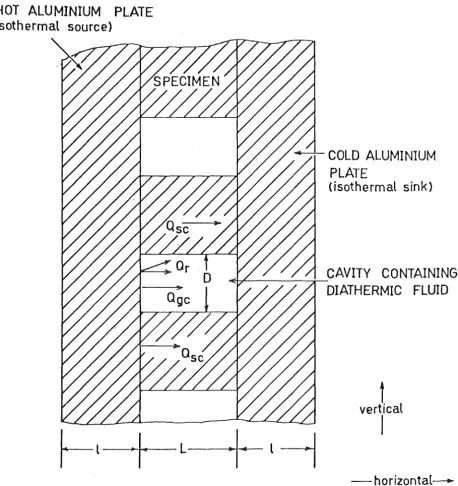
As shown in Figure 1-1, one end of the cylindrical
HOT ALUMINIUM PLATE
(isothermal source)
~l
+
L-+l-1
0
5c - heat transfer
by
solid conduction
Ogc - heat transfer
by
gas conduction
Or - heat transfer
by
radiation
COLD ALUMINIUM
PLATE
<isothermal sink)
1
vertical
I
[image:15.600.76.534.108.594.2]source zone. Energy is transported from the source to the sink by fluid conduction, solid conduction, and radiative transfer between the walls of the enclosure. Convective transfer is neglected by.doing all the work (theoretical and experimental) below the critical Rayleigh number (1,8,11,12). The problem is hereafter referred to as 'the cavity problem'.
As can be shown from dimensional analysis (1,9,10,14,15, 3,17), the cavity problem is a function of the following
dimensionless numbers:
1. Aspect ratio of enclosure 2. Grashof number
3. Prandtl number
4. Orientation of gravity
5. Radiation-conduction parameter (or Stark number) 6. Optical thickness (based on a system dimension) 7. Emissivity of the surface
8. Ratio of the absolute source and sink temperatures
It is clear that a complete description of the problem will require considerable theoretical and experimental effort and time. This is partially the reason for the emphasis in this thesis on the numerical and practical aspects of the problem.
The cavity problem is a good test problem for several
reasons. First, i t is one of the simplest enclosed interaction problems that could be simulated experimentally and
many practical applications which can be closely associated with the cavity problem.
1.4 PRACTICAL APPLICATIONS
The mathematical significance of the cav~ty problem is considered to be at least as important as its practical value and the focus of attention in this thesis is so divided. The cavity problem is of importance in a number of practical
situations.
One of the applications is in the thermal insulation field. Radiation transfer and solid conduction are important in determining the effectiveness of thermal insulation (6,13) in cryogenic storage equipment and high temperature thermal protection systems. For example, that used in spacecraft installations - Skylab I for instance. In most cryogenic and space applications, cavities are used to reduce conduction losses and by using low emissivity surfaces in evacuated conditions, reductions in radiation transfer also result.
Cavity walled structures are also used to provide high strength -to-weight ratios especially in aircraft. Other areas of
insulation engineering where the cavity problem is of
significance include building insulation, double-glazing of windows, and the cavities surrounding the core of a nuclear reactor.
are of cavity wall construction for thermal and economic
reasons~ using the techniques described in this work, i t is
possible to get better design methods and operating characteristics for furnaces.
A third area of application that has arisen more recently is in the design of solar energy collectors. In the design of these collectors, particularly the flat plate type, the
amounts of radiation, convection and conduction heat transferred from the heated plate must be known in order to compute the
efficiency of collection (16,18).
1.5 OUTLINE OF PRIOR WORK
1.5.1 BACKGROUND AND THEORY
Heat transfer processes in enclosures have received
increased attention in recent years. Most attention has been to convection transfer in enclosures (natural and forced)
(8,18). Conduction and radiation transfers have received very little attention. This section of the work reviews the
experimental, numerical and analytical studies on vertical, inclined and horizontal cavities.
1.5.1.1 Fundamentals of Heat Transfer (1) Definitions:
(a) Thermal Conductivity - is defined as the property of a homogeneous body measured by the ratio of steady-state heat flux (time rate of heat flow per unit area) to the temperature gradient (temperature difference per unit length of heat-flow path) in the direction perpendicular to the area. A material can be considered homogeneous when the value of thermal
or area over a small temperature range.
To be meaningful, thermal conductivity must be identified with respect to the mean temperature. For a material that is not isotropic, thermal conductivity varies
not only with temperature, but also with the direction and orientation of heat flow. Thermal conductivity is usually measured with a material exposed to a definite temperature difference. If the heat flux consists of a convective and radiative as well as a conductive contribution, the thermal conductivity calculated or measured is termed 'effective' or
'apparent'.
(b) Emittance - is the ratio of emission of radiant energy by an opaque material to the emission of a perfect emitter, or blackbody, at the same temperature and under the same geometric and wavelength conditions. Emittance, a
practical measure of a material's radiant emission, is distinct from emissivity, a more nearly ideal property
obtained by measuring a material who$e surface has been care-fully prepared to be optically flat.
(2) Basic laws of heat transfer:
The basic physical laws and relations which govern the various mechanisms of heat flow are:
(a) Conduction - the basic relation for heat transfer by conduction was proposed by the French scientist, J.B.J. Fourier, in 1822. It states that qc' the rate of heat flow by conduction in a material, is equal to the product of the following three quantities:
(ii) A, the area of the section through which heat flows by conduction, to be measured perpendicularly to the direction of heat flow
(iii) dT/dx, the temperature gradient at the section
Accordingly, the elementary equation for one-dimensional conduction in the steady-state is w~itten:
=
-KAdTdx (1-1)
(b) Thermal Radiation - the basic equation for total thermal radiation from the ideal radiator (the 'blackbody') was discovered empirically by Stefan in 1879 and was derived theoretically by Boltzmann in 1884:
qr
=
crAT'+ (1-2)where qr is the rate radiant energy emission,
w
A is the surface area of the emitting surface, M2 T is the absolute surface temperature, OK
cr is the Stefan-Boltzmann constant, W/M2/0Kif
Real bodies do not meet the specifications of an ideal radiator but emit radiation at a lower rate than blackbodies. If they emit, at a temperature equal to that of a blackbody,
'
a constaht fraction of blackbody emi~sion at each wavelength, they are called gray bodies. The rate of emission of
radiant energy of a gray body at a temperature T is: 1
= O'AET
If1
where E is the emittance of the gray surface.
(1-3)
(c) Convection - in 1701, Newton defined the heat transfer rate q from a surface of a solid to a fluid by
the equation:
(1-4)
where qco is the rate of heat transfer by convection,
w
A is the heat transfer area, M2T
s is the surface temperature, oc
Tf is the fluid temperature at some specified
location (usually far away from the surface) , oc h is the surface coefficient of heat transfer (or the
co
convective heat transfer coefficient) , W/M 2°C
1.5.2 REVIEW OF EXPERIMENTAL METHODS
It is mentioned at the outset that little work has been found which is related to measuring heat transfer rates in enclosures with conduction and radiation as the predominant modes. As such, the discussion of prior investigations pertinent to this study is of a general nature.
1.5.2.1 Heat Transfer Across Vertical and Horizontal Fluid Layers
The first systematic experimental investigation -directed at obtaining generalised relationships for the transfer of heat through enclosed, plane air layers -was made by Mull and Reiher (19) in 1930. They measured the
steady-state heat transfer rate by natural convection
across air layers. Most of their experiments were conducted for horizontal and vertical cavities. Their results were
presented in the form of a Nusselt-Grashof number correlation.
The results of Mull and Reiher were represented in a
within vertical air layers. At low values of Gr only
gaseous conduction occurs and Nu equals unity; the convective flow region can then be divided into laminar and turbulent regimes. The results were again presented in empirical relationships.
In 1951, Peck et al (22), performed a series of experi-ments on vertical, enclosed gas layers in which the environ-mental pressure was varied. The radiative, Qr, and solid conductive, Qsc, components of the total heat flux passing across the cavities were obtained by evacuating the test cell to a pressure of approximately 2 x 10⁻⁵ torr. At such vacua, the gaseous conductive and convective heat transfers are
completely eliminated. Their experiments could not distinguish Qr from Qsc. They however, obtained empirical correlations for air, at environmental pressures in the range 1 - 100 torr. Kent (23) used a similar technique to o~tain correlations of Nusselt and Rayleigh numbers for horizontal fluid layers in 1972.
De Graaf and Van der Held (9) examined the transfer of heat across enclosed air layers in horizontal, vertical and inclined positions. Attempts were made to determine the
convective flow patterns o~curring within air layers by means of both a modified shadow-graph technique and smoke methods. It was concluded from these tests that convection did not occur in vertical air layers provided Gr < 2.78 x 10³ , and that if Gr > 5.55 x 10⁴ laminar flow existed. When this
heat transferred through a horizontal air layer when the hot wall was placed uppermost. The experimental correlations given were in good numerical agreement with those of Jakob.
The thermal insulating values of enclosed air spaces, with particular reference to buildings, have been studied by Robinson and Powlitch (24). Steady-state heat transfer
measurements were obtained with enclosing surfaces of differing emissivities at five different inclinations of each cavity and for various directions of heat flow. Values of the combined conduction-convection heat transfer coefficients were plotted against the air layer thickness, with temperature difference as an experimental parameter. They concluded that for a given orientation and temperature difference there is an optimum thickness of air layer at which the thermal resis-tance of the air space has a maximum value, though at large air thickness values, greater resistances may be encountered.
The first detailed, phenomenological study of the heat transfer processes occurring within vertically-enclosed air layers was presented by Eckert and Carlson (25) , who used a Mach-Zehnder interferometer to determine the temperature distribution within the air layers. Three regimes of flow were distinguished in the range 2.92 x 10² < Gr < 1.94 x 10⁵•
The conduction regime was defined to exist when a linear
temperature gradient was established in the central portion of the cavity. The conditions under which a core of uniform
was becoming increasingly significant. This was called the transition regime. In the conduction regime heat is
trans-ferred by gaseous conduction only in the central section of the air layer. In the corners of the cavity, convection was found to contribute to the total heat flux across the cavity and
local heat transfer coefficients were obtained for these corner regions. Average Nusselt number correlations for the
con-duction regime, as well as empirical relationships for heat transfer in the boundary layer regime, were presented.
The earliest experiments on the thermal instability phenomenon referred to above were conducted by Thomson (26), and then Benard (27) presented a more complete description of the development of a cellular convection pattern.
Consequently, the thermal instability question is generally referred to as the Benard problem. Schmidt and Saunders
(28) found that instability and cellular motion within a horizontal layer of fluid ensued when Ra was approximately equal to 1700. When cellular convection occurred, the length of the horizontal side of a cell was found to be approximately twice the layer depth. As Ra was increased beyond its
critical value, the temperature gradients at the plane midway between the boundary surfaces decreased to negligible values, indicating that all the heat was being convected. Experi-ments on layers of different depths showed that on further heating the layer became completely turbulent at Ra
=
4.5 x 10⁴; the first signs of turbulence occurring at about Ra
=
5 X 10³•cavities, with aspect ratios which ranged from 16 to 70, and for several pressures of the contained air. The chosen temperature difference between the isothermal cylindrical
0 0
walls ranged from 20 K to 180 K. For constant values of the temperature difference, the gaseous conductive, convective and radiative components of the heat leaks across the air gap to the outer cylindrical wall were distinguished and evaluated using a technique which employed the air pressure as the variable. Convection of the air ensued throughout the whole height of the cavity when the Rayleigh number attained a value of 1.6 x 10⁴ •
Edwards (30) measur~d the rate of heat transfer through air across a rectangular sectioned cavity for different
values of temperature difference across the cavity, aspect ratio, angle of inclination of the cavity with respect to the horizontal, and air pressure within the cavity. By reducing the pressure of the air in the cavity from atmospheric to 10-3 torr for any given geometrical arrangement, he distinguished between the convective,
conductive and radiative components of heat transfer through the gas. He did not, however, distinguish between radiation through the gas and conduction via the cell structure
supports. The results were presented in dimensionless form, Nusselt number against Rayleigh number.
1.5.2.2 General Review of Natural Convection in Cavities - Experimental Studies
the greatest relevance to the thesis·are those of Churchill (12,31,32), Probert (8,33,34,35,36) and Ostrach (37,38).
The reader is referred to Drake (39) for a more comprehensive review of more general enclosed natural convection experi-mental studies.
1.5.2.3 Gas Conduction in Enclosures -Experimental Studies
Most experimental studies of gaseous conduction in enclosures were (and still are) associated with work relating to thermal insulation.
A comprehensive series of experiments on the insulating effectiveness of various materials was carried out by Allcut
(40) in 1951. The effects of varying the amounts of air conduction (by varying the density of the fibrous insulation materials) were studied in detail. Although no new theories or methods of evaluating air conduction were obtained, the results provided an experimental basis for future work on thermal insulation. The effects of radiation transfer, convection and air pressure were also studied.
Verschoor and Greebler (41) studied heat transfer of gas conduction and radiation in fibrous insulations. Thermal conductivity measurements were made at atmospheric pressures with four different gases in the insulation samples, and the thermal conductivity with air was studied over a pressure range of 1 micron to 760mm of Hg. Gas conduction was found to be the most important mechanism of heat transfer. A
considerations of heat transfer by radiation (mean free path of radiation calculations) were also confirmed by the experimental thermal conductivity values at low pressures.
Good reviews of gas conduction studies are presented by Tye (6) and Glaser (13).
1.5.2.4 Solid Conduction - Experimental Studies As mentioned earlier, the thermal conductivity of a material is a measure of heat flow by conduction in the
material. Numerous methods are available for the measurement of the thermal conductivity of a solid material (6). The basic method is the guarded hot plate which has been the subject of much experimental and theoretical study (42,43, 44,45).
References worthy of note are Bratis and Novotny (46), Kent (23), Swann (47,48), and various workers at the seventh conference on thermal conductivity measurements (49).
Experimental analogic methods have been used to measure the solid conduction contribution to heat transfer.
Schneider (5) used three different analogies (the electrical, the fluid-flow, and the membrane) to measure the solid
conduction component in a furnace wall problem. Kreith (1) also describes three different electrical analogies that have been successfully used. A comprehensive review of analog methods is presented by Rohsenow (51).
1.5.2.5 Radiation Heat Transfer in Enclosures -Experimental Studies
investigations of the influence of thermal radiation heat transfer in enclosures composed by various surfaces (black, diffuse-gray, specularly reflecting, non-diffuse non-gray, and transparent surfaces) (7,14,52,53). The majority of the publications have been analytical investigations using gas models such as the gray gas, the box or the exponental wide-band model.
At the present time, there are very few existing
experimental investigations concerned with radiative transfer in enclosures. Most of these experimental investigations deal with gaseous radiation interactions (54,55,56,57,58).
Allcut (40), Verschoor (41) and Strong (59) measured the effect of thermal radiation in conjunction with thermal
insulation studies in fibrous materials. Swann (4) and Stroud (60) measured the effects of thermal radiation in
enclosures in their studies of heat transfer across honeycomb core panels.
Sadhu (29) and Edwards (30) in their experimental studies of natural convection in enclosures, measured the amount of radiation flux as well.
1.5.2.6 Concluding Remarks on Experimental Methods of Analysing The Cavity Problem
(a) Conduction - gas conduction has been measured by reducing the working pressure to 10-3 torr (13,29,30). Solid conduction is either lumped together with thermal radiation
(23,29) occurring in the enclosure, or is reduced (conse-quently ignored) by using thin walls (61). Other workers (3,
as a loss in heat flux.
(b) Radiation - no work was found in which i t was measured or stated quantitatively, it was always associated with solid conduction.
(c) Convection - most workers estimated i t by using the Mach-Zehnder interferometer or by difference.
1.5.3 REVIEW OF THEORETICAL METHODS
This review of calculation methods falls into three categories:
(a) Empirical and ~emi-empirical - that is, correlations. (b) Analytical - the formal analytical approach
involves the derivation of a mathematical solution for the temperature as a function of space or space-time co-ordinates. The solution must satisfy the characteristic differential
equation from which i t was derived, and certain initial and boundary conditions imposed by the particular problem itself. Excellent books on this approach are Carslaw and Jaeger (62), Schneider (50), Jakob (21) and Ozisik (63).
(c) Numerical - these methods are associated with obtaining approximate solutions of the steady-state and transient heat transfer equations. Their basis are usually finite difference and finite element approximations.
1.5.3.1 Radiative Transfer in Enclosures -Theoretical Studies
linear equations could be solved and he suggested the use of matrix methods to do so. A different approach to the problem was offered by Poljak (21,64). Later Oppenheim (65)
introduced an electrical analogy to radiant heaL transfer which greatly simplified the representation of the problem and he suggested that the electrical network be solved by matrix methods similar to Hottel's. An alternate approach to the cavity problem was given by Gebhart (66). All of the above methods are basically equivalent as demonstrated by Sparrow (67); they are termed 'the net-radiation method'.
Bevans and Dunkle (68) used relaxation methods in
solving the resulting equations from the electrical networks of the cavity problem. Stott and Garrod (17,69) produced a method of assessing radiation heater transfer in an enclosure surrounded by several surfaces at different temperatures and containing a number of radiating and
absorbing volumes of gas. They showed that the application of an electrical analogy could be made relatively simple by the use of relaxation methods to solve equations describing the analogous electrical resistive network. A computer program was described which solved the problem in general terms and its application to furnace design was outlined.
hence iterative solving techniques. The analytical
approach involved solving the integral equations by success-ive substitution and variational calculus.
An alternate approach to the analysis of radiative transfer in enclosures is offered by the Monte Carlo method. It is a statistical numerical method. A review of the
problems solved in the literature using this method is given by Siegal (14).
Analytical and numerical studies of the interaction of thermal radiation with other modes of heat transfer in
enclosures is well reviewed in the work of Novotny (46,56,58).
1.5.3.2 Conduction Heat Transfer - Theoretical Studies
The study of conduction heat transfer is principally concerned with the distribution of temperature or rate of heat flow within a medium. The determination of the temper-ature field or heat flux constitutes a complete solution.
1.5.3.2.1 Analytical solutions of conduction problems
Analytical solutions are limited in their range of
applicability due to their complexity and uncertainty as far as practical boundary conditions are concerned. Many
practical two- and three-dimensional engineering problems require numerical methods for their solution. However, assumptions can usually be made in most practical problems which reduce them to simple geometrical shapes with
The classical works on analytical heat conduction are considered to be those of Fourier (71) and Carslaw and Jaeger
(62). Fourier, of course, laid the foundations of conduction in solids, while Carslaw and Jaeger later described numerous solutions to many different geometries and solutions. This latter work is principally an operational text in that the mathematical methods of solution are only briefly outlined. Carslaw and Jaeger were principally concerned with conduction for its own sake, but other authors such as Arpaci (72) have outlined conduction in an engineering context with the
solutions described in more detail.
This work can in no·way attempt a complete presentation of the analytical methods available for the solution of the heat conduction problems. What is attempted is a citation of some of the more commonly used and more straightforward procedures employed in engineering practice.
Schneider (50) solved various practical engineering
problems using analytical methods, principally Fourier series. One of the problems that he solved that is Rarticularly
applicable to this work is that of a temperature field in a nuclear reactor. The solution obtained was only approximate as he used circular harmonics.
The classical approach to an exact solution of the heat conduction equation is the separation-of-variables technique. Kreith (1), Bayley (73) and Myers (74) have given good
equations. An outline of the mathematical principles required to solve analytical problems is given. Bessel function, Fourier series and Laplace transforms are all presented in simple terms. Examples of the application of these principles to such problems as plane wall and semi-infinite solid conduction are given.
Rohsenow (51) also gives an excellent review of mathe-matical and practical examples of analytical methods used in conduction heat transfer. A systematic and unified study of methods for solutions of heat conduction problems is given by Ozisik (63). The feature of his book is a systematic tabulation of transformg; inversion formulas for finite, semi-finite and infinite regions, for all combinations of boundary conditions. Through the use of this integral
transform technique, the solution of heat conduction problems becomes a comprehensive study.
1.5.3.2.2 Numerical methods
These are methods of· obtaining approximate solutions to the heat conduction equation. Most treatments of numerical heat conduction are derived from the more generalised and more rigorous approach of the numerical analyst as advocated by Fox (75), Smith (76), Ames (77), Forsythe (78) and
Richtmyer (79). Of the numerical approximation methods available, those employing finite difference approximations are straightforward, are more frequently used, and are
generally more applicable than any other. Accordingly, this thesis concentrates on the finite difference approach.
a variational approach since the solution of the governing differential equation is obtained by minimising some
integrated quantity (referred to as a functional) which is evaluated over the whole region of interest.
This method is widely used in structural analysis and although i t is not as straightforward conceptually as the finite difference approach, i t offers several advantages in the treatment of heat conduction problems, particularly with curved boundaries and normal derivative boundary conditions.
It is common in heat transfer to treat steady-state conduction (involving two or more space variables) and transient heat conduction (involving one or more space
variables and time) separately, and this is also done in the numerical analysis of these problems since they form separate classes of partial differential equations. These classes are important in that they classify the nature of the
procedure used in their solution. Steady-state problems are elliptical partial differential equations and transient are parabolic. Only solutions of the former a-re considered in this work.
(I} Finite Differences
(a} Approach - the basic approach consists of over-laying the area of integration with a mesh (usually
With steady-state heat conduction this process gives N simultaneous algebraic equations for N mesh points in the region, the solution of which provides a numerical value of temperature for each mesh point. In the case of transient heat conduction, the partial differential equation is
approximated along one or two rows of mesh points at a time, so that the procedure results in the successive solution of small sets of algebraic equations (51,82).
(b) Physical formulation - the first step in the physical formulation of the problem is to subdivide the system into a number of small but finite subvolumes (1,51, 74,80). Each subvolume is assumed to be at the temperature corresponding to its centre. The physical system is
replaced by a network of fictitious heat-conducting rods between the centers, or nodal points, of the subvolumes.
Once the thermal conductance corresponding to the conductance of the material between nodal points is assigned, the heat flow in the rod network is obtained. This heat flow
approximates the flow in the continuous system.
(c) Finite difference approximations - the fundamental operation in the method of finite differences is the
replacement of each derivative in the partial differential equation by an algebraic approximation at each discrete
of Taylor expansions. Myers (74), Bayley (73) and Rohsenow (51) have shown that the latter method is brief, simple, and gives an indication of the accuracy of the approximation.
(d) Formulation of nodal equations - numerous examples exist of the finite difference representation of the main equations. Among the references worthy of note are the works of Dusinberre (80), Kreith (1), Rohsenow (51) and Myers (74). In all these references, radiation and convection boundary conditions, and irregular physical boundaries are considered in detail.
(e) Finite difference equations and their solutions -finite difference methods for solving steady-state heat
conduction problems lead to systems of algebraic equations. The solution of the equations is not a trivial matter. In the majority of cases, the equations are linear, so that the coefficients are constants or functions of the independent variables only, and the mathematical procedures of matrix algebra apply. However, some problems, such as those
involving temperature-dependent thermal conductivity, and the cavity problem, produce non-linear algebraic equations. The methods of solving the equations can be classed as either direct or iterative.
Emmons (81) presented one of the earliest solutions to the finite difference equations by using the relaxation method of Southwell (83,84). Later, Dusinberre (80)
Bayley and Myers present good accounts of this method. Iterative methods of solution include Gauss-Siedel
(relaxation method), Jacobi, successive overrelaxation, and alternating direction implicit methods (50,51).
(II) Finite Elements
The finite element approach was developed and has been extensively used for structural analysis (85,86). It is becoming of increasing importance in other engineering
fields such as fluid mechanics and heat conduction (87,88,89).
While the finite difference method represents a direct approach by approximating individual derivatives in the differential equation, the finite element procedure is an approximation applied to the variational form of the partial differential equation, so that, in general, the problem
becomes one of finding a function which minimises a 'variational functional' over the field of interest.
The region is divided into a numb~r of elements
(usually triangular (R6,90) for two-dimensional problems, or tetrahedral (88) for three~dimensional problems), and the unknown function is uniquely specified throughout the field by a discrete number of values associated with the node points of the elements. The value of the function at a particular node point influences only the function at the nodes of the adjacent elements so that the minimization of the functional throughout the whole region results, as with finite differences, in a system of simultaneous equations.
Zienkiewicz (85,88) present the finite element formulations well. More recently, Myers (74) has dealt with the subject very fully. Fundamental concepts are presented and two-dimensional steady-state problems are solved. Bayley (73) has used the finite element method to solve the classical gas turbine problem. Zienkiewicz (88) used finite element methods to solve electrical three-dimensional field problems which are analogous to heat transfer problems. He also
studied spontaneous ignition (89) using variational techniques.
(III) Concluding Remarks on Finite Difference and Finite Element Methods
Emery and Carson (90) made a study of the accuracy and efficiency of the finite element methods in comparison to the standard finite difference algorithms used for the computation of temperature. Their study was primarily concerned with
computational aspects, but their general conclusions seemed to favour the use of the finite element methods rather than finite difference ones. Their study suggested that the primary advantages of the finite element methods were
associated with the ease of inputting the required data and the capability of altering the basic accuracy of the method; its major disadvantages were large core memory requirements and lengthy execution times.
and in the ease with which derivative and mixed boundary conditions on irregularly shaped boundaries can be handled.
1.5.3.2.3 Other methods of obtaining approximate solutions
The theory of complex variables provides the means of obtaining solutions to two-dimensional steady-state heat transfer problems in many situations where analytical procedures are not applicable. The most useful aspect of this theory is its ability of transforming a region in which heat transfer takes place (where, for example, complicated boundary conditions prohibit the use of analysis) into another region, so that the problem can be easily solved
(91,92,93). This transformation, which preserves the magnitude and sense of the angles between isothermal
boundaries, is called conformal mapping. This theory also provides the fundamentals for graphical solutions. Kreith (1), Schneider (SO) and Rohsenow (51) have used graphical methods to solve numerous condu~tion problems.
1.5.3.2.4 Solutions of transient state problems
Unsteady-state heat transfer problems are characterised by time-dependent heat fluxes and temperature fields. Exact solutions to most practical transient heat transfer problems are rather difficult, if not impossible, to obtain. Thus, the necessity of obtaining an approximate solution to such problems has motivated a considerable effort for developing methods for achieving approximate solutions. The most
(1) Method of finite differences - this method has attracted most of the attention in recent years, primarily because i t is easily adapted to digital computations (94); consequently, this is the only method that can be used to obtain an approximate solution if a high degree of accuracy is required, or i t the problem at hand is of considerable size and complexity.
(2) Graphical methods - were first introduced by Schmidt and Binder (15). In recent years, with the
development of computers, the interest in such meuhods has diminished, though these methods can provide quick answers, and also have the advantages of simplicity and visualization.
(3) Approximate analytical methods - several have been developed (51,73) for obtaining approximate solutions of heat
transfer problems in an analytical form. They can be applied to both linear and non-linear problems yielding simple solutions with an accuracy adequate for engineering purposes. The most extensively used are the Integral method first introduced by Goodman and the Biot's variational
principle.
(4) Analog methods - these are discussed by Paschkis (51) in great detail.
1.5.3.3 Review of convection Heat Transfer -Theoretical Studies
restriction, little work has been found which is directly applicable.
Natural convection studies in enclosures can be classified as follows:
1.5.3.3.1 Empirical studies
Most of the experimental and numerical investigators of heat transfer in enclosures, presented their results in the form of the Nusselt number - Grashof (or Rayleigh) number correlations (25,70,95,96.97,98). The most up-to-date correlation (May 1976), is that due to Holland (114). The correlation is applicable for all values of the Rayleigh number and agrees well
(±
5%) with experimental results for angles of inclination to the horizontal less than 60 degrees.rh) (
1 _ (Sin 1 • 8
cp)
1• 617 0 8) Nu
=
1 + 1.44 (1 - 1708/Ra cos ~ Ra cos cp+ ( ( Ra cos
cp)
o • 3 3 3 _ 1 )5830 ( 1-5)
where Nu
=
Nusselt number for natural convective heat transfer across the air layerRa
=
Rayleigh numbercp
=
Angle of air layer from horizontal1.5.3.3.2 Analytical and numerical studies
(A) Vertical layers
Early theoretical analyses of the cavity problem were published by Batchelor (99) and Poots (100).
numbers or the cases where conduction predominated convection. Poots used a numerical method based on the use of orthogonal polynomial& to solve a variant of the cavity problem in which the temperature profiles along the top and bottom. of the
enclosure varied linearly between the source and sink
temperatures. Results were presented for aspect ratios of unity, Pr
=
0.73 and Rayleigh numbers from 500 through to 10,000. The Poots' correlation wasNu
=
1 + (9.8 x 10⁻⁸) Gr2 (1-6) provided the Grashof number was less than 1390. This result compared favourably with Batchelor's predictions.Mynett (101) attemp~ed to solve the governing equations by means of a relaxation technique for an aspect ratio of 6 only and for Rayleigh numbers of 100, 1,000 and 10,000
respectively. The partials differentials were replaced by their finite difference equivalents in preparation for the relaxation process, which involved an iterative procedure. The results obtained for Nu agreed closely with those of Batchelor's.
Following Eckert and Carlson (25), various publications (95,102,103,104,105) have used the temperature distribution in the cavity to distinguish between three regimes of flow. At Ra less than 3,000 the computed temperature profile across the cavity was virtually linear, that is, the continuum
conduction regime. As Ra increased, convection was found to become increasingly significant and the temperature profiles across the air layer flowed a progressive departure from
(B) Horizontal layers
The first analytical treatment aimed at determining the conditions delineating the breakdown of the quiescent state within horizontal fluid layers heated from below was carried out by Lord Rayleigh (106). This work was corroborated and extended by Jeffreys (107,108) and Low (109). From these analyses i t was concluded that the sole parameter determining stability was the product of the Prandtl and Grashof numbers, that is, the Rayleigh number. The critical value of Ra
(based on the thickness of the fluid layer) , above which cellular convection ensues, was computed to be 1709. The fundamental assumptions in these analyses were that (a) density variation effects were negligible except for their influence on the bouyancy; (b) the initial motion was slow; and (c) a linear temperature profile extended acrqss the entire fluid layer at the start of the motion.
More recent studies on convection in enclosures include the work of Churchill and Chu (110). They studied the effect of localised heating in a rectangular channel by solving the partial differential equations for the conservation of mass, energy and momentum numerically using an unsteady-state
Ozoe and Churchill (12) performed a three-dimensional numerical analysis of laminar natural convection in a
confined fluid heated from below. They tested three
geometrical configurations and compared their results with those of Aziz and Hellums, Catton, and Heitz and Westwater. For the cubical enclosure, the.criticaL.Rayleigh- number obtained by extrapolation to Nu
=
1 was 3500, which agrees closely with the computed value of 3446 by Catton (111) , and the experimental value of 3700 by Heitz and Westwater (112). For the long square channel, the critical Rayleigh number obtained from extrapolation to Nu=
1 was 2300 which agrees reasonably well with the prediction of 2452 by Catton. The results for the analysis of a region between infinitehorizontal plates heated from below gave similar results as obtained from earlier two-dimensional computer programs (31).
1.5.3.3.3 Theoretical convection studies in the post conductive regime
Catton (113), Hollands (114) and Buchberg (18) give good reviews of the work that has been done in this area in the last two decades.
1.5.3.3.4 Concluding remarks on natural convection studies in enclosures
It has been conclusively shown by Probert (11) for vertical air layers, that the limit of conduction can be identified solely in terms of the Grashof number
(Gr
=
2.2 x 10³Rayleigh (106), Jeffreys (107,108) and Low (109) have shown that for horizontal fluid layers, the critical Rayleigh number is 1709. The studies of Ozoe and Churchill (12) tend to come up with critical Rayleigh numbers close to 2300 for confined fluids heated from below.
1.6 METHOD OF SOLUTION
The cavity problem is solved in this work by two distinct methods (a) by an experimental method and (b) by a numerical method.
1.6.1 METHOD OF SOLUTION BY EXPERIMENT
The experiment is re~uired to measure or show the effects of: (a) the thermal conductivity of the specimen;
(b) solid conduction; (c) thermal radiation; (d) gaseous conduction; and (e) total heat flow.
1.6.1.1 Convection
As previously mentioned, i t was the aim of this work to suppress natural convection. Consequently, all the experi-ments were to be performed at sub-critical Rayleigh numbers
(less than 1700). As calibration runs will show later, by working with specimens of less than 0.75 inches (19.05rnrn) thick at moderate temperatures, the resulting Rayleigh and Grashof numbers are sub-critical. As no interferometer was available, the no convection assumption could not be
checked experimentally.
1.6.1.2 Radiation
difference or by showing its varying effects under
different conditions. Since conduction and convection were not measured individually or distinguished in .this work, the latter method was used. Radiation effects were assessed by varying the
(i) (ii) (iii) (iv) (v)
material
material thickness cavity size
temperature differences across the cavity surface conditions at the ends of the cavity
1.6.1.3 Conduction
Solid conduction could have been measured by imbedding thermocouple wires in the solid slabs used. The introduction of these probes in the solid would have disturbed the heat flux profiles (see section 1.6.3).
Gas conduction could also have been measured by varying the working pressure (below 10-3 torr gas conduction
negligible (13~30)), however, evacuating holes in the specimens would also have been necessary. They too would have disturbed the heat flow.
Consequently, conduction effects were also only assessed in relation to the total heat transferred under various
experimental conditions (see 1.6.1.4 below).
1.6.1.4 Total Heat Transferred
The total heat flow was determined using a guarded hot plate apparatus (5). For a given temperature difference and material, the apparatus was used to measure the thermal
specimen. The guarded hot plate apparatus was again used to find the total heat transferred at the same temperature
differences as for the solid specimen experiments. This set of experiments was repeated for various hole sizes,
thicknesses of the same material, and for various materials. By blocking the holes with aluminium foil, the effects of radiation were also assessed.
From quantitative heat flux curves of heat transferred against temperature difference for various operating
conditions, the effects of solid and gaseous conduction can be distinguished from radiation effects, as the former are linear relationships while the latter are non-linear. A comparison of total heat transferred by experimental and by theoretical work provided a check on the accuracy of the theoretical and experimental analyses.
1.6.1.5 General Remarks
The primary material used in the experiments was 'perspex' acrylic sheet (Imperial Chemical Industries
Limited tradename for polymethyl methacrylate). Rationale for this choice, is provided in the next chapter. Other materials used are particle board, rubber, and two types of asbestos cement board (durotherm and syndanyo board) .
1.6.1.6 Assumptions
Some of the basic assumptions used in the development of the experimental method of solution are summarised below. Other particular assumptions are discussed as they arise.
(b) Uni-directional heat flow - the thermocouple wires on each plate proved this to be practically correct.
(c) Heat flow from electrical power input is equally divided between the two specimens. Electrical power was computed from current multiplied by voltage assuming a power factor of one. Also the heat flux was assumed to be area dependent, that is, since the central metered section was
l/4th of total plate area, then l/4th of the power was associated with this area.
(d) The temperatures indicated by the thermocouple wires are the correct surface temperatures (see section on surface temperature measurement) .
(e) The surface temperature of the specimen at the hot end is equal to the surface temperature of the hot plate of the guarded hot plate apparatus. Similarly for the cold end of the apparatus, the specimen temperature is assumed to be the same as the cold plate temperature.
1.6.2 NUMERICAL SIMULATION OF THE EXPERIMENTAL SET-UP
1.6.2.1 Theoretical Basis
1.6.2.1.1 Assumptions
The basic assumptions used in the numerical simulation of the cavity problem are:
(l) Steady-state conditions exist
(2) No heat generation - heat sources or sinks in the problem are non-existent
the thermal conductivities of perspex and air are constant (at the mean temperatures) .
(4) Zones of constant temperature are associated with each node. Three different zoning systems are used (see Appendix) . For solid conduction, the zoning approximations are well known (1,50). For gas conduction, cores of air at constant temperature are considered. For radiation surfaces, the zoning approximations of Hottel (116) are assumed.
(5) The surfaces of the enclosure are assumed to be opaque and diffuse-gray (Appendix). Hence, the emissivity of perspex is taken as 0.9, and that of aluminium taking values of 0.04, 0.11, 0.2 and 0.5 (Appendix).
1.6.2.1.2 Basic transfer equations The basic equation used for the conduction flow calculations is the Fourier equation (1-1) in three dimensions. For radiant transfer, the Stefan-Boltzmann
equation (1-3) is used. The continuity and mass conservation equations are used in all heat balances. Note that for
radiant heat transfer in the enclosure, the net-radiation method (14,64) is applied.
1.6.2.2 Numerical Solution of the Cavity Problem
1.6.2.2.1 General description of the procedure
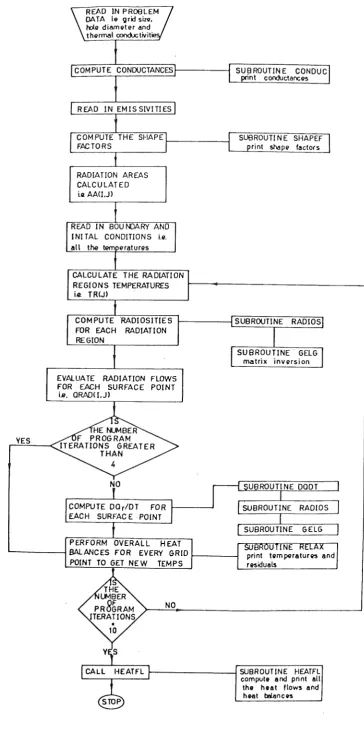
The method used is an iterative one using relaxation techniques. Unknown temperatures are first estimated and
the radiation fluxes between radiation regions are calculated. Using these fluxes, heat balances are calculated for each
are satisfied. The procedure is repeated until no further worthwhile changes occur. The calculation depends for its success on a technique (discussed later) which ensures convergence of the iterations which calculate the heat
balance, whilst simultaneously adjusting the radiation flow changes due to changes in temperature. The convergence, accuracy, and numerical stability of relaxation procedures is well documented in the literature (80,81).
1.6.2.2.2 Problem formulation -finite difference approximations
(a) Heat transfer equations
(i) Choice of grid - the three-dimensional cartesian co-ordinate system used (rectangular parallel-piped or box elements) is shown in the Appendix. The relationship of the grid to the physical layout of the problem is also presented. There are three solid conduction regions, each region has 58 temperature points. Note that due to the symmetry of the problem, only l/8th of the box element (or zone) is used. Six radiation regions are considered and three air conduction regions (each with four temperature (nodal) points).
The choice of grid presented numerous problems as the hole (or cavity) is cylindrical whereas the solid is
rectangular, hence mixed co-ordinate systems at the air-solid interface were necessary. As will be shown later, by using triangular meshes at this boundary, the problem was solved.
temperature was fixed at Tcold" All the other boundaries were taken as zero heat flux regions. In the computer
program this was done by putting the conductances associated with fictitious temperatures at zero conductances.
The initial temperatures within the grid were arbitrarily chosen.
(iii) Formulation of the nodal equations - detailed derivations of the equations are given in the Appendix. After completing the subdivision of the system, the thermal conductance K .. between the nodes i and its adjacent j nodes
lJ
must be calculated. The rate of heat flow q .. (watts) from
lJ
any node j to the adjacent node i is: q ..
=
K. . (T. - T.)lJ lJ J l ( l-7)
The heat balance for the node i gives the equation:
L:q ..
=
L:K. . (T. - T.)=
0' lJ ' lJ J l
J J
( 1-8)
Using this energy-balance method, equations of the type shown below were obtained for the temperature (T
299 - Figure B4) of an interior node:
{CXY(298)T(298)+CXY(299)T(300)+CYX(425)T(425)+CYX(299) T(l73)+CZX(285)T(285)+CZX(299)T(313)}
{CXY(298)+CXY(299)+CYX(425)+CYX(299)+CZX(285)+CZX(299)} - T(299)