SNAPS
A Snapshot Allocator and Processor System
for use
in
a Distributed Database
with application to a
Radiology Database System
A
thesis
submitted as partial fulfihnent
of the requirements for the Degree
of
Masters of Science
in
Computer Science
in
the
University of Canterbury
byRichard Douglas Fish
To
myparents,
Nanette and Michael
iii
Acknowledg-ements
I would like to thank my two supervisors. Firstly, Dick Cooper was the
person who was involved initially with the project, and gave me the initial
introduction to doctors Kennedy and Feltham, whom where wanting the
system developed. He also gave me a lot of ideas that have become an
integral part of the system. Neville Churcher became my supervisor from
February 1987. He has been a guiding light since then, right through to
the completion of my thesis. His support, encouragement, ideas, and
advice on the presentation of the thesis have been invaluable.
I would like to thank Dr Kennedy, Head of the X-Ray Department of
Christchurch Public Hospital, and Dr Feltham, Head of the X-Ray
Department of Nelson Hospital for their information and advice on the
requirements of the interconnectio:._l of the radiology systems.
I would like to thank my flatmates over the years last two years and my
friends for encouraging me to carry on when times were not too good. I
would also thank Chris Taylor for his advice on the presentation of this
thesis.
Last but not least, I would like to thank my parents for their support
through out my University years, and without them I would not have been
iv
Contents
Abstract _________________________________ ..:.. _______ vu
Introduction ---1 Chapter 1
Distributed Database Systems ______________________ 10
Site Autonomy--- 14 Data Independence __________________ -~ __________ 15 Redundancy ___________________________________ 16
Efficient Access ---17 Integrity, Concurrency Control and Recovery ___________ 18 Chapter 2
Database Snapshots --- 2D Categories of Snapshot
---21.
Distribution of Snapshots __________________________ 23Snapshot Semantics--~---'Z7
Refreshing Snapshots ____________________________ 30 Extensions to Snapshots ___________________ _: ______ 32
Chapter 3
The Radiology System--- 35 Interconnection Requirements ______________________ 36
Wide Area Network Requirements--- 38 Recommendations for the Christchurch System ---39 Recommendations for the Nelson System ---41 Chapter 4
The Approach to System Interconnection ---~---43 The Global Snapshot ____________________ .,.. ________ 47 The Local Database ______________________________ 51
Mapping between the Local Database and Global Snapshot __ 54 Possible Extensions to the Mapping System _____________ 64
Security and Site Autonomy--- 65 Chapter 5
Query Optimisation ---67 · Data Allocation ---69 Semi-Joins: When they are used--- 69 Techniques used in the SNAPS System ________________ 70
Chapter 6
Snapshots in the SNAPS system. ---77 The Global Snapshot _____________________________ 79
Contents v
Refreshing the Global Snapshot--- 81
The Local Snapshots _____________________________ 83 Implementing Local Snapshots--- 85
Creating Local Snapshots ---f!fl Refreshing Local Snapshots ________________________ f!fl Up data b 1 e Snapshots--- 88
Concurrency Control for the Updatable Snapshots--- 89
Chapter 7 The Algorithms--- 93
Algorithm to Perform a Local Query--- 94
The Unambiguous Query Algorithm--- 96
The Ambiguous Query Algorithm ________________ 98 The Query Decomposition Algorithm ______________ 99 Semi-Joins as part of a Local Query--- 101
Requesting Locks from the Global Snapshot Controller ____ 102 Algorithm to Check for Non-Mapped Attribute Updates ___ 104 Algorithm to Refresh Local ~napshots --- 105
Algorithm to Deleted Local Snapshots ________________ 106 Algorithm to Load the Global Snapshot _______________ 107 Algorithm to Refresh the Global Snapshot _____________ 109 Algorithm to Manage the Allocation of Locks 112 Algorithm to Manage User Enquiries ________________ 112 Conclusion --- 114
Appendices A. Local Database Relation Status Attribute 116 B. Global Snapshot Relation Status Attribute--- 118
C. Snapshot Description Relation--- 120
D. Snapshot definition relation _____________ ~--- 122
E. Communication Options for Radiology System ________ 12'3 Leased Lines ______________________________ 124 Packet Switching Network --- 125
Digital Data Network---'--- 126
F. Specification and Costs of G/X25 Net Gateway --- 128
G. Costs of Telecom's Telecommunication Costs --- 129
Packet Switching Network Costs--- 129
Digital Data Network Costs ____________________ 129 Leased Line Costs--- 130
Contents vi
Patient--- 131 Radiological Services Bureau Codes ___________ 132 Sites ____________________________________ 132 Visit ____________________________________ 1~
Visit Report --- 1~ I. Schema of the Global Snapshot--- 135
Doctor Relation--- 135 Out going Request Relation ____________________ 135 Patient Relation ____________________________ 135
vii
Abstract
Traditional snapshots have been proposed as a way of providing multiple
copies of read only data at remote sites. There are limitations in this
approach when this applied to distributed databases. The snapshots are
read only. They are very specific to a user, and the data they capture.
The snapshot system I propose allows for snapshots to be updated. They
are integrated into the local databases so that other users can access them
as part of the local database, and .uo specifically access the snapshot.
Most approaches to distributed database design has involved integrating
database in the same organis~tion. The system I propose is designed to be
used with different organisations that are loosely joined. It is suitable for a
database that is predominantly read only, and where limited update
capability is required on only some relations in the database. It provides a
high degree of autonomy to the different organisations. It is suitable when
there is no large computer at each of the sites to co-ordinate the operations
of the database.
This system was designed to be used in the radiology environment, where
a number of different health care organisations wanted to be able to access
patient x-ray records stored at other hospitals and clinics. Most of the data
being stored is read only. The system was based on micro computers that
1
Introduction
The 1970's and 1980's have been likened to the industrial revolution of the
late 19th century. This era has seen the start of the information revolution.
The 1970's was the decade when the computer came of age. From being an
oddity in the universities, it became widely used in the commercial
environment. The 1980's has seen the rise of the personal computer, the
PC. The 1990's, I believe, is going to be the decade where
telecommunications is going to revolutionise the way the world
communicates. The information revolution looks set to accelerate with the
advent of fast, efficient and cheap telecommunications which will be
available to everyone.
Users have always wanted more and better information. Banks, airlines
and hospitals, which have data stored over many sites, want to be able to
access information at any one of them. However, the technology was not
capable of providing this effectively and efficiently. This has changed with
the combination of two very different technologies, database management
systems and telecommunications, to give the user the most flexible system
. for doing this thus far developed : the distributed database management
system.
The development of database management systems in the 1970's offered
users a new way to store and retrieve information at one site. It allowed
them a standardised way to store data and a flexible method of accessing
and reporting.
At the same time, telecommunications were also beginning to become
readily available. Local and wide area networks were being developed but
Introduction 2
Both areas of technology were very new in the 1970's. Each was going
through the development stage, and though the idea of a distributed
database system had been postulated, neither was capable or reliable
enough to cope with the complex requirements of this type of system.
As telecommunication and database management systems became more
accepted, and their performance and reliability were enhanced,
distributed database systems became more feasible. The late 1970's and
1980's have seen the development and research into distributed database
systems around the world.
A distributed database has parts of the database partitioned over one or
more machines. It is designed to take advantage of the processing needs of
its users and to utilize parallelism by distributing processing over the
various machines in the network as much as possible. A full distributed
database system should offer all the same facilities as a single site
centralised database system, and should appear to the user to be a single
site database. At present, all research into distributed databases is being
done using the relational model [CODD70]. This is the model I shall use
throughout this thesis.
An organisation that is geographically distributed has a good case for a
distributed database system. A company with branches in a number of
centres would be a good example. It will allow a manager the ability to
have El.,ccess to all this organisation's data, thus being able to make better
decisions.
There is also a need for independent organisations to have access to the
information that others have. For example, public and private hospitals,
clinics, and other health care organisations hold large amounts of patient
information, that would be valuable to all health professionals. The
llltroaUCti.Oll 3
meant that distributed database systems have not been fully utilized in this
area.
The aim of this thesis was to design a database system that would connect
a number of private and public hospital radiology departments and private
x-ray clinics in Christchurch and a similar system for Nelson. The
system has to provide flexible operation, but still provide secure access to
information and provide a high degree of autonomy to the individual sites.
This is important as all the organisations operate independently.
[KENN85] and [FELT85].
An identical single site system was being installed at each site, and the
radiologists wanted to be able to have on-line access to some of the
information stored at other sites, such as x-ray records and patient
details. The major requirement was for read only access to information,
but update ability on selected parts of the database was also required. The
ratio of enquiries to updates is very high. This is one of the important
aspects and has a direct bearing on a number of decisions in the system
design.
Snapshots are a selected portion pf a database as of a particular time. In
1980, Abida and Lindsay first proposed system supported snapshots
[ABID80]. This and another paper by Abida [ABID81], deal specifically
with snapshots. In the two unpublished papers by Cooper [COOP86a] and
[COOP,86b]. In [COOP86a], the problems of maintaining snapshots, and
when it is appropriate to use them, are discussed. The second paper
[COOP86b], discusses the use of snapshots in MIMER. MIMER is a
relational database management system.
In centralised database systems, snapshots provide an "as of' view of
selected portions of the database to an application, without the complexity
Introduction 4
environment, snapshots are seen as a way of providing read only multiple
copies of part of the database, at individual sites. In the medical
environment, large amounts of data are read only and snapshots would be
appropriate, as most of the information stored in a hospital is of read only
nature,(e.g. medical records).
Snapshots are read only in nature, and are stored as separate relations
[ABIDSO]. In the general database system this method of implementation
is appropriate, though there is room for deviation for specific applications.
In this thesis, the system is designed to handle snapshots that can be
updated, to allow for more flexible use of the data. Another deviation from
the definition of snapshots as proposed by Abida and Lindsay, is that they
are stored as part of the relations they are derived from, instead of having
the snapshot stored in a separate relation.
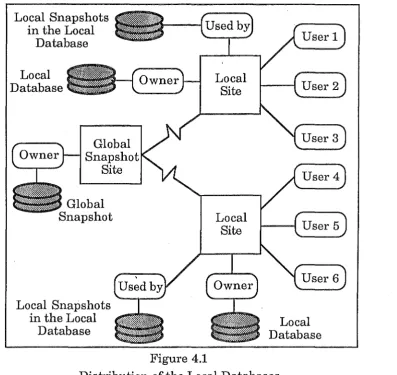
In the system I propose there are two levels of snapshot. The top level
would be a global snapshot of all the local databases, that would be stored
separately in a separate database. This global snapshot would be
maintained by a central controller. The second level is a snapshot of the
global snapshot that would be stored as part of the local database. These
levels are designed to simplify and speed up access, and provide a high
degree of site autonomy. When a local site requests data from other sites it
does not assume anything about where the data that will be returned
comes from. It assumes that all the other sites are involved, when in
reality' the data being accessed has already been brought to one site and
stored in the global snapshot.
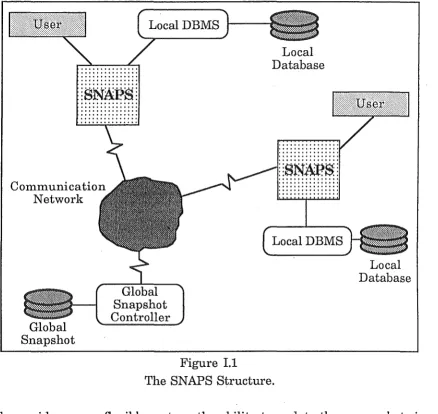
Figure I.l shows the structure of the system I propose. It includes an
interface to the local database management system, called SNAPS :
SNapshot Allocater and Processor System. SNAPS controls all the access
Introduction 5
of local snapshots of the global snapshot. The global snapshot controller
performs accesses, maintains locks, and manages the global snapshot.
Communication Network
Global Snapshot
[image:12.597.92.531.128.543.2]Global Snapshot Controller
Figure I.l
Local Database
...
...
...
...
...
Local DBMS
The SNAPS Structure.
Local Database
To provide a more flexible system, the ability to update these snapshots is
proposed. One of the major arguments for snapshots is that they are read
only, which makes them simple, and easy to maintain. The update
mecha.}1ism that I propose, does not significantly increase the
concurrency control costs required to maintain the snapshots above that of
a read only query. The mechanism takes advantage of optim{stic
concurrency control [KUNG81]. Locks on a database object are granted to a
site for the length of time between the global snapshot refresh. A site that
wants to update part of the global snapshot only has to access the central
Introduction 6
snapshot would be refreshed once a day, at a time when usage of the
system was low and communications charges were reduced.
The SNAPS system provides multiple copies using snapshots of the
database. The system provides some features of multiple copies and some
of snapshots. The snapshots are stored in the relations they are derived
from when mapped onto the local databases, and the local snapshots can
be updated. These updates do not alter the state of the global snapshot at
the time they occur. Updates of local snapshots lock the corresponding
tuples in the global snapshot, so that no other sites can not update them as
well. The commitment of updates to local snapshots, and also additions
and deletions to local relations, are only reflected in the global snapshot
when the global snapshot is refreshed.
The system also provides features of snapshots in that the global snapshot
is refreshed each day from modification to relations, and from changes
made to the local snapshots. The local snapshots are refreshed
automatically from the global snapshot, hence reflecting any changes in
the global snapshot. To avoid the build up of local snapshots in the local
database, any snapshot that has not been accessed at that site for a
predetermined number of days is deleted from the local database, unless it
has been explicitly placed into the local database permanently. This last
feature is important, if other relations in the local databases are
dependent on the local snapshot. For example, if values stored in a local
snapshot of a patient record are being used by other relations such as the
visit relation, then the patient record should not be deleted. This will be
discussed more in Chapter 6.
To fully understand the complexity and requirements of a distributed
database system, Chapter 1 introduces all aspects of distributed database
Introduction 7
Because of the large number . of distinct areas within distributed
databases, there have been few people who have taken an overall view of
distributed databases, and most have presented surveys of current
technology [CERI84] and [ULLM82]. In subsequent chapters, the areas
identified in chapter 1 will be discussed in more detail, and in the context
of the SNAPS system.
In Chapter 2, there is an introduction to the system requirements for the
radiology system. It discusses the design and development of the single
site system. The requirements of the interconnection of the radiology
systems are introduced and possible solutions are discussed.
The concept of a global snapshot and local databases is introduced in
Chapter 3. This chapter discusses how they will interact and the
requirements of both. There appears to be no previous work done which
has a global snapshot of parts of all the local databases, which is in turn
accessed by the users at the local sites as a means of providing distributed
access. There have been mentions in many papers about the possible use
of snapshots to be used in distributed databases. In [ABID80], [COOP86a],
[COOP86b], and [CERI84] possible uses are discussed, but their use is
confined to a snapshot that is the result of a distributed query.
One of the biggest areas of research in distributed databases at the
moment is query optimisation [APER83]. A query is any operation where
data i~ accessed in a database. The main objective of most distributed
query optimisation. strategies is to reduce the amount of communication
between sites. This is the approach I have taken, as the bandwidth of the
wide area network the system is to use is low at 2,400 bits per second. The
system I have design includes a number of optimisation techniques to
improve availability and response time. The storing of a global snapshot in
Introduction 8
snapshot is the only other site a local site has to access the complexity of
access and performing updates is greatly reduced. The storing of
snapshots at the local sites in the relations that they are made up of is also
an optimisation.
The main part of the thesis, database snapshots, are introduced in
Chapter 6. The concept of the global snapshot, and the local snapshots will
have been introduced in Chapter 4, and a general discussion of snapshot
is in Chapter 2. This chapter discusses the extensions that I have
introduced for the interconnection of the ·radiology systems. The concept of
an updatable snapshot is introduced, with reference to the two levels of
snapshot.
Having updatable snapshots leads to the problems of consistent
transactions and concurrency control. The method I propose for the
SNAPS system is optimistic concurrency control. This method does not
attempt to acquire locks or timestamps for the data it wants to update,
until it wants to commit the update [KUNG81]. The nature of the data
being stored in the radiology system, and the unlikely case of having more
than one site want to update data at the same time, means that optimistic
control could be used to reduce communications and increase response
time. In Chapter 6 the concurrency control method that is used in the
SNAPS system is presented.
There .~rea number of algorithms that have been developed to implement
the system. These are shown separately as they incorporate techniques
from the previous chapters. This way the integration of the aspects of
distributed databases used in the SNAPS system, discussed in the
previous chapters, can be shown better. The algorithms shown perform a
read only query on the global snapshot, perform an update of a local
futroduction 9
the local databases. In Chapter 7, the algorithms are shown in a Pascal
type language, and an example of their operation is shown with reference
to the radiology system.
A conclusion discusses the overall distributed system, and its potential for
10
Chapter 1
Distributed Database Systems
"A distributed database is a collection of data which is distributed over
different computers of a computer networh. Each site of the networh has
autonomous processing capability and can perform local applications.
Each site also participates in the execution of at least one global
application, which requires accessing data at several sites using a
communication sub system." [CERI84].
Database Management
System
Communication Network
Database Management
System
[image:17.600.77.515.312.683.2]Local Database
Figure 1.1
Database Management
System
Local Database
Architecture of a Generalised Distributed Database Management System
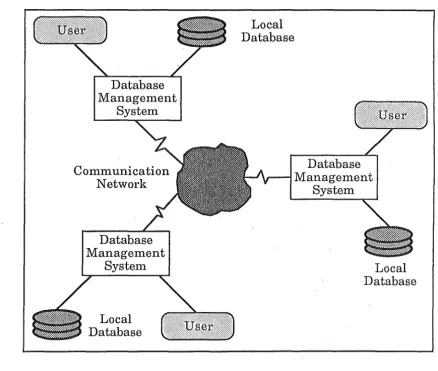
The definition and Figure 1.1 shows the two parts of a distributed database
Distributed Database Systems 11
one of the most important technological problems with distributed
databases, the cooperation between autonomous sites.
Some of the major areas of a centralised database system are data
independence, redundancy, efficient access, integrity, recovery,
concurrency control, privacy, and security [CERI84]. These are all
important issues in distributed database systems as well. Distributed
database systems are not just centralised systems linked together. In this
chapter, the overall design of distributed database system is discussed and
compared to that of centralised database systems.
Database
:.---' ,..---~Management 1---~
[image:18.598.117.486.304.541.2]QJ11±2illtillilli3 System
Figure 1.2
Central Database
Architecture of a Central Database Management System
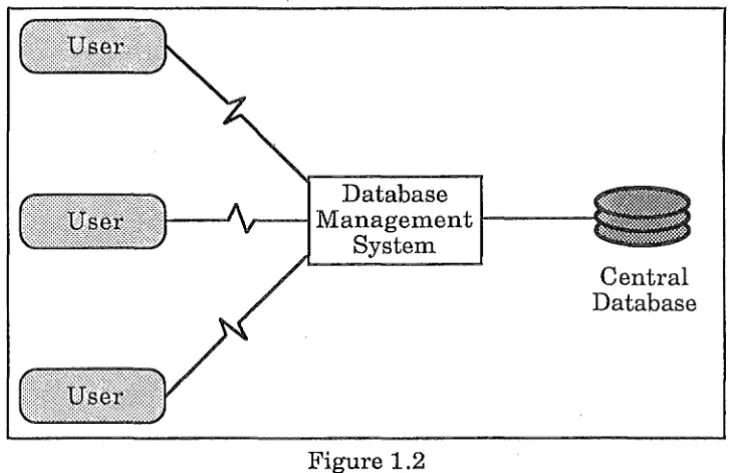
Figure 1.2 shows the structure of a centralised database management
system. There are a number of users connected to a single database
management system, which has only one database. It is different from the
distributed database diagram, Figure 2, in that there is only one database,
there is only one controller, and the users could connect to the database
over a wide area network, or on a local network. In the distributed case all
the users are connected to a local network or directly to their computer.
Distributed Database Systems 12
significant and is generally orders of magnitude larger for local
connections.
There are a number of advantages of a distributed database system over a
centralised database system [APER83].
·increased availability
In a distributed database, the failure of a site or communication link does
not necessarily imply that the whole database is inaccessible. If the data is
stored redundantly, then the system is more resilient to certain types of
failure. rrhis is not the case in a centralised system. There is only one
database and if the site where the database is stored fails or becomes
partitioned from a site where the data is being accessed, then there is
nothing that any site can do. It is unable to operate normally.
Because of the independent nature of the organisations that will use the
radiology system, the interconnection system can not rely on all the sites
being operative at one time, due to crashes, or the local systems being
powered down. This is more likely than one large organisation. In a
single organisation, there is likely to be a database administrator at each
site, but in the x-ray departments or clinics there are no highly qualified
database administrators that are,~apable enough to manage the database
effectively. Therefore, there needs to be some sort of mechanism in the
interco,nnection system that allows for the unpredictable nature of all the
different organisations, which will ensure the availability of the database
to all site within acceptable levels.
• decreased access time
If the data was all stored at one site, then every enquiry would have to
Distributed Database Systems 13
transfer of data between the two sites. By partitioning and fragmenting the
database over sites which are accessing those parts of the database
frequently, the locality of the application can be increased and the access
time will be significantly reduced. In the fully distributed environment,
where each site communicates with all the other sites, there are still large
amounts of communication required.
In the interconnection system I propose for the radiology environment,
there is a compromise. There is a global snapshot, which holds selected
portions of all the local databases, which is stored in a different database.
Enquiries on the global snapshot can be requested by the local sites and the
results stored in the local databases. Therefore the first time an enquiry is
performed, the global snapshot would be accessed, but after that the data
will be at the local sites, so that there would not be any need for any access
to the central database.
The design of the radiology system, in Chapter 2, specifies the
communication network requirements. The physical speed of the network
is proposed as 2400 bits per second, which means the access time is very
dependent on the communication time. Therefore to decrease access time
the amount of communication has to be decreased, which is one of the
important design specifications.
To reduce access time, data allocation and query optimisation are
importa,nt aspects to consider. In Chapter 3, the question of data allocation
is addressed, and in chapter 5, the whole question of query optimisation is
introduced.
• easy expansion and possible integration of existing databases
There is a large investment in existing centralised database systems. Most
Distributed Database Systems
14
into account. A distributed system has been developed that acts as a front
end to the local databases. This makes the systems easy to expand, as
another site can be added easily without requiring any modification to
existing databases.
The size of an organisations database will grow and it will eventually
reach its physical limit. It will also be putting a large strain on the system
and could case overloading of the computer. The upgrading of capacity
will be easier for a distributed system than for a centralised one. A
distributed system also reduces the system load by distributing the
processing over a number of sites. With the availability of cheap and faster
processing power it is not expensive to increase capacity as it used to be in
extending a mainframe system.
This is an important aspect of the radiology system. The system has been
designed to cope with new sites being added to the network, without
interfering with other sites. At present the system is designed to work
with only with the single site system that has been developed. In the
future, organisations that already have a different computer system might
be added to the system. The mapping mechanism proposed in Chapter 3 is
designed to allow for the integration of similar existing databases.
Discussions have been held with the Health Department about the possible
integration of their database in the future. There is more discussion on the
question of integration in Chapter 3.
Site Autonomy
Site autonomy is one of the most important aspects of a distributed
database. In a centralised system there are no problems with site
autonomy, as there are no other sites. In a distributed database system
there is a hierarchical control structure, which includes a central
Site Autonomy
15
whole, and local database administrators who are responsible for their
respective local database.
A local database administrator may have a high degree of site autonomy,
up to the point that there is no central database administrator at all. In
this case the local database administrators would have to act as
controllers and co-ordinate all activities themselves. This case offers a
high level of site autonomy, but puts a lot of reliance on the local database
administrators to co-ordinate the,Jperations. This has the draw back that
there would be a large amount of inter-site communication needed to do
this. An advantage however is that if a site crashes, it would have
minimal impact on the system, as the other sites should· be able to carry on
operating.
At the other end of the scale, the central database administrator has
almost complete control over the local database administrators. In this
case the database would operate more like a central database, with the
benefit of having centralised control but being very susceptible to the site of
central database administrator becoming unavailable [CERI84].
This is an important area in the radiology system, as the sites in the
network are independent organisations and no other site should have the
ability to control the operations at any other site. This is important as in a
commercial environment computer usage costs money.
Data fude.pendence
Data independence is essentially that the organisation of the data is
transparent to the application program. The program is written having a
conceptual view of the data, and the main advantage of this is that any
change to the physical organisation of the data does not affect the
uara maepenct.ence 16
independence : distributed transparency. This means that the database
appear to be a normal central database, even though the data is
distributed. [CERI84] and [ULLM82] give detailed descriptions of
distributed transparency, and data independence.
One of the aims of the radiology system is to provide distributed
transparency to all the users. The question of mapping and transparency
are covered in more detail in Chapter 3.
Redundancy
The arguments for redundancy are the same for distributed databases and
centralised databases. Redundancy in a centralised database is
minimised as far as possible, to reduce the potential for inconsistency.
Inconsistency among several copies of the same data item is avoided by
only having one copy, which in turn reduces storage requirements. In
distributed databases there are a number of reasons why redundancy is
desirable. The speed of applications can be increased if the data is
replicated at the sites where the applications need it. The availability of the
system is increased, because if a site fails then it does not stop the
. execution of applications at other sites. If a site fails then another site can
be used to get a copy of the data. [CERI84], [JOSE86], [PAPA84] and
[ULLM82] all discuss the issue of replicated data.
In general, as the ratio of retrievals to updates increase, replication
becomes more appropriate. It is more appropriate because if there are
several copies, then any one of them can be used to satisfy a query, but all
copies have to be kept up to date to ensure the database is consistent. Thus
the data is more available, and the cost of updating is still low in
Rednndancy
17
To increase availability in the radiology system, snapshots are used to
provide multiple copies of the database. Snapshots are introduced in
chapters 2 and how they are implemented in the SNAPS system in
Chapter 6.
Efficient Access
One of the most integral parts of centralised systems is their complex
acce·ssing structure, such as secondary indexes and interfile chains.
These structures provide for more efficient access to the data.
However in a distributed system, the difficulty of building and costs of
maintaining such structures is. too high in terms of communications
costs. rrhey are unsuitable for use in a distributed database, as these
methods work at the tuple level in a database. This is a very inefficient way
of working in a distributed system [CERI84].
For example consider the following schema and following query which
retrieves all the patients for the doctor "Feltham".
doctor ( name , surgery )
patient ( name , doctor-name , address , age )
retrieve (patient.name)
where "Feltham" = patient.doctor-name
To do this in a centralised system is easy, but if in a distributed system the
patient relation was distributed over a number of sites, it would become
more ~omplex. It would be very inefficient to do in the same way as a
centralised system. In a centralised system, each tuple would be retrieved
individually. In a distributed system, the tuples would be grouped together
and sent as a group and only the attributes required would be sent, not the
whole tuple. The query would be sent to all sites and therefore could be
Efficient Access 18
This introduces the whole question of query optimisation. Which is the
most efficient, cost effective, and fastest method of performing this query?
There has been a lot of research into this area over the last few years as
people realize that the methods used in centralised systems are not
suitable for use in distributed systems. There are a number of different
ways of approaching optimisation. Most researchers have assumed
transmission as the target for optimisation. There are also a number of
other approaches. The average response time and parallelism achieved in
the query are also other areas being considered. However, they are all
interconnected in some way and in general a combination of these
approaches is usually used in practice. [SEGE86], [ULLM82], [YU84],
[MAHM79], [GARC79] and [APER83] all discuss aspects of query
optimisation. Query Optimisation is covered in Chapter 5 in more detail.
futegrlty, Concurrency Control and Recovery
These three aspects of distributed database while quite different, are
strongly interrelated. An atomic transaction is a series of events, that
either all happen in entirety, or none happen at all. This ensures a
consistent database, and the integrity of the database.
Recovery is related in two ways. The first is when a site either becomes
unavailable, or the actual database becomes corrupted. In the first case,
the one where most research is being done, there has to be a method of
ensurip.g that the site that is brought back up, and has a database that is
consistent with all the others. A transaction could be stopped in
mid-stream. In this case should transactions be aborted, or should they be
logged until the site is operational again? [EAGE83] talks about achieving
robustness in distributed database.
To ensure a consistent database, distributed concurrency control is
Integrity, Concurrency Control and Recovery 19
handle this problem. There is the 2 phase locking method, which is
similar to the method used in single site database management systems.
Then there is timestamp based control methods, which use unique
transaction identifiers to order transactions. This method is used in
SDD-1. There is optimistic concurrency control [SCHL81] and [KUNG81],
and the majority consensus method [THOM79].
This is important in the radiology system, as some methods require a
large amount of communication to achieve concurrency. In the
interconnection of the radiology systems, one of the aims is to reduce the
amount of communication. The method of concurrency control used in the
SNAPS system is introduced in Chapter 6 in the Section on Concurrency
Chapter 2
Database Snapshots
Existing database management systems allow users to operate only on the
current database state. However, there are a number of applications that
require or will tolerate access to out of date versions of the database. A
snapshot reflects a selected portion of a database as of a particular time,
without having to execute the transaction at that time.
Snapshots are read only portions of a database. 'fhey are important when
an application needs an "as of' state of a database. Most periodic reporting
falls into this category. For example, a company might do monthly
accounting reports. It would define a snapshot of the database at the end of
each month, which it could later be used to process into reports. This
would allow other applications to carry on and use and modify the
database.
Snapshots have been implemented on a number of centralized systems,
but in 1980, system supported database snapshots were proposed by Michel
Abida and Bruce Lindsay [ABID80]. This paper was the first to directly
address the subject of system supported snapshots.
This paper identifies an number of areas where snapshots are useful, and
where further research is needed. In a distributed database environment
they can be used to store the result of a complex query that has to be
performed frequently. It can be performed once and the results used over
and over again with out the cost of having to execute the query. This is
particularly important in a distributed database, as the join might involve
relations stored at many different sites. They can be used to provide data
Database Snapshots
21
at other sites. If these snapshots are periodically refreshed they provide
approximate read only access to remote data, or avoid the maintenance
replicated data. This is the area that I have concentrated on in this thesis.
This paper discussed the semantics of snapshots, their definition, how
they can be refreshed, how they are implemented, and then possible
extensions to the concept of snapshots.
In another paper [ABID81], Abida discusses the definition of derived data
in a system called DEREL. This paper defines a method of defining base
relations, views, snapshots, and replicated data. It discussed the idea of a
view, snapshot definition producing more than one resulting relation.
This is important in the SNAPS system, as this is what I do.
In [LIND86], Lindsay introduces an algorithm for snapshot refresh using
the differential approach rather than the delete andre-execute approach
to refreshing snapshots.
Two unpublished papers by Cooper [COOP86a] and [COOP86b] deal with
the problems of snapshots, and attempts to define ways of categorising
snapshots on the basis of their composition. In [COOP86b], the possible
implementation of snapshots in MIMER, relational database
management system, is discussed. Some of the ideas presented in
[COOP86a] are discussed in the following sections.
Catef,{gries ofSna,pshot
One way to categorise the type of snapshot is to consider how they, are
derived. The source of the relation or relations in the snapshot are two
aspects. The number of receiver sites is also a factor. Therefore the types of
snapshot can be defined in terms of single (8) or multiple (M) source sites
(i.e. the relations that are involved in the snapshot are stored at multiple
Categories of Snapshots .22
irrespective of where they are stored. The last factor is the number of sites
that will receive the snapshot [COOP86a].
Based on these factors there are eight different types of snapshot.
1. Single Source Site, Single Source Relation, Single Receiver (SSS).
This type of snapshot is highly specific to a single user, and it is
questionable whether a snapshot is the most efficient way to satisfy
this request.
2. Single Source Site, Single Source Relation, Multiple Receiver
(SSM). This is one of the important uses of snapshots. This can be
likened to a price list being sent out from head office to other offices.
3. Single Source Site,. Multiple Source Relation, Single Receiver
(SMS). This is similar to type one, but involves a number of joins and
is questionable whether snapshots are appropriate in this case.
4. Single Source Site, Multiple Source Relation, Multiple Receiver
(SMM). This is one of the most important uses of snapshots. By
performing a complex join at one site, and distributing it to a number
of sites, processing costs can be reduced.
5. Multiple Source Sites, Single Source Relation, Single Receiver
(MSS). This type of snapshot assumes that the source relation is
partitioned over a number of sites, either redundantly or not. This
type of snapshot is useful if the snapshot is to be accessed frequently.
In the SNAPS system, the global snapshot is this type of snap~hot.
The local source relation from a number of sites is mapped onto the
global snapshot. This will be discussed more in Chapter 4 in the
Categories of Snapshots
6. Multiple Source Site, Single Source Relation, Multiple Receiver
(MSM). This type makes the same assumption as type five about
partitioning. This is an important type of snapshot as it performs a
union of a number of fragments of the same relation, and sends the
result to a number of sites.
7. Multiple Source Site, Multiple Source Relation, Single Receiver
(MMS). A complex join involving a number of sites and relations for a
single user. This type of snapshot would be expensive to maintain
and would probably require that all relations would have to be sent to
the receiver's site. The costs of computing the complex join would be
justified if the snapshot was to be used extensively.
8. Multiple Source Site, .Multiple Source Relation, Multiple Receiver
(MMM). The same complex join is required for each user, and if the
snapshot is computed only once, and distributed to each receiver,
then substantial processing costs can be saved. Like type four, this
type of snapshot would probably have an owner that was responsible
for the calculation and distribution of the snapshot.
Distribution of Snaj}Shots
Another issue related to the categories of snapshot is the distribution of the
database between the sites. There is a direct connection between this factor
and the snapshot type as defined in the previous section [COOP86a].
The types most relevant to the SNAPS system are the MSS, SSM and SMM,
and the different types of distribution will be discussed with relevance to
these types of snapshot. The resource in the following can be considered to
be a MSS snapshot, or the global snapshot.
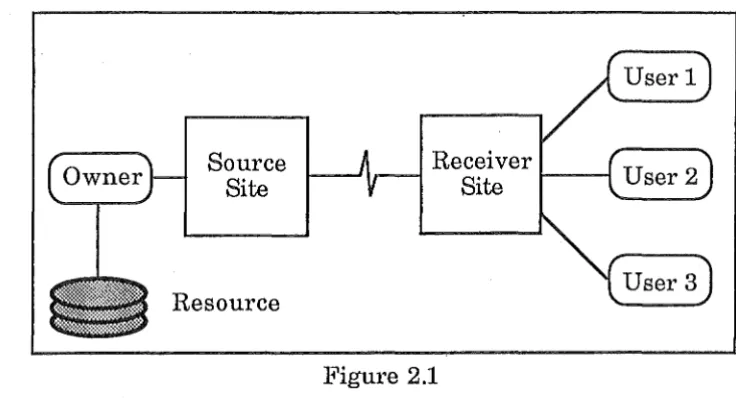
In the first case (See figure 2.1 ), the owner retains the resource at a single
E»sbibutlonofSnapShom
Source Site
[image:31.598.110.478.79.278.2]Resource
Figure 2.1
Case 1 - Single Resource : Managed by Owner
This is the normal type of processing, where there is only one copy of the
database. This is analogous to a centralised database with remote access.
This is the situation that we are trying to avoid, as the communication
traffic will be high.
This situation is not relevant to the types of snapshot we are dealing with
in the radiology system. It is more relevant to SSS and SMS type of
snapshot or where all the receivers are at one site.
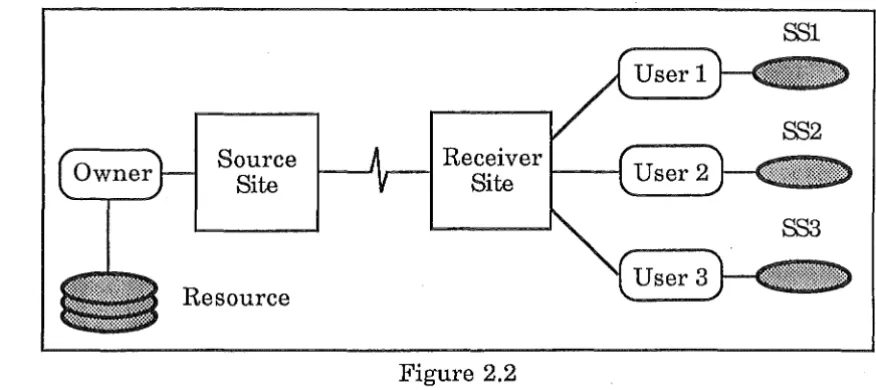
In the second case (See Figure 2.2), the resource is still managed
centrally, but the users at the receiver nodes maintain their own
Distribution of Snapshots
Source Site
Resource
25
[image:32.598.72.510.80.275.2]SSl
Figure 2.2
Case 2 - Resource Distributed : Snapshots Managed by Users
This situation could produce duplicate snapshots at the same receiver
node maintained by different users, which are clearly redundant. It could
be useful if the snapshots were significantly different. (e.g. an accounts
department, and sales department would access· different parts of the
database and create different snapshots).
This is relevant to SSM and SMM types of snapshots where the owner
wants to exert control over the users and creators of the snapshots.
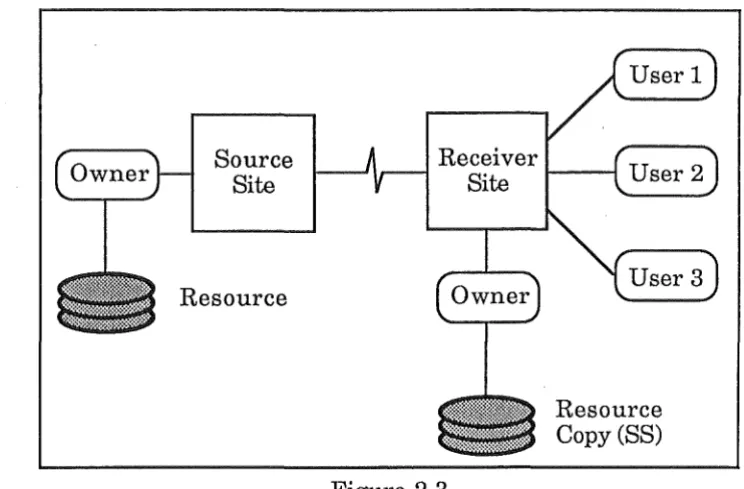
The third case (See Figure 2.3), is the one that is of most relevance cases as
InsbibutlonofSnap&hom
Source Site
[image:33.597.104.476.76.320.2]Resource
Figure 2.3
Resource Copy (SS)
Case 3 - Resource Distributed : Snapshot Copy : Both Managed by Owner
In this case the owner maintains control over the central resource, as well
as a snapshotted view of the resource at the receiver site. It is the owners
responsibility not the users, which is one of the important aspects of the
SNAPS system which will be discussed in later chapters. This
snapshotted view would be periodically updated by the owner.
This is particularly relevant to the SSM and SMM type of snapshot where
the parts of the database that users want to access are distributed, as
snapshots to those sites, and queries are satisfied from this snapshot.
It is also relevant to the SSS and SMS, where the ratio of enquiries to
updat~s is high.
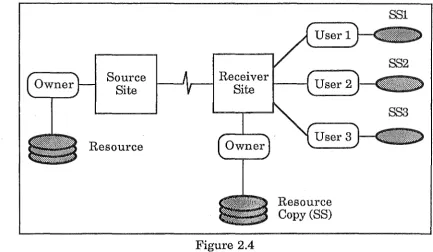
In case 4 (See Figure 2.4), the owner maintains both the central resource,
and the snapshotted view at the receiver site. There are also snapshots
Distribution of Snapshots
Source Site
[image:34.598.72.505.83.335.2]Resource
Figure 2.4
Resource Copy (SS)
SSl
Case 4 - Distributed Resource : Snapshot Copy Managed by Owner Snapshots Managed by Users
As for the second case, if the snapshots were significantly different and
the ratio of queries to updates was high then this method could be
relevant. Also, the more complex the snapshots, (i.e. type SMM) then the
more relevance these two methods have.
The four cases above identify the type of distribution that are possible. The
second and third cases are the ones most relevant to the SNAPS system.
These will be discussed in chapter 4, which discusses the local databases
and the global snapshot, and in chapter 6, which describes how snapshots
have been implemented in the SNAPS system.
Snapshot Semantics
Snapshots are stored in separate relations and can be accessed and used
like any ordinary relations in the database. Queries can be directed at
them and indexes created on them to improve access performance. They
can also be used as source relations for other snapshots. This aspect is
Snapshot Semantics .28
relations that contributed to the snapshot continue their own independent
evolution. This point will be discussed more in Chapter 6, as it raises some
interesting issues with regard to the SNAPS system.
Traditionally snapshots were defined explicitly by running by a program
or query executed by a user. This means that the relationship between the
snapshot and the rest of the database is embodied in the program that
populates the snapshot. In the system 'proposed by Abida and Lindsay the
snapshot would be based on a query on the database, which defines how
the snapshot should be populated. This allows the system to automatically
populate a snapshot with the tuples resulting from the evaluation of the
query at the time of the execution of the snapshot definition command. As
the snapshot definition is declared to the database management system
the system can refresh the snapshot contents when required, either on
demand or after a fixed period of time. The area of snapshot refresh is
discussed late in this chapter.
The definition of a snapshot is similar to that of a database view [DATE86].
The difference between a view and a snapshot is that the snapshot is a
static copy and a view is a dynamic "window" of the database. Any change
in the value of a relation would automatically alter the value of the view.
The change would only be reflected in the snapshot, when the snapshot
was refreshed. Updates run counter to the intended semantics of
snapshots as copies of selected parts of the database made at specific
times~· In the system I propose for updatable snapshots, this idea is not
violated. In [ABID80], it is says that updates to a snapshot should not be
propagated to the source relations, because these relations evolve on their
own. In the SNAPS system it is proposed that updates to a snapshot are
also made to the corresponding source relations if the source relations
have not been changed since the snapshot has been calculated. This aspect
Snapshot Semantics
Snapshots are stored in separate relations from those on which they are
based. In the SNAPS system, snapshots can be stored in the same
relations without causing conflict.
The lifetime of a snapshot starts with the execution of a DEFINE
SNAPSHOT command. In a query language such as QUEL [STON76], the
snapshot creating statement would look like
define snapshot <snapshot-name> (<attribute-list>) as <query>
The <attribute-list> defines the names of the snapshot attributes. The
attribute types are inherited from the attributes of the <query>. The query
can be any query that can be expressed in the query language being used.
It can include joins, restrictions, projections, and aggregate functions
where they are available.
As soon as the snapshot has been defined, it can be used in any query, and
take part in the definition of other snapshots or views.
Consider the following simple database consisting of scaled down versions
of the local database defined in Appendix H.
patient ( pno, name, address, age doctor ( code, name, phone )
visit ( pno, code, date )
Then the following QUEL statement
define snapshot by-jones ( name, date ) as
retrieve patient.name where visit.pno
and visit.code and doctor.name
, visit. date patient.pno doctor. code
11Jones11
defines a snapshot containing all the patients that doctor Jones has seen,
Re~tdngSnapshow
Re£resbrung Snapshots
Snapshots are intended to provide users with a particular state of a
database. For example, users might defines snapshots representing "last
month's sales", or "today's orders". User control over when the snapshot
is refreshed extends the snapshot definition construct. Snapshots can be
refreshed on demand with a QUEL command like
refresh snapshot <snapshot-name>
which will cause the system to replace the current snapshot contents with
the results of evaluating the snapshot query in the current database state.
Another approach is to have the system support periodic refresh. This is
supported by extending the s:napshot definition command, which becomes
define snapshot <snapshot-name> (<attribute-list>) as <query>
[refresh every <period>]
where
<period> : := year I month I week I day I hour
At the end of the refresh period the system refreshes the snapshot from
the current database state. Periodic refreshes by the system enhances the
semantic utility of the snapshot construct. No only can users specify what
parts of the database they want captured by the snapshot, they can also say
when new versions of the snapshot should be captured. ·
The area represents where there are the most interesting implementation
problems and solutions. Refreshing snapshots consists of (logically)
replacing the current snapshot contents with the results of evaluating the
snapshot query in the current database state.
Because the same query must be evaluated when the snapshot is defined
~~bmngSnapsho~ 31
reduce the overhead of query evaluation during snapshot refresh. In some
database management systems, such as System R [ASTR76], access
modules of queries are stored so that they can be executed without the
overhead of query analysis and optimisation.
Because snapshots can always be refreshed from the current state of the
database, snapshots do not require the usual database recovery facilities.
In the case of a system failure, the snapshots can be re-evaluated. This is
acceptable if the relations involved in the snapshot do not change very
much. However, a snapshot which is based on relations that changed
frequently, some applications may operate on different versions of the
snapshot. If two applications used the same snapshot, and one application
ran before a system crash. If the snapshot had to be refreshed after the
system crash, and the second application ran after the system crash and
snapshot refresh, then the two application would have used different
versions of the snapshot. This situation could cause problems, and some
mechanism would have to be able to get back to the state of the database,
possibly using the transaction log, when the last snapshot refresh was
performed to reconstruct the snapshot correctly.
The straightforward implementation of refresh would simply be to delete
all the tuples from the snapshot relation and then insert the tuples
returned by executing the snapshot query. This can be expensive if the
number of changes since the last refresh is small compared to the size of
the snapshot. It would also be expensive if the the query involved complex
joins over a number of sites in a distributed database.
If the snapshot is sufficiently simple, e.g. only based on one relation, then
the snapshot could be updated based on the updates on the relation. Any
insertions could be checked to see if they satisfy the restriction in the
~~ldngSnapsho~ 32
the approach I take in the SNAPS system, as the size of some of the
snapshots is quite large, and the number of updates in very small, and the
snapshots are generally based on single relations. For example
define snapshot patient-50+ ( patient-name, age as
retrieve ( patient.name, patient.age where patient.age >=50
This snapshot could be updated with reference to the changes made to the
patient relation, to see if any tuples in the snapshot should be modified.
This approach is called differential refresh as opposed to delete and
re-execute refresh.
Aggregate functions, such as MAX, MIN, AVG, SUM and COUN1, would
require more complex processing but can be done. For example
define snapshot seen~jones ( doctor, total-patients ) as
retrieve (visit.gp, total= (count(visit.pno)))
where visit.gp "Jones"
and visit.date = "12/5/63"
shows an example of a aggregate function in a snapshot that could be
updated by applying the modifications to the visit relation to the snapshot.
For snapshots that involve more than one source relation, the updating
problem becomes more complex. Joins especially over a number of sites in
a distributed database, would require large amounts of communication
and processing to perform differential refresh, and it would be easier to
delete., the snapshot and re-calculate the snapshot. This problem is related
to the view update problem [BANCSO], and like the view update will
probably require the re-evaluation of the snapshot query.
Extensions
to
SnapshotsIn [ABID80], a number of possible extensions are discussed. Increased
Extensions to Snapshots
control over the contents of the snapshot (e.g. every 4 hours). More control
over the base time (e.g. every week on Tuesday at 3am) would allow for
flexible scheduling when the system might be lightly used, or utilise lower
processing and/or communication charges.
In [COOP86a], the notion of a snapview is introduced. It is proposed that a
snapshot would be controlled by the owner of the relations being
responsible for the calculation and distribution of the snapshot. This is
like a head office sending out a price list. A snapview would be a user
requested snapshot, maintained by the user not the owner. This would be
like a radiologist requesting details of a new patient. This aspect is
important, and will be discussed in Chapter 4, with reference to the
SNAPS system.
The concept of a future update is proposed. This mechanism would be
used to have updates performed on snapshots at a predetermined time in
the future. The updates could be logged and then performed against the
snapshots at a latter date. This type of mechanism is used to define the
Chapter 3
The radiology system was first proposed by Dr Kennedy, Head of the X-ray
department at Christchurch Public Hospital, and Dr Feltham, Head of the
X-ray Department at Nelson Hospital in late 1985 [KENN85] and [FELT85].
The initial design of the system was done by David Tripp and Alaistair
Kenworthy, Honours students in Computer Science at the University of
Canterbury in late 1985 and early 1986 [TRIP86]. The development was to
be done in conjunction with Concept Data Systems, a software
development house based in Christchurch,[CONC86], and the
Christchurch Public Hospital.
Initially the system was to be installed in Christchurch in St Georges
Hospital, Christchurch Public Hospital and the Gloucester Radiology
Clinic. It was also being developed for Nelson Hospital and the Bridge
Street Radiology Clinic. The first part of this chapter discusses the
functions of the radiology system.
In discussions with the above doctors and Dr R.E.M. Cooper, the then
Head of the Computer Science Department at the University of
Canterbury, and myself, the possibility of interconnecting the systems at
the individual hospitals and clinics was discussed. The second part of this
chapter presents the requirements of the interconnection of the radiology
systems.
There were a number of options to be considered for the interconnection of
the sites in the two systems that would be compatible with the GIN et local
area networks. A study of the requirements for the wide area network for
both the Christchurch and Nelson systems was done by myself, and is
presented in Appendix E, and recommendations for both these systems
The Radiology System 35
The Radiology System
A feasibility study done by Tripp and Kenworthy [rrRIP87], identified the
following areas and the functions within these areas, that were to be
handled by the radiology system.
-patients
- maintain patient details
-visits
- schedule appointments
- record type of x-rays
- create visit labels
- record medical supervisors
- record reports
- organise distribution of reports to other doctors
- accounting
- calculates charges for the x-rays
- prepare invoice to patients
- receive payments
- calculates the ACCl claim and health department subsidy
- perform audits
- send messages between staff members
- handle requests for x-rays from other sites
- provide statistics on types of examinations, radiologists,patient type,
and room utilisation
- research facilities
At each site there is a network of IBM personal computers or IBM
compatible computers linked using the local area network(LAN),
The Radiology System
G/Net.[GATE87]. Each site has a small file server with between 40 and 80
megabytes capacity.
The application is written in a combination of Informix [INF086], and
using its C [KERN78], language interface. The program used the
relational database management system within Informix which has a
SQL interface [DATE86]. A local database was developed and the schema
is shown in Appendix H.
Interconnection Requirements
To increase the power and effectiveness of the system the radiologist
wanted to have access to patient details and reports of x-rays performed
not only at his clinic or hospital, but also those done at other hospitals or
clinics [KENN85]. This was particularly important for the Accident and
Emergency Department at Christchurch Hospital. It is generally not
possible to get hold of a patient's record or copies of previous x-rays in the
case of an emergency. The doctor needs to be able to have access to this
information immediately.
The system was to provide security at various levels for sensitive medical
information. Because the system was to· interconnect public and private
organisations there had to be security not only for the data, but also for
access to the other systems. The security of the data. was handled by the
single site system, by restricting users to various levels of E;ecurity from
the receptionist who could access only those parts of the database he/she
needed, to the radiologist who has the ability to access to all parts o£ the
database. There were various level in between these. This is done by only
allowing access to certain relations in the database. The Informix
[INF086], system performs automatic checks on the user code against
those that have read, or write or no access to a relation each time a
Interconnection Requirements
It was decided to have only selected parts of the local database available to
the other sites. This was done as some of the information that was stored
in the same relations was not unique to one site. (e.g. a patient can hold an
account at more than one site, which will contain different information).
It was done as some of the information stored is not relevant to other sites.
(e.g. time of x-ray appointment in visit relation). Some of the information
is also commercially sensitive. (e.g. accounts of the patient, clinics, and
hospitals).
In discussion with Dr Kennedy and myself the data that was to be made
available to the other sites was decided on. This is defined in the schema of
the global snapshot as shown in Appendix I, and is based on the local
schema in Appendix H.
The decision to map the local databases on to a global snapshot was
partially based on the requirement that not all data was to be made
available to the other sites. The concept of the global snapshot and the
mapping onto a local database is described in Chapter 4.
The radiology database in predominantly read only and the ratio of
enquiries to updates would be very high. There are some parts of the
database where it would be useful for users at other sites to be able to
update. This data would be stored as part of the global snapshot. This
requirement was the basis of providing updatable snapshots in the system.
One of the radiology system requirements is that the local sites have a
high level of site autonomy. This implies that each local site has very l.ittle
control over what happens at another local site. This is important because
of the type of information that is being stored by the system. It is also
important because the organisations running the systems are public
organisations, and private companies or hospitals, and they are
Interconnection Requirements 38
together on a local area network. There is therefore no dedicated computer
that could act as a controller for a distributed database. This means that
somewhere in the system there has to be a controller to co-ordinate all the
sites. This was the basis of the decision to have a central controller which
provided restricted access to the local databases and managed the updates
of data stored at other sites.
One of the problems with the interconnection o