warwick.ac.uk/lib-publications
http://wrap.warwick.ac.uk/79540
Copyright and reuse:
This thesis is made available online and is protected by original copyright.
Please scroll down to view the document itself.
Please refer to the repository record for this item for information to help you to cite it.
Our policy information is available from the repository home page.
TWO VOLUMES VOLUME ONE
By Michael John Carpenter
Submitted for Ph.D. in Business Studies
University of Warwick
School of Industrial and Business Studies University of Warwick
www.bl.uk
BEST COpy AVAILABLE.
TEXT CUT OFF IN THE
among hospital nurses in Britain between 1910-1976, within a 'situated'
materialistic perspective on union growth. It is argued that both
professionalism and unionism developed as a result of the decay of
traditional nursing ideology in its home base of the voluntary
hospital, and the failure of its proponents to win total hegemony
in areas where nursing reform spread, notably the asylums, workhouse
infirmaries and private nursing. In explaining these developments due
emphasis is given to both material changes in the labour process and
the influence of 'subjective' predispositions that are the result of
prior and continuing orientations, and of the extent to which wider
economic and political conditions are favourable. Thus, the expansion
of the medical division of labour in the 'acute-oriented' voluntary
hospitals, involving the delegation of more tasks to subordinates,
encouraged the development of professionalism; while in private nursing
the attempt to realise the value of nursing as a commodity was the key
material influence. However, in both instances the social background
of recruits was also influential in determining that 'professional
strategies of occupational closure would be the favoured 'solutions' to
problems caused by material changes. Thepartial success of professionalism
in achieving the 1919 Nurses Registration Act was influenced by the
temporarily favourable political and economic situation.
Trade unionism arose out of the contradictions with traditional nursing
ideology and the failure of professionalism to solve them fully. These
contradictions were most intense in those sectors where work was of lower
status, like the asylums and workhouse infirmaries, and where the social
background of recruits would also incline them to be more inclined towards
trade unionism. Changes in the tempo of popular struggle are also shown
to have had an important influence on the development of trade unionism.
Successive chapters follow the unfolding of these contradictions,
ideo-logical responses and wider influences through to the 1970's, where it
is argued that, despite continuing differences, there has been some
conver-gence between the apparently competing strategies of professionalism and
unionionism. The relative importance of the purported'rroletarianisation'
PART ONE: THEORETICAL ISSUES IN INDUSTRIAL RELATIONS
Chapter 1 - A Critique of Voluntaristic and Deterministic Approaches
(1) Constraints and Possibilities
(2) The Role of Prior and Continuing Orientations (3) Attitudinal v. structural Approaches to Union
Growth (4) Conclusion
Chapter 2 - An Alternative Situated Perspective
(1) A situated Analysis of Union Growth
(2) Recruitment Channels and the Reproduction of Membership Organisations.
(3) What and Who are Unions for?
(4) Trade Unions as Communities of Interest. (5) The Role of Cadres in the Reproduction of
Membership Organisations
PART TWO: THE BACKGROUND TO NURSING TRADES UNIONISM
Chapter 3 - Nursing and the Emergent Division of Labour in Health Care
(1) Models of the Division of Labour
(2) Explaining the Emergence of Modern Nursing (i) The Background
(ii) Nursing Reform
17 17 24 29 33 35 35 42 45 48 55 65 65 72 80
Chapter 4 - The Decay of Traditional Nursing Ideology 89
(1) The Meaning of Traditional Nursing Ideology (2) The Contradictions of Vocationalism
(3) The Contradictions of Professionalism (4) The Emergence of Proletarian Ideology (5) Conclusion
PART THREE: THE RISE OF NURSING TRADES UNIONISM
89
93 97 100
105
Mental Health Service
(1) 'Lunatics Never Combine' (2) Years of Frustration 1911-14
(3) Problems in Organising Before 1918
Chapter 6 Organising Mental Nurses 1918-39
(1) Conflict and Accommodation 1918-31 (2) Holding the Fort 1921-31
(3) From Attendants to Mental Nurses (4) Surviving the Thirties
Chapter 7 - The Challenge of Trade Unionism within General Hospital Nursing
(1) Organising Poor Law Workers
(2) o.;~ganising Poor Law Nurses in the 1920s
(3) Organising Local Authority Hospital Nurses in the 1930s.
Chapter 8 - The State Assumes Responsibility
(1) Towards National Pay Determination (2) Towards Socialised Health Care (3) The Mental Health Services (4) The Birth of N.H.S. Whit1eyism
Chapter 9 - The Lean years: 1948-60
(1) The Survival of Traditional Power Structures in a Socialist NHS
(2) The Implications for Trade Unionism
(3) Turnover and Problems of Union Reproduction (4) Whitleyism and the Character of Nursing Trade
Unionism
(5) The Beginnings of Opposition
Chapter 10 - The Road to Halsbury
Part One: The Foundations uf Militancy
(1) Introduction
(2) The Industrialisation of the NHS (3) The 'New Manageria1ism' in Nursing
Chapter 11 - The Road to Halsburv
Part Two: The Rise of the 'New Unionism'
(1) The Implications of the 'New Managerialism' (2) Growing Militancy and its impact on Nurses'
Organisations
(3) The 1974 Pay Campaign
(1) (2)
( 3)
Summarizing the Case Studies Discussion of the Case Studies
Assessing the 'Proletarianisation' Thesis
PART FOUR: CONCLUSIONS
Chapter 13 - Analysing Broad Historical Trends
VOLUME TWO
APPENDIX: THE CASE STUDIES
REFERENCES AND BIBLIOGRAPHY
405
436
452
459
1
INTRODUCTION
This thesis is both an historical narrative and a theoretical
examination of the uneven processes of unionisation among hospital
nurses in England and Wales from 1910 to 1976, within a 'situated'
materialist account of their course. The purpose of this
introduction is to examine the methodological issues· behind this
set of objectives, as the meaning of such words as 'uneven' and
'unionisation' is not as self-evident as might at first appear,
while the concept of 'situated' is also difficult to articulate.
The choice of period also requires some initial justification, as
does the decision to spend so much time and effort on the
invest-igation of trade unionism among hospital nurses in the first place.
The last two are the easiest to explain. I first embarked
upon my programme of research in 1974 as a dissertation for my MA
in Industrial Relations at the University of Warwick. The research
for this was conducted at the height of an unprecedented campaign
of pay militancy among nurses which was associated, in succeeding
years, with the largest-ever surge in trade union membership among
them. I was particularly interested in following through the
campaign, and its aftermath, at local level, and I continued this
research for a doctoral thesis through to 1976, when I withdrew
of analysing and writing up the results. Hence this date marks
the formal end to my period of review. I had a personal interest
in nurses as an ex-nurse myself. I had trained and qualified as a
general hospital nurse during the latter half of the 1960s. I
also considered nurses to be a significant group of workers who had
been little studied by students of industrial relations in comparison,
for example, with printers, coal miners, car workers· and other
members of the archetypically male industrial working class. I
also felt that nurses were a theoretically interesting and problematic
group of workers in terms of their class position: a predominantly
female, public sector group of 'intermediate' service workers.
Despite their exclusion from texts on industrial relations and
industrial sociology (except perhaps as a minor part of a chapter
on 'professions', where they had been overshadowed by an almost
obsessive focus on doctors) nurses, and similarly placed workers
such as teachers and social workers, were taking an increasingly
prominent position in the organised labour movement. The shift to
a greater historical focus was also dictated by the need to place
the militancy of 1974-6 in its evolving context. I discovered that
hospital nurses had much longer established traditions of collective
organisation than was often realised, and I increasingly sought,
after 1976, to remedy t!1e'ir neglect by labour historians.
The year 1910 was selected as a starting point because that
year witnessed the first successful attempts to establish permanent
However I have not stuck rigidly to my chosen period. I have
tried to place the development of trade unionism within a broad
understanding of the development of hospital nursing since the
mid 19th Century. In a postscript to Chapter 11 I have also
sought to sketch out developments in trade unionism among hospital
nurses since 1976.
It also seems important to point out that the thesis is in
the main confined to an investigation of hospital nurses. other
groups such as midwives, health visitors, community nurses
-receive cursory attention in this study, but at least I have not
made the common assumption that hospital general nurses are
'nursekind', which is implicit in much of Abel~Smith's 'History
of the Nursing Profession' (1). These other groups require study
in their own right. I have selected hospital nurses partly
because I am more familiar with them and the hospital has increasingly
,
become the locale where the majority of nurses work even though
this may change in the future. There is also more to say about
their collective trade union activities -though this is not to imply
that other groups, such as community nurses, have insignificant
traditions of collective organisation. For similar reasons, the
historical section of the thesis gives more weight to the collective
activities of psychiatric nurses than general hospital nurses.
If general nurses have been neglected by students of the profession,
psychiatric nurses have been virtually ignored. For example
them in a fairly systematic way (2), but before I undertook this
research, there was only one significant article on attempts to
unionise psychiatric nurses (3), and just one article on the
history of psychiatric nursing in Britain (4). Historians of
psychiatry and psychiatric institutions had tended to ignore the
group of staff on whom the success or failure of institutions
often rested, concentrating attention solely upon doctors (5).
The only real prominence given to them was by sociologists in the
1950s, particularly in the USA, who were interested in the ~nQer"fe
of institutions, such as Goffman (6), and Scheff (7). And it
is also worth observing that mental handicap nurses have been
almost invisible members of the psychiatric nurse community,
reflecting their even lower status ranking. I have therefore
tried to give some prominence to their separate history and
traditions of collective organisations.
Delineating the different segments with the hospital nursing
force is also necessary from a methodological point of view, not
just from the need to redress a research injustice. The
'uneven-ness' of trade union organisation among nurses is closely linked
toanerging lateral divisions in the labour force, with psychiatric
(both mental illness and mental handicap) nurses having markedly
higher trade union affiliations for most of the period under review.
vertical cleavages are also an important dimension of uneveness,
job and the effect these have upon their prior and continuing
'orientations' to work and work attachments - class, gender and
ethnicity being the most significant of these. Above all, there
is a need to examine the dialectic between internal structures
and 'latent identities' and the way these are both mediated through
the impac~ over time, of wider social and economic forces. This
seems crucial to explaining why unionisation is characterised by
sudden shifts at particular historical moments, followed by longer
more stable periods of little change.
The most difficult issue left unresolved by the thesis is
how to conceptualise class, gender and ethnicity in ways that make
for an integrated analysis of the processes under investigation.
The notions of class, gender and ethnicity used tend to be largely
descriptive and empiricist, not ones that could easily integrate
conceptually an exploration of the dialectic between social
back-ground, the organisation of the labour process, and wider social
and economic forces. I touch on some of these issues at times
-for example, in Chapter 12 I spell out some of the difficulties
involved in using a Marxist concept of proletarianisation - as
outlined by Bellaby and Oribabor (8) - to account for the recent
growth in trade unionism among hospital nurses. However I would
not claim to ; have solved these complexities, let alone to have
found ways of adequately connecting class analysis with analysis
I rejected an empiricist, 'fact gathering' approach in principle,
I did not fully transcend it in practice. Though not absolving
myself of responsibility, it seems valid to place this in the
wider context of research into industrial relations at Warwick
during the mid 1970s. The dominant, so-called 'Oxford School'
emphasised fact gathering both from a practical conqern with reform
and administration, and also out of a disdain for the abstract
theories of economists, and their assumptions concerning 'rational'
human behaviour. Better just to 'go out into the field' and see
what was really happening; and given the empiricist approach which
regarded reality as something easily yielded to the senses, method
was not seen as a particularly problematiC issue.
Marxists attacked these assumptions of empiricism - fact
gathering served particular political purposes and there could be
no such thing as a neutral observer, for the class position of the
observer mediated their perceptions. On the whole this did not
lead to the articulation of an alternative method of field research,
(though in particular the work of Beynon and Nichols, and those
associated with them, must be counted as an exception (9~. Instead
the tendency was to disdain empirical research as 'tainted~ or as
a deviation from more urgent tasks. The first led to Althusser's
extreme retreat into 'theoretical practice', and the examination of
sacred Marxist texts as a guide to action (almost reminiscent of
empiricists'attempt to 'hold a mirror up to nature' was a
reaction) • The second came from other Marxists who attacked
this but often from the point of view that the needs of political
practice should be uppermost and that methodological sophistication
was a lUxury that could not be afforded. In practice this meant
relying on existing research, whatever misgivings one may have had
of it. As Martin Shaw put it,
The technology of research must be as rich as the materials which are available. The researcherwill have little time, even if ideally he feels the need, to collect further
'raw' evidence of social conditions. Even a 'descriptive' social survey may well be
a diversion. (10)
Both responses were conditioned by a sense of superiority that
Marxist thought and method already provided a sufficient alternative,
and the only point was to change things. A feeling, in other words,
of already being 'in the know'. Sociology was in crisis, as i t
could not integrate analysis of the. economic and the social, and
Marxism was superior. Today that confidence has for the most part
.
evaporated. Shaw now talks of a 'crisis in Marxism' every bit as
deep as the crisis ·in sociology, and regrets the neglect of the
social and its relegation to the sidelines, that his earlier stance
involved (11).
Whilst not all Marxists rejected sociology as such (12), it
contradictions for this Marxist who was undertaking field research,
and who inevitably fell back upon the dominant Warwick empiricism
in gathering his material, only to find that this did not easily
lend itself to be written up within a Marxist perspective! I
found some help in the methods of enquiry established by British
social history following Thompson (13), and its emphasis upon
'process' as well as 'structure', and of the validity of personal
experience as historical evidence. I have belatedly discovered
Giddens' call for a sociology which deals with both 'the production
and reproduction of society' which must incorporate a treatment of
action as rationalised conduct ordered reflexively by human agents,
and must grasp the significance of language as the practical medium
whereby this is made possible. (14). This approximates the
'alternative situated perspective' which I seek to outline in Chapter
2 and which I must emphasise was constructed largely after the
field-work, as part of my process of reflecting upon the problems I had
encountered by adopting an empiricist approach in practice.
How-ever Gidden himself explains that his discourse in method is
'primarily an exercise in logical issues' and 'is not a guide to
"how to do practical research'" (15).
It seems unfortunate, even perhaps untenable, to divorce
questions of method from practical research strategy, and it is
significant perhaps that this is an issue which has been directly
'feminist methodology' (16). In place of the often crude
rejection of social research by some Marxists, is a more
sensitive, ('reflexive') awareness of both the possibilities
and contradictions involved in undertaking social research as
a social practice (17). 'Feminist research' has in fact often
distanced itself from some of the assumptions often made by
Marxists concerning what Stanley and Wise call the split between
structures and everyday life.
Structures are somewhere above and beyond the everyday, and structures ••• are where it's at. Structures are where the
revolution will happen and so there is no point in changing ••• your relationship with your husband, or your children, or your anything else.
(18)
Feminist research has typically treated the area of 'everyday
life' and personal experience as signifcant, and worthy of
research, whereas Marxism has often tended to regard it as
peripheral or secondary and hence has often ignored it.
Feminist research"has, above all, of course, asserted the
importance of the gender order as an issue at least as significant
as class. Although I certainly touch on gender issues throughout
the thesis I would say in hindsight that they are not adequately
theorised and given the prominence they deserve in a thesis upon
what is one of the most predominantly female occupations of all.
I am aware that the thesis tends to adopt by default an implicit
ethnicity. This of course has political implications in that
a class perspective makes it easier for me to legitimise my
position as a former nurse with a continuing research interest in
nurses. This becomes much more problematic if a more explicitly
feminist analysis were adopted, for the thesis could then be
regarded as parasitic 'research on women' undertaken by a man.
This is underlined by the fact that my own findings (particularly
in Chapters 10 and 12) suggest that men have come increasingly
to oppress women within nursing as managers and also as union
officials. If I had stayed in nursing I might well have followed
one path or the other, but instead I have made a good career for
myself as a male researcher into nursing! I do not pretend to
have resolved these contradictions. I raise them simply to make
clear that I am aware that men ~ a white man at that - cannot deal
with the problem of sexism simply by annexing feminist research
methods as the answer to their methodological problems. They (we)
must think through the full poltical implications of adopting them.
In any case, as Morgan has emphasised, there is nothing inherently
non-sexist in the rejection of positivistic for more qualitative
research techniques.
Qualitative ethnography after all has its own branch of machismo with its image of the male sociologist bringing back news from the fringes of society, the lower
depths, the mean streets, areas traditionally off-limits to female investigators. (lO)
develop a 'situated' perspective on my subject matter, one which
as I outline in Chapter 1, is 'aware both of structural constraints
upon human agency and of the possibilities that are created by
its intervention', rejecting the voluntarism of attitude surveys
and the determinism of those who emphasise 'structural' causes
of unionisation. In a more narrow sense 'situated' refers simply
to the need for an empirical examination of these processes as
they are mediated through the social relationships at particular
workplaces. But as this could, as I increasingly became aware,
drift from an empirical into an empiricist approach, I sought
-after the field research was conducted - to expand my conception
of a 'situated perspective' to include the meanings that nurses
themselves attach to their work, and the extent to which union
membership and collective action is congruent with particular
ideologies of nursing. 'Situat.ed' in this sense is more akin to
C.Wright Mills' conception of 'situated actions' and 'vocabularies
of mot.i ve' • This emphasises analysis of the language use~ by people
to justify their past conduct, and 'indicate' their future actions.
Mills was interested in language and meanings as indicators of
motives, which are not random as they 'vary in content and character
with historical epochs and societal structures', and are not
necessarily 'freely' chosen but subject to collective constraints,
as
'acts often will be abandoned if no reason
within the 'vocabularies of motive', implied by three 'core'
ideologies of nursing: 'vocational', 'professional', and
'proletarian'. These are outlined in Chapter 4 in some detail,
although admittedly not in sufficiently sharp focus. However
this is the subject of continui~g research, (21), and this thesis could be regarded as a stage reached in a long-term,programme of
work.
The notion of a 'situated' approach was therefore an ideal
constructed after the research was conducted - a product of it
more than its method of investigation, at least in the second more
expanded sense which I have outlined. However, my very brief
discussion of feminist research methodology indicates that there
is a third way in which the notion needs to be expanded. I need,
in other words, to situate myself as a male, white, left-wing
academic who began his research in the mid 1970s convinced that
unions were inherently superior to professional associations as a
means to the self-emancipation of nurses. At least my empiricism
has uncovered a more muddied picture: professional associations
have adopted an increasingly collective approach focussed on the
problems which ward level nurses face as workers, while trade unions
themselves often help, as I show in Chapter 12, to reproduce
existing divisions of rank, gender and ethnicity. The meaning of
'unionisation' itself in such a context becomes problematic, and
place between unions and professional associations. If the
positive side of my practical empiricism was that I did not
just confirm my male-left prejudices, there was, however, a
negative side. In practice I did tend to assume too often that
nurses were just another group of workers, and failed sufficiently
to theorise nursing as 'women's work' and its link with other
kinds of work, particularly household labour, and the continuing
relation between the two in the lives of the majority of women
nurses. This is the central limitation of the thesis. At
the very least, then, it serves as an illustration of the heightened
contradictions of seeking to apply a one-sided materialist analysis
to this sector of employment. Hopefully, despite this, the reader
will also find that it sheds sufficient light on its subject matter
to be of greater use than simply an exercise in the problems of
Chapter One - A Critigue of Voluntaristic and Deterministic Approaches
One result of the dominant empiricist approach to industrial
relations is its growing separation into sub-specialities, with
analysts tending to specialise in one area rather than another,
whether it be union growth, government, or wage bargaining processes.
It could be argued, however, that this holds inherent dangers:
In industrial relations as in medicine, too narrow a focus upon
one particular anatomical aspect may lead to the whole patient
becoming lost to view. This chapter is therefore a critique of
available theories of union growth, in two senses. First, that
they are inadequate in themselves, but second that they fail to
show us how processes of union growth are linked to wider processes
in workplaces. Though the focus of social science analysis must
inevitably be upon one particular area, some kind of holistic
conception is still necessary in order to understand 'what makes
Sammy run'. The next two sections of this chapter therefore discuss
more general problems of an~lysing the source of workers' collective
activity, as a necessary preliminary to a specific critique of
theories of union growth.
(1) Constraints and Possibilities
One of the most enduring questions in social science is the
extent to which Sammy runs according to his own inclinations, or
whether his speed and direction arE ~overned more by forces external
to him- about which he may (but more likely may not) be aware. It
would be foolish to pretend that this fundamental problem can be
resolved here, but it does touch on central issues in the substantive
however schematic it may appear.
The balance between what is materially or socially determined,
and the room remaining for conscious human action, is a methodological
problem not peculiar to a single political perspective. A
deterministic Marxist approach, which views history as rolling
inexorably from one mode of production to another according to
preordained 'laws of motion ',leaves little room for voluntaristic
human action. Similarly, the dominant systems approach. to industrial
relations, in stressing the 'institutional', purely formal aspects
of industrial relations leads, according to Hyman's Marxist critique,
to 'reification', the error of
••• treating abstract collective entities, which are the creation of human activity, as the active agencies in social relations and in consequence, devaluing the part played by human actors'
(1)
A prime example of extreme determinism within the non-Marxist
mainstream of industrial relations analysis is the work of Leonard
Sayles. Sayles argued that values and behaviour were largely
determined by factors ex~raneous to the individual, in particular by the social and technological organisation of the workplace.
He sought to explain variations in workers' grievance activity and
what can only be called their 'collective personality' as work groups
as the product of management decisions about the organisation and layout
of work tasks. Different forms of technological arrangements led to
d 'ff t tt f ' t' 't (2)
very ~ eren pa erns 0 gr~evance ac ~v~ y.
The extreme determinism of writers such as Sayles was questioned
by those advocating a more 'humanistic' sociology. From the 1950s
sociologists working with the 'action frame of reference'
of orthodox industrial relations. As one of their number, John
Goldthorpe, subsequently argued, industrial relations 'reformism'
as an applied social science tended to start from its own perception
of 'problems' requiring resolution, rather than those of the
workers themselves. (3) In assuming a consensus upon such problems
as strikes, 'restrictive practices', and earnings drift, it was
implicitly siding with management.
Those working within an action frame of reference consciously
sought to avoid such dangers by taking seriously the 'definition of the
situation' held by actors themselves. The emphasis upon motivated
behaviour strongly influenced Alvin Gouldner's approach to strike
behaviour. In Wildcat Strike he insisted that a strike was more than
merely a cessation of work, but also an act of defiance, 'a refusal
to obey' and, he claimed, a focus .. ed form of aggression by workers
. t t (4)
aga~ns managemen. The approach departed significantly from ,
the accepted systems model of organisational behaviour. He did not
assume the existence of an over-arching organisational purpose, which
the 'wildcat' strike threatened. Neither is an 'adaptive' model
.
of change advocated. Structures changed as a result of the clash
of expectations '::>etween the main collectivities in the plant, but
the resolution of this conflict - a more bureaucratised structure
is not explained by reference to an equilibrium model. Instead he
refers back to the expectations of the actors in the situation, and
the objectives they were trying to realise.
The action approach reached its peak of popularity in the
mid-1960s, as a result of telling criticisms of the
action and the possibilities inherent in social situations fitted
in with the mood of the times: the birth of the 'new left' and
the growth during the 1960s of radical activism. It was
responsible for a wide number and variety of interactional
studies which cast new light on the micro-politics of institutional
life. Some of these
wer~
inevitably, studies of workplace behaviour. (5)Yet though it provided valuable insights, the approacn suffered from
some serious defects. It was one thing to emphasize the creative
volitional aspects of collective behaviour as a counterweight to the
over-deterministic views associated with structural functionalism.
But in its extreme forms, it could lend credence to the view
that the social world was solely constructed according to the
designs of the actors participating in it. By emphasizing choices
it could underplay the role of constraints.
In some instances the emphasis upon cultural values led to an ,
almost complete neglect of material relationships at the place of
work. Nowhere was this more apparent than in Goldthorpe and
Lockwood's study of 'affluent' Luton workers. Seeking to combat
the technological determi~ism of Sayles and others, they argued
that workers'key values or 'orientations' were determined prior
(6)
to their becoming 'affluent workers'. Their pronouncements
have generated a voluminous discussion in industrial sociology.
Without going deeply into the entrails of these debates, one or
two points seem worth making.
Perhaps the failure of 1960s radicalism to induce fundamental
changes in western capitalist societies led, as its influence waned,
to a reappraisal of the influence of 'structural constraints'. And
perhaps also the declining impetus of revolt by 'marginal' groups
the 1970s upon the working class as agents of social change
-with considerable disagreement as to whether the declining,
'traditional' sectors, or the expanding 'new working class'
represented the best hopes for radical change. Undoubtedly this
new emphasis upon structure and the working class as potential agents
of change, led to a renewed emphasis upon classic Marxism and the
analysis of workplace relationships. In particular, this led to
a 'rediscovery' of Marx's writings on the labour process in
Capital Volume I, particular as given currency and updated by the
(11) work of Braverman.
It could not be claimed that Braverman's work was a conscious
refutation of the voluntaristic approach of writers like Goldthorpe,
but its mode of analysis stood in stark contrast to it. Instead of
the emphasis upon prior orientations, the primacy of workplace
relationships was stressed, with the creation of surplus value seen
,
as the prime dynamic force leading to the constant reorganisation
of the division of labour. It is interesting to note that many
of those following Braverman have looked at the 'radical' potential
of 'deskilling' generating' trade union and even socialist consciousness
among traditionally quiescent and collaborative sections of the
working class. (7) Braverman's own work was, however, suffused with
a profound pessimism. The 'degradation of work' which he (perhaps
correctly) diagnosed was more likely to lead to demoralisation than
revolt.
There is already an extensive commentary upon Braverman's work
d t ' , d b ' t (8) 1d h
an he ~ssues ra~se y ~ • I wou ere only want to draw a
few rough and ready conclusions in order to guide the approach taken
in subsequent chapters. First, the emphasis placed by Braverman upon
to me to be the correct starting point, and any account which
ignores them is almost bound to be severely deficient. However,
whilst labour process analysis is a robust and indispensable
approach it is prone to a number of dangers, two of which I would
emphasize. One, it can lead at times to a technological determinism,
in some ways reminiscent of the work of Sayles, in ascribing to
management an all-powerful influence, and underestimating the
ability of workers to frustrate their intentions. Second, and once
again reminiscent of the work of Sayles, the emphasis upon the
labour process can lead to an exclusion of all external, communal
influences upon work behaviour. In both instances, it seems to me
the basic error is in confounding an abstract conception of capitalist
social relations with the real thing. In practice capitalism is not
simply an economic system in which the law of value grinds the division
of labour in the workplace into the most appropriate shape. It is
profoundly affected by the struggles of workers, whom Marx r~cognized
to be the active, creative 'elements' in the labour process. Nor is
capitalism simply a system of social relations at the point of commodity
production - it is a tota~ society. So as well as the notion of structure, which emphasizes constraints, we need also to identify
processes, which show how things got to be as they are, without
assuming that particular outcomes are predestined - and we need also
to link processes in the workplace with those in the wider society.
The problem of how to combine in our explanations both an
awareness of the narrowing effects of material constraints on
values and behaviour, with a sensitive appreciation of the widening
of possibilities that can come through the role of conscious human
agency; of giving due emphasis to relationships at the point of
divisions extend into many spheres - both these issues have been
confronted most successfully in recent years within social history.
The work of Edward Thompson in particular, showed the way. For
Thompson, class is not a 'thing' but a 'relationship', even an
'event' :
I do not see class as a "structure" nor even as a "category", but as something which in fact happens (and can be shown to have happened) in human relationships ••• And class happens in human relationships when some men, as a result of common experiences (inherited or shared), feel and articulate the identity of their
interests as between themselves, and as against other men whose interests are different from
(and usually opposed to) theirs.
(9 )
The structure of The Making of the English Working Class, shows
how Thompson regarded class in multi-dimensional ways, rooted
in relations at the point of commodity production, but ranging
far beyond, to religion, politics, family life (the last ad~ittedly
to a far too limited extent). An emphasis on the narrative of
history does not imply a recourse to empiricism, for process is
still linked to theoretical constructs without which what is
written would have little meaning. But these are deployed in
a self conscious way, in the full realisation that:
If we stop history at a given point, then there are no classes but simply a multitude of individuals with a multitude of experiences. But if we watch these men over an adequate period of social change, we observe patterns in their relationships, their ideas and their institutions. Class is defined by men as they live their history, and, in the end, this is its only definition.
(2) The Role of Prior and Continuing Orientations
This thesis watches men - and also women - over what is
hopefullyan 'adequate period of social change' in order to explain
how their common experiences led them to 'feel and articulate
the identity of their interests', by recourse to collective
action. Behind processes of 'union growth' lie always the
aspirations of real men and women trying to make sense of their
lives. Only by understanding the foundations of unionisation in
these common experiences can collective action be understood.
Common experiences at the place at work must be the starting
point, but in many cases recruits also share prior common
experiences which will play a significant role. In nursing the
socialisation of women might lead to particular kinds of
orientations being adopted prior to entry, that would not
necessarily be true of men. But gender is only on element
to be taken into consideration. The orientations engendered by
different class backgrounds among women may also play a part, as
may ~ny previous work experience prior to entry to nursing.
However the notion of 'prior' orientation is a rather limited
one, because workplace and communal influences continue to
interact after entry to an occupation. This is a point that has
been emphasized by Beynon and Blackburn:
non-work life. The rejection of the adequacy of explanations based on technological determinancy and systems needs should not lead us to adopt
one which replaces an analysis of the work situation with one based on prior orientations.
(11)
We must also avoid the danger of making an unhelpful dichotomy
which views prior or continuing orientations as the voluntaristic
element in the narrative, and experience on the job as deterministic.
This is precisely the assumption that Goldthorpe and Lockwood seem
to have made in the affluent worker studies - the voluntaristic
adoption of particular sets of 'prior orientations' being seen as
the chief explanation of industrial behaviour. What was missing
was a sensitive awareness of the material factors which constrain
and influence the formation of orientations, generating certain
expectations rather than others. For example, are the prior
orientations that women have tended to have towards nursing merely
the result of free choices or have they been socially constructed?
The aim therefore is:
(1) to analyse the interplay of constraints and possibilities
in both the formation of prior orientations, and in the
articulation of collective strategies in the workplace;
(2) to analyse the continuing interplay of orientations and
workplace experience in the formation of occupational ideologies,
and the ways in which these then work through to the articulation
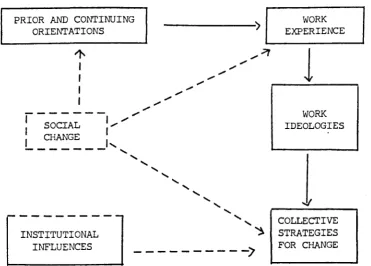
of collective strategies for change. This is represented
diagram-matically in Figure 1. Within the sequence [Prior Orientations
~ Work Experience ~ Work Ideologies -) Collective Strategies
PRIOR AND CONTINUING ORIENTATIONS
'1'-1 1 1 1, - - - -I ,,'"
1 SOCIAL 1 ."
CHANGE
1 I,
- - - -
,
,
INSTITUTIONAL . " . ", ,
- - - ) . ",
. " . ",
,
,
,
,
,
, ,
~INFLUENCES
-
-
-- ) WORK EXPERIENCE
1
WORK IDEOLOGIES COLLECTIVE STRATEGIES FOR CHANGEFigure 1 Basic Influences on the Development of Collective Strategies
lead in one direction rather than another. Goldthorpe and'
Lockwood, for example, discovered a considerable congruence between
all the elements in the sequence. However, this is only one
possibility. Commentators on nursing have frequently spoken of
the 'reality shock' experienced by recruits, as their prior
orientations come into profound conflict with the realities of
work experience. For example Bevington's classic study in
1943, described the probationer nurse's 'primary difficulty' in
adjusting to ward work to be
losing the illusions cherished before entering hospital. Chief among these, perhaps, was the belief that she would be given "real nursing" to do (i.e.
[image:32.520.53.424.99.365.2]"sanitary round", dusting or cleaning bedside furniture or baths, and giving minor, if any, attention to convalescent patients.
(12 )
How the process of being stripped of illusions works through, or
not, to the articul8tion of collective strategies for change, will
vary partly according to individual personal choices. One person
may leave nursing disillusioned, while another stays to try to
change things. Expectations may continue to be 'cherished' against
the odds or abandoned. There may be a desire to transform reality
to conform to the cherished ideal, or else cynicism may set in.
Nor should too many assumptions be made that recruits'prior
orientations are always congruent with cherished ideals. Indeed
I shall argue that nursinJ has always attracted significant
numbers of men and women whose attachment, if any, to 'illusions'
was marginal, and that these formed the spine of those who became
committed trades unionists. Those who needed to be stripped of
illusions joined later, if at all.
Therefore variations in patterns of unionisation were
partly dependent on the prior class and gender experiences of
nurses, which led to differential types of orientations.
Contrary to the Goldthorpe and Lockwood study, therefore,
orientations and work experience can clash. The extent to which
this is the case will, however, also be subject to variation:
(1) Between different types of nursing work; (2) In the
same field of nursing work over time. The first is important
horizontally and vertically. Horizontally acute general nursing
may be the basis for greater illusions than care of the chronically
ill, if the image of what it entails is more romanticized.
career paths, for example, hov..' far the unpleasant experiences are
likely to be temporary or permanent features of an individual
•
nurses job situation. The second is important because the nature
of nursing work changes over time and prior orientations may
be based on past realities rather than present ones. In which
case the contradictions between cherished ideals and work
realities may be that much greater. On the other hand, it is also
possible that orientations have changed more than the work situation.
For example, the orientations of women to work and to life have
undergone a revolution since the end of the 19th century. Former
expectations, of self-denial and limited career prospects have
Changed dramatically. Perhaps changes in the institutions of
nursing have occurred at a much slOWEr rate. Rather than speculate
at this point, we can conclude that there is a complex dialectic
between changing orientations and changes in the labour process
in nursing. One needs a sensitive understanding of both the'
changes themselves and how they interact together in the creation
of ideologies of nursing work.
Yet though the influences upon work ideologies are crucial
to the understanding workers' collective action they do not provide
a complete explanation. As already noted a deviant work ideology
may lead simply to demoralisation or a decision to leave nursing.
Other factors affect the situation, such as, for example, the
general employment situation, inflation, the degree of
c_ ... rcssivenc.:;::; ~y other sections of the working class. Therefore in the diagram these are represented as wider forces of 'social
change'. However even this is not sufficient, for as will
hopefulJybecome apparent, the intensity and focus of collective action
workers, even taking account of wider environmental factors.
There are other 'institutional influences' which are the
consequences of the practical imperatives of organising collective
action. The remainder of this chapter therefore, explores the
possibility of constructing a model of union growth which while
giving due weight to the role of prior and continuing orientations
and work experience, is nevertheless sensitive also to 'the
importance of'institutional influences' which may have a degree
of autonomy from them both.
(3) Attitudinal versus structural Approaches to Union Growth
Different interpretations of the relationship between
attitudes and union growth divide the two dominant approaches,
the 'attitudinal' and the 'structural'. It will be argued here
that both are deficient. The 'attitudinal' approach is naively
voluntaristic, assuming an almost automatic congruence betwee~ ideologies and collective action. The 'structural' approach is
superior in recognizing the limitations of the attitudinal approach.
However, it is excessively ?eterministic, reifyinS the processes of
union growth in ways that almost discount the role of human agency.
While it correctly recognizes the importance of institutional and
environmental influences, it has not integrated these into a
situated account rooted in an analysis of changing workplace
relationships.
Until recently the 'attitudinal' approach led the field.
Its prime method was the social survey. Workers were asked
questions about their attitudes and reasons for joining/not
joining. The answers were added together, correlations were
the general problems of validity and reliability associated with
the social survey. Above all, however, the attitudinal approach
wrenches the act of joining a union from its social context in
assuming that attitudes are normally the key determining factor.
Yet, for example, in a closed shop situation there may be no
correlation or, with some individuals, even a negative correlation
between attitudes and membership of a trade union. Even where
joining a union (or not joining one) is apparently an individual's
'free choice', there may be still pressures of circumstance
and situation which lead to a breach between attitudes and
behaviour. From this it follows that the pressures involved in
the social context of joining must be thoroughly explored, and not
just individual attitudes.
At first sight it seems that the 'structural' approach
overcomes these deficiences and its proponents are often critical
of the attitudinal approach. Yet though it appears to take
situational factors into account, these are considered at such
a high level of abstraction that it too divorces recruitment to
unions from the pattern of workplace relations into which it
fits. While the attitudinal approach exaggerates the degree to
which people choose to join a union, the danger of the structural
approach is the opposite one of excessive determinism. The most
developed structural approach to union growth is that pioneered
by Bain and his colleagues. In his early work Bain set out to
identify the prime causes or 'strategic variables' in union
growth, while not entirely discounting the role of 'secondary'
'aggregate' from the 'less aggregated' causes of union
growth. As he argues:
••• while the strategic variables may explain the existence of unionism per se among a given group of workers, which particular union is successful in organising the group may be determined
by union structures and recruitment policies. Similarly the explanation of why one worker in a given environment joins a union while
another does not, may well be found in the different personality structures of the two individuals. But the strategic variables predominate and unless they are held constant any explanation of these less aggregate patterns 6f union growth is likely to be obscured or distorted.
(14)
The beau ty of Bain
's
approach lies in its simplicity, for heidentifies only three strategic variables - employment concentration,
union recognition, and government action - which appear to provide
a good 'fit' to explain the density of white collar unionism.
He claims therefore that recognition is the result of employment
concentration and the readiness of employers to recognize trade
(15 ) unions, prodded at times by the state.
Underlying the first two is what Bain calls the
process of 'bureaucratisation'. Employment concentration leads
to the massing of workers in large administrative units. They
have collective problems as workers and, since personal
supervision by managers is no longer so feasible as previously in
smaller units, it is carried out by means of impersonal rules from
a distance. In such circumstances, Bain believes, both workers
and management will be more ready to accept the role of an
intermediary. In the white collar field, Bain insists, workers
are usually reluctant to join a union unless it is sanctioned
by their employer especially because they do not want to
This theory has a great deal of mileage in it and is
clearly superior to the attitudinal approach. In some respects
it is not dissimilar to a materialist approach,if the underlying
processes behind bureaucratisation were to be spelled out. There
are however a number of problems with it. The discussion of
career prospects shows first his assumption that male white
collar workers are the norm despite the growing 'feminisation'
. (16)
of the lower ends of wh1te collar work, and indeed the role
of gender is specifically discounted. Second, there is in the
last resort a reliance on psychologistic explanation which
appears to be speculative rather than based on empirical research.
We are not given any real evidence to support his contention that
management recognition is important since:
••• because they (workers) are less likely to jeopardise their career prospects by joining, they can more easily reconcile union membership with their "loyalty" to the company.
(17)
In discounting the importance of a whole range of phenomena, not
just gender, but also 'econ~mic' factors such as earnings and 'conditions' such as insecurity, as well as features of the
'work situation' such as mechanisation and blocked career mobility,
. t t· . f d· t <18 )
the theory 1S a 1mes compressed to the p01nt 0 cru 1 y.
The analysis and emphasis placed on management recognition
can also be questioned. Since Bain himself admits that in most
cases recognition is due to some prior density, there must therefore
to risk their career chances to join a union, without whom white
collar trade unionism would not be possible. What is needed is
a perspective which Can also account for growth in the work place
prior to recog~ition.
(4) Conclusion
This chapter has focussed briefly on problems of ' method
in the social sciences, with particular reference to the analysis
of union growth. The need for a holistic approach was argued, one
which recognised the central importance of work ideologies - the
meanings that work holds for the individuals performing it - to
the subsequent articulation of collective strategies. General
and particular problems of method were identified: the general
issue of how at all stages of an~lysis to be aware both of
structural constraints upon human agency and of the possibilities
that are created by its intervention. The particular quest~ons
concerned first the influences upon ideologies themselves, and
second a recognition that though necessary to an explanation of
collective strategies for,change, they are not sufficient in
themselves for wider institutional and environmental influences
mediate the linkages between ideology and action. The available
approaches to growth were criticised as deficient from the
methodological standpoints adopted. They were either excessively
voluntaristic or excessively deterministic, either focussing too
single-mindedly upon ideologies or virtually ignoring them; above
all neither was able to link ideology or structural influences to
consistent with the chosen methodological stance. The issues
are so large that, within the constraints imposed by a thesis,
the discussion will be inevitably tentative. However, a critique
is not a useful exercise unless it can be combined with an
approach that shows how the deficiencies identified by it might
Chapter Two - An Alternative, Situated Perspective
This chapter seeks to develop a 'situated' approach to the
analysis of union growth which is congruent with the methodological
stances outlined in Chapter One. Rather than assuming attitudes
are determinate (or irrelevant), rather than separating aggregate
from less aggregate analysis, it seems more useful to examine the
interplay of ideological and structural (both environmental and
institutional) factors in specific situations. It is an approach
which treats union growth as an event which happens, and tries to
theorize from a more 'grounded' analysis of the constraints acting
upon collectivities and the meanings members of it attach to their
behaviour. As we shall see by the conclusion of this thesis, many
of the factors Bain identifies as significant to explain the density
of white collar unionism are highly relevant to nursing as a whole,
and its segments. But they will be situated within a framework
which looks at unionisation as an active, creative process, rather
than almost an epiphenomenon of aggregate factors.
(1) A Situated Analysis of Union Growth
The most significant attempt by a social scientist to take
specifically a processu:al approach to these issues is the work of
Donald Roy in the U.S.A. (1)
Roy sees union recruitment as a battle for the affiliation of workers
that takes place between the management and the union, and he
describes the outcome over the course of a union recruitment campaign.
In his model, workers ~ffiliate to the union by psychologically
disaffiliating from their firm, affirming this by the act of union
membership. Similarly, this process can occur in the reverse, when
workers actually disaffiliate from their union and psychically
sevenfold typology of workers, classified according to their type
of affiliation: a continuum which runs from 'pro-union "actives'"
through the 'indifferent' or 'undecided' to the 'pro-company "actives"'.
Following this he begins to assess the factors, in the make-up of the
people concerned, and the surrounding ecological conditions, which
encourage affiliation-disaffiliation, towards and away from the
union.
There is much to commend in Roy's approach but there are, as
always, problems with such simple typologies. In the first place, it
describes a situation of profound confrontation between management
and unions, where loyalty to one political system and community of
interest is seen as incompatible to loyalty to the other. While it
may have been true in this particular instance, it would be
simplistic to assume that trade union affiliation is universally, and
totally, oppositional in character. However, as many writers of
,
various political persuasions have emphasized, trade unions are an
integral part of capitalism, and are often collaborative as well as
oppositional institutions: loyalty to the firm, the union and the
nation state are by no means incompatible with each other. Even
when it is 'oppositional' in its day-to-day operations,a union may be
so in a way that questions the distribution of rewards but not
fundamentally the distribution of power in society. (2) Nevertheless,
this is not to assume that such integration is perfect. Even in
the most appnrently harmonious situations, trade unionism may
represent at least an implicit challenge to the legitmacy of
management's power, and even the germs of a reorganisation of
industry and economic life upon co-operative, more humane lines.
Furthermore, though day to day union activities may often not be
example, upon profitability) may be to pose a threat to it. Trade
unionism, then, if it has become part of the status quo, sits rather
uncomfortably within it.
In any case, these issues must be considered dynamically.
The extent to which unions are judged oppositional or collaborative
institutions is an empirical question; varying across different
employment settings, at different points in time, and even within
collectivities. Neither should absence of militant collective
activity be taken necessarily as evidence of quiescence, for this
may be influenced by tactical considerations. Among the factors
to be considered are undoubtedly the dominant ideological attitudes
held by both workers and management. In his earlier work, for example,
Fox emphasized the importance of 'pluralist' and 'unitary'
frames of reference among management; the former recognizing (to
an extent) that workers had legitimate identifications with ~eir own collectivity as well as (i.e. not instead of) the firm.
Managements operating within a 'unitary' frame of reference, however,
recognized only one source of loyalty. (3) It requires little
imagination to see that management's approach to trade unionism
would vary considerably according to whether they adhered to a
'pluralist' or 'unitary' frame of reference. What was missing,
however, from this influential account was a discussion of the
material and social factors which influenced managerial ideology,
the absence of which encouraged an explanation based on 'nice guys'
versus 'bad guys'. Were 'pluralists' merely making a virtue of
necessity faced by powerful worker collectivities? Were they
cleverly trying to manipulate trade unionism for their own ends and
neutralise its oppositional effects? Were they able to be 'nice guys'