The Effects of Objects-First and Objects-Late Methods on
Achievements of OOP Learners
Murat Pasa Uysal
Rochester Institute of Technology, Saunders College of Business, Department of MIS and Decision Sciences, Rochester, USA. Email: [email protected], [email protected]
Received August 15th, 2012; revised September 17th, 2012; accepted September 29th, 2012
ABSTRACT
Our research explored the effects of objects-first and objects-late methods on achievements of object-oriented pro-gramming (OOP) learners during a graduate course. The course’s scope was virtually identical for two groups, but the structure of the contents differed in sequence. The objects-first method emphasized the design and discussion of the object-oriented concepts from the very beginning while the objects-late deferred these concepts to the late lectures. The objects-first learners used all visual functionalities of BlueJ IDE. However, the objects-late learners started with only the text-based interfaces of BlueJ and they benefited its visual support in the last lectures. At the end of the study, we found that there was a statistically significant difference between OOP learner groups.
Keywords: Object-Oriented Programming; Objects-First; Objects-Late
1. Introduction
It is fair to say that object-oriented programming (OOP) has gained much interest while it is becoming a common programming paradigm. This is partly because it is simi-lar to our view of the real world. However, it has been difficult to introduce OOP to novice programmers [1-4]. The instructional methods, tools and the programming languages constitute the intrinsic or external factors for learning programming and they may greatly determine the complexity of this paradigm [5,6]. Consequently, tea- ching and learning OOP have been sources of many stu- dies since they are challenging not only for students, but also for instructors. The studies are continually evolving in the hope of finding better tools, methods or innovative strategies. The literature review of teaching OOP suggests that the research studies conducted on teaching OOP can be broadly divided into three categories, as 1) Program-ming or educational tools for OOP learners; 2) Instruc-tional approaches to teaching OOP; and 3) Learners’ cha- racteristics, conceptions and attitudes to OOP.
The instructional methods, objects-first and objects-late, are two of the important topics centering in the research area of teaching OOP. The primary reason would be the debates that are continuing whether introducing the ob-jects and classes to the students at the very beginning is the right decision [7]. Because, there are many peda-gogical dimensions involved in the issues, and we need to classify and clarify these effecting parameters care-
fully [8]. It seems that instructional effectiveness of these methods will continue being a subject to many discus-sions and more empirical evidence is needed to reach reliable conclusions. In this study, we compared two in-structional methods for teaching OOP, which are the ob-jects-first and the objects-late method. The next sections present this study along with the findings and discussion.
2. Tools and Methods for Teaching OOP
the needs such as ease of use, support for code reuse, object-support, learning support, and finally group sup-port [13]. BlueJ, DrJava, JKarelRobot, JCreater LE and Alice are some of the examples of educational environ-ments used in the literature [10,13-15].
The other determining factor for teaching OOP is the instructional approach that has a close relationship with the programming paradigms. The way of structuring or organizing the programming tasks performed on a com-puter determines these paradigms. For example, impera-tive and declaraimpera-tive programming has found an important place in a wide range of applications. With the increased popularity of OOP paradigm, objects-first and objects- late instructional approaches have been attracting much interest among OOP researchers. The objects-first method puts emphasis on both design and programming princi-ples of OOP from the very beginning. However, the ob-jects-late method initially starts with non-object-oriented concepts, such as the statements and the control struc-tures, and it defers the discussion of classes and objects to later lectures. Additionally, the conceptual approach, the apprentice approach, the model-first approach and the hybrid methodologies could be given as the other meth-ods to teach OOP [16-18].
3. Method
The goal of this study was to find the effects of objects-first and objects-late methods on achievements of OOP learn-ers. The academic performance constituted the dependent variable of our research design. The hypothesis was:
Hypothesis: The achievements of students will not dif- fer significantly according to the OOP teaching methods.
We carried out the study with two experimental groups. Both the participants in group-1 and group-2 used BlueJ IDE. This was to eliminate possible effects of different instructional tools. The students were pre-tested and post- tested, and group-2 was administered as the treatment. The pre-tests and post-tests were given as open-ended aca-demic achievement tests to determine whether the par-ticipants (Table 1) acquired the OOP knowledge and skills.
3.1. Subjects
[image:2.595.62.278.703.736.2]The twenty male graduate OOP learners participated to this study. The students previously received a BS degree in systems engineering. They knew structured program-ming with Java at an introductory level and they previ-ously used JCreater LE as a software development tool.
Table 1. The representation of the research design.
Group Pre-test Method Tool Post-test
Group-1 X Objects-late BlueJ X Group-2 X Objects-first BlueJ X
3.2. OOP Environments
When designing the OOP instructional environments, it is important to give a special notice for choosing a pro-gramming environment. In general, professional software development tools are not suited for introducing learners to OOP. They are optimized for rapid application devel-opment as well as the needs of software professionals. Therefore, we considered mostly the pedagogical issues when deciding on the software development tool for this study. There are specific requirements for a first year object-oriented teaching. First, the basic concepts of OOP should be presented with simple and well-defined in-structional strategies to teach in a consisted and under-standable environment. Second, programming tool should display object-orientation by adopting a basic abstraction approach. Third, it should have an understandable execu-tion model while avoiding the concepts that would possi-bly lead to erroneous programs. Finally, development en- vironment should be easy to use with a debugger so that students can focus on learning OOP concepts rather than the environment itself [3].
BlueJ is the programming tool chosen for this study. It is an IDE especially for introductory teaching of OOP. It is hypothesized that OOP is not intrinsically complex, but it is made more complicated by a lack of appropriate tools [13]. Commercial tools mainly focus on user inter-faces and they are too complex for the beginners. How-ever, BlueJ’s environment facilitates the discussion of object-oriented design by allowing interaction with ob-jects before implementing them. It helps adopting a true objects-first approach while introducing the classes, ob-jects and methods concepts before talking about Java and its syntax. The direct interactivity with classes and ob-jects, the mechanisms allowing sophisticated and detailed testing of classes, and finally the visualization of object- oriented (OO) concepts could be given as the reason for preferring it as an objects-first teaching tool. A novice programmer using BlueJ is not only able to execute a co- mplete application, but also she can directly interact with the objects of any classes without writing a complete application. Furthermore, the simple debugging mecha-nism showing the internal states of objects allows a quick and easy understanding of the Java code.
The unique nature of BlueJ is its user interfaces sup-porting a greater degree of interaction than the other OOP environments. Most importantly for our study, it allowed us to adopt two different OOP instructional approaches by enabling both conventional text-based and UML like programming interfaces.
3.3. Procedure
The fundamentals of OOP concepts were given in this course. It consisted of two-hour lecture and two-hour lab per week, with 13 weeks per semester. The same instructor taught the students in group-1 and group-2 on different days. The expected learning outcomes were:
The participants should
Be able to define the basic concepts of OOP: classes, objects and methods;
Develop skills for reading, writing and debugging OO programs;
Understand statements, iterative and conditional struc- tures in Java language;
Be able to write event-based interactive programs;
[image:3.595.310.536.104.436.2] Be able to apply the abstraction, inheritance, polymor- phism and encapsulation concepts to their programs. The course’s scope was virtually identical for two ex-perimental groups, but the structure of the contents dif-fered in their sequence (Tables 2 and 3). The contents were designed and grouped into the units so that they were consisted with either of the OOP teaching methods. The two-hour lecture included necessary programming topics, OOP concepts and illustration of sample prog- rams. The weekly exercises and the lab studies were dif-ferent in both presentations and example applications. Thus, instructional activities were tailored to each of the group’s Java programming interfaces.
Table 2. The sequence and structure of the course topics for objects-late method.
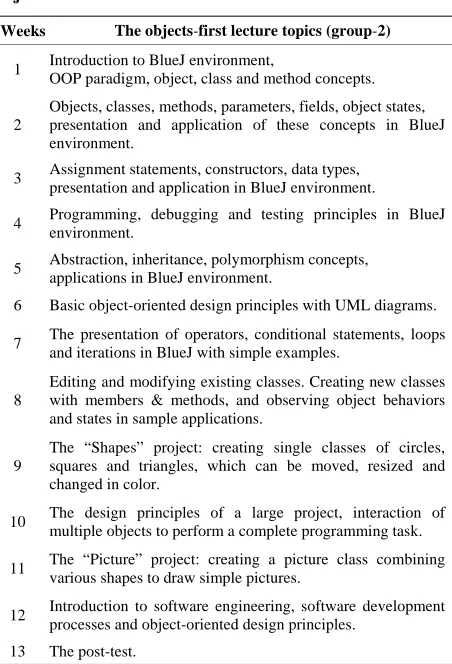
Weeks The objects-late lecture topics (group-1)
1 Introduction of BlueJ IDE, representation of class, methods and attributes at an introductory level.
2 Data types, variables, constants. Assignment statements. Referencing to object and class concepts.
3 The use of operators and conditional statements with sample applications.
4 Loops and iteration structures with sample applications.
5
Editing and modifying existing classes. Creating new classes with members & methods, observing object behaviors and states with sample applications.
6 Event handling in Java applications.
7 Working with graphics (i.e. drawing lines, rectangle, and circle). Introducing the AWT.
8
The “Shapes” project: creating single classes of circles, squares and triangles which can be moved, resized and changed in color.
9 Introducing abstraction, inheritance, polymorphism concepts with basic UML diagrams
10 The design principles of a large project, interaction of multiple objects to perform a complete programming task.
11 The “Picture” project: creating a picture class combining various shapes to draw a picture.
12 Introduction to software engineering, object-oriented design principles, software development processes.
13 The post-test.
Table 3. The sequence and structure of the course topics for objects-first method.
Weeks The objects-first lecture topics (group-2)
1 Introduction to BlueJ environment, OOP paradigm, object, class and method concepts.
2
Objects, classes, methods, parameters, fields, object states, presentation and application of these concepts in BlueJ environment.
3 Assignment statements, constructors, data types, presentation and application in BlueJ environment.
4 Programming, debugging and testing principles in BlueJ environment.
5 Abstraction, inheritance, polymorphism concepts, applications in BlueJ environment.
6 Basic object-oriented design principles with UML diagrams.
7 The presentation of operators, conditional statements, loops and iterations in BlueJ with simple examples.
8
Editing and modifying existing classes. Creating new classes with members & methods, and observing object behaviors and states in sample applications.
9
The “Shapes” project: creating single classes of circles, squares and triangles, which can be moved, resized and changed in color.
10 The design principles of a large project, interaction of multiple objects to perform a complete programming task.
11 The “Picture” project: creating a picture class combining various shapes to draw simple pictures.
12 Introduction to software engineering, software development processes and object-oriented design principles.
13 The post-test.
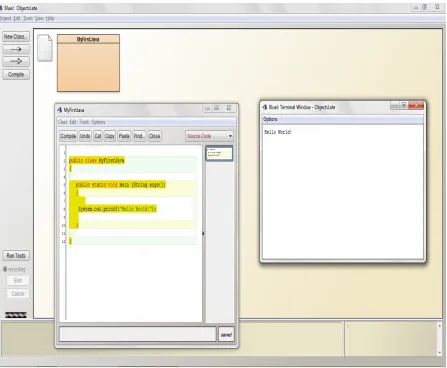
The objects-late method initially followed the classical instructional pattern, which was similar to that in most of the structured Java programming courses (Table 2). The participants started using BlueJ’s text-based interface. Their first program was about a class with the “main” method saying “Hello World” (Figure 1). The instructor specially noticed that the group-1 learners gave their fo-cus to the text-based editor rather than graphical repre-sentations. Therefore, the students directly started devel-oping stand-alone applications in BlueJ instead of using the UML like representations of BlueJ.
[image:3.595.59.287.433.737.2]Figure 1. BlueJ interfaces used by objects-late learners.
relationships. The participants formed the basic program- ming constructs such as variables, data types and state-ments. Later, the selection and iterative control structures were given in the next contents. The lectures also cov-ered the issues of writing clear and understandable codes as well as testing and debugging techniques. The students developed their simple programs during the lab hours. Since the classes are central for data and behaviors in Java language, these constructs were illustrated briefly with in the framework of class definitions. The core OOP concepts such as inheritance and polymorphism were de- ferred to the late in weekly lectures. The group-1 stude- nts benefited BlueJ’s visual support for OO design and the support for interaction with objects in the last weeks (8 - 13 weeks).
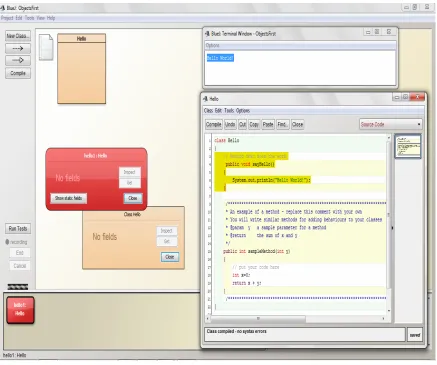
When teaching programming with the objects-first method, the classes and objects were introduced without going into the further details of Java syntax rules. The participants directly started by creating objects and exe-cuting methods of the previously developed sample pro-jects to conceptualize classes, obpro-jects and methods (
Fig-ure 2).
The participants were also expected to learn simple forms of statements, control structures, method imple- mentations and creation of source codes to define object behaviors and to observe their states. Later, they experi-enced editing, compiling and executing processes while gaining an insight into Java programming. The presenta-tion of the core OOP concepts, such as inheritance, poly- morphism, coupling and cohesion concepts were intro-duced to the group-2 students. Finally, the interaction of multiple objects was presented to these students when invoking each other’s methods (Table 3).
3.4. Data Analysis
Figure 2. BlueJ interfaces used by objects-first learners.
for the intention of measuring their understanding and OOP skills of students whether they met the learning out- comes. The participants were graded based on the con-cepts they correctly defined and the Java applications that they developed. We carried out the statistical analy-sis with the SPSS v.16 software.
3.5. Findings
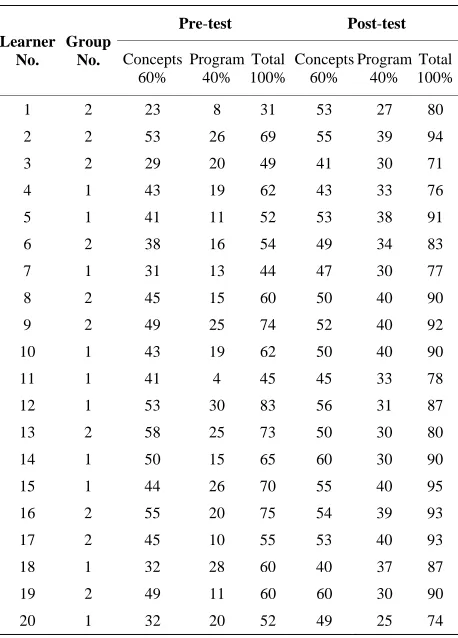
Table 4 presents the descriptive statistical data of the study.
The null hypothesis stated that no significant statistical difference would exist between the test scores of students in two different groups. However, as it is seen in Table 5, there is a statistically significant difference between these experimental groups and we reject the null hypothesis (z = –2.290, p < 0.05). It is possible to say that the learn-ers instructed with objects-first method achieved higher learning outcomes.
4. Discussion and Conclusions
The objects-first instructional design emphasized the
Table 4. The descriptive data of the participants.
Pre-test Post-test
Learner No.
Group
No. Concepts 60%
Program 40%
Total 100%
Concepts 60%
Program 40%
Total 100%
1 2 23 8 31 53 27 80
2 2 53 26 69 55 39 94
3 2 29 20 49 41 30 71
4 1 43 19 62 43 33 76
5 1 41 11 52 53 38 91
6 2 38 16 54 49 34 83
7 1 31 13 44 47 30 77
8 2 45 15 60 50 40 90
9 2 49 25 74 52 40 92
10 1 43 19 62 50 40 90
11 1 41 4 45 45 33 78
12 1 53 30 83 56 31 87
13 2 58 25 73 50 30 80
14 1 50 15 65 60 30 90
15 1 44 26 70 55 40 95
16 2 55 20 75 54 39 93
17 2 45 10 55 53 40 93
18 1 32 28 60 40 37 87
19 2 49 11 60 60 30 90
20 1 32 20 52 49 25 74
Table 5. The Mann-Whitney test results of the academic achievements.
Group n Mean
rank Sum of ranks z p
Group-1
(objects-late) 10 6.89 62.00 Group-2
(object-first) 10 12.80 128.00
–2.290 0.022
environment. This eased the application of basic pro-gramming skills. Therefore, high achievements of the learners in group-2 could be attributed to instructional ap- propriateness of the objects-first method.
Initially allowing the group-2 students to interact with objects and methods possibility formed the concrete un-derstanding of the inner workings of OOP paradigm. Therefore, objects-first strategy, which is supplemented with visual interfaces, made the information apprehensible, apparent and visible to the learners [19,20]. We observed that the learners in group-2 could easily find, design or interpret the relevant information pertaining to program-ming tasks. Any visual software development environ-ment should provide necessary abstractions. Therefore, the objects-first strategy is thought have provided the learners with appropriate conceptual models, and it en-abled them to incorporate abstraction details with
con-crete programming facts and rules. This strategy also reflected the state, behavior and existing attributes of an entity that an object encapsulated. We observed that the students in group-2 were easily able to explore the OOP concepts and to carry out programming tasks in visual and text-based environments, which also directly support- ed the objects-first strategy.
During the study, the nature of the objects-first method supported visual design of programs while maintaining access to the text editor. This gave different perspectives to the learners of group-2. Software development requires fundamental skills i.e. analysis, design and coding. In terms visualization, different tasks would require differ-ent types of represdiffer-entations suited for the learners’ pref-erences. While visual environments could be suitable for the analysis and design tasks of software development phases, text-based environments would be more appeal-ing to traditional programmers. The learners in group-2 felt comfortable in this two-dimensional visual environ-ment through out programming. Therefore, the two-mode of objects-first method (visual and text) enabled the func- tionalities that the learners needed. As a result, learners were able to switch among representations while course topics were presented with the objects-first strategies.
The learners in group-2 found objects-first method enjoy- able since it allowed more freedom and layout opportuni-ties in terms of instructional activiopportuni-ties. From experienced to novice ones, the majority of the programmers find a number of advantages of graphical representations over the text-based ones. While the overview of programming context is provided, software structures are made more visible and clearer in objects-first environments. We know that these environments have a higher level of abstrac-tions, they are easier and faster to understand, and they provide closer mapping of programming domain. In our study, the objects-first strategy helped the learners un-derstand what the class or object mean and grasp the re-lated OOP concepts. It is possible to say that the ob-jects-first instructional method, which was rich in visu-alization and instructional activities, played an important role in high-level achievements of learners in group-2.
[image:6.595.57.286.455.520.2]REFERENCES
[1] M. Ben-Ari, “Constructivism in Computer Science Edu-cation,” Proceedings of the 29th Technical Symposium on
Computer Science Education, New York, 26 February-1
March 1998, pp. 257-261.
[2] A. E. Fleury, “Student Conceptions of Object-Oriented Programming in Java,” The Journal of Computing in
Small Colleges, Vol. 15, No. 1, 1999, pp. 69-78.
[3] M. Kolling, “The Problem of Teaching Object-Oriented Programming, Part 1: Languages,” Journal of Object-
Oriented Programming, Vol. 11, No. 8, 1999, pp. 8-15.
[4] A. Eckerdal, “Novice Students’ Learning of Object-Oriented Programming,” Unpublished Doctoral Dissertation, The Uppsala University, Uppsala, 2006.
[5] M. Kolling and J. Rosenberg, “Guidelines for Teaching Object Orientation with Java,” Proceedings of the 6th Annual Conference on Innovation and Technology in
Computer Science Education, Canterbury, 25-27 June 2001,
pp. 33-36.
[6] H. Zhu and M. Zhou, “Methodology First and Language Second: A Way to Teach Object-Oriented Programming,”
OOPSLA 2003: Companion of the 18th Annual ACM
Conference on Object-Oriented Programming, Systems,
Languages, and Applications, New York, 26-30 October
2003, pp. 140-147.
[7] K. B. Bruce, “Controversy on How to Teach CS 1: A Discussion on the SIGCSE-Members Mailing List,” In-
roads—The SIGCSE Bulletin, Vol. 37, No. 2, 2005, pp.
111-117.
[8] A. Ehlert and C. Schulte, “Empirical Comparison of Ob-jects-First and Objects-Later,” Proceedings of the 5th In-ternational Workshop on Computing Education Research
Workshop, Berkeley, 10-11 August 2009, pp. 15-26.
doi:10.1145/1584322.1584326
[9] R. B. Findler, C. Flanagan, M. Flatt, S. Krishnamurthi and M. Felleisen, “Drscheme: A Pedagogic Programming Environment for Scheme,” Programming Languages:
Implementations, Logics, and Programs, Vol. 12, No. 2,
2002, pp. 159-182. doi:10.1007/BFb0033856
[10] E. Allen, R. Cartwright and B. Stoler, “DrJava: A Light-Weight Pedagogic Environment for Java,” Proceedings of
the 33rd Technical Symposium on Computer Science
Education, New York, 26 February-2 March 2002, pp.
137-141.
[11] S. Georgantaki and S. Retalis, “Using Educational Tools for Teaching Object Oriented Design and Programming,”
Journal of Information Technology Impact, Vol. 7, No. 2,
2007, pp. 111-130.
[12] A. Patterson, M. Kölling, B. Quig and J. Rosenberg, “The BlueJ System and Its Pedagogy,” Journal of Computer
Science Education, Vol. 13, No. 4, 2003, pp. 13-24.
[13] M. Kolling, “The Problem of Teaching Object-Oriented Programming, Part 2: Environments,” Journal of Object-
Oriented Programming, Vol. 11, No. 9, 1999, pp. 6-12.
[14] D. Buck and D. J. Stucki, “JKarel Robot: A Case Study in Supporting Levels of Cognitive Development in Com-puter Science Curriculum,” ACM SICGSE Bulletin, Vol. 33, No. 1, 2000, pp. 16-20.
[15] S. Cooper, W. Dann and R. Paush, “Alice: A 3-D Tool for Introductory Programming Concepts,” Journal of
Computing in Small Colleges, Vol. 15, No. 5, 2000, pp.
108-117.
[16] D. J. Barnes and M. Kölling, “Objects First with Java: A Practical Introduction Using BlueJ,” 2nd Edition, Prentice Hall, New Jersey, 2005.
[17] M. Torgersen, H. R. Kresten and K. Thorup, “A Concep-tual Approach to Teaching Object-Orientation to C Pro-grammers,” The Proceedings of Educators’ Symposium:
Conference on Object-Oriented Programming Systems,
Languages and Applications, Vancouver, 18-22 October
1998, pp. 3-10.
[18] J. Bennedsen and M. Caspersen, “Programming in Con-text: A Model-First Approach to CS1,” Proceedings of
the 35th SIGCSE Technical Symposium on Computer
Sci-ence Education, Norfolk, 3-7 March 2004, pp. 477-481.
[19] S. Xinogalos, “Guidelines for Designing and Teaching an Effective Object-Oriented Design and Programming Course,”
Advance Learning, 2010, pp. 397-422.
[20] M. Petre, “Mental Imagery and Software Visualization in High-Performance Software Development Teams,”
Jour-nal of Visual Languages and Computing, Vol. 21, No. 3,