Abstract—In order to solve the problem between chainsaw damping and operability, this paper used Conversion Bridge of extension methods. Firstly, the paper analyzed the condition -element of the key issue, established a basic transformation database, defined the transformation type and their priority, and then calculated the effects of transformation for controlling the direction of the changes. Secondly, the programs had been substituted into mechanical model one by one, for the purpose of calculating the value of the chainsaw vibration acceleration and stiffness correspondingly. Then the value of the correlation functions could be calculated and chose, in which the value that was more than zero will be retained. Finally, the best solution could be got by judging the operability.
Index Terms—transforming effect; correlation function;
Conversion Bridge; chainsaw.
I. INTRODUCTION
With the humanized and personalized design of the mechanical products, Wang Li-po [1] has pointed out that conflict in the development of the modern manufacturing was inevitable, in which existing many independencies among different design objects or attributes. And the domestic and foreign scholars have done a lot of research on this problem [2-3], where the conflicts appeared in the product development process must be solved timely and effectively. Literature [4] proposed a case-based conflict solution. And literature [5] proposed a solution based on rule conflict, which was used to solve the conflicts by the support of reasoning mechanism. And TRIZ theory could solve the innovative problem because of taking scientific method. But this theory suggested that the sign of the product innovation was to solve or remove the conflicts in the design, while would extend the development cycle, increase the cost of development and affect the design efficiency as well. Domestic chainsaw is largely in imitation of the foreign similar products, so the research is mainly focused on the partial and performance improvement of the original products. When the noise and vibration are decreased, the operability will be corresponding declined.
Schliemann H [6] invented a patent which was research on the hand-held power tool. And its advantage was that the exterior side of the housing was surrounded by the protective devices, as the damping area for protecting the housing from damage effectively. According to the patent
Y.-w. Zhao, H.-h. Hong. J. Chen, N. Su
Key Laboratory of Mechanical Manufacture and Automation of Ministry of Education, Zhejiang University of Technology,
Hangzhou 310014, China
E-mail: [email protected], [email protected], [email protected]
of Woody J C [7], in which he carried out innovative design on carburetor, which had an advantage in that the carburetor minimized the volume of fuel thus facilitating the fuel system to reduce evaporative emissions of a volatile fuel in an effective manner. Atchley R, Buttery J L, Lucas D E, Shymkus R M [8] used the chainsaw clutch to connect the cam directly, so that the predetermined load was applied to guide bar for tensioning cutting chain, thus the over tensioning of cutting chain was prevented.
Weinhold P, Wintrich P [9] inserted a cone shaped port into the suction funnel of 2-stroke engine in the patent, which improved operating efficiency of two-stroke engine and suppressed deterioration in running behavior and structural durability of engine. Beauchaud F, Dominguez F, Guillot N [10] put vibration damper surrounding a shaft of a sheave, where the members and the layer were secured together to reduce the amount of space occupied by the lift car, associate components and isolate vibrations of a sheave from a remainder of a lift car. Hoang N, Fujino Y [11] have done a research on a stay cable with viscous damper in the design progress, and the analytical results were also extended to high-damping rubber dampers which had recently been encountered in practice, finally, the important formulas of both damper design types were tabulated.
Mendes AS, Meirelles PS, Zampieri DE [12] have analyzed a rubber and viscous damper assembling to the crankshaft front-end, comparing the system behavior with rubber and viscous damper options. Dall'Asta A, Ragni L [13] have done some experimental on the behavior of the material under cyclic shear paths with different strain rate and strain amplitude tests in order to obtain more accurate information, and proposed a nonlinear viscoelastic damage model to describe the rubber behavior under cyclic loads.
For that this paper uses Conversion Bridge approach, taking the YD-KW-43 type of chainsaw as an example, and analyzes the conflicts between vibration acceleration and stiffness, builds the model, judges the results, and then gets the optimal solution and a new conversion bridge. Finally the opposition problem will be turned into the co-existence problem.
II. EXTENSION OPPOSITION PROBLEM AND DEFINITION OF CONVERSION BRIDGE
The problem of mechanical products in design progress is given, P= (G1G2)L [14]. G1, G2 is affair-element, matter-element or composite-element of the product performance; L is connecting relation-element or connector structure-element in side. Setting c0 is evaluate feature, Z1 and Z2 is the performance object of G1 andG2; c0s is the feature of condition L about c0; X1, X2 is value domain; X10, X20 is value of the positive domain, and X10X1, X20X2; c0t is feature offered by object Z1, Z2 of target G1, G2; c0t(Z10) and c0t(Z20) is value. So it can be concluded as follows:
Conflict between Chainsaw Rigid and Vibration Acceleration based on Conversion Bridge
Yan-wei Zhao, Huan-huan Hong, Jian Chen, Nan Su
object-element:g10(Z10,c0,v1),g20(Z20,c0,v2), condition-element:
10 ( 10, 0t, 0t( 10)), 20 ( 20, 0s, 0t( 20))
l Z c c Z l Z c c Z .
So P0 [P0(g10g20)l0] is called the key problem of problem P; and K0(p)K(g10,g20)k(c0t(Z10),c0t(Z20)) is called the correlation function of problem P. If
0 )
0(p
K , P is the co-exist problem; ifK0(p)0, P is the opposition problem; ifK0(p)0, P is the critical problem.
Conversion Bridge consists of transition section and transformation channel. The key point to solve opposition problem is how to build structure transition section and transformation channel by Conversion Bridge method.
III. CONVERT BRIDGE SOLVE OPPOSITION PROBLEM A. Divergence Analysis
If the existing structure cannot meet the assembled needs of the new structure or performance promotion during the design process of mechanical products, there should be done some changes. So the condition-element must be complete the divergence analysis, as the basic to developing many different type of matter-element, value-element or characteristics-element as shown in Fig.1.
Fig.1 The tree of divergence analysis
B. Transformation Types and Their Priority
The essence of extension transformation is that one object turns into another object or breaks down into several object-element of the same category. Transformation type has five major kinds including expansion and contraction transformation, duplication transformation, displacement transformation, division and combination transformation, addition and deletion transformation.
In the matter-element transformation process of product structure, the transformation types should be set the change Table 1 Basic transformation types and priority
degree and their priority. Thus the first is to transform the value of the matter-element structure. The second is to transform the characteristic. The last is to transform the object. The attributes of these changes have been shown in Table 1.
The basic transformation types are shown as matrix type.
12 1m
11
21 22 2m
m1 m2 mm
...
...
...
ij m m
m m
t t t
t t t
T t
t t t
tij is one kind of the five transformation types or a zero value (that does not make any transformation); m is the total number of the transformation characteristics. The matrix T should be generated and updated randomly by a computer.
C. Transformation Direction and Transforming Effect The basic transformation database includes three transformation types: 1) the transformation direction meets the requirements; 2) the transformation direction does not meet the requirements; 3) the transformation does not have any impact on the results. So it must control the transform direction in order to reduce the computation load and speed up the solving efficiency. Transformation effect is used to quantitatively describe the degree of the extension transformation. One transformation ( 1 ' 1
1 v
v v
) will
cause another change (v2 v'2v2). When they have the same transformation characteristic, the transformation direction will be defined asr 11'/1. If not, r will be defined asr1/2.
Transformation direction indicated by using the upper and lower symbols (“+” and “-”).
r
orr
will be regard as the useful transformation and will be saved for the next step. Others will be deleted or re-evaluated by the result.D. Correlation Function and Operability Judgment Correlation function presents the degree of element adaption and its value is used to quantitatively describe contradiction. Therefore it can judge the fitness degree [15].
To judge the operability, the first one is to calculate the weight of the characteristic with AHP to determine the difficulty degree of each transformation. Using the formula
name symbol object priority change degree weight
expansion and contraction
T1 v I easy
1 addition and deletion
T2 O,c II easier
2 duplication
T3 c III medium
3 replacement
T4 O,v IV difficult
4 division and combination
T5 O,v V hard
5
1. O c vi, , i ,i1, 2, ,n
LO c vi, , ),i i1, 2, ,n
(
2. O c v ii, ,i , 1, 2, ,n
3. O c v ii, , , 1, 2, ,n
4. O c v, ,i i ,i1, 2, ,n
5. O c v i, ,i , 1, 2, ,n
6. O c v, , i ,i1, 2, ,n
5
1 i
ti
i
, (irepresents the corresponding weight of the change type, tirepresents the weight of each change), to figure out the value of operability that meets the demand.
Then the optimal program will be found by comparing with each other, in which selecting the smallest value of them.
IV. CASE STUDY A. Rubber Damper Parameter
Taking the YD-KW-43 type of chainsaw as an example, the two performances of reduced vibration acceleration and increased rigidity is the opposition problem. And the rubber damper directly affects the two performances. So the key model of the opposition problem can be established.
P0= (g10 ∧ g20) ∗l0
= [reduced vibration, vibration acceleration, ≤ 11.2 m/s2]
[increased rigidity, stiffness, ≥1.44×10⁴N/m]*
mm radius
outside
mm radius
inside
mm height
annular shape
NBR material
damper rubber
10 5 . 5
5 . 14
For (g10∧g20) ↑l0, thus the condition-element should be changed.
B. Obtain the Basic Transformation Database
Making a divergence analysis, while air springs [16]
needs many accessories and high cost, so it should be excluded. Rubber-metal spiral composite damper is widely used in railway and road vehicles, vibration machines, vibration transmission cutting machines and other machinery bearing vibration isolation devices, if being installed on a chainsaw, the total cost will be higher, so it should be excluded as well. Finally it will form a transformation database that is based on the divergence of the rubber shock absorber materials, shape and size.
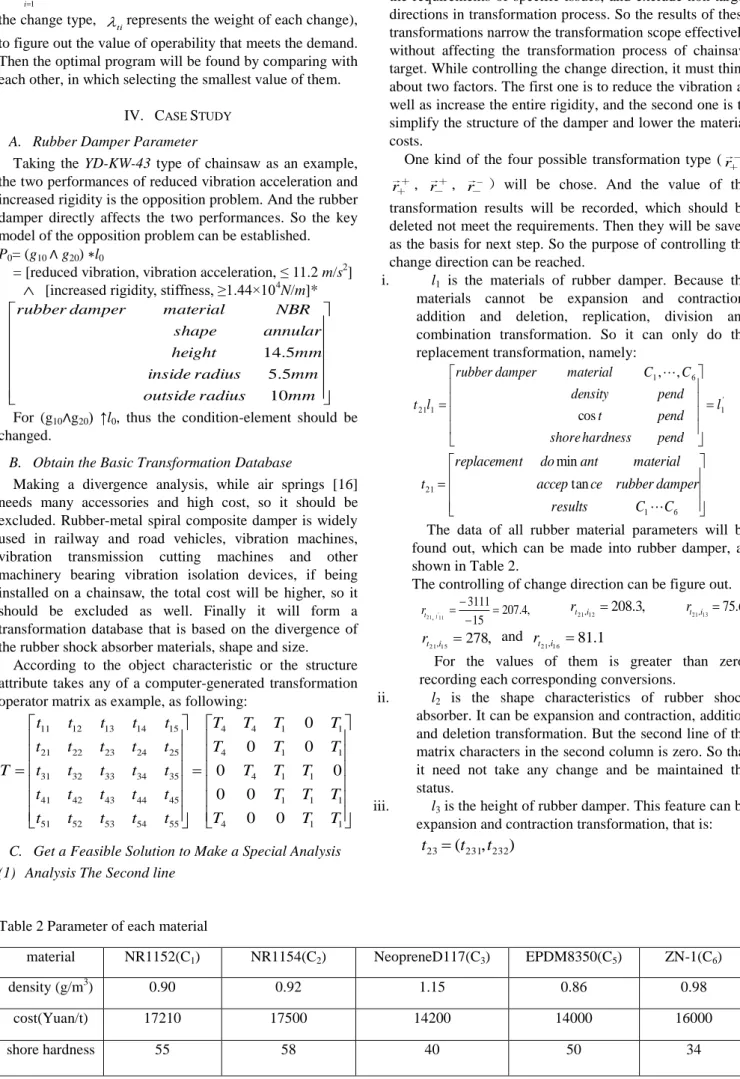
According to the object characteristic or the structure attribute takes any of a computer-generated transformation operator matrix as example, as following:
11 12 13 14 15 4 4 1 1
21 22 23 24 25 4 1 1
31 32 33 34 35 4 1 1
41 42 43 44 45 1 1 1
51 52 53 54 55 4 1 1
0
0 0
0 0
0 0
0 0
t t t t t T T T T
t t t t t T T T
T t t t t t T T T
t t t t t T T T
t t t t t T T T
C. Get a Feasible Solution to Make a Special Analysis (1) Analysis The Second line
Table 2 Parameter of each material
First of all, it must set the change direction according to the requirements of specific issues, and exclude non-target directions in transformation process. So the results of these transformations narrow the transformation scope effectively, without affecting the transformation process of chainsaw target. While controlling the change direction, it must think about two factors. The first one is to reduce the vibration as well as increase the entire rigidity, and the second one is to simplify the structure of the damper and lower the material costs.
One kind of the four possible transformation type (r+-, r++, r-+, r-) will be chose. And the value of the transformation results will be recorded, which should be deleted not meet the requirements. Then they will be saved as the basis for next step. So the purpose of controlling the change direction can be reached.
i. l1 is the materials of rubber damper. Because the materials cannot be expansion and contraction, addition and deletion, replication, division and combination transformation. So it can only do the replacement transformation, namely:
' 1 6 1
1
21 cos
, ,
l pend hardness
shore
pend t
pend density
C C material damper
rubber l
t
6 1
21 tan
min
C C results
damper rubber ce
accep
material ant
do t replacemen t
The data of all rubber material parameters will be found out, which can be made into rubber damper, as shown in Table 2.
The controlling of change direction can be figure out.
, 4 . 15 207 3111
'11
21,
t l
r 208.3,
12 21,i
rt 75.6,
13 21,i rt
,
15 278
21,i
rt and 81.1
16 21,i rt
For the values of them is greater than zero, recording each corresponding conversions.
ii. l2 is the shape characteristics of rubber shock absorber. It can be expansion and contraction, addition and deletion transformation. But the second line of the matrix characters in the second column is zero. So that it need not take any change and be maintained the status.
iii. l3 is the height of rubber damper. This feature can be expansion and contraction transformation, that is:
) , (231 232
23 t t
t
material NR1152(C1) NR1154(C2) NeopreneD117(C3) EPDM8350(C5) ZN-1(C6)
density (g/m3) 0.90 0.92 1.15 0.86 0.98
cost(Yuan/t) 17210 17500 14200 14000 16000
shore hardness 55 58 40 50 34
axial direction
change result mm
tion transforma
damper rubber object
ce accep
height object
ant addition do
t
5 . 14 tan
min
231
,
axial direction
change result mm
tion transforma
damper rubber object
ce accep
height object
ant reduced do
t
5 . 14 tan
min
232
And the change result is l31’
, l32’
.
'313
231l rubber damper,axial height,16mm l
t
'323
232l rubber damper,axial height,12mm l
t
The change direction control can be calculated.
103 .
2 3 10 rt
It will take “-” as for the direction of increase rigidity and reduced vibration. If 231_
231
r
r
t , thechange does not be record and will be delete. But the value ( 0.828
2 3 2
rt ) is greater than zero, so the change will be record.
iv. l4 is the inner radius of rubber vibration. It can be extended or shrank transformation. The second line and the fourth column of the selected matrix elements is 0, so it need not carry out any transformation in this step, and should be maintained the original characteristic parameters.
v. l5 is the exterior radius of rubber vibration. It can be extended or shrank transformation. And its change is like that, as following.
) , (251 252
25 t t
t .
radial direction
change result mm
tion transforma
damper rubber object
ce accep
dadius outside object
ant reduced do
t
10 tan
min
251
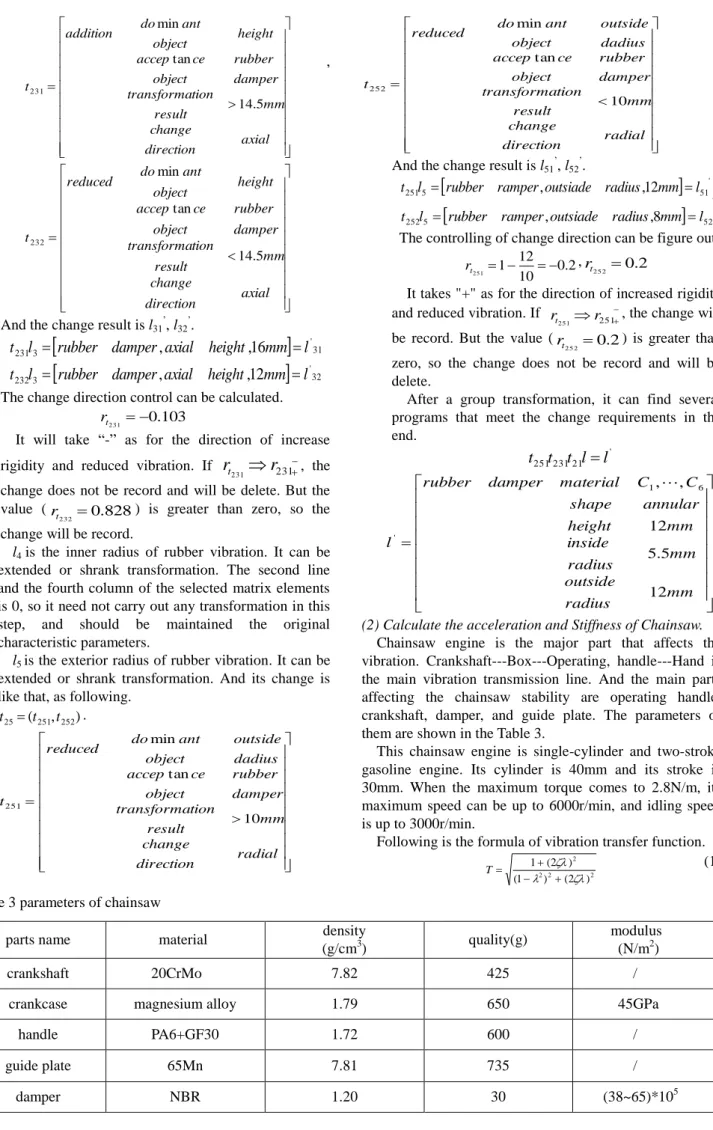
Table 3 parameters of chainsaw
radial direction
change result mm
tion transforma
damper rubber object
ce accep
dadius outside object
ant reduced do
t
10 tan
min
2 5 2
And the change result is l51’, l52’.
51'5
251l rubber ramper,outsiade radius,12mm l
t ,
52'5
252l rubber ramper,outsiade radius,8mm l
t
The controlling of change direction can be figure out.
2 . 10 0 1 12
2 5 1
rt , 0.2
2 5 2 rt
It takes "+" as for the direction of increased rigidity and reduced vibration. If
251
2 5 1 r
rt , the change will be record. But the value ( 0.2
2 5 2
rt ) is greater than zero, so the change does not be record and will be delete.
After a group transformation, it can find several programs that meet the change requirements in the end.
' 21 231 251t t l l
t
radius mm outside
radius mm inside
mm height
annular shape
C C material damper
rubber
l
12 5 . 5 12
,
, 6
1
'
(2) Calculate the acceleration and Stiffness of Chainsaw.
Chainsaw engine is the major part that affects the vibration. Crankshaft---Box---Operating, handle---Hand is the main vibration transmission line. And the main parts affecting the chainsaw stability are operating handle, crankshaft, damper, and guide plate. The parameters of them are shown in the Table 3.
This chainsaw engine is single-cylinder and two-stroke gasoline engine. Its cylinder is 40mm and its stroke is 30mm. When the maximum torque comes to 2.8N/m, its maximum speed can be up to 6000r/min, and idling speed is up to 3000r/min.
Following is the formula of vibration transfer function.
2 2 2
2
) 2 ( ) 1 (
) 2 ( 1
T
(1)
parts name material density
(g/cm3) quality(g) modulus
(N/m2)
crankshaft 20CrMo 7.82 425 /
crankcase magnesium alloy 1.79 650 45GPa
handle PA6+GF30 1.72 600 /
guide plate 65Mn 7.81 735 /
damper NBR 1.20 30 (38~65)*105
Table 4 the feature value of each material
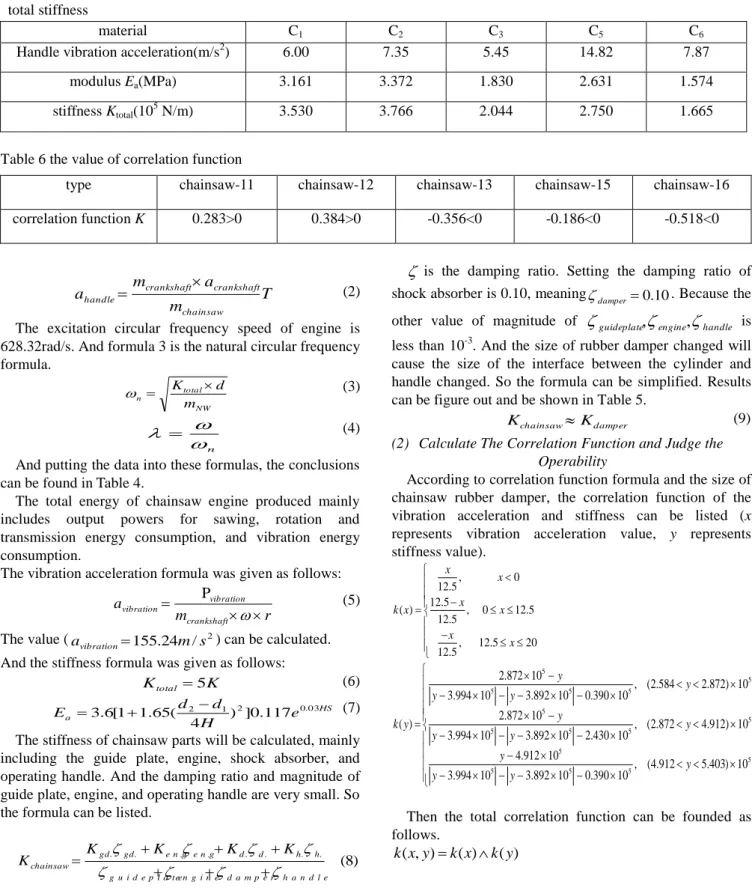
Table 5 the value of modulus, vibration acceleration, and total stiffness
Table 6 the value of correlation function
m T a a m
chainsaw crankshaft crankshaft
handle
(2)
The excitation circular frequency speed of engine is 628.32rad/s. And formula 3 is the natural circular frequency formula.
NW total
n m
d
K
(3)
n (4)
And putting the data into these formulas, the conclusions can be found in Table 4.
The total energy of chainsaw engine produced mainly includes output powers for sawing, rotation and transmission energy consumption, and vibration energy consumption.
The vibration acceleration formula was given as follows:
r a m
crankshaft vibration
vibration
P (5)
The value (avibration155.24m/s2) can be calculated.
And the stiffness formula was given as follows:
K
Ktotal 5 (6)
HS
a e
H d
E d2 1)2]0.117 0.03 ( 4
65 . 1 1 [ 6 .
3
(7)
The stiffness of chainsaw parts will be calculated, mainly including the guide plate, engine, shock absorber, and operating handle. And the damping ratio and magnitude of guide plate, engine, and operating handle are very small. So the formula can be listed.
) 8
. (
. . . . . . .
h a n d l e d a m p e r
e n g i n e g u i d e p l a t e
h h d d e n g e n g gd
gd chainsaw
K K
K K K
is the damping ratio. Setting the damping ratio of shock absorber is 0.10, meaningdamper0.10. Because the other value of magnitude of guideplate,engine,handle is
less than 10-3. And the size of rubber damper changed will cause the size of the interface between the cylinder and handle changed. So the formula can be simplified. Results can be figure out and be shown in Table 5.
damper
chainsaw K
K
(9) (2) Calculate The Correlation Function and Judge the
Operability
According to correlation function formula and the size of chainsaw rubber damper, the correlation function of the vibration acceleration and stiffness can be listed (x represents vibration acceleration value, y represents stiffness value).
, 0
12.5
( ) 12.5 , 0 12.5 12.5
, 12.5 20
12.5
x x
k x x x
x x
5 5
5 5
5
5 5
5 5
5
5 5
5 5
5
10 ) 403 . 5 912 . 4 ( 10 , 390 . 0 10 892 . 3 10 994 . 3
10 912 . 4
10 ) 912 . 4 872 . 2 ( 10 , 430 . 2 10 892 . 3 10 994 . 3
10 872 . 2
10 ) 872 . 2 584 . 2 ( 10 , 390 . 0 10 892 . 3 10 994 . 3
10 872 . 2
) (
y y y
y y y y
y y y y
y
y k
Then the total correlation function can be founded as follows.
) ( ) ( ) ,
(x y k x k y
k
material C1 C2 C3 C5 C6
dynamic coefficient 1.6 1.6 2.0 2.4 2.5
natural circular
frequencyn(Hz) 366.71 378.75 311.95 396.38 314.77
frequency ratio
1.713 1.659 2.014 1.585 1.996damping ratio 0.050 0.058 0.025 0.085 0.100
transfer function T 0.273 0.334 0.108 0.674 0.358
material C1 C2 C3 C5 C6
Handle vibration acceleration(m/s2) 6.00 7.35 5.45 14.82 7.87
modulus Ea(MPa) 3.161 3.372 1.830 2.631 1.574
stiffness Ktotal(105 N/m) 3.530 3.766 2.044 2.750 1.665
type chainsaw-11 chainsaw-12 chainsaw-13 chainsaw-15 chainsaw-16
correlation function K 0.283>0 0.384>0 -0.356<0 -0.186<0 -0.518<0
20 5
. 5 12 . 12
5 . 12 5 0
. 12
5 . 12
5 0 . 12
x x x x x x
5 5
5 5
5
5 5
5 5
5
5 5
5 5
5
10 ) 403 . 5 912 . 4 ( 10 , 390 . 0 10 892 . 3 10 994 . 3
10 912 . 4
10 ) 912 . 4 872 . 2 ( 10 , 430 . 2 10 892 . 3 10 994 . 3
10 872 . 2
10 ) 872 . 2 584 . 2 ( , 10 390 . 0 10 892 . 3 10 994 . 3
10 872 . 2
y y y
y y y y
y
y y
y
y
Simplifying the logic operation, it will turn into like that as follows.
( , ) ( ) ( ) min{ ( ), ( )}
k x y k x k y k x k y (10) Adding the data into the above formulas, it can figure out the value of vibration acceleration and stiffness, as shown in Table 6. In this Table, taking the second column for an example, the chainsaw-11 represents the new chainsaw with new rubber damper (use the material of C1, NR1152) and some new parts. That is because the change of the interface will cause the size of the related parts changing.
According to the calculated value of correlation function in Table 6, we can conclude the result. Only the corresponding program of k11(x,y)、k12(x,y) can meet the requirements. Then combining the weight of structural feature with the operability formula, the value can be figure out.
664 . 1 305 . 0 1 0 199 . 0 1 0 290 . 0 4
5
1
11
i
ti
i
264 . 1 305 . 0 1 0 199 . 0 1 0 190 . 0 4
5
1
12
i
ti
i
Because of 1112,
12will be chose, this means that the program of chainsaw-12 will be chose. And the new conversion bridge will be built.
mm Radius
Outer
mm Radius
Inner
mm Hight
Type Ring Shape
NR Meterial
Damper Rubber
l
12 5 . 5 12
1154
' 2
,
,
,
,
,
,
V. CONCLUSION
This paper has solved the conflict problem of chainsaw using Conversion Bridge of extension methods. Vibration and stiffness is the two important indicator of chainsaw, and the values of them directly influence the operability and safety. So this paper turned the two opposing performance parameters problem into co-existence one through the extension transfer towards the condition -element. Then the paper analyzed the case, which was used to explain the validity of the solution by using the bridge method. In the end, the new conversion bridge was established.
ACKNOWLEDGMENT
This project is supported by Program Funds of China (Grant No. 60970021), Natural Science Foundation of
Zhejiang (Grant No. Y1090364), and Science and Technology Department of Zhejiang Province of China (Grant No. 2009C32109).
REFERENCES
[1] WANG LP, Li S, Tian FY(1996)A noisy chaotic neural network for solving combinatorial optimization problems:Stochastic chaotic simulated annealing,” IEEE Transaction on Systems, Man and Cybernetics, 34(5), 2219-2125.
[2] Li T, Xiong GL (2001) Conflict resolution strategy based on optimization. 2001 IEEE International Conference on Systems, Man and Cybernetics. USA: IEEE, 2001. 1789-1794.
[3] Taratou Khinev (2002) Conflict management in computer supported collaborative design: The methodology and applications.
Proceedings of 2002 IEEE International Conference on Artificial Intelligence Systems. USA: IEEE, 2002. 152-157.
[4] Meng XL, Han XD (2005) Research on case-based conflict resolution system in collaborative design of machine tools. China Manufacturing Industry 34(10): l09-l12, l15.
[5] Ding YF, Hu YF, Sheng BY, Zhou ZD (2005) Collision-solution technique by integrating case-based and rule-based reasoning.
Mechanical Science and Technology 24(3): 256-260.
[6] Schliemann H(2008)Hand-help power tool i.e. blower, has protective device arranged on exterior side of housing, and has damping area protecting housing in area provided with openings from mechanical impact loads. Patent: US2008189903-A1; DE- 102007007182-A1; CN101255681-A.
[7] Woody JC (2008) carburetor e.g. diaphragm carburetor, for e.g. use in fuel pump, has bowl including closed end having inside bottom surface sloped generally downwardly away from pivot axis and low-lying collection area. Patent: US2008276911-A1; US7568472- B2.
[8] Atchley R, Buttery JL, Lucas DE, Shymkus RM(2010) Chainsaw has clutch that is connected to cam so that predetermined load is applied to guide bar for tensioning cutting chain. Patent:
WO2010005485-A1.
[9] Weinhold P, Wintrich P (2010) Two-stroke engine, particularly Otto-engine, comprises carburetor for external fuel-mixture generation, where intake air duct is connected upstream on air intake side of carburetor. Patent: DE102008038915-A1.
[10] Beauchaud F, Dominguez F, Guillot N (2010) Vibration isolation assembly for isolating vibrations of sheave from remainder of lift, has resilient layer made of elastomer defined between two rigid members for isolating one of rigid members from vibrations of another rigid member. Patent: WO2010013099-A1.
[11] Hoang N, Fujino Y (2009) Multi-mode control performance of nonlinear damper in stay cable vibrations. Structural Control
&Health Monitoring 16(7-8): 860-868.
[12] Mendes AS, Meirelles PS, Zampieri DE (2008) Analysis of torsional vibration in internal combustion engines: modeling and experimental validation. Proceedings of the Institution of Mechanical Engineers Park-Journal of Multi-Body Dynamics 222(2): 155-178.
[13] Dall’Asta A, Ragni L (2008) Nonlinear behavior of dynamic systems with high damping rubber devices. Engineering Structures 30(12): 3610-3618.
[14] Yang CY, Cai W (2007) Extension Project. Science Press, Beijing.
[15] Cheng DX, Wang DF, Ji KS (2004) Mechanical design. Chemical Industry Press, Beijing.