Promoting intergenerational
understanding through
Community Philosophy
Sue Porter and
Chris Seeley
October 2008
This report looks at how Community Philosophy can open
community conversations within and between generations about ‘nuisance’ behaviours and the fear of crime.
Community Philosophy is a way of mutual learning which emphasises the importance of questioning and enquiry in the development of understanding.
This study explores Community Philosophy in an intergenerational and residential environment, rather than the more usual context of schools and young people only. It:
introduces Community Philosophy and demonstrates how it can develop over time;
explores the activities and levels of participation of local residents, the team of philosophers, the project’s advisory group and the project management;
examines emerging themes and the extent to which philosophy is an appropriate tool for developing relationships in the community;
discusses, through project workers’ stories, issues for supporting Community Philosophy practitioners and engaging and
developing trust within the community.
•
•
•
2 Contents
Contents
Foreword
00
Section 1 The evidence on rural housing needs in
Wales
00
Contents
1 Introduction and background
5
2 What does Community Philosophy look like
in practice?
7
3 The evaluation
12
4 The findings
15
5 The participants’ story
18
6 The project workers’ story
20
7 Learning points, recommendations and
final conclusions
26
Notes
31
References
32
Appendix: The most significant change (MSC)
List of figures and tables
List of figures
and tables
Figures
1 Number of events per month 8
2 Number of participants per month 10
The age profile of participants 10
Tables
Chapter heading
1 Chapter title
Chapter subtitle
Anti-social behaviour, and the rise
of fear of crime
Fear of crime is a complex issue, made up of a mix of both perceptions and experience. Reduction of fear of crime is high on the government’s policy agenda and is a priority for both policing and local authorities, for whom it is a performance indicator. The reporting rate of fear of crime has fallen from a high of one in four respondents being particularly worried in 1998 to one in six in 2005/06. However, many people perceive that crime rates are rising, with one in three reported as thinking that there is a lot more crime than there was two years ago. Just under one in five adults think anti-social behaviour is a problem in their area (Crime Reduction and Community Safety Group, 2006).
The highest rates of reporting of fear of crime come from those on low incomes, in social sector housing and/or in inner-city areas, and young people. However, the largest numbers of complaints of anti-social behaviour to police forces are likely to come from middle-class areas with high levels of owner occupation (Christmann and Rogerson, 200). The most common type of perceived anti-social behaviour reported is that of young people ‘hanging around’.
Academics and regeneration practitioners have long attempted to define fear of crime, and to separate the community member’s more personal fears from more general judgements and perceptions. A growing body of research suggests that fear is not a necessary consequence of crime victimisation, but is a compound of different insecurities – perceived or experienced in certain environments, and should therefore be viewed as an aspect of quality of life.
Results from many recent public surveys on crime and policing in the UK (eg Bland and Read, 2000) show that, as well as prioritising more serious crime, the public places a high priority on police tackling less serious incidents including anti-social
behaviour, incivility, minor disorder and quality of life issues.
Police campaigns to reduce anti-social behaviour and visible signs of disorder, if
successful, can lead to decreased public fear of crime, increased public confidence in the police and a reduced incidence of more serious crime (Wilson and Kelling, 1985).1 However, the potential
sensitivity of certain policing approaches to anti-social behaviour for community relations is an issue. Police actions may be interpreted differently by different sections of the community, ie those considering themselves ‘victims’ of the behaviour and the young people themselves and/or their parents who may have legitimate concerns that their actions do not merit police attention.
One pragmatic response to gaining a deeper understanding and acceptance of these multiple interpretations of an event or incident is to invite and support conversations that otherwise would not have happened between the generations.
The context
The Thinking Village project was designed to promote intergenerational understanding, through promoting conversations and relationships
between disaffected/dissatisfied young people and disaffected/dissatisfied adults in a neighbourhood managed by the Joseph Rowntree Housing Trust (JRHT) This neighbourhood is called New Earswick, a garden village in York.
The neighbourhood has relatively low levels of crime and disorder, and relatively high levels of anxiety about them. Managers at the Housing Trust were concerned to reduce both nuisance levels and anti-social behaviour, and to increase levels of tolerance of younger people’s presence among the wider population. The project aims were outlined as being:
1 Introduction and
background
5
Introduction and background
To promote wider community conversations (especially between generations and especially about controversial issues) that could be enjoyed for their own sake, could provide a medium for learning, could act as a stimulus for action, or could be valued in other ways.
Through the conversations and actions, to develop relationships within the community (especially across the generations) and across professional groupings; to enable groups to work with each other, even around issues of potential conflict; and to generate enough momentum to enable dialogue to become self-sustaining.
The project intended to achieve these aims by applying the techniques of Community Philosophy. The support for the project extended to three years, the second year of which was subject to (this) evaluation.
Community Philosophy
Community Philosophy developed from an approach called Philosophy for Children.
Originating in the US, it was developed by Professor Matthew Lipman and associates at the Institute for the Advancement of Philosophy for Children, Montclair State College, New Jersey. Lipman emphasised the importance of questioning or enquiry in the development of reasoning, and proposed that we learn to think in much the same way as we leant to speak, that is by internalising the patterns of thought and speech that we hear around us – thinking for ourselves is, in effect, borrowing the language of others to talk to ourselves.
From this, Lipman developed a new model of learning, which he named ‘Communities of Enquiry’, in which teacher and learner collaborate with each other to grow in understanding of the material, ethical and personal worlds around them. Enquiry is interpreted as going beyond information to seek understanding – this is the key practice that starts and drives the whole thinking process; and the key practice that results in significant changes of thought and acting in the world is that of reflection.
•
•
This approach was demonstrated to:
increase children’s reasoning powers, reading and mathematical skills, and speaking and listening skills;
raise their self-esteem; and
enhance their ability to become independent learners.
Practitioners have aspired to transfer this model from the classroom to community settings, so creating ‘Community Philosophy’. It is this way of working with Communities of Enquiry that has been introduced into the neighbourhood and forms the basis for community problem solving and intergenerational dialogue under the title Thinking Village.
•
•
6 Chapter heading
1 Chapter title
Chapter subtitle
Community Philosophy in practice isn’t just sitting down for a chat; the facilitators are persistent in opening, then deepening and personalising, the conversation. Instead of generalisations about ‘we’ or ‘they’, the facilitators probe for personal responses, asking ‘what do you think?’, ‘what is your experience?’ The facilitators need to be attentive and responsive, constantly questioning and adapting their interventions to deepen the conversation and invite all participants to join in. Facilitators use a range of stimulus material to initiate conversations, ranging from children’s books, to photographs, newspaper articles and stories. We understand that the Thinking Village project has also used creative activities – drama, art, photography and outdoor experience – to stimulate discussions via Communities of Enquiry.
The process is one of robustness and resilience to keep bringing the dialogue back to meaningful and challenging conversational ground. In this project, observation of the Community Philosophers demonstrated:
on-the-fly, demanding, moment-by-moment attention and flexibility;
a high degree of resilience to facilitate ever shifting, sometimes faltering and sometimes tough, angry and opinionated dialogue;
a sense of lightness and humour in response to the ordinariness of much of the conversation:
Facilitator: ‘Can you remember the last time you were happy?’
Participant: ‘Not me love, can’t remember what I had for lunch’
This chapter gives a flavour of what the Thinking Villageproject, which took place between January and December 2007, was about, drawing on the project’s own monitoring material and reflections.
•
•
•
Monitoring data
Data from team monitoring sheets during 2007 showed that 159 sessions were recorded in total, of which 89 (56%) were recorded as ‘Communities of Enquiry’, and 70 (%) as ‘Other Activities’ (such as meetings with volunteers). It was later acknowledged that there had been some confusion between these terms and the distinction between what was and was not a Community of Enquiry event is thus less than clear.
However, the broad picture implies that Communities of Enquiry (depending on how they are understood and defined) need to be supported by up to as much again of other activities and meetings in order to be initiated and maintained.
Levels of activity
Most sessions (over 90%) took place on weekdays although, of these, over 0% were timed for evenings. Thirty per cent of meetings and events were facilitated by one team member working alone, including nearly half (9 out of 89) of the Community of Enquiry sessions.
The number of events per month gradually accelerated as the year progressed, (with a clear drop-off when a team member left at the end of February, and when team members were undergoing training and taking annual leave) (see Figure 1).
The scope of conversations
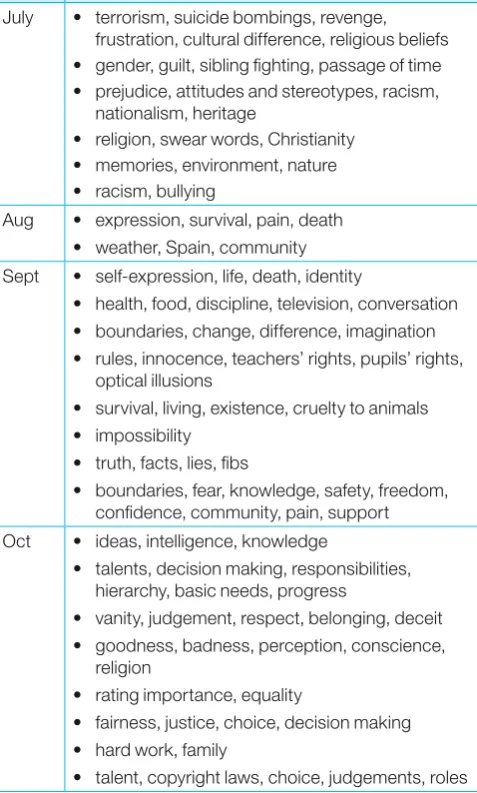
The monitoring information captured the nature of discussions held (see Table 1). This range offers evidence that the team were able to convene conversations that were (a) philosophical, (b) potentially conflictual and (c) controversial.
Participation rates
Of the recorded events, 112 (70%) took place with or as part of groups that regularly met. These
2 What does Community
Philosophy look
like in practice?
7
What does Community Philosophy look like in practice?
2007
Number of events r
ecor
ded
0 5 10 15 20 25
Dec Nov
Oct Sept
Aug July
June May
April March Feb
[image:7.595.65.537.67.394.2]Jan
Figure 1: Number of events per month
Month Sessions addressed questions of…
Jan • football, tribalism, hooligans, media violence
• change, getting older
• littering, environment, recycling • jealously, friendship
• thinking, sharing • bullying
• change, prejudice, death • facilitation
Feb • supervision, expansion, trust
• parental control/responsibility, ‘poshness’, prejudice, self-image
• lying, rudeness
• police behaviour, being arrested, accusation, being searched, human rights
• ‘grassing’, telling tales
• responsibility, prejudice, fairness, rights, equality, security, information, making decisions • formality, informality
March • film piracy, theft, morality, grey areas, honesty, dishonesty
[image:7.595.62.538.76.717.2]• perceptions and realities, community involvement, relationship with housing trust
Table 1: Nature of discussions held
Month Sessions addressed questions of…
April • animal rights, human rights, disabled people’s
rights, fairness and choice • daydreaming, imagination
• cheating, strategic decision making, ‘fair play’, rules, support, rights and wrongs
• happiness, sadness, memories, ghosts
May • employment, apprenticeships, equal pay, living
standards, debt, medicine and health • leadership, fairness
• realism, art, imagination, nature, earth’s resources
• community, disaster, philosophy, engagement
June • disease, guilt, ideas, cheating, perfection
• fear, emotion, evil, drugs, sin, embarrassment • homosexuality, legalities of sexual conduct,
swear words
• bombs, bad luck, risk, rejection, theft, ownership, knowledge, memories, happiness, humour
• metaphor, storytelling, communication, misfits, belonging
• addiction, escapism, stress, coolness
• life context, self-change, subconscious values, mental illness, awareness
8 What does Community Philosophy look like in practice?
included both regular meetings and shorter-term events involving the same groups, as well as regularly scheduled sessions that had varying participation rates – for example, street-based work. The remaining recorded activities were one-offs, such as volunteer planning meetings and seasonal events.
There was no clear pattern to the number of people participating in the project over the course of the year. Although Figure 2 outlines participation per month, a one-off community event with around 170 attendees accounted for the peak in July. There was also no apparent correlation between when a meeting was held and how many people attended. For Communities of Enquiry sessions, the mean attendance was nine people and the median six,
with numbers ranging from none at all to around 100 attendees.
In all, a total of 1,55 participant attendances were recorded. Although some of these people will have attended more than one event, the numbers of participants at some of the open events (for example the ‘Philo-bus’) were not always captured. When compared to a total population estimate of around ,500, the figures suggest that the project touched a notable proportion of the local community during this year of its operation.
Profile of participants
[image:8.595.50.289.83.480.2]The age profile of participants at particular sessions is illustrated by Figure .
Table 1: Nature of discussions held (continued)
Month Sessions addressed questions of…
July • terrorism, suicide bombings, revenge,
frustration, cultural difference, religious beliefs • gender, guilt, sibling fighting, passage of time • prejudice, attitudes and stereotypes, racism,
nationalism, heritage
• religion, swear words, Christianity • memories, environment, nature • racism, bullying
Aug • expression, survival, pain, death
• weather, Spain, community
Sept • self-expression, life, death, identity
• health, food, discipline, television, conversation • boundaries, change, difference, imagination • rules, innocence, teachers’ rights, pupils’ rights,
optical illusions
• survival, living, existence, cruelty to animals • impossibility
• truth, facts, lies, fibs
• boundaries, fear, knowledge, safety, freedom, confidence, community, pain, support
Oct • ideas, intelligence, knowledge
• talents, decision making, responsibilities, hierarchy, basic needs, progress
• vanity, judgement, respect, belonging, deceit • goodness, badness, perception, conscience,
religion
• rating importance, equality
• fairness, justice, choice, decision making • hard work, family
• talent, copyright laws, choice, judgements, roles
Month Sessions addressed questions of…
Oct
(contd) • anger, sadness, perceptions, moods• disability, respect, appearances
• growing up, separation, grief, imagination, rules, companionship, responsibility
• stereotypes, drugs, gangsters, racism, image
Nov • love, lust, vanity, tolerance, acceptance
• tricking, age
• children and culture, children and eating • respect, achievement
• respect, control, media, stereotypes, perceptions, opinions, fairness
• fear, control, survival, team work, celebrity • children’s imagination, culpability, growing up • happiness
• randomness, normality, discrimination
Dec • provocation, annoyances, hindsight,
consequences, anger • commercialisation, children
• knowledge, education, progress, history • Santa, Jesus, likes and dislikes, proof, faith,
belief
• love, partnerships, homosexuality • choice, romance, control, stereotypes • God, Christmas, punishment
• kindness, enjoyment, toilet training • punishment, fostering, employment law,
9
What does Community Philosophy look like in practice?
The highest proportion of single age bracket groups to meet were teenagers, with a very slightly lower proportion of groups meeting who were of mixed age. Most of the sessions involving participants from a mixture of age groups
combined older people and teenagers, or younger people with active (not ‘neutral’) adult volunteers. This indicates that the work carried out has focused (albeit unintentionally) on the teenage age group. It has been far harder for the project to engage with mid-age adults.
Where recorded, 9% of participants were male and 51% were female, and there was no clear pattern of gender mix over time. However, the gender of participants was captured relatively rarely; this aspect of profile could usefully be built in to systematic monitoring in the future.
Working in context over time
The following two accounts, drawn together by the project workers, give a flavour of what has been involved in applying these techniques within the context of the project.
2007
Participants r
ecor
ded
0 50 100 150 200 250 00
Dec Nov
Oct Sept
Aug July
June May
April March Feb
[image:9.595.64.537.83.380.2]Jan
Figure 2: Number of participants per month
Primary school children
Teenagers
Mid-age adults Older
people Mixed
age groups
[image:9.595.50.289.563.755.2]10 What does Community Philosophy look like in practice?
Work with young people
PhilosophyU, a young people’s group, grew out of what had been called the Police Advisory Group. Supported by the Community Philosophy project, this had formed in response to a Dispersal Order that had been implemented in the area, and provided a forum for dialogue between young people and the police.
The group of young people involved would fall into the category of ‘at risk’ in terms of social exclusion, and began with quite negative perceptions and experiences of the police. They were given time to explore their views and research their rights before any contact with police officers took place; something that also provided them with the opportunity to facilitate workshops and philosophical sessions within the group, extending these city-wide in youth groups to gather the views of other young people.
These wider views were represented, along with their own, when the project hosted a ‘speed-dating’ event with police officers where young people had the opportunity to ask the questions they had spent time formulating and articulating. As well as being positively received by the police, the young people reported enjoying the project and claimed to have changed their views: ‘I will never look at the police the same again’.
Rather than dissolving, the group developed into PhilosophyU, and were joined by a younger cohort who had been involved in a separate community initiative supported by the Community Philosophy team. The group holds regular sessions and has tackled some challenging philosophical questions around issues such as the background to addiction, and the oft-posited association between terrorism with Islam.
Intergenerational work
A group of young people recruited through street-based work were introduced to a group of older people living in a local sheltered housing and care home facility.
The initial focus of their shared philosophical discussion built on a joint visit to the National Media Museum. This was followed by the older people inviting the younger people into their scheme to play a game of carpet bowls.
The different age groups have continued to meet on a monthly basis for activities and subsequent philosophy session, facilitated by the project team. Examples include shared exploration of views around homosexuality (prompted by a theatre outing); a debate about farming and animal activism; and the use of drama techniques to explore local and societal stereotypes. As time has gone on, discussions have become more challenging and robust.
In addition, and independently of the project, young people continue to attend a weekly bowls night at the older people’s scheme. This has carried on even though the original group of young people are no longer involved; a new cohort of young people has taken their place.
11
Chapter heading
1 Chapter title
Chapter subtitle
The Joseph Rowntree Foundation’s (JRF’s) aim for this evaluation study was:
to support and assist the project team in
developing their own systems of monitoring and recording, and their own framework for self-evaluation.
The evaluators were also asked to:
independently assess the success or otherwise of the project in meeting its stated objectives;
assess the contribution of a ‘Community Philosophy’ approach in achieving success or otherwise;
consider, if judged successful, how the project and/or approach could be replicated and made visible to others.
An additional aim was to offer an evaluation process that:
worked with pre-existing networks to reach into the community;
took a creative approach, congruent with and building on the existing project;
provided a ‘safe’ space in which to speak out and for shared reflection;
was congruent with the values of the Thinking Village approach, ie was participative, inclusive and able to access multiple ways of knowing without privileging intellectual knowledge or presentation, respecting that people learn with their ‘whole selves’;
developed both bonding and bridging social capital (Putnam, 2000);
did not contribute to ‘participation fatigue’.
•
•
•
•
•
•
•
•
•
•
In these ways the evaluation process was intended to be formative (informing the project process as it unfolded), as well as summative (collecting data to tell the story of and make sense of the whole).
Evaluation approach
For the evaluation of the Thinking Village project we proposed using the most significant change (MSC) technique (Davies and Dart, 2005) (see the Appendix). This is a participative story-based monitoring and evaluation technique that promotes dialogue between stakeholders. The technique is participatory in that many stakeholders (young people, residents, agencies, project staff) are involved both in deciding the sorts of change to be recorded and in analysing the data. It is a form of monitoring because it can occur throughout the project cycle and provides information to help people manage the programme. It is evaluation because it provides data on impact and outcomes that can be used to assess the performance of the programme as a whole.
Essentially, the process involves the collection of critical ‘significant change’ stories emanating from the field, and the systematic selection of the
most significant of these stories by stakeholders. We believed that this approach to evaluation would build on and complement the existing work of the Thinking Village project by continuing to stimulate conversation, dialogue and leadership between generations.
However, our evaluation approach became naturalised. The MSC technique collects stories from multiple levels of the community of research, passing these up the hierarchy in a process that seeks significance. Our experience was that it was impossible to use this methodology in its ‘pure’ form. Just as the method of the Community Philosophy project itself needed to adapt to the context (see Chapter Four), so too did the method of the evaluation … the result is a cumulative collection of many glimpses rather than a collection
3 The evaluation
12 The evaluation
of rounded stories. So, we have concluded, perhaps the rounded story needs to be built up from the different fragments that are available.
For both the Community Philosophy project and the evaluation there have been no moments of Eureka!; what there has been is a lot of sensitive practice and some unforeseen aspects.
Evaluation activity
During the 12-month evaluation period we visited New Earswick on seven occasions, usually staying for two days at a time. During these visits we met with the Community Philosophy facilitators, the Community Philosophy participants, the project managers and supervisors, and the wider group of people convened by JRF to advise the project and the evaluation.
Participants/residents
We met with key groups to discuss the most significant changes for them in relation to the project, and to collect the stories of significant change that they related to the Community Philosophy process/activities. This included meeting with young people who were members of the Police Liaison Group (as well as the police who had been involved with their activities); and attending a session with older residents at a local sheltered/care facility (both described in the previous chapter). It also involved talking with participants at some of the ‘open to everybody’ sessions – the ‘Philo Bus’ and ‘Café Philo’, and had conversations with people of all ages at other times when they were not actively engaged in Community Philosophy activities.
The Philosophers/project team
We met with the project team of Philosophers on each visit to New Earswick. The meetings took the form of the team telling stories to illustrate the project’s progress, including its challenges. These meetings and discussions took the form of half-day sessions, plus additional discussions in the context of Community Philosophy activities. The evaluation team also offered a reflective space to team
members in which they could ‘make sense’ of their experiences, which feedback suggests was valued.
The Advisory Group
On four occasions, the evaluators also met with, and presented updates to, the Advisory Group that had been selected and appointed by JRF to guide and advise the project and its evaluation. This group included the project workers (Philosophers), their line manager, two advisors on Community Philosophy, a practitioner from a similar intergenerational project, and a number of other stakeholders and advisors. Having such a group was very helpful for the evaluation team, not only in their role as advisors and experts, but as a group to whom the evaluation team could bring the stories that they collected from community members and the project team and others, as part of the MSC process. Meetings were highly participative, with the evaluation team presenting the work done, highlighting the questions the evaluation was raising and identifying learning for the project; and the Advisory Group engaging in robust discussion.
Managers
In addition to meeting with the project team we had discussions with the Philosophers’ line manager and with an advisor who was offering the project team critical reflection sessions with an emphasis on the methodology of Community Philosophy. We also had meetings with the research manager from JRF.
As a result of our observations and discussions we took our reflections and recommendations regarding ongoing support and supervision for the project team to the Advisory Group at our mid-term meeting with them (this is an example of the formative nature of the evaluation). Subsequently, the team was offered some different types and levels of support, and some aspects of their management were clarified.
Evaluators’ questions
1
The evaluation
project workers and the project’s Community Philosophy advisor provided basic information, and our questions evolved to include issues about the application of this technique to the issues of tolerance and nuisance, and the transfer of a methodology from an education setting to that of a whole community.
We also started to wrestle with questions of the application of our chosen methodology in this context. We were convinced that storytelling would be an approach congruent with the methodology of Community Philosophy, but we were rapidly finding that the hierarchy and structure assumed by the ‘pure’ MSC method was not in place in the system. We could not apply our chosen tool rigidly without unsettling the balance within the community that the project we were evaluating was working with. We did not consider it appropriate for the evaluation tool to dictate and shape the actions of the project as a whole. Just as the Community Philosophy team had to be pragmatic, so did we, and we adapted our response accordingly.
We began to ask ourselves and the Advisory Group whether the focusing question for the project was: ‘How do we do Community Philosophy
really well?’ or ‘How do we work with issues of intergenerational tolerance and nuisance really well?’. The former could require the project to apply the method to multiple issues, as they arose in the community; the latter could require addressing the single set of issues around ‘nuisance and tolerance’ through multiple methods. While we found that we were gathering evidence of the project’s effectiveness in relation to both questions, it became clear to us that the project was struggling to produce results in both areas simultaneously.
By the mid-point of the evaluation, we were identifying three areas of interest that related to this potential dilemma between Community Philosophy as a methodology (a demonstration project) and the Project as being there to address issues of nuisance and tolerance (a pilot project). These were:
practice matters (eg was it valid to have
developed a ‘naturalised’ model of Community Philosophy?);
•
structure matters (eg was the tool or the issue most important?); and
context matters (eg what bearing did the unique setting of the project have?).
We were also noticing that: ‘The project has not yet got as far as participants using the skills they have learned to address the issue of intergenerational tolerance and nuisance directly’ and asking ‘How will the project now apply its energy to facilitating this?’
The next chapter, which looks at our findings, demonstrates that these were core issues for the project, and for the evaluation.
•
1 Chapter heading
1 Chapter title
Chapter subtitle
As noted above, the evaluation approach was both ‘formative and summative’. By this we mean that the findings, observations and reflections of the evaluation team have been shared with the project team, their managers, the Advisory Group, and the project commissioners as the evaluation has progressed. In this way the evaluation has aimed to influence the project’s development through posing inquiring questions and encouraging shared reflection, as well as producing this final report.
The next two chapters of the report reflect the sources (and therefore the perspectives) of the stories we have gathered from participants and facilitators. We have included their words to illustrate points made through the stories told to us, and shared by us with other stakeholders across the project. This chapter covers more general and overarching issues and learning points, and also includes the words of the various stakeholders. Because of the sense-making role of the Advisory Group meetings in the MSC approach, many quotes are drawn from this source.
General and overarching issues
Overlapping roles for the project
The Thinking Village project has been both a pilot project (a short experimental trial assessing the feasibility of a wider roll-out of Community Philosophy in a particular neighbourhood) and
a demonstration project (a project acting as a reference example to inform practitioners outside of the community – both within JRHT and JRF and on a wider basis).
As a pilot project it has explored the
effectiveness of using Community Philosophy as a tool to address the issues of reducing nuisance and increasing tolerance in New Earswick. As a demonstration project it has researched what it means to use a philosophy approach in a
community setting, and as such has experimented with ‘naturalising’ the original Philosophy for
Children approach to make it more appropriate and sustainable in this setting.
In our opinion these two distinct and
overlapping roles for the project have not always been clearly distinguished, and the project has sometimes struggled to address the tensions between purpose, process and content in the work.
Is philosophy the appropriate tool?
The aims of the project, as outlined in Chapter 1, were:
To promote wider community conversations (especially between generations and especially about controversial issues) that can be enjoyed for their own sake, can provide a medium for learning, can act as a stimulus for action, or can be valued in other ways.
Through the conversations and actions, to develop relationships within the community (especially across the generations) and across professional groupings; to enable groups to work with each other, even around issues of potential conflict; and to generate enough momentum to enable dialogue to become self-sustaining.
It is interesting to note that the original aims have been translated into a sort of shorthand across the project; when we have spoken to team members, to managers and at some Advisory Group
meetings, the mantra of reducing nuisance and maximising tolerance has come to be the short-form of the project’s objectives in common use.
Our research and discussions lead us to be able, at this stage, to claim that Community Philosophy is an interesting tool to open up broad, and sometimes deep, conversational space, which, in itself, may or may not lead to discussions about
reducing nuisance and maximising tolerance.
We also claim that such discussions, should they arise, are sufficiently thorough to be capable of triggering subsequent behaviour change – or at least lead someone to think twice before acting habitually around these issues of nuisance and tolerance.
•
•
4 The findings
15
The findings
Is tolerance a good thing?
More fundamentally perhaps there is the question as to whether this aim of increasing tolerance was an appropriate one for a philosophy project:
‘Someone is not being a nuisance unless someone else is being intolerant.’ (Advisory group member)
‘Some of the people we are talking about have spent a lifetime of not having to face their own behaviour.’ (Facilitator)
‘If you have critical people, ethical people, you will probably become less tolerant, because actually you say, “Hang on a minute, that’s not right – we should not be doing that”. So I don’t think we can just look at this project in order to say we actually want more or less tolerant people – I think we are asking the wrong questions.’ (Advisory group member)
‘In community development, we say “No racism!”; in Community Philosophy we say, “Validate your racism. Speak for racism. Let us interrogate you!”’ (Advisory group member)
The dual nature of the Thinking Village project, as both a demonstration project for community-based philosophy and as a pilot project seeking to address anti-social behaviour issues in New Earswick, has led to an ongoing confusion as to what constitutes success for the project.
One important aspect of this confusion relates specifically to the declared aim of the project to ‘maximise tolerance and minimise nuisance’. There was discussion in the Advisory Group about perception versus reality; intolerance versus crime and disorder, and about the applicability of Community Philosophy to the (lower) levels of nuisance found in the village (as compared to some urban areas).
‘This [Community Philosophy] seemed to be particularly useful in terms of the intolerance agenda, rather than the crime and disorder agenda – the hypothesis that this is something that can be more encompassing, rather than
simply focusing on one set of issues around one sort of population.’ (Advisory group member)
‘The need for clarity of the purpose of the project appeared repeatedly in discussions with the Advisory Group, the Philosophers and their managers: Is it resolving the problems that we want to test here, or is it the unpicking, the process of orientation that is really at the nub of what we are trying to research here?’ (Advisory group member)
Perhaps, for the Thinking Village project the issues have moved on since the project was first conceived. The Dispersal Order that was implemented in the neighbourhood created its own impact on relationships within the community and between parts of the community and JRHT. The sheer number of contacts between community members facilitated by the project is likely in itself to have had an impact of lessening the sense of alienation between some members of groups in the community as they have come to together in debates and socials. As one member of the Advisory Group observed:
‘Community Philosophy is a tool that can help unpick these issues in a much more meaningful way, now the anti-social incidences have calmed down.’ (Advisory group member)
And one of the project workers commented:
‘In effect it is like a mediation between some members of the community and other members of the community, like young and old, or different beliefs. In a way it has parallels with things like counselling, except you are doing it for a community rather than an individual. It’s been a catalyst really of change; it’s kind of helping people compromise with each other.’ (Facilitator)
16 The findings
philosophy sessions have not been forthcoming from the community. The levels of property ownership, development and responsibility taken by JRHT for residents’ well-being mean that in this neighbourhood, more than most communities, it is clear who is perceived to have the power to set agendas. The project is also based in a building that is shared with management staff from JRHT. It may have been better for the project to be based in a more neutral building in the neighbourhood.
The effects of social policy
‘Social policy is a blunt instrument.’ (Advisory group member)
The importance of the housing policy changes that led to a number of more vulnerable families being housed in the village were identified by local residents, the project team and the Advisory Group. Some more established residents lamented the decreasing number of middle-class professionals living in the village and saw the incomers as largely uneducated.
‘[Y]ou are getting riff-raff in, that’s the basic insinuation.… When the social housing policies opened up to take on the most vulnerable, Joseph Rowntree lost control over who they could invite and who they couldn’t, there was a huge thing felt by those who’d been the chosen few, to suddenly have all these council tenants thrust upon them.’ (Facilitator)
The Community Philosophers identified this as a source of stress for some residents who resented the changes, and the change in policy meant that more families with young children were housed in the village, changing the age profile of the population.
Developing relationships in the community
The Thinking Village project has succeeded in developing relationships and dialogue across generations. We are more cautious about the potential for many of these relationships to be self-sustaining beyond the life of the project.
However, we would question whether this is always appropriate or realistic: people are likely to engage
with Community Philosophy when it has meaning for them, rather than take part in debates on a regular basis; in addition, because the focus of the project has been on intergenerational dialogue, the membership of the groups involved changes: young people grow up and move on and older people become less socially active and eventually die.
The sustainable element that we have observed is the way that some participants have taken philosophical practices into their everyday lives (see the next chapter). In this way the project can have a lasting effect on individual behaviour and practice.
17 Our aim has been to collect stories from people
participating in a range of Community Philosophy projects. As evaluators we had direct contact with participants during Community Philosophy activities and in more casual conversations. We also recorded some participant’s stories as told by the Philosophers. Our starting question for participants was: ‘tell us a story about a time, a memory or an event when something you thought was significant happened that related to this project’. From these conversations we have gathered a number of views about the project and its significance for participants. These views influenced the conversations we had with the project team and the Advisory Group.
Community Philosophy in everyday
life
We were interested to understand whether project participants identified benefits from engaging in the Community Philosophy project that lasted beyond a specific activity. Conversations with participants suggested that most understood that Community Philosophy was about developing different ways of thinking about and questioning their own and others’ assumptions, as the following example of a conversation about approaches to parenting demonstrates:
Evaluator: ‘Well it sounds like it made the basis of a good night out.’
Participant: ‘A laugh.’
Evaluator: ‘A laugh, but maybe a thoughtful laugh…?’
Participant: ‘Yeah. Afterwards, we were talking about X and his wife and how to bring up your kids. It did get meaningful. It sort of carried on into everyday life situations.… It’s what you get out of life.’
Community Philosophy and general
benefit
A range of benefits from participation were identified, as the following extract illustrates:
‘[The Community Philosophers] are really interesting. If they weren’t coming, we should really miss it.… Because it keeps your brain active, an’ all.’ (Participant)
And when members of an older group were asked:
‘Do you think doing this has changed the way you see things outside of the session?’
the following answer was typical:
‘Yes I think it does. You are maybe looking for things that are taking place that you maybe wouldn’t normally look for or take notice of.’ (Participant)
Another participant at a Café Philo event commented:
‘I go home and think about things like this and have a really good think.…’ (Participant)
Community Philosophy and
enjoyment
Discussions with participants suggested that a range of venues were considered by them as appropriate for Community Philosophy, including a function room in a nearby pub. Conversation with participants led us to conclude that they are aware of the difference between dialogue and a chat, but also see that Community Philosophy can be undertaken in relaxed social settings as an extension of the skills they have acquired through activities based on specific stimuli.
5 The participants’ story
18 The participants’ story
Participant: ‘Where [the Café Philo] was, was more appealing than where it normally is.’
Evaluator: ‘What was appealing about that one? Tell us a bit about what happened last time.’
Participant: ‘You can have a drink.’
Evaluator: ‘And do you think that makes a difference to sitting and wanting to talk in that way – that a drink helps?’
Participant: ‘Yes, because you talk a bit more freely once you’ve had a drink [laughs]. It sort of lubricates things, maybe. I persuaded my friend to come along and she brought her partner. She wasn’t going to go and then he decided he was going to go, he was thinking of a pint, so we all went together. So it was a laugh.’
Community Philosophy and greater
understanding
Listening to the stories participants told about the changes/benefits they associated with Community Philosophy leads us to believe that it can improve understanding between groups in the community:
‘I go home and think about things like this and have a really good think.… Not just that, but it’s the way that it’s brought out the best in the residents at X, plus the fact that [the project team] have brought in children, and this is really, really important, because if you talk to an 80-year-old in X, they will say to you, ‘I never go out in the dark, I daren’t go out in the dark’. So what I think we were all trying to do was say to the children, “These are old people and they are not as stupid as you think they might be”. And say to the old people: “These are young people and they are not all tearaways and thugs”.’ (Volunteer worker and participant)
A project worker told us a story of an occasion when one older resident had offered her services as a ‘listening ear’ to young people she had met through the project who were having problems at home:
19
Chapter heading
1 Chapter title
Chapter subtitle
The Community Philosophy team employed to initiate, facilitate and maintain this work faced a threefold challenge in their work:
addressing the tensions between purpose, process and content;
pioneering the practice of Community Philosophy in this overall community context, rather than within the context of schools alone;
engaging and developing trust within the community.
Addressing the tensions between
purpose, process and content
This has manifested in a shifting emphasis between directly addressing fear and nuisance issues and allowing the range of philosophical discussion to emerge and, consequently, unclear ‘success’ criteria for the team to work to. The team of facilitators have shown great resilience and responsiveness over time to the uncertainties of their context and have lived with emergence1 in a complex, changing setting.
For example, the distinction between Community Philosophy and community development work was a recurring theme in Advisory Group meetings:
‘What, according to the Advisory Group, is actually this project about? ... The philosophical nature of the project is not apparent yet for many people involved in this project. How come that is the case? ... What perhaps up to this point have we not been doing which we should have been doing at an organisational level?’ (Advisory group member)
The question and the subsequent discussion suggested that there was no common agreement or understanding about Community Philosophy within the group, only some of whom had
•
•
•
6 The project workers’ story
witnessed the project team ‘in action’. Our
discussions with the project team, their managers and participants would lead us to believe that this lack of a common understanding was shared by others, and caused difficulties for the project team when they sought management support and supervision for their practice. There were also instances of positive pragmatism being interpreted (by members of the Advisory Group) as ‘lapses into community work’.
However, the Philosophers themselves were clear that they had come to understand the difference between Community Philosophy and community development work, and in fact had found that working with Community Philosophy had changed them personally.
‘[I]t’s different because you can’t switch off, it changes you for life.’ (Facilitator)
But they agreed that they had found it hard to get appropriate levels of support and training to translate an education-based tool into a community setting.
Moreover, the experimental nature of this project and consequent lack of clarity meant that it was not always clear what ‘success’ was for the project: was it reducing nuisance/increasing tolerance or was it piloting the use of (community) philosophy in a community setting and recording the experience?
Pioneering Community Philosophy
practice in a community context
One of the most pioneering aspects of the project has been the way in which the Community Philosophers have adapted the education-based tool of Philosophy for Children to be used in a community setting. The Thinking Village is not entirely alone in using the approach in a setting other than that of a school, but it is one of only a very small number of projects doing so. The advisory input of someone working in a similar
20 The project workers’ story
initiative (using philosophy with older people as part of an intergenerational project) has proved invaluable to the team.
After attending a conference, and later training organised specifically for the team, the Community Philosophers described the model used by others as still being ‘too schoolish’ for more general use. Initially this appeared to pose problems for the team. However, over the year we observed them growing in the confidence to adapt the model to the setting in which they are working. It has become a model of philosophy better suited to the groups and the opportunities for engagement in the particular locality, and this has meant the evolution of a form of the work that has been naturalised to fit the context.
The original vision for the project thus differed from this more pragmatic and opportunistic
approach adopted by the Philosophers in response to the challenges they met on the ground:
‘[It’s been] fireworks versus chinks of light – I just thought it came over particularly in the affirmation of the workers ... how the nature of the project might be a different nature to what had been envisaged at the start.’ (Advisory group member)
The development of a community-based Community Philosophy method, such as the democratic approach developed by the project team, requires a project to be clear about the values it is working with:
‘What are the values that we are operating with, and what are the understandings that we have got that we are trying to operate attached to those values? – which we agree are absolutely crucial and are at the heart of this.’ (Advisory group member)
The ‘adaptation’/evolution of the model has involved the workers developing the approach, using their values (ensuring the process is democratic and responsive to participants) and taking into account the context in which they are working. The team perceive that they have struggled for legitimacy for this naturalised approach, with questions raised
by managers, advisors and community critics, including:
Is this community work?
Does the number of participants matter?
Is it essential to engage all sectors of the community, or only those who wish to engage?
What is a result?
What is more important, the topic or the method?
The project has been experimental, yet the
experiments were not always made explicit through structured management. To some extent, the delivery team have been pulled in many different directions at once by the varied, tacit expectations and assumptions of the advisory and management teams around them. This has meant that there has been no clearly defined and mutually agreed sense of evolving purpose.
As evaluators we have conceptualised this purpose as two emerging questions:
How do we do Community Philosophy really well (and work with multiple issues)?
orHow do we work with issues of
intergenerational tolerance and nuisance really well (and work with multiple methods)?
There are particular challenges posed to organisations hosting a Community Philosophy project. It is a challenging approach and likely to throw up issues for the organisation, including challenging its power to set agendas and to decide who is heard, who influences and who is challenged.
The Thinking Village project leads us to conclude that an organisation or project can start off by setting the topic of a dialogue as part of the invitation to engage, but the process of Community Philosophy is one of communicative action and requires those in the organisation to let go of some aspects of control, to be prepared to live with
•
•
•
•
•
•
21
The project workers’ story
emergence, and to support project workers to do the same.
‘When we look at dialogue and wanting philosophical dialogue in a community …
there is a lot of discomfort, there are a lot of questions that are being asked that perhaps people don’t want to hear, but perhaps they should be asked.… How do you manage that as an organisation?’ (Advisory group member)
The project team have needed to cultivate
confidence to facilitate dialogues on controversial issues (and have succeeded in doing so at times). In order to do this they need to know that their employer is supporting them in their approach.
‘I think that you need to have that confidence to go into that space and do that work, to know that your employing organisation is behind you all the way, because they are the ones who pay your wages and put your job contract on the table. And that is why I think there is another aspect … I think there are issues to be addressed, because you would want everyone to be on side with the purpose.’ (Advisory group member)
Community Philosophy, by its very nature can create more controversy and be intolerant of some views and behaviours, and the project workers felt, rightly or wrongly, that at times their employer was reluctant to support them in challenging some behaviours and attitudes of particular powerful resident groups and individuals. The art of the work seems to be simultaneously creating controversy and questioning assumptions while increasing the resilience on all fronts to keep the dialogue open and generative. Controversy without resilience can at worst be conversational bullying, and resilience without controversy can at worst be avoidance.
‘We haven’t been allowed as much licence to unsettle some people or to challenge them…. It’s like “don’t read into anything, just read what’s there, just accept the words that are there”….’ (Facilitator)
The Advisory Group has had a role to play in identifying support for the project team and in unblocking resistances in their employing organisation, and has been mindful to identify lessons for other projects.
Issues for supporting
Community Philosophy
practitioners
Throughout the period of the evaluation, the project team and their managers have been reviewing the structure within which the team have been working (and as part of our formative evaluation role we have discussed with the project team and Advisory Group the team’s support needs). The team now has non-managerial support from a reflective mentor, reinstatement of process supervision, and line management.
Other aspects of support valued by the team are/have been:
• a strong collaborative team of project workers;
• peer support;
• reflective recording;
• adopting a reflective approach – and institutionalising it through supervision;
• support to view the project as research, an inquiry into working with Community Philosophy as a process – viewing everything as data;
• a team planning day once a term;
• recognition for their reworking of the schools-based tool;
• the Advisory Group;
22 The project workers’ story ‘We are finding out by interrogating things;
we are finding out where the real issues lie in this project and if we are to care for the workers and the process, then we have to continue to interrogate these things, and that might mean that the outcomes and the evaluation relate much more to that, than to the engagement with the community, but so what! At least we find that out, … one of the things that we didn’t entertain at the beginning of all this is that it might actually provide some really interesting material about organisational management and democratic organisations … at the end of this, maybe the only thing that we have to tell the world is something about organisational management. That is fine by me!’ (Advisory group member)
Engaging and developing trust
within the community
The primary concern about the success of the project (as a pilot) in the particular community in which it was based is that of perceived ‘initiative- and research-fatigue’ in the community. Because of the relationship between the neighbourhood, JRHT and JRF, the community has been the setting for a large number of ‘special initiatives’ and research projects.
The project suffered from low turn-out at many events, with some having a very short (one event) honeymoon period, whereas in another community there may have been sufficient ‘novelty factor’ to get numbers of residents engaged for long enough to establish the project more quickly and securely. Our own evaluation experienced a similar effect, as we were obliged to naturalise and adapt our MSC process to respond to a context where the extended in-depth engagement with participants, which we had anticipated from our experience of working with other communities, did not materialise.
The other aspect of this issue is that of building trust in a context where JRHT, as property owner, developer and the organisation taking responsibility for community well-being, has an inordinate
influence. This raises questions of influence, values-in-use and power dynamics. Both the project team
and the Advisory Group have raised the question as to whether the location was really the right one for a Community Philosophy project. One aspect of this is the Quaker heritage of JRF/JRHT and the potential for confusion between religion and philosophy. Another aspect is the overwhelming power of JRHT within the community and the way that this affects people’s perceptions about the independence of the project:
‘I think there were particular political and power issues here, which I think the project workers are very well aware of: “What can we talk about here, what is safe to talk about, what is not safe to talk about?”’ (Advisory group member)
There was also concern expressed that the philosophical and political question is really ‘Who decides what intolerance is?’ This will have an effect on the possibility of having a truly philosophical discussion as participants will anticipate that there is an acceptable perspective or opinion that they should be holding, and may therefore be reluctant to share their real views and engage in debate about them.
‘We are going to tell them that this is intolerant behaviour, we are going to tell them that that is racist; so you are almost on a loser from the start.’ (Advisory group member)
Building confidence and capacity
On a positive note we saw a huge growth in confidence in members of the project team, confidence in themselves as practitioners and in their naturalised Community Philosophy as a method. This led to them being more experimental and more relaxed about the simplistic measures of success such as numbers engaging in any one activity. The bonding of the team in the second half of the year meant that there was more peer support for team members:
2
The project workers’ story
back into the much more conventional mindset that says “bums on seats!”’ (Facilitator)
As evaluators we encouraged the project team to explore their insecurities and examine their successes as researchers:
‘And if nobody turned up, I’m doing it badly. And if I am doing it badly, somebody else must know how to do it better than I do, which is such an easy well-reinforced situation to get into and yet it’s nonsense isn’t it? Because you are taking the temperature of the community, and their ability to engage with a methodology, which you are also then tailoring to respond to them all the time…. That is an incredibly sophisticated piece of work to be doing and to sustain yourself with those feelings.’ (Facilitator)
‘We really have been knocked down so many times that we are beyond caring now. During the summer, with conversation corner, we were just setting up deckchairs on the village green and we had no shame – we were just going to sit there: “If you want to talk to us, come and talk to us!” and we were sitting there with a flask of coffee.’ (Facilitator)
We have noticed two aspects of building capacity in relation to the project. One is the aspect of
building capacity over time, the other is the way in which capacity building is mirrored throughout the project; for community members, for the Philosophers, their managers, the Advisory Group and for us as evaluators. By which we mean that there are clearly capacity issues around building trust, building confidence and building relationships in this work that operate at every level (social capital).
We have noticed the importance of recognising
how long it takes to build confidence; the need for project workers to be around long enough to build that confidence and trust, with participants, and with each other as a team. Similarly, the groups the project is working with have needed time to ‘gel’ and build trust within the groups, for example the Police Liaison Group and the older people’s groups, before they can start to come together with others for dialogue. The intergenerational work
in particular requires a respect for the pace of the groups involved:
‘This is not a quick hit.’ (Facilitator)
Something that the Philosophers talk about is
knowing about when to persist, challenge and deepen and when to desist, hold back and bide their time, given that they are in it for the long-term relationship. They have had to let themselves be led by the pace of the groups they are working with (aiming for timely interventions rather than ‘steam-rollering’ people) and to respect that some aspects of capacity building for participants may need to be undertaken by others – as in the situation when the young people in the Police Liaison Group met with local police officers.
‘The questions put to [police officers] by young people were challenging and informative. Challenging because they questioned basic rights of officers to do their job and informative because the questions themselves spoke of the thoughts young people have of the police.… Officers said the project had helped them understand what the views and expectations were of the police when they interacted with them. This would help them deal with the reaction and behaviour they sometimes encounter in a more empathetic way…. [Community Philosophy] creates a level of understanding between members of the community about issues that far too often go undiscussed as the opportunity to do so does not otherwise exist.’ (Police Officer)
The project team had worked to build the capacity in the young people to be able to engage the police in dialogue, but for some of the police officers involved the experience was very challenging as they were unused to this type of exchange. In the longer term this raises an issue of capacity building for professional agencies and other organisations engaging in philosophical debate.
2 The project workers’ story ‘There is now much more confidence, much
more sense of being sure of themselves around that ‘persist/desist’ choice for where they put the energy within the project. It felt like a much more skilful conversation. Much less driven by “we have got to have as many people as we can, as many meetings as we can and as much reach as we can”. There is much more choice for prioritising going on around the work that they were doing.’ (Evaluation team member)
Another aspect of timing that emerged from the project was that of becoming recognised as part of the community, even if it was apparent that members of the project team did not live within the community. This process of acceptance took almost two years:
‘It is a shame, because … this final year is just where you are able to walk in a shop and people will talk to you. It has taken us this long for people to put down the barrier and speak to us as normal. So it is a shame it wasn’t a longer-term project, but I suppose you have got to make a time limit at some point, to say it either works or it doesn’t…. It takes two years to build trust.’ (Facilitator)
‘So you are not living the experience of being here, but you are part of the temporary community of people who come in and out of New Earswick, rather than people who are resident here. They don’t mind talking to us about their experiences, but they know we are not living their experiences with them.’ (Facilitator)
25 In this chapter we begin by reporting what we
now know about the practice of Community Philosophy in the context of the Thinking Village project. We then identify what we have observed about the practice, structure and context of the pioneering project. Following this we provide a list of recommendations, divided into those for the continuation of the Thinking Village project as a pilot initiative, and those identified through viewing the Thinking Village project more broadly as a demonstration project. We then draw the chapter to a close with some final conclusions.
What do we now know about
Community Philosophy in the
context of the Thinking Village
project?
Establishing a community of enquiry is itself insufficient, also required is at least as much related activities and meetings to support the community of enquiry.
The team achieved the required
intergenerational mix in two ways: bringing together on numerous occasions the young persons’ Philosophy U group and an older people’s group; and recruiting adult volunteers to work with young people. The former
appeared to be more successful at achieving intergenerational peer-to-peer discussion.
There were two types of regular group: those where the same/an evolving group of people met time and again (eg Philosophy U, After School Club, Older People’s Group) and those where the project team ran the same event over and over with different participants in attendance (eg Philo-bus, Café Philo, street
•
•
•
philosophy). The first achieved trust and depth, the second, breadth.
There were inexplicable fluctuations in
attendance; and participants seemed fickle at times. Holidays had an effect on attendance in regular groups during the month of August.
It is clear that there was need for a shared definition of Community Philosophy among the Advisory Group, Facilitator team and wider JRHT staff.
There is a need for training in Community Philosophy that directly relates to community-based practice.
There have been implications for the project because of its position within JRHT (shared premises, line management, the community perception of lack of neutrality). The project team have needed to develop a political awareness in order to work with the effects of these.
Community Philosophy is good at building relationships, increasing understanding, developing empathy, cultivating tolerance, practising the skills that could be helpful in addressing the issue of intergenerational tolerance… but how is the project bringing together the different ‘sides’ around the issue in direct ways?
The project has not yet got as far as participants directly applying the skills they have learned to the issue of intergenerational tolerance and nuisance in a consistent or organised manner. How will the remainder of the project apply its energy and resources to facilitating this?
•
•
•
•
•
•
7 Learning points,
recommendations and
final conclusions
26 Learning points, recommendations and final conclusions
Making sense of the themes
Our processas evaluators has been to regularly report our findings and reflections to the Advisory Group in order to engage with them in a robust process of sense making. And we have been well served by Advisory Group members who have helped us to develop the themes we have seen emerging from the stories and other data that we have collected.
Meetings with the Advisory Group have enabled us to identify a series of themes in the work. These were summarised at the October Advisory Group as follows:
addressing the issues of nuisance and tolerance generally;
Community Philosophy and improving tolerance;
Community Philosophy and minimising nuisance;
building trust, confidence, relationships;
Community Philosophy spreading into everyday life;
timing, restraint and ‘push’;
engaging intolerant people and issues of power;
‘pure’ versus ‘naturalised’ practice;
pioneering community (versus ‘schoolish’) philosophy;
unplanned benefits of engaging in Community Philosophy.
This section now summarises the ‘noticings’ that the evaluation team have taken to the Advisory Group as part of the evaluation sense-making process described above. These are divided into three areas:
practice matters;
•
•
•
•
•