Sample Selection for Statistical G r a m m a r I n d u c t i o n
R e b e c c a H w aDivision of E n g i n e e r i n g a n d A p p l i e d Sciences • H a r v a r d University
C a m b r i d g e , M A 02138 U S A [email protected]
A b s t r a c t
Corpus-based grz.mmar induction relies on us- ing many hand-parsed sentences as training examples. However, the construction of a training corpus with detailed syntactic analy- sis for every sentence is a labor-intensive task. We propose to use sample selection methods to minimize the amount of annotation needed in the training data, thereby reducing the workload of the human annotators. This pa- per shows t h a t the amount of annotated train- ing data can be reduced by 36% without de- grading the quality of the induced grammars. 1 I n t r o d u c t i o n :
Many learning problems in the domain of natural language processing need supervised training. For instance, it is difficult to induce a grammar from a corpus of raw text; b u t the task becomes much easier when the training sentences are supplemented with their parse trees. However, appropriate supervised train- ing data may be difficult to obtain. Existing corpora might not contain t h e relevant type of supervision, and the d a t a might not be in the domain of interest. For example, one might need morphological analyses of the lex- icon in addition to the parse trees for inducing a grammar, or one might be interested in pro- cessing non-English languages for which there is no annotated corpus. Because supervised training typically demands significant h u m a n involvement (e.g., annotating the parse trees of sentences by hand), building a new corpus is a labor-intensive task. Therefore, it is worth- while to consider ways of minimizing the size of the corpus to reduce the effort spent by an- notators.
* This material is based upon work supported by the National Science Foundation under Grant No. IRI 9712068. W e thank Wheeler Rural for his plotting tool; and Stuart Shieber, Lillian Lee, Ric Crabbe, and the anonymous reviewers for their comments on the paper.
There are two possible directions: one might a t t e m p t to reduce the amount of anno- tations in each sentence, as was explored by Hwa (1999); alternatively, one might a t t e m p t to reduce the n u m b e r of training sentences. In this paper, we consider the latter approach using sample selection, an interactive learning m e t h o d in which the machine takes the initia- tive of selecting potentially beneficial train- ing examples for the humans to annotate. If the system could accurately identify a subset of examples with high Training Utility Values
(TUV) out of a pool of unlabeled data, the annotators would not need to waste time on processing uninformative examples.
We show that sample selection can be applied to g r a m m a r induction to produce high quality grammars with fewer annotated training sentences. Our approach is to use
uncertainty-based evaluation functions that estimate t h e T U V of a sentence by quantify- ing t h e grammar's uncertainty about assign- ing a parse tree to this sentence. We have considered two functions. T h e first is a sire- • ple heuristic t h a t approximates the grammar's uncertainty in terms of sentence lengths. T h e second computes uncertainty in terms of the
tree entropy of the sentence. This metric is described in detail later.
2 S a m p l e S e l e c t i o n
Unlike traditional learning systems that re- ceive training examples indiscriminately, a learning system that uses sample selection actively influences its progress by choosing new examples to incorporate into its training set. Sample selection works with two types of learning systems: a committee of learners or a single learner. The committee-based se- lection algorithm works with multiple learn- ers, each maintaining a different hypothesis (perhaps pertaining to different aspects of the problem). The candidate examples that led to the most disagreements among the differ- ent learners are considered to have the high- est TUV (Cohn et al., 1994; Freund et al., 1997). For computationally intensive prob- lems such as grammar induction, maintaining multiple learners may be an impracticality. In this work, we explore sample selection with a single learner that keeps just one working hy- pothesis at all times.
Figure 1 outlines the single-learner sample selection training loop in pseudo-code. Ini- tially, the training set, L , consists of a small number of labeled examples, based on which the learner proposes its first hypothesis of the target concept, C. Also available to the learner is a large pool of uulabeled training candidates, U. In each training iteration, the selection algorithm, Select(n, U, C, f ) , ranks t h e candidates of U according to their ex- pected TUVs and returns the n candidates with the highest values. The algorithm com- putes the expected TUV of each candidate, u E U, with an evaluation function, f ( u , C). This function may possibly rely on the hy- pothesis concept C to estimate the utility of a candidate u. The set of the n chosen candi- dates are then labeled by human and added to the existing training set.
Rnnning
the learning algorithm~ Train(L), on the updated training set, the system proposes a new hy- pothesis consistent with all the examples seen thus far. The loop continues until one of three stopping conditions is met: the hypothesis is considered close enough to the target concept, all candidates are labeled, or all human re- sources are exhausted.Sample selection may be beneficial for many learning tasks in natural language process- ing. Although there exist abundant collec- tions of raw text, the high expense of man- ually annotating the text sets a severe lim- itation for many learning algorithms in nat-
U is a Set of unlabeled candidates. L is a set of labeled training examples. C is the current hypothesis.
Initialize:
C +-- Train(L). R e p e a t
N ~-- Select(n, U, C, f ) . U ~ - U - N .
L ~-- L t2 Label(N). C ~ Train(L).
U n t i l (C ---- C t r u e ) O r ( U = O) o r (human stops)
Figure 1: The pseudo-code for the sample se- lection learning algorithm
ural language processing. Sample selection presents an attractive solution to offset this labeled data sparsity problem. Thus far, it has been successfully applied to several classi- fication applications. Some examples include text categorization (Lewis and Gale, 1994), part-of-speech tagging (Engelson and Dagan, 1996), word-sense disambiguation (Fujii et al., 1998), and prepositional-phrase attachment (Hwa, 2000).
More difficult are learning problems whose objective is not classification, but generation of complex structures. One example in this di- rection is applying sample selection to seman- tic parsing (Thompson et al., 1999), in which sentences are paired with their semantic rep- resentation using a deterministic shift-reduce parser. Our work focuses on another complex natural language learning problem: inducing a stochastic context-free g r a m m a r that can generate syntactic parse trees for novel test sentences.
3 G r a m m a r I n d u c t i o n
The degree of difficulty of t h e task of learning a grammar from data depends on the quantity and quality of the training supervision. When the training corpus consists of a larg e reservoir of fully annotated parse trees, it is possible to directly extract a g r a m m a r based on these parse trees. T h e success of recent high-quality parsers (Charniak, 1997; Collins, 1997) relies on the availability of such treebank corpora. To work with smaller training corpora, the learning system would require even more in- formation about the examples than their syn- tactic parse trees. For instance, Hermjakob and Mooney (1997) have described a learning system that can build a deterministic shift- reduce parser from a small set of training examples with the aid of detailed morpho- logical, syntactical, and semantic knowledge databases and step-by-step guidance from hu- man experts.
The induction task becomes more chal- lenging as the amount o f supervision in the training data and background knowledge de- creases. To compensate for the missing infor- mation, the learning process requires heuristic search to find locally optimal grammars. One form of partially supervised data might spec- ify the phrasal boundaries without specify- ing their labels by bracketing each constituent unit with a pair of parentheses (McNaughton, 1967). For example, the parse tree for the sen- tence '~Several fund managers expect a rough market this morning before prices stablize."
is labeled as "((Several f u n d managers) (ex- pect ((a rough market) (this morning)) (be- fore (prices stabilize))).)" As shown in Pereira and Schabes (1992), an essentially unsuper- vised learning algorithm such as the Inside- Outside re-estimation process (Baker, 1979; Lari and Young, 1990) can be modified to take advantage of these bracketing constraints.
For our sample selection experiment, we chose to work under the m o r e stringent con- dition of partially supervised training data, as described above, because our ultimate goal is to minimize the amount of annotation done by humans in terms of b o t h t h e number of sentences and the number of brackets within the sentences. Thus, t h e quality of our in- duced grammars should n o t be compared to those extracted from a fully annotated train- ing corpus. T h e learning algorithm we use is a variant of the Inside-Outside algorithm that induces grammars expressed in the Probabilis-
tic Lexicalized Tree Insertion Grammar rep- resentation (Schabes a n d Waters, 1993; Hwa, 1998). This formalism's Context-free equiva- lence and its lexicalized representation make the training process efficient and computa- tionally plausible.
4 S e l e c t i v e S a m p l i n g E v a l u a t i o n F u n c t i o n s
In this paper, we propose two uncertainty- based evaluation functions for estimating the training utilities of t h e candidate sentences. The first is a simple heuristic that uses the length of a sentence to estimate uncertain- ties. The second function computes uncer- tainty in terms of t h e entropy of the parse trees that the hypothesis-grammar generated for the sentence.
4.1 S e n t e n c e L e n g t h
Let us first consider a simple evaluation function that estimates the training utility of a candidate w i t h o u t consulting the cur- rent hypothesis-grammar, G. The function
ften(s,G) coarsely approximates the uncer- tainty of a c a n d i d a t e sentence s with its length:
flen(S, G) = length(s).
The intuition b e h i n d this function is based on the general observation that longer sen- tences tend to have complex structures and introduce more opportunities for ambiguous parses. Since the scoring only depends on sentence lengths, this naive evaluation func- tion orders the training pool deterministically regardless of either t h e current state of the g r a m m a r or the a n n o t a t i o n of previous train- ing sentences. This approach has one major advantage: it is easy to compute and takes negligible processing time.
4.2 T r e e E n t r o p y
Sentence length is n o t a very reliable indi- cator of uncertainty. To measure the un- certainty of a sentence more accurately, the evaluation function m u s t base its estimation on the outcome of testing the sentence on the hypothesis-grammar. When a stochastic g r a m m a r parses a sentence, it generates a set of possible trees and associates a likelihood value with each. Typically, the most likely tree is taken to be the best parse for the sen- tence.
set of probabilities of the possible parse trees for a sentence defines a distribution that in- dicates the grammar's uncertainty about the structure of the sentence. For example, a uni- form distribution signifies that the grammar is at its highest uncertainty because all the parses are equally likely; whereas a distribu- tion resembling an impulse function suggests that the grammar is very certain because it finds one parse much more likely than all oth- ers. To quantitatively characterize a distribu- tion, we compute its entropy.
Entropy measures the uncertainty of assign- ing a value to a random variable over a dis- tribution. Informally speaking, it is the ex- pected number of bits needed to encode the assignment. A higher entropy value signifies a higher degree of uncertainty. At the highest uncertainty, the random variable is assigned one o f n values over a uniform distribution, and the outcome would require
log2 (n)
bits to encode.More formally, let V be a discrete random variable that can take any possible outcome in set V. Let
p(v)
be the density functionp(v)
=
Pr(Y
= v), v E l). The entropyH(V)
is the expected negative log likelihood of ran- dom variable V:H (V) =
- E X ( l o g d v ( V ) ) ).
= -
vEY
Further details about the properties of en- tropy can be found in textbooks on informa- tion theory (Cover and Thomas, 1991).
Determining the parse tree for a sentence from a set of possible parses can be viewed as assigning a value to a r a n d o m variable. Thus, a direct application of the entropy definition to the probability distribution of the parses for sentence s in grammar G computes its
tree en-
tropy, TE(s, G),
the expected number of bits needed to encode the distribution of possible parses for s. Note that we cannot compare sentences of different lengths by their entropy. For two sentences of unequal lengths, both with uniform distributions, the entropy of the longer one is higher. To normalize for sen- tence length, we define an evaluation function that computes the similarity between the ac- tual probability distribution and the uniform distribution for a sentence of that length. For a sentence s of length l, there can be at most 0 ( 2 l) equally likely parse trees and its maxi-real entropy is
0(l)
bits (Cover and Thomas, 1991). Therefore, we define the evaluation function,fte(s, G)
to be the tree entropy di- vided by the sentence length.TE(s, G)
Ire(s, G) = length(s)"
We now derive the expression for
TE(s, G).
Suppose that a sentence s can be generated by a grammar G with some non-zero probability,Pr(s [ G).
Let V be the set of possible parses t h a t G generated for s. Then the probability that sentence s is generated by G is the sum of the probabilities of its parses. T h a t is:Pr(s
[G)
= ~ P r ( v l G ) .vEY
Note that
Pr(v [ G)
reflects the probability of one particular parse tree, v, in the grammar out of all possible parse trees for all possible sentences that G accepts. But in order to ap- ply the entropy definition from above, we need to specify a distribution of probabilities for the parses of sentence s such thatvr(v Is, o ) = 1.
vEV
Pr(v [ s, G)
indicates the likelihood that v is the correct parse tree out of a set of possible parses for s according to g r a m m a r G. It is also the density function,p(v),
for the distri- bution (i.e., the probability of assigning v to a r a n d o m variable V). Using Bayes Rule and noting thatPr(v, s [ G) = Pr(v [ G)
(because the existence of tree v implies the existence of sentence s), we get:v(v) = v r ( v I s, G) = V r ( . , s I G) = V r ( v I G)
Pr(s
I G)
Pr(s I G)"
Replacing the generic density function term in the entropy definition, we derive the expres- sion for
TE(s, G),
the tree entropy of s:TE(s,G) = H(V)
- - - -
-- Z PCv)
Iog2P(V
)vEV
=
-
P (s I
a)
log2(? (s I c) )
vEY
Pr(v l C)
= - ~ P r ( s [G) l ° g 2 P r ( v
[ G)
vEY
~ , c v Pr(v l G) log2 Pr(v l G)
Pr(s I G)
E sv P (v I a)
+ logs P (s I
- , ib)
~vev Pr(v ] G) l°g
2 P r ( v I G)
Pr(s
1
a)
+ log 2
Pr(s I G)
Using the bottom-up, dynamic program- ming technique of c o m p u t i n g Inside Proba- bilities (Lari and Young, 1990), we can ef- ficiently compute the probability of the sen- tence,
Pr(s I G).
Similarly, the algorithm can be modified to c o m p u t e the quantity~]v~vPr( v I G)log2(Pr(v
I G)) (see Ap- pendix A).5 E x p e r i m e n t a l S e t u p
To determine t h e effectiveness of selecting training examples with the two proposed eval- uation functions, we compare t h e m against a baseline of r a n d o m selection
(frand(S, G) =
rand()).
T h e task is to induce grammars from selected sentences in the Wall Street Journal (WSJ) corpus, and to parse unseen test sen- tences with the trained gr~.mmars. Because the vocabulary size (and t h e grammar size by extension) is very large, we have substi- tuted the words with their part-of-speech tags to avoid additional computational complexity in training the grammar. After replacing the words with part-of-speech tags, the vocabu- lary size of the corpus is reduced to 47 tags.We repeat the study for two different candidate-pool sizes. For the first experiment, we assume t h a t there exists an abundant sup-- ply of unlabeled data. Based on empirical ob- servations (as will be shown in Section 6), for the task we are considering, the induction al- gorithm typically reaches its asymptotic limit after training with 2600 sentences; therefore, it is sufficient to allow for a candidate-pool size of U = 3500 unlabeled W S J sentences. In the second experiment, we restrict the size of the candidate-pool such that U contains only 900 unlabeled sentences. This experiment studies how the paucity of training data affects the evaluation functions.
For b o t h experiments, each of the three evaluation functions:
frand, ften,
andfte,
is applied to t h e sample selection learning algo- rithm shown in Figure 1, where concept C is the current hypothesis-grammar G, and L, the set of labeled training data; initially consistsof 100 sentences. In every iteration, n = 100 new sentences are picked from U to be added to L, and a new C is induced from the updated L. After the hypothesis-grammar is updated, it is tested. The quality of the induced gram- max is judged by its ability to generate cor- rect parses for unseen test sentences. We use the consistent bracketing metric (i.e., the per- centage of brackets in the proposed parse not crossing brackets of the true parse) to mea- sure parsing accuracy 1. To ensure the staffs- tical significance of the results, we report the average of ten trials for each experiment 2.
6 R e s u l t s
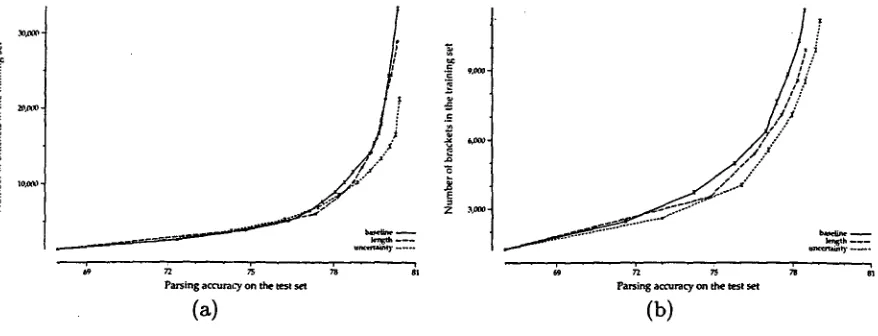
The results of the two experiments are graph- ically depicted in Figure 2. W e plot learning rates of the induction processes using train- ing sentences selected by the three evaluation functions. The learning rate relates the qual- ity of the induced grammars to the amount of supervised training data available. In order for the induced g r a m m a r to parse test sen- tences with higher accuracy (x-axis), more su- pervision (y-axis) is needed. T h e amount of supervision is measured in terms of the num- ber of brackets rather than sentences because it more accurately quantifies the effort spent by the h u m a n annotator. Longer sentences tend to require more brackets than short ones, and thus take more time to analyze. W e d e e m one evaluation function more effective than another if the smallest set of sentences it se- lected can train a g r a m m a r that performs at least as well as the g r a m m a r trained under the other function and if the selected data con- tains considerably fewer brackets than that of the other function.
Figure 2(a) presents the outcomes of the first experiment, in which the evaluation func- tions select training examples out of a large candidate-pool. We see that overall, sample selection has a positive effect on the learning IThe unsupervised induction algorithm induces grammars that generate binary branching trees so that the n u m b e r of proposed brackets in a sentence is al- ways one fewer than the length of the sentence. T h e W S J corpus, on the other hand, favors a more fiat- tened tree structure with considerably fewer brackets
per sentence. T h e consistent bracketing metric does not unfairly penalize a proposed parse tree for being binary branching.
E
/ o
a ~ . . . .
Pa.~ing accura,.~ on the ~
(a)
i t f s : • J
. / J
...o°..o-- ~
Farsir~ accuracy o n t h e t t ~ t (b)
Figure 2: T h e learning rates of the induction processes using examples selected by the three evaluation functions for (a) when the candidate-pool is large, a n d (b) when the candidate-pool is small.
g r a m m a r set baseline-26 length-17 tree entropy-!4
11 avg. training brackets [ t-test on bracket.avg. avg. score
33355 N / A 80.3
30288 better 80.3
21236 better 80.4
t-test on score avg N / A not sig. worse not sig. worse Table 1: S u m m a r y of pair-wise t-test with 95% confidence comparing the best set of grammars induced with the baseline (after 26 selection iterations) to the sets of grammars induced under the proposed evaluation functions
(ften
after 17 iterations,fte
after 14 iterations).rate of the induction process. For the base- line case, the induction process u s e s
frand,
in which training sentences are randomly se- lected. T h e resulting grammars achieves an average parsing accuracy of 80.3% on the test sentences after seeing an average of 33355 brackets in the training data. T h e learning rate of the tree entropy evaluation function,
fte,
progresses much faster t h a n the baseline. To induce a grammar t h a t reaches t h e same 80.3% parsing accuracy with the examples se- lected byfte,
the learner requires, on average, 21236 training brackets, reducing the amount of annotation by 36% comparing to t h e base- line. While the simplistic sentence length evaluation function, f~en, is less helpful, its learning rate still improves slightly faster than the baseline. A g r a m m a r of comparable qual- ity can be induced from a set of training exam- ples selected byfzen
containing an average of 30288 brackets. This provides a small reduc- tion of 9% f r o m the baseline 3. We consider a set of grammars to be comparable to the base-3In terms of the number of sentences, the baseline
f ~ d used 2600 randomly chosen training sentences; .fze,~ selected the 1700 longest sentences as training data; and fte selected 1400 sentences.
line if its mean test score is at least as high as t h a t of the baseline and if t h e difference of t h e means is n o t statistically significant (us- ing pair-wise t-test at 95% confidence). Ta- ble 1 summarizes the statistical significance of comparing the best set of baseline grammars with those of of
f~en and ffte.
Figure 2(b) presents the results of the sec- o n d experiment, in which the evaluation func- tions only have access to a small c a n d i d a t e pool. Similar to the previous experiment, g r a m m a r s induced from training examples se- lected by fte require significantly less a n n o t a - tions t h a n the baseline. Under t h e baseline,
frand,
to train g r a m m a r s w i t h 78.5% parsing accuracy on test data, an average of 11699 brackets (in 900 sentences) is required. In con- trast,fte
can induce a comparable g r a m m a r w i t h an average of 8559 brackets (in 600 sen- tences), providing a saving of 27% in t h e num- ber of training brackets. T h e simpler evalua- tion function f ~ n out:performs t h e baseline as well; the 600 sentences it selected have an average of 9935 brackets. Table 2 shows the statistical significance of these comParisons. [image:6.596.126.565.63.231.2]grammar set baseline-9 length-6 tree entropy-6 tree entropy-8
II avg. training brackets t-test on bracket avg. avg. score t-~est on score a~
11699 N/A 78.5 N / A
9936 better 78.5 not sig. worse
8559 better 78.5 not sig. worse
11242 better 79.1 better
t-test avg.
Table 2: Summary of pair-wise t-test with 95% confidence comparing the best set of grammars induced with the baseline (after 9 selection iterations) to the sets of grammars induced under the proposed evaluation functions (ften after 6 iterations, fte after 6 and 8 iterations).
the three methods did not parse with the same accuracy when all the sentences from the un- labeled pool have been added to the training set. Presenting the training examples in dif- ferent orders changes the search path of the induction process. Trained on data selected by fte, the induced grammar parses the test sentences with 79.1% accuracy, a small but statistically significant improvement over the baseline. This suggests that, when faced with a dearth of training candidates, fte can make good use of the available data to induce gram- mars that are comparable to those directly in- duced from more data.
7 C o n c l u s i o n a n d F u t u r e W o r k This empirical study indicates that sample se- lection can significantly reduce the human ef- fort in parsing sentences for inducing gram- mars. Our proposed evaluation function using tree entropy selects helpful training examples. Choosing from a large pool of unlabeled can- didates, it significantly reduces the amount of training annotations needed (by 36% in the experiment). Although the reduction is less dramatic when the pool of candidates is small (by 27% in the experiment), the training ex- amples it selected helped to induce slightly better grammars.
The current work suggests many potential research directions on selective sampling for grammar induction. First, since the ideas be- h i n d the proposed evaluation fimctions are general and independent of formalisms, we would like to empirically determine their ef- fect on other parsers. Next, we shall explore alternative formulations of evaluation func- tions for the single-learner system. The cur- rent approach uses uncertainty-based evalua- tion functions; we hope to consider other fac- tors such as confidence about the parameters of the grammars and domain knowledge. We also plan to focus on the constituent units within a sentence as training examples. Thus,
the evaluation functions could estimate the training utilities of constituent units rather than full sentences. Another area of interest is to experiment with committee-based sam- ple selection using multiple learners. Finally, we are interested in applying sample selection to other natural language learning algorithms that have been limited by the sparsity of an- notated data.
R e f e r e n c e s
James K. Baker. 1979. Trainable grammars for speech recognition. In Proceedings of the Spring Conference of the Acoustical Society of Amer-
ica, pages 547-550, Boston, MA, June.
Eugene Charniak. 1997. Statistical parsing with a context-free grammar and word statistics. In
Proceedings of the AAAI, pages 598-603, Prov- idence, RI. AAAI Press/MIT Press.
David Cohn, Les Atlas, and Richard Ladner. 1994. Improving generalization with active learning.
Machine Learning, 15(2):201-221.
Michael Collins. 1997. Three generative, lexi- calised models for statistical parsing. In Pro-
ceedings of the 35th Annual Meeting of the A CL,
pages 16-23, Madrid, Spain.
Thomas M. Cover and Joy A. Thomas. 1991. El- ements of Information Theory. John Wiley. Sean P. Engelson and Ido Dagan. 1996. Mhaimiz-
ing manual annotation cost in supervised train- ing from copora. In Proceedings of the 34th An- nual Meeting of the ACL, pages 319-326. Yoav Freund, H. Sebastian Seung, Eli Shamir, and
Naftali Tishby. 1997. Selective sampling using the query by committee algorithm. Machine Learning, 28(2-3):133-168.
Atsushi Fujii, Kentaro Inui, Takenobu Tokunaga, and Hozumi Tanaka. 1998. Selective sampling for example-based word sense disambiguation.
Computational Linguistics, 24(4):573-598, De- cember.
Ulf Hermjakob and Raymond J. Mooney. 1997. Learning parse and translation decisions from examples with rich context. In Proceedings o/ the Association for Computational Linguistics,
pages 482-489.
[image:7.596.88.564.64.133.2]mars. In Proceedings off COLING-ACL, vol- ume 1, pages 557-563.
Rebecca Hwa. 1999. Supervised grammar in- duction using training data with limited con- stituent information. In Proceedings of 37th An- nual Meeting of the ACL, pages 73-79, June. Rebecca Hwa. 2000. Learning Probabilistic Lex-
icalized Grammars for Natural Language Pro- cessing. Ph.D. thesis, ttarvard University. Forthcoming.
K. Lari and S.J. Young. 19!70. The estimation of stochastic context-free grammars using the inside-outside algorithm. Computer Speech and Language, 4:35-56.
David D. Lewis and William A. Gale. 1994. A se- quential algorithm for training text classifiers.
In Proceedings of the 17th Annual International ACM SIGIR Conference on Research and De- velopment in Information Retrieval, pages 3-12. Mitchell Marcus, Beatrice Santorini, and Mary Ann Marcinkiewicz. 1993. Building a large annotated corpus of English: the Penn Treebank. Computational Linguistics,
19(2):313--330.
Robert McNaughton. 1967. Parenthesis gram- mars. Journal off the ACM, 2(3):490--500. Fernando Pereira and Yves Schabes. 1992. Inside-
Outside reestimation from partially bracketed corpora. In Proceedings of the 30th Annual Meeting o] the ACL, pages 128-135, Newark, Delaware.
Yves Schabes and Richard Waters. 1993. Stochas- tic lexicalized context-free grammar. In Pro-
ceedings of the Third International Workshop on Parsing Technologies, pages 257-266. Cynthia A. Thompson, Mary Elaine Califf, and
Raymond J. Mooney. 1999. Active learning for natural language parsing and information extraction. In Proceedings of 1CML-99, pages 406-414, Bled, Slovenia.
A E f f i c i e n t C o m p u t a t i o n o f T r e e E n t r o p y
The tree entropy of a sentence depends on the quantity ~ v e v P r ( v [ G ) l o g ~ ( P r ( v ] G)) de-
scribed in Section 4.2, a snm of an exponential number of parses. Fortunately, through a dy- namic programming algorithm similar to the computation of the Inside Probabilities, this quantity can be efficiently computed. The ba- sic idea is to compose the tree entropy of the entire sentence from the tree entropy of the subtrees.
For illustrative purposes, we describe the computation process using a PCFG g r a m m a r expressed in Chomsky Normal Form, in which each rule can have two forms: X ~ Y Z
or X ---r a, where X, Y, Z are variables over
non-terminal symbols and a is a variable over terminal symbols. Moreover, let the sym- bol S be the start symbol of the grammar G. Following the notation of Lari and Young, we denote the inside probability as e(X, i,j),
which represents the probability that a non- terminal X :~ w i . . . w j . Similarly, we define a new function h(X, i , j ) to represent the cor- responding entropy for the set of subtrees.
h ( X , i , j ) = - P r ( .
I a)log (Pr(,
IV)).
vEX~wi...w~Therefore, ~ v e v P r ( v [ G ) l o g 2 P r ( v l G ) can
be expressed as h(S, 1, n).
We compute all possible h ( X , i , j ) re-
cursively. The base case is h ( X , i , i ) = - e ( X , i, i) log2 (e(X, i, i)) since a non-terminal X can generate the symbol wi in exactly one way. For the more general case, h(X, i,j), we consider all the possible rules with X on the left hand side that might have contributed to build X =~ wi . . . wj.
j - 1
hr,
k=i (x~YZ)T h e function hy, z , k ( X , i , j ) is a portion of
h ( X , i , j ) where Y =~ w i . . . w k and Z ~
Wk+l... wj. The non-terminals Y a n d Z may, in turn, generate their substrings with mul- tiple parses. Let there be a parses for Y
w i . . . Wk and f~ parses for Z ~ W k + l . . . w i.
Let x denote the event of X --r Y Z ; y E Y l , . . . , Y a ; and z E z l , . . . , z z . T h e proba- bility of one of the a x fl possible parses is
P r ( x ) P r ( y ) P r ( z ) , and hY, z,k is computed by summing over all possible parses:
hy, z,k(X, i,j)
= -- ~ , z P r ( x ) P r ( y ) P r ( z ) x
log 2 (Pr (x)Pr (y)Pr (z) ) = - Z ~ , ~ P r ( x ) P r ( y ) P r ( z ) ×
[log 2 Pr(x) + log 2 Pr(y) + log 2 P r ( z ) ]
= - P r ( x ) log 2 Pr(x)e(Y, i, k)e(Z, k+l, j) + P r ( x ) h ( Y , i , k ) e ( Z , k + 1,j)
+Pr(x)e(Y, i, k)h(Z, k + 1,j).