BLANC
1: Learning Evaluation Metrics for MT
Lucian Vlad Lita and Monica Rogati and Alon Lavie
Carnegie Mellon University
{llita,mrogati,alavie}@cs.cmu.edu
Abstract
We introduce BLANC, a family of dy-namic, trainable evaluation metrics for ma-chine translation. Flexible, parametrized models can be learned from past data and automatically optimized to correlate well with human judgments for different cri-teria (e.g. adequacy, fluency) using dif-ferent correlation measures. Towards this end, we discuss ACS (all common skip-ngrams), a practical algorithm with train-able parameters that estimates reference-candidate translation overlap by comput-ing a weighted sum of all common skip-ngrams in polynomial time. We show that the BLEU and ROUGE metric families are special cases of BLANC, and we compare correlations with human judgments across these three metric families. We analyze the algorithmic complexity of ACS and argue that it is more powerful in modeling both local meaning and sentence-level structure, while offering the same practicality as the established algorithms it generalizes.
1 Introduction
Although recent MT evaluation methods show promising correlations to human judgments in terms of adequacy and fluency, there is still considerable room for improvement (Culy and Riehemann, 2003). Most of these studies have been performed at a sys-tem level and have not investigated metric robust-ness at a lower granularity. Moreover, even though
the emphasis on adequacy vs. fluency is application-dependent, automatic evaluation metrics do not dis-tinguish between the need to optimize correlation with regard to one or the other.
Machine translation automatic evaluation metrics face two important challenges: the lack of powerful features to capture both sentence level structure and local meaning, and the difficulty of designing good functions for combining these features into meaning-ful quality estimation algorithms.
In this paper, we introduce BLANC1, an automatic MT evaluation metric family that is a generaliza-tion of popular and successful metric families cur-rently used in the MT community (BLEU, ROUGE, F-measure etc.). We describe an efficient, polynomial-time algorithm for BLANC, and show how it can be optimized to target adequacy, fluency or any other criterion. We compare our metric’s performance with traditional and recent automatic evaluation met-rics. We also describe the parameter conditions under which BLANCcan emulate them.
Throughout the remainder of this paper, we dis-tinguish between two components of automatic MT evaluation: the statistics computed on candidate and reference translations and the function used in defining evaluation metrics and generating transla-tion scores. Commonly used statistics include bag-of-words overlap, edit distance, longest common sub-sequence, ngram overlap, and skip-bigram overlap. Preferred functions are various combinations of pre-cision and recall (Soricut and Brill, 2004), including
1Since existing evaluation metrics (e.g. BLEU, ROUGE) are special cases of our metric family, it is only natural to name it Broad Learning and Adaptation for Numeric Criteria (BLANC) – white light contains light of all frequencies
weighted precision and F-measures (Van-Rijsbergen, 1979).
BLANC implements a practical algorithm with learnable parameters for automatic MT evaluation which estimates the reference-candidate translation overlap by computing a weighted sum of common subsequences (also known as skip-ngrams). Com-mon skip-ngrams are sequences of words in their sentence order that are found both in the reference and candidate translations. By generalizing and sep-arating the overlap statistics from the function used to combine them, and by identifying the latter as a learnable component, BLANC subsumes the ngram based evaluation metrics as special cases and can better reflect the need of end applications for ade-quacy/fluency tradeoffs .
1.1 Related Work
Initial work in evaluating translation quality focused on edit distance-based metrics (Su et al., 1992; Akiba et al., 2001). In the MT context, edit distance (Lev-enshtein, 1965) represents the amount of word inser-tions, deletions and substitutions necessary to form a candidate translation into a reference trans-lation. Another evaluation metric based on edit dis-tance is the Word Error Rate (Niessen et al., 2000) which computes the normalized edit distance. BLEU is a weighted precision evaluation metric introduced by IBM (Papineni et al., 2001). BLEUand its exten-sions/variants (e.g. NIST (Doddington, 2002)) have become de-facto standards in the MT community and are consistently being used for system optimization and tuning. These methods rely on local features and do not explicitly capture sentence-level features, although implicitly longer n-gram matches are re-warded in BLEU. The General Text Matcher (GTM) (Turian et al., 2003) is another MT evaluation method that rewards longer ngrams instead of assigning them equal weight.
(Lin and Och, 2004) recently proposed a set of metrics (ROUGE) for MT evaluation. ROUGE-L is a longest common subsequence (LCS) based automatic evaluation metric for MT. The intuition behind it is that long common subsequences reflect a large over-lap between a candidate translation and a reference translation. ROUGE-W is also based on LCS, but assigns higher weights to sequences that have fewer gaps. However, these metrics still do not distinguish
among translations with the same LCS but different number of shorter sized subsequences, also indica-tive of overlap. ROUGE-S attempts to correct this problem by combining the precision/recall of
skip-bigrams of the reference and candidate translations.
However, by using skip-ngrams with n¿=2, we might be able to capture more information encoded in the higher level sentence structure. With BLANC, we propose a way to exploit local contiguity in a man-ner similar to BLEU and also higher level structure similar to ROUGEtype metrics.
2 Approach
We have designed an algorithm that can perform a full overlap search over variable-size, non-contiguous word sequences (skip-ngrams) efficiently. At first glance, in order to perform this search, one has to first exhaustively generate all skip-ngrams in the can-didate and reference segments and then assess the overlap. This approach is highly prohibitive since the number of possible sequences is exponential in the number of words in the sentence. Our algorithm – ACS(all common skip-ngrams) – directly constructs the set of overlapping skip-ngrams through incremen-tal composition of word-level matches. With ACS, we can reduce computation complexity to a fifth de-gree polynomial in the number of words.
Through the ACSalgorithm, BLANCis not limited only to counting skip-ngram overlap: the contribu-tion of different skip-ngrams to the overall score is based on a set of features. ACS computes the over-lap between two segments of text and also allows local and global features to be computed during the overlap search. These local and global features are subsequently used to train evaluation models within the BLANCfamily. We introduce below several sim-ple skip-ngram-based features and show that special-case parameter settings for these features emulate the computation of existing ngram-based metrics. In or-der to define the relative significance of a particular skip-ngram found by the ACSalgorithm, we employ an exponential model for feature integration.
2.1 Weighted Skip-Ngrams
We define skip-ngrams as sequences ofnwords taken in sentence order allowing for arbitrary gaps. In algo-rithms literature skip-ngrams are equivalent to
referred to as skip-bigrams and skip-ngrams with no gaps between the words are simplyngrams. A sen-tence S of size |S|hasC(|S|, n) = (|S|−|Sn|!)!n! skip-ngrams.
For example, the sentence “To be or not to be” has
C(6,2) = 15corresponding skip-bigrams including “be or”, “to to”, and three occurrences of “to be”. It also hasC(6,4) = 15corresponding skip-4grams (n= 4) including “to be to be” and “to or not to”.
Consider the following sample reference and can-didate translations:
R0: machine translated text is evaluated automatically K1: machine translated stories are chosen automatically K2: machine and human together can forge a friendship that
cannot be translated into words automatically
K3: machine code is being translated automatically
The skip-ngram “machine translated
automati-cally” appears in both the referenceR0and all
candi-date translations. Arguably, a skip-bigram that con-tains few gaps is likely to capture local structure or meaning. At the same time, skip-ngrams spread across a sentence are also very useful since they may capture part of the high level sentence structure.
We define a weighting feature function for skip-ngrams that estimates how likely they are to capture local meaning and sentence structure. The weighting functionϕfor a skip-ngram w1 ..wnis defined as:
ϕ(w1..wn) =e−α·G(w1..wn) (1)
where α ≥ 0 is a decay parameter and G(w1..wn) measures the overall gap of the skip-ngramw1..wnin a specific sentence. This overall skip-ngram weight can be decomposed into the weights of its constituent skip-bigrams:
ϕ(w1..wn) = e−α·G(w1,..,wn) (2)
= e−α·Pn−1
i=1 G(wi,wi+1)
=
nY−1
i=1
ϕ(wiwi+1) (3)
In equation 3, ϕ(wiwi+1) is the number of words
betweenwiandwi+1in the sentence. In the example
above, the skip-ngram “machine translated automat-ically” has weighte−3α for sentence K
1 and weight
e−12α = 1for sentenceK
2.
In our initial experiments the gap Ghas been ex-pressed as a linear function, but different families of
functions can be explored and their corresponding pa-rameters learned. The parameter α dictates the be-havior of the weighting function. When α = 0 ϕ
equalse0 = 1, rendering gap sizes irrelevant. In this case, skip-ngrams are given the same weight as con-tiguous ngrams. Whenαis very large,ϕapproaches
0if there are any gaps in the skip-ngram and is1 if there are no gaps. This setting has the effect of con-sidering only contiguous ngrams and discarding all skip-ngrams with gaps.
In the above example, although the skip-ngram “machine translated automatically” has the same cu-mulative gap in both inK1andK3, the occurrence in
K1has is a gap distribution that more closely reflects
that of the reference skip-ngram inR0. To model gap
distribution differences between two occurrences of a skip-ngram, we define a piece-wise distance function
δXY between two sentencesxandy. For two succes-sive words in the skip-ngram, the distance function is defined as:
δXY(w1w2) =e−β·|GX(w1,w2)−GY(w1,w2)| (4)
where β ≥ 0 is a decay parameter. Intuitively, the
β parameter is used to reward better aligned skip-ngrams. Similar to the ϕfunction, the overall δXY distance between two occurrences of a skip-ngram
withn >1is:
δXY(w1..wn) =
nY−1
i=1
δXY(wiwi+1) (5)
Note that equation 5 takes into account pairs of skip-ngrams skip in different places by summing over piecewise differences. Finally, using an exponen-tial model, we assign an overall score to the matched skip-ngram. The skip-ngram scoring functionSxy al-lows independent features to be incorporated into the overall score:
Sxy(wi..wk) =ϕ(wi..wk)·δxy(wi..wk)
·eλ1f1(wi..wk)·...·eλhfh(wi..wk) (6)
2.2 Multiple References
In BLANC we incorporate multiple references in a manner similar to the ROUGE metric family. We compute the precision and recall of each size skip-ngrams for individual references. Based on these we combine the maximum precision and maximum re-call of the candidate translation obtained using all reference translations and use them to compute an ag-gregate F-measure.
The F-measure parameter βF is modeled by BLANC. In our experiments we optimized βF indi-vidually for fluency and adequacy.
2.3 The ACS Algorithm
We present a practical algorithm for extracting All
Common Skip-ngrams (ACS) of any size that appear in the candidate and reference translations. For clar-ity purposes, we present the ACS algorithm as it relates to the MT problem: find all common skip-ngrams (ACS) of any size in two sentencesXandY:
wSKIP ←Acs(δ, ϕ, X, Y) (7)
={wSKIP1..wSKIPmin(|X|,|Y|)} (8)
wherewSkipnis the set of all skip-ngrams of sizen and is defined as:
wSKIPn={“w1..wn”|wi∈X, wi ∈Y,∀i∈[1..n]
andwi ≺wj,∀i < j∈[1..n]}
Given two sentences X and Y we observe a match
(w, x, y)if wordwis found in sentenceXat indexx
and in sentenceY at indexy:
(w, x, y)≡ {0≤x≤ |X|,0≤y≤ |Y|,
w∈V,andX[x] =Y[y] =w} (9)
whereV is the vocabulary with a finite set of words. In the following subsections, we present the fol-lowing steps in the ACSalgorithm:
1. identify all matches – find matches and generate corresponding nodes in the dependency graph 2. generate dependencies – construct edges
ac-cording to pairwise match dependencies
3. propagate common subsequences – count all common skip-ngrams using corresponding weights and distances
In the following sections we use the following exam-ple to illustrate the intermediate steps of ACS.
X. “to be or not to be” Y. “to exist or not be”
2.3.1 Step 1: Identify All Matches
In this step we identify all word matches(w, x, y)
in sentencesXandY. Using the example above, the intermediate inputs and outputs of this step are:
Input: X. “to be or not to be” Y. “to exist or not be”
Output: (to,1,1); (to,5,1); (or,3,3); (be,2,5); . . . For each match we create a corresponding node N
in a dependency graph. With each node we associate the actual word matched and its corresponding index positions in both sentences.
2.3.2 Step 2: Generate Dependencies
A dependency N1 → N2 occurs when the two
corresponding matches (w1, x1, y1)and (w2, x2, y2)
can form a valid common skip-bigram: i.e. when
x1 < x2 and y1 < y2. Note that the matches can
cover identical words, but their indices cannot be the same (x1 6= x2 and y1 6= y2) since a skip-bigram
requires two different word matches.
In order to facilitate the generation of all common subsequences, the graph is populated with the appropriate dependency edges:
for each node N in DAG for each node M6=N in DAG
if N(x)≤M(x) and N(y)≤M(y) create edge E: N→M
computeδXY(E) computeϕ(E)
This step incorporates the concepts of skip-ngram weight and distance into the graph. With each edge
E :N1 →N2we associate step-wise weight and
dis-tance information for the corresponding skip-bigram formed by matches(w1, x1, y1)and(w2, x2, y2).
Note that rather than counting all skip-ngrams, which would be exponential in the worst case sce-nario, we only construct a structure of match depen-dencies (i.e. skip-bigrams). As in dynamic program-ming, in order to avoid exponential complexity, we compute individual skip-ngram scores only once.
2.3.3 Step 3: Propagate Common Subsequences
In this last step, the ACSalgorithm counts all com-mon skip-ngrams using corresponding weights and distances. In the general case, this step is equiva-lent measuring the overlap of the two sentences X
ACS algorithm is equivalent to counting the number of common skip-ngrams regardless of gap sizes.
//depth first search (DFS)
for each node N in DAG compute node N’s depth
//initialize skip-ngram counts
for each node N in DAG vN[1]←1
for i=2 to LCS(X,Y) vN[i] = 0
//compute ngram counts
for d=1 to MAXDEPTH
for each node N of depth d in DAG for each edge E: N→M
for i=2 to d
vM[i] +=Sxy(δ(E),ϕ(E), vN[i-1])
After algorithm ACS is run, the number of skip-ngrams (weighted skip-ngram score) of sizekis sim-ply the sum of the number of skip-ngrams of size k
ending in each nodeN’s corresponding match:
wSKIPk=
X
Ni∈DAG
vNi[k] (10)
2.3.4 ACSComplexity and Feasibility
In the worst case scenario, both sentencesXandY
are composed of exactly the same repeated word: X
= “w w w w .. ” and Y = “w w w w ..”. We letm=|X|
andn =|Y|. In this case, the number of matches is
M = n·m. Therefore, Step 1 has worst case time and space complexity of O(m ·n). However, em-pirical data suggest that there are far fewer matches than in the worst-case scenario and the actual space requirements are drastically reduced. Even in the worst-case scenario, if we assume the average sen-tences is fewer than100words, the number of nodes in the DAG would only be10,000. Step 2 of the al-gorithm consists of creating edges in the dependency graph. In the worst case scenario, the number of di-rected edges is O(M2) and furthermore if the
sen-tences are uniformly composed of the same repeated word as seen above, the worst-case time and space complexity ism(m+ 1)/2·n(n+ 1)/2 =O(m2n2). In Step 3 of the algorithm, the DFS complexity for computing of node depths isO(M)and the complex-ity of LCS(X, Y) isO(m·n). The dominant step
is the propagation of common subsequences (skip-ngram counts). Letlbe the size of theLCS. The up-per bound on the size of the longest common subse-quence ismin(|X|,|Y|) =min(m, n). In the worst case scenario, for each node we propagatelcount val-ues (the size of vector v) to all other nodes in the DAG. Therefore, the time complexity for Step 3 is
O(M2·l) =O(m2n2l)(fifth degree polynomial).
3 BLANC as a Generalization of BLEU and
ROUGE
Due to its parametric nature, the All Common Sub-sequences algorithm can emulate the ngram compu-tation of several popular MT evaluation metrics. The weighting functionϕallows skip-ngrams with differ-ent gap sizes to be assigned differdiffer-ent weights. Param-eterαcontrols the shape of the weighting function.
In one extreme scenario, if we allow α to take very large values, the net effect is that all contiguous ngrams of any size will have corresponding weights of e0 = 1 while all other skip-ngrams will have weights that are zero. In this case, the distance function will only apply to contiguous ngrams which have the same size and no gaps. Therefore, the dis-tance function will also be 1. The overall result is that the ACSalgorithm collects contiguous common ngram counts for all ngram sizes. This is equivalent to computing the ngram overlap between two sen-tences, which is equivalent to the ngram computa-tion performed BLEUmetric. In addition to comput-ing ngram overlap, BLEUincorporates a thresholding (clipping) on ngram counts based on reference trans-lations, as well as a brevity penalty which makes sure the machine-produced translations are not too short. In BLANC, this is replaced by standard F-measure, which research (Turian et al., 2003) has shown it can be used successfully in MT evaluation.
Another scenario consists of setting theα and β
parameters to0. In this case, all skip-ngrams are as-signed the same weight value of 1 and skip-ngram matches are also assigned the same distance value of
1regardless of gap sizes and differences in gap sizes. This renders all skip-ngrams equivalent and the ACS algorithm is reduced to counting the skip-ngram
over-lap between two sentences. Using these counts,
0 50 100 0
50 100 150 200
Arabic 2003
Sentence Length
#sentences
0 50 100
0 50 100 150 200 250 300 350
Chinese 2003
Sentence Length
#sentences
0 50 100
100 102 104
ACS #Matches
Sentence Length
Avg #Matches
0 50 100
100 105
ACS #Edges
Sentence Length
Avg #Edges
0 50 100
100 105 1010
ACS #Feature Calls
Sentence Length
Avg #Total
[image:6.612.163.455.55.297.2]Arabic Chinese Worst Case
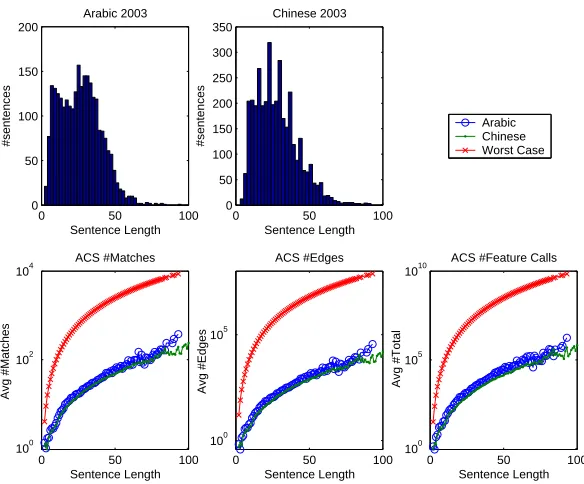
Figure 1: Empirical and theoretical behavior of ACSon 2003 machine translation evaluation data (semilog scale).
the ACSonly for skip-ngrams of size2, the ACS algo-rithm is equivalent to the ROUGE-S metric (Lin and Och, 2004). This case represents a specific parameter setting in the ACSskip-ngram computation.
The longest common subsequence statistic has also been successfully used for automatic machine trans-lation evaluation in the ROUGE-L (Lin and Och, 2004) algorithm. In BLANC, if we set both α and
β parameters to zero, the net result is a set of skip-bigram (common subsequence) overlap counts for all skip-bigram sizes. Although dynamic programming or suffix trees can be used to compute the LCS much faster, under this parameter setting the ACSalgorithm can also produce the longest common subsequence:
LCS(X, Y)←argmax
k
ACS(wSKIPk)>0
where Acs(wSKIPk) is the number of common skip-ngrams (common subsequences) produced by the ACSalgorithm.
ROUGE-W (Lin and Och, 2004) relies on a weighted version of the longest common subse-quence, under which longer contiguous subsequences are assigned a higher weight than subsequences that incorporate gaps. ROUGE-W uses the polynomial function xain the weighted LCS computation. This setting can also be simulated by BLANCby adjusting
the parametersαto reward tighter skip-ngrams andβ
to assign a very high score to similar size gaps. In-tuitively, α is used to reward skip-ngrams that have smaller gaps, whileβis used to reward better aligned skip-ngram overlap.
4 Scalability & Data Exploration
In Figure 1 we show theoretical and empirical prac-tical behavior for the ACS algorithm on the 2003 TIDES machine translation evaluation data for Ara-bic and Chinese. Sentence length distribution is somewhat similar for the two languages – only a very small amount of text segments have more than 50 tokens. We show the ACS graph size in the worst case scenario, and the empirical average number of matches for both languages as a function of sentence length. We also show (on a log scale) the upper bound on time/space complexity in terms of total number of feature computations. Even though the worst-case scenario is tractable (polynomial), the empirical amount of computation is considerably smaller in the form of polynomials of lower degree. In Figure 1, sentence length is the average between reference and candidate lengths.
reference-candidate translation pair. We have exper-imented with the ACS algorithm using a worst-case scenario where all words are exactly the same for a fifty words reference translation and candidate trans-lation. In practice when considering real sentences the number of matches is very small. In this setting, the algorithm takes less than two seconds on a low-end desktop system when working on the worst case scenario, and less then a second for all candidate-reference pairs in the TIDES 2003 dataset. This re-sult renders the ACS algorithm very practical for au-tomatic MT evaluation.
5 Experiments & Results
In the dynamic metric BLANC, we have implemented the ACS algorithm using several parameters includ-ing the aggregate gap sizeα, the displacement feature
β, a parameter for regulating skip-ngram size contri-bution, and the F-measureβF parameter.
Until recently, most experiments that evaluate au-tomatic metrics correlation to human judgments have been performed at a system level. In such experi-ments, human judgments are aggregated across sen-tences for each MT system and compared to aggre-gate scores for automatic metrics. While high scor-ing metrics in this settscor-ing are useful for understand-ing relative system performance, not all of them are robust enough for evaluating the quality of machine translation output at a lower granularity. Sentence-level translation quality estimation is very useful when MT is used as a component in a pipeline of text-processing applications (e.g. question answering). The fact that current automatic MT evaluation met-rics including BLANCdo not correlate well with hu-man judgments at the sentence level, does not mean we should ignore this need and focus only on system level evaluation. On the contrary, further research is required to improve these metrics. Due to its train-able nature, and by allowing additional features to be incorporated into its model, BLANChas the potential to address this issue.
For comparison purposes with previous literature, we have also performed experiments at system level for Arabic. The datasets used consist of the MT trans-lation outputs from all systems available through the Tides 2003 evaluation (663 sentences) for training and Tides 2004 evaluation (1353 sentences) for test-ing.
We compare (Table 1) the performance of BLANC on Arabic translation output with the performance of more established evaluation metrics: BLEU and NIST, and also with more recent metrics: ROUGE-L and ROUGE-S (using an unlimited size skip win-dow), which have been shown to correlate well with human judgments at system level – as confirmed by our results. We have performed experiments in which case information is preserved as well as experiments that ignore case information. Since the results are very similar, we only show here experiments under the former condition. In order to maintain consis-tency, when using any metric we apply the same pre-processing provided by the MTEval script. When computing the correlation between metrics and hu-man judgments, we only keep strictly positive scores. While this is not fully equivalent to BLEU smooth-ing, it partially mitigates the same problem of zero count ngrams for short sentences. In future work we plan to implement smoothing for all metrics, includ-ing BLANC.
We train BLANCseparately for adequacy and flu-ency, as well as for system level and segment level correlation with human judgments. The BLANC pa-rameters are currently trained using a simple hill-climbing procedure and using several starting points in order to decrease the chance of reaching a local maximum.
BLANC proves to be robust across criteria and granularity levels. As expected, different parameter values of BLANCoptimize different criteria (e.g. ad-equacy and fluency). We have observed that train-ing BLANC for adequacy results in more bias to-wards recall (βF=3) compared to training it for flu-ency (βF=2). This confirms our intuition that a dy-namic, parametric metric is justified for automatic evaluation.
6 Conclusions & Future Work
In previous sections we have defined simple distance functions. More complex functions can also be incor-porated in ACS. Skip-ngrams in the candidate sen-tence might be rewarded if they contain fewer gaps in the candidate sentence and penalized if they contain more. Different distance functions could also be used in ACS, including functions based on surface-form features and part-of-speech features.
Tides 2003 Arabic
System Level Segment Level Method Adequacy Fluency Adequacy Fluency
BLEU 0.950 0.934 0.382 0.286
NIST 0.962 0.939 0.439 0.304
ROUGE-L 0.974 0.926 0.440 0.328 ROUGE-S 0.949 0.935 0.360 0.328 BLANC 0.988 0.979 0.492 0.391
Tides 2004 Arabic
System Level Segment Level Method Adequacy Fluency Adequacy Fluency
BLEU 0.978 0.994 0.446 0.337
[image:8.612.87.528.54.141.2]NIST 0.987 0.952 0.529 0.358 ROUGE-L 0.981 0.985 0.538 0.412 ROUGE-S 0.937 0.980 0.367 0.408 BLANC 0.982 0.994 0.565 0.438
Table 1:Pearson correlation of several metrics with human judgments at system level and segment level for fluency and adequacy.
static functions according to which automatic evalu-ation scores are computed. In this paper, we have laid the foundation for a more flexible, parametric ap-proach that can be trained using existing MT data and that can be optimized for highest agreement with hu-man assessors, for different criteria.
We have introduced ACS, a practical algorithm with learnable parameters for automatic MT evalu-ation and showed that ngram computevalu-ation of popu-lar evaluation methods can be emulated through dif-ferent parameters byACS. We have computed time and space bounds for theACSalgorithm and argued that while it is more powerful in modeling local and sentence structure, it offers the same practicality as established algorithms.
In our experiments, we trained and tested BLANC on data from consecutive years, and therefore tai-lored the metric for two different operating points in MT system performance. In this paper we show that BLANCcorrelates well with human performance when trained on previous year data for both sentence and system level.
In the future, we plan to investigate the stability and performance of BLANCand also apply it to auto-matic summarization evaluation. We plan to optimize the BLANC parameters for different criteria in addi-tion to incorporating syntactic and semantic features (e.g. ngrams, word classes, part-of-speech).
In previous sections we have defined simple dis-tance functions. More complex functions can also be incorporated in ACS. Skip-ngrams in the candi-date sentence might be rewarded if they contain fewer gaps in the candidate sentence and penalized if they contain more. Different distance functions could also be used in ACS, including functions based on surface-form features and part-of-speech features.
Looking beyond the BLANC metric, this paper makes the case for the need to shift to trained, dy-namic evaluation metrics which can adapt to
individ-ual optimization criteria and correlation functions. We plan to make available an implementation of BLANCat http://www.cs.cmu.edu/ llita/blanc.
References
Y. Akiba, K. Iamamurfa, and E. Sumita. 2001. Using multiple edit distances to automatically rank machine translation output. MT Summit VIII.
C. Culy and S.Z. Riehemann. 2003. The limits of n-gram translation evaluation metrics. Machine
Transla-tion Summit IX.
George Doddington. 2002. Automatic evaluation of ma-chine translation quality using n-gram co-occurrence
statistics. Human Language Technology Conference
(HLT).
V.I. Levenshtein. 1965. Binary codes capable of
cor-recting deletions, insertions, and reversals. Doklady
Akademii Nauk SSSR.
C.Y. Lin and F.J. Och. 2004. Automatic evaluation of machine translation quality using longest common sub-sequence and skip bigram statistics. ACL.
S. Niessen, F.J. Och, G. Leusch, and H. Ney. 2000. An evaluation tool for machine translation: Fast evaluation for mt research. LREC.
K. Papineni, S. Roukos, T. Ward, and W.J. Zhu. 2001. Bleu: a method for automatic evaluation of machine translation. IBM Research Report.
R. Soricut and E. Brill. 2004. A unified framework for automatic evaluation using n-gram co-occurence statis-tics. ACL.
K.Y. Su, M.W. Wu, and J.S. Chang. 1992. A new quanti-tative quality measure for machine translation systems.
COLING.
J.P. Turian, L. Shen, and I.D. Melamed. 2003. Evaluation of machine translation and its evaluation. MT Summit
IX.