Abstract—Linear equations provide useful tools for understanding the behavior of a wide variety of phenomena— from science and engineering to social sciences. A number of techniques have arisen to find the solution of these systems; examples are Jacobi, Gauss-Seidel, Successive Over Relaxation, and Multigrid. In this paper, we present an accelerated version of the Jacobi algorithm by implementing it on reconfigurable hardware devices- Field Programmable Gate Arrays such as Virtex II Pro, Altera Stratix and Spartan3L. The design presented is implemented using Handel-C, a hardware compiler. The implementation results obtained are compared with a software version results written in C++ and running on a general purpose processor. Final results illustrate that Jacobi on a reconfigurable hardware can outperform a software version of the same algorithm.
Index Terms— FPGA; Hardware Design, Iterative Methods, Parallelization, PDE.
I. INTRODUCTION
The problem of finding the solution of Partial Differential Equations (PDEs) plays a central role in modeling real world problems varying from physics, chemistry, economics, computer vision and engineering. The broad field of modeling real systems has drawn the researchers’ attention for designing efficient algorithms for solving PDEs [6].Examples of such algorithms are: Gauss-Seidel, Multigrid, Successive Over relaxation and Jacobi.
The simplest iterative method for solving a linear system of equations,
A
Φ
=
b
, is the Jacobi method. It is relatively easy to understand and is usually considered as a starting point for understanding more useful but complicated iterative methods. The advantage of the Jacobi method over other iterative methods lies in its computation which can be, trivially, done in parallel. However, for large system of linear equations, it is not preferable to use the Jacobi technique since the other iterative methods have proved to be more powerful and converge faster than the Jacobi [2]. For this reason, all the effort has been reserved for implementing and designing accelerated versions of SOR, Multigrid and Gauss-Seidel, leaving few versions of Jacobi for solving problems of small sizes. In an attempt to benefit from the simplest iterative method (Jacobi) which is primarily used in education; weManuscript received March , 2007.
Safaa J. Kasbah is with the Division of Computer Science and Mathematics, Lebanese American University, Beirut, Lebanon (phone: 961-3-788402; email: [email protected]).
Issam W. Damaj is with the Department of Electrical and Computer Engineer, Dhofar University, Salalah, Sultanate of Oman (e-mail:
benefit from the technological advanced to accelerate the method.
The emergence of the new computing paradigm, Reconfigurable Computing (RC), introduces novel techniques for accelerating certain classes of applications including signal processing (e.g., weather forecasting, seismic data processing, Magnetic Resonance Imaging (MRI), adaptive filters), cryptography and DNA matching [5]. Besides, the well known direct PDE solver, fast fourier transform, which is used in a number of signal and image processing algorithms, has been successfully accelerated using RC concepts [7]. RC-systems combine the flexibility offered by software and the performance offered by hardware [4]. It requires a reconfigurable hardware, such as an FPGA, and a software design environment that aids in the creation of configurations for the reconfigurable hardware [5].
This paper provides the first hardware implementation of the Jacobi method for computing the solution to a 2D Poisson equation. We use Handel-C, a hardware compiler, to code our design which is mapped into Virtex II Pro, Altera Stratix and Spartan3L Field Programmable Gate Arrays. The design is analyzed, synthesized and placed and routed using the FPGAs’ propriety software. The results obtained demonstrate that Jacobi in hardware outperforms Jacobi in software.
The rest of the paper is organized as follows: Section 2 introduces the Jacobi method. Section 3 introduces our hardware implementation of the method. Section 4 gives the experimental results. The conclusion and the future work are drawn in Section 5.
II. DESCRIPTION OF THE ALGORITHM
The simplest iterative method for solving a linear system of is the Jacobi method. As it is the case with the other iterative methods (Gauss-Seidel, SOR and Multigrid), the Jacobi technique starts with an initial estimate for the true solution and at each step, the current approximate solution is used to produce a better approximation for the true solution. This iterates continues until the approximate solution is sufficiently close to the true solution. Unlike Gauss-Siedel and SOR strategies where the update of the (i+1)thelement depends on the update of the
i
thelement, the Jacobi’s strategy is updating all the elements at the same time [2].Given the linear system of equations:
b
A
Φ
=
where A can be split into three matrices: the diagonal
(D
)
, anThe Jacobi Method in Reconfigurable Hardware
the diagonal part of
A
,−
U
the upper part ofA
, and−
L
the lower part ofA
.A
can be written as:A
=
D
−
L
−
U
Therefore:b
U
L
D
−
−
)
Φ
=
(
can be rewritten as:b
U
L
D
Φ
=
(
+
)
Φ
+
andb
D
U
L
D
−1(
+
)
Φ
+
−1=
Φ
This leads to the iterative Jacobi technique:
b
D
U
L
D
kk) 1 ( 1) 1
(
)
(
− −−
+
Φ
+
=
Φ
wherek
=
1
,
2
,...
The convergence of the Jacobi technique is guaranteed if the matrix
A
is diagonally dominant; i.e., in every row of the matrix, the magnitude of the diagonal entry in that row is larger than the sum of the magnitude of all the other entries in that row [2].III. IMPLEMENTATION
The Jacobi algorithm was designed and implemented using a higher level hardware design tool, Handel-C. Our choice of the tool was based on the language’s features for rapid and efficient prototyping. Handel-C syntax is similar to ANSI-C with additional extensions for expressing parallelism, e.g. ‘par’ construct [3]. The Handel-C compiler comes packaged with Celoxica Design Suite.
We tested our Jacobi design using the Handel-C simulator. We targeted available high-performance FPGAs: Xilinx Virtex II Pro, Altera Stratix, and Spartan3L which is hosted on an RC10 board from Celoxica. We synthesized and placed and routed the design using the devices’ vendors’ tools [1] [3] [8].
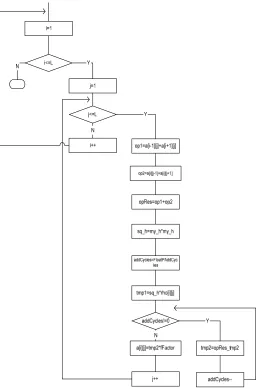
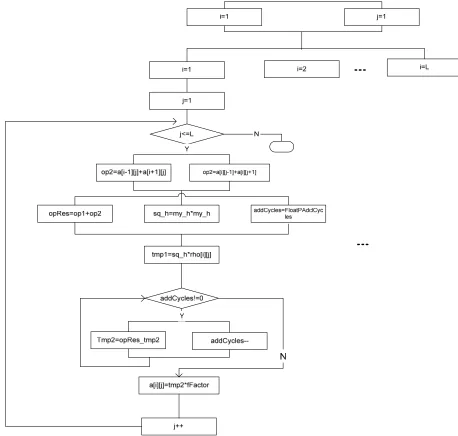
Unlike Gauss-Seidel and SOR, in the Jacobi iteration, all elements are updated at the same time and the computation can be done in parallel. In our Handel-C design we used the ‘par’ construct whenever it was possible to execute more than one instruction in parallel and in the same clock cycle. The traditional l way of executing instructions on a GPP is shown in Figure 1, where a sequential version of the Jacobi algorithm was design to be compared with our hardware design of the algorithm. Figure 2 shows the combined flowchart/concurrent process model of our design. Estimating the number of clock cycles needed for each version, one can easily expect that the hardware version would outperform the software version.
It is well known that Floating point operations are far more complex than fixed point operations. They consume more area on FPGA, for this reason, Handel-C does not support floating point type. To handle floating point arithmetic operations in our design, we used the Pipelined Floating Point Library provided in the Platform Developer’s Kit from Celoxica. The
[image:2.612.328.584.118.507.2]library contains: the Float type, macro procedures needed to perform arithmetic operations on floating point numbers, and macros for converting from integers to floating points and vice versa.
Fig. 1: Jacobi Flowchart, Sequential Version
Fig. 2: : Jacobi parallel version, showing the combined flowchart/concurrent process model. The dots represent replicated instances.
“Magnetization (A⋅m−1),” not just “A/m.” Do not label axes with a ratio of quantities and units. For example, write “Temperature (K),” not “Temperature/K.”
Multipliers can be especially confusing. Write “Magnetization (kA/m)” or “Magnetization (103 A/m).” Do not write “Magnetization (A/m) × 1000” because the reader would not know whether the top axis label in Fig. 1 meant 16000 A/m or 0.016 A/m. Figure labels should be legible, approximately 8 to 12 point type.
IV. EXPERIMENTAL RESULTS
The hardware implementation results were obtained using the Handel-C simulator and the FPGA vendor’s tools (DK Design Suite, Xilinx ISE 8.1i and Quartus II 5.1). The software version was written in C++, compiled using Microsoft Visual
Studio .Net and running on a Pentium (M) processor 2.0 GHz, 1.99 GB of RAM.
We targeted Xilinx Virtex II Pro (2vp7ff672-1) FPGA, simulatedour design and calculated the execution time using clock cycles of the design divided by the frequency at which the design operates at.
0 1 2 3 4 5 Ex e c u ti o n t im e (s e c on ds )
8x8 16x16 32x32 64x64
Mesh size
Handel-C C++
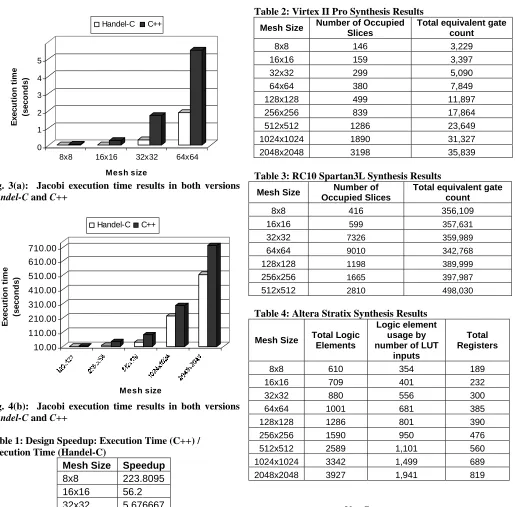
Fig. 3(a): Jacobi execution time results in both versions Handel-C and C++
10.00 110.00 210.00 310.00 410.00 510.00 610.00 710.00 E xecu ti o n t im e (seco n d s) Mesh size Handel-C C++
Fig. 4(b): Jacobi execution time results in both versions Handel-C and C++
Table 1: Design Speedup: Execution Time (C++) / Execution Time (Handel-C)
Mesh Size Speedup
8x8 223.8095 16x16 56.2 32x32 5.676667 64x64 2.89267 128x128 1.409887 256x256 2.287887 512x512 2.386364 1024x1024 0.753898 2024x2024 1.391351
[image:4.612.59.574.45.552.2]The Handel-C code was synthesized for Xilinx Virtex II Pro (2vp7ff672-1), Altera Stratix (ep1s10f484C5), and Spartan3L (3s15001fg320-4) which is embedded on RC10 board from Celoxica. Tables 2, 3 and 4 report the obtained synthesis results.
Table 2: Virtex II Pro Synthesis Results
Mesh Size Number of Occupied
Slices
Total equivalent gate count
8x8 146 3,229
16x16 159 3,397
32x32 299 5,090
64x64 380 7,849
128x128 499 11,897
256x256 839 17,864
512x512 1286 23,649
1024x1024 1890 31,327
2048x2048 3198 35,839
Table 3: RC10 Spartan3L Synthesis Results
Mesh Size Number of
Occupied Slices
Total equivalent gate count
8x8 416 356,109
16x16 599 357,631
32x32 7326 359,989
64x64 9010 342,768
128x128 1198 389,999
256x256 1665 397,987
512x512 2810 498,030
Table 4: Altera Stratix Synthesis Results
Mesh Size Total Logic
Elements
Logic element usage by number of LUT
inputs
Total Registers
8x8 610 354 189
16x16 709 401 232
32x32 880 556 300
64x64 1001 681 385
128x128 1286 801 390
256x256 1590 950 476
512x512 2589 1,101 560
1024x1024 3342 1,499 689
2048x2048 3927 1,941 819
V. CONCLUSION
[image:4.612.67.281.61.221.2]REFERENCES [1] Altera Inc., www.altera.com. 2006.
[2] Bertsekas D. P. and Tsitsiklis J. N., "Some aspects of parallel and distributed iterative algorithms -- a survey," Automatica, vol. 27, no. 1, pp. 3--21, 1991.
[3] Celoxica, www.celoxica.com. 2006.
[4] Compton K. and Hauck S. "Reconfigurable Computing: A Survey of Systems and Software". In ACM Computing Surveys, vol. 34, no. 2, pp. 171-210, June 2002.
[5] Li Y., Callahan T., Darnell E., Harr R., Kurkure U., and Stockwood J., "Hardware-Software Co-Design of Embedded Reconfigurable Architectures," In 37th Design Automation Conference, Los Angeles, CA, pp. 507-512, 2000.
[6] Osher, S. and Fedkiw, R. Level set methods: An overview and some recent results. Tech. Rep. 00-08, UCLA Center for Applied Mathematics, Department of Mathematics,University of California, Los Angeles, 2000. [7] Uzun, I. S., Amira, A. and Bouridane, A. “FPGA implementations of fast Fourier transforms for real-time signal and image processing”. IEE Proceedings - Vision, Image, and Signal Processing. vol. 152, no. 3, pp. 283-296, 2005.
[8] Xilinx. www.xilinx.com. 2006.