Proceedings of the 2019 Conference on Empirical Methods in Natural Language Processing and the 9th International Joint Conference on Natural Language Processing, pages 31–42,
31
Transfer Learning Between Related Tasks
Using Expected Label Proportions
Matan Ben Noach∗† and Yoav Goldberg∗‡
∗
Computer Science Department, Bar-Ilan University, Ramat-Gan Israel
†
Intel AI Lab, Petah-Tikva Israel
‡Allen Institute for Artificial Intelligence
[email protected], [email protected]
Abstract
Deep learning systems thrive on abundance of labeled training data but such data is not al-ways available, calling for alternative methods of supervision. One such method is expecta-tion regularizaexpecta-tion (XR) (Mann and McCal-lum, 2007), where models are trained based on expected label proportions. We propose a novel application of the XR framework for transfer learning between related tasks, where knowing the labels of task A provides an es-timation of the label proportion of task B. We then use a model trained for A to label a large corpus, and use this corpus with an XR loss to train a model for task B. To make the XR framework applicable to large-scale deep-learning setups, we propose a stochastic batched approximation procedure. We demon-strate the approach on the task of Aspect-based Sentiment classification, where we ef-fectively use a sentence-level sentiment pre-dictor to train accurate aspect-based prepre-dictor. The method improves upon fully supervised neural system trained on aspect-level data, and is also cumulative with LM-based pretrain-ing, as we demonstrate by improving a BERT-based Aspect-BERT-based Sentiment model.
1 Introduction
Data annotation is a key bottleneck in many data driven algorithms. Specifically, deep learning models, which became a prominent tool in many data driven tasks in recent years, require large datasets to work well. However, many tasks re-quire manual annotations which are relatively hard to obtain at scale. An attractive alternative is lightly supervised learning (Schapire et al.,2002;
Jin and Liu,2005;Chang et al.,2007;Grac¸a et al.,
2007; Quadrianto et al., 2009a; Mann and Mc-Callum, 2010a; Ganchev et al., 2010; Hope and Shahaf, 2016), in which the objective function is supplemented by a set of domain-specific
soft-constraints over the model’s predictions on unla-beled data. For example, in label regularization
(Mann and McCallum,2007) the model is trained to fit the true label proportions of an unlabeled dataset. Label regularization is special case of ex-pectation regularization(XR) (Mann and McCal-lum,2007), in which the model is trained to fit the conditional probabilities of labels given features.
In this work we consider the case of correlated tasks, in the sense that knowing the labels for task A provides information on the expected la-bel composition of task B. We demonstrate the ap-proach using sentence-level and aspect-level senti-ment analysis, which we use as a running example: knowing that a sentence has positive sentiment label (task A), we can expect that most aspects within this sentence (task B) will also have pos-itive label. While this expectation may be noisy on the individual example level, it holds well in aggregate: given a set of positively-labeled sen-tences, we can robustly estimate theproportionof positively-labeled aspects within this set. For ex-ample, in a random set of positive sentences, we expect to find 90% positive aspects, while in a set of negative sentences, we expect to find 70% nega-tive aspects. These proportions can be easily either guessed or estimated from a small set.
a medium-sized sentiment corpus with sentence-level labels, and a large collection ofun-annotated
text from the same distribution, we can train an ac-curate aspect-level sentiment classifier.
The XR loss allows us to use task A labels for training task B predictors. This ability seamlessly integrates into other semi-supervised schemes: we can use the XR loss on top of a pre-trained model to fine-tune the pre-trained representation to the target task, and we can also take the model trained using XR loss and plentiful data and fine-tune it to the target task using the available small-scale an-notated data. In Section5.3we explore these op-tions and show that our XR framework improves the results also when applied on top of a pre-trained BERT-based model (Devlin et al.,2018).
Finally, to make the XR framework applicable to large-scale deep-learning setups, we propose a stochastic batched approximation procedure (Sec-tion 3.2). Source code is available at https:
//github.com/MatanBN/XRTransfer.
2 Background and Related Work
2.1 Lightly Supervised Learning
An effective way to supplement small annotated datasets is to use lightly supervised learning, in which the objective function is supplemented by a set of domain-specific soft-constraints over the model’s predictions on unlabeled data. Previ-ous work in lightly-supervised learning focused on training classifiers by using prior knowledge of label proportions (Jin and Liu, 2005; Chang et al.,2007;Musicant et al.,2007;Mann and Mc-Callum, 2007; Quadrianto et al., 2009b; Liang et al.,2009;Ganchev et al.,2010;Mann and Mc-Callum, 2010b; Chang et al., 2012; Wang et al.,
2012;Zhu et al., 2014; Hope and Shahaf, 2016) or prior knowledge of features label associations (Schapire et al.,2002;Haghighi and Klein,2006;
Druck et al.,2008;Melville et al.,2009; Moham-mady and Culotta,2015). In the context of NLP,
Haghighi and Klein (2006) suggested to use dis-tributional similarities of words to train sequence models for part-of-speech tagging and a classi-fied ads information extraction task. Melville et al.(2009) used background lexical information in terms of word-class associations to train a sen-timent classifier. Ganchev and Das (2013);Wang and Manning(2014) suggested to exploit the bilin-gual correlations between a resource rich language and a resource poor language to train a classifier
for the resource poor language in a lightly super-vised manner.
2.2 Expectation Regularization (XR)
Expectation Regularization(XR) (Mann and Mc-Callum, 2007) is a lightly supervised learning method, in which the model is trained to fit the conditional probabilities of labels given features. In the context of NLP, XR was used by Moham-mady and Culotta(2015) to train twitter-user at-tribute prediction using hundreds of noisy distri-butional expectations based on census demograph-ics. Here, we suggest using XR to train a target task (aspect-level sentiment) based on the output of a related source-task classifier (sentence-level sentiment).
Learning Setup The main idea of XR is mov-ing from a fully supervised situation in which each data-pointxihas an associated labelyi, to a setup
in which sets of data pointsUjare associated with
corresponding label proportionsp˜jover that set. Formally, letX = {x1, x2, . . . , xn} ⊆ X be a
set of data points, Y be a set of |Y| class labels, U = {U1, U2, . . . , Um} be a set of sets where
Uj ⊆ X for every j ∈ {1,2, . . . , m}, and let ˜
pj ∈ R|Y| be the label distribution of set Uj.
For example,p˜j ={.7, .2, .1}would indicate that 70% of data points inUjare expected to have class
0, 20% are expected to have class 1 and 10% are expected to have class 2. Letpθ(x) be a
param-eterized function with parametersθ from X to a vector of conditional probabilities over labels in Y. We writepθ(y|x)to denote the probability
as-signed to theyth event (the conditional probability ofygivenx).
A typically objective when training on fully la-beled data of (xi, yi) pairs is to maximize
likeli-hood of labeled data using the cross entropy loss,
Lcross(θ) =− n X
i
logpθ(yi|xi)
Instead, in XR our data comes in the form of pairs
(Uj,p˜j)of sets and their corresponding expected label proportions, and we aim to optimizeθto fit the label distributionp˜joverUj, for allj.
XR Loss As counting the number of
pre-dicted class labels over a set U leads to a non-differentiable objective, Mann and McCallum
model’s posterior distributionpˆjover the set:
ˆ qj(y) =
X
x∈Uj
pθ(y|x) (1)
ˆ pj(y) =
ˆ qj(y)
P
y0ˆqj(y0)
(2)
whereq(y)indicates theyth entry inq. Then, we would like to setθ such thatpˆj and˜pj are close.
Mann and McCallum(2007) suggest to use KL-divergence for this. KL-KL-divergence is composed of two parts:
DKL(p˜j||pˆj) =−˜pj·logpˆj+˜pj·logp˜j
=H(˜pj,ˆpj)−H(p˜j)
Since H(p˜j) is constant, we only need to min-imize H(p˜j,pˆj), therefore the loss function be-comes:1
LXR(θ) =− m X
j=1 ˜
pj·logpˆj (3)
Notice that computing ˆqj requires summation overpθ(x)for the entire setUj, which can be
pro-hibitive. We present batched approximation (Sec-tion3.2) to overcome this.
Temperature Parameter Mann and McCallum
(2007) find that XR might find a degenerate solu-tion. For example, in a three class classification task, wherep˜j ={.5, .35, .15}, it might find a
so-lution such that pˆθ(y) = {.5, .35, .15} for every
instance, as a result, every instance will be classi-fied the same. To avoid this,Mann and McCallum
(2007) suggest to penalize flat distributions by us-ing a temperature coefficient T likewise:
pθ(y|x) =
ezW+b
P
k
e(zW+b)k
T1
(4)
Wherez is a feature vector and W andb are the linear classifier parameters.
2.3 Aspect-based Sentiment Classification
In the aspect-based sentiment classification (ABSC) task, we are given a sentence and an aspect, and need to determine the sentiment that is expressed towards the aspect. For example the sentence “Excellent food, although the in-terior could use some help.“ has two aspects:
1Note also that∀
j|Uj|= 1 ⇐⇒ LXR(θ) =Lcross(θ)
Algorithm 1Stochastic Batched XR
Inputs: A dataset(U1, ..., Um,p˜1, ...,p˜m), batch sizek, differentiable classifierpθ(y|x)
whilenot convergeddo
j←random(1, ..., m) U0 ←random-choice(Uj,k) ˆ
q0u ←P
x∈U0pθ(x) ˆ
p0u←normalize(qˆ0u)
`← −p˜jlog ˆpu .Compute loss`(eq (4))
Compute gradients and updateθ
end while returnθ
food and interior, a positive sentiment is ex-pressed about the food, but a negative sentiment is expressed about the interior. A sentence α = (w1, w2, . . . , wn), may contain 0 or more
aspects ai, where each aspect corresponds to a
sub-sequence of the original sentence, and has an associated sentiment label (NEG, POS, or NEU). Concretely, we follow the task definition in the SemEval-2015 and SemEval-2016 shared tasks (Pontiki et al.,2015,2016), in which the relevant aspects are given and the task focuses on finding the sentiment label of the aspects.
While sentence-level sentiment labels are rela-tively easy to obtain, aspect-level annotation are much more scarce, as demonstrated in the small datasets of the SemEval shared tasks.
3 Technical Contributions
3.1 Transfer-training between related tasks with XR
Consider two classification tasks over a shared in-put space, a source tasksfromX toYsand a
tar-get tasktfromX toYt, which are related through
a conditional distribution P(yt = i|ys = j). In other words, a labeling decision for tasksinduces an expected label distribution over the taskt. For a set of datapointsx1, ..., xnthat share a source
la-belys, we expect to see a target label distribution ofP(yt|ys) =˜pys.
Given a large unlabeled dataset Du =
(xu1, ..., xu|Du|), a small labeled dataset for the tar-get taskDt = ((xt1, yt1), ...,(xt|Dt|, y|tDt|)), classi-fierCs : X 7→ Ys (or sufficient training data to
train one) for the source task,2we wish to useCs
2Note that the classifier does not need to be trainable or
net-andDu to train a good classifier Ct : X 7→ Yt
for the target task. This can be achieved using the following procedure.
• ApplyCstoDt, resulting in a noisy source-side labelsy˜is=Cs(xti)for the target task.
• Estimate the conditional probabilityP(yt|y˜s)
table using MLE estimates overDt
˜
pj(yt=i|y˜s=j) =
#(yt=i,y˜s =j) #(˜ys=j)
where#is a counting function overDt.3
• ApplyCsto the unlabeled dataDuresulting in labelsCs(xui). SplitDu into|Ys|setsU
j
according to the labeling induced byCs:
Uj ={xui |xui ∈Du∧Cs(xui) =j}
• Use Algorithm1 to train a classifier for the target task using input pairs(Uj,p˜j)and the XR loss.
In words, by using XR training, we use the ex-pected label proportions over the target task given predicted labels of the source task, to train a target-class target-classifier.
3.2 Stochastic Batched Training for Deep XR
Mann and McCallum (2007) and following work take the base classifierpθ(y|x)to be a logistic
re-gression classifier, for which they manually derive gradients for the XR loss and train with LBFGs (Byrd et al., 1995). However, nothing precludes us from using an arbitrary neural network instead, as long as it culminates in a softmax layer.
One complicating factor is that the computa-tion of ˆqj in equation (1) requires a summation over pθ(x) for the entire set Uj, which in our
setup may contain hundreds of thousands of exam-ples, making gradient computation and optimiza-tion impractical. We instead proposed astochastic batched approximationin which, instead of requir-ing that the full constraint setUjwill match the
ex-pected label posterior distribution, we require that sufficiently large random subsets of it will match
work, etc. In this work, we use a neural classification model.
3
In theory, we could estimate—or even “guess”—these
|Ys| × |Yt|values without usingDtat all. In practice, and in particular because we care about the target label proportions givennoisysource labelsy˜sassigned byCs, we use MLE estimates over the taggedDt.
the distribution. At each training step we com-pute the loss and update the gradient with respect to a different random subset. Specifically, in each training step we sample a random pair (Uj,p˜j), sample a random subset U0 ofUj of sizek, and
compute the local XR loss of setU0:
LXR(θ;j, U0) =−˜pj·logpˆu0 (5)
whereˆpu0 is computed by summing over the
ele-ments ofU0 rather than ofUj in equations (1–2).
The stochastic batched XR training algorithm is given in Algorithm1. For large enoughk, the ex-pected label distribution of the subset is the same as that of the complete set.
4 Application to Aspect-based Sentiment
We demonstrate the procedure given above by training Aspect-based Sentiment Classifier (ABSC) using sentence-level4sentiment signals.
4.1 Relating the classification tasks
We observe that while the sentence-level senti-ment does notdeterminethe sentiment of individ-ual aspects (a positive sentence may contain nega-tive remarks about some aspects), it is very pre-dictive of the proportion of sentiment labels of the fragments within a sentence. Positively la-beled sentences are likely to have more positive as-pects and fewer negative ones, and vice-versa for negatively-labeled sentences. While these propor-tions may vary on the individual sentence level, we expect them to be stable when aggregating fragments from several sentences: when consid-ering a large enough sample of fragments that all come from positively labeled sentences, we expect the different samples to have roughly similar label proportions to each other. This situation is idealy suited for performing XR training, as described in section3.1.
The application to ABSC is almost straight-forward, but is complicated a bit by the decom-position of sentences into fragments: each sen-tence level decision now corresponds to multi-ple fragment-level decisions. Thus, we apply the sentence-level (task A) classifierCson the aspect-level corpus Dt by applying it on the sentence level and then associating the predicted sentence labels with each of the fragments, resulting in
4In practice, our “sentences” are in fact short documents,
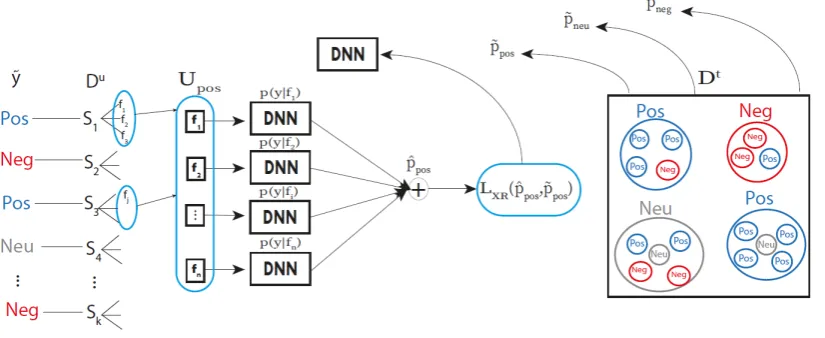
Figure 1: Illustration of the algorithm.Csis applied toDuresulting iny˜for each sentence,Ujis built according
[image:5.595.77.292.319.467.2]with the fragments of the same labelled sentences, the probabilities for each fragment in Uj are summed and normalized, the XR loss in equation (4) is calculated and the network is updated.
Figure 2: Illustration of the decomposition procedure, when givena1=“duck confit“ anda2= “foie gras terrine
with figs“ as the pivot phrases.
fragment-level labeling. Similarly, when we ap-plyCsto the unlabeled dataDu we again do it at the sentence level, but the setsUjare composed of
fragments, not sentences:
Uj ={fiα|α∈Du∧fiα ∈frags(α)∧Cs(α) =j}
We then apply algorithm 1 as is: at each step of training we sample a source label j ∈ {POS,NEG,NEU}, sample k fragments from Uj,
and use the XR loss to fit the expected fragment-label proportions over these k fragments to ˜pj. Figure1illustrates the procedure.
4.2 Classification Architecture
We model the ABSC problem by associating each (sentence,aspect) pair with a sentence-fragment, and constructing a neural classifier from fragments
to sentiment labels. We heuristically decompose a sentence into fragments. We use the same BiL-STM based neural architecture for both sentence classification and fragment classification.
Fragment-decomposition We now describe the procedure we use to associate a sentence fragment with each (sentence,aspect) pairs. The shared tasks data associates each aspect with a pivot-phrasea, where pivot phrase(w1, w2, ...wl)is
de-fined as a pre-determined sequence of words that is contained within the sentence. For a sentenceα, a set of pivot phrasesA = (a1, ..., am)and a
spe-cific pivot phraseai, we consult the constituency
parse tree ofαand look for tree nodes that satisfy the following conditions:5
1. The node governs the desired pivot phraseai.
2. The node governs either a verb (VB, VBD, VBN, VBG, VBP, VBZ) or an adjective (JJ, JJR, JJS), which is different than anyaj ∈A.
3. The node governs a minimal number of pivot phrases from(a1, ..., am), ideally onlyai.
We then select the highest node in the tree that satisfies all conditions. The span governed by this node is taken as the fragment associated with
as-5
pectai.6 The decomposition procedure is
demon-strated in Figure2.
When aspect-level information is given, we take the pivot-phrases to be the requested aspects. When aspect-level information is not available, we take each noun in the sentence to be a pivot-phrase.
Neural Classifier Our classification model is a simple 1-layer BiLSTM encoder (a concatenation of the last states of a forward and a backward run-ning LSTMs) followed by a linear-predictor. The encoder is fed either a complete sentence or a sen-tence fragment.
5 Experiments
Data Our target task is aspect-based fragment-classification, with small labeled datasets from the SemEval 2015 and 2016 shared tasks, each dataset containing aspect-level predictions for about 2000 sentences in the restaurants reviews domain. Our
source classifier is based on training on up to 10,000 sentences from the same domain and 2000 sentences for validation, labeled for only for sentence-level sentiment. We additionally have an unlabeled dataset of up to 670,000 sentences from the same domain7. We tokenized all datasets us-ing the Tweet Tokenizer from NLTK package8and parsed the tokenized sentences with AllenNLP parser.9
Training Details Both the sentence level classi-fication models and the models trained with XR have a hidden state vector dimension of size 300, they use dropout (Hinton et al., 2012) on the sentence representation or fragment representa-tion vector (rate=0.5) and optimized using Adam (Kingma and Ba,2014). The sentence classifica-tion is trained with a batch size of 30 and XR mod-els are trained with batch sizeskthat each contain 450 fragments10. We used a temperature
param-6
On the rare occasions where we cannot find such a node, we take the root node of the tree (the entire sentence) as the fragment for the given aspect.
7
All of the sentence-level sentiment data is obtained from the Yelp dataset challenge: https://www.yelp.com/ dataset/challenge
8
https://www.nltk.org/ 9https://allennlp.org/ 10
We also increased the batch sizes of the baselines to match those of the XR setups. This decreased the perfor-mance of the baselines, which is consistent with the folk knowledge in the community according to which smaller batch sizes are more effective overall.
eter of 111. We use pre-trained 300-dimensional GloVe embeddings12 (Pennington et al., 2014), and fine-tune them during training. The XR train-ing was validated with a validation set of 20% of SemEval-2015 training set, the sentence level BiL-STM classifiers were validated with a validation of 2000 sentences.13 When fine-tuning to the aspect
based task we used 20% of train in each dataset as validation and evaluated on this set. On each train-ing method the models were evaluated on the vali-dation set, after each epoch and the best model was chosen. The data is highly imbalanced, with only very few sentences receiving a NEU label. We do not deal with this imbalance directly and train both the sentence level and the XR aspect-based ing on the imbalanced data. However, when train-ingCs, we trained five models and chose the best
model that predicts correctly at least 20% of the neutral sentences. The models are implemented using DyNet14(Neubig et al.,2017).
Baseline models In recent years many neural network architectures with increasing sophistica-tion were applied to the ABSC task (Nguyen and Shirai, 2015; Vo and Zhang, 2015; Tang et al.,
2016a,b; Wang et al., 2016; Zhang et al., 2016;
Ruder et al., 2016; Ma et al., 2017; Liu and Zhang,2017;Chen et al., 2017;Liu et al.,2018;
Yang et al., 2018; Wang et al., 2018b,a; Fan et al., 2018a,b; Li et al., 2018; Ouyang and Su,
2018). We compare to a series of state-of-the-art ABSC neural classifiers that pstate-of-the-articipated in the shared tasks. TDLSTM-ATT (Tang et al.,
2016a) encodes the information around an aspect using forward and backward LSTMs, followed by an attention mechanism. ATAE-LSTM (Wang et al., 2016) is an attention based LSTM vari-ant. MM (Tang et al., 2016b) is a deep mem-ory network with multiple-hops of attention lay-ers. RAM (Chen et al.,2017) uses multiple atten-tion mechanisms combined with a recurrent neu-ral networks and a weighted memory mechanism. LSTM+SynATT+TarRep (He et al., 2018a) is an attention based LSTM which incorporates
syn-11
Despite (Mann and McCallum, 2007) claim regarding the temperature parameter, we observed lower performance when using it in our setup. However, in other setups this pa-rameter might be found to be beneficial.
12
https://nlp.stanford.edu/projects/ glove/
13
We also tested the sentence BiLSTM baselines with a SemEval validation set, and received slightly lower results without a significant statistical difference.
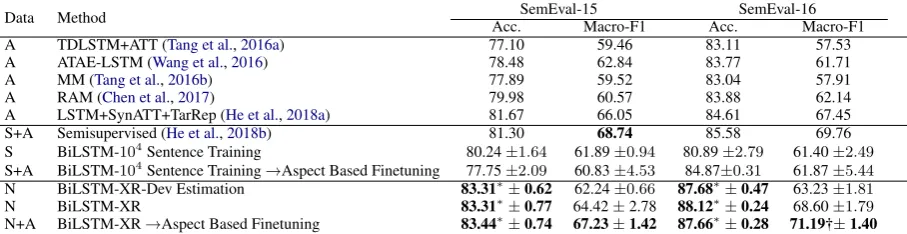
Data Method SemEval-15 SemEval-16 Acc. Macro-F1 Acc. Macro-F1 A TDLSTM+ATT (Tang et al.,2016a) 77.10 59.46 83.11 57.53 A ATAE-LSTM (Wang et al.,2016) 78.48 62.84 83.77 61.71
A MM (Tang et al.,2016b) 77.89 59.52 83.04 57.91
A RAM (Chen et al.,2017) 79.98 60.57 83.88 62.14
A LSTM+SynATT+TarRep (He et al.,2018a) 81.67 66.05 84.61 67.45 S+A Semisupervised (He et al.,2018b) 81.30 68.74 85.58 69.76 S BiLSTM-104
Sentence Training 80.24±1.64 61.89±0.94 80.89±2.79 61.40±2.49 S+A BiLSTM-104
Sentence Training→Aspect Based Finetuning 77.75±2.09 60.83±4.53 84.87±0.31 61.87±5.44 N BiLSTM-XR-Dev Estimation 83.31∗±0.62 62.24±0.66 87.68∗±0.47 63.23±1.81 N BiLSTM-XR 83.31∗±0.77 64.42±2.78 88.12∗±0.24 68.60±1.79
[image:7.595.77.531.62.179.2]N+A BiLSTM-XR→Aspect Based Finetuning 83.44∗±0.74 67.23±1.42 87.66∗±0.28 71.19†±1.40
Table 1: Average accuracies and Macro-F1 scores over five runs with random initialization along with their stan-dard deviations. Bold: best results or within std of them.∗indicates that the method’s result is significantly better than all baseline methods,† indicates that the method’s result is significantly better than all baselines methods that use the aspect-based data only, withp <0.05according to a one-tailed unpaired t-test. The data annotationsS,N
andAindicate training with Sentence-level, Noisy sentence-level and Aspect-level data respectively. Numbers for TDLSTM+Att,ATAE-LSTM,MM,RAM and LSTM+SynATT+TarRep are from (He et al.,2018a). Numbers for Semisupervised are from (He et al.,2018b).
tactic information into the attention mechanism and uses an auto-encoder structure to produce an aspect representations. All of these models are trained only on the small, fully-supervised ABSC datasets.
“Semisupervised” is the semi-supervised setup of (He et al., 2018b), it train an attention-based LSTM model on 30,000 documents addi-tional to an aspect-based train set, 10,000 doc-uments to each class. We consider additional two simple but strong semi-supervised baselines. Sentence-BiLSTM is our BiLSTM model trained on the 104 sentence-level annotations, and ap-plied as-is to the individual fragments. Sentence-BiLSTM+Finetuning is the same model, but fine-tuned on the aspect-based data as explained above. Finetuning is performed using our own implemen-tation of the attention-based model of He et al.
(2018b).15 Both these models are on par with the fully-supervised ABSC models.
Empirical Proportions The proportion con-straint sets ˜pj based on the SemEval-2015 aspect-based train data are:
˜
pPOS={POS: 0.93,NEG: 0.06,NEU: 0.01} ˜
pNEG={POS: 0.27,NEG: 0.7,NEU : 0.03} ˜
pNEU={POS: 0.45,NEG: 0.41,NEU: 0.14}
5.1 Main Results
Table1compares these baselines to three XR con-ditions.16
15
We changed the LSTM component to a BiLSTM.
16To be consistent with existing research (He et al.,2018b),
aspects with conflicted polarity are removed.
The first condition, BiLSTM-XR-Dev, per-forms XR training on the automatically-labeled sentence-level dataset. The only access it has to aspect-level annotation is for estimating the proportions of labels for each sentence-level la-bel, which is done based on the validation set of SemEval-2015 (i.e., 20% of the train set). The XR setting is very effective: without using any in-task data, this model already surpasses all other mod-els, both supervised and semi-supervised, except for the (He et al.,2018b,a) models which achieve higher F1 scores. We note that in contrast to XR, the competing models have complete access to the supervised aspect-based labels. The second con-dition, BiLSTM-XR, is similar but now the model is allowed to estimate the conditional label pro-portions based on the entire aspect-based training set (the classifier still does not have direct access to the labels beyond the aggregate proportion in-formation). This improves results further, show-ing the importance of accurately estimatshow-ing the proportions. Finally, in BiLSTM-XR+Finetuning, we follow the XR training with fully supervised fine-tuning on the small labeled dataset, using the attention-based model of He et al.(2018b). This achieves the best results, and surpasses also the semi-supervisedHe et al.(2018b) baseline on ac-curacy, and matching it on F1.17
We report significance tests for the robustness
17
of the method under random parameter initializa-tion. Our reported numbers are averaged over five random initialization. Since the datasets are un-balanced w.r.t the label distribution, we report both accuracy and macro-F1.
The XR training is also more stable than the other semi-supervised baselines, achieving sub-stantially lower standard deviations across differ-ent runs.
5.2 Further experiments
In each experiment in this section we estimate the proportions using the SemEval-2015 train set.
Effect of unlabeled data size How does the XR training scale with the amount of unlabeled data? Figure3a shows the macro-F1 scores on the entire SemEval-2016 dataset, with different unlabeled corpus sizes (measured in number of sentences). An unannotated corpus of5×104sentences is suf-ficient to surpass the results of the 104 sentence-level trained classifier, and more unannotated data further improves the results.
Effect of Base-classifier Quality Our method requires a sentence level classifierCsto label both
the target-task corpus and the unlabeled corpus. How does the quality of this classifier affect the overall XR training? We vary the amount of su-pervision used to train Cs from 0 sentences (as-signing the same label to all sentences), to 100, 1000, 5000 and 10000 sentences. We again mea-sure macro-F1 on the entire SemEval 2016 corpus. The results in Figure3b show that when using the prior distributions of aspects (0), the model strug-gles to learn from this signal, it learns mostly to predict the majority class, and hence reaches very low F1 scores of 35.28. The more data given to the sentence level classifier, the better the potential re-sults will be when training with our method using the classifier labels, with a classifiers trained on 100,1000,5000 and 10000 labeled sentences, we get a F1 scores of 53.81, 58.84, 61.81, 65.58 re-spectively. Improvements in the source task clas-sifier’s quality clearly contribute to the target task accuracy.
Effect of k The Stochastic Batched XR algo-rithm (Algoalgo-rithm1) samples a batch ofkexamples at each step to estimate the posterior label distri-bution used in the loss computation. How does the size ofkaffect the results? We usek= 450 frag-ments in our main experifrag-ments, but smaller values
ofkreduce GPU memory load and may train bet-ter in practice. We tested our method with varying values ofkon a sample of5×104, using batches that are composed of fragments of 5, 25, 100, 450, 1000 and 4500 sentences. The results are shown in Figure3c. Settingk = 5 result in low scores. Settingk= 25yields better F1 score but with high variance across runs. Fork = 100 fragments the results begin to stabilize, we also see a slight de-crease in F1-scores with larger batch sizes. We attribute this drop despite having better estimation of the gradients to the general trend of larger batch sizes being harder to train with stochastic gradient methods.
5.3 Pre-training, BERT
The XR training can be performed also over pre-trained representations. We experiment with two pre-training methods: (1) pre-training by training the BiLSTM model to predict the noisy sentence-level predictions. (2) Using the pre-trained BERT representation (Devlin et al., 2018). For (1), we compare the effect of pre-train on unlabeled cor-pora of sizes of5×104,105 and6.7×105
sen-tences. Results in Figure3d show that this form of pre-training is effective for smaller unlabeled cor-pora but evens out for larger ones.
BERT For the BERT experiments, we experi-ment with the BERT-base model18 withk = 450
sets, 30 epochs for XR training or sentence level fine-tuning19and 15 epochs for aspect based fine-tuning, on each training method we evaluated the model on the dev set after each epoch and the best model was chosen20. We compare the following setups:
-BERT→Aspect Based Finetuning: pretrained BERTmodel finetuned to the aspect based task. -BERT→104: A pretrainedBERTmodel finetuned to the sentence level task on the104sentences, and tested by predicting fragment-level sentiment. -BERT→104→Aspect Based Finetuning: pre-trainedBERTmodel finetuned to the sentence level task, and finetuned again to the aspect based one. -BERT→XR: pretrainedBERTmodel followed by
18
We could not fitk = 450 sets of BERT-large on our GPU.
19When fine-tuning to the sentence level task, we provide
the sentence as input. When fine-tuning to the aspect-level task, we provide the sentence, a seperator and then the aspect.
20The other configuration parameters were the
(a) (b) (c) (d)
Figure 3: Macro-F1 scores for the entire SemEval-2016 dataset of the different analyses. (a) the contribution of unlabeled data. (b) the effect of sentence classifier quality. (c) the effect of k. (d) the effect of sentence-level pretraining vs. corpus size.
Data Training SemEval-15 SemEval-16
Acc. Macro-F1 Acc. Macro-F1 N BiLSTM-XR 83.31±0.77 64.42±2.78 88.12±0.24 68.60±1.79 N+A BiLSTM-XR→Aspect Based Finetuning 83.44±0.74 67.23±1.42 87.66±0.28 71.19±1.40 A BERT→Aspect Based Finetuning 81.87±1.12 59.24±4.94 85.81±1.07 62.46±6.76 S BERT→104Sent Finetuning 83.29±0.77 66.79±1.99 84.53±1.66 65.53±3.03 S+A BERT→104Sent Finetuning→Aspect Based Finetuning 82.54±1.21 64.13±5.05 85.67±1.14 64.13±7.07 N BERT→XR 85.46∗±0.59 66.86±2.8 89.5∗±0.55 70.86†±2.96
N+A BERT→XR→Aspect Based Finetuning 85.78∗±0.65 68.74±1.36 89.57∗±1.4 73.89∗±2.05
Table 2: BERTpre-training: average accuracies and Macro-F1 scores from five runs and their stdev. ∗indicates that the method’s result is significantly better than all baseline methods,† indicates that the method’s result is significantly better than all non XR baseline methods, withp < 0.05according to a one-tailed unpaired t-test. The data annotationsS,NandAindicate training with Sentence-level, Noisy sentence-level and Aspect-level data respectively.
XR training using our method.
-BERT→ XR → Aspect Based Finetuning: pre-trained BERT followed by XR training and then fine-tuned to the aspect level task.
The results are presented in Table2. As before, aspect-based fine-tuning is beneficial for both SemEval-16 and SemEval-15. Training a BiL-STM with XR surpasses pre-trainedBERTmodels and using XR training on top of the pre-trained BERT models substantially increases the results even further.
6 Discussion
We presented a transfer learning method based on expectation regularization (XR), and demon-strated its effectiveness for training aspect-based sentiment classifiers using sentence-level supervi-sion. The method achieves state-of-the-art results for the task, and is also effective for improving on top of a strong pre-trained BERTmodel. The pro-posed method provides an additional data-efficient tool in the modeling arsenal, which can be ap-plied on its own or together with another training method, in situations where there is a conditional
relations between the labels of a source task for which we have supervision, and a target task for which we don’t.
While we demonstrated the approach on the sentiment domain, the required conditional depen-dence between task labels is present in many sit-uations. Other possible application of the method includes training language identification of tweets given location supervision (knowing the geo-graphical region gives a prior on languages spo-ken), training predictors for renal failure from tex-tual medical records given classifier for diabetes (there is a strong correlation between the two con-ditions), training a political affiliation classifier from social media tweets based on age-group sifiers, zip-code information, or social-status clas-sifiers (there are known correlations between all of these to political affiliation), training hate-speech detection based on emotion detection, and so on.
Acknowledgements
[image:9.595.78.522.259.340.2]References
Richard H. Byrd, Peihuang Lu, Jorge Nocedal, and Ciyou Zhu. 1995. A limited memory algorithm for bound constrained optimization. SIAM J. Scientific Computing, 16(5):1190–1208.
Ming-Wei Chang, Lev Ratinov, and Dan Roth. 2007.
Guiding semi-supervision with constraint-driven learning. InProceedings of the 45th Annual Meet-ing of the Association of Computational LMeet-inguistics, pages 280–287. Association for Computational Lin-guistics.
Ming-Wei Chang, Lev-Arie Ratinov, and Dan Roth. 2012. Structured learning with constrained condi-tional models.Machine Learning, 88(3):399–431.
Peng Chen, Zhongqian Sun, Lidong Bing, and Wei Yang. 2017. Recurrent attention network on mem-ory for aspect sentiment analysis. InProceedings of the 2017 Conference on Empirical Methods in Nat-ural Language Processing, pages 452–461. Associ-ation for ComputAssoci-ational Linguistics.
Jacob Devlin, Ming-Wei Chang, Kenton Lee, and Kristina Toutanova. 2018. Bert: Pre-training of deep bidirectional transformers for language understand-ing. CoRR, abs/1810.04805.
Gregory Druck, Gideon S. Mann, and Andrew McCal-lum. 2008. Learning from labeled features using generalized expectation criteria. InProceedings of the 31st Annual International ACM SIGIR Confer-ence on Research and Development in Information Retrieval, SIGIR 2008, Singapore, July 20-24, 2008, pages 595–602.
Chuang Fan, Qinghong Gao, Jiachen Du, Lin Gui, Ruifeng Xu, and Kam-Fai Wong. 2018a.
Convolution-based memory network for aspect-based sentiment analysis. InThe 41st International ACM SIGIR Conference on Research & Develop-ment in Information Retrieval, SIGIR 2018, Ann Ar-bor, MI, USA, July 08-12, 2018, pages 1161–1164.
Feifan Fan, Yansong Feng, and Dongyan Zhao. 2018b.
Multi-grained attention network for aspect-level sentiment classification. InProceedings of the 2018 Conference on Empirical Methods in Natural Lan-guage Processing, pages 3433–3442. Association for Computational Linguistics.
Kuzman Ganchev and Dipanjan Das. 2013. Cross-lingual discriminative learning of sequence models with posterior regularization. InProceedings of the 2013 Conference on Empirical Methods in Natural Language Processing, pages 1996–2006. Associa-tion for ComputaAssocia-tional Linguistics.
Kuzman Ganchev, Jo˜ao Grac¸a, Jennifer Gillenwater, and Ben Taskar. 2010. Posterior regularization for structured latent variable models. Journal of Ma-chine Learning Research, 11:2001–2049.
Jo˜ao Grac¸a, Kuzman Ganchev, and Ben Taskar. 2007.
Expectation maximization and posterior constraints. InAdvances in Neural Information Processing Sys-tems 20, Proceedings of the Twenty-First Annual Conference on Neural Information Processing Sys-tems, Vancouver, British Columbia, Canada, De-cember 3-6, 2007, pages 569–576.
Aria Haghighi and Dan Klein. 2006. Prototype-driven learning for sequence models. In Human Lan-guage Technology Conference of the North Amer-ican Chapter of the Association of Computational Linguistics, Proceedings, June 4-9, 2006, New York, New York, USA.
Ruidan He, Wee Sun Lee, Hwee Tou Ng, and Daniel Dahlmeier. 2018a. Effective attention modeling for aspect-level sentiment classification. In Proceed-ings of the 27th International Conference on Com-putational Linguistics, pages 1121–1131. Associa-tion for ComputaAssocia-tional Linguistics.
Ruidan He, Wee Sun Lee, Hwee Tou Ng, and Daniel Dahlmeier. 2018b. Exploiting document knowledge for aspect-level sentiment classification. In Pro-ceedings of the 56th Annual Meeting of the Associa-tion for ComputaAssocia-tional Linguistics (Volume 2: Short Papers), pages 579–585. Association for Computa-tional Linguistics.
Geoffrey E. Hinton, Nitish Srivastava, Alex Krizhevsky, Ilya Sutskever, and Ruslan Salakhut-dinov. 2012. Improving neural networks by preventing co-adaptation of feature detectors.
CoRR, abs/1207.0580.
Tom Hope and Dafna Shahaf. 2016. Ballpark learn-ing: Estimating labels from rough group compar-isons. In Machine Learning and Knowledge Dis-covery in Databases - European Conference, ECML PKDD 2016, Riva del Garda, Italy, September 19-23, 2016, Proceedings, Part II, pages 299–314.
Rong Jin and Yi Liu. 2005. A framework for in-corporating class priors into discriminative classifi-cation. InAdvances in Knowledge Discovery and Data Mining, 9th Pacific-Asia Conference, PAKDD 2005, Hanoi, Vietnam, May 18-20, 2005, Proceed-ings, pages 568–577.
Diederik P. Kingma and Jimmy Ba. 2014. Adam: A method for stochastic optimization. CoRR, abs/1412.6980.
Lishuang Li, Yang Liu, and AnQiao Zhou. 2018. Hi-erarchical attention based position-aware network for aspect-level sentiment analysis. InProceedings of the 22nd Conference on Computational Natural Language Learning, pages 181–189. Association for Computational Linguistics.
Percy Liang, Michael I. Jordan, and Dan Klein. 2009.
2009, Montreal, Quebec, Canada, June 14-18, 2009, pages 641–648.
Fei Liu, Trevor Cohn, and Timothy Baldwin. 2018. Re-current entity networks with delayed memory update for targeted aspect-based sentiment analysis. In Pro-ceedings of the 2018 Conference of the North Amer-ican Chapter of the Association for Computational Linguistics: Human Language Technologies, Vol-ume 2 (Short Papers), pages 278–283. Association for Computational Linguistics.
Jiangming Liu and Yue Zhang. 2017. Attention mod-eling for targeted sentiment. InProceedings of the 15th Conference of the European Chapter of the As-sociation for Computational Linguistics: Volume 2, Short Papers, pages 572–577. Association for Com-putational Linguistics.
Dehong Ma, Sujian Li, Xiaodong Zhang, and Houfeng Wang. 2017. Interactive attention networks for aspect-level sentiment classification. In Proceed-ings of the Twenty-Sixth International Joint Con-ference on Artificial Intelligence, IJCAI 2017, Mel-bourne, Australia, August 19-25, 2017, pages 4068– 4074.
Gideon S. Mann and Andrew McCallum. 2007. Sim-ple, robust, scalable semi-supervised learning via expectation regularization. In Machine Learn-ing, Proceedings of the Twenty-Fourth International Conference (ICML 2007), Corvallis, Oregon, USA, June 20-24, 2007, pages 593–600.
Gideon S. Mann and Andrew McCallum. 2010a. Gen-eralized expectation criteria for semi-supervised learning with weakly labeled data. Journal of Ma-chine Learning Research, 11:955–984.
Gideon S. Mann and Andrew McCallum. 2010b. Gen-eralized expectation criteria for semi-supervised learning with weakly labeled data. Journal of Ma-chine Learning Research, 11:955–984.
Prem Melville, Wojciech Gryc, and Richard D. Lawrence. 2009. Sentiment analysis of blogs by combining lexical knowledge with text classifica-tion. In Proceedings of the 15th ACM SIGKDD International Conference on Knowledge Discovery and Data Mining, Paris, France, June 28 - July 1, 2009, pages 1275–1284.
Ardehaly Ehsan Mohammady and Aron Culotta. 2015.
Inferring latent attributes of twitter users with label regularization. InProceedings of the 2015 Confer-ence of the North American Chapter of the Associ-ation for ComputAssoci-ational Linguistics: Human Lan-guage Technologies, pages 185–195. Association for Computational Linguistics.
David R. Musicant, Janara M. Christensen, and Jamie F. Olson. 2007. Supervised learning by train-ing on aggregate outputs. In Proceedings of the 7th IEEE International Conference on Data Mining (ICDM 2007), October 28-31, 2007, Omaha, Ne-braska, USA, pages 252–261.
Graham Neubig, Chris Dyer, Yoav Goldberg, Austin Matthews, Waleed Ammar, Antonios Anastasopou-los, Miguel Ballesteros, David Chiang, Daniel Clothiaux, Trevor Cohn, Kevin Duh, Manaal Faruqui, Cynthia Gan, Dan Garrette, Yangfeng Ji, Lingpeng Kong, Adhiguna Kuncoro, Gaurav Ku-mar, Chaitanya Malaviya, Paul Michel, Yusuke Oda, Matthew Richardson, Naomi Saphra, Swabha Swayamdipta, and Pengcheng Yin. 2017. Dynet: The dynamic neural network toolkit. CoRR, abs/1701.03980.
Thien Hai Nguyen and Kiyoaki Shirai. 2015.
Phrasernn: Phrase recursive neural network for aspect-based sentiment analysis. InProceedings of the 2015 Conference on Empirical Methods in Nat-ural Language Processing, pages 2509–2514. Asso-ciation for Computational Linguistics.
Zhifan Ouyang and Jindian Su. 2018. Dependency parsing and attention network for aspect-level sen-timent classification. InNatural Language Process-ing and Chinese ComputProcess-ing - 7th CCF International Conference, NLPCC 2018, Hohhot, China, August 26-30, 2018, Proceedings, Part I, pages 391–403.
Jeffrey Pennington, Richard Socher, and Christopher Manning. 2014. Glove: Global vectors for word representation. In Proceedings of the 2014 Con-ference on Empirical Methods in Natural Language Processing (EMNLP), pages 1532–1543. Associa-tion for ComputaAssocia-tional Linguistics.
Maria Pontiki, Dimitris Galanis, Haris Papageorgiou, Ion Androutsopoulos, Suresh Manandhar, Moham-mad AL-SMoham-madi, Mahmoud Al-Ayyoub, Yanyan Zhao, Bing Qin, Orphee De Clercq, Veronique Hoste, Marianna Apidianaki, Xavier Tannier, Na-talia Loukachevitch, Evgeniy Kotelnikov, N´uria Bel, Salud Mar´ıa Jim´enez-Zafra, and G¨uls¸en Eryi˘git. 2016. Semeval-2016 task 5: Aspect based senti-ment analysis. InProceedings of the 10th Interna-tional Workshop on Semantic Evaluation (SemEval-2016), pages 19–30. Association for Computational Linguistics.
Maria Pontiki, Dimitris Galanis, Haris Papageorgiou, Suresh Manandhar, and Ion Androutsopoulos. 2015.
Semeval-2015 task 12: Aspect based sentiment anal-ysis. InProceedings of the 9th International Work-shop on Semantic Evaluation (SemEval 2015), pages 486–495. Association for Computational Linguis-tics.
Novi Quadrianto, Alexander J. Smola, Tib´erio S. Cae-tano, and Quoc V. Le. 2009a. Estimating labels from label proportions.Journal of Machine Learning Re-search, 10:2349–2374.
Sebastian Ruder, Parsa Ghaffari, and John G. Breslin. 2016. A hierarchical model of reviews for aspect-based sentiment analysis. In Proceedings of the 2016 Conference on Empirical Methods in Natural Language Processing, pages 999–1005. Association for Computational Linguistics.
Robert E. Schapire, Marie Rochery, Mazin G. Rahim, and Narendra K. Gupta. 2002. Incorporating prior knowledge into boosting. In Machine Learning, Proceedings of the Nineteenth International Confer-ence (ICML 2002), University of New South Wales, Sydney, Australia, July 8-12, 2002, pages 538–545.
Duyu Tang, Bing Qin, Xiaocheng Feng, and Ting Liu. 2016a. Effective lstms for target-dependent sen-timent classification. In Proceedings of COLING 2016, the 26th International Conference on Compu-tational Linguistics: Technical Papers, pages 3298– 3307. The COLING 2016 Organizing Committee.
Duyu Tang, Bing Qin, and Ting Liu. 2016b. Aspect level sentiment classification with deep memory net-work. In Proceedings of the 2016 Conference on Empirical Methods in Natural Language Process-ing, pages 214–224. Association for Computational Linguistics.
Duy-Tin Vo and Yue Zhang. 2015. Target-dependent twitter sentiment classification with rich automatic features. InProceedings of the Twenty-Fourth Inter-national Joint Conference on Artificial Intelligence, IJCAI 2015, Buenos Aires, Argentina, July 25-31, 2015, pages 1347–1353.
Jingjing Wang, Jie Li, Shoushan Li, Yangyang Kang, Min Zhang, Luo Si, and Guodong Zhou. 2018a. As-pect sentiment classification with both word-level and clause-level attention networks. In Proceed-ings of the Twenty-Seventh International Joint Con-ference on Artificial Intelligence, IJCAI 2018, July 13-19, 2018, Stockholm, Sweden., pages 4439–4445.
Mengqiu Wang and Christopher D. Manning. 2014.
Cross-lingual projected expectation regularization for weakly supervised learning.TACL, 2:55–66.
Shuai Wang, Sahisnu Mazumder, Bing Liu, Mianwei Zhou, and Yi Chang. 2018b. Target-sensitive mem-ory networks for aspect sentiment classification. In
Proceedings of the 56th Annual Meeting of the As-sociation for Computational Linguistics (Volume 1: Long Papers), pages 957–967. Association for Com-putational Linguistics.
Yequan Wang, Minlie Huang, xiaoyan zhu, and Li Zhao. 2016. Attention-based lstm for aspect-level sentiment classification. InProceedings of the 2016 Conference on Empirical Methods in Natural Lan-guage Processing, pages 606–615. Association for Computational Linguistics.
Zuoguan Wang, Siwei Lyu, Gerwin Schalk, and Qiang Ji. 2012. Learning with target prior. In Advances in Neural Information Processing Systems 25: 26th
Annual Conference on Neural Information Process-ing Systems 2012. ProceedProcess-ings of a meetProcess-ing held December 3-6, 2012, Lake Tahoe, Nevada, United States., pages 2240–2248.
Min Yang, Qiang Qu, Xiaojun Chen, Chaoxue Guo, Ying Shen, and Kai Lei. 2018. Feature-enhanced at-tention network for target-dependent sentiment clas-sification.Neurocomputing, 307:91–97.
Meishan Zhang, Yue Zhang, and Duy-Tin Vo. 2016.
Gated neural networks for targeted sentiment anal-ysis. In Proceedings of the Thirtieth AAAI Con-ference on Artificial Intelligence, February 12-17, 2016, Phoenix, Arizona, USA., pages 3087–3093.