Entity Projection via Machine-Translation for Cross-Lingual NER
Alankar Jain Bhargavi Paranjape Zachary C. Lipton Carnegie Mellon University
Pittsburgh, USA
{alankarjain91,bhargavi22294}@gmail.com,[email protected]
Abstract
Although over 100 languages are supported
by strong off-the-shelf machine translation sys-tems, only a subset of them possess large
annotated corpora for named entity
recogni-tion. Motivated by this fact, we leverage
machine translation to improve annotation-projection approaches to cross-lingual named entity recognition. We propose a system that improves over prior entity-projection methods by: (a) leveraging machine translation systems twice: first for translating sentences and sub-sequently for translating entities; (b) match-ing entities based on orthographic and pho-netic similarity; and (c) identifying matches based on distributional statistics derived from the dataset. Our approach improves upon cur-rent state-of-the-art methods for cross-lingual
named entity recognition on 5 diverse
lan-guages by an average of4.1points. Further,
our method achieves state-of-the-artF1scores
for Armenian, outperforming even a
monolin-gual model trained on Armenian source data.1
1 Introduction
While machine learning methods for various Nat-ural Language Processing (NLP)tasks have pro-gressed rapidly, the benefits accrue disproportion-ately among languages endowed with large anno-tated corpora. Owing to the dependence of state-of-the-art deep learning approaches on massive amounts of data, creating suitable datasets can be prohibitively expensive. This asymmetry be-tween resource-rich and relatively under-resourced languages has inspired work oncross-lingual ap-proaches that leverage annotated datasets from the former to build strong models for the latter.
This paper focuses on cross-lingual approaches to Named Entity Recognition (NER), owing to
1Code for our paper can be found at:https://github.
com/alankarj/cross_lingual_ner
NER’s importance as a core component in infor-mation retrievalandquestion answeringsystems. Specifically, we focus onmedium-resource lan-guages. We define these to be languages for which although annotated NER corpora do not exist, off-the-shelfMachine Translation (MT)systems, such as Google Translate2, do. We are motivated by the fact that although there are fewer than50 lan-guages for which large NER datasets (greater than
200k tokens) with gold annotations are publicly available3, many more languages are supported by good-quality MT (Wu et al.,2016). Google Trans-late alone supports103languages4, many of which have either no, or only small, NER datasets.
We address the setting where annotated cor-pora exist in the source (resource-rich) language— English in our experiments—but for the target (medium-resource) language, we can only afford to label a small validation set. We tackle this problem by first creating an unlabeled dataset in the target language by translating each sentence in the source dataset to the target language. For MT, we use Google Translate, motivated by its large coverage. Next, we annotate this dataset via entity projec-tion—first aligning every entity in a source sen-tence with its counterpart in the corresponding tar-get sentence (entity alignment) and then projecting the tags from source to target in the aligned entity pairs (tag projection). One consequence of relying on MT as opposed to word-by-word or phrase-by-phrase translation is that the entity projection step can be difficult, owing to the frequency with which original sentences and their translated counterparts are not word-for-word aligned.
Our proposed solution to this problem consists of (a) leveraging MT again for translating entities; (b) matching entities based on orthographic and
2
https://cloud.google.com/translate/
3
http://damien.nouvels.net/resourcesen/corpora.html
___________ ___________ ___________ ___________ ___________
Source annotated NER data
___________ ___________ ___________ ___________ ___________
Target annotated NER data ___________
___________ ___________ ___________ ___________
Target raw data Google
Translate
Candidate match
generation Best match selection Distribution-based matching
TRANSLATE
MATCH + PROJECT
. . .
Barack Obama Unidos B-PER I-PER I-LOC
[image:2.595.132.469.64.189.2]NER Model in Target Language
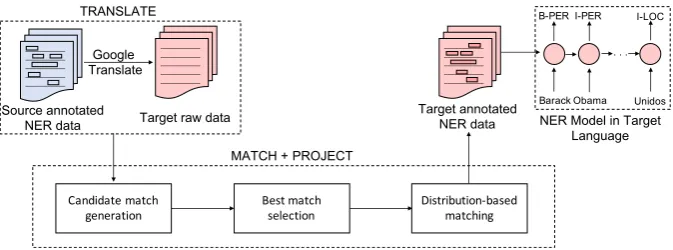
Figure 1: A schematic diagram representing the chief steps in our method.
phonetic similarity; and (c) identifying matches based on distributional statistics derived from the dataset.Importantly, while our method depends on several matching heuristics, these techniques are remarkably portable across target languages, re-quiring the tuning of only two hyperparameters. Our method achieves state-of-the art F1 scores
for cross-lingual NER for Spanish (+1.1points), German (+1.4 points), and Chinese (+5points) and beats state-of-the-art baselines on Hindi (+2.1
points) and Tamil (+5points). Further, it achieves state-of-the-artF1scores for Armenian, a
medium-resource language, beating a monolingual model trained on Armenian source data by0.4points.
2 Related Work
Cross-lingual approaches have been applied to many NLP tasks, including part-of-speech tagging
(Yarowsky et al., 2001;Xi and Hwa, 2005;Das
and Petrov,2011;T¨ackstr¨om et al.,2013), parsing
(Hwa et al.,2005;Zeman and Resnik,2008;Smith
and Eisner,2009;Ganchev et al.,2009), and
seman-tic role labeling (Tonelli and Pianta,2008;Pad´o and
Lapata,2009;Kozhevnikov and Titov,2013,2014).
Prior cross-lingual NLP papers cleave roughly into two distinct approaches:direct model transferand annotation projection.
2.1 Direct model transfer
These approaches apply models trained on the source language absent modification (to the model) to data from the target language by exploiting a shared representation for the two languages
(T¨ackstr¨om et al., 2012;Bharadwaj et al., 2016;
Chaudhary et al.,2018;Kozhevnikov and Titov,
2014; Ni et al., 2017). However, direct model
transfer techniques face a problem when applied to markedly dissimilar languages: they lack of lexical-ized (especially character-based) features, which
are known to have predictive power for tasks such as NER.Xie et al.(2018) provide evidence for this in the cross-lingual setting, comparing otherwise similar annotation projection approaches that differ in their use of lexicalized features.
2.2 Annotation projection
These approaches to cross-lingual NLP train a model in the target language. This requires first projecting annotations from the source data to the (unlabeled) target data. Many approaches in this category rely upon parallel corpora (Yarowsky
et al.,2001;Hwa et al.,2005;Zeman and Resnik,
2008; Ehrmann et al., 2011; Fu et al., 2011; Ni
et al.,2017), first annotating the source data using
a trained model and then projecting the annotations. Only a few works explore the use of MT to first translate a gold annotated corpus to obtain a syn-theticparallel corpus and then project annotations
(Tiedemann et al.,2014).Shah et al.(2010) go in
the opposite direction, translating target to source using Google Translate, annotating the translated source sentences using a trained NER system and then projecting annotations back.
When projecting annotations, one encounters the problem of word alignment. Most of the existing works (Yarowsky et al.,2001;Shah et al.,2010;Ni
et al.,2017) rely upon unsupervised alignment
mod-els from statistical MT literature, such as IBM Mod-els 1-6 (Brown et al.,1993;Och and Ney,2003). Other works focus on low-resource settings ( May-hew et al.,2017;Xie et al.,2018) perform transla-tion word-by-word or phrase-by-phrase, and thus do not need to perform word alignment. Several papers explore heuristics such as using Wikipedia links across languages to align entities (Richman
and Schone,2008;Nothman et al.,2013;Al-Rfou
et al.,2015), matching tokens based on their surface
Barack Obama
American President was born in Hawaii , US
B-PER I-PER
B-MISC O O O O B-LOC O B-LOC
Barack Obama ,
El presidente estadounidense , nació en Hawai EE.UU. Google
Translate
[image:3.595.82.284.61.141.2],
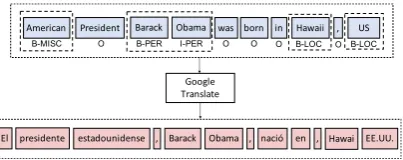
Figure 2: TheTranslatestep of our method.
manner (Samy et al.,2005;Ehrmann et al.,2011) or as features in a supervised model trained on a small seeddataset (Feng et al.,2004). Many of these pa-pers often rely on language-specific features (Feng
et al.,2004) and evaluate their alignment methods
on only a few languages.
To our knowledge, few works effectively use translation for annotation projection for NER, es-pecially for medium-resource languages for which strong MT systems exist. Motivated by this re-search gap, we explore the use of MT systems for translating the dataset and for annotation projec-tion and thus do not rely on parallel corpora. How-ever, we demonstrate the efficacy of our projection method in all three settings: (a) translation from source to target, (b) using parallel corpora and (c) translation from target to source.
3 The Translate-Match-Project Method
In our formulation, we are given an annotated NER corpus in the source language:DS
A={(xSi, ySi) :
i = 1,2, ..., N}, where xSi = (xSi1 , ..., xSiLSi) is the ith source sentence with LSi tokens and
ySi= (y1Si, ..., ySiLSi)are the NER tags from a fixed tag set. We work with four tags: PER (person), ORG (organisation), LOC (location), and MISC (miscellaneous). We follow the commonly-used IOB (Inside Outside Beginning) tagging format
(Ramshaw and Marcus,1999). In our experiments,
we work with English as the source language due to the availability of high-quality annotated corpora, e.g., CoNLL 2002 (Sang,2002) and OntoNotes 4.0
(Weischedel et al.,2011). However, our method can
easily be applied to any other resource-rich source language as well. See Figure2for an example of an annotated source sentence (blue),(xSi, ySi).
We are given a small labeled development set data (but no training data) in the target languageT for tuning hyperparameters. Our method, denoted Translate-Match-Project (TMP), proceeds in three steps: First, we translate the annotated corpus in StoT using an off-the-shelf MT system (Google
Translate). This results in an un-labeled dataset in the target language,DT ={xT i :i= 1,2, ..., N}
(Figure2); Second, we identify and tag all named entities in the translated target sentences by entity projection, which involves entity alignment and tag projection. We perform entity alignment by first constructing a set of potential matches in the target sentence for every entity in the source sen-tence (candidate match generation, Section 3.1) and then by selecting the best matching pairs of source and target entities (best match selection, Section 3.2); Third, after alignment, we project the tag type (PER, LOC, etc.) from the source to the target entity in every pair of aligned entities by adhering to the IOB tagging scheme in target. In Figure1, we depict the complete pipeline.
3.1 Candidate match generation
To generate candidate matches for an entity in a source sentence, we construct a set of its poten-tial translations and then find matches for each in the corresponding target sentence. We find these matches by token-level matching and then concate-nate matched tokens to obtain multi-token matches. We drop the indexibelow for ease of notation.
Token-level matching Consider a source entity
eS = (xSj, ..., xSk). For every eS ∈ ES, where
ES is the set of all entities in a source sentence,
we obtain a set of potential translations in the tar-get language,T(eS), via MT. However, in some cases, translating a standalone entity produces a different translation from that which emerges when translating a full sentence. For example, Google Translate maps the source entity “UAE” to “Emi-ratos ´Arabes Unidos” in most sentences but the word-by-word translation is “EAU”. Similarly, the (person) name “Tang” (e.g., “Mr. Tang”) remains “Tang” in translated sentences, but is translated to “Espiga” (Spanish for “spike”, synonymous with the English word “tang”). We address these prob-lems by augmentingT(·) with translations from publicly availablebilingual lexicons (“UAE” trans-lates to “Emiratos ´Arabes Unidos” in one of the lexicons we use) and retain a copy of the source entity (“Tang” will now find a match in the tar-get sentence). Finally,T(“UAE”)looks roughly like:{“EAU” [Google Translate], “UAE” [copy], “Emiratos ´Arabes Unidos” [lexicon]}. We note that
to-day5. However, we demonstrate that our method also works in absence of such lexicons in our case study for Armenian (Section4.3).
Next, we tokenize each candidate translation in
T(eS)to obtain a set of translation tokens foreS,
Tw(eS). For example, Tw(“UAE”) = {“EAU”,
“UAE”, “Emiratos”, “ ´Arabes”, “Unidos”}. We do this to allow for soft token-level matches be-cause we observed empirically that matching ex-act entity phrases might result in few matches. Next, we obtain a match for each hypothesis to-ken h ∈ Tw(eS) by matching it with each
ref-erence token xS
l ∀ l ∈ {1, ..., LT} in the target
sentencexT = (xT1, ..., xTLT)of lengthLT. This match is carried out at (a) the orthographic (surface form) level; and (b) the phonetic level, by match-ing transliterations in the International Phonetic Alphabet (IPA) of the two tokens. In either case, we look for the longest sequence of characters in h that are an affix (prefix or suffix) ofxTl. This softaffix-matching heuristicallows for inflection in morphologically-rich target languages. The (token-level) score for the match is given as follows:
sw(h, xTl ) = min
nnl
Lh
, nl LxT
l
o
Here,Lh andLxT
l are the lengths (in characters) of the hypothesis and reference tokens andnl is
the number of matching characters. We take min-imum in order to enforce a stricter notion of frac-tional (soft) match. For example, the phrase “Ger-man first-time registrations...” [English] gets trans-lated to “Los registros Alemanes por primera...” [Spanish]. Using our matching heuristic, “Alem´an”
∈ Tw(“German”) matches to the reference token
“Alemanes” with a score of 0.5, since nl = 4
(“Alem”) and LxT
l = 8 > Lh = 6. Next, we define the matching (entity-level) score between a source entityeSand any target tokenxTl as follows:
se(eS, xTl ) = max h∈Tw(eS)s
w(h, xT l )
Note that the token-level scores, sw, include scores based on both orthographic and phonetic match, and thus, the entity-level scores,se, corre-spond to the best token-level match (orthographic or phonetic) between any hypothesis tokenh ∈ Tw(eS) and a target token xT
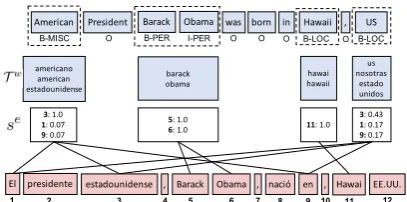
l . In Figure3, we
depict the token-level matching procedure. The
5Panlex (Kamholz et al.,2014) has lexicons for 10k
differ-ent languages.
Barack Obama
American President was born in Hawaii , US
B-PER I-PER
B-MISC O O O O B-LOC O B-LOC
Barack Obama ,
El presidente estadounidense , nació en , Hawai EE.UU.
americano american estadounidense
barack
obama hawaiihawai
us nosotras
estado unidos
3: 1.0 1: 0.07 9: 0.07
5: 1.0
6: 1.0 11: 1.0
3: 0.43 1: 0.17 9:0.17
[image:4.595.314.518.60.161.2]1 2 3 4 5 6 7 8 9 10 11 12
Figure 3: Token-level matching: Blue boxes in
row-2 (Tw) show sets of potential translations and white
boxes in row-3 (se) show target tokens (numbered)
each source entity can match with, with their scores.
score between the entity “American” and the target “estadounidense”(labeled 3 in the figure) is the
max-imum over matching scores between any token in
{“americano”, “american”, “estadounidense”}and the target token (“estadounidense”), i.e.,1.0(exact match) since the scores for the first two tokens in
Tw(·) are 0. Note some artifacts of token-level
matching: (a) our matching heuristic currently han-dles prefixes or suffixes, but can potentially be ex-tended with character edit distance for other types of affixes (e.g., circumfix) (b) every target token can match with multiple source entities (for e.g., “El” matches with both “American” and “US”) and (c) some source entities might fail to find their true match (“US” fails to match with “EE.UU.”, a pos-sibly erroneous translation of “US” provided by Google Translate). Further, many matches are of very poor quality (especially those with stop words such as “El” and “en”). We address these issues and describe how to convert these token-level matches into spans to get multi-token target entities next.
Span match generation After token-level
matching, we construct a list of potential entity spans in the target sentence that match with a given source entityeSby grouping adjacent target tokens
for which a token-level matching scorese(eS,·)is above a thresholdδ(to remove spurious matches). In other words, we construct the following set:
M(eS) ={span(q, r) :se(eS, xTu)≥δ
∀q≤u≤r}
Here, span(q, r) = (xTq, ..., xTr)is the phrase span-ning tokens indexed fromqtor(1≤q, r≤LT) in
the target sentence. Further, we require span(q, r)
to be maximal in the sense that ∀ q0 < q and
Barack Obama
American President was born in Hawaii , US
B-PER I-PER
B-MISC O O O O B-LOC O B-LOC
Barack Obama ,
El presidente estadounidense , nació en , Hawai EE.UU. americano
american estadounidense
barack
obama hawai hawaii
us nosotras
estado unidos
3: 1.0 1: 0.07 9: 0.07
5: 1.0
6: 1.0 11: 1.0
[image:5.595.79.281.60.165.2]3: 0.43 1: 0.17 9:0.17
Figure 4: Span match generation: Adjacent target to-kens with matching scores higher than a threshold (0.25 here) are concatenated to form span-level matches.
In our running example, choosingδ = 0.25 re-sults in the spans shown in Figure4, eliminating spurious matches (with “El” and “en”) and con-catenating “Barack” and “Obama” in the target sentence. However, the token “estadounidense” is still matched with two different source entities. We solve this problem in the next step.
3.2 Best match selection
For selecting the best matching pair of entities, we first expand the set of potential translationsT(·)to include all possible token-level permutations of the translations. We call this setTp(·). For example,
Tp(“UAE”) ={“EAU”, “UAE”, “Emiratos ´Arabes
Unidos”, “Emiratos Unidos ´Arabes”, “ ´Arabes Emi-ratos Unidos”, ...}. Then, we greedily align eS
with the target entity span from the set M(eS), with the least character edit distancedE(·,·)from
any translation inTp(eS), i.e.,
eT = argmin
span(·,·)∈M(eS)
dE(eS,span(·,·))
In this manner, we form aligned entity pairs
(eS, eT), along which tags can then be projected. In our running example, since the edit distance between “estadounidense” (inTp(·)) and the
tar-get single-token span “estadounidense” is0, and is lower than that with “estado”, we match “esta-dounidense” with “American”, tagging it B-MISC.
3.3 Distribution-based matching
After selecting best matching pairs, there still re-main some source entities that do not find any matching target entity (“US” in our example). These arise either due to significant differences between word-by-word and contextual sentence-level translations either due to literal (e.g., “West Bank” gets translated to “Cisjordania” in sentences and “Banco Oeste” otherwise) or possibly incorrect
translations (e.g., “U.S.” gets translated to “EE.UU.” in sentences and “NOSOTRAS” otherwise).
Barack Obama
American President was born in Hawaii , US
B-PER I-PER
B-MISC
B-LOC B-LOC
O O O O O
Barack Obama ,
El presidente estadounidense , nació en , Hawai EE.UU.
B-MISC
B-PER I-PER B-LOC B-LOC
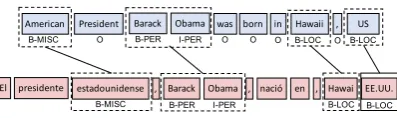
Figure 5: Final aligned pairs and projected tags.
We remedy this by exploiting corpus-level con-sistency in such discrepancies. For every un-matched source entity, we construct a set of top-kpotential matches ordered by their tf-idf (term frequency—inverse document frequency) scores, where tf is calculated over all sentences containing at least one unmatched entity and the idf score is calculated over the entire dataset to severely penal-ize commonly occurring tokens. Finally, we match each unmatched source entity with an unmatched span in its top-klist with the highest tf-idf score. Figure5shows the final matches and tags.
4 Experimental Evaluation
Data In order to compare our method against benchmarks reported for prior approaches, we eval-uate its performance on three European languages: Spanish (es), Dutch (nl) and German (de). Fur-ther, for a more extensive evaluation, we conduct additional experiments in an Indo-Aryan language (Hindi (hi)), a Dravidian language (Tamil (ta)), and Simplified Chinese (zh).
For all languages except Chinese, we use English NER training data from the CoNLL 2003 shared task (Sang and Meulder,2003) to translate into the target language. For Chinese, we sample the same number of sentences as in the CoNLL 2003 corpus (14,041) from the OntoNotes 4.0 (2012) dataset for English (Weischedel et al.,2011) to minimize dis-tribution shift from Chinese development data. The development and test datasets for Spanish, Dutch and German are obtained from CoNLL 2002 (Sang,
2002) and CoNLL 2003 shared tasks. For Hindi and Tamil, we obtain the NER corpus from FIRE 2013 shared task6. Since this task doesn’t provide the test dataset, we create our own splits: two-thirds for training and one-sixth each for devel-opment and test (to match with the proportions in the CoNLL dataset). For Chinese, we use the OntoNotes 4.0 development and test datasets. En-glish, Spanish, Dutch and German contain PER,
[image:5.595.318.517.97.156.2]Method Spanish German Dutch Chinese Hindi Tamil Average
TMP 73.5±0.4 61.5±0.4 69.9±0.4 50.1±0.2 41.7±1.3 33.8±2.2 55.1±0.8
fast-align 65.0±1.2 60.1±0.9 67.6±0.7 45.1±0.8 39.6±1.1 28.8±1.8 51.0±1.1 BWET 72.4±0.6 57.8±0.1 70.4±1.2 3.51±0.8 26.6±0.8 15.6±0.9 48.5±0.7
Co-decoding 65.1 58.5 65.4 - - -
-Polyglot-NER 63.0 - 59.6 - - -
-Monolingual 86.3±0.4 78.2±0.4 86.4±0.2 68.59±0.3 65.8±1.2 51.8±1.0 73.7±0.6
Table 1: TestF1scores for our method (TMP), 4 cross-lingual baselines and a model trained on monolingual data.
ORG, LOC and MISC tags, while Hindi, Tamil and Chinese were preprocessed to contain only PER, LOC and ORG tags. We use MUSE ground-truth bilingual lexicons7 (gold lexicon) for aug-menting the set of potential entity translations and use Epitran (Mortensen et al.,2018) for obtaining IPA transliterations.
Baselines We compare against four other
annota-tion projecannota-tion approaches that have achieved state-of-the-art results on some of our datasets.Xie et al.
(2018) (BWET) use a bilingual lexicon induced us-ing monolus-ingual corpora (Conneau et al.,2017) to translate each source sentence word-by-word and then copy the corresponding NER tags using gold lexicons. As a ceiling for their method,Mayhew
et al.(2017) used Google Translate with fast-align
(Dyer et al., 2013) (fast-align), an unsupervised
expectation maximization based algorithm, for en-tity alignment. Since this algorithm can produce multiple matches for a given source entity, we post-process the alignments produced by this algorithm and select the longest match and then project tags in the same way as our method. Our third base-line isNi et al.(2017) (Co-decoding), who use a co-decoding scheme on two different NER models. We also compare our method with Polyglot-NER
(Al-Rfou et al.,2015) who use Wikipedia links to
project entities. Finally, we also compare our per-formance with a model trained on annotated data in target language (Monolingual).
NER Model We use the state-of-the-art neural
NER tagging model from (Xie et al.,2018) to train TMP and fast-align baseline for all languages. This model adds a self-attention layer to the character-and word-based BiLSTM + CRF model due to
Lample et al.(2016). For each experiment, we run
our models5times using different seeds and report the mean and standard deviation (as recommended
byReimers and Gurevych(2017)) ofF1 measure.
7https://github.com/facebookresearch/MUSE
Hyperparameters For the fast-align baseline,
we tune their λ parameter, which controls how much the model deviates from perfectly diagonal alignments, for each language separately. For TMP, we tuneδ, the score threshold andk, the number of top candidates selected in distribution-based match-ing. We use the same hyperparameters for the NER model asXie et al.(2018) for all our experiments.
4.1 Results
Our technique outperforms previous state-of-the-art cross-lingual methods on Spanish, German, Chi-nese, Hindi and Tamil and performs competitively on Dutch (Table 1). In particular, our method shows marked improvements over BWET, a word-by-word translation baseline, for languages such as German, Hindi, Tamil and Chinese that differ markedly in word ordering (with respect to En-glish), demonstrating the impact of improved ma-chine translation quality on final NER tagging ac-curacy. For more distant languages, word ordering can drastically affect the position of entities in a sentence, which can hurt performance on a test set in the target language. For instance, consider the Hindi word-by-word translation in Figure6(c), which is incoherent and violates the Subj-Obj-Verb ordering of Hindi. On languages that are closer to English, like Spanish and Dutch, the gains are comparatively modest, indicating that word order and quality MT is not critical for such languages.
We also show improvements over the fast-align baseline, which performs unsupervised word-level alignment over the full sequence. This can lead to alignment errors for named entities, which tend to be low-frequency words. Moreover, since fast-align allows for multiple target words to be fast-aligned to a given source word, several noisy tags are added to the target sentence (see Figures6(a) and (b)).
4.2 Comparison of projection settings
German farm ministry tells consumers to avoid British mutton
B-MISC
B-MISC
El ministerio agrícola alemán les dice a los consumidores que eviten el cordero británico .
B-MISC
B-MISC
B-MISC B-MISC B-MISC
B-MISC
Rubgy Union - Telfer conformed for Lions coaching roleB-ORG, I-PER B-PER B-ORG
Unión Rugby - Telfer confirmó para el papel de coordinación de los Leones B-PER
B-ORG, I-PER
B-ORG, I-PER
B-ORG B-PER B-ORG
B-ORG
averaged 57.345 kph to beat Soren Lausgberg of Germany by eighteen hundredths of a second
ने औसत के अठारह सौव ान पर जमनी के सोरन लॉज़बग को हराकर 57.345 कलोमीटर त घंट का औसत बनाया averaged 57.345 kph to ताल Soren Lausgberg of जमनी by अठारह hundredths of a ूसरी
Kelly
Kelly
केली
(a) Extra tags: red is fast-align and green is TMP, blue are gold tags (b) Error in labels: red is fast-align and green is TMP, blue are gold tags
(c) Poor translation and word-order in Xie et. al., 2018 (top row) compared to Google Translate (bottom row)
CRICKET - GIBBS GETS INTERNATIONAL CALL UP
(d) in TMP: Noisy translation of entity GIBBS within sentence (top row) and independently (bottom row)
GIBBS
केट - जीआईबीबीएसअंतरा ीयकॉलयूपी ा करताह
[image:7.595.73.525.66.198.2]SUB VERB OBJ
Figure 6: Examples of different errors (details in individual captions).
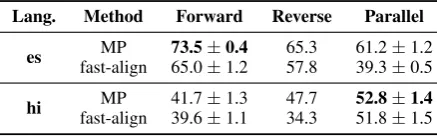
conduct deeper experiments to evaluate the effec-tiveness of the matching (M) and projection (P) steps of TMP over the other projection baseline, fast-align. As mentioned in Section2, there are variants of the annotation projection paradigm for cross-lingual NER that require an entity projection step, namely (i) reversing the direction of machine translation and (ii) using parallel corpora. We com-pare MP with fast-align for Spanish and Hindi lan-guages under both these settings.
Lang. Method Forward Reverse Parallel
es MP 73.5±0.4 65.3 61.2±1.2
fast-align 65.0±1.2 57.8 39.3±0.5
hi MP 41.7±1.3 47.7 52.8±1.4
fast-align 39.6±1.1 34.3 51.8±1.5
Table 2: Performance of MP and fast-align on Forward,
Reverse and Parallel settings in terms ofF1.
Reversing the direction of translation In this
setting, we translate the target test set into the source language using Google Translate and then use the NER tagger with state-of-the-art results Flair8to tag entities in the translated English sen-tences. Finally, we employ MP/fast-align to project the tagged entities back to the target sentence. As shown in table2, MP outperforms fast-align for both Spanish and Hindi and performs better than the forward direction translation for Hindi. This can be attributed to (a) the inherent difficulty of NER tagging in Hindi, which is morphologically richer than English and (b) the superior quality of the English NER model.
Parallel corpora In order to remove translation
errors while evaluating TMP and fast-align, we
8https://github.com/zalandoresearch/flair
experiment with parallel corpora. For English-Spanish, we use the Europarl corpus (Koehn,2005) and for English-Hindi, the IIT Bombay parallel corpus (Kunchukuttan et al.,2017). We again use Flairto obtain NER tags in English, which are then projected to their corresponding target sentences to generate a training dataset, which is used to train an NER model in the target language. To minimize confounding variables, we sample 14k (same as CoNLL) high quality tagged sentences (average confidence score>0.9). Results in Table2show that MP once again outperforms fast-align. Fur-ther, it performs better than Forward for Hindi by a significant margin possibly because the chosen parallel corpus is closer in time period to the test set, thereby reducing distribution shift.
4.3 Case study: Armenian
So far, we have only evaluated the performance of our method on languages for which large or moderately-sized gold annotated corpora already exist that provide an upper-bound for cross-lingual NER methods. Here, we evaluate our method on a true medium-resource language, Armenian. Recently, Ghukasyan et al. (2018) introduced a ground truth test corpus for Armenian along with a train corpus with silver annotations extracted from Wikipedia. This test dataset is comprised of2566
sentences (53k tokens) from political, sports, lo-cal and world news between August 2012 and July 2018. Since the English CoNLL 2003 dataset con-tains sentences nearly two decades older, we ex-pect to see significant distribution shift if we fol-low TMP (Forward approach). Further, we are not aware of any large English-Armenian parallel cor-pora. So, we choose the Reverse paradigm for this problem. We achieve anF1score of62.6, which
[image:7.595.72.291.389.457.2]fast-align (44.8). Further, this is0.4points higher than the current state-of-the-art model trained on over
160k tokens of Armenian. Note that our model does not make use of any external resources for Armenian (gold lexicons, Epitran, etc.) other than an MT system. This provides evidence towards our proposed approach being an effective and general-izable cross-lingual NER method that can be used for rapid deployment to new languages.
5 Analysis
Measuring alignment accuracy Since we do
not possess ground truth word alignments for the “synthetic” parallel corpus generated through
trans-lation, we rely on heuristics to measure the accu-racy of alignments. We measure the annotation miss rate among target sentences with equal or fewer tagged entities as compared to source. We also calculate theexcess rate, representing the frac-tion of excess entities among sentences with more tagged entities. Both methods perform similarly in terms of miss rate,0.79% (MP) vs0.83% (fast-align) on Spanish and3.96% (MP) vs3.48% (fast-align) on Hindi. However, fast-align seems to add more noisy annotations as compared to MP, with higher excess rates for both Spanish (8.29 % vs
0.49%) and Hindi (6.35% vs2.20%). A repre-sentative illustration of these noisy tags is shown in Figure6(a). where fast-align tags frequent words like “El”, “de”, “en” as entities. To offer a more fine-grained evaluation of alignment performance, we manually annotate100examples from the trans-lated Spanish and Hindi training data and calculate precision, recall and F1 score. MP outperforms
fast-align for both the languages (Table3).
Lang. Method Precision Recall F1
es MP 96.2 96.7 96.4
fast-align 84.6 87.4 85.9
hi MP 87.4 77.6 82.2
fast-align 82.0 76.8 79.3
Table 3: Alignment performance on 100 sentences.
Ablation of features for alignment We also
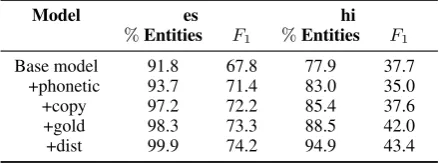
conduct an ablation study (Table4) to understand the sources of our gains beyond a base model that uses translations only from Google Translate and orthographic affix matching. To this base model, we successively add various features of our method: phonetic matching, exact copy translations, gold lexicons and finally distribution-based alignment
(dist) of remaining entities. For both languages, we observe that every additional feature improves the performance of tagging, with the most important features being phonetic matching for Spanish and use of gold lexicons for Hindi. Interestingly, addi-tion of phonetic matching hurts Hindi because of the low value of the threshold (δ = 0.25), which re-sults in spurious matches due to phonetic matching. In Table4, we also see that the number of entities tagged (as a fraction of total entities) increase with the introduction of almost every feature (however, all matches might not be correct). This underscores the correlation between quality of entity alignment and performance on the downstream tagging task.
Model es hi
%Entities F1 %Entities F1
Base model 91.8 67.8 77.9 37.7
+phonetic 93.7 71.4 83.0 35.0
+copy 97.2 72.2 85.4 37.6
+gold 98.3 73.3 88.5 42.0
[image:8.595.307.527.266.348.2]+dist 99.9 74.2 94.9 43.4
Table 4: Ablation study for Spanish and Hindi
Sources of errors in TMP We also analyze
mis-takes made by TMP in aligning entities. Many false negative errors can be traced back to a high thresholdδ, resulting in an empty set of candidate matches. Errors also arise due to noise and vari-ation introduced in the contextual sentence level translation of a word (Figure6(c) where GIBBS is interpreted as an acronym, (d) where MEDVEDEV is mistranslated). This causes discrepancies be-tween translations of standalone entities and those in context, thereby, causing TMP to not find a match. However, these errors can be reduced as off-the-shelf MT systems continue to improve.
6 Conclusion
like to explore ways to extend our method to lan-guages not supported by Google Translate through the use of pivot languages.
While dependence on MT restricts our approach to languages covered by off-the-shelf MT systems, these systems continue to improve in coverage and quality, outpacing the availability of large-scale corpora for a variety of other tasks. Moreover as translation quality improves, approaches like ours are poised to benefit. Finally, although our method beats state-of-the-art baselines, not surprisingly, it falls short of NER models trained on large monolin-gual corpora. We suspect that a significant portion of this degradation is due to distribution shift (as evidenced by improvement in HindiF1in Parallel
regime). Thus one promising route to improving our models might be to incorporate domain adap-tation techniques, which aim to build classifiers robust to various forms of distribution shift.
References
Rami Al-Rfou, Vivek Kulkarni, Bryan Perozzi, and Steven Skiena. 2015. Polyglot-ner: Massive
multi-lingual named entity recognition. In International
Conference on Data Mining (ICDM).
Akash Bharadwaj, David Mortensen, Chris Dyer, and Jaime Carbonell. 2016. Phonologically aware neural model for named entity recognition in low resource
transfer settings. InEmpirical Methods in Natural
Language Processing (EMNLP).
Peter F Brown, Vincent J Della Pietra, Stephen A Della Pietra, and Robert L Mercer. 1993. The mathemat-ics of statistical machine translation: Parameter
esti-mation. Computational linguistics, 19(2):263–311.
Aditi Chaudhary, Chunting Zhou, Lori Levin, Graham Neubig, David R Mortensen, and Jaime G Carbonell. 2018. Adapting word embeddings to new languages with morphological and phonological subword
rep-resentations. arXiv preprint arXiv:1808.09500.
Alexis Conneau, Guillaume Lample, Marc’Aurelio Ranzato, Ludovic Denoyer, and Herv´e J´egou. 2017.
Word translation without parallel data. arXiv
preprint arXiv:1710.04087.
Dipanjan Das and Slav Petrov. 2011. Unsupervised part-of-speech tagging with bilingual graph-based
projections. InAssociation for Computational
Lin-guistics (ACL).
Chris Dyer, Victor Chahuneau, and Noah A. Smith.
2013. A simple, fast, and effective
reparameteri-zation of ibm model 2. InNorth American
Chap-ter of the Association for Computational Linguistics (NAACL).
Maud Ehrmann, Marco Turchi, and Ralf Steinberger.
2011. Building a multilingual named
entity-annotated corpus using annotation projection. In
Proceedings of the International Conference Recent Advances in Natural Language Processing 2011, pages 118–124.
Donghui Feng, Yajuan Lv, and Ming Zhou. 2004. A new approach for english-chinese named entity
alignment. InProceedings of the 2004 Conference
on Empirical Methods in Natural Language Process-ing.
Ruiji Fu, Bing Qin, and Ting Liu. 2011. Generating chinese named entity data from a parallel corpus. In International Joint Conference on Natural Lan-guage Processing (IJCNLP).
Kuzman Ganchev, Jennifer Gillenwater, and Ben Taskar. 2009. Dependency grammar induction via
bitext projection constraints. InProceedings of the
Joint Conference of the 47th Annual Meeting of the ACL and the 4th International Joint Conference on Natural Language Processing of the AFNLP: Vol-ume 1-VolVol-ume 1, pages 369–377. Association for Computational Linguistics.
Tsolak Ghukasyan, Garnik Davtyan, Karen Avetisyan,
and Ivan Andrianov. 2018. pioner: Datasets and
baselines for armenian named entity recognition.
arXiv preprint arXiv:1810.08699.
Rebecca Hwa, Philip Resnik, Amy Weinberg, Clara
Cabezas, and Okan Kolak. 2005. Bootstrapping
parsers via syntactic projection across parallel texts.
Natural language engineering, 11(3):311–325.
David Kamholz, Jonathan Pool, and Susan M Colow-ick. 2014. Panlex: Building a resource for
panlin-gual lexical translation. InInternational Conference
on Language Resources and Evaluation (LREC).
Philipp Koehn. 2005. Europarl: A parallel corpus for
statistical machine translation. In MT summit,
vol-ume 5, pages 79–86.
Mikhail Kozhevnikov and Ivan Titov. 2013.
Cross-lingual transfer of semantic role labeling models. In
Proceedings of the 51st Annual Meeting of the As-sociation for Computational Linguistics (Volume 1: Long Papers), volume 1, pages 1190–1200.
Mikhail Kozhevnikov and Ivan Titov. 2014.
Cross-lingual model transfer using feature representation
projection. In Association for Computational
Lin-guistics (ACL).
Anoop Kunchukuttan, Pratik Mehta, and Pushpak Bhat-tacharyya. 2017. The iit bombay english-hindi
par-allel corpus. arXiv preprint arXiv:1710.02855.
Stephen Mayhew, Chen-Tse Tsai, and Dan Roth. 2017. Cheap translation for cross-lingual named entity
recognition. InEmpirical Methods in Natural
Lan-guage Processing (EMNLP).
David R. Mortensen, Siddharth Dalmia, and Patrick Lit-tell. 2018. Epitran: Precision G2P for many
lan-guages. In Proceedings of the Eleventh
Interna-tional Conference on Language Resources and Eval-uation (LREC 2018), Paris, France. European Lan-guage Resources Association (ELRA).
Jian Ni, Georgiana Dinu, and Radu Florian. 2017. Weakly supervised cross-lingual named entity recog-nition via effective annotation and representation
projection. In Association for Computational
Lin-guistics (ACL).
Joel Nothman, Nicky Ringland, Will Radford, Tara Murphy, and James R Curran. 2013. Learning mul-tilingual named entity recognition from wikipedia.
Artificial Intelligence, 194:151–175.
Franz Josef Och and Hermann Ney. 2003. A systematic comparison of various statistical alignment models.
Computational linguistics, 29(1):19–51.
Sebastian Pad´o and Mirella Lapata. 2009.
Cross-lingual annotation projection for semantic roles.
Journal of Artificial Intelligence Research (JAIR), 36:307–340.
Lance A Ramshaw and Mitchell P Marcus. 1999. Text chunking using transformation-based learning. In
Natural language processing using very large
cor-pora, pages 157–176. Springer.
Nils Reimers and Iryna Gurevych. 2017. Reporting score distributions makes a difference: Performance
study of lstm-networks for sequence tagging. arXiv
preprint arXiv:1707.09861.
Alexander E Richman and Patrick Schone. 2008. Min-ing wiki resources for multilMin-ingual named entity
recognition. InAssociation for Computational
Lin-guistics (ACL).
Doaa Samy, Antonio Moreno, and Jose M Guirao. 2005. A proposal for an arabic named entity tagger
leveraging a parallel corpus. InInternational
Con-ference RANLP, Borovets, Bulgaria, pages 459–465.
Erik F. Tjong Kim Sang. 2002. Introduction to the
CoNLL-2002 shared task: Language-independent
named entity recognition. In COLING-02: The
6th Conference on Natural Language Learning (CoNLL).
Erik F. Tjong Kim Sang and Fien De Meulder. 2003. Introduction to the CoNLL-2003 shared task: Language-independent named entity recognition. In
Conference on Natural Language Learning at HLT-NAACL.
Rushin Shah, Bo Lin, Anatole Gershman, and Robert Frederking. 2010. Synergy: a named entity recog-nition system for resource-scarce languages such as
swahili using online machine translation. In
Pro-ceedings of the Second Workshop on African Lan-guage Technology (AfLaT 2010), pages 21–26.
David A Smith and Jason Eisner. 2009. Parser adap-tation and projection with quasi-synchronous
gram-mar features. InEmpirical Methods in Natural
Lan-guage Processing (EMNLP).
Oscar T¨ackstr¨om, Dipanjan Das, Slav Petrov, Ryan Mc-Donald, and Joakim Nivre. 2013. Token and type constraints for cross-lingual part-of-speech tagging.
Transactions of the Association for Computational Linguistics (TACL), 1:1–12.
Oscar T¨ackstr¨om, Ryan McDonald, and Jakob
Uszko-reit. 2012. Cross-lingual word clusters for direct
transfer of linguistic structure. In Proceedings of
the 2012 conference of the North American chapter of the association for computational linguistics: Hu-man language technologies, pages 477–487. Associ-ation for ComputAssoci-ational Linguistics.
J¨org Tiedemann, ˇZeljko Agi´c, and Joakim Nivre. 2014.
Treebank translation for cross-lingual parser
induc-tion. In Eighteenth Conference on Computational
Natural Language Learning (CoNLL 2014).
Sara Tonelli and Emanuele Pianta. 2008. Frame
infor-mation transfer from english to italian. In
Interna-tional Conference on Language Resources and Eval-uation (LREC).
Ralph Weischedel, Sameer Pradhan, Lance Ramshaw, Martha Palmer, Nianwen Xue, Mitchell Marcus, Ann Taylor, Craig Greenberg, Eduard Hovy, Robert
Belvin, et al. 2011. Ontonotes release 4.0.
LDC2011T03, Philadelphia, Penn.: Linguistic Data Consortium.
Yonghui Wu, Mike Schuster, Zhifeng Chen, Quoc V Le, Mohammad Norouzi, Wolfgang Macherey,
Maxim Krikun, Yuan Cao, Qin Gao, Klaus
Macherey, et al. 2016. Google’s neural machine
translation system: Bridging the gap between
hu-man and machine translation. arXiv preprint
arXiv:1609.08144.
Chenhai Xi and Rebecca Hwa. 2005. A backoff
model for bootstrapping resources for non-english
languages. In Empirical Methods in Natural
Lan-guage Processing (EMNLP).
Jiateng Xie, Zhilin Yang, Graham Neubig, Noah A. Smith, and Jaime Carbonell. 2018. Neural cross-lingual named entity recognition with minimal
re-sources. InEmpirical Methods in Natural Language
Processing (EMNLP).
Proceedings of the first international conference on Human language technology research. Association for Computational Linguistics.
Daniel Zeman and Philip Resnik. 2008.
Cross-language parser adaptation between related
lan-guages. InIJCNLP-08 Workshop on NLP for Less