C
3EL
: A Joint Model for
Cross-Document Co-Reference Resolution and Entity Linking
Sourav Dutta
Max-Planck Institute for Informatics Saarbr¨ucken, Germany
Gerhard Weikum
Max-Planck Institute for Informatics Saarbr¨ucken, Germany
Abstract
Cross-document co-reference resolution (CCR) computes equivalence classes over textual mentions denoting the same entity in a document corpus. Named-entity link-ing (NEL) disambiguates mentions onto entities present in a knowledge base (KB) or maps them to null if not present in the KB. Traditionally, CCR and NEL have been addressed separately. However, such approaches miss out on the mutual syn-ergies if CCR and NEL were performed jointly.
This paper proposes C3EL, an unsuper-vised framework combining CCR and NEL for jointly tackling both problems. C3EL incorporates results from the CCR stage into NEL, and vice versa: additional global context obtained from CCR improves the feature space and performance of NEL, while NEL in turn provides distant KB fea-tures for already disambiguated mentions to improve CCR. The CCR and NEL steps are interleaved in an iterative algorithm that focuses on the highest-confidence still un-resolved mentions in each iteration. Ex-perimental results on two different corpora, news-centric and web-centric, demonstrate significant gains over state-of-the-art base-lines for both CCR and NEL.
1 Introduction
With the advent of large knowledge bases (KB) like DBpedia, YAGO, Freebase, and others, enti-ties (people, places, organizations, etc.) along with their attributes and relationships form the basis of smart applications like search, analytics, recom-mendations, question answering, and more. The major task that arises in both the KB construc-tion process and the entity-centric applicaconstruc-tions in-volves precise recognition, resolution, and link-ingof named entities distributed across web pages, news articles, and social media.
Named Entity Recognition(NER) deals with the identification of entitymentionsin a text and their classification into coarse-grained semantic types (person, location, etc.) (Finkel et al., 2005; Nadeau
& Sekine, 2007; Ratinov & Roth, 2009). This in-volves segmentation of token sequences to obtain mention boundaries, and mapping relevant token spans to pre-defined entity categories. For exam-ple, NER on the text Einstein won the Nobel Prizeidentifies the mentions “Einstein” and
“No-bel Prize” and marks them aspersonandmisctype, respectively.
Named Entity Linking (NEL)1 involves the
dis-ambiguationof textual mentions, based on context and semantic information, and their mapping to properentities in a KB (Bunescu & Pas¸ca, 2006; Cucerzan, 2007; Milne & Witten, 2008; Hoffart et al., 2011; Ratinov et al., 2011; Cornolti et al., 2013). For example, in the above text, the mention “Einstein” is linked to the physicistAlbert Einstein. Entity Co-reference Resolution(CR) (Haghighi & Klein, 2010; Ng, 2010; Lee et al., 2013) is essentially a clustering task to identify mentions (and anaphoras) within a document referring to the same entity, thus computing equivalence classes or
mention groups. For example, mentions Albert
Einstein and Nobel laureate Einstein both
refer to the same entity German physicist Albert Einstein, but are different from the mentionHans Albert Einstein.
When CR is extended to an entire text cor-pus, in order to generate equivalence classes of co-referring mentions across documents, the task is known asCross-document Co-reference Resolu-tion (CCR) (Bagga & Baldwin, 1998; Culotta et al., 2007; Singh et al., 2011; Dutta & Weikum, 2015). Note that CCR is not the same as merely concatenating all documents in the corpus and uti-lizing existing CR methods. The linguistic diver-sity across documents and high computational cost for huge numbers of mentions in the corpus would typically make such a CR-based simulation per-form poorly. Neither CR nor CCR links mention groups to corresponding KB entities. Thus, they represent both in-KB entities and out-of-KB enti-ties (e.g., long-tail or emerging entienti-ties that do not have a Wikipedia article) in the same way.
1Named Entity Disambiguation (NED)and “Wikification”
are often used to denote the same task. The latter may be more broadly used, though, to include the disambiguation of com-mon nouns and phrases onto concepts, whereas NED restricts itself to noun phrases that denote individual entities.
State-of-the-Art and its Limitations:Established CR methods rely on rule-based methods or super-vised learning techniques on syntactic paths be-tween mentions, semantic compatibility, and other linguistic features (Haghighi & Klein, 2009), with additional use of distant features from KBs (Lee et al., 2013). Modern cluster-ranking (Rahman & Ng, 2011) and multi-sieve methods (Ratinov & Roth, 2012) involve incremental expansion of mention groups by considering semantic types and Wikipedia categories. CCR methods utilize transitivity-aware clustering techniques (Singh et al., 2011), by considering mention-mention sim-ilarities (Bagga & Baldwin, 1998) along with features extracted from external KBs (Dutta & Weikum, 2015).
NEL methods often harness the semantic sim-ilarity between mentions and entities and also among candidate entities for different mentions (in Wikipedia or other KBs) for contextualization and coherence disambiguation (Hoffart et al., 2011; Milne & Witten, 2008; Kulkarni et al., 2009; Rati-nov et al., 2011). However, in the absence of CR mention groups, NEL has limited context and is bound to miss out on certain kinds of difficult cases.
Although NER, CR, CCR and NEL involve closely related tasks and their tighter integration has been shown to be promising (Chen & Roth, 2013; Zheng et al., 2013), they have mostly been explored in isolation. Recently, severaljoint mod-els have been proposed for CR-NER (Haghighi & Klein, 2010; Singh et al., 2013),CR-NEL(Hajishirzi
et al., 2013), and NER-CR-NEL (Durrett & Klein,
2014). However, to the best of our knowledge, no method exists for jointly handling CCR and NEL on large text corpora.
1.1 Approach and Contributions
This paper proposes the novel C3EL (C ross-doCument Co-reference resolution and Entity
Linking) framework for jointly modeling cross-document co-reference resolution (CCR) and link-age of mention groups to entities in a knowledge base (NEL).
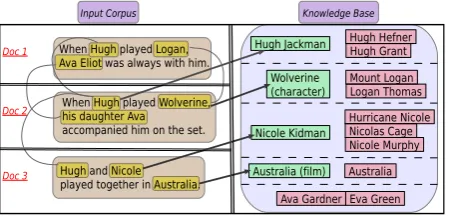
Example: To illustrate the potential synergies between CCR and NEL, consider the 3 docu-ments in Figure 1 containing 9 mentions (on the left) with candidate entities from a KB (on the right). CCR alone would likely miss the co-reference relation betweenLogan (Doc 1) and its
alias Wolverine (Doc 2), leaving NEL with the difficult task of disambiguating “Logan” in a doc-ument with sparse and highly ambiguous context (Doc 1). On the other hand, NEL alone would likely mapAustralia(Doc 3) to the country (not
the movie) and could easily choose the wrong link for mention “Hugh”. Moreover, the presence of
Ava Eliotas an out-of-KB mention complicates the task.
However, if we could more freely interleave
When Hugh played Logan,
Ava Eliot was always with him. Hugh Grant Hugh Jackman
Wolverine (character)
Ava Gardner Australia Australia (film)
Eva Green Mount Logan Logan Thomas Hugh Hefner
Nicole Kidman
Nicole Murphy Hurricane Nicole Nicolas Cage Doc 1
Doc 2
Doc 3
Knowledge Base
When Hugh played Wolverine, his daughter Ava accompanied him on the set.
Hugh and Nicole played together in Australia.
[image:2.595.302.527.63.171.2]Input Corpus
Figure 1: Joint CCR-NEL Example(GreenKB en-tries connected via arrows denote the correct entity linkage for the mention co-reference groups; while theredones represent alternative incorrect candidates with similar surface forms)
CCR and NEL and could iterate them several times, we would be in a much stronger position. An initial NEL step for the easiest mention, namely “Wolverine”, maps it to the character of X-Men movies. This indicates that the three “Hugh” men-tions could all be the same actor, and are thus eas-ily merged into a co-reference group using CCR. We now have enough cues for NEL to choose the right entity for the “Hugh” mention group, which in turn enables the proper mapping of “Australia” to the movie. Finally, it becomes clear that men-tions “Ava Eliot” and “his daughter Ava” should be merged into the same group and represented as an out-of-KB entity mapped tonull.
The above example clearly demonstrates that interleaving CCR and NEL is highly beneficial. However, appropriate choices for the ordering of CCR and NEL steps are usually not obvious at all. The proposed C3EL algorithm solves this prob-lem: automatically determining an efficient inter-leaving of CCR and NEL.
Approach: C3ELiteratively aggregates interme-diate information obtained from alternating steps of CCR and NEL, thus forming a feedback loop
for propagating mention features and entity knowl-edge. Intuitively, co-referring mentions obtained via CCR generate global context for improved NEL performance, while mentions linked to KB entities (by NEL) provide distant semantic features with additional cues for CCR.C3ELcouples sev-eral building blocks like unsupervised hierarchi-cal clustering,context summariesfor mentions and distant KB features for entities, drawing inspiration from the CCR-only method of (Dutta & Weikum, 2015). Mention linking to the KB (NEL) is per-formed using distant knowledge and co-occurring mentions.
In a nutshell, the major contributions of this pa-per are:
• theC3ELframework for joint computation of cross-document co-reference resolution (CCR) and entity linking to a KB (NEL), based on propagating information across iterative CCR and NEL steps;
context-based keywords for link validation in NEL, improving accuracy on out-of-KB enti-ties;
• an experimental evaluation with two different corpora, one based on news articles and one based on web pages, demonstrating substantial gains for both CCR and NEL over state-of-the-art methods.
2 C3EL: Joint CCR-NEL Framework
Given an input corpus C of n documents, C =
{D1, D2,· · ·, Dn} with entity mentions EM = {m11, m12,· · · , m21, m22,· · · } (mij ∈ Di), C3ELaims tojointly compute:
• CCR: an equivalence relation overEM with equivalence classesEi, such thatEi∩i6=jEj = ∅and∪iEi =EM, and
• NEL: linking each of the classesEito entities present in a KB or map it tonullif there is no proper entity in the KB.
To this end, C3EL consists of 3 algorithmic stages:(i)Pre-Processing,(ii)Interleaved NEL and CCR, and(iii)Finalization.
2.1 Pre-Processing Stage
HTML pages in the input corpusCare transformed into plain text using standard tools likejsoup. org. Recognition and markup of mentions are per-formed using the Stanford CoreNLP toolkit (nlp.
stanford.edu), and a coarse-grained lexical
type for each mention (e.g., person, location, orga-nization, etc.) is obtained from the Stanford NER Tagger (Finkel et al., 2005). The multi-pass sieve algorithm for single-document CR (Raghunathan et al., 2010; Lee et al., 2011; Lee et al., 2013) then computes mention co-reference chains per docu-ment, and ahead mentionis chosen for each of the mention groups (chains). The head mention is typ-ically represented by the most explicit denotation of the entity (e.g., person’s full name with title, lo-cation name with country, etc.).
For each of the mention groupsMi, C3EL then constructs acontext summaryusing:
• Sentences– all sentences in the document that contain mentions of groupMi; and
• Co-occurrence – all sentences for other men-tion groups that contain menmen-tions co-occurring in any of the sentences of Mi (as obtained above).
Formally, for each mention groupMi, letS(Mi) = {sentence(mj) |mj ∈ Mi} represent the set of extracted sentences, where sentence(mj) de-notes the sentences in which mention mj occurs. Also, let the co-occurring mention set of Mi be Co(Mi) = {m0 |m0 ∈ S(Mi)∧m0 ∈/ Mi}. The
context summary ofMiis defined as:
CS(Mi) =S(Mi) ∪
[
m0∈Co(Mi) S(m0)
The context summaries intentionally do not in-clude any distant KB features for mentions. The intuition is to minimize potential noise from overly speculative mappings to the KB at this initial stage.
2.2 Interleaved NEL & CCR Approach
After the preliminary CR step on each document and the construction of context summaries,C3EL now performs an initial NEL step for each of the mention groupsMi, using the extracted sentences S(Mi)as inputs to NEL. It obtains the best match-ing entity, the confidence of the match, and its corresponding Wikipedia page. Off-the-shelf NEL software (like WikipediaMiner or Illinois-Wikifier) is used for mention-entity mapping based on prior popularity of the named-entities (from the KB) and textual similarity between S(Mi) (context of the mention group) and the entity descriptions in KB.
For each Mi, the entity link obtained (from NEL) is then “validated” using a similarity mea-sure between features from the context summary,
CS(Mi) (including co-occurring mentions) and distant KB labels – forming thelink validation pro-cedure ofC3EL. This explicit use of co-occurring mentions’ (Co(Mi)) contexts helps to better iden-tify out-of-KB entities compared to direct full-fledged NEL using the entire input text (shown in Section 3). Also the use of NEL onS(Mi)alone, makesC3EL“light-weighted”.
The mappings between the mention groups and KB entries are then classified, on the basis of the NEL confidence scores, into Strong Evidence
(SE),Weak Evidence(WE), andNo Evidence(NE) classes. For mention groups placed in SE, the KB features (obtained previously) are appended to their context summaries, while mentions strongly linked to same KB entities are considered to be co-referring and hence grouped together (performing implicit CCR).
Considering our example (Figure 1), we now outline the iterative steps of C3EL interleaving NEL & CCR.
1.DuringIteration 1,C3ELperforms:
• NEL: The initial NEL step maps the unam-biguous mentions, Wolverine to the X-Men movie character andAustraliato the country,
SE class and enriched with KB features (e.g., alias Logan).
On the other hand, the 3 “Hugh” mentions ex-hibit low NEL confidence due to the high am-biguity of this first name and are therefore clas-sified into WE. The remaining mentions have extremely low NEL confidence (due to sparse contextual information) and are added to NE. • CCR: The WE and NE classes are fed
sep-arately to the CCR procedure. Based on thecontext summarysimilarities between men-tions, C3EL performs hierarchical clustering to group together the “Hugh” mentions (in the WE class) and creates a co-referring men-tion group with the individual menmen-tions’ con-text summaries concatenated. This merging of summaries grows and strengthens captured contexts, which propagates across documents. This concludes the first iteration ofC3EL.
2. The above results are provided to the second Iteration:
• NEL: The context summary of the “Hugh” mention group in WE now provides definitive cues to correctly map it to the actor Hugh Jack-man with high confidence, thus placing it in the SE class.
• CCR: The ensuing CCR step groups together “Ava Eliot” and “Ava” (in NE) using co-occurrence context of the co-referring Hugh mentions.
3. Subsequent NEL iterations (on WE and NE) identify “Ava” as an out-of-KB entity and cor-rectly links “Australia” to the movie using CCR-generated mention-group contexts and link valida-tion. CCR finally groups together “Logan” with “Wolverine” based on context similarity with dis-tant KB features. This process of alternating CCR and NEL is repeated until all mention groups are strongly connected to KB entities (placed inSE), or no changes are made anymore.
The NEL and CCR procedures are performed separately on the different mention types (like PER, LOC, etc.), since different mention types rarely co-refer. We next present the internal work-ing details of the NEL and CCR stages ofC3EL.
2.2.1 Named-Entity Linking (NEL) Stage
In its NEL procedure,C3ELdisambiguates men-tions to entities in the YAGO knowledge base
(yago-knowledge.org). We perform NEL on
the sentences (S(Mi)) of a mention group, us-ing named-entity popularity statistics and context, to obtain the best matching entity, its confidence score, and the corresponding Wikipedia page (from sameAslink in YAGO). Assume a mention group Mito be mapped to an entityei with a confidence score ofφ(Mi, ei).
A. Link Validation:For each mention group (e.g., Hugh), we extract distant KB labels such as
se-mantic types or categories (e.g., actor), title (e.g., Golden Globe winner), alias (e.g., Wolverine), lo-cation, and gender (for person) from the Wikipedia page infoboxes. The similarity of these features to keywords obtained from the context summary
CS(Mi)is computed using IR-style term frequen-cies within a document (tf) and inverse document frequencies within the corpus (idf). We utilize the bag-of-words model based tf ×idf-weighted co-sine similarity measure. If the similarity score is above a threshold, τ, the NEL result is accepted, otherwise it is discarded – thus avoiding noisy link-age of sparse mentions to prominent KB entries. This subtle introduction of controlled distant su-pervisionwithin theC3ELframework enables ef-ficient detection of out-of-KB mentions.
B. Classification: To sift out well-known and long-tail entities from new ones, and prevent “noisy” interactions among the contexts of in-KB and out-of-in-KB mentions (with similar surface forms), mention groupsMi(linked toeiwith score φ(Mi, ei)) are classified into3classes by2 thresh-old parameters,δsandδw, as:
• Strong Evidence (SE): For φ(Mi, ei) ≥ δs, mention group Mi exhibits high linkage con-fidence with ei and is placed in SE. If two or more mentions in SE are independently mapped to the same KB entity, they co-refer transitively and are hence grouped together with their context summaries merged (implicit CCR). Distant KB features for mentions in SE are extracted and appended toCS(Mi), provid-ing additional cues for later steps.
• Weak Evidence (WE): Mention groups with δw ≤ φ(Mi, ei) < δs are placed in this class. They mostly represent long-tail in-KB entities (sparsely represented in KB) with limited se-mantic information (for detection) but might also be new/emerging entities absent from KB. • No Evidence(NE):φ(Mi, ei) < δw represents mentions groups that have been mapped tonull (or have near-zero match confidence) or have failed link validation during the NEL proce-dure. These entities are most likely to be out-of-KB and are allocated to this class.
2.2.2 Cross-Document CR (CCR) Stage
The CCR stage of C3EL adopts the sampling-based hierarchical clustering approach of (Dutta & Weikum, 2015), to obtain co-referring mention clusters.
fea-ture vectors for similarity computation. Finally, the mixture model of bag-of-words (BoW) and
keyphrases (KP) of (Dutta & Weikum, 2015) is used to assign feature weights usingtf-idf measure.
B. Hierarchical Clustering: s mention groups are uniformly randomly sampled and their sim-ilarities to the other groups (using context sum-mary) are computed. A similarity-weighted graph with the mention groups as nodes and edge weights representing mention-mention similarities is con-structed. Bisection-based hierarchical balanced min-edge-cut graph partitioning (Buluc et al., 2013) is performed, using the MET IS soft-ware (Karypis & Kumar, 1999)2, to partition non-coreferent mentions groups. The Bayesian Infor-mation Criterion (BIC) (Schwarz, 1978; Hour-dakis et al., 2010), a Bayesian variant of Minimum Description Length (Gr¨unwald, 2007), is used as the cluster split stopping criterion, and the context summaries within each final cluster are merged.
CCR aims to process heterogeneous corpora that go beyond a single domain and style, such as Web collections.
2.3 Finalization Stage
For the remaining mention groups in WE, we fi-nally perform threshold based disambiguation of mention clusters using the context summaries. For each mention groupMi∈W E, we compute (1) its context summary similarities (as in Section 2.2.2) to all other mention groupsMjin SE by also using distance features from the weakly linked KB enti-ties, and (2) textual overlap between the mention group representatives.Miis concatenated with the best matching entityMk (in SE) if the similarity score is above a thresholdθ; elseMi is marked as an out-of-KB entity (mapped tonull) and is placed in theNEclass. This helps in reducing propagated CR errors like erroneous mention boundary detec-tion (in NER), omissions in co-reference chain, etc. (leading to “phantom” out-of-KB entities).
The obtained mention groups represent the final equivalence classes of co-referring mentions across documents – capturing both in-KB entities (with links to the KB) in the SE class and out-of-KB entities (mapped tonull) in theNEclass.
3 Experimental Evaluation
In this section, we empirically study the perfor-mance of C3EL against various state-of-the-art methods. We analyze the individual gains in CCR and NEL due to the joint modeling.
Datasets: We use the following 2 publicly avail-able corpora:
• EventCorefBank (ECB) corpus3 (Bejan & Harabagiu, 2010):contains482news and Web articles (classified into 43 topics) with a total
2glaros.dtc.umn.edu/gkhome/metis/metis/overview 3faulty.washington.edu/bejan/data/ECB1.0.tar.gz
of 5447 mentions corresponding to 1068 dis-tinct named-entities. Entity co-reference an-notations (across documents within each topic cluster) were provided by (Lee et al., 2012), and we performed manual examination of the annotations for KB linking of the entities to Wikipedia entries, if present; thus providing ground truth for both CCR and NEL.
• ClueWeb2009 FACC1 dataset4 (Gabrilovich et al., 2013): provides machine automated entity-linkage annotations of the ClueWeb09
corpus (ca. 1Billion crawled Web pages) with Freebase entries5. The corpus contains many topical domains and highly diverse documents from news, movie reviews, people home pages to blogs and other social media posts. We ran-domly select500Kdocuments containing4.64
Million mentions associated with1.29Million distinct entities to form our corpus. For NEL ground-truth construction, we link the entities to their Wikipedia pages (using Freebase’s “on the web” property). Since no explicit anno-tations of inter-document entity co-references exists, we consider two mentions (in different documents) to co-refer if they are linked with the same Freebase entity.
Evaluation:To assess the output quality ofC3EL we use the following established metrics:
• B3 F1score(Bagga & Baldwin, 1998):
mea-sures the F1 score as the harmonic mean of av-erage precision and recall computed over all mention groups in the final equivalence classes. Precision (for a mention group) represents the ratio of the number of correctly reported co-references (or linking) to the actual number; while recall computes the fraction of the gold-standard annotations correctly identified. • φ3 − CEAF score (Luo, 2005): provides
an alternate F1 score computed as in the B3
measure; but calculates precision and recall of mention groups using the best 1-to-1 mapping (i.e., mapping with maximum mention overlap) between the resultant equivalence classes and those in the ground truth. Normalization with the number of mentions for each of the resul-tant classes yields theφ4-CEAF score.
We consider only the 3 most notable mention types: person (PER), location (LOC), and orga-nization (ORG) – accounting for 99.7% of enti-ties present in the ECB corpus and 96.3%of our ClueWeb09 corpus. All experiments were con-ducted on a 4 core Intel i5 2.50 GHz processor with 8GB RAM running Ubuntu 12.04 LTS.
3.1 Parameter Tuning & Sensitivity Study
Validation of entity linkage to KB and their subse-quent classification intoconfidence classes(as
de-4lemurproject.org/clueweb09/FACC1
5Human analysis of a subset of the annotations generated revealed a
Approach P R B3 φ3 φ4
EECR 74.9 55.5 63.7 - 33.7
CROCS 73.11 75.28 74.18 67.35
[image:6.595.315.517.59.179.2]-C3EL 79.52 82.91 81.18 73.89 53.3 Table 2:CCR performance (%) comparison on ECB scribed in Section 2) during the NEL step ofC3EL are based on3 parameters: confidence thresholds (δsandδw) and validation threshold (τ); the values of which can be tuned based on cross-validation
approach with trainand test data subsets. Using the “gold annotations” of the train-set (30%of to-tal data), parameter values providing the best preci-sion score are individually learnt usingline search
with small step size.
In our experimental setup, we systematically vary the parameter values and observe its effects on C3EL for the training data. With increase in δs, the number of mentions mapped to theStrong Evidence(SE) class decreases. This in turn limits the influx of external KB features, thus degrading CCR performance as observed in Table 1(a). While for low values ofδs, even weak mention links are placed in SE, leading to a decrease in precision due to noisy KB feature inclusion. On the other hand, a highδw value increases the number of mentions in the NE class, while low values tends to accu-mulate mentions in theW E class. This adversely affects the detection of out-of-KB entities due to noise from other co-occurring similar KB mentions (refer Table 1(b)) during clustering in CCR step.
The effect of τ on C3EL has be shown in Ta-ble 1(c). Similar to the behavior induced by δs, we observe that a highτ limits entity linking and possible KB feature inclusion, while an extremely low value (near to zero) allows for noisy feature incorporation – both situations leading to lowered CCR efficiency. However, sinceτ prevents gross mis-alignment of mentions to KB entities, a wide range of small value (0.1−0.35) is seen to provide comparable performance.
Hence, for our remaining experimental study we setδs = 0.11andδw = 0.06(as in (Hoffart et al., 2014)), whileτ is set to 0.1, and threshold for the finalization stageθ= 2×δs= 0.22.
3.2 CCR Performance Results
We initially benchmark the performance improve-ment in cross-docuimprove-ment co-reference resolution (CCR) procedure by C3EL against two compet-ing approaches:
(1) state-of-the art sampling based hierarchical clustering method, CROCS (Dutta & Weikum, 2015); and
(2) iterative joint entity-event CCR,EECR (Lee et al., 2012).
Table 2 tabulates the results obtained on the ECB dataset. We observe C3EL to decisively outper-form both the existing methods, providing a B3
F1 improvement of around7%overCROCS and
17% over EECR. We further attain around 6%
φ3−CEAFscore enhancement over CROCS, and
Approach P (%) R (%) B3(%) φ3(%)
CROCSG 79.9 83.33 81.58 74.11
C3ELG 84.74 89.9 87.24 80.5
Table 3:CCR results on ECB
Type Approach P (%) R (%) B3(%)
PER CROCSG 71.8 74.15 72.96
C3ELG 84.85 82.73 83.78
LOC CROCSG 78.23 85.41 81.66
C3ELG 81.41 94.31 87.29
ORG CROCSG 85.73 87.89 86.8
C3ELG 88.52 91.82 90.14
Table 4:CCR results on ECB for mention types a significant 20% improved φ4 − CEAF score
compared to EECR.
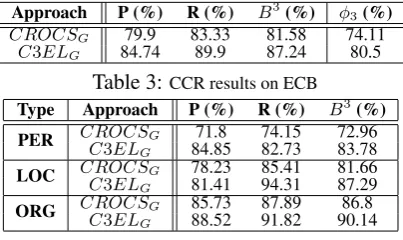
A. Gold Results:Errors introduced during the pre-processing stage of C3EL (e.g., mention omission, tag mis-classification, intra-document CR errors, etc., by the Stanford CoreNLP toolkit) propagate to subsequent computing stages and adversely im-pacts the overall system performance. To provide an unbiased viewpoint of the actual performance of C3EL, we manually provided “exact” tions, mention tags, and intra-document CR men-tion chains for the ECB corpus; thereby obtaining
gold performance results. From Table 3 we ob-serve a6%F1 points improvement (for bothB3&
CEAF-φ3) inC3ELcompared toCROCS.
B. Mention Categorization:Person mention type (PER) provides the greatest challenge for CCR sys-tems (compared to other types like LOC, ORG, etc.) due to associated nicknames, titles, and varied surface forms (abbreviations, spellings, etc.). We thus evaluate the CCR performance ofC3EL(and compare it with CROCS) on the ECB data, with “exact” input mentions, for the different mention categories. Table 4 validates that our joint mod-eling provides better global information cues, re-porting aB3F1 score enhancement of around11%
over CROCS for PER mentions; along with im-proved results for the other mention types as well.
C. Large Data:To study the robustness ofC3EL and the effects of large datasets on CCR, we performed evaluations on the ClueWeb09-FACC1 dataset. Similar to the ECB dataset, C3EL ex-hibits a B3 F1 score improvement of nearly 10%
and a φ3-CEAF F1 improvement of 12% over
CROCS(refer Table 5).
The above experimental results showcase that a combined approach helps overcome challenges faced in CCR by entity linkage and corresponding distant KB feature extraction; improving the over-all accuracy.
3.3 Named-Entity Linking (NEL) Results
We now benchmark the performance of named-entity linking (NEL) procedure forC3ELagainst the state-of-the-art open-source AIDA software
(github.com/yago-naga/aida). We
sepa-rately inspect the precision of mention linking for
prominent entities(in-KB) as well asnew/emerging
[image:6.595.76.281.59.102.2]Datasets δs(B3F1) δw(P) τ(B3F1)
0.01 0.05 0.10 0.15 0.20 0.01 0.02 0.04 0.06 0.08 0.03 0.10 0.20 0.35 0.50
ECB 79.3 82.2 84.2 83.5 81.0 73.1 75.3 77.3 78.7 78.4 76.9 81.2 81.2 81.1 79.2 ClueWeb 70.1 77.2 81.5 81.0 78.7 78.2 81.1 83.6 85.1 85.1 70.3 79.1 78.2 78.8 76.4
(a) (b) (c)
Table 1:C3ELperformance (a) in CCR withδs, (b) in out-of-KB NEL withδw, and (c) in CCR withτ
Approach P (%) R (%) B3(%) φ3(%)
CROCS 68.66 70.96 69.79 62.85
C3EL 75.76 81.42 78.49 74.13 Table 5:CCR results on ClueWeb09-FACC1
Approach CWithin-KBI U Out-of-KBC I OverallP(%)
AIDA 86.5 13.5 0.0 63.9 36.1 83.4
C3EL 85.4 14.4 0.2 79.0 21.0 84.9
Table 6:NEL performance (%) comparison on ECB
Correct (C), Incorrect (I), or Unlinked (U). The results on the ECB corpus are reported in Table 6. C3EL attains comparable performance (∼ 85%
precision) to that of AIDA for well-known entity-mentions present in KB; albeit with a few entity-mentions remaining unlinked due to our cautious link val-idation (using τ) approach. However, the use of τ reduces aggressive KB linking to provide a sig-nificant15%improvement (over AIDA) in precise detection of new/emerging entities absent in KB. Overall, an1.5%precision gain is observed by the joint formulation.
A. Large Data: The diverse nature of the web-scale ClueWeb09 dataset clearly portrays the per-formance gains in NEL procedure due to CCR gen-erated information integration. For entities present in the KB, we observe an accuracy improvement of
0.5% over AIDA (refer Table 7). Similar to that of the ECB data,C3ELattains a significant∼ 14%
improvement in the detection of new/emerging en-tities not represented in KB. For the 1 million men-tions, C3EL provides around4% overall perfor-mance improvements.
Using a bootstrap re-sampling t-test (as in (Dur-rett & Klein, 2014)), we observed high statistical significance (p <0.01) for Out-of-KB and Overall NEL, whereas the difference for Within-KB NEL is not statistically significant. Coping with Out-of-KB entities is essential for joint CCR+NEL, and an improved NEL performance using propagated information from CCR using semantics along with link validation enables highly efficient detection of new or emerging entities.
3.4 Comparison with Joint Models
Traditional CR methods fail to cope with the het-erogeneity of mentions and contexts across mul-tiple documents, and some form of clustering or joint reasoning over all mentions is thus mandatory. These methods have quadratic or cubic (some-times even exponential) complexity, and hence run-ning CR+NEL on a concatenated super-document works only for small corpora, and would be pro-hibitively expensive for large corpora, even in of-fline processing mode (Singh et al., 2011).
However, to study the behavior of existing CR-NEL joint models under “small” CCR
environ-Approach CWithin-KBI U Out-of-KBC I OverallP(%)
AIDA 88.5 10.6 1.0 69.6 30.4 84.6
C3EL 89.0 9.8 1.2 83.7 16.3 88.1
Table 7:NEL results (%) on ClueWeb09-FACC1 (statistical significancep <0.01for Out-of-KB entities)
ments, we compareC3ELwith:
(1) multi-sieve based NECo (Hajishirzi et al., 2013)6; and
(2) conditional random field basedBER(Durrett & Klein, 2014)7.
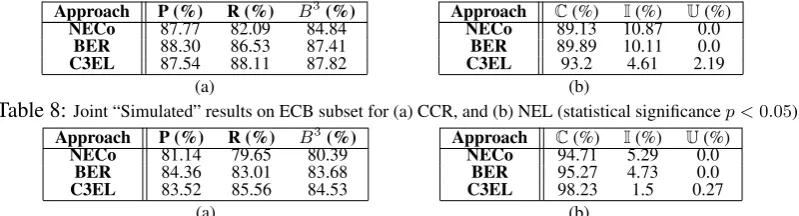
Three topic clusters from the ECB corpus with
3,4, and5articles respectively were selected, and the documents within each cluster were merged to form3“super-articles” (one per topic), forming a simulated CR setting.NECoandBERwere then used to perform CR and NEL on these 3articles, and the results compared with that obtained by C3ELon the original documents. We repeatedly sample 12 articles across 3 topic clusters, and ex-ecute the approaches to report the micro-averaged results across5independent runs.
From Table 8(a) we observe that the algorithms exhibit comparable co-reference resolution perfor-mance; thus validating propagation of global se-mantics in C3EL due to the joint formulation. However, such CR methods using multi-sieves and CRF do not scale beyond few documents (upon concatenation), and require at least4×more run-time compared toC3EL. Hence, CCR cannot be efficiently tackled by simply employing CR meth-ods on a “super-document”.
However, harnessing of non-local mention fea-tures (via CCR) and efficient detection of new mentions using link validation enables C3EL to achieve a gain of around5%in NEL compared to others (see Table 8(b)). For both procedures, we observed statistically significant improvements of C3EL over BER and NECo withp < 0.05, using the bootstrap re-sampling t-test.
To further study the effect of larger corpus, we sampled 25 documents (with co-referring men-tions) from the ClueWeb09 dataset and performed analysis among the algorithms. As previously, we observed significant computational complexity for traditional CR methods when applied to CCR set-ting making them far slower (6−7×) thanC3EL. Table 9 reports the CCR and NEL averaged results obtained across 5 independent runs. We attained comparable performance in CCR with around3%
improvement in NEL. All the algorithms are seen to achieve high NEL results due to the large pres-ence of well-known (in-KB) entities.
Approach P (%) R (%) B3(%) Approach C(%) I(%) U(%)
NECo 87.77 82.09 84.84 NECo 89.13 10.87 0.0
BER 88.30 86.53 87.41 BER 89.89 10.11 0.0
C3EL 87.54 88.11 87.82 C3EL 93.2 4.61 2.19
(a) (b)
Table 8:Joint “Simulated” results on ECB subset for (a) CCR, and (b) NEL (statistical significancep <0.05)
Approach P (%) R (%) B3(%) Approach C(%) I(%) U(%)
NECo 81.14 79.65 80.39 NECo 94.71 5.29 0.0
BER 84.36 83.01 83.68 BER 95.27 4.73 0.0
C3EL 83.52 85.56 84.53 C3EL 98.23 1.5 0.27
[image:8.595.100.500.62.170.2](a) (b)
Table 9:Joint “Simulated” results on ClueWeb09 subset for (a) CCR, and (b) NEL
3.5 Algorithmic Baseline Study
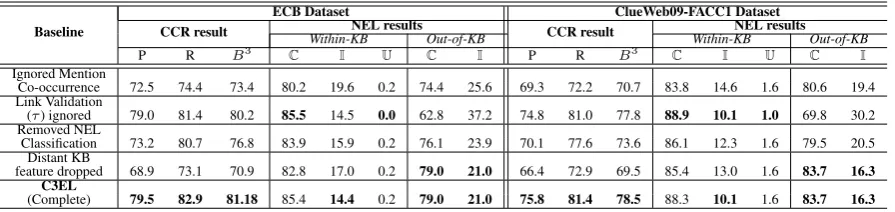
We explore the performance of variants ofC3EL (on both corpora) ablating various system compo-nents (see Table 10). Explicitly, we consider:
• Co-occurring Mentions: Removal of cooc-currence mentions context from the context summaries constructed, reduces semantic in-formation and adversely affects both NEL and CCR procedures. We thus observe a sharp de-crease in CCR performance and also a degra-dation in entity linking.
• Link Validation: Filtering of mention linking to KB entities using link validation step (with thresholdτ) inC3ELenables corroboration of mention context keywords with the linked en-tity features. This leads to enhanced detection of new or emerging entities by reducing induc-tion of noise during the CCR phase. Removal of this process permits aggressive entity linking and introduces noise, affecting new/emerging entity detection. We observe (from Table 10) nearly 20% reduction of precision (on both datasets) in identification of out-of-KB entity-mentions compared toC3EL.
• NEL Categorization: The differentiation of mentions (into classes) confidently mapped to KB entity reduces the collusion of “strong” linked mentions with other “noisy” mention contexts. This reduces incorrect grouping of different mentions with similar surface forms, contexts, etc., thereby improving precision of the CCR process. Use of a single NEL classi-fication approach is observed to degrade CCR results, which in turn increases spurious entity linkage, decreasing NEL efficiency (Table 10). • Distant KB features: As observed in (Baker, 2012; Zheng et al., 2013), extracted external KB features provide global and enhanced infor-mation cues promoting CR. We similarly ob-serve CCR to attain the lowest F1 scores (com-pared to other baselines) when KB features are ignored. This in turn affects the linking of (some) well-known entities due to reduced context, leading to incorrect or low confidence NEL. Since no feature inclusion is performed for out-of-KB mentions, no effect is observed.
We observe that a joint formulation encompass-ing multiple information sources (along with noise filtering) enables mutually enhanced CCR and NEL within the proposed iterative feedback based framework,C3EL.
4 Related Work
Co-reference Resolution (CR):Traditional intra-document CR methods involve syntactic and se-mantic feature combination for identifying the best antecedent (preceding name or phrase) for a men-tion. CR methods employ rules or supervised learning techniques based on linguistic features such as syntactic paths and mention distances to assess semantic compatibility (Haghighi & Klein, 2009; Raghunathan et al., 2010; Rahman & Ng, 2011), while syntactic features are derived by deep parsing of sentences and noun group parsing. Se-mantic features from background knowledge re-sources like encyclopedia were used in (Daum´e & Marcu, 2005; Ponzetto & Strube, 2006; Ng, 2007). The use of Wikipedia and structured knowledge bases (such as YAGO) to obtain mention-type re-lation and fine-grained mention attributes was ex-plored by (Haghighi & Klein, 2009; Rahman & Ng, 2011). An overview of CR methods is given in (Ng, 2010).
Recent methods involve the use of multi-phase sieve, applying a cascade of rules for narrow-ing down the antecedent candidates for a men-tion (Raghunathan et al., 2010). Cluster ranking functions have also been proposed (Rahman & Ng, 2011; Zheng et al., 2013) to extend this paradigm for incrementally expanding and merging mention groups with preceding candidate clusters using re-latedness features (Ratinov & Roth, 2012) and dis-tant knowledge inclusion (Durrett & Klein, 2013). Person name disambiguation, a specific variation of CR, dealing with only person names, titles, nick-names, and other surface form variations was intro-duced in (Chen & Martin, 2007).
tech-Baseline
ECB Dataset ClueWeb09-FACC1 Dataset
CCR result Within-KBNEL resultsOut-of-KB CCR result Within-KBNEL resultsOut-of-KB
P R B3 C I U C I P R B3 C I U C I
Ignored Mention
Co-occurrence 72.5 74.4 73.4 80.2 19.6 0.2 74.4 25.6 69.3 72.2 70.7 83.8 14.6 1.6 80.6 19.4 Link Validation
(τ) ignored 79.0 81.4 80.2 85.5 14.5 0.0 62.8 37.2 74.8 81.0 77.8 88.9 10.1 1.0 69.8 30.2 Removed NEL
Classification 73.2 80.7 76.8 83.9 15.9 0.2 76.1 23.9 70.1 77.6 73.6 86.1 12.3 1.6 79.5 20.5 Distant KB
feature dropped 68.9 73.1 70.9 82.8 17.0 0.2 79.0 21.0 66.4 72.9 69.5 85.4 13.0 1.6 83.7 16.3 C3EL
[image:9.595.75.523.62.168.2](Complete) 79.5 82.9 81.18 85.4 14.4 0.2 79.0 21.0 75.8 81.4 78.5 88.3 10.1 1.6 83.7 16.3
Table 10:CCR and NEL results (%) of C3EL for different baseline variations niques by ranking the matching entities for
dis-tant labeling. However, such prior methods utilize distance labels of the current mention and consid-ers all matching mentions making the procedure expensive. On the other hand, we extract distant features for the strongly matching (best) candidate only, reducing the performance overhead.
Cross-Document CR (CCR): Early approaches towards CCR involved the use contextual infor-mation from input documents for IR-style similar-ity measures (e.g., tf×idf score, KL divergence, etc.) over textual features (Bagga & Baldwin, 1998; Gooi & Allan, 2004). Probabilistic graph-ical models jointly learning the mappings of men-tions to equivalent classes (co-referring menmen-tions) using features similar to local CR techniques were studied in (Culotta et al., 2007; Singh et al., 2010; Singh et al., 2011), A clustering approach coupled with statistical learning of parameters was stud-ied in (Baron & Freedman, 2008). However, such methods fail to cope with large corpora, and hence a “light-weight” streaming variant of CCR was in-troduced by (Rao et al., 2010).
Co-occurring mentions context have been har-nessed for disambiguating person names for CR in (Mann & Yarowsky, 2003; Niu et al., 2004; Chen & Martin, 2007; Baron & Freedman, 2008). How-ever, these methods do not use KB and depend on information extraction (IE) methods, witness-ing substantial noise due to IE quality variance. A CCR framework combining co-occurring mention context with distant KB features embedded in an active hierarchical clustering procedure (Dutta & Weikum, 2015) was recently shown to perform ef-ficiently, and provides inspiration for parts of our proposedC3ELapproach.
Named Entity Linking (NEL):Named entity res-olution and linking stems from SemTag (Dill et al., 2003), and similar frameworks like GLOW, WikipediaMiner, AIDA, and others (Milne & Wit-ten, 2008; Ratinov et al., 2011). A collection of entity disambiguation models was presented in (Kulkarni et al., 2009). Other NEL approaches utilize the notion of semantic similarity of enti-ties to corresponding Wikipedia pages (Milne & Witten, 2008), while co-referent mention graph construction modeling mention co-occurrences and context similarity from outgoing hyperlinks in Wikipedia was used by (Hoffart et al., 2011). An integer linear programming (ILP) formulation also
based on Wikipedia page similarities was presented in (Ratinov et al., 2011). However, none of these methods involve the incorporation of CR results for NEL. The first study on the benefits of CR for NEL was by (Ratinov & Roth, 2012); but a joint model was not proposed, instead attributes from Wikipedia categories were used as features. An overview and evaluation of different NEL methods has been given by (Hachey et al., 2013).
Joint Models: Jointly solving CR for entities and events utilizing cluster construction based on fea-ture semantic dependencies was devised in (Lee et al., 2012). The use of CR as a pre-processing step for subsequent NEL procedure using an ILP for-mulation was proposed by (Chen & Roth, 2013). Recently, (Hajishirzi et al., 2013) proposed a joint model for CR and NEL using the Stanford multi-pass cluster update CR system with automatic link-ing of mentions to Wikipedia. An integrated belief propagation-based framework for CR, NER, and relation extraction was developed in (Singh et al., 2013). Subsequently, the model was enhanced by the use of structured conditional random fields, to solve CR, NER, and NEL in combination (Durrett & Klein, 2014). Other works involving joint for-mulation of NER and NEL use uncertainty of men-tion boundaries along with segmentamen-tion informa-tion extracted from Wikipedia (Sil & Yates, 2013). However, to the best of our knowledge, this work provides the first approach to jointly tackle CCR and NEL across documents in an entire corpus.
5 Conclusions
References
Amit Bagga and Breck Baldwin. Entity-Based Cross-Document Coreferencing Using the Vector Space Model.In COLING-ACL1998, pages 79–85. Collin F. Baker. FrameNet, Current Collaborations and
Future Goals.LREC2012, 46(2):269–286.
Alex Baron and Marjorie Freedman. Who is Who and What is What: Experiments in Cross-Document Co-Reference.In EMNLP2008, pages 274–283. Cosmin A. Bejan and Sanda Harabagiu. Unsupervised
Event Coreference Resolution with Rich Linguistic Features.In ACL2010, pages 1412–1422.
Aydin Buluc, Henning Meyerhenke, Ilya Safro, Peter Sanders, and Christian Schulz. Recent Advances in Graph Partitioning. Karlsruhe Institute of Technol-ogy, Technical Report 2013.
Razvan Bunescu and Marius Pas¸ca. Using Encyclope-dic Knowledge for Named Entity Disambiguation.In EACL2006, pages 9–16.
Ying Chen and James Martin. Towards Robust Unsu-pervised Personal Name Disambiguation.In EMNLP
2007, pages 190–198.
Xiao Cheng and Dan Roth. Relational Inference for Wikification.In EMNLP2013, pages 1787–1796. Marco Cornolti, Paolo Ferragina, and Massimiliano
Ciaramita. A Framework for Benchmarking Entity-Annotation Systems.In WWW2013, pages 249–260. Silviu Cucerzan. Large-Scale Named Entity Disam-biguation Based on Wikipedia Data. In EMNLP-CoNLL2007, pages 708–716.
Aron Culotta, Michael L. Wick, and Andrew McCal-lum. First-Order Probabilistic Models for Corefer-ence Resolution.In HLT-NAACL2007, pages 81–87. Hal Daum´e III, Daniel Marcu. A large-scale exploration of effective global features for a joint entity detection and tracking model.In HLT-EMNLP2005, pages 97– 104.
Stephan Dill, Nadav Eiron, David Gibson, Daniel Gruhl, Ramanathan V. Guha, Aanat Jhingran, Tapas Kanungo, Sridhar Rajagopalan, Andrew Tomkins, John A. Tomlin, and Jason Y. Zien. SemTag and Seeker: bootstrapping the semantic web via auto-mated semantic annotation. In WWW 2003, pages 178–186.
Greg Durrett and Dan Klein. Easy victories and uphill battles in coreference resolution. In EMNLP 2013, pages 1971–1982.
Greg Durrett and Dan Klein. A Joint Model for Entity Analysis: Coreference, Typing, and Linking.TACL
2014, 2:477–490.
Sourav Dutta and Gerhard Weikum. Cross-Document Co-Reference Resolution using Sample-Based Clus-tering with Knowledge Enrichment. TACL 2015, 3:15–28.
Jenny R. Finkel, Trond Grenager, and Christopher D. Manning. Incorporating Non-local Information into Information Extraction Systems by Gibbs Sampling.
In ACL2005, pages 363–370.
Jenny R. Finkel and Christopher D. Manning. Joint Parsing and Named Entity Recognition.In EMNLP-CoNLL2009, pages 326–334.
Evgeniy Gabrilovich, Michael Ringgaard, and Amar-nag Subramanya. FACC1: Freebase annotation of ClueWeb corpora, Version 1 (Format version 1, Cor-rection level 0). 2013.
Chung H. Gooi and James Allan. Cross-Document Coreference on a Large Scale Corpus. In HLT-NAACL2004, pages 9–16.
Peter D. Gr¨unwald.The Minimum Description Length Principle. MIT University Press, 2007.
Ben Hachey, Will Radford, Joel Nothman, Matthew Honnibal, and James R. Curran. Evaluating entity linking with Wikipedia.Artificial Intelligence Jour-nal2013, 194:130–150.
Aria Haghighi and Dan Klein. Simple Coreference Res-olution with Rich Syntactic and Semantic Features.
In EMNLP2009, pages 1152–1161.
Aria Haghighi and Dan Klein. Coreference Resolu-tion in a Modular, Entity-Centered Model. In HLT-NAACL2010, pages 385–393.
Hannaneh Hajishirzi, Leila Zilles, Daniel S. Weld, and Luke Zettlemoyer. Joint Coreference Resolution and Named-Entity Linking with Multi-pass Sieves. In EMNLP2013, pages 289–299.
Johannes Hoffart, Mohamed A. Yosef, Ilaria Bordino, Hagen F¨urstenau, Manfred Pinkal, Marc Spaniol, Bilyana Taneva, Stefan Thater, and Gerhard Weikum. Robust Disambiguation of Named Entities in Text.In EMNLP2011, pages 782–792.
Johannes Hoffart, Yasemin Altun, and Gerhard Weikum. Discovering Emerging Entities with Am-biguous Names.In WWW2014, pages 385–396. Nikos Hourdakis, Michalis Argyriou, Euripides G. M.
Petrakis, and Evangelos E. Milios. Hierarchical Clus-tering in Medical Document Collections: the BIC-Means Method.Journal of Digital Information Man-agement2010, 8(2):71–77.
George Karypis and Vipin Kumar. A Fast and Highly Quality Multilevel Scheme for Partitioning Irregu-lar Graphs. Journal on Scientific Computing 1999, 20(1):359–392.
Sayali Kulkarni, Amit Singh, Ganesh Ramakrishnan, and Soumen Chakrabarti. Collective annotation of Wikipedia entities in Web text.In KDD2009, pages 457–466.
Heeyoung Lee, Yves Peirsman, Angel Chang, Nathanael Chambers, Mihai Surdeanu, and Dan Jurafsky. Stanford’s Multi-Pass Sieve Coreference Resolution System at the CoNLL-2011 Shared Task.
In CoNLL2011, pages 28–34.
Heeyoung Lee, Marta Recasens, Angel Chang, Mi-hai Surdeanu, and Dan Jurafsky. Joint Entity and Event Coreference Resolution across Documents.In EMNLP2012, pages 489–500.
Heeyoung Lee, Angel Chang, Yves Peirsman, Nathanael Chambers, Mihai Surdeanu, and Dan Jurafsky. Deterministic Coreference Resolution based on Entity-centric, Precision-ranked Rules.
Computational Linguistics2013, 39(4): 885–916. Xiaoqiang Luo. On Coreference Resolution
Perfor-mance Metrics.In EMNLP2005, pages 25–32. Gideon S. Mann and David Yarowsky: Unsupervised
Personal Name Disambiguation. In CoNLL 2003, pages 33–40.
David Milne and Ian H. Witten. Learning to Link with Wikipedia.In CIKM2008, pages 509–518.
David Nadeau and Satoshi Sekine. A survey of named entity recognition and classification.Lingvisticae In-vestigationes2007, 30(1):3–26.
Vincent Ng. Shallow semantics for coreference resolu-tion.In IJCAI2007, pages 1689–1694.
Vincent Ng. Supervised Noun Phrase Coreference Re-search: The First Fifteen Years.In ACL2010, pages 1396–1411.
Cheng Niu, Wei Li, and Rohini K. Srihari. Weakly Su-pervised Learning for Cross-document Person Name Disambiguation Supported by Information Extrac-tion.In ACL2004, article 597.
Simone P. Ponzetto and Michael Strube. Exploiting se-mantic role labeling, WordNet and Wikipedia for coreference resolution.In HLT-NAACL2006, pages 192–199.
Karthik Raghunathan, Heeyoung Lee, Sudarshan Ran-garajan, Nathanael Chambers, Mihai Surdeanu, Dan Jurafsky, and Christopher Manning. A Multi-Pass Sieve for Coreference Resolution.In EMNLP2010, pages 492–501.
Altaf Rahman and Vincent Ng. Coreference Resolution with World Knowledge. In ACL 2011, pages 814– 824.
Altaf Rahman and Vincent Ng. Ensemble-Based Coref-erence Resolution.In IJCAI2011, pages 1884–1889. Delip Rao, Paul McNamee, and Mark Dredze. Stream-ing Cross Document Entity Coreference Resolution.
In COLING2010, pages 1050–1058.
Lev A. Ratinov and Dan Roth. Design Challenges and Misconceptions in Named Entity Recognition. In CoNLL2009, pages 147–155.
Lev A. Ratinov, Dan Roth, Doug Downey, and Mike Anderson. Local and Global Algorithms for Disam-biguation to Wikipedia. In ACL2011, pages 1375– 1384.
Lev A. Ratinov and Dan Roth. Learning-based Multi-Sieve Co-reference Resolution with Knowledge. In EMNLP-CoNLL2012, pages 1234–1244.
Gideon E. Schwarz. Estimating the Dimension of a Model.Annals of Statistics1978, 6(2):461–464. Avirup Sil and Alexander Yates. Re-ranking for Joint
Named-Entity Recognition and Linking. In CIKM
2013, pages 2369–2374.
Sameer Singh, Michael L. Wick, and Andrew McCal-lum. Distantly Labeling Data for Large Scale Cross-Document Coreference. CoRR abs/1005.4298, 2010. Sameer Singh, Amarnag Subramanya, Fernando Pereira, and Andrew McCallum. Large-Scale Cross-Document Coreference Using Distributed Inference and Hierarchical Models.In ACL2011, pages 793– 803.
Sameer Singh, Sebastian Reidel, Brian Martin, Jiaping Zheng, and Andrew McCallum. Joint Inference of Entities, Relations, and Coreference.In Workshop of AKBC2013, pages 1–6.
Fabian M. Suchanek, Gjergji Kasneci, and Gerhard Weikum. YAGO: a Core of Semantic Knowledge.In WWW2007, pages 697–706.
Bilyana Taneva, Mouna Kacimi, and Gerhard Weikum. Finding Images of Difficult Entities in the Long Tail.
In CIKM2011, pages 189–194.
Mohamed A. Yosef, Johannes Hoffart, Marc Spaniol, and Gerhard Weikum. AIDA: An Online Tool for Ac-curate Disambiguation of Named Entities in Text and Tables.In VLDB2011, 4(12):1450–1453.
Jiaping Zheng, Luke Vilnis, Sameer Singh, Jinho D. Choi, and Andrew McCallum. Dynamic knowledge-base alignment for coreference resolution.In CoNLL