Resolving “This-issue” Anaphora
Varada Kolhatkar
Department of Computer Science University of Toronto Toronto, ON, M5S 3G4, Canada
Graeme Hirst
Department of Computer Science University of Toronto Toronto, ON, M5S 3G4, Canada
Abstract
We annotate and resolve a particular case of abstract anaphora, namely, this-issueanaphora. We propose a candidate ranking model for this-issue anaphora resolution that explores different issue -specific and general abstract-anaphora features. The model is not restricted to nominal or verbal antecedents; rather, it is able to identify antecedents that are arbitrary spans of text. Our re-sults show that (a) the model outperforms the strong adjacent-sentence baseline; (b) general abstract-anaphora features, as distinguished fromissue-specific fea-tures, play a crucial role in this-issue
anaphora resolution, suggesting that our approach can be generalized for other NPs such asthis problemandthis debate; and (c) it is possible to reduce the search space in order to improve performance.
1 Introduction
Anaphora in which the anaphoric expression refers to an abstract object such as a proposition, a prop-erty, or a fact is known asabstract object anaphora. This is seen in the following examples.
(1) [Be careful what you wish... because wishes sometimes come true.]i [That]i is what the Semiconductor Industry Association, which rep-resents U.S. manufacturers, has been learning. (from Asher (1993))
(2) This prospective study suggested [that oral carvedilol is more effective than oral meto-prolol in the prevention of AF after on-pump
CABG]i. It is well tolerated when started before and continued after the surgery. However, further prospective studies are needed to clarify [this is-sue]i.
(3) In principle, he said, airlines should be allowed
[to sell standing-room-only tickets for adults]i — as long as [this decision]i was approved by their marketing departments.
These examples highlight a difficulty not found with nominal anaphora. First, the anaphors refer to ab-stract concepts that can be expressed with differ-ent syntactic shapes which are usually not nominals. The anaphorThatin (1) refers to the proposition in the previous utterance, whereas the anaphorthis is-suein (2) refers to a clause from the previous text. In (3), the anaphoric expressionthis decisionrefers to a verb phrase from the same sentence. Second, the antecedents do not always have precisely defined boundaries. In (2), for example, the whole sentence containing the marked clause could also be thought to be the correct antecedent. Third, the actual refer-ents are not always the precise textual antecedrefer-ents. The actual referent in (2), the issue to be clarified, iswhether oral carvedilol is more effective than oral metoprolol in the prevention of AF after on-pump CABG or not, a variant of the antecedent text.
Generally, abstract anaphora, as distinguished fromnominal anaphora, is signalled in English by pronouns this, that, and it (M¨uller, 2008). But in abstract anaphora, English prefers demonstratives to personal pronouns and definite articles (Pas-sonneau, 1989; Navarretta, 2011).1
Demonstra-1This is not to say that personal pronouns and definite
arti-cles do not occur in abstract anaphora, but they are not common.
tives can be used in isolation (That in (1)) or with
nouns (e.g., this issue in (2)). The latter follows the pattern demonstrative {modifier}* noun. The demonstrative acts as a determiner and the noun fol-lowing the demonstrative imposes selectional con-straints for the antecedent, as in examples (2) and (3). Francis (1994) calls such nouns label nouns, which “serve to encapsulate or package a stretch of discourse”. Schmid (2000) refers to them as
shell nouns, a metaphoric term which reflects differ-ent functions of these nouns such as encapsulation, pointing, and signalling.
Demonstrative nouns, along with pronouns like
both andeither, are referred to as sortal anaphors
(Casta˜no et al., 2002; Lin and Liang, 2004; Torii and Vijay-Shanker, 2007). Casta˜no et al. observed that sortal anaphors are prevalent in the biomedi-cal literature. They noted that among 100 distinct anaphors derived from a corpus of 70 Medline ab-stracts, 60% were sortal anaphors. But how often do demonstrative nouns refer to abstract objects? We observed that from a corpus of 74,000 randomly chosen Medline2abstracts, of the first 150 most fre-quently occurring distinct demonstrative nouns (fre-quency >30), 51.3% were abstract, 41.3% were concrete, and 7.3% were discourse deictic. This shows that abstract anaphora resolution is an impor-tant component of general anaphora resolution in the biomedical domain. However, automatic resolution of this type of anaphora has not attracted much atten-tion and the previous work for this task is limited.
The present work is a step towards resolving ab-stract anaphora in written text. In particular, we choose the interesting abstract concept issue and demonstrate the complexities of resolvingthis-issue
anaphora manually as well as automatically in the Medline domain. We present our algorithm, results, and error analysis forthis-issueanaphora resolution. The abstract conceptissuewas chosen for the fol-lowing reasons. First, it occurs frequently in all kinds of text from newspaper articles to novels to scientific articles. There are 13,489issueanaphora instances in the New York Times corpus and 1,116 instances in 65,000 Medline abstracts. Second, it is abstract enough that it can take several syntactic and
2http://www.nlm.nih.gov/bsd/pmresources.
html
semantic forms, which makes the problem interest-ing and non-trivial. Third,issuereferents in scien-tific literature generally lie in the previous sentence or two, which makes the problem tractable. Fourth,
issuesin Medline abstracts are generally associated with clinical problems in the medical domain and spell out the motivation of the research presented in the article. So extraction of this information would be useful in any biomedical information retrieval system.
2 Related Work
Anaphora resolution has been extensively studied in computational linguistics (Hirst, 1981; Mitkov, 2002; Poesio et al., 2011). But CL research has mostly focused on nominal anaphora resolution (e.g., resolving multiple ambiguous mentions of a single entity representing a person, a location, or an organization) mainly for two reasons. First, nominal anaphora is the most frequently occurring anaphora in most domains, and second, there is a substantial amount of annotated data available for this kind of anaphora.
Besides pronominal anaphora, some work has been done on complement anaphora (Modjeska, 2003) (e.g., British and other European steelmak-ers). There is also some research on resolving sor-tal anaphora in the medical domain using domain knowledge (Casta˜no et al., 2002; Lin and Liang, 2004; Torii and Vijay-Shanker, 2007). But all these approaches focus only on the anaphors with nominal antecedents.
focus on events and actions and use verbs as a proxy for the non-nominal antecedents. Butthis-issue an-tecedents cannot usually be represented by a verb. Our work is not restricted to a particular syntactic type of the antecedent; rather we provide the flexibil-ity of marking arbitrary spans of text as antecedents. There are also some prominent approaches to ab-stract anaphora resolution in the spoken dialogue domain (Eckert and Strube, 2000; Byron, 2004; M¨uller, 2008). These approaches go beyond nom-inal antecedents; however, they are restricted to spo-ken dialogues in specific domains and need serious adaptation if one wants to apply them to arbitrary text.
In addition to research on resolution, there is also some work on effective annotation of abstract anaphora (Strube and M¨uller, 2003; Botley, 2006; Poesio and Artstein, 2008; Dipper and Zinsmeister, 2011). However, to the best of our knowledge, there is currently no English corpus annotated for issue
anaphora antecedents.
3 Data and Annotation
To create an initial annotated dataset, we collected
188this{modifier}* issueinstances along with the
surrounding context from Medline abstracts.3 Five instances were discarded as they had an unrelated (publication related) sense. Among the remaining 183 instances, 132 instances were independently an-notated by two annotators, a domain expert and a non-expert, and the remaining 51 instances were an-notated only by the domain expert. We use the for-mer instances for training and the latter instances (unseen by the developer) for testing. The anno-tator’s task was to mark arbitrary text segments as antecedents (without concern for their linguistic types). To make the task tractable, we assumed that an antecedent does not span multiple sentences but lies in a single sentence (since we are dealing with singularthis-issueanaphors) and that it is a continu-ous span of text.
3Although our dataset is rather small, its size is similar to
other available abstract anaphora corpora in English: 154 in-stances in Eckert and Strube (2000), 69 inin-stances in Byron (2003), 462 instances annotated by only one annotator in Botley (2006), and 455 instances restricted to those which have only nominal or clausal antecedents in Poesio and Artstein (2008).
r11 r12 r13 r14 r15
r21 r22 r23 r24 r25
Annotator 1
Annotator 2
r16 r17 r18 r19
r26 r27 r28 r29 r2,10 id2
Intersections 1 2 3 4 5 6 7 8 9 10 11 12 13 14
id3 id4 id5
[image:3.612.313.531.55.122.2]id1 id2 id3 id4 id5
Figure 1: Example of annotated data. Bold segments denote the marked antecedents for the corresponding anaphorids. rh j is the jth section identified by the an-notatorh.
3.1 Inter-annotator Agreement
This kind of annotation — identifying and marking arbitrary units of text that are not necessarily con-stituents — requires a non-trivial variant of the usual inter-annotator agreement measures. We use Krip-pendorff’s reliability coefficient for unitizing (αu) (Krippendorff, 1995) which has not often been used or described in CL. In our context,unitizingmeans marking the spans of the text that serve as the an-tecedent for the given anaphors within the given text. The coefficientαu assumes that the annotated sec-tions do not overlap in a single annotator’s output and our data satisfies this criterion.4 The general form of coefficientαuis:
αu=1−
uDo
uDe
(1)
whereuDo anduDe are observed and expected dis-agreements respectively. Both disagreement quanti-ties express the average squared differences between the mismatching pairs of values assigned by anno-tators to given units of analysis. αu=1 indicates perfect reliability andαu=0 indicates the absence of reliability. Whenαu<0, the disagreement is sys-tematic. Annotated data with reliability ofαu≥0.80 is considered reliable (Krippendorff, 2004).
Krippendorff’sαuis non-trivial, and explaining it in detail would take too much space, but the general idea, in our context, is as follows. The annotators mark the antecedents corresponding to each anaphor in their respective copies of the text, as shown in Fig-ure 1. The marked antecedents are mutually exclu-sive sectionsr; we denote the jth section identified
4If antecedents overlap with each other in a single
Antecedent type Distribution Example
clause 37.9% There is a controversial debate (SBARwhether back school program might improve quality of life in back pain patients). This study aimed to addressthis issue.
sentence 26.5% (SReduced serotonin function and abnormalities in the hypothalamic-pituitary-adrenal axis are thought to play a role in the aetiology of major depression.) We sought to examinethis issuein the elderly ...
mixed 18.2% (S (PP Given these data) (, ,) (NPdecreasing HTD to<or=5years) (VPmay have a detrimental effect on patients with locally advanced prostate cancer) (. .)) Only a randomized trial will conclusively clarifythis issue.
nominalization 17.4% As (NPthe influence of estrogen alone on breast cancer detection) is not established, we examinedthis issuein the Women’s Health Initiative trial...
Table 1: Antecedent types. In examples, the antecedent type is inboldand the marked antecedent is initalics.
by the annotatorhbyrh j. In Figure 1, annotators 1 and 2 have reached different conclusions by identi-fying 9 and 10 sections respectively in their copies of the text. Annotator 1 has not marked any an-tecedent for the anaphor withid=1, while annotator 2 has markedr21 for the same anaphor. Both anno-tators have marked exactly the same antecedent for the anaphor withid=4. The difference between two annotated sections is defined in terms of the square of the distance between the non-overlapping parts of the sections. The distance is 0 when the sections are unmarked by both annotators or are marked and ex-actly same, and is the summation of the squares of the unmatched parts if they are different. The coeffi-cient is computed using intersections of the marked sections. In Figure 1, annotators 1 and 2 have a to-tal of 14 intersections. The observed disagreement
uDois the weighted sum of the differences between all mismatching intersections of sections marked by the annotators, and the expected disagreement is the summation of all possible differences of pairwise combinations of all sections of all annotators nor-malized by the length of the text (in terms of the number of tokens) and the number of pairwise com-binations of annotators.
For our data, the inter-annotator agreement was
αu=0.86 (uDo=0.81 anduDe=5.81) despite the fact that the annotators differed in their domain ex-pertise, which suggests that abstract concepts such asissuecan be annotated reliably.
3.2 Corpus Statistics
A gold standard corpus was created by resolving the cases where the annotators disagreed. Among 132 training instances, the annotators could not resolve
6 instances and we broke the tie by writing to the authors of the articles and using their response to resolve the disagreement. In the gold standard cor-pus, 95.5% of the antecedents were in the current or previous sentence and 99.2% were in the current or previous two sentences. Only one antecedent was found more than two sentences back and it was six sentences back. One instance was a cataphor, but the antecedent occurred in the same sentence as the anaphor. This suggests that for an automatic this-issue resolution system, it would be reasonable to consider only the previous two sentences along with the sentence containing the anaphor.
The distribution of the different linguistic forms that an antecedent ofthis-issuecan take in our data set is shown in Table 1. The majority of antecedents are clauses or whole sentences. A number of an-tecedents are noun phrases, but these are gener-ally nominalizations that refer to abstract concepts (e.g.,the influence of estrogen alone on breast can-cer detection). Some antecedents are not even well-defined syntactic constituents5but are combinations of several well-defined constituents. We denote the type of such antecedents as mixed. In the corpus, 18.2% of the antecedents are of this type, suggest-ing that it is not sufficient to restrict the antecedent search space to well-defined syntactic constituents.6 In our data, we did not find anaphoric chains for any of thethis-issueanaphor instances, which indi-cates that the antecedents ofthis-issueanaphors are
5We refer to every syntactic constituent identified by the
parser as awell-defined syntactic constituent.
6Indeed, many of mixed type antecedents (nearly
in the reader’s local memory and not in the global memory. This observation supports the THIS-NPs hypothesis (Gundel et al., 1993; Poesio and Mod-jeska, 2002) thatthis-NPs are used to refer to enti-ties which areactivealbeit not infocus, i.e., they are not the center of the previous utterance.
4 Resolution Algorithm
4.1 Candidate Extraction
For correct resolution, the set of extracted candidates must contain the correct antecedent in the first place. The problem of candidate extraction is non-trivial in abstract anaphora resolution because the antecedents are of many different types of syntactic constituents such as clauses, sentences, and nominalizations. Drawing on our observation that the mixed type an-tecedents are generally a combination of different well-defined syntactic constituents, we extract the set of candidate antecedents as follows. First, we create a set of candidate sentences which contains the sentence containing the this-issue anaphor and the two preceding sentences. Then, we parse every candidate sentence with the Stanford Parser7. Ini-tially, the set of candidate constituents contains a list of well-defined syntactic constituents. We re-quire that the node type of these constituents be in the set {S, SBAR, NP, SQ, SBARQ, S+V}. This set was empirically derived from our data. To each constituent, there is associated a set of mixed type constituents. These are created by concatenating the original constituent with its sister constituents. For example, in (4), the set of well-defined eligible can-didate constituents is{NP, NP1}and so NP1 PP1is a mixed type candidate.
(4) NP
NP1 PP1 PP2
The set of candidate constituents is updated with the extracted mixed type constituents. Extracting mixed type candidate constituents not only deals with mixed type instances as shown in Table 1, but as a side effect it also corrects some attachment er-rors made by the parser. Finally, the constituents
7http://nlp.stanford.edu/software/
lex-parser.shtml
having a number of leaves (words) less than a thresh-old8 are discarded to give the final set of candidate constituents.
4.2 Features
We explored the effect of including 43 automati-cally extracted features (12 feature classes), which are summarized in Table 2. The features can also be broadly divided into two groups: issue-specific fea-tures and general abstract-anaphora feafea-tures. Issue -specific features are based on our common-sense knowledge of the concept ofissueand the different semantic forms it can take; e.g., controversy (X is controversial), hypothesis (It has been hypothesized X), or lack of knowledge (X is unknown), where X
is the issue. In our data, we observed certain syn-tactic patterns of issues such as whether X or not
andthat X and the IP feature class encodes this in-formation. Otherissue-specific features are IVERB and IHEAD. The feature IVERB checks whether the governing verb of the candidate is an issue verb (e.g., speculate, hypothesize, argue, debate), whereas IHEAD checks whether the candidate head in the dependency tree is an issue word (e.g., contro-versy, uncertain, unknown). The general abstract-anaphora resolution features do not make use of the semantic properties of the word issue. Some of these features are derived empirically from the training data (e.g., ST, L, D). The EL feature is bor-rowed from M¨uller (2008) and encodes the embed-ding level of the candidate within the candidate sen-tence. The MC feature tries to capture the idea of the THIS-NPs hypothesis (Gundel et al., 1993; Poesio and Modjeska, 2002) that the antecedents of this -NP anaphors are not the center of the previous utter-ance. The general abstract-anaphora features in the SR feature class capture the semantic role of the can-didate in the cancan-didate sentence. We used the Illinois Semantic Role Labeler9 for SR features. The gen-eral abstract-anaphora features also contain a few lexical features (e.g., M, SC). But these features are independent of the semantic properties of the word
issue. The general abstract-anaphora resolution fea-tures also contain dependency-tree feafea-tures,
lexical-8The threshold 5 was empirically derived. Antecedents in
our training data had on average 17 words.
9http://cogcomp.cs.illinois.edu/page/
ISSUE PATTERN (IP)
ISWHETHER 1 iff the candidate follows the patternSBAR→(IN whether) (S ...)
ISTHAT 1 iff the candidate follows the patternSBAR→(IN that) (S ...)
ISIF 1 iff the candidate follows the patternSBAR→(IN iff) (S ...)
ISQUESTION 1 iff the candidate node isSBARQorSQ
SYNTACTIC TYPE (ST)
ISNP 1 iff the candidate node is of type NP ISS 1 iff the candidate node is a sentence node ISSBAR 1 iff the candidate node is an SBAR node ISSQ 1 iff the candidate node is an SQ or SBARQ node MIXED 1 iff the candidate node is of typemixed EMBEDDING LEVEL (EL) (M ¨uller, 2008)
TLEMBEDDING level of embedding of the given candidate in its top clause (the root node of the syntactic tree)
ILEMBEDDING level of embedding of the given candidate in its immediate clause (the closest parent of type S or SBAR) MAIN CLAUSE (MC)
MCLAUSE 1 iff the candidate is in the main clause DISTANCE (D)
ISSAME 1 iff the candidate is in the same sentence as anaphor SADJA 1 iff the candidate is in the adjacent sentence
ISREM 1 iff the candidate occurs 2 or more sentences before the anaphor POSITION 1 iff the antecedent occurs before anaphor
SEMANTIC ROLE LABELLING (SR)
IVERB 1 iff the governing verb of the given candidate is anissueverb ISA0 1 iff the candidate is theagentof the governing verb ISA1 1 iff the candidate is thepatientof the governing verb ISA2 1 iff the candidate is theinstrumentof the governing verb ISAM 1 iff the candidate plays the role ofmodiffication
ISNOR 1 iff the candidate plays no well-defined semantic role in the sentence DEPENDENCY TREE (DT)
IHEAD 1 iff the candidate head in the dependency tree is an issue word (e.g.,controversial,unknown)
ISSUBJ 1 iff the dependency relation of the candidate to its head is of typenominal, controlling orclausal subject ISOBJ 1 iff the dependency relation of the candidate to its head is of typedirect objectorpreposition obj ISDEP 1 iff the dependency relation of the candidate to its head is of typedependent
ISROOT 1 iff the candidate is the root of the dependency tree
ISPREP 1 iff the dependency relation of the candidate to its head is of typepreposition ISCONT 1 iff the dependency relation of the candidate to its head is of typecontinuation
ISCOMP 1 iff the dependency relation of the candidate to its head is of typeclausaloradjectival complement ISSENT 1 iff candidate’s head is the root node
PRESENCE OF MODALS (M)
MODAL 1 iff the given candidate contains a modal verb PRESENCE OF SUBORDINATING CONJUNCTION (SC)
ISCONT 1 iff the candidate starts with a contrastive subordinating conjunction (e.g.,however,but,yet) ISCAUSE 1 iff the candidate starts with a causal subordinating conjunction (e.g.,because,as,since) ISCOND 1 iff the candidate starts with a conditional subordinating conjunction (e.g.,if,that,whether or not) LEXICAL OVERLAP (LO)
TOS normalized ratio of the overlapping words in candidate and the title of the article AOS normalized ratio of the overlapping words in candidate and the anaphor sentence DWS proportion of domain-specific words in the candidate
CONTEXT (C)
ISPPREP 1 iff the preceding word of the candidate is a preposition ISFPREP 1 iff the following word of the candidate is a preposition ISPPUNCT 1 iff the preceding word of the candidate is a punctuation ISFPUNCT 1 iff the following word of the candidate is a punctuation LENGTH (L)
[image:6.612.77.494.85.634.2]LEN length of the candidate in words
overlap features, and context features.
4.3 Candidate Ranking Model
Given an anaphor ai and a set of candidate antecedents C = {C1,C2, ...,Ck}, the problem of anaphora resolution is to choose the best candidate antecedent forai. We follow the candidate-ranking model proposed by Denis and Baldridge (2008). The advantage of the candidate-ranking model over the mention-pair model is that it overcomes the strong independence assumption made in mention-pair models and evaluates how good a candidate is relative toallother candidates.
We train our model as follows. If the anaphor is a this-issue anaphor, the set C is extracted us-ing the candidate extraction algorithm from Section 4.1. Then a corresponding set of feature vectors,
Cf ={Cf1,Cf2, ...,Cf k}, is created using the features
in Table 2. The training instances are created as de-scribed by Soon et al. (2001). Note that the instance creation is simpler than for general coreference res-olution because of the absence of anaphoric chains in our data. For every anaphorai and eligible can-didatesCf ={Cf1,Cf2, ...,Cf k}, we create training examples(ai,Cf i,label),∀Cf i∈Cf. The label is 1 ifCi is the true antecedent of the anaphor ai, oth-erwise the label is −1. The examples with label 1 get the rank of 1, while other examples get the rank of 2. We use SVMrank (Joachims, 2002) for train-ing the candidate-ranktrain-ing model. Durtrain-ing testtrain-ing, the trained model is used to rank the candidates of each test instance ofthis-issueanaphor.
5 Evaluation
In this section we present the evaluation of each component of our resolution system.
5.1 Evaluation of Candidate Extraction
The set of candidate antecedents extracted by the method from Section 4.1 contained the correct an-tecedent 92% of the time. Each anaphor had, on average, 23.80 candidates, of which only 5.19 can-didates were nominal type. The accuracy dropped to 84% when we did not extract mixed type candi-dates. The error analysis of the 8% of the instances where we failed to extract the correct antecedent re-vealed that most of these errors were parsing errors
which could not be corrected by our candidate ex-traction method.10 In these cases, the parts of the antecedent had been placed in completely different branches of the parse tree. For example, in (5), the correct antecedent is a combination of the NP from theS→V P→NP→PP→NPbranch and the PP fromS→V P→PPbranch. In such a case, concate-nating sister constituents does not help.
(5) The data from this pilot study (VP (VBP provide) (NP (NP no evidence) (PP (IN for) (NP a dif-ference in hemodynamic effects between pulse HVHF and CPFA))) (PPin patients with sep-tic shock already receiving CRRT)). A larger sample size is needed to adequately explorethis issue.
5.2 Evaluation ofthis-issueResolution
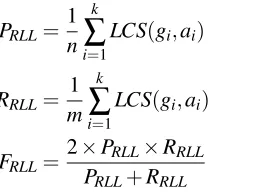
We propose two metrics for abstract anaphora eval-uation. The simplest metric is the percentage of an-tecedents on which the system and the annotated gold data agree. We denote this metric as EXACT-M (Exact Match) and compute it as the ratio of number of correctly identified antecedents to the to-tal number of marked antecedents. This metric is a good indicator of a system’s performance; how-ever, it is a rather strict evaluation because, as we noted in section 1, issues generally have no precise boundaries in the text. So we propose another met-ric called RLL, which is similar to the ROUGE-L metric (Lin, 2004) used for the evaluation of auto-matic summarization. Let the marked antecedents of the gold corpus fork anaphor instances be G=
hg1,g2, ...,gkiand the system-annotated antecedents
be A=ha1,a2, ...,aki. Let the number of words in
G and A be m and n respectively. Let LCS(gi,ai) be the the number of words in the longest common subsequence ofgi andai. Then the precision (PRLL) and recall (RRLL) over the whole data set are com-puted as shown in equations (2) and (3). PRLL is the total number of word overlaps between the gold and system-annotated antecedents normalized by the number of words in system-annotated antecedents andRRLLis the total number of such word overlaps normalized by the number of words in the gold tecedents. If the system picks too much text for an-tecedents,RRLLis high butPRLLis low. The F-score,
10Extracting candidate constituents from the dependency
5-fold Cross-Validation Test
PRLL RRLL FRLL EX-M PRLL RRLL FRLL EX-M
1 Adjacent sentence 66.47 86.16 74.93 22.93 61.73 87.69 72.46 24.00
2 Random 50.71 32.84 39.63 8.40 43.75 35.00 38.89 15.69
3 {IP, D, C, LO, EL, M, MC, L, SC, SR, DT} 79.37 83.66 81.11 59.80 71.89 85.74 78.20 58.82 4 {IP, D, C, LO, M, MC, L, SC, DT} 78.71 83.86 81.14 59.89 70.64 88.09 78.40 54.90 5 {IP, D, C, EL, L, SC, SR, DT} 77.95 83.06 80.33 57.41 72.03 84.85 77.92 60.78 6 {IP, D, EL, MC, L, SR, DT} 80.00 84.75 82.24 59.91 68.88 85.29 76.22 56.86 7 {IP, D, M, L, SR} 73.42 83.16 77.90 52.31 70.74 91.03 79.61 50.98 8 {D, C, LO, L, SC, SR, DT} 79.15 85.28 82.04 56.07 67.39 86.32 75.69 52.94 9 issue-specific features 74.66 45.70 56.57 41.42 64.20 45.88 53.52 41.38 10 non-issuefeatures 76.39 79.39 77.82 51.48 71.19 83.24 76.75 58.82
11 All 78.22 82.92 80.41 56.75 71.28 83.24 76.80 56.86
[image:8.612.76.540.58.244.2]12 Oracle candidate extractor + row 3 79.63 82.26 80.70 58.32 74.65 87.06 80.38 64.71 13 Oracle candidate sentence extractor + row 3 86.67 92.12 89.25 63.72 79.71 91.49 85.20 62.00
Table 3:this-issueresolution results with SVMrank.Allmeans evaluation using all features. Issue-specific features = {IP, IVERB, IHEAD}. EX-M is EXACT-M.
FRLL, combines these two scores.
PRLL= 1
n
k
∑
i=1
LCS(gi,ai) (2)
RRLL= 1
m
k
∑
i=1
LCS(gi,ai) (3)
FRLL=
2×PRLL×RRLL
PRLL+RRLL
(4)
The lower bound of FRLL is 0, where no true an-tecedent has any common substring with the pre-dicted antecedents and the upper bound is 1, where all the predicted and true antecedents are exactly the same. In our results we represent these scores in terms of percentage.
There are no implemented systems that resolve is-sueanaphora or abstract anaphora signalled by label nouns in arbitrary text to use as a comparison. So we compare our results against two baselines: ad-jacent sentenceandrandom. The adjacent sentence baseline chooses the previous sentence as the correct antecedent. This is a high baseline because in our data 84.1% of the antecedents lie within the adjacent sentence. The random baseline chooses a candidate drawn from a uniform random distribution over the set of candidates.11
11Note that ourF
RLLscores for both baselines are rather high because candidates often have considerable overlap with one another; hence a wrong choice may still have a highFRLLscore.
We carried out two sets of systematic experi-ments in which we considered all combinations of our twelve feature classes. The first set consists of 5-fold cross-validation experiments on our training data. The second set evaluates how well the model built on the training data works on the unseen test data.
[image:8.612.134.271.335.431.2]EXACT-M scores in rows 6 and 5 respectively.12 To pinpoint the errors made by our system, we carried out three experiments. In the first experi-ment, we examined the contribution ofissue-specific features versus non-issuefeatures (rows 9 and 10). Interestingly, when we used only non-issuefeatures, the performance dropped only slightly. TheFRLL re-sults from using only issue-specific features were below baseline, suggesting that the more general features associated with abstract anaphora play a crucial role in resolvingthis-issueanaphora.
In the second experiment, we determined the er-ror caused by the candidate extractor component of our system. Row 12 of the table gives the result when an oracle candidate extractor was used to add the correct antecedent in the set of candidates when-ever our candidate extractor failed. This did not affect cross-validation results by much because of the rarity of such instances. However, in the test-data experiment, the EXACT-M improvements that resulted were statistically significant. This shows that our resolution algorithm was able to identify an-tecedents that were arbitrary spans of text.
In the last experiment, we examined the effect of the reduction of the candidate search space. We as-sumed an oracle candidate sentence extractor (Row 13) which knows the exact candidate sentence in which the antecedent lies. We can see that both RLL and EXACT-M scores markedly improved in this setting. In response to these results, we trained a decision-tree classifier to identify the correct an-tecedent sentence with simple location and length features and achieved 95% accuracy in identifying the correct candidate sentence.
6 Discussion and Conclusions
We have demonstrated the possibility of resolv-ing complex abstract anaphora, namely, this-issue
anaphora having arbitrary antecedents. The work takes the annotation work of Botley (2006) and Dip-per and Zinsmeister (2011) to the next level by re-solvingthis-issueanaphora automatically. We pro-posed a set of 43 automatically extracted features that can be used for resolving abstract anaphora.
12We performed a simple one-tailed, k-fold cross-validated
pairedt-test at significance levelp=0.05 to determine whether the difference between the EXACT-M scores of two feature classes is statistically significant.
Our results show that general abstract-anaphora resolution features (i.e., other than issue-specific features) play a crucial role in resolving this-issue
anaphora. This is encouraging, as it suggests that the approach could be generalized for other NPs — especially NPs having similar semantic constraints such asthis problem,this decision, andthis conflict. The results also show that reduction of search space markedly improves the resolution perfor-mance, suggesting that a two-stage process that first identifies the broad region of the antecedent and then pinpoints the exact antecedent might work better than the current single-stage approach. The rationale behind this two-stage process is twofold. First, the search space of abstract anaphora is large and noisy compared to nominal anaphora.13 And second, it is possible to reduce the search space and accurately identify the broad region of the antecedents using simple features such as the location of the anaphor in the anaphor sentence (e.g., if the anaphor occurs at the beginning of the sentence, the antecedent is most likely present in the previous sentence).
We chose scientific articles over general text be-cause in the former domain the actual referents are seldom discourse deictic (i.e., not present in the text). In the news domain, for instance, which we have also examined and are presently annotating, a large percentage of this-issue antecedents lie out-side the text. For example, newspaper articles often quote sentences of others who talk about the issues in their own world, as shown in example (6).
(6) As surprising and encouraging to organizers of the movement are the Wall Street names added to their roster. Prominent among them is Paul Singer, a hedge fund manager who is straight and chairman of the conservative Manhattan Institute. He has donated more than $8 million to various same-sex marriage efforts, in states including California, Maine, New Hampshire, New Jersey, New York and Oregon, much of it since 2007.
“It’s become something that gradually
peo-13If we consider all well-defined syntactic constituents of a
ple like myself weren’t afraid to fund, weren’t afraid to speak out on,” Mr. Singer said in an in-terview. “I’m somebody who is philosophically very conservative, and on this issue I thought that this really was important on the basis of liberty and actual family stability.”
In such a case, the antecedent of this issue is not always in the text of the newspaper article itself, but must be inferred from the context of the quotation and the world of the speaker quoted. That said, we do not use any domain-specific information in our
this-issueresolution model. Our features are solely based on distance, syntactic structure, and semantic and lexical properties of the candidate antecedents which could be extracted for text in any domain.
Issue anaphora can also be signalled by demon-stratives other than this. However, for our initial study, we chosethis issuefor two reasons. First, in our corpus as well as in other general corpora such as the New York Times corpus,issue occurs much more frequently withthisthan other demonstratives. Second, we did not want to increase the complexity of the problem by including the pluralissues.
Our approach needs further development to make it useful. Our broad goal is to resolve abstract anaphora signalled by label nouns in all kinds of text. At present, the major obstacle is that there is very little annotated data available that could be used to train an abstract anaphora resolution sys-tem. And the understanding of abstract anaphora itself is still at an early stage; it would be prema-ture to think about unsupervised approaches. In this work, we studied the narrow problem of resolution ofthis-issueanaphora in the medical domain to get a good grasp of the general abstract-anaphora reso-lution problem.
A number of extensions are planned for this work. First, we will extend the work to resolve other ab-stract anaphors (e.g., this decision, this problem). Second, we will experiment with a two-stage reso-lution approach. Third, we would like to explore the effect of including serious discourse structure fea-tures in our model. (The feature sets SC and C en-code only shallow discourse information.) Finally, during annotation, we noted a number ofissue pat-terns (e.g.,An open question is X,X is under debate); a possible extension is extracting issues and prob-lems from text using these patterns as seed patterns.
7 Acknowledgements
We thank Dr. Brian Budgell from the Canadian Memorial Chiropractic College for annotating our data and for helpful discussions. We also thank the anonymous reviewers for their detailed and con-structive comments. This research was financially supported by the Natural Sciences and Engineering Research Council of Canada and by the University of Toronto.
References
Nicholas Asher. 1993. Reference to Abstract Objects in Discourse. Kluwer Academic Publishers, Dordrecht, Netherlands.
Philip Simon Botley. 2006. Indirect anaphora: Testing the limits of corpus-based linguistics. International Journal of Corpus Linguistics, 11(1):73–112.
Donna K. Byron. 2003. Annotation of pronouns and their antecedents: A comparison of two domains.
Technical Report, University of Rochester.
Donna K. Byron. 2004. Resolving pronominal refer-ence to abstract entities. Ph.D. thesis, Rochester, New York: University of Rochester.
Jos´e Casta˜no, Jason Zhang, and James Pustejovsky. 2002. Anaphora resolution in biomedical literature. In
Proceedings of the International Symposium on Refer-ence Resolution for NLP, Alicante, Spain, June. Bin Chen, Jian Su, Sinno Jialin Pan, and Chew Lim Tan.
2011. A unified event coreference resolution by inte-grating multiple resolvers. InProceedings of 5th Inter-national Joint Conference on Natural Language Pro-cessing, Chiang Mai, Thailand, November.
Pascal Denis and Jason Baldridge. 2008. Specialized models and ranking for coreference resolution. In Pro-ceedings of the 2008 Conference on Empirical Meth-ods in Natural Language Processing, pages 660–669, Honolulu, Hawaii, October. Association for Computa-tional Linguistics.
Stefanie Dipper and Heike Zinsmeister. 2011. Annotat-ing abstract anaphora.Language Resources and Eval-uation, 69:1–16.
Miriam Eckert and Michael Strube. 2000. Dialogue acts, synchronizing units, and anaphora resolution. Journal of Semantics, 17:51–89.
Gill Francis. 1994. Labelling discourse: an aspect of nominal group lexical cohesion. In Malcolm Coulthard, editor, Advances in written text analysis, pages 83–101, London. Routledge.
ex-pressions in discourse. Language, 69(2):274–307, June.
Graeme Hirst. 1981.Anaphora in Natural Language Un-derstanding: A Survey, volume 119 ofLecture Notes in Computer Science. Springer.
Thorsten Joachims. 2002. Optimizing search engines us-ing clickthrough data. InACM SIGKDD Conference on Knowledge Discovery and Data Mining (KDD), pages 133–142.
Klaus Krippendorff. 1995. On the reliability of unitizing contiguous data. Sociological Methodology, 25:47– 76.
Klaus Krippendorff. 2004. Content Analysis: An In-troduction to Its Methodology. Sage, Thousand Oaks, CA, second edition.
Yu-Hsiang Lin and Tyne Liang. 2004. Pronominal and sortal anaphora resolution for biomedical literature. In
Proceedings of ROCLING XVI: Conference on Com-putational Linguistics and Speech Processing, Taiwan, September.
Chin-Yew Lin. 2004. ROUGE: A package for auto-matic evaluation of summaries. InText Summarization Branches Out: Proceedings of the ACL-04 Workshop, pages 74–81, Barcelona, Spain, July. Association for Computational Linguistics.
Ruslan Mitkov. 2002.Anaphora Resolution. Longman. Natalia N. Modjeska. 2003. Resolving Other-Anaphora.
Ph.D. thesis, School of Informatics, University of Ed-inburgh.
Christoph M¨uller. 2008. Fully Automatic Resolution of It, This and That in Unrestricted Multi-Party Dialog. Ph.D. thesis, Universit¨at T¨ubingen.
Costanza Navarretta. 2011. Antecedent and referent types of abstract pronominal anaphora. In Proceed-ings of the Workshop Beyond Semantics: Corpus-based investigations of pragmatic and discourse phe-nomena, G¨ottingen, Germany, February.
Rebecca Passonneau. 1989. Getting at discourse refer-ents. In Proceedings of the 27th Annual Meeting of the Association for Computational Linguistics, pages 51–59, Vancouver, British Columbia, Canada, June. Association for Computational Linguistics.
Massimo Poesio and Ron Artstein. 2008. Anaphoric annotation in the ARRAU corpus. InProceedings of the Sixth International Conference on Language Re-sources and Evaluation (LREC’08), Marrakech, Mo-rocco, May.
Massimo Poesio and Natalia N. Modjeska. 2002. The THIS-NPs hypothesis: A corpus-based investiga-tion. InProceedings of the 4th Discourse Anaphora and Anaphor Resolution Conference (DAARC 2002), pages 157–162, Lisbon, Portugal, September.
Massimo Poesio, Simone Ponzetto, and Yannick Versley. 2011. Computational models of anaphora resolution: A survey. Unpublished.
Hans-J¨org Schmid. 2000. English Abstract Nouns As Conceptual Shells: From Corpus to Cognition. Topics in English Linguistics. De Gruyter Mouton, Berlin. Wee Meng Soon, Hwee Tou Ng, and Chung Yong Lim.
2001. A machine learning approach to coreference resolution of noun phrases. Computational Linguis-tics, 27(4):521–544.
Michael Strube and Christoph M¨uller. 2003. A machine learning approach to pronoun resolution in spoken di-alogue. InProceedings of the 41st Annual Meeting of the Association for Computational Linguistics, pages 168–175, Sapporo, Japan, July. Association for Com-putational Linguistics.