A Sequence Labelling Approach to Quote Attribution
Tim O’Keefe† Silvia Pareti James R. Curran† Irena Koprinska† Matthew Honnibal‡
† e
-lab, School of IT School of Informatics ‡Centre for Language Technology University of Sydney University of Edinburgh Macquarie University
NSW 2006, Australia United Kingdom NSW 2109, Australia
{tokeefe,james,irena}@it.usyd.edu.au [email protected] [email protected]
Abstract
Quote extraction and attribution is the task of automatically extracting quotes from text and attributing each quote to its correct speaker. The present state-of-the-art system uses gold standard information from previous decisions in its features, which, when removed, results in a large drop in performance. We treat the problem as a sequence labelling task, which allows us to incorporate sequence features without using gold standard information. We present results on two new corpora and an aug-mented version of a third, achieving a new state-of-the-art for systems using only realis-tic features.
1 Introduction
News stories are often driven by the quotes made by politicians, sports stars, musicians, and celebri-ties. When these stories exit the news cycle, the quotes they contain are often forgotten by both read-ers and journalists. A system that automatically ex-tracts quotes and attributes those quotes to the cor-rect speaker would enable readers and journalists to place news in the context of all comments made by a person on a given topic.
Though quote attribution may appear to be a straightforward task, the simple rule-based ap-proaches proposed thus far have produced disap-pointing results. Going beyond these to machine learning approaches presents several problems that make quote attribution surprisingly difficult. The main challenge is that while a large portion of quotes can be attributed to a speaker based on simple rules,
the remainder have few or no contextual clues as to who the correct speaker is. Additionally, many quote sequences, such as dialogues, rely on the reader understanding that there is an alternating se-quence of speakers, which creates dependencies be-tween attribution decisions made by a classifier.
Elson and McKeown (2010) is the only study that directly uses machine learning in quote attribution, treating the task as a classification task, where each quote is attributed independently of other quotes. To handle conversations and similar constructs they use gold standard information about speakers of previ-ous quotes as features for their model. This is an unrealistic assumption, since gold standard informa-tion is not available in practice.
The primary contribution of this paper is that we reformulate quote attribution as a sequence labelling task. This allows us to use sequence features with-out having to use the unrealistic gold standard fea-tures that were used in Elson and McKeown (2010). We experiment with three sequence decoding mod-els including greedy, Viterbi and a linear chain Con-ditional Random Field (CRF).
Furthermore we present results on two new cor-pora and an augmented version of a third. The two new corpora are from news articles from the Wall Street Journal and the Sydney Morning Herald re-spectively, while the third corpus is an extension to the classic literature corpus from Elson and McK-eown (2010). Our results show that a quote attri-bution system using only realistic features is highly feasible for the news domain, with accuracies of 92.4% on the SMH corpus and 84.1% on the WSJ corpus.
2 Background
Early work into quote attribution by Zhang et al. (2003) focused on identifying when different char-acters were talking in children’s stories, so that a speech synthesis system could read the quoted parts in different voices. While they were able to ex-tract quotes with high precision and recall, their at-tribution accuracy was highly dependent on the doc-ument in question, ranging from 47.6% to 86.7%. Mamede and Chaleira (2004) conducted similar re-search on children’s stories written in Portuguese. Their system proved to be very good at extracting quotes through simple rules, but when using a hand-crafted decision tree to attribute those quotes to a speaker, they achieved an accuracy of only 65.7%.
In the news domain, both Pouliquen et al. (2007) and Sarmento and Nunes (2009) proposed rule-based systems that work over large volumes of text. Both systems aimed for high precision at the ex-pense of low recall, as their data contained many re-dundant quotes. More recently,SAPIENS, a French-language quote extraction and attribution system, was developed by de La Clergerie et al. (2011). It conducts a full parse of the text, which allows it to use patterns to extract direct and indirect quotes, as well as the speaker of each quote. Their evaluation found that 19 out of 40 quotes (47.5%) had a correct span and author, while a further 19 had an incorrect author, and 4 had an incorrect span. In related work, Sagot et al. (2010) built a lexicon of French reported speech verbs, and conducted some analysis of dif-ferent types of quotes.
Glass and Bangay (2007) approached the task with a three stage method. For each quote they first find the nearest speech verb, they then find the grammatical actor of that speech verb, and finally they select the appropriate speaker for that actor. To achieve each of these subtasks they built a model with several manually weighted features that good candidates should possess. For each subtask they then choose the candidate with the largest weighted sum of features. Their full approach yields an ac-curacy of 79.4% on a corpus of manually annotated fiction books.
Schneider et al. (2010) describe PICTOR, which is principally a quote visualisation tool. Their task was to find direct and indirect quotes, which they
attribute to a text span representing the speaker. To do this they constructed a specialised grammar, which was built with reference to a small develop-ment corpus. With a permissive evaluation metric their grammar-based approach yielded 86% recall and 75% precision, however this dropped to 52% re-call and 56% precision when measured in terms of completely correct quote-speaker pairs.
The work most similar to ours is the work by El-son and McKeown (2010). Their aim was to au-tomatically identify both quotes and speakers, and then to attribute each quote to a speaker, in a corpus of classic literature that they compiled themselves. To identify potential speakers they used the Stanford NER tagger (Finkel et al., 2005) and a method out-lined in Davis et al. (2003) that allowed them to find nominal character references. They then grouped name variants and pronominal mentions into a coref-erence chain.
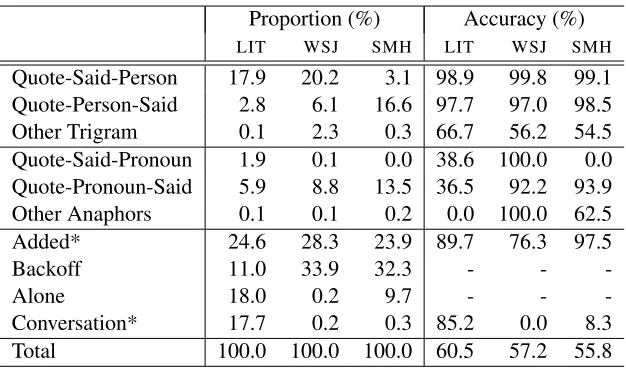
Proportion (%) Accuracy (%)
LIT WSJ SMH LIT WSJ SMH
Quote-Said-Person 17.9 20.2 3.1 98.9 99.8 99.1 Quote-Person-Said 2.8 6.1 16.6 97.7 97.0 98.5 Other Trigram 0.1 2.3 0.3 66.7 56.2 54.5 Quote-Said-Pronoun 1.9 0.1 0.0 38.6 100.0 0.0 Quote-Pronoun-Said 5.9 8.8 13.5 36.5 92.2 93.9 Other Anaphors 0.1 0.1 0.2 0.0 100.0 62.5 Added* 24.6 28.3 23.9 89.7 76.3 97.5
Backoff 11.0 33.9 32.3 - -
-Alone 18.0 0.2 9.7 - -
[image:3.612.150.463.55.239.2]-Conversation* 17.7 0.2 0.3 85.2 0.0 8.3 Total 100.0 100.0 100.0 60.5 57.2 55.8
Table 1: The proportion of quotes in each category and the accuracy of the speaker prediction based on the category. The two categories marked with an asterisk (*) depend on previous decisions.
3 Corpora
We evaluate our methods on two new corpora com-ing from the news domain, and an augmented ver-sion of an existing corpus, which covers classic lit-erature. They are described below.
3.1 Columbia Quoted Speech Attribution Corpus (LIT)
The first corpus we use was originally created by Elson and McKeown (2010). It is a set of excerpts from 11 fictional 19th century works by six well-known authors, split into 18 documents. In total it contains 3,126 quotes annotated with their speakers. Elson and McKeown used an automated system to find named entity spans and nominal mentions in the text, with the named entities being linked to form a coreference chain (they did not link nominal men-tions). The corpus was built using Amazon’s Me-chanical Turk, with three annotations per quote. To ensure quality, all annotations from poorly perform-ing annotators were removed, as were quotes where each annotator chose a different speaker. Though excluding some quotes ensures quality annotations, it causes gaps in the quote chains, which is a prob-lem for sequence labelling. Furthermore, the cases where annotators disagreed are likely to be challeng-ing, so removing them from the corpus could make results appear better than they would be in practice.
To rectify this, we conducted additional annota-tion of the quotes that were excluded by the
origi-nal authors. Two postgraduates annotated 654 addi-tional quotes, with a raw agreement of 79% over 48 double-annotated quotes. Our annotators reported seeing some errors in existing annotations, so we had one annotator check 400 existing annotations for correctness. This additional check found that 92.5% of the quotes were correctly annotated.
3.2 PDTBAttribution Corpus Extension (WSJ)
Our next corpus is an extension to the attribution annotations found in the Penn Discourse TreeBank (PDTB). The original PDTB contains several forms of discourse, including assertions, beliefs, facts, and eventualities. These can be attributed to named enti-ties or to unnamed, pronominal, or implicit sources. Recent work by Pareti (2012) conducted further an-notation of this corpus, including reconstructing at-tributions that were only partially annotated, and in-troducing additional information. From this corpus we use only direct quotes and the directly quoted portions of mixed quotes, giving us 4,923 quotes.
3.3 Sydney Morning Herald Corpus (SMH)
We compiled the final corpus from a set of news documents taken from the Sydney Morning Her-ald website1. We randomly selected 965 documents published in 2009 that were not obituaries, opin-ion pages, advertisements or other non-news sto-ries. To conduct the annotation we employed 11 non-expert annotators via the outsourcing site Free-lancer2, as well as five expert annotators from our research group. A total of 400 news stories were double-annotated, with at least 33 double-annotated stories per annotator. Raw agreement on the speaker of each quote was high at 98.3%. These documents had already been annotated with named entities as part of a separate research project (Hachey et al., 2012), which includes manually constructed coref-erence chains. The resulting corpus contains 965 documents, with 3,535 quotes.
3.4 Corpus Comparisons
In order to compare the corpora we categorise the quotes into the categories defined by Elson and McKeown (2010), as shown in Table 1. We assigned quotes to these categories by testing (after text pre-processing) whether the quote belonged to each cat-egory, in the order shown below:
1. Trigram– the quote appears consecutively with a mention of an entity, and a reported speech verb, in any order;
2. Anaphors– same as above, except that the men-tion is a pronoun;
3. Added– the quote is in the same paragraph as another quote that precedes it;
4. Conversation – the quote appears in a para-graph on its own, and the two parapara-graphs pre-ceding the current paragraph each contain a sin-gle quote, with alternating speakers;
5. Alone– the quote is in a paragraph on its own;
6. Miscellaneous– the quote matches none of the preceding categories. This category is called “Backoff” in Elson and McKeown (2010).
1
http://www.smh.com.au
2http://www.freelancer.com
Unsurprisingly, the two corpora from the news do-main share similar proportions of quotes in each category. The main differences are that the SMH uses a larger number of pronouns compared to the WSJ, which tends to use explicit attribution more fre-quently. TheSMH also has a significant proportion of quotes that appear alone in a paragraph, while the WSJ has almost none. Finally, when attribut-ing a quote usattribut-ing a trigram pattern, theSMHmostly uses the Quote-Person-Said pattern, while the WSJ mostly uses the Quote-Said-Person pattern. These differences probably reflect the editorial guidelines of the two newspapers.
The differences between the news corpora and the literature corpus are more substantial. Most no-tably the LIT corpus has a much higher proportion of quotes that fall into theConversation andAlone categories. This is unsurprising as both monologues and dialogues are common in fiction, but are rare in newswire. The two news corpora have more quotes in theTrigramandBackoff categories.
4 Quote Extraction
Quote extraction is the task of finding the spans that represent quotes within a document. There are three types of quotes that can appear:
1. Direct quotes appear entirely between quota-tion marks, and are used to indicate that the speaker said precisely what is written;
2. Indirect quotesdo not appear between or con-tain quotation marks, and are used to get the speaker’s point across without implying that the speaker used the exact words of the quote;
3. Mixed quotesare indirect quotes that contain a directly quoted portion.
In this work, we limit ourselves to detecting direct quotes and the direct portions of mixed quotes.
5 Quote Attribution
Given a document with a set of quotes and a set of entities, quote attribution is the task of finding the entity that represents the speaker of each quote, based on the context provided by the document. Identifying the correct entity can involve choosing either an entire coreference chain representing an entity, or identifying a specific span of text that rep-resents the entity.
In practice, most applications only need to know which coreference chain represents the speaker, not which particular span in the text. Despite this, the best evidence about which chain is the speaker is found in the context of the individual text spans, and most existing systems aim to get the particular entity span correct. This presents a problem for evaluation, as an incorrect entity span may be identified, but it might still be part of the correct coreference chain. We chose to count attributions as correct if they at-tributed the quote to the correct coreference chain for both theLITandSMHcorpora, while for theWSJ corpus, where the full coreference chains do not ex-ist, we evaluated an attribution as correct if it was to the correct entity span in the text.
5.1 Rule-based Baseline
To establish the effectiveness of our method we built a rule-based baseline system. For each quote it pro-ceeds with the following steps:
1. Search backwards in the text from the end of the sentence the quote appears in for a reported speech verb
2. If the verb is found return the entity mention nearest the verb (ignoring mentions in quotes), in the current sentence or any sentence preced-ing it
3. If not, return the mention of an entity near-est the end of the quote (ignoring mentions in quotes), in the current sentence or any sentence preceding it
This forms a reasonable baseline as it is able to pick up the quotes that fall into the more simple cate-gories, such as theTrigramcategory and theAdded category. It is also able to make a guess at the more complicated categories, without using gold standard information as the category predictions do.
6 Experimental Setup
We use two classifiers: a logistic regression imple-mentation available inLIBLINEAR(Fan et al., 2008), and a Conditional Random Field (CRF) from CRF-Suite (Okazaki, 2007). Both packages use maxi-mum likelihood estimation with L2 regularisation. We experimented with several values for the coef-ficient on a development set, but found that it had little impact, so stuck with the default value. All of our machine learning experiments use the same text encoding, which is explained below, and all use the category predictions when they are available.
6.1 Text Encoding
We encode our text similarly to Elson and McKeown (2010). The major steps are:
1. Replace all quotes and speakers with special symbols;
2. Replace all reported speech verbs with a sym-bol. Elson and McKeown (2010) provided us with their list of reported speech verbs;
3. Part-of-Speech (POS) tag the text and remove adjectives, adverbs, and other parts of speech that do not contribute useful information. We used the POS tagger from Curran and Clark (2003);
4. Remove any paragraphs or sentences where no quotes, pronouns or names occur.
All features that will be discussed are calculated with respect to this encoding (e.g. word distance would be the number of words in the encoded text, rather than the number of words in the original text).
6.2 Features
In our experiments we use the feature set from Elson and McKeown (2010). The features for a particu-lar pair of target quote (q) and target speaker (s) are summarised below.
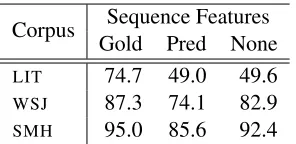
Corpus Sequence Features Gold Pred None
LIT 74.7 49.0 49.6
WSJ 87.3 74.1 82.9
[image:6.612.113.261.56.128.2]SMH 95.0 85.6 92.4
Table 2: Accuracy results comparing the E&M approach with gold standard, predicted or no sequence features.
Paragraph features derived from the 10 graphs preceding the quote (including the para-graph the quote is in), includes number of men-tions ofs, number of mentions of other speak-ers, number of words in each paragraph, and number of quotes in each paragraph
Nearby features relating to the two tokens either side of q and s, includes binary features for each position indicating whether the position is punctuation, s, q, a different speaker, a differ-ent quote, or a reported speech verb
Quote features about q itself, including whether s is mentioned within it, whether other speakers are mentioned within it, how far the quote is from the start of its paragraph and the length in words ofq
Sequence features that depend on the speakers chosen for the previous quotes, includes num-ber of quotes in the 10 paragraphs preceding and including the paragraph where q appears that were attributed tos, and the number that were attributed to other speakers
6.3 Elson and McKeown Reimplementation
As part of our study we reproduce the core results of Elson and McKeown (2010) (E&M ), as we be-lieve it is a state-of-the-art system. This allows us to determine the effectiveness of our approach when compared to a state-of-the-art approach, and it also allows us to determine how well the E&M approach performs on other corpora. In this section we will briefly summarise the key elements needed to repro-duce their work.
The E&M approach makes a binary classification between “speaker” and ‘not speaker” for up to 15 candidate speakers for each quote. They then recon-cile these 15 classifications into one speaker
predic-tion for the quote. While E&M experimented with several different reconciliation methods, we simply chose the speaker with the highest probability at-tached to its “speaker” label.
We conducted an experiment using our imple-mentation of the E&M method on the original, unaugmented E&M corpus, to see how our result compared with E&M ’s 83%. On our test set we achieved 78.2%, however this rose to 82.3% when performing 10-fold cross validation across the whole corpus. Though this is a large difference, it is not necessarily that surprising, as our test set contains documents by authors which are unseen, whereas both the original E&M test set and all the cross val-idation test sets contain documents by authors that the learner has seen before.
In their work, E&M make a simplifying assump-tion that all previous attribuassump-tion decisions were cor-rect. Due to this, their sequence features use gold standard labels from previous quotes, which makes their results unrealistic. In Table 2 we show the ef-fect of replacing the gold standard sequence features with features based on the predicted labels, or with no sequence features at all. All three corpora show a significant drop in accuracy, with theLIT corpus in particular suffering a drop of more than 25%. This motivates our study into including sequence infor-mation without using gold standard labels.
7 Class Models
We consider two class models for our experiments, which are described in detail below. The binary model is able to take advantage of more data but has less competition between decisions, while then-way model has more competition with less data. Both models are used with all the decoding methods, with the exception that the binary model is unsuitable for theCRFexperiments.
7.1 Binary
speaker with the highest “speaker” probability. Us-ing a binary class with reconciliation in a greedy decoding model is equivalent to the method in El-son and McKeown (2010), except that the gold stan-dard sequence features are replaced with predicted sequence features.
7.2 n-way
A key advantage of the binary class model is that when predicting “speaker” versus “not speaker” the classifier only needs to predict one probability, and thus can take into account the evidence of all other quote-speaker pairs. The drawback to the binary model is that the probabilities assigned to the can-didate speakers do not need to directly compete against each other. In other words when assigning a binary probability to a candidate speaker, the clas-sifier does not take into account how good the other candidate speakers are.
To rectify these issues we experiment with a sin-gle classification for each quote, where the classifier directly decides between up toncandidate speakers per quote. As speaker-specific evidence is far too sparse, we encode the speakers with their ordinal po-sition backwards from the quote. In other words, the candidate speaker immediately preceding the quote would be labelled “speaker1”, the speaker preced-ing it would be “speaker2” and so on. The classifier then directly predicts these labels. This representa-tion means that candidate speakers need to directly compete for probability mass, although it has the drawback that the evidence for the higher-numbered speakers is quite sparse.
The features we use for this representation are similar to the features used in the E&M binary model. The key difference is that where there were individual features that were calculated with respect to the speaker, there are nownfeatures, one for each of the speaker candidates. This allows the model to account for the strength of other candidates when as-signing a speaker label.
8 Sequence Decoding
We noted in the previous section that the E&M re-sults are based on the unrealistic assumption that all previous quotes were attributed correctly. In this section we outline three sequence decoding
ap-proaches that remove this unrealistic assumption, without removing all of the transition information that it provides. We believe the transition infor-mation is important as many quotes have no ex-plicit attribution in the text, and instead rely on the reader understanding something about the sequence of speakers.
For these experiments we regard the set of speaker attributions in a document as the sequence that we want to decode. Each individual state therefore rep-resents a sequence of w previous attribution deci-sions, and a decision for the current quote. Obtain-ing a probability for this state can be done in one of two ways. Either the transition probabilities from state to state can be learned explicitly, or thew pre-vious attribution decisions can be used to build the sequence features for the current state, which im-plicitly encodes the transition probabilities.
8.1 Greedy Decoding
In sequence decoding the greedy algorithm calcu-lates the probability of each label at a decision point based on the predictions it has already made for pre-vious decisions. More concretely this means we ap-ply a standard classifier at each step, with the se-quence features being calculated from the predic-tions made in previous steps. Greedy decoding is efficient in that it only considers one possible history at each decision point, but it is consequently unable to make trade-offs between good previous choices and good current choices, which means that in gen-eral it will not return the optimum sequence of la-bels. As greedy decoding is an efficient algorithm we do not restrict w, the number of previous deci-sions, beyond the 10 paragraph restriction that is al-ready in place.
8.2 Viterbi Decoding
Although they do not come with probabilities, we chose to include the category predictions in our Viterbi model. As we already know that they are accurate indicators of the speaker we assign them a probability of 100%, which effectively forces the Viterbi decoder to choose the category predictions when they are available. It is worth noting that quotes are only assigned to theConversation cate-gory if the two prior quotes had alternating speakers. As such, during the Viterbi decoding the categori-sation of the quote actually needs to be recalculated with regard to the two previous attribution decisions. By forcing the Viterbi decoder to choose category predictions when they are available, we get the ad-vantage that quote sequences with no intervening text may be forced into theConversation category, which is typically under-represented otherwise.
Both the sequences using the binary class and the n-way class can be decoded using the Viterbi algorithm, so we experiment with both class mod-els. We also experiment with varying window sizes (w), in order to gain insight into how many previous decisions impact the current decision. Though the Viterbi algorithm is able to find the best sequence of probabilities without the need for an exhaustive search, it can still take an impractical amount of time to run. As such we ignore all but the 10 most promis-ing sequences at each decision point.
8.3 Conditional Random Field (CRF) Decoding
The key drawback with the logistic regression ex-periments described thus far is that the sequence features are trained with gold standard information. This means that during the training phase the se-quence features have perfect information about vious speakers and are thus unrealistically good pre-dictors of the final outcome. When the resulting model is used with the less accurate predicted se-quence features, it is overconfident about the infor-mation those features provide.
We account for this by using a first-order linear chain CRF model, which learns the probabilities of progressing from speaker to speaker more directly. During training the CRF is able to learn the asso-ciation between features and labels, as well as the chance of transitioning from one label to the next. It also has the advantage of avoiding the label bias problem that would be present in the equivalent
Hid-den Markov Model (Lafferty et al., 2001).
Though the n-way class model can be used di-rectly in aCRF, the binary class model is more chal-lenging. The main problem is that the “speaker” versus “not speaker” output of the binary classifier does not directly form a meaningful sequence that theCRF can learn over. If the reconciliation step is included it effectively adds an extra layer to the lin-ear chain, making llin-earning more difficult. Due to these difficulties we only use then-way class model in ourCRFexperiments.
9 Results
The main result of our experiments with the E&M method is the large drop in accuracy that occurs when the gold standard sequence features are re-moved, which can be seen in Table 3. When using the binary class model this results in a drop of 25.1% for theLITcorpus, while for theWSJandSMH cor-pora the drop is less substantial at 4.4% and 2.6%, respectively. For theLITcorpus the drop is so severe that it actually performs worse than the simple rule-based system. Even more surprisingly, when the predictions from previous decisions are used with a simple greedy decoder, the accuracy drops even fur-ther for all three corpora. This indicates that the clas-sifier is putting too much weight on the gold stan-dard sequence features during training, and is mis-led into making poor decisions when the predicted features are used during test time.
Table 4 shows the results for the n-way class model. Compared to the binary model, the n-way class model generally produced lower results, al-though the results were more stable to changes in parameters and decoders. The only corpus that pro-duced better results with then-way class model was the WSJ corpus, which does not have full entity coreference information. This indicates that then -way model may be helpful when there is more vari-ety in the choice of entities.
Corpus E&M Rule No seq. Greedy Viterbi
w= 1 w= 2 w= 5
LIT 74.7 53.3 49.6 49.0 46.0 49.8 45.9
WSJ 87.3 77.9 82.9 74.1 82.3 83.1 83.1
[image:9.612.145.468.56.130.2]SMH 95.0 91.2 92.4 85.6 91.7 90.5 84.1
Table 3: Accuracy on test set with the binary class model. Italicised results indicate gold standard information is used. Bold results show the best realistic result for each corpus.
Corpus Gold seq. Rule No seq. Greedy Viterbi CRF
w= 1 w= 2 w= 5
LIT 68.6 53.3 47.1 46.7 42.5 46.5 44.4 48.6
WSJ 88.9 77.9 83.6 77.0 84.1 83.7 83.3 79.6
SMH 94.4 91.2 90.0 89.6 89.5 90.1 90.4 91.0
Table 4: Accuracy on test set with then-way class model. Italicised results indicate gold standard information is used. Bold results show the best realistic result for each corpus.
the test set consisted of 6 sequences. With so few sequences it is unsurprising that theCRF model did not perform well. The limited range of the first order linear chain model could also have played a part in the poor performance of theCRFmodels. However, moving to a higher-order model is problematic as the number of transition probabilities that need to be calculated increases exponentially with the order of the model.
10 Conclusion
In this paper, we present the first large-scale evalua-tion of a quote attribuevalua-tion system on newswire from the 1989 Wall Street Journal (WSJ) and the 2009 Sydney Morning Herald (SMH), as well as compar-ing against previous work (Elson and McKeown, 2010) on 19th-century literature.
We show that when Elson and McKeown’s unalistic use of gold-standard history information is re-moved, accuracy on all three corpora drops substan-tially. We demonstrate that by treating quote attribu-tion as a sequence labelling task, we can achieve re-sults that are very close to their rere-sults on newswire, though not for literature.
In future work, we intend to further explore the sequence features that have a large impact on accu-racy, and to find similar features or proxies for the sequence features that would be beneficial. We will also explore other approaches to representing quote
attribution with aCRF. For the task more broadly, it would be beneficial to compare methods of find-ing indirect and mixed quotes, and to evaluate how well quote attribution performs on those quotes as opposed to just direct quotes.
Our newswire results, 92.4% for the SMH and 84.1% for theWSJcorpus, demonstrate it is possible to develop an accurate and practical quote extraction system. On theLITcorpus our best result was from the simple rule-based system, which yielded 53.3%. It is clear that literature poses an ongoing research challenge.
Acknowledgements
We would like to thank David Elson for helping us to reimplement his method and Bonnie Webber for her feedback and assistance. O’Keefe has been supported by a University of Sydney Merit schol-arship and a Capital Markets CRC top-up scholar-ship; Pareti has been supported by a Scottish Infor-matics and Computer Science Alliance (SICSA) stu-dentship. This work has been supported by ARC Discovery grant DP1097291 and the Capital Mar-kets CRC Computable News project.
References
European chapter of the Association for Compu-tational Linguistics, pages 91–98.
Peter T. Davis, David K. Elson, and Judith L. Kla-vans. 2003. Methods for precise named entity matching in digital collections. InProceedings of the 3rd ACM/IEEE-CS Joint Conference on Digi-tal libraries, pages 125–127.
Eric de La Clergerie, Benoit Sagot, Rosa Stern, Pas-cal Denis, Gaelle Recource, and Victor Mignot. 2011. Extracting and visualizing quotations from news wires. Human Language Technology. Chal-lenges for Computer Science and Linguistics, pages 522–532.
David. K Elson and Kathleen. R McKeown. 2010. Automatic attribution of quoted speech in literary narrative. In Proceedings of AAAI, pages 1013– 1019.
Rong-En Fan, Kai-Wei Chang, Cho-Jui Hsieh, Xiang-Rui Wang, and Chih-Jen Lin. 2008. LIB-LINEAR: A library for large linear classification. Journal of Machine Learning Research, 9:1871– 1874.
Jenny Rose Finkel, Trond Grenager, and Christo-pher Manning. 2005. Incorporating non-local in-formation into inin-formation extraction systems by gibbs sampling. In Proceedings of the 43rd An-nual Meeting on Association for Computational Linguistics, pages 363–370.
Kevin Glass and Shaun Bangay. 2007. A naive salience-based method for speaker identification in fiction books. In Proceedings of the 18th An-nual Symposium of the Pattern Recognition Asso-ciation of South Africa (PRASA07), pages 1–6.
Ben Hachey, Will Radford, Joel Nothman, Matthew Honnibal, and James R. Curran. 2012. Evaluating entity linking with Wikipedia. Artificial Intelli-gence. (in press).
John Lafferty, Andrew McCallum, and Fernando C.N. Pereira. 2001. Conditional random fields: Probabilistic models for segmenting and labeling sequence data. International Conference on Ma-chine Learning, pages 282–289.
Nuno Mamede and Pedro Chaleira. 2004. Charac-ter identification in children stories. Advances in Natural Language Processing, pages 82–90.
Naoaki Okazaki. 2007. CRFsuite: a fast im-plementation of Conditional Random Fields (CRFs). URLhttp://www.chokkan.org/ software/crfsuite/.
Silvia Pareti. 2012. A database of attribution rela-tions. In Proceedings of the Eight International Conference on Language Resources and Evalua-tion (LREC’12), pages 3213–3217.
Bruno Pouliquen, Ralf Steinberger, and Clive Best. 2007. Automatic detection of quotations in multi-lingual news. InProceedings of Recent Advances in Natural Language Processing, pages 487–492.
Benoˆıt Sagot, Laurence Danlos, and Rosa Stern. 2010. A lexicon of french quotation verbs for au-tomatic quotation extraction. In7th international conference on Language Resources and Evalua-tion - LREC 2010.
Luis Sarmento and Sergio Nunes. 2009. Automatic extraction of quotes and topics from news feeds. In4th Doctoral Symposium on Informatics Engi-neering.
Nathan Schneider, Rebecca Hwa, Philip Gianfor-toni, Dipanjan Das, Michael Heilman, Alan W. Black, Frederik L. Crabbe, and Noah A. Smith. 2010. Visualizing topical quotations over time to understand news discourse. Technical Report CMU-LTI-01-013, Carnegie Mellon University.
Ralph Weischedel and Ada Brunstein. 2005. BBN pronoun coreference and entity type corpus. Lin-guistic Data Consortium, Philadelphia.